pod by irwatts

"Hello freelancer! The first thing we need is your support in programming the movement of our new no-contact delivery pod. Because this is the cheapest delivery pod yet, you will not have access to any sensor data and movement curves are limited to sine waves. Just make sure the package doesn't fall out of the pod and everyone will be happy. It will probably only take you about 5 minutes. Good luck!"
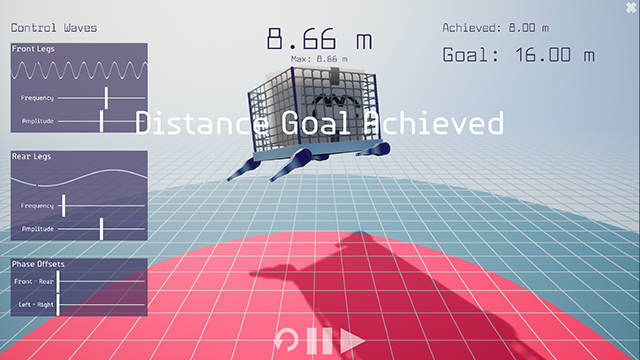
| Link | https://irwatts.itch.io/pod |
| Link | https://irwatts.itch.io/pod |
| Original URL | https://ldjam.com/events/ludum-dare/46/pod |
Ratings
| Overall | 190th | 3.804⭐ | 30🧑⚖️ |
| Fun | 170th | 3.768⭐ | 30🧑⚖️ |
| Innovation | 35th | 4.161⭐ | 30🧑⚖️ |
| Theme | 713th | 3.464⭐ | 30🧑⚖️ |
| Graphics | 36th | 4.393⭐ | 30🧑⚖️ |
| Audio | 138th | 3.732⭐ | 30🧑⚖️ |
| Humor | 110th | 3.704⭐ | 29🧑⚖️ |
| Mood | 232th | 3.593⭐ | 29🧑⚖️ |
| Given | 28🗳️ | 31🗨️ |
Good job!
Cheers.
Btw, when you change the amplitude, the "reference point" doesn't change and hence the leg will immediately jump to the target location as if the frequency is measured from 0. The only way to "safely" change frequency is to reduce amplitude to 0, then change frequency, then change amplitude back to desired. Instead, I suggest you should move the reference point as well. For example you could track time yourself and add delta time * frequency each frame. Then the position will be preserved when you change amplitudes.
I assume it's currently something like this:
```
legAngle = sin(game.time * frequency);
```
Instead, you should do something like:
```
float legTime = 0;
// in update:
legTime += game.deltaTime * frequency;
legAngle = sin(legTime);
```