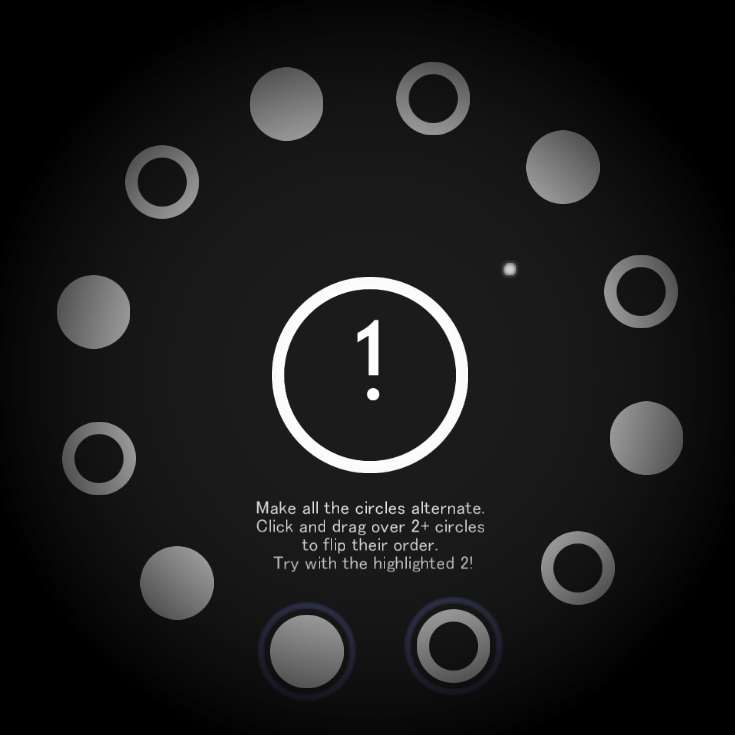
Orbit is a meditative puzzle game built around patterns and restoring the loop. The concept is simple, select a group of circles, and flip their order. But the more you progress the more you need to step back, and think about each and every flip. Atmospheric and calming, Orbit allows you to relax, and enjoy the puzzles in your own time.
 I barely had time this LD, but I haven't done it in ages so I wanted to squeeze this in. I ended up making this game in around half a day, with a few hours the next for final polishing. As one of my first HTML only projects, I'm pretty happy with how it turned out, and I might take this concept and attempt to flesh it out even further. (feedback and suggestions for future updates are welcome)
 I hope you enjoy the game!
This is an interesting puzzle idea, however I also think it needs at least one more mechanics because, in its current state, I have the feeling that there is a systematic way to solve all the puzzles (move a circle at the end of a same-color sequence between two circles of the other color and repeat).
Whatever, Good job anyway!
It just took me a bit in the beginning to get what I was supposed to do. Maybe the hickup was that I didn't realize that the white tutorial outlines meant that I should connect these nodes in the beginning. Maybe if you made the tutorial text and the tutorial outlines around the circles colored and the same color (maybe yellow) it would be clearer that the belong together.
Also it might be confusing to the player that the circles make a sound when you hover over them (indicating that this has some form of effect), while in fact hovering over them does not affect gameplay. Be considerate with you audio queues.
But those are minor points and easy fixes.
I would also love to see this being developed further. I can think of two possibilities right now to add gameplay variation and complexity:
- Having levels where the interactables are different shapes than circles. You could have a triangle shape, which means that each object connects to 3 neighbors instead of 2. And still every node has to be different than to all of their neighbors. You can also do squares and actually any number of dimensions.
- You can also have nodes with different kinds of effects. Maybe there is one node that needs to have one neighbor that is the same state and one that is different. Or nodes that require all similar neighbors.
- Finally I thought about having more than two states (on or off). And immediately I though of graph coloring: https://en.wikipedia.org/wiki/Graph_coloring. The goal there is also to give each adjacent node in the network a different color. Your game is actually a graph coloring game. Although you only have one color and perfect circle networks. But this might maybe expand your view on this.
Keep rocking! :) And thanks for the awesome review on our game.
The monochrome palette was a good way to emphasize that. And the sound was *almost* just right. I think the concept was right on point, but maybe the actual sound was slightly wrong. It was maybe a little too peppy to my ear. So still good, but maybe a sleepier more synthetic sound with a little slower attack would have had even more harmony with the rest of the experience.
The tactile interaction was nice. I liked the slow sliding movement of the puzzle when it wasn't being interacted with, though I was glad it was very slow because faster rotation would have been too distracting and caused me to lose the geography of the puzzle. I never once made an error in input, and when I was testing to see if I could swap non-adjacent pieces the result was clear ("you cannot").
Gameplay-wise the puzzles were nice. The length was appropriate for the depth, and I felt like you explored most avenues. Because there are only two types, and because the selection must be continuous, it felt like the possible ideas for you to explore were a bit limited. Totally appropriate for the game length and stayed engaging throughout, but I suspect you'd need some extra element to unlock further puzzle-space to explore.
My general strategy was "find the largest existing contiguous already-correct section, almost certainly the best move is to flip at its borders" and I feel like generally this held true. In the 3-move puzzles I generally made move 1 on blind faith on that basis and I never once had to restart. So a new element for an expansion would probably have to invalidate that shortcut.
Really a very nice all around entry, especially when I consider the limited time you had available! Great job on both puzzle mechanics and feel.