Ės (Wish/Journey) by Ava Skoog

This is a non-digital board game ♟️
📜 Instructions are in the PDF
Needs dice, cards, a checkerboard, and pawns 🎲 🃏
This LD submission is only the ruleset and the PDF.
(Making a barebones digital version too—coming soon, but don't rate it)
It's a family of games sharing core components
| | |
| --- | --- |
|  | You can play in a single lane of any length. |
|
| You can play in a single lane of any length. |
| 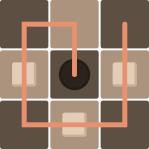 | You can play in a spiral of any size. |
|
| You can play in a spiral of any size. |
|  | Draw challenge and appeal cards. |
|
| Draw challenge and appeal cards. |
|  | Clear challenges with charm dice and move your pawn to win! |
|
| Clear challenges with charm dice and move your pawn to win! |
|  | Play alone, with people, against people, or in teams! |
Credits
- Game by me
- Logo font is Yellowtail
- Icon font is OpenMoji
Ratings
| Given | 23🗳️ | 24🗨️ |
It seems that, in order to win, you really need to beat diamond challenges and keep your dice to 2. I made it to the last challenge once with all the dice, but never won with them all. Club challenges carried that run.
Nice job keeping the requirements minimal, and while a bit RNG heavy, it's a solid single player experience. Thanks for sharing :)
I didn't have playing cards on hand so I created a numbered list for each deck (the appeal cards and the challenge cards) and used an RNG to "draw" from each deck. In addition, I didn't have any dice so I used this instead:
https://flipsimu.com/dice-roller/
The flow chart on pg. 9 of the instructions made the rules much easier to learn. However, there was at least one section of the chart, shown below, which confused me at first because of the two **NO** branches:

Even with the flow chart, however, I struggled to learn all the rules. I started to become a little more confident with the rules after several turns, but even then, I wondered if I understood everything correctly. So, maybe the rules could be simplified somehow. Perhaps you could remove the cards and just have dice with a grid and pawns. In that case, you could have rules reflect various outcomes of dice rolls. For example, if one rolls three dice and the outcome is symmetric, as shown below, then a special rule is triggered:

That being stated, one of the more enjoyable parts of the game was drawing a challenge card and rolling the dice to see if I met the challenge. So maybe you could have two sets of dice, one to replace the cards — just an idea. I'm sure others feel differently about this game, it's maybe just me being intimidated by complicated rules.
Overall, a unique game, especially since you mix genres, and the rules, though complicated, seem well thought out. You get 5 stars for innovation.
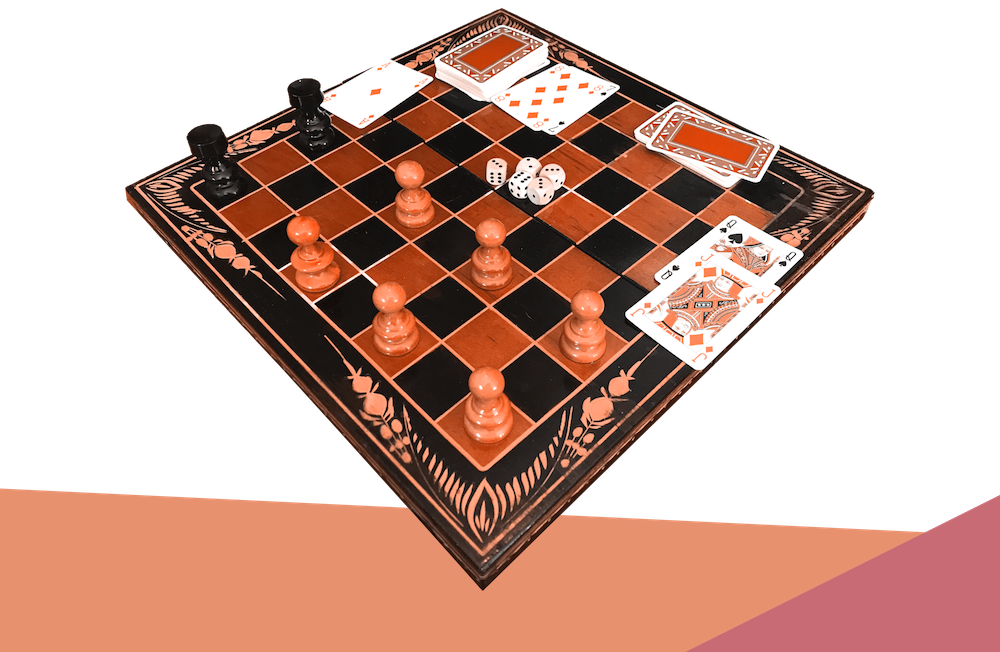
Really appreciate the details with pictures and all. Fun to see your setup, @keithswanger!
Thanks for telling me about the messed up flowchart, @gamebuilder. Fixed now. I think it did become a bit complicated indeed; it didn't feel like it when I played but I was surprised when I saw how big the flowchart got. Dice instead of cards would definitely work I think. The "canonical" version would have bespoke cards with all the info on them so you wouldn't have to consult a document but I never got around to making those or finishing the digital version. :(

Some comments about the PDF:
I set it up as you did in the image, but it should matter a bit to the game if one starts on a dark square or not (given that you get cards on entering light squares)
The instructions about the challenges say nothing about all dice being equal as far as I could spot but in the flow-chart, if it's the a :diamonds: challenge, you get stuck in a loop in the top of the flow chart never reaching the end of the player's turn:
Not discarding -> All dice equal -> Not diamonds -> Draw one card if you can and first time -> Repeat.
The game itself was very much back and forth, I managed staying with two dice almost the entire game, yet for a long time my partner got ahead of me with her three dice an had a chance at winning while I almost backtracked the entire board towards the start.
Finally I got myself to the victory though.
Interesting in how relatively balanced it was to have unequal number of dice, and there were some interesting strategic decisions to be made about what cards to be played when, but it also felt a bit too exposed to chance for our taste. And from a psychological point of view, I would have liked to progress much more often than stepping back and rather have a longer track to walk. But not sure how to do that exactly.