Signal Surfer by Ausstein
Signal Surfer
An analog-synth inspired arcade survival game built for Ludum Dare 59.
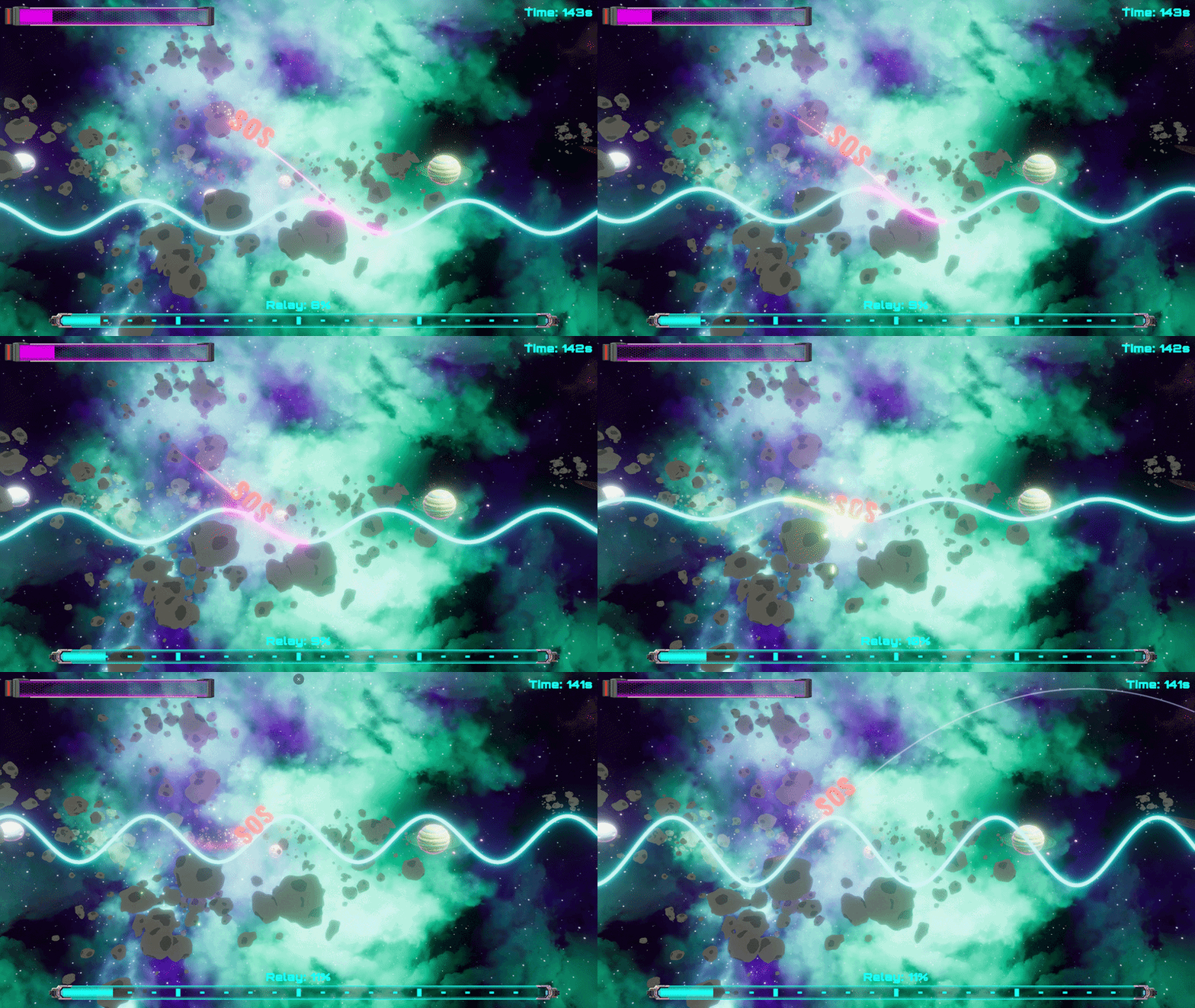
Overview
"Signal Surfer" is an arcade survival game inspired by the momentum-gathering mechanics of classics like Tiny Wings. Instead of pressing a button to dive, you dynamically shape the terrain itself (a carrier wave) in real-time to escort an automatic, momentum-driven SOS distress wave packet to its destination.
The Story
A spaceship is in distress and sends an SOS signal back to Earth. You must guide this desperate transmission through the interference of space to reach its destination before the signal is lost in the void.
How To Play
The core loop turns you into an analog synthesizer! You must fluidly stretch and squash the wave track to create massive downhill slopes for speed and avoid steep uphill climbs that kill momentum.
Controls
You exclusively use the Mouse to modulate the wave: - Mouse Y-Axis (Up/Down) -> Amplitude: Moving the mouse up increases the wave's amplitude, creating towering peaks and steep slopes. Moving it down flattens the wave. - Mouse X-Axis (Left/Right) -> Frequency: Moving the mouse right compresses the wave (high frequency), creating tight, rapid peaks. Moving it left stretches the wave out (low frequency), creating long, smooth rolling hills.
Mechanics
- Momentum Conservation & Loss: Try to line up the downhills to maintain momentum, avoid crashes.
- Airborne Speed Boosts: Launching the packet high into the air builds up a Boost Meter based on maximum altitude. Landing perfectly parallel to a downhill slope converts that built-up meter into a continuous thrust that sustains momentum! Conversely, slamming perpendicularly into a wall destroys momentum and triggers a heavy visual slam.
- Game Over: This is a pure Time Trial! The run only ends in failure if the stage's time limit expires before the packet reaches the destination antenna.
Features
- Dynamic Wave Terrain: The base carrier wave evolves as you progress, forcing you to adapt your modulation strategy over Asymmetrical rolling hills, smooth Sine waves, Enveloped waveforms, and finally endless Complex Harmonics.
- Time Trials & Leaderboards: Compete for 1-3 star ratings across multiple stages, pushing your best clear times to the online Unity UGS Leaderboard.
Playthrough Video
https://youtu.be/kcrvE2qqZfg
Bugfixe version changes
- Fixed UI sliders not clickable and not applying settings properly. (Color adjustments and Music Sliders)
- Fixed Missing Font for Star Display (Windows version used a default font, so it was still visible but on web stars were not shown at all)
- Removed Invert Y toggle, it was not working properly
- Changed Story text to use coroutines because otherwise it crashed WebGL
- Fixed Custom cursor having wrong target point
- Fixed Custom name field in WebGL version
AI disclosure
- AI was used for parts of the Code, the Thumbnail and this description. All Art and Sound assets are, to the best of my knowledge, from Human creators.
| Link | https://ausstein.itch.io/signal-surfer |
| (Some have issue with Firefox) | https://ausstein.itch.io/signal-surfer |
| Post Jam | https://ausstein.itch.io/signal-surfer-post-jam |
| Original URL | https://ldjam.com/events/ludum-dare/59/signal-surfer-2 |
Ratings
| Overall | 596th | 3.333⭐ | 29🧑⚖️ |
| Fun | 477th | 3.296⭐ | 29🧑⚖️ |
| Innovation | 86th | 3.963⭐ | 29🧑⚖️ |
| Theme | 400th | 3.796⭐ | 29🧑⚖️ |
| Humor | 470th | 2.64⭐ | 27🧑⚖️ |
| Mood | 719th | 3.019⭐ | 28🧑⚖️ |
| Given | 16🗳️ | 32🗨️ |
I'd be interested in seeing a gameplay video from someone better than me!
Congrats!
It seems to run fine for me in browser on chrome too
Here is an image of the collider, It is definetly not the issue :D
The SOS is just a visual, it does not affect the physics

https://youtu.be/kcrvE2qqZfg
Here is a playthrough of the Game. I have not figured out fully myself what the best way is to play the last level.
Right now I get the best times if I play it safe. If I try to go for boosts, I maybe chain 1 or 2 and then get stuck like you. But I think if one gets better at it this can be very satisfying.
I've been flatting out the curve after going downhill, expecting that if I then went back uphill I would lose the momentum I gained. But it seems like I actually should be increasing the amplitude again, to make a bigger jump?
It is not hard just hard to learn because it is not some normal control scheme.That's why I put a lot of effort in the tutorial you can re-activate the tutorial in the settings.
Once you have the hang of it it becomes very satisfying :).
Maybe watch the playthrough video
Thx for the nice comment. I am not sure how to improve the controls really, if you have any suggestions let me know. It is just not very intuitive to indirectly control the terrain and has a little steep learning curve. But once your brain adapts to it, it becomes easier and even more satisfying :)
I found it is best to go higher initially to charge the boost meter quicker and the at some point go for flatter jumps to travel faster.
Thanks for the feedback, you can disable the tutorial in the settings menu :)
I reworked the control scheme and ditched unity physics to write my own system, which makes it feel much nicer, check out the post jam version: https://ausstein.itch.io/signal-surfer-post-jam
Now that that is done, I really need to start playing and rating some of the other games haha :D
you can just go backwards with the uphil, then accelerate again on the previous downhill :)
Its frustrating how much your gameplay is close to the sonic feeling but rarely reach it, you have something here, but it needs to be more polished on this aspect. Had a good time anyway.
The music is good, I am in love with your tutorial :heart_eyes: very clever and I liked how you have diversified the "level design" by tweaking the signals a bit each level ;)
The tutorial was well handled, and the slow motion while landing felt great. That could be used more in the main game as a form of grace when the player is struggling. The visuals are strong; a light vignette and small changes to saturation or brightness based on speed or a meter could improve feedback.
Beyond time-based play, a chasing element or ghost mode for best runs could add depth, though that’s more of an extension.
