LD23 April 20–23, 2012

Escape from MiniMars Postmortem & Extras

(quick game link for reference: http://www.ludumdare.com/compo/ludum-dare-23/?action=preview&uid=7860)

Since ours was a team-based jam entry we got 3 postmortems for ya. spacemars/mroushey’s first:

Just finished up my second Ludum Dare, and my first time in the jam version of the competition. Myself and two other darer’s ( adhesion, and emarcotte ) joined forces to take on LD23′s theme: Tiny World. Pretty much all of the first day was spent coming up with ideas. After 4 hours of tossing ideas around we boiled it down to “Escape from MiniMars”.

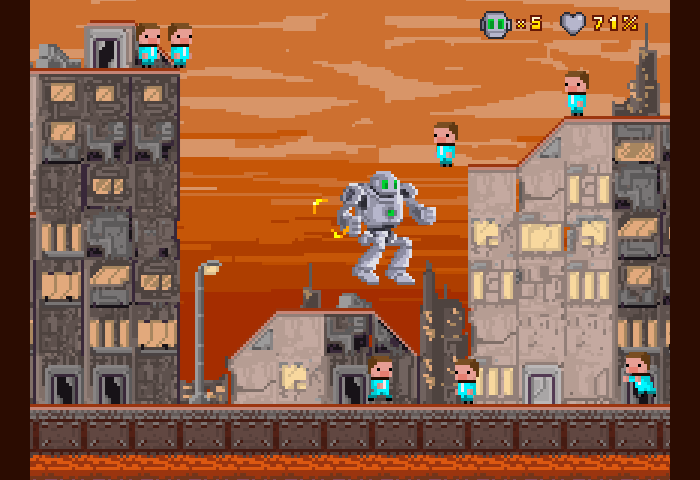
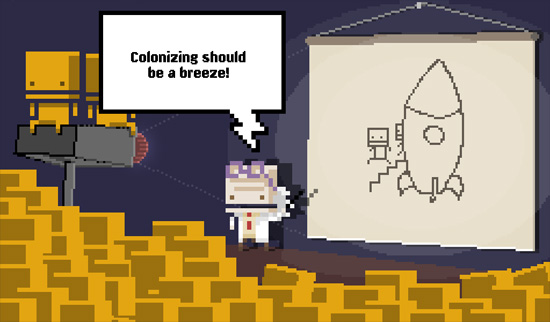
You are a robot that finds himself on the surface of mars (well, minimars… but its the same damned thing :P ) and must escape. For all intents and purposes it is a mario style platformer. We loved the idea however, that there would be tons of tiny people in this tiny world that love the shit out of robots. They chase after you and jump on so they can hug you! Killing them was to be incredibly easy as youre… a goddamn giant robot. The difficulty is such that the people can never really kill you (except in maybe one or 2 areas) so its more of a way to kinda color the world and just make you chuckle a little bit whist mowing all these tiny dudes down with supercharged eye-lazers.

Now since this was a JAM entry, we had a team. Emarcotte adhesion and I all programmed it up.  (although they did most of the work, I just tweaked jump arcs and stuff like that XD ) While Adhesion rocked his chiptune magic and I was free to spend pretty much the entire weekend making art assets.

Tools: 

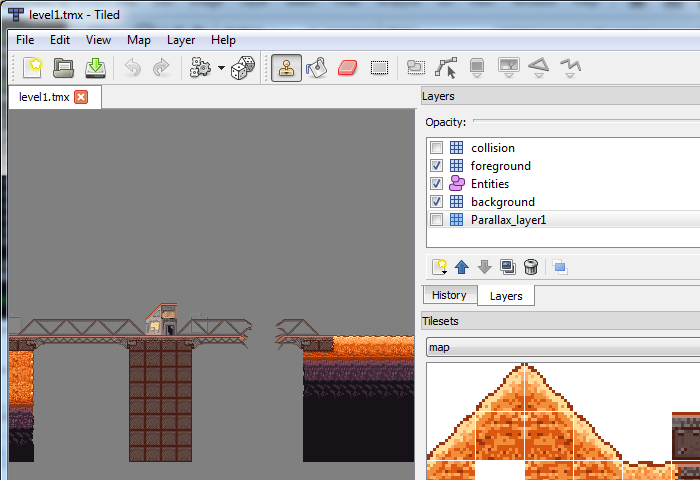
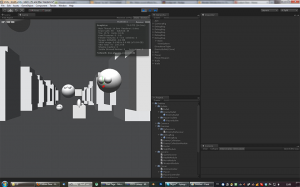
For the art and level design I used a combination of Photoshop, Graphics Gale (http://www.humanbalance.net/gale/us/), and Tiled ( http://www.mapeditor.org/). The game was programmed using MelonJS (http://www.melonjs.org/) (a html5 canvas game engine).

I really can’t say enough about Tiled. It’s a map editor thats incredibly easy to use and can export data in a buncha different formats, one of them being XML.

All you do is import your tileset, and start to paint. You can have multiple layers of map tiles, setup entities within the level, as well as setup your collision maps. Flash’s Flixel and MelonJS both have native support for this guy. It’s a must in my opinion.

Graphics Gale is a pretty nice freeware pixel animation app. The interface is a bit clunky, and the Layer stuff can be a bit annoying, but It works really well for animation.

Photoshop is an obvious choice, but it pretty much blows for animation. XD If Graphics Gale’s UI was better id never close it~

MelonJS is pretty easy to work with.  You can make a platformer basically out of the box. The engine is pretty high level though, I found that you have to hack in even the most basic of additional features.  I also have some pretty large complaints about html/js games and javascript in general, but that is a rant that will go on and on and on forever. :/

JAM vs COMPO :

Last LD I did the compo and I must say, it was brutal. I didn’t get to put as much time as i wanted into either programming, art or.. cough cough sound. (if you saw my last game, the music was actually playing a randomized selection of notes. ) With the jam, you get more time, and more manpower. I really do like both, but I think the jam comes out a little bit ahead in my book. I got to work on art to my heart’s content (and drawing arm’s discontent) and got what i feel to be quite a bit of stuff done. I think i will do the compo for my next LD competition, but the JAM was damned fun.

and now adhesion’s postmortem:

I’m very pleased with how this LD went overall – we made a solid game, didn’t overextend too much, and learned quite a bit about HTML5 game engine issues & melonJS. I’m super proud of what we accomplished.

what went right:
Music/sound – I was really happy with how both came out. I was so pumped to actually hear them in game; audio just makes a massive difference in the overall experience. I ended up doing the music in 2 separate chunks of time (thanks to the extra time of the jam), which felt a lot better than the one giant slog when I did the LD22 compo – that got a bit frustrating at the end. The tools I used, Ableton Live & bfxr, worked great as expected. I focused more on FM synths for the music which made it all the more awesome.

Graphics – I obviously can’t take credit, but I have to point out how much of an intense badass roushey is, and as such his art is amazing as usual.

Coding (mostly) – Despite being not all that familiar with Javascript, and despite all the horror stories I’ve heard about its awful innards, I found it quite easy to use – didn’t have any huge (core JS-related) bugs, and I was able to figure out the built-in data structures and such without too much trouble.

what went wrong:
Time management, again – was an intense rush at the end to get the final polish done, particularly the RADMARS intro screen (waaaay worth it though :D). It was also hard to be productive on saturday before a lot of the art assets were done, which is kind of a weird side effect of melonJS providing a lot of the core gameplay functionality very easily. Plus, I had to work on the Monday the jam ends and ended up miscalculating how much time I would have to work on it that day which didn’t help.

Code framework, a little – had some major memory/memory leak issues right at the end which was really frustrating to deal with. (Wish I caught that earlier, it kinda drove me insane for a while.) I managed to fix it but more familiarity with Javascript, melonJS & browser debugging tools would’ve definitely helped. Struggled with a multiple collision issue for a while too – in retrospect it was pretty obvious, hopefully I’ll wise up to this stuff as I do more game dev stuff. Otherwise I’m pretty satisfied with melonJS in general.

Whew! Overall LD was a great experience again. I’m so glad to have the opportunity to do this sort of challenge and have something awesome to show for it at the end. See you in August!

and emarcotte’s:

– Dedicated time would definitely help, coming in and out of the project is frustrating and anti productive
– flexibility of javascript makes time very productive, melon’s tool integration is also very flexible and simple.
– asset pipeline is still a mystery to me, roushey just does magic and we consume it…
– polish is 90% of the battle. the rest is easy.

Extra bonus stuffs!!:
Timelapse:


Soundtrack:

http://adhesion.mu/sic/Adhesion-MinimarsOST.zip

Tags: mars, postmortem, timelapse

In celebrtion of 101 ratings given, here is a list of buried treasure

A lot of great games have gotten a lot of attention here on LD but some other games that are equally impressive have received comparatively little buzz. I’m here to help bring some of these less-known gems to the surface:

Dwindling Worlds

A sensory overload of epic proportions, this game is all about sound, color, and moving your mouse in just the right way as to make the worlds grow. The narration offers clues on how to clear each stage. The visual effects are wondrous and magical.

ZUNZANDA

Speaking of excellent narration, the storyteller in ZUNZANDA is an incredible touch. The game may be a bit slow at times, but whether you finish or not you’ll be happy you started. This one really stuck out early and I have remembered it since based on the strength of the script and the narration alone.

Quest^3

While the combat in the game is random and brutal, the game can be beaten. The idea that the world shifts like a rubix cube as you traverse the top plane is a really interesting concept that could have been explored in greater depth, but that still deserves some spotlight regardless.

Tags: review, reviews

Comments

SonnyBone
30. Apr 2012 · 03:12 UTC
THANK YOU , DR SODA!!!!

“Toad Warrior” Timelapse!

Just got a timelapse capture of Toad Warrior up. First Ludum Dare, and I’m very proud of my effort!

Play/rate here.  

I hope you enjoy playing the game as much as I’ve enjoyed making it.

Tags: timelapse

Improvements for next time.

After completing my first LD, I have been playing and rating many different games. While playing/rating, I’ve noticed a few things that I should do next time to make my game better. Here is a list of what I have so far. Please comment if you have anything to add.

  • Games should be 32 bit not 64.
  • Cross platform things like Unity, web games, or Java games are also good.
  • Any background music that isn’t annoying to listen to is a good use of time.
  • Clear controls and simple game play.
  • Gamepad/XBox controller support is awesome.
  • Good collision detection is important. I’ve been stuck inside too many things. -_-
  • Games that look cool send a better first impression.
  • Arrow key alternates seem to be very nice for people with non QWERTY keyboards.

I know its kinda short… but oh well, its better than nothing! If you’re interested in seeing where I am coming from for my list of improvements, you can play my game here: http://www.ludumdare.com/compo/ludum-dare-23/?action=preview&uid=6529

Comments

30. Apr 2012 · 13:15 UTC
* Tutorials are good

* Easy learning curve (I am terrible at platformers, so I hate when the first screen involves jump over flaming pits of spikes)
dr_soda
30. Apr 2012 · 14:17 UTC
I think the main failure of the cited wasd control schemes is that the dev is testing the string output of the keystroke rather than the keycode. Keycodes are generally more reliable.

Thoughts on My Little Planetoid

Hi guys,

So I created My Little Planetoid in 48 hours. Read on to find out what I thought afterwards (a post-mortem, if you will).


What went right

Genre/Setting

This is both a science-fiction and city-builder game. The combination itself is rather rare.

Building stuff

It just feels awesome. And I love the “Build now on moon”-gag, which I think is quite good game-design.

Timelapse

According to people this video is “intense”. It might be due to the orchestral music, but probably because my facial expressions during Ludum Dare varies between “frown” and “manic laughter”.

Soundtrack

I composed this over the course of the 24 hours. The first idea of the music I had immediately after I decided on the idea, and it grew from there. It has been quite well received, with many people saying they like it and find it relaxing.

Also, the idea of a space-banjo is just awesome.

Graphics

Having empty space as background meant I was able to concentrate more on the 3d-models in the foreground. And while they could be improved a lot, you’ll notice there’s a lot of detail to be found.

Mood

The combination of the somber soundtrack and the space-y visuals worked quite well, which people also remarked positively.


What went alright

Theme

This time I actually prepared. I made a list of ideas for every possible theme. Tiny World was the one where I didn’t have anything brilliant ready, so threw in an idea I already had before. After the announcement I developed more of them, but threw them out when I saw others made them first.

Scope in fiction

My Little Planetoid has a somewhat weird range of buildings. You start out with houses and farms, which could position this game anywhere in the past or future. Then you quickly advance to Science-Laboratories and advanced-space-stations. So while it is a progression through technology, I feel it could’ve been more focused.

Scope in design

In design-terms My Little Planetoid is huge.  It has more unique features/elements than any of my previous games. It has multiple complex 3d-models. It has a somewhat extensive GUI. And, most importantly, a huge web of each other influencing resources and variables.

I was even glad when something emergent happened, but there was lot of potential for bugs and unforeseen combinations. Which led to…

Balancing & bug-testing

I literally coded in something 10 minutes before the deadline. There was no time left for dedicated balancing and bug-hunting, only what I noticed during test-plays myself. The resource-balancing now kinda works, but it does feel off sometimes.

In the end the basic resources become abundant, so you aren’t really thinking about them any longer.

Textures

I used a basic pixelated diffuse-map on all things. Sadly there was no time to take care of UV-maps, but it doesn’t really show unless you really look.


What went wrong

Failure to realize how bloody huge this project is

This led to a (frankly mental) development-speed in the last hours, and the incomplete balancing.


All in all

This was an awesome and fun gamejam. My Little Planetoid is right now one of the most-played games, and people really enjoy it. The general consensus is that this could be huge if further developed. And so I will 😛

Play | LD-page | Mini-Review (at 9:50) | Review


-Matthew


Tags: 3dsmax, max, postmortem, unity, unity3d

First LD postmortem.

Hi,


i finally decided to write a little postmortem of my first LD experience. I will do a classic “what went right” and at the opposite, “what went wrong”.

What went right?


The coolest part to write : )


  • I found an idea quite quickly. I did not start to write code like crazy at the early minutes, i took times to think about a cool idea to not realize at the middle of the compo: “ho god… this concept sux and does not fit and i don’t have enough time to do something else…”. So i think i acted pretty wisely (at least for this part of the work).
  • I love game development and i do some little game since few years, i usually work with Python/Pygame (cause i love Python sooo much) but i’m, most of times, focused on the programming part, not on graphics. So, to be honest, i was afraid to think i will have to do my own graphics… FROM SCRATCH! And regarding this apprehension i had on making graphics by myself, i’m pretty glad of what i did. I think i was able to communicate the mood of the game i imagined through the graphics (even if they are really simple, pixel art blablabla).


What went wrong?


Of course for a first LD, there are things that i did wrong. Obviously!


  • Bad management of Sleeping/Working time. I don’t really know how to express it properly but, i really think my organization was so wrong concerning my sleep times. I will not over extend myself to much on this part but i will definitively think of how i could optimize this for the next event : ) I think my dad was right: “Les heures avant minuit comptent double.”
  • Worked with the company of others people. For some people i think it’s perfectly fine. To me… it was not smart at all. I was able to stay focused more that 15 minutes… needed to stand up, walk around, ask people some dump questions: “what are you doing?”, “can i see it working?”, “where did you buy your t shirt?”. Next compo, i think i will just buy lot of foods and stay at home in my room avoiding all human contacts : D. No seriously… i need to work my focusing ability… i have this problem since my first hours of school.


Conclusion


So. To conclude. I’m pretty glad of my work for my first LD event but definitively need to work on some details for the next time. I will of course continue doing some games with time restriction to train myself and try correct the points i mentioned in the above part. This experience was awesome anyway and i don’t regret to have lost my LD virginity and i hope i will do better the next time!

Big kiss to all the people who submitted for the LD because indie game development is awesome and because YOU are awesome!


Bye!


PS: You can check out my game here : http://www.ludumdare.com/compo/ludum-dare-23/?action=preview&uid=12915


Tags: postmortem

Comments

30. Apr 2012 · 13:06 UTC
Congratulations on your first LD and your first post mortem.

Supercell Timelapse

Hi all! I’m still getting around to doing a full postmortem. However, I did finally upload my timelapse to Youtube, so I figured I would post it here. Check it out :)

Tags: timelapse

love the idea

Interstellar Moai Ranger now on OSX!

Hi all!

Due to a request we made an OSX build of the game. So if you are a Mac user you do not need to play through Parallel or Bootcamp or anything else.

If you have a pad, please play the game using it. Here is a soft that makes the Xbox360 gamepad working on OSX.

Thanks :)

Interstellar Moai Ranger

LD has 1400 entries – we’re beyond the time of just Windows

I’m getting really tired of only being able to play 1/3 of the games because I have a Mac. Practically every game-making option has some way of being cross-platform, and people should be utilizing that. We now have 1400 people entering games into LD. That means we naturally must have a huge demographic of users in terms of OS and machine capability.

According to w3schools, approximately 5% of users are on Linux, 10% on Mac, and 80% on Windows. Back when LD was starting and we had maybe 100 entries, that meant that just 10 people would have issues playing games that stuck with the “Windows-only” requirement LD has. Not a huge deal. But now, there are 140 people playing on Mac and 70 people on Linux. That’s a whole lot of people being left out in the cold if you decide to go with just Windows versions of your game.

Do you really want to keep over 200 people from playing your game? Me neither. That’s why I think libraries like XNA which force Windows-only should be actively discouraged from Ludum Dare. Yup, that’s a giant opinion. I don’t mean to offend. But unless you can give clear instructions for getting your game to run on mono or wine or anything else, I’d say avoid that.

Even worse than Windows-only games are people who throw their source up expecting others to compile it (Python users, I’m looking at you). That, in my mind, is completely unacceptable. Even if I happen to have Python installed on my machine, do you really expect me to figure out how you need your source run? Nope, I want to double-click something and play. Even better, I want to go to a website and play from there.

I know Objective-C and I really like it. Does that mean I’m going to make a game that’s Mac only? No sir. Because I want people to play my game. Why don’t you?

There are a whole lot of options for making games that are very portable. Here’s just a few of them:

Java (check out LWJGL, jME, Slick2D, javagaming.org for lots of gamey options)
Unity (XNA users, you can even code in C#, also great for putting post-compo games on the app store)
Python (pyGame has a lot of options, can even be compiled into binaries!)
– C++ (my lord there are so many cross-platform libraries here)
Löve
haXe NME

That list goes on. Go ahead and add more in the comments below, and also you can yell at me for whining all you want.

But really, I think we need some kind of official requirement on this. Windows-only is a relic from when LD was a tiny hobby place. Now that it’s a tour de force in the indie game world, it needs to move on. Let’s change that policy!

(removed GameMaker, as it can’t get on Linux and people don’t think it’s a viable gamedev option)

100 rated, here’s some “underrated” gems

There Is A Picture  – MortisGhost

probably the best use of audio in the whole competition. lots of analog blips and bloops, really feels like a 60’s sci-fi show. charming little game.

Stade 2 – 30dogs

posting this here simply because of the visuals. the game itself is kind of difficult but the whole atmosphere is great.

Going Rogue – FrankieSmileShow

this game is really, really great.

Wulcan – leafo

a very pretty, and clever game, in a subtle way.

Cloud Realm – Hempuli

i really love the whole feel of this one. tiny sky people/settlements, destruction of mechanical dragons, lots of whooshing and swooping noises. really nice little game.

so go on, what did i miss?

Tags: favourites, review

Minikin Post Mortem

http://www.ludumdare.com/compo/ludum-dare-23/?action=preview&uid=7321

I just got time today to write my post mortem for my 2nd Ludum Dare game, Minikin.  I needed a quiet activity because I’m trying to catch a field mouse that’s trapped in my home to let it outside.  Anyway, this time around I did much better than before, I was just picking up flash punk back in December and had a lot of hiccups with learning it. So I’ll get into a bulleted list for easier reading.

What went Right:

  • Flash Punk - I really came to love Flash Punk over this last Ludum Dare, I picked up some new tricks and the helper classes REALLY saved me some time. Over this past LD, it has definitely become my engine of choice.
  • The New Ogmo Editor - I’m gonna be honest I picked the new version of the Ogmo Editor up like an hour before LD started, I was planning all my games around not using it because it nearly killed me last Ludum Dare. To my surprise I fired it up and saw a whole new tile editor.  It made the level design I had not only possible, but actually fun to make.
  • Timing - I was PUMPED for this LD, I literally could not wait for the theme to be announced. I was so focused on the game I didn’t realize time passing by. I was up literally from 9AM Friday to 12AM Sunday, powering through the development. It was a real rush this time around, I got so excited about everything that I was able to just charge through every problem that came my way.
  • Assets – The sprites for this game are probably some of my best, and that mostly has to do with the small scale of them being easy to create. But I’ve been exploring some different pixel art tutorials and I’m really proud of the quality of the slime boss especially.  Another thing I learned is when I’m deliriously sleep deprived, I can make some decent background music, half the audio in my game was done at around hour 30 of no sleep, and I definitely notice a higher quality in the composition. I’ll have to explore that next LD.

What went Wrong:

  • Expecting the Popular Theme - I should have known from December that the popular theme wouldn’t be chosen. I had wasted a bunch of time solidifying awesome game ideas for Artificial Life and Build it, then Use it. I’m really glad those didn’t get chosen personally, my game would have been better but it was more of a challenge to get a theme I wasn’t expecting.
  • Not doing the warmup - My schedule was kind of rough the weekend prior and I didn’t get the chance to do the warm up, but that probably would have shaved 2-3 hours off of my development time trying to figure out things I had forgotten.  Loading maps from Ogmo especially, I had completely forgotten how the xml objects work and ended up wasting a bunch of time on them.
  • I kind of copped out - I’ve made a few games in my time aside from Ludum Dare, and almost all of them have been fantasy rpgs of some sort. They’re what I grew up with and I’ve gotten pretty good at them, but I’d like to challenge myself more often by creating different types of games. Like I said, this theme caught me off guard so I ran back to my safe zone, but I would like to stop doing that.

All said and done, I think I did a really good job this time.  I can improve the time it takes to come up with the code just a little bit more and make some room for more polish.  Next Ludum dare I hope to improve on the content in my game, preparing my mind more beforehand so I waste less time on the basics.  This was a very exciting weekend for me, I’ve gotten a lot of great reviews and it’s kicked my motivation into high gear.  I’ve already started adding new enemies to an extended version of Minikin and plan to release it online in a few weeks.

75 judged – my top eleven so far

I’ve rated 75 so far.  Here are my top eleven, determined by combined rating points, given here in alphabetical order:

Alien Archaeologist jplur
Backyard Pirates bompo
Cylcubere Origins Birchmountain
Drill It!: Demolition Co. Julian Spillane
Little Sheep Alexandre
My Kid Dropped The Planet MadGnomeGamer
Nina Nueve Jonathan Whiting
Primordial Smackdown: Bacteria with Badditude Vilborg
Shoebox World sanojian
Stampede at the Crooked Thorax Ranch mimshwright
Stranded Evil Cult

I liked these for very different reasons – some are fun, some have a very cool underlying concept, some are elegant games, some have great art and sound – but they were the ones I gave the best numbers to.


Petri – the aftermath

Petri

 The Aftermath

Not quite sure if I should call it a ‘post-mortem‘. There are hundreds of these already there. It’s not about what I think went right or wrong. It just … did. Generally I’m glad the way it turned out. However, since I want to keep working on this game I’ve decided to make a list of changes I want to apply to it. That’s why I called the post ‘The Aftermath‘.

The main purpose is to expand it and make the framework more flexible. Then I will extract it and use in future compos.

So, here it goes:


Level entities’ management. Every object in a level is derived from a CEntity class. The examples are mainly … blobs. The pointers to the entities’ instances are stored in a globally-accessible array, which can be accessed at any time. When an entity is no longer needed – it gets deleted and the array is rearranged, getting rid of an unnecessary pointer ( it’s a C++ vector container ).

What if we want to store the reference to the entity and use it on later occasion? For instance, a blob chasing another blob could save a reference to its target and update its position every tick based on that. Storing a raw pointer to the data in memory is risky – we are not able to check whether the entity has been already deleted and the memory’s been freed. Trying to use such a pointer would result in very pesky and hard to track down bugs.

That’s why I came out with the idea of … IDs. An entity’s ID is an index at which it can be accessed in the main entity array ( the STL vector mentioned earlier ). When an entity is about to get deleted, the memory is freed, but the pointer in the array is set to NULL. That way it never gets overwritten and we can check if the object is available, or not. An ID would be an unsigned integer, so it could range from 0 to over 4 000 000 000! The free IDs will never get depleted and the entities themselves will be getting deleted from memory at a constant rate.

The array itself could be though great in size after a while. Every frame each entity needs to receive a tick. Iterating the entire array will be getting more and more time-consuming with the number of the array members growing in size. So … what about a second array? It would contain the IDs of non-deleted entities – that way only the valid members will receive a tick every frame without iterating through the NULL-ed entries.

Although it looks complicated compared to the previous system, it seems that it’s worth a try. Did anybody run into similar, or other worthy conclusions on that matter?


The level editor. Because of a lack of time, I had a really tough time designing the levels. A level editor and an external level file format could really get in handy in this case. Running a game, writing down coordinates and typing them in manually in a source code doesn’t sound appealing, especially when you’ve got dozens of objects which need to be somehow adjusted. I have really no idea how I’ve managed to put all of these blobs in place manually in 48 hours.


The scenes. The hardest thing to think through than the levels themselves. I’m talking here about an intro and ending scenes. Naturally, when you have an idea, you write it down as following: “It fades in within the first 2 seconds. Then it plays the sound X, waits another 2 seconds, shows a few lines of text slowly and gradually fading in …” etc. Not a tough job. It gets complicated, when you only have a level tick method called every frame to put these things in.

Let’s say you want an entity to play an animation after 2 seconds after the beginning of a scene. In the level you’d have to write an if statement which will be called each frame. It’d have to check, whether the time from the beginning of the scene was greater than 2 seconds and if it hadn’t been already greater that 2 seconds the frame before ( starting playing a sound every frame wouldn’t sound pretty – it must be called once and left alone for it to play along ). If there’s many of such ‘timed events’, we need a lot of variables. And now, if not the static variables available in C++, I’d find myself in the dead end. Although the scenes work pretty well, the code itself is a massacre and I was really confused which if statement was responsible for what event.

The threading system could be excellent here. Unfortunately I did attempt this concept few months ago and failed tremendously. Maybe because I used very unfriendly Windows API, who knows? But what other alternatives do I have?

And that’s when I thought of … Lua. I never had the opportunity to work with Lua and so I don’t know its specifications. Hopefully it allows for such maneuvers. I’ll have to dig into it. Is it possible to use threading in Lua?


That’d be it I suppose. There’s a lot of other points in my list but these are regarding either entities’ classes in particular or their implementations. Anyways, after polishing out the game itself, I will add more enemies and more levels, scenes. Hopefully it will come with a great ease. Greater than previously, that’s for sure. Eventually I will publish it.

If you have any suggestions, I’d appreciate if you shared them! I don’t want to implement a total bummer and base the upcoming code on that 😉

Cheers! Thomas

Tags: aftermath, C++, entities, framework, level, levels, list, lua, petri, scenes, to do, TODO

HUD you guess?

(This is a cross-post from my post-compo devlog.)

Yes, there will be puns. I apologize for nothing.


The most recent addition to the game was the heads-up-display for your ship in flight mode. It’s a subtle addition but it’s the sort of thing that makes it feel like, yanno, a game. I’m happy to say that it doesn’t act as a big distraction or take away from any “immersiveness” that the game might (accidentally) already have.

Right now, the only info the player needs to see are their shield levels. The way I chose to display this was an unassuming, white vertical bar. When you take damage, the bar shrinks accordingly. The important bit is that it does so in an animated fashion — any time the bar is shrinking, the ‘S’ (label for ‘shields’) shakes proportional to the amount the bar is moving.

Once your shields are below a critical threshold, the bar turns red, and the ‘S’ continues to shake along with the bar until your shields are repaired. I usually hate UI-nags but I make an exception for imminent death.


What isn’t pictured is that the camera also shakes whenever you take damage. The reason for this is two-fold: 1) This helps indicate that you took damage, but it also 2) can disorient you, much like it would happen if you were at the controls and a burst of plasma breaches your hull.

Along the same line, I’m considering having your craft be propelled by the shots as well, but I’m afraid that might be too jarring for the average player. Maybe in a sort of “expert mode”. 😉

Tags: devlog, game design, game development, gamedev, hud, muniverse, space, space game

A Super Mario Summary – UPDATED

First off, thank you so much for all the kind words about the game, I’m really happy that so many people seem to like it.

Second, since so many people seem to like it, I’ve given the game a much needed update based on the comments I received. Biggest change in the new version (1.1) is time trials. Once you get a three star ranking on a level you can also strive for the best time. Other changes include updated ui, difficulty tweaks, tighter controls, lots of tweaking, and bug fixes. Oh and there’s replays too, so you can show your friends your awesome time attacks. :)

The compo page for both the old and the new version is available here: A Super Mario Summary. I hope you enjoy the new features!

Pretentious Game Post Mortem

Alright, this is my first post on Ludum Dare with my first entry, Pretentious Game. Also, this is my very first post-mortem!

So far, Pretentious Game has got a great score on Newgrounds, Kongregate and ArmorGames and also made it to hot posts on reddit /gaming and some talking on 4chan. I don’t know if that’s something, but for me I just love reading the comments from everywhere.

Now let’s start telling the story of the game!

What went right:

The ending –  I think I just made the new maze scare (not really), but instead of shocking the player, I presented an unexpected emotional ending.

The difficulty – or should I say, how easy the game is. I even fixed one level to specifically tell the player that they can use mouse too. (I can make a way)

The blocks – Games like this has more personality with simpler graphics.

The music – It’s a great piece from Kevin MacLeod, you should check him out at www.incompetech.

The game engine – This is my platformer engine built around box2d, I’ve specifically modified the jump so it would feel more Mario-like and not floaty.

The number of levels – Including the final level, there are a total of 18 levels. Just perfect to get any player through the game and get to the ending.


Monetary gains

Pretentious Game has won weekly 3rd on Kongregate and also got badges, earning me additional dollars from revenue shares. I also have a walkthrough link directed to my site, and I’ve sold sitelock licenses to ArmorGames and Andkon. All in all, after game was done in under 4 hours, I actually managed to gain almost $1,000 from it.

The Concept

Is Pretentious Game deep or is it a satire? This is perhaps the question going on in the minds of some players. Ok, if you haven’t noticed, the game is inspired by I Saw Her Standing There and Midas. I Saw Her Standing There got 4.2 when I first saw it on Kongregate and Newgrounds, and I couldn’t believe it. I played it and I noticed a very original mechanic and a very good presentation. We discussed it on FGL chat, and a developer said, what a pretentious game. Or something like that.

Then comes Ludum Dare 23, I so wanted to join this, and now is the time. I am already convinced that I will do a platformer with blocks. The challenge for me is to create something with unique mechanic but blocky graphics that will do great on Kongregate and Newgrounds. I attended some personal event, and after I got home, I noticed there’s only 8 hours left. So I tried doing something easier like This is The Only Level. PinoyGameGeek from FGL advised me to use a good story, and it is when I remembered, I Saw Her Standing There.

So I did it, I made the story about a blue block and a pink block and how the blue block will do obscure things just to reach the pink block. I used the title Pretentious Game for I was gonna do a very satirical comment at the end of the level. But then, I have thought of this ending where the pink block will just be out of reach seems more evoking. I added the two cute little blocks so the player can easily analyze what is going on, and also how hopeless the situation turned out.

Why didn’t I get to the satire route? I’ve already made fun of Art Games in Johnny Why Are You In An Art Game?

.. and that’s it!

Congratulations to all who joined and the founders of Ludum Dare. This is one hell of a fun ride, and I hope to join it again!

Dragons of Pluto gameplay vid and post-compo update

A couple things bugged me about my entry, so I decided to make a post-compo update. The updated version is available alongside the original behind the webplayer link at the review page.

http://www.ludumdare.com/compo/ludum-dare-23/?action=preview&uid=8347

Also, here’s a gameplay vid of the original version.

As a sidenote, the game plays quite well on iOS as well, though touch controls aren’t quite as nimble as mouse, and on an iPhone your finger kinda blocks the view. Gameplay is fine on the iPad though.

Thanks for everyone who have taken the time to review my game so far! I’m planning to take some time off later this week to play and review a bunch of games by others. If you made or you know a game where the gameplay also revolves around a planet, please let me know, I’d love to check it out.


Comments

azurenimbus
12. May 2012 · 21:37 UTC
Nice, good job.

Nineties Holywood Hacker post-mortem

(Yes, I realise I spelled Hollywood wrong, but I didn’t want to cheat and fix it after the deadline)

Link to my game (ratings and feedback appreciated!)

Background

I have a bit of experience in Flash and have released a few small games over the past few years. I took a hiatus for a while and picked it up again about six months ago very part-time. I’ve wanted to give Ludum Dare a try for ages, but honestly didn’t think I could actually finish anything in <48 hours. Since this was the 10th anniversary, I figured I’d block out this weekend and force myself to at least try. I read a lot of post-mortems to try and learn from others, and made a few very very simple games in Flixel last weekend to familiarise myself with the library.

Tools

The finished product

Nineties Holywood Hacker has you hacking like in a cliched nineties Hollywood movie, i.e. with no resemblance to actual hacking in the real world. First, in the Pipeline-esque intro game you need to build a link between your computer and the target node. Then, you have to fly through the link cell-by-cell from the start to the exit in a top-down Smash TV style. Watch out for rogue security programs and collect coins to buy upgrades.

What went well

  • Editing levels visually
I started off trying to make levels in a text editor and hard-coding them. This was fine for the very early testing, but as soon as I started on the actual game I gave FlxTilemap.imageToCSV a try and drew monochromatic tilemaps in Paint.NET. Making changes to a level became as simple as ALT-Tabbing to Paint, drawing a couple of black/white pixels and recompiling. At the start and whenever I came to a good stopping point, I spent 10-15 minutes updating a features, tasks and bugs list, estimating how long each might take and prioritising accordingly. Because of this, I implemented *nearly* all of my originally planned features and fixed all the major bugs with time to spare. Sometimes I’m in the zone coding for hours and everything compiles first try. Other times I’m stuck for ages trying to fix a bug and it turns out to be something stupid like for(i = 0; i < numEnemies; j++). For the most part, I was pretty good at stepping away from my PC for five minutes every so often to reset my brain.
  • Build an MVP and iterate
A ‘minimum viable product’ is the minimum feature set for your product to be in a releasable state. Since I was worried about not being able to finish in 48 hours, one of the first things I did was figuring out the absolute minimum requirements for the game I *knew* I could implement in a few hours (e.g. basic main menu, player controlled entity, basic enemies that move towards and destroy the player), and built a working bug-free version. Then, I did this again with another logical grouping of features (tilemap+collision detection, different screen-sized rooms, ability to move between rooms). I repeated this process until the 48 hours was up.
  • Made use of available libraries
Little to say on this except I now love Flixel. Even being fairly unfamiliar with it, things like animations, pathfinding and collision detection were ridiculously easy to implement. I guess my point is: don’t try to reinvent the wheel in a weekend (unless that’s the theme). What went poorly
  • Tried to implement two mechanics
While I really do like the Pipeline/level editor subgame, I essentially had to split my effort 50:50 between that and the main game. The entirety of day one was spent on the main game and day two on the subgame.
  • Doing the graphics
I’ll be honest: I’m really bad at art. I should have accepted this early on and gone for a minimalistic style from the beginning, but instead I kept coming back and adding a little extra colour here and a half-finished animation there. The end result is a complete lack of consistency.
  • Chasing annoying bugs

The example earlier wasn’t the worst bug I came across – I spent over an hour trying to figure out why my sounds weren’t importing and it turned out that when exporting from as3fxr to Audacity and converting to mp3, I should have saved them with IDV1 tags rather than IDV2. One simple click and I could have had an extra hour to add another cool feature. But is there really a way to avoid this entirely?

  • No time for balancing
This was one of those “I’ll do it last” tasks. Unfortunately, given how close I was developing up to the finish, I ended spending less than 15 minutes playing through a couple of times to mess with the variables.

What I’ll do differently next time

  • Focus on a single mechanic
This really should be an obvious one, as it’s pretty much Game Jam 101: come up with a single innovative gameplay mechanic and get it working really really well.
  • Balance the gameplay as I go
While I was constantly playing it, I could have easily spent a bit more time playtesting as I went and tweaking the variables to make it a bit more playable, rather than planning to set aside a few hours at the very end but running out of time.
  • Use the theme to guide the project, not just the initial brainstorming
My use of the theme was simply writing ‘Tiny World’ on a piece of A4 paper and brainstorming mechanics around it. Once I’d come up with something I liked and thought I could achieve, I completely forgot about the theme until a few hours before the end. Ideally, the theme would guide every one of the metrics you’re scored on.
  • Implement basic tracking
Playtomic takes <10 minutes to set up and implement, and it would be really nice to actually see how many people are playing it and for how long.
  • Get a good night’s sleep ahead of the compo
After a long work week and a heavy Thursday night, I was already knackered on Thursday but decided to stay up until 2am GMT to see what the theme was, in the hope that I’d have a spark of genius in my sleep and wake up with a pre-designed game in my head. Instead, I slept until about mid-day and dreamt about ducks.

Tags: postmortem

Ancestor’s Sword, post mortem

Post Mortem
Best Ludum Dare I’ve entered yet! I’ve played 75 games now, when I get to 100 I’ll post a list of games I liked most. But first my post mortem.

What went wrong
I start with what went wrong to end positive.

Wanting complicated things

I promised myself I would make something simple and polished. I knew I wouldn’t have the full 48 hours for my game (I had other things to do as well) and after having made an entry that was too confusing to understand (escape) and a game with controls that were too slow to be enjoyable (alone), I wanted to make something simple and fun.

Well forget it, what I want and what I want are two completely different things. I decided I wanted to make a game where you can walk on each side of the platforms, causing a lot of problems with the controls.

There is no right solution to this!

It turned out that not a single control method I came up with worked well. When I used the method where left always makes you walk to the character’s left and right to the character’s right (the method most similar games have used in this competition), players got confused when the character was upside down. So I decided that it would be better if you always walk in the direction you press, with the option to press space to jump regardless of direction. I, and people who tested this game, thought that this worked pretty well, but quite some people have disagreed. My guess is that it feels natural for people who don’t play games often (my testers this weekend) but not for gamers. Perhaps there is an option I have missed?

Funny glitches

The game has no known ways to get stuck or cheat, which deserves a place in “what went right” since that’s pretty rare for me, but I’ve already said it now. However, there are quite some funny things that can happen due to the gravity switches.

What went right

The theme

I loved it! I was so afraid that the theme would be “death is a new beginning” or some other theme that seems to be based on games that already exist. You can do so many things with “tiny world” but it still manages to inspire you. Those are the best themes.

Starting with the music works for me.

This is the third time I composed the music first, but this time I took it one step further. Before I even had a concept I made this song based on the theme alone: http://dl.dropbox.com/u/4358735/TinyWorldJaj.mid . Nothing is as inspiring to me as a piece of music, and I guess having this so early made it a lot easier for me to create the mood of the game.

Autopilot.

I don’t know what came over me, but I just worked and worked without actively thinking about what I was doing too much. Going forward and not looking back. And when I finally looked back, I liked what I saw. I still can’t believe I managed to finish this game in less than 48 hours, with time left to tweak, test and polish.

I’m already looking forward to next Ludum Dare to make something even better!

Play and rate here!

http://www.ludumdare.com/compo/ludum-dare-23/?action=preview&uid=5496


Comments

Chinchilla
01. May 2012 · 14:16 UTC
Looks really cool! Without having played it (yet) I guess the controls that would make the most sense to me would be the first method, but with controls inverted just for when you’re upside down. But its hard to know for sure. The second method would make sense for an analog stick.
JaJ
01. May 2012 · 14:28 UTC
Thanks for the suggestion! I’ve tried having the controls inverted when upside-down, but this complicates things at turning points, because the moment you go around the corner the controls switch again, making you go back and forth until you release the key. You don’t get stuck that way, but it is very annoying.
johnfn
01. May 2012 · 18:31 UTC
I really liked your game, so I’m happy you did a postmortem.
JaJ
02. May 2012 · 08:48 UTC
Thank you!

Actually, I did try that during the competition. It’s not much work in gamemaker. However, I got extremely dizzy after just a few seconds of play, and it is a lot more disorienting than you might think. At some points, even I couldn’t find my way, and I’ve placed everything where it is! Perhaps I should have mentioned all these tries in the post mortem, but I wanted to keep it of reasonable length. :)

Respect to all of you who already rated tens of games!

Since now I played and rated only 10 games (in random order):

Now I will export and upload Timelapse 2/5 to YouTube. It should be available within few hours (I will make another blog post about it).
I will not upload Timelapse 3/5 until I play and rate additional 20 games!-). This time also on Windows!

Check out my LD #23 entry HERE. And don’t forget to provide constructive criticism. 😉

Comments

PabloAM
02. May 2012 · 13:29 UTC
Hello Pavel!
03. May 2012 · 06:03 UTC
Hello Pablo!

Dev diary / post mortem for Tiny Maze Speedrun.

Now that a week has passed, it think it’s a good time to summarize the experience that has been my first Ludum Dare.

My very first attempt at making a game a year or so ago kind of failed. The text-only action RPG was basically just a fighting engine. It was playable, if you were able to install and run the thing. Ruby was the language I knew well, and so I made the game in it. But distributing Ruby games is a pain. Installing it was almost impossible without deeper knowledge of the Ruby ecosystem.

Fast forward to one week before Ludum Dare 23.

I somehow decided to give up my resistance against having anything to do with JavaScript, that I kept for so long. One of my colleagues at work is some kind of JavaScript genius, and he recommended a few learning resources to me.
After having read one of the books for a couple days, I felt I wasn’t really learning anything. I needed a project.

Luckily the 10 year anniversary Ludum Dare was that very weekend. I always wanted to participate in Ludum Dare, but never had the guts. I finally came up with the crazy idea to jump head first into a 48 hour game making competition, using a programming language I’d been barely exposed to. Even if it would be a complete failure, I would still learn a ton.

I live in Germany, so the theme announcement was on Saturday at 3am. I spend Friday evening googling for a usable JavaScript game framework. I found Crafty.js, set it up, and made myself familiar with the absolute basics of how to use it. Crafty.js is great, much better than anything I found in the Ruby world.

My girlfriend was visiting friends on that weekend, so I had plenty of time. My plan was getting a good nights sleep, get up around 9am on Saturday, read the theme announcement, and then think about it, while having a shower and breakfast.
Then I would start coding around lunchtime, be finished with the core mechanics when I go to sleep, and have the whole Sunday for sound, graphics and polishing.

Overall that plan kind of worked. I started panicking when, after a couple hours, I still had no idea what to build. The time constraints put immense pressure on me and I felt way too stressed. I had to remind myself that I was doing this for fun and it wouldn’t matter if I failed.

After calming down, I decided to just start coding without having a concept. Looking for level generation algorithms, I stumbled upon recursive backtracking, and started implementing that. Turns out implementing algorithms in a language you’re not familiar with is quite a challenge.

By saturday evening I had a pretty good maze generator, a way to draw the maze on the screen, a blue rectangle that I could move with cursor keys, and collision detection. But still no idea what the player actually had to do.
The best I could come up with was an exit you had to reach in the shortest amount of time possible. Maybe a few powerups and obstacles along the way.

When I stopped coding at around 11pm, there was a timer and an exit, which would stop the timer when reached. I looked on what I had and was quite happy with the output of one day. Before going to bed I spend an hour playing my game. And realized it was fun. I couldn’t have been more happy at that moment :)

Unfortunately I overslept on Sunday. After breakfast and showering it was 12am.

I opened Pixen and started drawing animation sprites for the player and exit. I figured the reason the player needs to run around in a maze was that he desperately needed at toilet. I gave the walking animation some urgency, which I think turned out quite well. Especially since I had never drawn sprites before in my life. I made the sprites 8x8px to pay at least some credit to the ‘Tiny World’ theme. Then I made the start and exit screen in Pixelmator and built a very basic main menu.

It was hard to focus after my girlfriend came home at 5pm. So I decided to ditch powerups and sound, and instead fix the remaining bugs, wrap the whole thing up, and submit it.

Play and rate my game here:

http://www.ludumdare.com/compo/ludum-dare-23/?action=preview&uid=11213


What went well:

  • I learned A LOT of JavaScript.
  • I learned to actually like JavaScript.
  • I drew a little pixel dude and love the outcome.
  • After the first stressful hours, I enjoyed the weekend.
  • I finished a game!
  • The game is actually fun to play.
  • Great result for first time Ludum Dare, first time JavaScript, first time Crafty.js, first selfmade graphics, and first finished game.

What could have been better:

  • There is no sound. (Turns out proper audio is incredibly hard to do in JavaScript, so it was the right decision afterall.)
  • I couldn’t build all the ideas I had into the game.
  • I wasn’t able to come up with a good game concept that matched the theme.
  • Crafty.js has a few bugs/limitations that took me a lot of time to work around due to lacking JavaScript experience.
  • Concept and name of my game are the most uncreative anybody could come up with.

Experience gained:

  • I need to be alone to be able to really focus on something.
  • Building games is awesome.
  • JavaScript/html5 have boatloads of limitations when it comes to building games.
  • Have a basic idea what you want to build BEFORE the theme is announced.

After the compo

What really stuck with me is how awesome and friendly the Ludum Dare community is. Almost everyone had something nice to say about my game, even if it isn’t much compared to the other entries.
I will definitely participate again.

I continued working on the game, to implement the missing powerups and sound. And I made sprites for the walls as well.

You can find the improved ‘after compo’ version here:

http://tinymaze.netmute.org/

Thanks for the awesome experience everyone!

Comments

netmute
03. May 2012 · 04:39 UTC
The ‘after compo’ version has online leaderboards now, so you can compare your scores :)

I’m back! :)

Hi there!

I promised you I’ll finish this game and will inform you on the developement like before so here are the new features.

The algorithm that calculates the player position is finally implemented. Given the angle to it it claculates the vector from the center point to the player so it can move in a circular curve.

I was finally able to grab a video of what’s going on so I can show you that. You will see the 4 enemies moving along a temporal curve I’ve made only for this demonstration. They not coming randomly yet. After that I show you player movement along a circular curve and a crazy variation just to show you how powerful and reusable algorithm this is.

Here is the short video.

Tomorrow I try to make use of the pseudo-random number generator I have done durig the compo for starting the enemies randomly. Next I implement the player controls. Finally integrate the whole thing into the game. I hope I’ll have time to do all that… wish me luck! :)

Tags: 2600, atari, stella, vcs, video

“Recluse Postmortem” or “My hits and misses: let me show you them.”


In this post, I will share with you guys some details about the game’s development and my final thoughts on the project. It ended up becoming quite a long text, but at least it’s good to have the process documented before I forget how it went. Please skip to the final parts if you want to see a summarized list of what went right and what went wrong. There is also a timelapse video featuring everything I mention here, in case you’re interested.

First of all, I need to say this was my first Ludum Dare and the experience was very enjoyable. I had already taken part of 2 game jams in the past, so I had a slight idea of what 48 hours meant in terms of development, and had already worked on game projects of my own, though I hardly ever finish them. I am a designer and I don’t know any programming language besides Processing, which I feel very comfortable to use (the reason why I chose to work with it instead of Scirra Construct, which was also an option). Since I knew there was a chance I’d make a platformer game, I decided to announce before the competition started that I would probably use some classes from one of my old games.

Second, I live in Brazil, so the competition started on Friday, at 10:00PM for me. Take that in mind when reading the time marks!

And last, I strongly suggest that you play the game before reading this, because I’d like everyone who plays it to have the experience of finding out what they have to do on their own. In other words, this post will contain SPOILERS.


Tools used

Language: Processing (java)
Map editor: Tiled
Graphics: Photoshop
Sound: Intended to use Bfxr and Famitracker, but ended up not having time to implement.


Development summary

Brainstorming and research (Fri, 10:10PM to Fri, 11:00PM)

I admit I was really lucky that the game idea came so quickly and naturally, unlike my other experiences in jams (according to my timelapse video, which I will post here later, I had the window resizing idea in the first 4 minutes of competition). For those who haven’t played it, my game’s core mechanic is that the character can expand the game world by literally pushing the limits of the application window. At first I was kind of disappointed by the unveiling of the theme, since “Tiny World” wasn’t one of my favorite finalists, but went straight to brainstorming right away. I basically first thought of the theme “tiny world” as a person’s private world, and then thought about social reclusion, which led me to the hikikomori (social recluse) cases in Japan. A long time ago, in a “Peter Molydeux”-like vibe, I had already imagined how cool it would be if the game window position was part of the mechanics, but never really thought of how would a game like that be. When I started imagining a game set inside a hikikomori bedroom, the idea of finding a way out in the least likely way came to my mind, and pushing the limits of the screen was one of the first things I thought of.

The first thing I did then was transforming the time limit I had stablished for the brainstorm (2 hours) in a time limit for a research phase in which I would check on the internet if it was possible to make window resizing using Processing or not. And if not, go back to brainstorming. After a successful test of window resizing, I decided to stick with the idea.

Still during this research phase, I found an interesting chart for web developers showing the most common screen resolutions, and decided that in the game window shouldn’t pass 1024×600 pixels (which is the window size at the final moments of the final game). Though the game wouldn’t be accessible by netbook users, it was guaranteed that more than 80% of users would be able to play, and this number should be even bigger if you only consider only the gaming community. The good thing is that, due to that screen size limit, I had no option but to make a short game. In other words, what was fortunate about the window size mechanic choice was that it solved two problems at the same time: It was not just a charming core-mechanic, but also a way of restraining me from taking too much time to make an unnecessarily long level design. When I had all the information I needed, which happened way earlier than I had planned, I started development properly speaking.


Early Development (Fri, 11:00PM to Sat, 12:40PM)

Throughout the 48 hours I kept an open all-purpose txt file that somehow served as a game design document. This text file was not very well-organized, but I don’t think they need to be when we’re talking about quick one-man projects. It contained:

  • Important notes and numbers (like the starting and final screen sizes);
  • A checklist of what I had to do, in order of importance (THIS WAS VERY IMPORTANT);
  • All ideas for gameplay and story that came to my mind;
  • Urgent matters (either big concept flaws that I couldn’t forget that existed, like “how does the player find out that he has to push the window limits?” or things I had to ask friends, like “can this bug be even fixed?”);
  • Ideas for the game’s name.

At the start of the development, I could only make the window grow to the right or down, because of how java’s frame.resize() method worked. This led me to start drafting a stage where the starting room was located on the top-left corner of the map instead of the center, so I could try to visualize the gameplay and imagine what mechanics would have been neat. Due to the expanding and continuous nature of the map, I thought metroidvania-style elements like non-linear exploration and gradual acquirement of new actions would fit well, so I also starting writing down a few a actions that could help unveiling new parts of the map (ground pound, double jump, jet pack, etc).

First draft for the game world, with the starting room in the corner

Back then, I had already started working on an preliminary sketches for the main character’s sprite, and for technical reasons, I decided to turn the neckbearded human hikikomori into a snail, which would be easier to draw and animate, and fit the “recluse” and “tiny world” themes. As a result, I found it would be cool if the game world was actually the inside that snail’s shell. The problem was that, with the first room located on the top-left corner, I found it was a huge loss for the game’s concept that I wouldn’t be able to make a helix-based level design starting from the center. At this moment, I started losing my interest in the project, because in my head, the game experience would be way better if I could make the game area grow towards all 4 directions. On top of that, the constant window resizing would result on the player constantly having to move the window around using the mouse, which didn’t sound much desirable to me.

After insisting a little bit more on finding a solution for that, I finally found a way of forcing a window to be positioned always in the center of the screen, and that also made it possible for the window to expand to the left and upwards. On the other hand, by this time I realized there would be a huge chance that the mechanic wouldn’t work on other OS’s besides Windows, due how different OS’s might deal with window sizes. Either way, I decided to take the risk.

Up until this moment I had only worked on programming the basic mechanics and was kind of frustrated that it had taken so much time, after all, 1/4 of the competition had already passed and I still had no idea of what the map would look like and had hardly any piece of artwork. But I sent the first working prototype for a few friends to test, and their reaction to the window-resizing mechanic was so positive that from this point I started feeling motivated again, and worked more seriously on the project from this point.


Development: Game design (Sat, 12:41 PM, Sat, 8:30 PM)

With the level design back to being a spiraling maze of reclusion (wow, I liked the sound of that!), I decided for a while removing the metroidvania influences and making a 100% linear gameplay centered on simple platform jumping and enemy avoiding. Something like a snail-speed super meat boy with checkpoints and a good variety of hazards. That’s because I thought that it wouldn’t make sense to make a short, single screen game with metroidvania characteristics, since there would be not enough space to do backtracking, and the experience would be too short for the player to acquire items and new significant actions that changed gameplay.

The ideas I had for the game so far were the following:

  • Starts off in a room with videogames, stacked pizza boxes and a computer.
  • The character would ocasionally say things like “let’s see what’s on TV”, “I feel like playing videogames” or “I wonder what’s for dinner”, through a speech bubble.
  • The player can interact with all those objects using the “down” key, which makes the snail use them or talk about the object.
  • This misguides the player, who thinks he’s playing an adventure game. But this game is quite boring since it feels pointless.
  • Only when the player tries leaving the room through pushing the window border away, the game suddenly transforms into an action platformer.
  • From this point on, there would be 2 or more enemy types and other environmental hazards, like spikes and springs.

Thus reinforcing the concept of escaping from a monotonous recluse life.

After talking to a friend, though, I got the feedback that the window-resizing mechanic was neat but not enough to make the game fun. I somehow got convinced back that a metroidvania-style level design with a little backtracking could enrich the game more than a regular platformer and would fit well with the “expanding” mechanic. Since I’ve been in a really big vibe for this genre lately, I decided to give it a shot. After all, I found the “ground pound” ability a good solution for the downwards window expansion, and I didn’t find it a good idea for the player to start off with it right in the first room, so the idea of gradually acquiring more actions suddenly seemed very adequate for the game.

I then reviewed my list and made a final choice of which actions the player would acquire throughout the gameplay: ground-pounding, double-jumping and sprinting. Except for ground-pounding, none of them would need specific animation frames.

So when I got tired of coding, at around 1:00PM, I started working on the final character sprites. The snail, which was originally yellow and 1 tile (16 pixels) high, became way bigger (which affected level design a lot) and also blue, so details like the glasses and beard could be more easily understood.

From this point on, I spent a long time working on the game mechanics, because I didn’t want to start working on the level design before “feeling” how the game played and knowing all speeds, jumping distances, and enemy behaviour. This only happened by around 6:00PM.

I spent the following period finally working on the level design properly speaking, using as a guideline the following concepts:

  • The level is has a spiral pattern-At one or more points, the player would have to go back to a previously visited room so he could reach a place he couldn’t before.
  • Make all 3 abilities useful throughout the whole game, and not only in specific situations;
  • Leave some spaces for for secret collectibles in case I have time to include some in the game;
  • Rising difficulty

In 40 minutes of work I had almost 80% of the map done. Most of it is very similar to what you see in the final version of the game. By 8:30PM I had to stop working, only to return at midnight. At the moment I left, my checklist looked like this, in priority order:

  • Damage & knockback (programming)
  • Items (programming)
  • Game Over & restart (programming)
  • Items (art)
  • Game Ending (art & programming)
  • Title Screen (art & coming up with a name for the game)
  • Tileset (art)
  • Sound
  • Checkpoint (programming)
  • Fixing enemy behavior
  • Furniture in the starting room.

I also listed a few animations like “adding dust clouds for when the snail is dashing” but realistically thinking I didn’t believe there would have time to implement that sort of polish.


Development – Final day, 22 hours remain (Sun, 0:00AM to Sun, 8:00PM)

I started working on each of the items in the list in the order they appear, and tried to do them quickly (for example, didn’t spend much time thinking on what appearance would be appropriate for each item and sticked with whatever was easiest to draw).

At around 5:30AM, I could say I finally had a fully playable version of the game, though there were still a few bugs here and there. Since I felt more relaxed, I even worked a little bit on a few non-essencial mechanics that were neat but not top-priority, like the checkpoint. At that time, I was already halfway through that checklist and started working on the title screen and ending screen art. I came up with the name “Recluse” because, even though I had more interesting name suggestions, this was the only one that fit the tiny title screen.

The ending screen art took almost 3 hours to make (wow) and I made it using illustrator since I had lost my tablet. After it was done I imported the curves into photoshop and stroked them with the pencil to make it pixelized. I thought the drawing would look way worse, so the final result kind of exceeded my expectations, even though it still looks like some sort of old educational game. But since it was not essencial for the game, I figured I shouldn’t spend any more time in it. It also took a lot of time to program the scripted animation, but both art and programming were done, at 2:20PM, I sent the first fully playable version of the game to friends to test, even though there was still no terrain tileset.

I researched references for the tileset and worked on it for around 3 hours, though I didn’t like the result, which kind of hurt my eyes. Feedback from friends pointed out that the game was too hard and that the dash ability wasn’t very noticeable, so I had to prioritize making a dust animation to indicate more clearly that the sprint was activated.

Comparison between the terrain tiles at this point and in the final version of the game

Comparison between the terrain tiles at this point and in the final version of the game


Even though I was still unhappy with the tileset and there was no sound in the game or furniture in the main character’s room, I decided to upload a fully playable version to the LD website 2 hours before the time limit (actually a friend pressed me into doing it, but I think it was one of the best things I did in the whole project). This was important because I found out what kinds of trouble could happen while exporting the game application and uploading the game.


Development – Final sprint! (Sun, 8:00PM to Sun, 10:00PM)

I had 2 hours to improve whatever I could in the game, so I decided to give up on the sound (the files were all already on the game folder, but I couldn’t find out why they weren’t working – after the competition ended, though, I found out it was just a missing line in the code) and include the bedroom objects, even though there wouldn’t be time to interact with them, I found them extremely important to characterize the snail as a social recluse and justify the game’s theme. When I finished doing that, I worked until the very last moment in a new tileset – which I liked a lot. In other words, I sacrificed sound in order to give the game better graphics, something I didn’t regret.


TL;DR:

What went right:

  • Good project dimensioning.
  • The game’s “expanding” mechanic implied that the game couldn’t be too long, at least not bigger than most computer screens. This helped me not overworking on the level design.
  • Only started working properly on the “true” level design after I could feel all the player’s actions (jumping, double-jumping, sprinting, ground pound) and be sure they would be in the final version of the game.
  • Showed the game to trustworthy friends while developing, who gave me good feedback and motivation.
  • Had the idea really early, and found out how to implement window-resizing mechanics pretty quickly, too.
  • The spiral level design fit the “recluse snail” theme like a glove.
  • I really liked the final sprites and the tileset, they look different from my previous works, in a good way.

What went Wrong:

  • Didn’t prepare myself beforehand. Found out during the competition I had lost my drawing tablet’s pen, so I had to make all the graphics using the mouse. Also, I spent MANY hours trying to fix bugs from the platforming code I used as a source (it was kind of hard-coded and it took a long time to adapt to a re-usable generic platformer). I could have done that before the competition and saved time.
  • Had to cut down the double jump’s height midway through the development due to a bug. This made me have to redesign some parts of the map. Fortunately, though, the game is very short and that wasn’t too much of a hassle. If it was a big game, this mistake could have costed a lot.
  • Lost some really cool graphics in a power outage, and part of the game documentation.
  • Even though I think the game matched the theme very well, I could have made a better use of the expanding screen as a game mechanic, instead of just an aesthetic gimmick. For example, a friend found out a very interesting way of picking up one of the secrets, which involved not pushing one of the walls to its limit on purpose so you could stand on it later and reach a certain platform; I wish I had thought of that kind of use for the mechanic.
  • Some things like the second jump height and the dash speed are lower than I planned because of bugs in my platformer “engine” and level design issues. I think both should be increased to make the mechanics better.
  • I should have followed suggestions from friends and made the game easier.
  • Enemy placement was kind of random and their movement pattern is weird and not very predictable.
  • I didn’t really have a pallete, so I used colors kind of randomly.

Tips for future participants:

  • Fall in love with your game idea. A project made enthusiastically is better than a project made by self-imposed obligation.
  • Fall in love with an alternative idea before working on your main one. I didn’t do that, but that was risky. If you don’t, you won’t be able to give up on the first idea and still feel motivated, if needed.
  • In my personal opinion, it’s better to make a game that’s close to your capabilities and spend the rest of the time polishing it than starting off a great game concept and cutting features that composed what the overall game experience was planned to be.
  • Always have a quick way of transfering files from one computer to another beforehand. Even if you don’t plan on using more than one computer.
  • Have a priority to-do list.
  • Try to find solutions that solve more than one problem.
  • If you’re taking part of LD for the first time, upload a preliminary version of the game BEFORE the time limit.
10

This entry was posted on Wednesday, May 2nd, 2012 at 2:44 am and is filed under LD #23. You can follow any responses to this entry through the RSS 2.0 feed. You can leave a response, or trackback from your own site.

Make The Game You Want (The Way You Want To Make It)

Be an artist. Be unique. Be rad.

Don’t set out to reach the largest audience just because you think that’s what you’re supposed to do.

Set out to make something great, and those that CAN play it… WILL play it.

If making a cross-platform game is what you WANT to do, then do that.

If making a game that only 1 person can play is what you WANT to do, then do that.

The games industry would be much better off if the artists could focus more on what they wanted to do rather than what they were told to do or persuaded to do… and that includes trying to reach the largest audience possible.

Just a quick message to anyone that may feel pressured into making a browser game for the next Ludum Dare, even if you don’t really want to.

Make the game you want… the way you want to make it.

Tags: encouragement

Path O’ Invasion Timelapse

After about a week dealing with Avidemux unsuccessfully I’ve decided just to release the rough timelapse as is. If anybody could help me with either a better video editor or explain why camstudio can’t import into Avidemux, I would greatly appreciate it.

Anyway, play the game here:

http://www.ludumdare.com/compo/ludum-dare-23/?action=preview&uid=5162

Post Mortem to come shortly.

Tags: ld23, Path O' Invasion, timelapse

Microbial Post-Mortem

OK, been meaning to write this for a while – a post-mortem for my game Microbial.

This was my first Ludum Dare – my first game jam also, and the first time I ever released a finished game for people to play :). Really enjoyed it – and enjoyed hearing people’s feedback and experiences playing the game. I was hoping it’d re-energize my game development enthusiasm which was waning a bit, and it totally succeeded at that.

I have been working on a “bigger” indie game project for a while, after a couple prototype games I decided to kill off, so have some game programming experience under my belt (and debatably some art experience). Plus a career’s worth of business web application programming (lots of forms and lists :) ).


What worked:

Exploratory development approach: I was really inspired by Jon Blow and Marc Ten Bosch’s talk Designing to Reveal the Nature of the Universe, where they outline a process of starting with an idea (a game mechanic, a detail, a desired result) and exploring it’s space of possibilities completely – then present the best of what you discover to the player. I tried to take that approach with this game. A lot of people have commented on the great learning curve / progression, and surprisingly it didn’t take any deliberate effort on my part – I developed the levels pretty much in the order they appeared in the game – when one mechanic or game object felt “tapped out” in terms of what kind of unique puzzles and level types I could make, I’d try introducing a new mechanic. So really, the learning curve the player is experiencing is the same learning curve I as the designer was going through during the making of it (or maybe the same state of mind in the cases of level 27-30 :) )

The 80/20 principle: With a 48 hour teeny timeframe I tried to stick to this mindset, also known as the Pareto principle – that in many areas of life, 80% of the effects come from 20% of the causes. E.g. 20% of the stocks produce 80% of the gains – 20% of your clients provide 80% of your business. I tried to focus on the 20% of to-dos that would make the most difference to the game.

Blender as a level editor, with hot reloading: I love me some Blender. I have an ultra bare-bones script that exports just the world transform matrices and names of the objects in a Blender scene into a simple XML file that my game engine can parse while it’s running. Upshot is, I can use all of Blender’s fancy tools for moving, rotating, copying, deleting, hiding, snapping to a grid etc. (way more than I could implement in some fancy level editor of my own) and hit a key to export the XML file, which I can then hot-reload in a running copy of the game. So, like, instant level iterations. Woohoo.

Engine I know well, with some prep beforehand: I adapted the game engine from my larger game, which was helpful – it’s not as fancy as something like Unity or GameMaker, but it took away a lot of the chores of managing game objects and components, playing sounds, handling input cleanly, doing basic 3D rendering, etc. So I could focus on gameplay programming and content creation when the contest started.

Using real recorded sounds: Got a lot of compliments on the soundscape of this game – most of it was me doing weird things with my iPhone. E.g. the bubbling noises were from a bowl of water and a straw with some post-processing in Audacity and FL Studio for added ominousness (I tried putting the iPhone in a sandwich baggie and submerging it underwater, but all I got was plastic bag noise :) ). It was all very quick and dirty, I’m happy it came out sounding as good as it did.

Ye Olde Triple-A Sound Studio

Ye Olde Triple-A Sound Studio

Having to do it in 48 hours: I can tend to geek out too much on perfecting my game engines, polishing little features, etc. and take forever to get things done – so having a fierce deadline was good to keep my dawdling under control :).

Using 3D: Ironically I’m a little unknowledgable and shaky on 2D programming, having dived headfirst early on into the hardcore 3D stuff. So I stuck with what I was comfortable with on this entry. I think the 3D rendering it might have set the game apart visually a little bit from the majority of entries, even though it’s mechanically a very 2D game.

What didn’t work:

Crashes / problems on some systems: I got a mix of positive comments from those who could play and frustrated comments from people who couldn’t play the thing early on. I tested things out on a wimpy laptop and it ran OK, so figured I was good to go, but there were some weird GPU and other incompatibilities on certain systems. Anyway after being scared that I’d disqualify myself, I eventually made post-compo fixes and workarounds in a separate 2nd version (e.g. in Poland the default .NET floating-point parser will choke on “12.5” – it’s expecting a comma thanks to it’s helpful worldly awareness :) ). Big thanks to the folks that helped me debug.

XNA excluding mac / linux folks: XNA is by far what I have the most experience in, so for this compo it was the only real choice I had, but I know it bummed out some people. Don’t want to get too far into this debate as it’s covered elsewhere – but I might give MonoGame a try next time, which allegedly brings XNA to Mac and other platforms (though it’s 3D support is apparently not that great).

Random break from wall of blog text

HDR rendering / shadows busted in Reach: XNA 4 has two “graphics profiles” – Reach for crappy computers, and HiDef for beefier DirectX 10+ computers. My engine was written for HiDef and the Xbox 360 mainly, but I wanted a lot of people to be able to play this, so I had to hack together a Reach-compatible version of the rendering pipeline pre-compo. I lost single-format texture support in that process, so my HDR / light bloom setup, and my fancy shadow system had to go, after some frantic attempts to work around the limitations. After some late nights lately though I think I’ve got the engine in better shape for LD24 :).

Particle system busted: I wanted to add some nice particle effects – dust floating by, cell innards when they’re broken, etc. – but my particle system was broken and I lost about an hour trying to fix it. Particles were moving 2x faster and dissapearing abruptly halfway through their lifecycle. Oh well.

Anyway – I’ve used more than my share of blog space – thanks for reading.

Microbial: Game | Timelapse

My Personal Top 10

There are a lot of wicked awesome games out there. I thought I’d share my favourites so far so that you can check out some absolute gems. So here is my personal top 10:

1. Planet Life
A fun little game about life in the rat race. Manages to be incredibly cheerful despite featuring people starving to death in their apartments during the night.


2. T in Y World
Awesome ASCII art adventure game. Especially cool because players can expand the world that everyone plays in and can even edit the rules of the game. It really encourages people to get creative with how they play with it. Plus, the music is totally sweet.


3. Aether
This game is super intense. You are forced to dash across a deformable landscape that is being smashed by a barrage from alien invaders, and can stop along the way to shoot them down. Awesome.


4. Recluse
Fun little game about a socially reclusive snail. This is the game that I think does the best things with the theme. Totally worth checking out.


5. Disregard All Humans
Who doesn’t love smashing and stomping on things with a big green dinosaur?


6. Cloud Realm
Floating villages and dogfights with mechanical dragons!


7. Memento XII
Takes the old ‘escape the room’ scenario and does some cool things with it.


8. Sub Atomic
Sick old school point and click adventure game. Reminds me of Monkey Island and games like that. Funny stuff.


9. The Tiny Pirate Knows Magic
It’s a short game but it’s hilarious. Go play this now!


10. Urth Defense
I love this one because I made it. Defend the planet from waves of missiles.


My picks from 200 rated games

Me and my team have finished rating 200 games, and I’d like to take a moment to pick some of my favorites that I’d hope you’ll try out.

I’m going to present two different lists: one of games that I see as particularly well designed, and another for games that are awesomely weird.

5 Best games for normies:

screenshot for our game Kumiho

Kumiho

A beautiful vertical-scrolling shooter with a wonderfully animated squid boss and a very well balance of difficulty.


Phobius

A puzzle platformer that has one of the more rare takes on the concept of “Tiny World” by having the game mechanics revolve around your blue nerd dude’s claustrophobia.


Tiny Garden Of Hope


MakHappy


Save Your Folks


5 best awesomely strange games:


Baby Farm

Plant those babies in the ground, build your own, baby farm.


Big Bad Dom Finds a Little Happiness

I really have to wonder what the combat system would have looked like. (The author has declared it to be Not For Human Consumption. I suggest you violate his wishes in a bizarre reversal of power roles.)


Eye Quest


Dino-Cab


Nobody

Classical myth meets pixel wang!

Comments

deejorg
03. May 2012 · 14:01 UTC
Hi!

Micro world: Toolbox

Ludum Dare is a great place to know more tools for game development, so I’d like to share the tools I used to make Micro World.


Programming:

Flixel – Open source game-making library for ActionScript 3.


FlashDevelop – Open source code editor. Supports ActionScript (2 and 3) and haXe .


Graphics:

GraphicsGale – Animation graphic editor. Good for pixel art.


Music:

Guitar Pro. Tabulature editor software. I used it to write the song and export it to MIDI.

GXSCC – Automatically converts a MIDI to 8-bit chiptune. Just drag and drop your MIDI to this window, then click Authoring to export it.


Sound:

Bfxr – Generates manipulable sound effects with 8-bit style.


Free Audio Converter – I used it to convert WAV to MP3.


Tags: 8-bits, chiptune, music, pixel, pixel art, toolbox, tools

I want to turn the heater on – post mortem

A 2D game: the 1st and 4th dimensions!

Well then…

This was not my original idea, not at all. I wanted to do a mind based conversation driven thing. I had most of the core done, no graphics though, a debug text skeleton of a game. I couldn’t figure out a clear entertaining and unboring goal for it so I scraped it.

Then I went out to grab a late lunch. It was already over 12 hours down on the clock, and I was zoning out looking for ideas half the time. Several hours later as I was walking back through rain the idea hit me. A mind in a mind in a mind.. mindception!

Look! the room is shaped like a brain!

I figured I’d do something different this time and do all the art assets first. In case you remember my previous entries, I wanted to avoid cutting so many corners on the visuals. Only way to do that effectively was to get it nice and pixelly.

First I made the character, which looking back, I forgot to name or even assign a gender to. I guess that’s less relevant in the great scheme of things though.

They see me walkin'

They hatin

I’ve done this, and all other assets in ASEPrite, which is a perfect little tool for it. Needs some work on managing layers but otherwise I have no complaints.

After I got the assets done I began fiddling with the ‘engine’ of the game. I basically made up a sort of scripting language, and made the game interpret it. This is what the ’empty coals into the heater’ script looks like:

kill crt
add thu 16 2 100 0 3 Frederik:_It_seems_that_while_you_were_turning_the_heater_on_Miguel_took_your_bed_away.
kill tr2
kill bed
add pot 12 0 40 0 1
add hed 15 0 50 0 0
add crw 11 2 100 -40 -1
add hl1 7 0 110 100 3 Miguel:_Your_bed_was_stupid,_but_I’m_hungry._Trade_you_the_pot_for_food.
add ge2 4 0 110 100 2 unlocksecond.txt -1
add fd 7 0 110 80 2 feedfish.txt fis
add sla 7 2 120 50 2 cut.txt swrd
sound coaldump2.ogg

Wasn’t complicated at all but took longer than expected. Making the level(s) took longer than expected as well, but only slightly. I intended to have a puzzle based on the warp mechanic and item drop mechanic, where the player would have to warp in certain spots and pick items up in a certain order to emerge carrying the right item in the right spot. I couldn’t get this right. It was frustrating to the player and unintuitive so I ended up dropping it alltogether. I did leave the steal-the-pot loophole instead and was positively beaming across the room when someone figured out they could do that.

I hate beds because I can't use blankets because I have NO ARMS!

I hate beds because I can't use blankets because I have NO ARMS!

I knew I could make sounds work, and how. I tried that after failing to get it right on my previous html5 entry. Problem was getting the sounds themselves. Well.. not really. My laptop came with a mic, and I had audacity installed. See where this is going? Most sound effects were done by mouth or various objects (like cereal) hitting the desk.

Maybe next time I’ll figure out how to loop music as well.

And that is that.

  • I’ve figured out better/different ways to do things
  • including scripting
  • I’ve  figured out worse ways to do things
  • I’ve made a game that some people can easily figure out
  • and have fun with
  • And some people have trouble with
  • and find frustrating
  • And some people get weirded out by
  • I’ve ported it to android
  • And now I’ve written a post-mortem

Overall, not bad.

You can give the game a play/rating by clicking on this lengthy verbose link which you are reading right now.


Tags: post-mortem, postmortem

Real War – What’s that mean? Unusual post-mortem, I guess.

I left some messages in Russian in my game Real War.

Here is translation.

1 – Word [СМЕРТЬ] means DEATH

2 – Word [ГОРЕ] means GRIEF

3 – Word [БОЛЬ] means PAIN

4 – Word [СТОН] means GROAN

5 – Word [УБЕЙ] means KILL

6 – Word [ГНЕВ] means ANGER

7 – Word [КРИК] means SHOUT

8 – Word [ВОЙНА] means WAR

9 – On the top of this cubes you can found word [ПОРАЖЕНИЕ], which means DEFEAT

10 – Word [РОК] means FATE

11 – Word [ПОТЕРЯ] means LOSS


Life after Ludum Dare

It’s been a couple of weeks now since Ludum Dare 23 and I wonder what everyone has been up to… I know a lot of people have been updating and improving their games that they entered into LD23 and that is great! It’s super awesome to see people actively keeping up the interest in their game development.

I thought long and hard about what I should do with my entry, post-LD, and finally came to the conclusion that I wouldn’t directly be making modifications to my game or adding stuff/making it better. Since I didn’t really have a grand design plan for my game as I was creating it and most of the gameplay ideas came about quite abruptly during the 2nd day, I decided to let it stand as it is and move onto other things.

So…. I have been spending the time since the competition making my voxel engine even better!! :)

I have been doing a lot of the core voxel engine related programming that I didn’t get a chance to do while I rushed to get something playable during LD:

  • Octree support
  • Culling
  • Rendering optimizations
  • Player movement
  • *Proper* collision detection
  • Loading/unloading scenes
  • Editor ^_^
  • Terrain generation
  • Etc..

I am going to be keeping a dev vlog diary of progress I make and uploading a daily video of features to my YouTube channel:

https://www.youtube.com/playlist?list=PL3899B2CEE4CD4687&feature=plcp

If anyone wants to keep track of my progress, or see my videos on general game development, and if you like my YouTube channel then feel free to subscribe, I have lots of cool gamedev stuff planned and could really do with more subscribers. 😛

I’ve also been thinking also that I might make a public release of my voxel engine (with all the improvements), if anyone would be interested in that…? I am probably going to be using it to make something for the next LD competition, but I haven’t fully committed to that yet, we shall see how things go.

Anyway, it’s so nice to see all the activity from the Ludum Dare community still going.

Cheers.
AlwaysGeeky

Tags: alwaysgeeky, cubes, gamedev, indie, minecraft, SuccessStory, tips, vlog, voxel engine, voxels, youtube

Unity Pro Discount

Hey folks! Unity has been generous and offered us a 20% discount on Unity Pro to members of the community! A big thanks to them for that.

If you’re interested, I’ve opened up a form here:

https://docs.google.com/spreadsheet/viewform

Serious applicants only. Unity Pro is typically a $1500 product, so (Advice:) if you’re not making money from games, you should probably stick with the free version.

I’ll be passing the list on to Unity on Monday/Tuesday. If you need a few more days to decide, feel free to contact me (mike AT sykhronics DOT com), and I might still be able to slip you in.

Postmortem

So, my first Ludum Dare was a success. My first objective for this edition was to manage to finish something, and at the end I had plenty of time to deliver so, probably, I was too cautious with my estimation.

What went right?

  • Programming language and libraries: I have relied, mainly on plain C++ and simple SDL which proved to work quite well to program a simple game.
  • Data driven: Making the levels data driven was a VERY lucky choice. I was able to tweak them quite easily, although for the next jam I’m going with a tool
  • Sound Effects: sfxr worked awesome. And FX really add a lot to the project.
  • Pixel art: Maybe I see the game through fathers eyes, but I think the simplistic 8-bit look makes programmer art looks pretty decent.
  • Planning: Since I decided to participate, I had a timetable in mind. I’ve managed to be “on time” for the full weekend. Saturday night I had the game with graphics, music, sfx and I made a “beta” version which tested on my father computer (if you work on Windows you MUST do this). I was able to expend sunday morning polishing the levels and music. Even I had time to add a new type of enemy in the game.

What went wrong?

  • Lack of art skills: I’m pretty comfortable programming but I’ve found I lack art skills. Not only unfamiliarity with tools, although PyxelEdit had some quirks (like not remembering last used folders) and lacks some way of previewing animations (or I didn’t know how to do it), I had never animated a sprite and couldn’t get a walk animation I liked. I even decided to switch to a simplistic character, because it was easier to animate.
  • Lack of a tool: Making the game data driven was a good choice, but for next compo I think I need to experiment with some tool to layout the sprites. If you check my Timelapse you’ll see I expend a lot of time tweaking the numbers in a text file. Manipulating text files with Vim is quite easy, but being my first time making art I didn’t prepare the sprites in a way they were easing to remember (nor made a reference chart, although I had one for enemies).
  • Theme: I wanted to do something original and, while I think my idea of going for a Borrowers theme was nifty, I don’t think I was able to put that on the game.
  • More mechanics: I wanted to keep the game short, but the biggest improvement I left out  was adding a new set of enemies and levels based on “ice” (the food section). I think I have almost exploited fully the tools I had for designing levels. The game is quite easy as it is now, but I have tried to don’t require the player to use double jump or the wall jump.
  • Testing: I only had 2 other computers at home without development environment, so my test cases weren’t able to cover the full range of problems people have been finding in the game. I should have added more error checking code and a MessageBox, so I can find why people can’t run the game. Next time, I will do a very simple warmup game with the boilerplate I’ll use and try to test it in as many machines I can find.

Conclusion

I had a lot of fun programming Arnold Bros and I plan to refactor the code and try improving the graphics as a way to get some pixel art skill for the next Ludum Dare. If I can I’ll try to get friday and monday off work so I can squeeze some extra hours to add ambition to the project and to do some preparation before the jam.

Tags: postmortem, timelapse

Defend the Planet – Post Mortem

*Cough cough* Ahem, is this thing on? *tap tap* Ok? good

Ok. Im late as hell, but this is my first entry to LD and I didn’t really know weather I needed to write one of these or not, but apparently I should, So hear goes.

DEFEND THE PLANET: http://www.ludumdare.com/compo/ludum-dare-23/?action=preview&uid=4613

Development

So I stayed up ’till 2Am on friday night to see the theme. Tiny World. Panic. This completely threw me. I’m quite an obsessive game maker, I like puzzles and any game I make MUST be unique, otherise I just lose all motivation, but by the midday on Saturday, with the help of a certain IRC channel, I managed to conjure up the theory of this circular planet platformer.

What went well

Ill be honest, I have Never programmed an engine like this before, so have the engine in place by the first night, was a massive boost in confidence. Flashs graphics editor was perfect for coming up with the asteroids, bullets, powerups and spaceships. The ground was conveniently made by colour transforms and noise functions.

The sound effects were also a completely new subject for me, having never worked with any kind of sound before, great thanks to Brfx for the great sound effect editing tool. It was really quite a nice touch.

What could have gone better?

Ok. This game was far from perfect. Many people informed me that it was possible to stand on 1 line of blocks and just shoot any asteroids that came near to survive. Which certainly could have been fixed. Also the game felt quite content-less by the end, with only 3 types of item. I felt much more should have been in it by the end, but by that time my code was such a mess I couldn’t bring myself re-write a whole new object for the sake of a new feature. It was horrible.

By the end however, the game was solid, and was really a great boost of self confidence in making games, not to mention great fun taking part.

Thanks for reading! Every rate is appreciated greatly!

Tags: as3, flash, ld48, post-mortem

Ethereal Isles Post Mortem

This is my first Ludum Dare, although I’ve done several other game creating events including game-in-a-day (now defunct, apparently) and several TIGSource game competitions. So I had already learned the valuable lesson of limiting the game scope. Apparently I didn’t learn it well enough!

The game is Ethereal Isles, with the “plot” that you are a wizard conquering islands floating in the great ether. Each island is defended by some monsters, and you conquer it by dropping some of your own monsters onto the island.


Development Tools and Process

I got everything ready a few days beforehand. I had considered using Haxe or Javascript to make a fully browser-based game but in the end decided to stick with Unity since I had already made a few games with it. I had Sculptris, Blender, and Inkscape for graphics and Wavasaur for audio. I hadn’t used Inkscape for game graphics before but I decided to give it a try since Inkscape filters made it easy to make good-looking UI components.

I was a bit worried that the theme would be something I couldn’t riff off of, and in fact spent the first few hours after the theme announcement thinking about possible games. Many concepts were too large and complex; I finally settled on a simple “drop monsters onto a floating island” game. Even that was too ambitious. However, the part of the game that I did get done was more fun to play than I expected.


What Went Right

  • Sketching out concepts. Surprisingly, this is the first time I sketched out some monster concepts on paper. Usually I just hop onto the computer and start fiddling with mesh vertices in Blender. But this time I was eating breakfast and decided to draw out some monsters on paper. This helped because drawing out a concept on paper is fast and I can see if the general idea is going to work, so I can quickly create a bunch of different monster concepts and throw out the ones I didn’t like.
  • Don’t neglect the graphics. As a mostly-programming guy, I usually make some crappy-looking squares or blobs so that I can spend all my time on the “real work” of programming. But I’ve since come around and decided that bad graphics and/or audio really degrade the entire game experience. So I spent a lot of time making, texturing, and animating monsters so that even if the gameplay is bad, at least you get to see little monsters punching each other.
  • Don’t neglect the audio either, at least not too much. I decided that bad audio is better than no audio but was under a lot of time pressure. Instead of spending a lot of time fiddling with sfxr and various audio processor effects, I just recorded myself making various odd noises into a microphone. This turned out better than I expected, and having any audio improved the general game experience.
  • Learn some new stuff. I actually learned a lot about texture painting in Sculptris and in Blender. I also learned to make vector-based GUI buttons and icons in Inkscape, which looked loads better than any stuff I had made previously with raster-based editors. I’m sure that you can use a tool such as GIMP to make good GUI elements, but I personally found it faster and easier to build them in Inkscape.

What Went Wrong

  • Scope was still too big. I ended up cutting out some mechanics since I ran out of time. Specifically, each monster was going to have a special ability randomly chosen from a pool of abilities like “does more damage when fighting lots of enemies” or “sometimes knocks enemies up in the air.” These abilities would have made the combat more interesting and given the game a bit more depth. I’m in the process of adding in these abilities for a post-compo version.
  • Too much time on the art. I really went gonzo on the art and made four different monsters. Each monster has a mesh, a texture, and an animated skeleton. This stuff takes time. I actually spent the previous week speed-modeling a bunch of sample monsters to make sure I was up to snuff in the modeling department. Still, if each monster takes about two hours and I make four monsters, that’s eight hours spent just to model the monsters. Plus I had to make some trees and the island. The game looks good for having this much variety, but I can’t help but wonder what else I could have added if I had made only 2 or 3 monsters or made simpler animations.

All in all, I think the game has some potential even if the official compo entry is a little light on game mechanics. With some extra gameplay elements and more cute monsters, it will probably be worth publishing somewhere.


Comments

03. May 2012 · 19:26 UTC
Neat monsters! :)

Planet Protectors HAS BEEN UPDATED!

Hi guys,

I’ve fixed numorous bugs regarding sound and images.


I hope you try this and rate it.

Many people have played it and said it is a decent game and should be known.

SPREAD THE WORD!


TRY IT OUT HERE!


TM13 (creator of Planet Protectors)

Tags: planet, Protectors, tiny, TM13

Burning Platform :: After the compo

Like Android games? Play and Rate Burning Platform

A lot of people have left feedback on what they like and what could be improved in Burning Platform. To that end I’ve been working on some post-compo updates, but I will not push them to Google Play until after the rating period has ended. Since Google is my official compo distro, I have no choice other than to hold off on publishing a post-compo build for public consumption.

That said, here are a few things you can expect the next time the app shows up on your updates list:

  • Longer lived lines – The #1 comment people had was that they wished the lines lasted longer on the screen. Your wish is granted! The screenshot above shows a particularly swishy wall. They persist for about half a second after you remove your finger, as well.
  • Slightly slower friends – Your friends don’t have quite as much velocity coming out of the gate in the update.
  • 1-UPs spawn more frequently – You get many more escape hatches now in this new update.

I’m toying with some other upgrades and improvements, such as a high score board, an on-screen tilt/gravity meter to give players who don’t “get it” that they can tilt the device, and possibly some other powerups.

Thank you all who have left feedback for me in this LD! I hope those of you who play and rate the current version will enjoy the update next week!

Play and Rate Burning Platform

Update3: Timelapse video (second part)

Timelapse video (speed: 10x) – Work on my Virtual Machine and work on my new microgame Tiny World Adventure developed inside this new VM.

Check out my LD23 entry HERE. And don’t forget to provide constructive criticism. 😉

Enjoy!-)

Greed Wars

Hello Comrades, I’ve decided to have a little self promotion for my little jam game by making a small video.

Play Here

Flyspeck revisited

Here’s my mini-post-mortem:

This time was even more chaotic than last time :) My game Flyspeck turned out to be a point&click adventure and I’m rather happy with it, but my original plans looked different:

My original idea was to make a small sim/civ game on a tiny 3×3 world. There would be a very limited number of structures to build and a set of resources to harvest, products to turn those into. The tricky part for the player would be to handle the limited space and resources most efficiently to have a thriving civilisation and conquer space.

So as it has turned out to be my LD-workflow, once I somehow had a visual idea, I started to make tiles, to do some low-level brainstorming and fermenting in the back of my head while pixeling away. I somehow couldn’t think of an interesting balance of buildings resources, and I tried to investigate other ideas I had, that would still allow me to use the tiles I was making. One idea would have been a simple dialogue-based (or monologue-based) point&click adventure happening in a tiny world – probably not the most fun to play, but something I had been wanting to do for a while. A possible twist on this, slightly re-uniting this idea with the sim/civ idea would have been to have the various dialogues influence the development of the nation/world around the player. For instance the mayor would ask “Shall we research astrology or anstronomy?  We only have resources for one of them.” The decision would alter the look of the world but also lead to other possible developments, there would be either mythological temples or universities, future developments could be the search for either alien life or for gods… That sounded like a somewhat interesting concept – adventure with tech-tree –  very ambitious, but so what, I could always scale it down to a simple adventure.

So I started to make the engine-parts for a point and click adventure, walking, dialogues, characters.. etc but I was soo tired. My time was consumed by sleep somehow. I knew I had to scale down and come up with a minimalist version of the plan…

I sat down to write the dialogue and interactions with pencil and paper and something like an adventure started to emerge. It was more time-consuming than I had thought, though. So I continued, taking turns scripting and implementing, always an eye on the clock, in order to adjust the scope to the remaining time. I had decided to go for the 72 hours in the jam, because sleep, sleep-deprivation and real life had really gotten in my way. Unfortunately I had to dump all ideas about a tech-tree and multiple solutions, but I was kind of happy with my micro-adventure I had laid out in pencil before me and which was coming to life in code. At about 11pm – roughly 5 hours before the end of the jam I was finished with a version that felt somewhat complete and I decided to call it a wrap instead of desperatly trying to cram more stuff into it.

Again, this was an awesome experience. I’ve gotten quite positive reactions, which made me very happy.

The beginning is a little hard, but since there is not that much content in there, I think that’s ok. Also, being one myself, I’m aiming for old-school adventure players…

I had a great time, thank you all for making awesome games!

You can play mine here.

~ Amodo

JavaScript Tile Map Editor

One of the things that took me a lot of time during LD23 was level design. This is partly because I didn’t have a tile map editor that I was familiar with and it seemed like working with the CSV data was good enough.

I decided I wanted to have a more visual editor for future LDs (yes, I’m definitely doing this again!) so I made one. Of course, it’s in JavaScript since that’s what my game was made with and I’m trying to improve my JavaScript programming.

Please, give it a try and let me know what you think in the comments below. I’m currently hosting it via Dropbox, but I may provide a more permanent home if needed. Also, if there is interest, I’d be glad to put up a bitbucket repo with complete source.

It has been tested thoroughly in Chrome, and minimally in Firefox and IE9. I recommend using Chrome for now.

Here’s a simple screenshot to give you a feel for it:


Tags: canvas, html5, javascript, tile level maker, tilemap, tiles

Comments

TheHobbyist
02. Aug 2012 · 23:27 UTC
Hi Kiswa,

My favourite games #1

Hi guys, it’s been a while.

I didn’t have time to play as many game as I wanted at first, but I played enough to be dazzled a few times. I’ll show you my discoveries in a small serie of articles. There is no particular order.

Fracuum

A real gem. The concept is awesome. Not too easy, and for a maze game, not boring ! The graphics are simplistic but they couldn’t be better. They are similar to those of VVVVVV in some ways, maybe the colour palette… TylerGlaiel is working on an infinite version, I’m looking forward to play it.

Pretentious Game

Again the graphics are simplistic, but the story is told in a really clever way. It’s not a very original story, nor a long one, yet I was enraptured by the storytelling. Too bad it’s so short.

To all the programmers who read me : you could have made this game. The genius here really does not rely on the graphics or on algorithmic abilities.

Kumioh

Awesome. I finished it twice already, and I think I’m gonna do it again. A small vertical manic shooter, where your ship has the ability to teleport.

As I said in the comments, I can be the first to pay for a longer version. A bunch of things could be improved though, but for 3 days of work (that’s a jam game) the result is breath taking. Casual gamers beware, the game is a bit hard :)


… and don’t forget to give a try to my game ! Thanks !

Comments

04. May 2012 · 18:08 UTC
I’d love to hear your opinion on mine as well! Please give it a go, I’ll return the favor!

Path O’ Invasion: Post Mortem

So it has been a week and I’ve had time to think about it and now it is time to write up my thoughts in a nice solid post-mortem form. But first, play my game Path O’ Invasion!

What Went Right:

Tools – I laid out all my tools beforehand and had been practicing with them for the week before, so I knew what I was going to do and how I was going to do it. This really helps get things going as soon as the bell rings.

Starting Slow – I didn’t start on the game right away, I let the idea of Tiny World just sit there for a while whilst I did other things. This time apart from the contest ensured I didn’t make the same mistake I did last time, which was start a game I didn’t really want to make.

Time Management – I only spent about 25 hours actually working on the game. The rest of the time was spent sleeping, eating, hanging out with people, and generally being non-stressed. This time was good for me in that it prevented me from freaking out soo much, which is always a good step. Unfortunately it prevented me from adding some features that people have really missed *cough* Group select, AI balanace *cough* but I think it was for the best.

Keeping Assets Simple – Last time I created an asset heavy game, which was pretty terrible. I spent most of my time drawing very ugly backgrounds and generic level code and I didn’t get to program anything that really caught my attention. This time, for more than half the contest, I had one art asset and three class files. Keeping those things simple I was able to make a game I thought was fun, and then on the last day go around adding other assets to make it more diverse. I had a much better time this contest because of it.

Programmical Animation – Is that a word? I don’t think it is. Anyway, I’m not an artist, but I didn’t want my sprites to just slide around the screen. I came up with this little shrinking/expanding sprite movement (known in code as “squishy” movement) that I think looks so much better than anything I could have drawn.

Using Paper – There were a couple times when I was stuck on a problem and I kept trying to solve it in my head and turn that into code, and bugs just kept popping up. Finally I got out a sheet of paper and started writing out the problem, and it practically solved itself. Never underestimate the power of pen and paper.

What Went Wrong:

Programmical Animation – I spent way too much time trying to get this to look good. I’m very proud of the result, but that was all time that could have been making a decent AI. I had to stop and force myself to work on the rest of the game, which is why there are still obvious animation problems.

Scaling – While testing the game I had everything 4x bigger, to help me see animations and quickly move around. I thought that that wasn’t enough play area, so in the last few hours I shrunk it back down to 1x size. Because it was soo late, and I had been soo used to playing, I didn’t realize that this made seeing what is going on and selecting units very difficult to do. I probably should have left it ay 2x, or implemented some kind of zoom function.

Outside Testers – I meant to get on IRC and ask people to test my game before I finished, but I never got around to it. Because of that, there were never a fresh set of eyes on the game, and I think playability suffered from things not being too obvious.


Conclusion:

I had a lot of fun and I think I did far better on my second showing than I did my first time. I would like to thank my girlfriend for coming up with the initial game idea, for making me food, for preventing me from freaking out, for dealing with me and my crazy ideas all weekend, and for making me go to sleep. Nothing would have been done without you.

If you have a moment, please play and rate the game.

Tags: ld23, Path O' Invasion, post-mortem

Fake Atmosphere

(This is a cross-post from my post-compo devlog.)

I’ve been playing around with different ways to fake the atmosphere of a planet in a 2D canvas context.

That’s interactive, by the way, so mess around with it (Chrome/Chromium is recommended!). Clicking on/around the planet changes the “angle” of light. You can get some pretty nifty looking results. I made this to determine what were reasonable parameter-ranges to use to generate plausible-looking planets.

The way I get the sort of “volumetric” look for the atmosphere is really simple: I just stack many semi-opaque layers of the same gradient-filled-circle over the planet, each one having a radius slightly bigger than the previous.

I actually threw this together using with a JSFiddle which you can view/hack here.

Of course, I still need to figure out how to combine this with a surface/cloud texture (procedurally generated or otherwise…).

Tags: canvas, html5, javascript, muniverse, procedural generation, space

Comments

Chinchilla
11. May 2012 · 12:49 UTC
Very, very cool effect!

POLARITY: what worked (and what didn’t)

It’s been two weeks since that fateful weekend on which we all decided (perhaps against our better judgement) to make a game in less than 48 hours.

How’d it go?

Well, since the compo finished, POLARITY has been rated by 58 awesome LDers, seen nearly 900 unique visitors and been rated “Clever and brain exercising/10” by Rock Paper Shotgun. Not bad!

So how did I pull it off? POLARITY is all HTML5 and CoffeeScript, using a tiny helper library I wrote called atom (coincidentally theme-appropriate). I used the excellent Chipmunk-js for physics, which made collision detection and response trivially easy. I drew the pixels in GrafX2, which is a superb tool but for its animation support (of which there is very nearly none). The sound effects were a result of noodling around with BFXR‘s “Random” button for a while. And the font is 04font, created by the sublime Yuji Oshimoto.

I think one of the things that really made POLARITY was the polish. I had the gameplay more or less finished early on day one, and I even had a few levels. Day two was entirely polish: particle effects when you die, animations when you change polarity, level names and transition effects, an attract screen, and so on. On top of POLARITY’s simple and flexible mechanic, these bits of aesthetic tightening worked wonders.


That said, there are certainly some things that I wish had gone better. Most obviously: music. Since LD I’ve been trying to figure out how to make it (unsuccessfully).

Less obviously, I’d like to improve my tools in preparation for the next game jam I participate in. GrafX2’s lack of animation support is pretty bad, and I would have saved a bunch of time if it’d had e.g. live preview. I need to find a tool that works on Mac that I can do pixel anims with.

When working out how to make your web browser bloop, I spent nearly an hour staring at Sound Manager 2‘s documentation before giving up and using the Web Audio API. Unfortunately that meant that my sound effects would only work in Chrome, so a goal for next jam is to add some audio support to atom that works with Firefox’s audio API as well.

And with that, please enjoy this video of me making POLARITY. Yes, I really type that fast.

Tags: ld23, postmortem, timelapse

Comments

05. May 2012 · 00:54 UTC
You can use sound from JS using the element, if I recall. I’m not sure how well-supported that is, though.
05. May 2012 · 00:54 UTC
Derp. “audio” element, that is.
nornagon
05. May 2012 · 03:03 UTC
Yeah, works but the timing isn’t very good (not accurate enough for SFX in games). It’s good for music though.

Speculations About the Mini-LD

So… there’s a Mini-LD this month, right? I thought so.

Well… I’m going to be doing freelance work (hopefully), but I can will carve out some time for the Mini-LD.

So here are some tools that I’m thinking about:

  • XNA with C#
  • XNA with Visual Basic (as of 4.0 “refresh”, XNA supports Visual Basic!)
  • Construct 2
  • Unity Free
  • Python+Pygame+py2exe
  • Game Maker (unlikely, though)
  • FlashPunk + AIR
  • Flixel + AIR

That being said, I’m not sure yet. I’m leaning toward XNA+C# or Construct 2 at the moment…

Any thoughts on this are welcome!

With this many options, how can I go wrong?

– Henry


Comments

digital_sorceress
05. May 2012 · 11:35 UTC
I’m not sure if XNA has much of a future. So it may not be a good thing to start learning.
Attrition
07. May 2012 · 12:42 UTC
If you want to learn something that you can apply to several operating systems (good for LD), I’d go with Unity — and note that contrary to what another poster said, you CAN make commercial products with Unity Free. This is from their official FAQ:

More picks (I’m at 336, btw)

Here are some more awesome games. Enjoy.


Lilac.27

Beautiful twin-stick-shooter/adventure on several spherical workls.


Angle Isle

Everything is 45°! Also, you’re a bird. Lovely platformer.


Cruel Space

Twin-stick-shooter on multiple planets with leveling-up-mechanics. Beautiful presentation.


DINO-CAB

Ferry people around town without causing too much collateral damage. Or destroy the city, should you get pissed off.


Trucking the Universe

Rednecks in space. Also, one-button-controlled.


Rambros

Defend the freedom with 80s action-heroes. Laugh-out-loud funny.


Inside my Radio

Rhythm-bases platformer. It’s beautiful, and sounds great.


-Matthew


Tags: review, reviews

Walker – a post-feedback post-mortem

I wrote a post-mortem for Walker just as I finished it, publishing a small series of thoughts in the middle of the night (here it is!). I thought that the game deserved a bit more and thus the traffic signs in the streets in these days, looking at me and judging my conduct, made me realize I needed to write a bit more and in a less sleepy moment.

So, here is its real post-portem!


This is Walker! Play and rate here!


What is Walker?

Walker is my entry for the Ludum Dare 23 Jam.

The game takes place in the early XXI century in the busy streets of some metropolis.

There is a tiny world just before our eyes. It is the world of the traffic signs, of which we can only catch a glimpse through small round, square and triangular windows. You are the Walker, a man who lives in the tiny world of the traffic signs, able to travel in this world but not in ours. This means that he is able to jump from sign to sign, but our world is off-limits!

In this time and place, the traffic signs have it hard as the GPS is slowly making all of them useless!

Enter the roadroller.

This enormous and scary machine is determined to squash all traffic signs in our streets and, without remorse, it will squash the Walker and his friends too!

Flee from the roadroller, escape to the Exit, save all your friends and score high to win the game, currently sporting 12 levels!


Why did you… Whyyy!!!!!!

Who are you?

I am Michele “Catman” Pirovano from Politecnico di Milano and this game I created in three days with the help of  Federica Tana (for the game concept and some 2D art) and Dario Campanella (for the drawn background and the “Hello-o” voice). This is our first Ludum Dare and we had a lot of fun!

The beginning

I live in Italy and thus the theme was revealed at 2.30 in the night here. Needless to say, I was sleeping by that time. In order to be prepared for the loss of the initial hours, I brought pen and paper Friday night so that me, Federica and Dario could throw in ideas for all the twenty themes-to-be.

Needless to say, I arranged the list alphabetically and thus “Tiny World” was the last one. Obviously, when we reached it we were tired and sleepy and it was past midnight, hence we gave it little thought.

Thus, I woke up Saturday at 7 o’clock and opened the web to find out that we were wasting time! (or were we? It was fun and we did get good ideas to use next time! J  )

I started working on a game idea which later got scrapped: two aliens on a single round(ish) world, one is happy and the other is not. Not-happy-alien wants to bust the other out of his planet! This was a play on the “this place is too small for both of us”.

Then, at around 10, I went to meet Federica and she told me: “Well, I had an idea, what if the tiny world is the one in the streets?”. She showed me a few doodles of traffic signs, we threw a few ideas for each one and ta-da! I scrapped the other idea altogether! We would do the Walker!

Behind the scenes!

The development

Development went good, steady and without surprises. We spent saturday and sunday at my home and at Federica’s, then I finished the polishing during Monday. The game was made with Unity free. First, I created a few signs and the Walker, playing around a bit with the controls. Then, I started adding the roadroller (since I wanted more tension in the game!) and a lot of different signs. I spent a good while trying to get the platforms right (if you notice, you can enter from below but you will stop on them if jumping from above), althought the collisions still have problems.

Well, I don’t want to waste time with useless details, so let’s go straight to the good & the bad!

The good

The game concept

I am really fond of the game concept and I think it is quite original. Comments seem to agree thus far and that makes me and Federica happy!

Lots of signs!

I had fun creating the traffic signs and I think there is a good variety in them. Try them all out! I think there are around twenty of them!

You will notice that the plane doesn’t really do much, here is why: I planned to make it follow the player and push him down, and it still does that. HOwever, I had no time to tune its speed and fix some bugs, so I tuned it down. I left it inside because it is fun! (Wooooooooohhhhssss)

Lots of signs in here! Where is that plane going?


The art style

This was easy to achieve, yet I am really satisfied with the result. Me and Federica just took the most iconic traffic signs and recreated them in 2D and 3D. Paired with Dario’s background, a 90’s urban style was born! (I remember keeping telling Dario: “More graffiti!” :D)


Yes, the walker is a 3D mesh, I cannot quite draw so I prefer to do everything in 3D!


The sounds

I got scared when I realized I had to do sounds and that I could not use anything from freesounds or similar. I panicked and tried out bsfx only to find out that I did not like its really electronic feel.  Then Federica suggested we did everything by voice. I was skeptical at first, then we tried a bit of “boings” and “swoshhs” and it easily became fun! Suddenly, we found ourselves wanting to add sound to anything.

The best one yet is the “Hellooo” done by Dario when you greet the Hat Walker.


Hello-o-o-o-o. T’is a nice day, isn’t it?

The menu

I liked how the main menu turned out, with its smooth movements. I think that the Walker jumping out of its sign as the game starts is a nice touch, since it tells the player that he can do that! I could however have spent less time on it to fix the controls… oh well!


Unity

I really like unity for how fast you can be if you know what you are doing. It still is a hassle to optimize games for phones and tablets (I do know something about it :( ) but I like how many features it has!!!! All in all it is a great framework and I will use it again next time.

The community

I was surprised at how kind and tight the Ludum Dare community is, I love reading the postmortem and I really like how people are always making constructive comments! This is a nice environment to work in and the IRC people are kind too! I will definitely participate in the next one too! (well, maybe the one in December!)

I also really liked the game I played so far and I plan to play more during the week!

The bad

Little time to do music

I was not able to allocate enough time to the music. I usually pay a lot attention to the sound of games, being a keyboard player myself (And loving music in general! The main game I am working on is a music game after all!).

Too bad, I wanted to give Walker a memorable track, but the end result was kind of repetitive! Especially since I forgot to not reset the music between levels, so people only listen to the first few measures! Try to listen to the whole song if you can! (Well, not in the menu, that was an old version!)


Controls and collisions

This is my fault, I am sorry. L I did pay enough attention to controls and collisions and, I must say, Unity’s collision system still sometimes eludes me (I never remember what collides with what!). Controls are sloppy and, although a few really like them, most people find them bad. I will surely modify them for next version, but not before the competition finishes (I think it is fairier that way, so that people can really rate what we did with these few days).


Proper planning ahead

I think I should have allocated time to everything and, althought I did finish everything, I released the game at the last time (20 minutes before the deadline!).

Next time I’ll make sure to plan ahead how much time I’ll need for each part and not spend too much time on one feature while neglecting another one!


The release… where???

I panicked when releasing, didn’t know where to put the game and I had no internet space. In addition, my connection was going slow! I went to IRC and the kind folks there told me how to use Dropbox with its public folder, thank you guys! :)

Watch the video the folks at IndieVault.it created!!


Last words

So, get out of here and play our game if you didn’t have a chance yet, I am still looking for feedback!

Thank you for reading!

Tiny War Of The Worlds the Post Mortem

Finally I’m writing this post mortem :-)

Here I’ll show you some of the main steps from my game creation. (In other words, I removed all the boring debugging which took me 90% of the time :-))

1. Getting the idea

This part took me some time but I managed to do it (of course).

2. Making the basic world & “tank”

I programmed the basic world and tank, than added some graphics.

3. Pew pew

I added shooting bullets!

4. The space

I made the space (feels like god :-)) and added it to the game.

5. Adding some enemies

I created the enemy for making your life harder.

6. Kaboom!

“It’s the end of the world!”

7. Adding “brain”and health bars

I added something to the enemie’s head.

8. Money!

I added the “Galactic Points” to the game so you’ll be able to buy upgrades.

9. Adding the upgrades!

I added the most fun part of the game, the upgrades!

== The Game Is done ==

I had some great times making this game :-)

My “graphics skills” really improved from the last time and I’m very happy from it. One big thing that I learnt from this Ludum Dare was that you really have to make sure that your weekend is clear. I had a lot of things in this weekend and in a result I almost ran out of time and had a lot of pressure. But I still managed to finish my game as I wanted.

You can play & rate my game here!


Tags: post-mortem, postmortem, screenshot, timelapse

Comments

astronaut113
05. May 2012 · 14:11 UTC
I have a question – how did you import the graphics and such into FlashDevelop? I can’t find a tutorial anywhere for how that’s done.
astronaut113
05. May 2012 · 23:13 UTC
I figured it out anyways.

Finding Yourself Post-Mortem: A Look Back on the Development Process

"I can't be too far ahead, can I? I can't take this much longer..."

(Feel free to try out my game “Finding Yourself” >here< or watch the timelapse >here<. It’s a difficult platformer. You’ve been warned.)

The theme was to be announced at 11AM where I live, so I had time to walk to the nearest supermarket to do some last minute stocking up while the sky was overcast and the air was still fresh and misty, and get back to eat something I can’t remember if I’ve even experienced before at breakfast time: Bacon and eggs on toast, with juice. I then did some last-minute flicking through of The Game Jam Survival Guide, wrote down somewhat of a plan for the 48 hours which mainly consisted of what I was going to do in the first quarter of Ludum Dare because I didn’t have time to plan much more, and then I uploaded a GameMaker 8.1 (.gm81) file (which contained the stuff needed to play .pttune files) and distributed it in a blog entry on the Ludum Dare website so as to follow the rules like a good boy. Well, I finished posting that blog entry 20 mins in to the 48 hours due to website traffic screwing me over as everyone raced in to check what the theme was (and also due to the fact I am not a fast typer), and didn’t even end up using .pttune files in the actual game. The theme was “Tiny World”.

Dawn of The First Day -48 Hours Remain-

Following the little plan I put together, I did really well to begin with and had a box maneuvering around a test room the way the character does in the final version of the game, and also a way to move on to the next level within the first few hours. I then imported the font I was to use in the game and started displaying a giant number in the background of the levels to show what level the player is currently on, and made a simple rain effect by simply drawing lines at random over a simple gradient background (oh no, two games in a row I’ve used a gradient as a background!). I also made the gems at this point too, which I later changed into keys.

After that I was kinda lost and didn’t know how to make my game idea fit the theme, nor did I know what small step I should take next in moving my game towards the complete idea I had in my mind either. After some pondering I remembered something I learnt myself a while ago that was reiterated to me in The Game Jam Survival Guide: The first thing you should do is make the most basic thing you can call a complete game; something with a menu, a level, a way to win, and a way to lose. It’s here that I added those red dangers and worked on the player respawning via lighting strike (I was going to change the “dangers” into spikes later on, but after I made the first few levels I decided they looked almost like little berries or something on the side of a giant vine, and so I left them like that so it at least looked like you may have been really tiny, because I still didn’t have much of an idea of how I was to tackle the “Tiny World” theme). It’s also here that I worked on the main menu and the most basic tileset which was to be used in the level/s, which I had planned to give some texture or pattern later if I had the time, which I didn’t. I then made the first levels (the green ones), with text showing the player the mechanics that are used in the game, and wasted a bunch of time sitting there playing through what I had made while thinking of what to do next. It was getting late, so I slept on it.

Dawn of The Second Day -24 Hours Remain-

I woke early, shaved early, clipped my nails early, and showered early, whilst gathering in my mind some sort of plan for the morning to follow through with until I was to attend church. As planned, I jumped onto the computer, programmed the file saving system including the saving of best runs and displaying of the stats on the title menu, and I made character sprites and got them displaying properly in place of the character hitbox, then I left for church.

In the afternoon after a bit of food, It was time to get back into it. I made the mini intro cutscene where you see yourself running across the screen and jumping over the red dangers, and I made the ending level and the ending mini cutscene, turned the gems into keys, and made the Congratulations screen which follows, displaying the stats of that run. The game could now be called done; I now had the basic framework of the game complete.

It was time to add sound, music, and wrap it all up with a few more levels. To start off, I tried to get .pttune files playing in the game. After I did this, I decided I didn’t have time to make my own music anyway, and then cut out the .pttune functionality from the game, made the rain sound effect in Pxtone which I exported to .wav and softened with GameMaker’s inbuilt basic sound manipulation stuff, then moved on to making the rest of the sound effects with SFXR, alongside the running game, to try to get sounds that I thought fit well. I was very happy with how the lightning sound effect turned out. I then did the same thing with Autotracker-bu and music; I generated about 20 tracks and played the game with the rain sound and other sound effects implemented while listening to the tracks, and eliminating ones I thought didn’t feel right, until I ended up with the tracks you hear in the game now, after converting the .it files to .wav and then to .mp3. It was time to make levels until the submission time. I had work the next day, so submission time for me was before I went to bed.

Before designing levels, I thought I should gauge how difficult I was making them by testing the limits of the physics. For example, I knew that the player could jump x blocks high, and jump x blocks far, and how far the player could jump, and the limits of where they could land by running off a platform and holding right, etc (You can actually see me testing this in the timelapse. You can see I make a room with purple tiles laid out like a grid. I was using that grid of tiles as a way of measuring the distance that the different maneuvers take you in different situations). I would then use this information to know how hard I was making levels. For example if I wanted to make an easy level, knowing that the player can jump x blocks high, maybe all of the jumps in an easy level should only require the player to jump half that high, so as to make it easy, and more difficult levels would require the player to jump with more precision to make jumps. This testing was all well and good, and probably would have gotten somewhere, but there was just no way I’d be able to properly design levels using this distance counting method in the time I had left, so I stopped with that and just hurried on to making levels. I was aiming to make 20, but I realised they were all going to be crap If I just rushed them out like that. I had rushed out the 5 yellow stages just then, guessing how hard the jumps were that I was making the player traverse, and they didn’t turn out very unique or good in my opinion, so I decided to cut the levels down to 15 and just have some fun with the last 5 levels (also disregarding the testing I did, and just winging it and playtesting). As I was making the levels, I made it so that each set of 5 levels had their own architecture, which I thought ended up alright. The green ones I threw the blocks around in a mountainous, curvacious fashion like a forest, while you can see the yellow section had all platforms that weird shape, and the blue world had levels structured like buildings.

I then played the game through just as a general sort of sweep, to catch any obvious problems with it to fix before I uploaded, but all was good, so then I wrote up my submission and submitted my entry. It was late. I was happy with my game. It was time for bed.

What Went Right

– I did plan at least a little bit before the start of the 48 hours.
– I went to bed on time and woke up refreshed, early.
– I stayed in familiar territory in regards to the character spriting, and as such was able to do that rather fast.
– I made something that was “complete” early, allowing me to choose how to refine my game in the spare time I had left over.
– Deciding to let Autotracker-bu handle the music meant that I was able to spend more time making levels.

What Went Wrong / Amending mistakes

– I could have planned much more than I did prior to Ludum Dare. I was lost a few times during the 48 hours and wasted time trying to decide what to do next when I could have been progressing the game.
– It is still a habit of mine to playtest more than needs be, procrastinating and wasting time that could be used developing the game (This being said, overall I was rather happy with my low procrastination levels this Ludum Dare).
– I wasted a lot of time doing things that didn’t make it into the final game, like fiddling around with Pxtone and testing the limits of the physics. This could have been better anticipated.
– I was testing the physics so that I could develop levels to be a specific level of difficulty, but because I didn’t use that information and just powered on to making as many levels as I could, I got so into making the difficult path for the 5 blue levels super amazing that I forgot to make the easy path of those blue levels actually easy. I really wanted to make it so that most people would be able to beat the game, but I got carried away and as such, a very small percentage of people have actually beaten it, and that is by taking the ‘easy’ route. I should have thought more and had better control over the difficulty curve I was feeding down the player’s throat.
– I uh, also could have bought less food or something. I still had more than half of the stuff I got for the weekend still sitting in the fridge.

Future Tense

I’m fairly certain that I could have made my entry in half of the time with all of my mistakes amended and a little bit of speed-dev practice down. I should probably make typing with all of my fingers a habit too. With a bit of practice, I believe the same sort of game with better graphics, gameplay, homemade music, and added wildlife or enemies is fairly doable by one person in 48 hours. I look forward to being blown away by entries like these. Until then, put down your glasses and let your eyes recover from the wall of text I threw into them.
Goodnight.

~Maple

(…Holy crap, did I just write a 2000 word essay?…)

Tags: difficult, finding yourself, maple, platformer, post-mortem

More Pallete Tools!

This picture should suffice as an explanation of what this is.

Have fun.

http://dl.dropbox.com/u/75062453/Ludum%20Palettes.exe

http://dl.dropbox.com/u/75062453/Ludum%20Palettes.zip

3

This entry was posted on Saturday, May 5th, 2012 at 12:34 pm and is filed under LD #23. You can follow any responses to this entry through the RSS 2.0 feed. You can leave a response, or trackback from your own site.
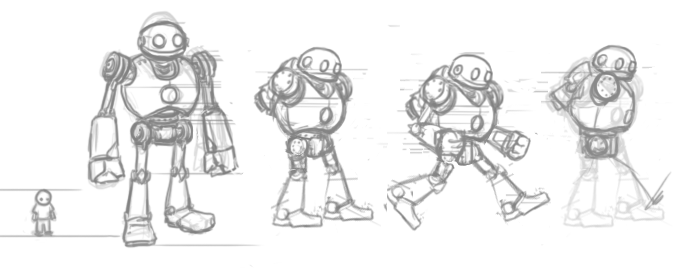
Super Strict Farmer !

I’m a bit late but here’s the Post Mortem for   Super Strict Farmer 

It tooks me some time to figure out what to do with the Tiny world theme. I was just thinking to a little piece of ground floating in the air. So I decided to adapt a famous boardgame ( my favorite ) named Agricola to a short and more accessible version .

I think I succeded in making it shorter ( boargame version play are 2h-3h long ) but the result is still very difficult to handle and not very intuitive.

You can play Super Strict Farmer  here !

The Timelapse is here


What went right :

– Preparation / Efficiency

On the week before LD23, I focus my attention to go to bed early and slept at least 9h-10h per night  ( that’s a lot for me ). It made my 48h very pleasant, I slept only 6h in one shot and had almost no focus problems. It didn’t help to take good decisions, but I had my head clear when I had to implement them :)

– Animation and arts :

I’m used to graphics gale and can work fast with it. I spend a few percent of my time on graphics and could focus on the core of the game. I just wish I had more time for particles and special effects

– Artificial Intelligence :

Well. I was thinking I wont have time for this in 48h. So I first decided to make the computer player play random move and balance difficulty with initial advantages ( more food, peoples or ressources ). I finally decided to give 2 hours for AI and I dont regret it. I mean, the result is not perfect but working on it was the most fun part of the project. Trying to give score for each possible action, made me think like a player ( not a game designer ) and it works like actually testing your game and detecting his weaknesses. At the end, I made the AI compute opponet best actions so it can try to steal them from you. It made the game more interesting and in my case very introversive, because I really had the feeling to play versus myself.

– Title

I had fun imagine it and draw it in 90’s super street fighter style. I was thinking that maybe, it could be the best title and then… I saw Copulous 😀


What went wrong :

– Simplification of the orginial Gameplay :

One of the bad points of Agricola is that you have to wait the end of the game to have a clear view of your score. It make it very obscure to new player, and I was thinking I could avoid it by creating ingame-actions that let the player trade ressources for victory points. I could not balance them in time, and was forced to add a final grain/sheep/cattle count. It ruined my original idea.

– Balancing :

Even if the result is playable, the game balance is unstable and took me most of my time. It’s difficult to estimate it, but it should be around 9-10h . I could have better intro screen and better ingame help if I didnt spent all this time on balancing.

– Boardgame :

Trying to adapt a boardgame to a short casaul game for LD is not the best choice I could make. This kind of boardgames are not very popular and I know that only few people enjoy their mathematics. I think I ended with a game too simple for boardgame veteran and too complicated for unitiated.

– Loneliness in a crowd :

One more time I had a chance to share this Ludum Dare with a lot of friends who was participating in the same place ( deepnight, 01101101, thotor , valandre ). And once again I stayed focus on my work not trying to go around and see what they were doing. But this time I have the solution : LD24 will be a jam entry for me :)


Aedicula – Postmortem

It’s been a couple of weeks since I worked on and finished Aedicula, my Tiny World themed game for the 48 hour compo. I figure enough time has passed that I can talk more objectively about it and my future plans for it.

Progress
The concept came together pretty quickly on the first night. The second day was mostly spent watching Ogmo Editor tutorials and reading documentation while figuring out how to get basic levels to import properly into Flashpunk. The majority of the game came together on the last day. The 4 levels and final polish necessary for it to be considered a finished game were done in the last 4 hours.

Final Polish
The last hour was spent making the title, adding menu and restart buttons to the level, and adding instructional text. These don’t seem like a big deal, but I’m really glad I put them in. They’re the difference between a tech demo and knowing that someone coming into the game without any knowledge of it beforehand would be able to play it from start to finish.

Next Steps
I ran out of time to add a pushing mechanic to anything but the keys. The original goal was to also have blocks that could only be pushed when you’re large. Large blocks would have passages that could only be passed through when you’re small. I’m going to keep working on the game and switch the top down view to an orthographic view. I’m also going to rename the game to Minor Deity. The name is more accessible and better describes the gameplay in the title.

Aedicula screen shot

Dwindling Worlds Post-Compo Version

It took me a bit longer than I’d intended, but I’ve now uploaded a post-compo version of Dwindling Worlds. This version mainly smooths over the rough edges and adds some of the things suggested in the comments (thanks everyone who commented! :) ). The main changes:

  • Updated title screen.
  • Space will now repeat the current world’s hint.
  • Tweaked the difficulty to make it easier.
  • Smoothed the voiceover levels so it should be easier to make out what’s being said when the music’s playing.
  • Better end sequence.

Post-Compo Version

Also, I’ve updated the competition version with a fix for the crash bug that a number of people reported. At least, I think it’ll fix it; I don’t actually have a low-spec Windows machine to test it on.

Competition Version

Do you end up playing more than developing?

This always ends up happening to me the further into development I get and the more gamey that my creations become. I usually find that I end up just playing around with what I have made and experimenting with stuff in-game much more than writing more code. 😛 lol

Does anyone else notice this with themselves or have a similar problem when making games or writing code?


Also, I find that the more sandboxey or open world or experimental the thing I am creating is, the more I tend to play around with it. The second I implement any kind of 3D physics into whatever I am creating I turn into a 12 year old boy and just spend hours and hours messing around with what I have created and being fascinated with what you can do with physics…

I made a 3D physics engine for my final dissertation during my masters course and I swear I could have coded about double what I finally ended up with, if I hadn’t spent so *many*, *many* long hours into the early morning just playing around with different physics properties and making fun stuff happen in my engine…

I guess that’s one of the problems with coding stuff/games that you truly want to, you end up making the thing you want to play so much, that you just end up playing it half the time! 😀

Tags: alwaysgeeky, cubes, gamedev, indie, minecraft, SuccessStory, tips, vlog, voxel engine, voxels, youtube

Comments

05. May 2012 · 17:02 UTC
It would be nice you’d put at least some annotations to your video about how stuff works and so on. Could be valuable stuff 😀
namuol
05. May 2012 · 22:41 UTC
The moment where I cross that line, and I realize it, is a great feeling.

“Compatibility update” or “Now Mac and Linux users can be recluses too”


Hey guys!

After reading demonpants’ post, I worked overnight to make mac and linux-compatible versions of my game! Fortunately it wasn’t so hard to find out what bug was crashing the game in those systems and now it should run with no problems. Sorry to keep you waiting!

These versions also try to correct the white flash bug, but I still found no solution for that. The game now flashes purple instead of white, which is less hard on the eyes, but still is an undesirable effect.

Thanks for reading and have fun!

8

This entry was posted on Saturday, May 5th, 2012 at 4:23 pm and is filed under LD #23. You can follow any responses to this entry through the RSS 2.0 feed. You can leave a response, or trackback from your own site.

My Post Mortem

This was my first Ludum Dare and even though I didn’t finish my game I really enjoyed the experience. I intend to participate in future jams.

Here’s how things went for me….

What Went Right

Tools Were Ready

With the exception of one thing I’l discuss below, I had my Mac completely set up for the competition. All tools were installed/updated and ready to go so there was nothing to slow me down in that regard.

I had also discussed the event with my girlfriend in advance, so she made her own plans for the weekend as well.

Community Involvement

I made a decent effort to get involved with the community: I was logged into IRC for a good portion of the weekend, I was tweeting on Twitter, I made a few posts on the LD site. I’m also currently running a survey for the tools people used during the competition and am sharing the results of that with the community.

I need to make a strong effort reviewing games but unfortunately real life has gotten in the way the last week or so.

Submitted Something

Even though I didn’t have a finished game I forced myself to submit what I had done. I don’t know if that ends up being a waste of time for most people looking at my “game” but I did receive a number of encouraging comments from other LDers to finish up what I had done since it looked promising. That was certainly a nice thing to read and makes me want to participate again.

What Went Wrong

Collision Detection Woes

I decided to use Ruby for my game. This is because I’ve been doing a lot of Ruby at work and wanted to use the opportunity to expose myself to more. I used the Chingu gem, which I like a lot, but I hadn’t sufficiently practiced/learned enough of it before the competition. My main faltering point was with collision detection. Not knowing the correct/best way to check various kinds of collisions made behavior like falling, climbing and jumping buggy to implement.

The built-in editor that Chingu provides made it easy to put together a level and I definitely learned a lot about Chingu during the competition.

No Solid Idea

At the start of the competition I drew out a few vague ideas of what I wanted to do. Originally I was going to make a game using 8×8 sprites since that would make for a “tiny world”. I actually got frustrated with playing something that small and bumped it up to 16×16. I was going in the direction of some sort of Lode Runner type clone (but with Donuts!) but it never really came together.

Didn’t Finish

Since I didn’t have a solid idea, I didn’t really have a finished game. There’s no score. No real goal. No death handling. There’s potential there and I should consider trying to finish it up, as people have suggested.

But nobody wants to play an unfinished game, so it limits my feedback for improvement.

No Windows Package

The one piece I didn’t get around to setting up before the weekend was packaging Ruby apps on Windows. I used the Releasy gem (which was quite easy to use), but due to dependency issues on Windows, I couldn’t get it to work there. You can see me struggling with it towards the end of my time lapse for a bit.

For Next Time

Unity 3D

As much as I love Ruby, it’s probably not the best choice for creating a cross-platform game, especially if I want something people can play in a browser. I’ve played with Unity 3D before so I’m going to go back to and try to improve my skills there.

Practice, Practice, Practice

I need to spend more time practicing implementing various game mechanics, rules, features, etc. I’ve got a list of games to try cloning in an increasingly difficult order. Hopefully this practice will expand my game programming skills.

Solid Idea

Hopefully the two above steps will put me in line to be able to come up with and implement a better game idea next time. A game jam is a bad time to try and figure out something completely new to you. I should probably be focusing on creating something with 80% of the functionality being something I’ve already done.

Tags: post-mortem

Tiny Religion final version done!

After now 2 weeks of *almost* intense work on my game (which can be found here) I’ve reached the point I wanted to take it to, I have now reached a final state for the game!

In a quest for perfection and in response to the feedback I got, this final version features:
– new stuff!
– a more expressive god!
– a god with mood swings that also changes colors!
– bad music!
– more sound effects!
– a bit more explanatory introduction texts!
– evil-er enemies!
– 100% more polish!
And brand new graphics done by my sister, see for yourself:

and without further ado, you can download a version without an installer here and a version with an installer here

15 awesome games with less than 50 ratings

Ok…so I’ve rated 133 games so far, and I reviewed a dozen of them on my blog. Time for a break.

I’m very grateful to all the people who recommended some games on the Ludum Dare frontpage and allowed me to discover some jewels, so I’m gonna do the same.

Of course, a lot of my favourites already got 100+ ratings and it would be stupid to recommend them one more time, so I’ve decided to present 15 games with less than 50 ratings and which deserve to be played. (The order is not important)


Dr. Biology’s Educational Game

Because biology is fun !


Five by Five

A very clever puzzle game


These are your friends

I fell in love with an island !


Minilization

A very deep civilization simulation


Evolve

A grow-like with awesome graphics


Tiny Toy

The weirder it is, the more I like it !


There is a picture

An suprisingly awesome adventure made on RPGMaker


Dwindling Worlds

My brain and my eyes still hurt…

Real War

Not for kids !


Circus Flea

This one made me ROFL


Tiny World Cardgame

A well balanced card game…moreover : it’s cute


Tinyville confidential

What would happen if Facebook games were actually good.


Rambros

Looks like a video game version of The Expendables


It’s a tab

A 16×16 pixels game…playable in a favicon.


Beefwar

Meat+Panzers = Fun (too bad I can’t see any link with the theme)


On a previous post, Madball explained how he rated the games, and that was very interesting, especially because I myself rated games quite differently. So maybe some people will be interested by my own rating grid :

Here are the categories, by order of importance according to me :


Innovation
1 : This game is a total ripoff, I blame you for that (never used)

2 : This game is nothing more than a platformer/shooter ^^

3 : Ok…you got some good ideas.
4 : That is clever !

5 : MIND BLOWN ! (when I give 5 in innovation, I automatically give 5 overall)


Theme

1:No link with the theme
2: Easy use of the theme (only introduced in a single sentence, or in the title for exemple)

3: Fits the theme, but meh…not very cleverly

4: A rather original approach of the theme

5:A unique approach of the theme


Mood

1 : /

2 : I see what you’ve tried to do, but you obviously failed

3 : Meh.

4 : You made me smile/cry/rage…etc

5 : I was so in your game that I forgot I was playing a game


Fun

1 : /

2 : That was soooo boring

3 : I don’t regret the few minutes I spent on this game

4 : I enjoyed playing this game

5 : I’m still playing this game.


Humor

1 : /

2 : /

3 : Ok, you got me, I smiled

4 : My eyes laughed

5 : My body laughed


Graphics

1 : /

2 : Graphics annoyed me

3 : I didn’t notice the graphics, that means they’re good enough.

4 : You put a lot of efforts into your graphics

5 : Graphics fits perfectly with the game, even if it’s only three pixels on a screen


Audio

1 : / (no audio, I don’t rate)

2 : There is some audio, but honestly, it would be better without it

3 : There is audio, and it is not annoying.

4 : Great audio or/and great music

5 : Audio is part of the gameplay


Overall

Most of the time, Overall is the better value between Innovation and Theme, but is could be lowered if something really suck. I would never give 5 overall to someone with 1 or 2 in Theme or Innovation. On the opposite, if you’re a cool guy, overall could be raised by 1, that’s not voluntary, but I know it counts.


Well that’s all folks.

By the way, Have you played my game-with-an-accidental-spelling-mistake-in-the-title ?

In honor of 151 ratings, here are some hidden gems

I’ve decided that for the rest of the rating period that I’m going to wander through two sections of the site to find games to rate:

1. Least Ratings
2. The full gallery of 1400 games, paging through them all

Doing so I found a these things to be true :

1. There are occasionally some really interesting games sitting in the Least Rated pile that are there only because the creator came, built, posted, and abandoned the site.
2. There are some really interesting games sitting in the middle that had just enough Coolness at one point to get attention but that have not been promoted much since

So in honor of the mushy middle, where great ideas get lost in the shuffle, here are a few that you probably won’t ever hear about from anyone else :

=================================================
=================================================

Obsolecense — By quickfingers


The gameplay is very simple. The graphics are hauntingly beautiful. The music is poigniant. Humankind has pillaged all the resource-rich planets in the universe until nothing is left but the small, “worthless” planets that had been overlooked for millenia. Unfortunately, they’re all that’s left now. Colonize these tiny worlds and watch as humanity tears their resources asunder to build up industry and housing, but don’t dally as you have only a short amount of time to find the next planet that might sustain you for a few more centuries.

=================================================
=================================================

Game With a Fantastic Title — batzerk

On a lighter note, this game was sitting on the “Least Rated” page with only 4 votes when I found it. Again, very simple gameplay, but it’s a real gem in the rough. Hit the platforms to compose a tune and watch the happy particles and listen to the happy tunes. It’ll brighten your day.

=================================================
=================================================

HMS Imahara — SLiV

This is the first game I’ve found where there is no audio and yet I still gave the Audio 4 stars. Why? Because the complete and utter silence adds to the tension presented in this minimalist boardgame simulation. The “tiny world” theme was well represented here by making the entirety of the “known” world be just your tiny space ship. The graphics are basic but the story is so well laid out that they let your imagination really take over. Can you get all six crew members to the escape pods? Keep your crew alive amidst the rapidly depleting oxygen supply and the hungry aliens.

=================================================
=================================================

stack::tracer() — nihilocrat

A very short, but very inventive puzzle game with a code-based idiom of pushing and popping stack frames with “functions”. There’s so much potential here. Keep an eye on this space and encourage nihilocrat to keep going post-compo!

=================================================
=================================================

Catamari Meowacy– SethR


From the first comment : “LOL. This might be the Citizen Kane of gaming that we’ve all been waiting for.”

This game is remarkable for having sticky controls, badly drawn graphics, fuzzy voiceovers, an overall feeling of being a bad acid trip, and the single greatest villain I’ve seen in 151 games in this Ludum Dare.

Zorlax is watching you shower.

Zorlax needs to be a recurring character.

Tags: review, reviews

Tiny Galaxy on Chrome Web Store

Tiny Galaxy is now available on Chrome Web Store 😀

The game is online and has no ads. Even if I don’t plan to make money with it I hope it will have enough visibility among the lot of games in store!

It is version 1 completly debugged with tuned gameplay. There are no really new stuffs but the ability to destroy blue bridges.

I hope you will enjoy it! Give me stars ;p
Have Fun.

Web store page

Direct game page


It’s war! A Tiny World War postmortem

Link to my game – (ratings and feeback very much appreciated!)

@BigDaveIsCheap’s LD23 video roundup featuring Tiny World War (at 3:40)

Timelapse of the creation of Tiny World War

Preparing For War

Having followed LD for yonks it was finally time to bite the bullet and jump in with both feet. I was so excited to spend the weekend entirely devoted to the hobby I love, I couldn’t wait to get started, so preparation was no problem whatsoever. The first thing I did was

Tip #1 – Buy McFunkypants “The Game Jam Survival Guide”

And from this flowed forth much insight and timesaving! So I decided on Flash and Fllixel since I was familiar with the tools and could easily share the game – and I got my toolchain all setup and ready with a HelloWorld app that built and ran. I won’t reiterate all the great tips in McFunkypants’ book, I recommend you buy it! However, as a happily married chappy one of the most important tips I will add here is

Tip #2 – Plan the weekend around your loved ones

I can’t overemphasise how important this was. With my lovely wife on board (and guaranteed a place in the credits ;) ) I not only felt free to indulge gratuitously in my hobby, but I had a superbly supportive playtester, motivator, and carer on hand making sure I ate, drank and slept in appropriate proportions! Going out for dinner on Saturday night not only helped me chill out and come down from the intense day, I woke up after a great night sleep full of ideas for day 2! Speaking of ideas:

Tip #3 – Have some rough game outlines in the back of your mind, pre-jam

Restored German trench near Ypres, Belgium

Controversial, perhaps, but I found great inspiration from a recent trip visiting World War 1 battlefields near Ypres in Belgium, and I knew I fancied making a WW1 themed game. I felt WW1 was under-represented in games, so I figured I’d have something niche. Fitting this with the Tiny World theme took some creative thinking, but hey that’s the whole point!

It’s War!

Tip #4 – Have a battle plan

Since this was my first LD I really had no idea how much I’d be able to achieve in the time available. I knew I’d have all day Saturday and all day Sunday and that would be it (EU timezone thing). So my plan was to have the game basically “finished”, and then spend all Sunday polishing it. This definitely paid off as I’m happy with the level of polish the game has. I’m not so happy with the very simple gameplay but it’s finished, and without the text boxes, menu screens, music and sounds it would not be a complete game. Of course ideas and features popped up in my mind throughout, but I had to discard loads of these and hopefully just keep the best ones, so

Tip #5 – Make bold decisions and stick with them

There’s no time to restart in a different direction. A highly polished turd still has artistic merit, that’s the risk you take. At least your experience will be a “something” rather than a mashup of nonsense. The same principle applies to tweaking and balancing. There’s no point making tiny adjustments to the game; it’s going to be rough but as long as all the parts are there you have something you can call a game at the end, so concretely:

Tip #6 – If you tweak a variable in-game, double or half it, don’t micro-adjust

This tip, from Jesse Schell’s excellent “The Art of Game Design – A book of lenses” saved me so much time and helped to pin down things like: player move speed, enemy firing rate, map size, the interval between random explosions, the number of enemies… the list is endless, pretty much every tuneable parameter in the game got to where it is by doubling and halving until it felt right. It’s a binary search logarithmic complexity thing (I guess). It relates to a general principle:

Tip #7 – Get into “the zone” and get over “the wall”

That flow state where you are deploying your skills to their fullest and the challenge is worthy of your ability. In a jam you set your own level of challenge, so know yourself and know your limits. Know what you need to keep you flowing (quiet, breaks, food, sunshine, IRC, feedback, whatever). The “Wall” was an interesting one. I genuinely didn’t expect to hit it because I really do love this hobby so much – wrong! After spending an hour on player controls I felt my love for the game waning. Time to stop that path. I pushed on and finished that nasty section, then did something fun and “easy” – generated a ton of sound effects in BFXR! What a juicy tool, that was great. I finished day 1 with a game that looked and sounded more or less the finished product. For keeping motivation high, nothing beats

Tip #8 – Go directly to final art

Programmer art being what it is, front-loading the art creation task seems sensible. The art is hard, the code is easy (relatively). Now I may have to revise this because I think the main problem with my game is that it is too simplistic, and the only thing harder than art is that holy grail:

Tip #9 – But don’t forget the fun

A sad fact is that in a competition with 1400 entries, no-one is going to play anywhere near all of them. You have to stand out and your main channel for this is graphical screenshots. A pretty game *will* get more plays, initially. However as time passes and word of mouth comes to dominate ratings, a fun game will eventually outshine a boring pretty one. A game that is well balanced, full of game-y pleasures and surprises will always win the day, just not initially. However if a game jam is the nursery from which games grow, the real world is where games that stand the test of time will flourish. Tiny World War is fun, but not for as long as I’d have liked. I’d like to know what you think in that regard… Which brings me onto the final point

Tip #10 – Share the joy

It’s perhaps obvious, almost too obvious, but the point of this competition as far as I see it is not to make money or have glory (for most), it is quite simply the opportunity to dive right into an enormous bubbling conversation about the fantastic experience of satisfying the highest of creative urges under extraordinary conditions with hundreds, indeed, thousands of like-minded individuals. It’s a celebration of gaming, creativity, humour and perseverance. If you create your game in a bunker, release it on the quiet, tell no one, post nothing on the blog, ignore irc and don’t bother to play anyone else’s games, wow that is some crazy behaviour. Community and feedback is what this is about. I just wish I’d spent time on IRC as I feel I really missed out there. I’m trying to make up for it now by leaving the most useful ratings I can and keeping the conversation going.

The Aftermath

In a nutshell, that was one of the most intense 48 hours periods of my life. It was an emotional rollercoaster, and at the end of it I have a game I’m proud of, despite its problems. There are highs and lows in an escapade like this, but wow, what an unforgettable experience! I can’t wait to do it all again for LD24 ;D


Tags: postmortem, timelapse, tips

Big Dave’s Ludum Dare 23 Video Review

@BigDaveIsCheap has posted a video roundup of 7 Ludum Dare gems! He’s really gone into depth with the reviews and it’s a really nicely made video.

Three of the games are twitter respondents:

Yep I’m biased to Tiny World War 😉

The other four are his top picks:

Watch it here!

Post-compo Version of Bottlecolonies

As promised, here comes the first post-compo version of my LD 23 game Bottlecolonies. I evaluated a lot of the feedback you gave me on my LD entry and tried to improve the game with different additions and changes. If you click the link below, you can see that this is just the first beta version for the finalized game. At the moment there is only the windows executable. I’m working on a Linux port but have to try out if the subfolder works first. The changes from the LD version so far:

Link to post compo webpage

  • Add: +1 bonus point if a building is placed next to any park
  • Change: -6 point for discarding a tile
  • Add: second music track
  • Add: new map, selectable as level 3. The old level 3 is hidden behind level 2. If you beat level 2 you automatically will play the old level 3 next.
  • Change: goal scores for prosperous colonies changed for new bonus points
  • Change: subfolder for assets
  • Add: elliptic marker where next tile will be placed

Further updates will include:

  • More maps
  • At least one more music track
  • Additional buildings for the end game to make the game more interesting
  • Saved highscore per level

Even if you have played it before, you should try it out again. The changes in the score system have a big impact on available strategies. In case you haven’t rated the original version yet, you can find it here.

And last a screenshot of the new map:

Tags: handdrawn, post-compo, pygame, python

Comments

06. May 2012 · 20:31 UTC
Those are some sexy drawing skills.

A bathtub story – Post mortem


Introduction

This is my first Ludum Dare. As a full-time developer I have always  liked games, but never programmed them. Ludum Dare is the perfect opportunity. As developer, programming is my daily job, but Ludum Dare requires not only programming, but also graphics, music and game design.


In order to accomplish a game in just 48 hours I selected the following tools:

– Game maker: Fast to prototype and really easy to learn.

– Paint.net: A free and easy tool to create pixel art.

– SFXR: the best for music effects


How I work

1. Get ideas on post-it


2. Make concept art

3. Polish concept

4. Make it move! Having your art in motion gives you early motivation :)


What went wrong


1. Not deciding fast enough how the game will go.

At first I had decided to make it a never ending game, survival style, but later changed to several levels. That change required more graphics, more programming and more time.


2. Almost none musical ability

My ability is almost null, so… no music for the game.


3. Not working on game navigation soon enough.

I never thought in the game flow, and how much time it really required to create menus, navigation and high scores. Create a font required more time than I had thought and it is a tedious chore. I had to go with a simple style but fast enough.


What went right

1. Making the concept art early enough.

The concept matured really fast and having the concept really early on gave me time to toy with the ideas I had.


2. Correct tools

Having experience in Game Maker really reduced the development time. Many devs don’t like GM for considering it not a powerful enough tool, but for me is a prototyping tool. It can create very fast prototypes that can later be migrated to a more powerful language, but allowing very fast development.


3. Previous experience creating shooters

Shooter is a genre I like very much. I am a full-time dev and as such my free time is reduced. A shooter allows me to have fun even if I have very little time. They are easy to play and very fun. I had made some other shooters and that definitely helped.


Conclusion

Creating Games is great! Ludum Dare is a great opportunity to get that game you wanted to make but never dedicated enough time. Selecting the correct tools is fundamental since it will allow you to work more in the fun, avoid learning on the go is fundamental for a fast pace development such as Ludum Dare.


You can play my game in here


Enjoy!


Edit 1: As an advice I would recommend making browser games to make it more available for people to play. I will work on that for the next LD.


Who’s Awesome:

I’ve played 100 games, and now I’m doing a post on my favs. (I’ll update it if I find more really good games.)

Here, in roughly the order I found them in, are my favourite games from this LD:

Tiny Stomp:   Nice simple 3d graphics, including stomp marks. You stomp on tiny creatures, trying not to trip over your feet or puncture yourself. Very fun, addicting, and easy to pick up! Like the sound fx too.       link
Invasion of Tiny World: A  good core mechanic that the game revolves around, creative, lots of destruction, great graphics, great audio, an all around winner!   link   
Fracuum: Awesome! Lots of gameplay, and the zooming thing gives you a sense of the world like  few other games do! Best level design.  link
Asylum:  Beautiful! A good story AND a great way of telling it that takes advantage of various game elements, just like a videogame story should.  This game is awesome. link 
Obsolecence: Most polished entry! Also has a really good sense of mood.  link
subAtomic: Most funny!  link
Planet Zoob: Best audio!  link
Tiny Worlds (the one with all the blue and orange): Gameplay isn’t the best…but it has the most stick-in-your-head music by far!  link
 Moon Base: Third most unique mechanic!    link
Tiny Computer People: Innovative, and relaxing to play! A very cool idea.    link
Pow! Pow! Pow! Best graphical style! Very nice-looking!  link
Diety: For simple all-around enjoyability.  link
Pioneer: Very replayable!      link  
Dave Is In A Fish Tank: For high replayability, and being the game i played MORE than any other entry!     link    
Casal Navity: Best readme introduction! (Although unfortunately I couldn’t play it…letdown!)      link
Going Rogue: For the music, and the great fun I had discovering different ways of causing havoc. Also because it’s a LD entry with random generation!      link     
Stellar Nurse: Very unique mechanic, fun,  good graphics, good music, all around winner! Second most unique mechanic.    linkety link
Super Ant Surfer Hero (or some such): Lots of gameplay, feels polished, and the ant is really cool! Deserves mentioning just for the ant companion. Feels very complete.   link
Evolve: Best combination of simple fun, relaxing to play, awesome graphics, and humour. Lots of games had those, but this one really brought them all together nicely.  link
Path O Invasion: Best bacteria game!  link 
Bipolar: Best pychosis game! Really zany. REALLY zany.   link to gender switching madness
Michael Is Myopic: Best unique mechanic! It’s everything a good core mechanic should be. link
Overpopulous: Best animated intro! link 

It’s A Tab: Most innovative take on theme. Play it. You’ll see what I mean.  link  

Walker: Gnarly! Very cool idea, great execution.  another link  

TinyTanic: Pure awesomeness!   link 

If your game is on the list..come and play mine!

http://www.ludumdare.com/compo/ludum-dare-23/?action=preview&uid=10251

Tags: awesome, compo, gnome, ld, mad, my kid dropped the planet, review, reviews

Comments

ratboy2713
07. May 2012 · 02:38 UTC
Whoooo! I made it onto somebody’s “Top n Games I’ve Played” list. Thank you!
chambers
07. May 2012 · 07:06 UTC
Good list, drove my attention to a few awesome games I had never played like Planet Zoob. I think you should hyperlink the games in your list though, as much as I know that it takes a while to do this, it’s not much compared to the time it saves from each of the readers… Also, some titles are troublesome to find in the search engine.
07. May 2012 · 20:35 UTC
Thanks for putting Planet ZOOB on your list! :)
Cake&amp;Code
08. May 2012 · 20:39 UTC
Thanks for the shoutout to Pow! Pow! Pow! We appreciate the love! :)
MadGnomeGamer
13. May 2012 · 02:08 UTC
No problem!

Post mortem – The Tiny Gryphalope

Entry page

Introduction

This was my first Ludum Dare, and I was psyched!
I had the days before the competition more or less decided that I wanted to do a 3d-shmup. The theme “tiny world” got me thinking of giant bugs, and all the other stuff I thought up along the way. Now, in hindsight; after seeing all the clever theme interpretations of the other submitted games, I think I’ll devote more time to the brainstorming during the next compo. I had to do a little too much work with the shoehorn this time. 😛

Now, I should warn you, this post mortem turned into a wall of text, but I’ve also made a timelapse video:


Day 1

I live in Sweden so the competition started at 3.00 am. I got up at 4 and had a look at the theme, and then decided to sleep some more. 😛 After some sleep, some breakfast and some brainstorming; I finally got started at around 6:45 am.

I decided early on to try and make the game heavily component based, instead of trying to juggle around with inheritance and whatnot during this short amount of time.

So I began by making a player input handler and a movement module. The movement module for example was going to be repurposed in all moving objects, for instance. And I made sure to keep this mindset when coding the rest of the game.

About two hours in I had the basics for movement and weapon handling done.

I then proceeded to make aiming-, mouse input- and enemy behaviour modules. To give another example of the modularity of the project: the enemy behaviour in this case replaces the player input for telling the movement module what to do, and the enemy behaviour uses information from a sight module, instead of relying on mouse input, for targeting.

Around noon I had some funny-looking bowling ball enemies spitting laser(And no, that landscape is not that of a small moon).

As I also had health working by now, I added a game over state, as things like end-states and score-keeping should not be saved until last. However, it was still very temporary-looking, and while I didn’t want to put it aside until last, I more or less ended up doing it anyway. Sigh.

I kept working on player-enemy interaction until around 5.00 pm, fiddling around with enemy aiming, adding camera and object shake upon hit(I made the shaking as a kind of transferable effect-module). I also began working on the triple weapons system, and the weapon switching. A module for rolling was added as well, I decided to keep it separate from the movement module.

By now I actually had something pretty playable!

I had this idea from the start, as I wanted to keep the game on rails; to make the player and all the enemies to follow a path along a spline, thus enabling me to easily make loopy level designs. Implementing the spline and spline traverser was not that hard, but it took me about six hours. And it would prove to be causing a little too much trouble later on, compared to how much use I actually got out of it. However, should I ever decide to make more levels it will certainly come in handy. For the next LD I’ve got to tone down on the long term planning. :]

Screenshot of the player following a spline path.


Maybe I should’ve made some kind of balloon game instead? xD

As it was nearing midnight by now, I decided to call it a day, and went to sleep. I had gotten a lot of the mechanics in place. During day 2 I had to get all the graphics done.


Day 2

Got a solid eight hours of sleep, and after some breakfast I began creating the player model; the, ahem, Tiny Gryphalope!

After about an hour I had the the head of the Gryphalope done, and had begun drawing the body.
To the left is the quick sketch that I made for the model.

It took me until noon to get the mesh done. Although it was fun and a nice change from all the programming from day 1, I still feel like I could’ve put that time to better use. During the next compo I’ll try to make simpler character designs, with less feet. 😛

Screenshots, in chronological order, of the making of the main character.

 And the UV-map.

After I had the model, I began looking into keeping player and monsters from getting to far off the path. This was one of the biggest mess-ups in my opinion, one of the things which I spent far too much time on. I began by trying to make the constraint purely distance based, but I never managed to get it to work smooth enough, so after two hours of failure, and feeling pretty stressed out, I decided to put it aside for a while and start making an enemy model and calm myself down.

What a mess.

I decided not to spend as much time on modeling the enemy as I had spent on the main character. As I previously stated the theme got me thinking of giant flies (for some reason), so I decided to make a fly-like monster. I made it a very simple model, without any legs and a loosely defined, pudgy “face”, based on a quick and dirty sculpt. It took me about two hours to make the model from scratch and UV-map it. An improvement, but oh had it felt good had I only spent one hour instead. xD

Creating the enemy mesh, modelling on top of sculpts and primitives.

After that I went back to battling the problem of making the level constraints. I decided to switch to using only mesh collision as it is already provided by Unity. However, since I had made my movement code completely separate and not based on Unity’s physics engine, I got a lot of twitching and shaking when implementing collision. I had to go back to the collision handling several times for small fixes and fine tuning during the rest of the development time, and I never got it just right before the deadline, sometimes it freaks out. *I think* I fixed it in the post-compo update, but to be more certain I would have to make movement physics based.

I long for the day when I no longer will have any problems whatsoever when implementing collision handling. Ha ha.

I then decided to get the textures for the Gryphalope and the fly-monster done. As I had grown quite weary of wrestling with ill-behaving code, it was a nice change to just draw for a while. I found a really good reference picture on Wikipedia for drawing the wings.

Yay, colours! =D

I now had 7 hours to go, and so much left to do.
I decided I had to start making something that could pass as a level, instead of the randomly placed boxes. The level ended up of consisting of only one mesh, duplicated, rotated and scaled in different ways. I began by making a tube in Blender, subdivided it like crazy and began sculpting tree-like grooves and roots into it.

After one and a half hour of sculpting and painting, I had this:

I then began making some sound effects for the game, using Bfxr. I also started the long overdue task of completing the game over- and victory-states. To sweeten the menus I implemented my own button system, so I could easily animate them and make them compatible with gamepad thumbsticks. I wanted to make the game totally playable using only a gamepad.

When making these end-states I got the idea to present all the monsters the player had killed, by lining thumbnails of them up, kind of like how it is presented in Spelunky between levels. I figured that this could then be expanded into showing some kind of score based on kills and loot. I never got the time to implement more than the line of thumbnails though.

With game over- and victory-screens done, the big crunch began.
During the last three hours I made a title screen, particle effects, rigged and animated the main character, “designed” a level, created music (thanks, inudge), playtested, squashed some minor bugs, and uploaded.

Work, work.

I was pretty happy with the end result, it being my first Ludum Dare, and all. The game ended up with pretty nice looking visuals but suffered from a lack of gameplay. It was great to get such a large amount of good feedback from the community, and it helped and spurred me to make and release an updated version.

What went right

  • Going for a component based architecture.
  • Getting all the core mechanics done by day 1.
  • Reusing the same mesh for the whole level. 😛
  • Getting the spline system done pretty quickly.
  • Actually managing to make some simple music(first time I made my own music).
  • Having some friends over during the compo, kept me sane.
  • Right amount of food and sleep. ^^
  • Managed to make something playable. Next time: something enjoyable. 😀

What went wrong

  • Spent too much time making the main character.
  • Spent even more time wrestling with collision handling. >.<
  • Ended up not really needing the splines for the simple level that I made. (May come in handy later on though)
  • Got some performance issues in the game on some computers.
  • Realised after the deadline just how dark the game actually turned out, and how sluggish the movement was.
  • Never got the time to make a pretty HUD.
  • The project might have been a little too ambitious for being my first LD, it was hard to predict what to prioritise in only 48 hours.
  • I should’ve brainstomed some more to make something a little more connected to the theme, and more innovative.


Compo version

You can visit the entry page here, and play/rate the compo version. Web and download available.

Updated post-compo version

Click here to play the updated version if you’ve rated the original.

…and while we’re at it, some shameless plugs:
My Portfolio, Twitter and Youtube.       ŎםŎ


Conclusion

All in all, the compo was a great experience and I felt that I learned a lot, and as usual; still so much to learn. =D I’m really looking forward to the next compo!

And this concludes my post mortem, kudos to you if you read it all! :)
If you still got some energy left, and if I managed to pique your interest, please give the game a go, and I’m very thankful for all feedback and constructive criticism. If there’s enough interest I’ll probably keep working on it. :)

Thank you for your time.
-Jarl Larsson

Tags: bytegrove, gryphalope, postmortem, SuccessStory, timelapse, unity

I’ve played 10%, here are my top n games!

And…… Done! I got through 10% of the total games and I’m mighty impressed. I have been mostly just searching for web games and am pleased that there are soo many games that don’t require anything to download. Anyway, here are my favorites (as in they received a 4 or 5 in the overall category).

Atomsmash – By Dan C. It’s a C64 game, like for reals. If you bother to you could actually play it on a  Commodore 64, and it would be awesome. If you don’t want to go through that, there is an emulator you can get to experience the awesome for yourself.

Aether – by Danik. It’s a planet defense game, with a bit of a twist. What happens to the planet on a large scale is experienced on the small scale. I love the concept, and the visuals for both large and small are stunning. Really a great game.

Deconstructorium – by GreyShock. Go into objects and steal their molecules, then use these molecules to destroy the world! Essentially a collection of minigames with a linking story of mad scientist. Really fun and very funny.

This Precious Land – by Ishisoft. A nice puzzle game where you create resources to try to grow a new land. Very relaxing and yet still engaging.

The Good Ship Higgs Boson – by Jezzamon. Its a platformer. No, hear me out, it’s a gravity manipulating platformer. Give it a chance, it is actually very polished and provides some good puzzles.

ANT SURF HERO: THE SURFENING – by Jigxor. This has been on everybody’s top N games list and if you haven’t played it by now, for shame. Anyway, very good, very pretty, very funny, play the game already!

My Little Planetoid – by matthias_zarzecki. You build up a planet and evolve to the point where you can travel through space. Very nicely done and relaxing to play. I would also like to thank Mathias Zarzecki for playing everyone’s game. Seriously, look at his coolness, he is really trying to play all of them and I salute you for your efforts.

Atom Planet – by NMcCoy. A little puzzle game that is a mix of minecraft and alchemy, with a cute little character and relaxing music.

Tiny World – by piterlouis. A planetary defense game with a bit of a twist. Defend your planet with your own orbiting moon. Very fun. Should have picked a better title, however.

Michael is Myopic – by Several. Another puzzle game where you eat to grow, and have to avoid growing too large too fast. Has a nice zoom out feature that just looks awesome.

Tiny World Cardgame – by SusanTheCat. A fantastic card game that I wish was real. I would play everybody in it. In fact, I’m going to print off the cards as soon as I’m done with this post.

Fracuum – by TylerGlaiel. A maze game where you zoom in to advance in the maze. Reach the center to win, but there will be enemies trying to impede your progress.


And there you go, my list of games you should play. It has been a long hard ride through some 140 odd games, but these gems made it all worth while. And, if you are feeling generous, also play my game, Path O’ Invasion. Not as good as those games, but it has squishy movement, and really that’s what Ludum Dare is all about.

Tags: ld23, review

Rated 100 Games! Here are my favourites

I’ve played and rated 100 Ludum Dare entries so far, and along the way I’ve found a fair few games that are really a lot of fun which I’d like to share with you all. What follows, in no particular order, are my favourite games from Ludum Dare #23

————————————————————————————————————————————

Tiny Wizard – kebabskal

Actually, this one probably is my favourite. I love the bite-sized levels, slow difficulty increase, and of course the general gameplay. It’s really very satisfying to simply shoot and move around, and beating each level feels great!

http://www.ludumdare.com/compo/ludum-dare-23/?action=preview&uid=8353


————————————————————————————————————————————

Dude, where’s my planet – Zamando

Beautiful to look at, though challenging.

http://www.ludumdare.com/compo/ludum-dare-23/?action=preview&uid=12041


————————————————————————————————————————————

Celia – Finn Stokes

Stunning graphics, a cool core mechanic and a lot of fun.

http://www.ludumdare.com/compo/ludum-dare-23/?action=preview&uid=7674


————————————————————————————————————————————

Inside My Radio – TurboDindon

A unique and innovative take on music games. It’s good to see a music game in Ludum Dare. Extremely well polished.

http://www.ludumdare.com/compo/ludum-dare-23/?action=preview&uid=5611


————————————————————————————————————————————

Prince of Leaves – evilseanbot

A feel good game. Cute graphics and an original bespoked music track which make you want to play all the way through to the end.

http://www.ludumdare.com/compo/ludum-dare-23/?action=preview&uid=7902


————————————————————————————————————————————

Corebound – Ryusui

Challenging at times, but very rewarding. Unique gameplay mechanic which is sort of an automatic twist on VVVVVV’s gravity system, allowing circular orbiting movements.

http://www.ludumdare.com/compo/ludum-dare-23/?action=preview&uid=12635

————————————————————————————————————————————

Lililput – Incredible Ape

Amazing pixel art and educational fun! Learn to type like a pro while destroying aliens!

http://www.ludumdare.com/compo/ludum-dare-23/?action=preview&uid=12165


————————————————————————————————————————————

Astro Break – hulahulahest

One of the most compelling games in the competition. Powerups and new weapons can keep you blowing up rocks all day!

http://www.ludumdare.com/compo/ludum-dare-23/?action=preview&uid=528


————————————————————————————————————————————

Little City – dustmyte

Hilarious game with entertaining dialogue. Nice black and white visuals as well.

http://www.ludumdare.com/compo/ludum-dare-23/?action=preview&uid=12796


————————————————————————————————————————————

Microscopia – azurenimbus

The premise is simple: Navigate to the center of the screen. The real question is, where are you? Very innovative.

http://www.ludumdare.com/compo/ludum-dare-23/?action=preview&uid=12119


————————————————————————————————————————————

And, I may as well shamelessly plug my own game too!

ANT SURF HERO: THE SURFENING – Jigxor (Me!)

http://www.ludumdare.com/compo/ludum-dare-23/?action=rate&uid=3289


Thank you to everyone who has submitted awesome games. I’ve had a lot of fun playing them so far, and I can’t wait to play some more! I hope you all do the same.

Tags: best games, favourites

Belated Timelapse and Post Mortem

Originally, I intended to write a post-mortem and include this timelapse recording for illustration. But apparently in these days I can find neither the time nor the energy to write such a thing. Scroll down to read it! So here is my timelapse. There are a lot of screen messages in there – enjoy!
And don’t forget to play and rate my game 😉

Post Mortem

—Tools—
Ok, I should at least give you a list of tools I used and how they worked out for me.
I made this game in Processing, and I just used the standard code editor that comes with this API. It’s probably more basic and tedious than full blown IDEs, but – at least for a small project like this – it worked pretty well.

My sprites and fonts were drawn in in GIMP. I didn’t make a lot of them (there’s just one 2×2 tileset for objects and one 3×3 for the walls), but still there are quite a few comments saying how good my game looks. I think, I kind of got a hang of how to set a good mood through interesting colors and effects programming (do your eyes bleed yet?)

For level editing I used the game itself. I implemented a tiny little editing-mode where I could just click on any point of the game window and a wall would appear there. Later I added a save_level() function where I could just press ‘s’ and save the current layout to a file. When wrapping up the game I just disabled the editing functions. I liked this method and intend to keep using it for future projects.

Sadly, there was no time to add sound to the game, but I would have used Audacity and MilkyTracker. Music would probably be unfitting, but some ambience would be nice.

—Content—
The texts that appear in between levels were supposed to add someting poetic or philosophic to my game, but I wrote them ten minutes before the deadline so the formulations are still a bit rough. The basic thoughts are already there, though.

So there was the deadline, the game submitted, but it still had no title. I came up with the word “extensionism” and googled it. I’ve never before heard about this metaphysical theory, but it sounded interesting, so I went with it. Had I found this earlier, I would have incorporated it into my game somehow.

My notebook.

What about the game mechanics? Are they fun? Are they interesting? I’m still not shure. Initially, I was quite convinced my concept would work out, but it was only bare bones and I racked my brain to come up with good additions to it. This is my main “what went wrong” this time: too much time was spent (read wasted) on doubtfully overthinking my mechanics. If there’s one thing that had to be perfect, it was the concept! And the bad thing is, it isn’t. All that crate-pushing Sokoban-likeness is just plainly tedious. Because of this, I almost abandoned the project alltogether, but luckily, my pride protected me from this fate. In retrospective I guess, I was on the right path from the beginning, and I just have to accept that 48h-games are never big, sublime masterpieces (although, some of you have come pretty close :)). Well, I’m always pretty harsh on myself, so I’m even more thankful for all the positive comments on my submission page. Apparently, I made something interesting after all.

Oops, I just recognized this text has accidentally become a real post-mortem. Forget about the very first paragraph (exept the part where I tell you to play my game. )!

Thank you for reading!

Tags: post-mortem, postmortem, timelapse

Dialogues file is up !

For our game Super Tiny Adventure (our entry), we had made a lot of funny dialogues but we could not integrate them all with the fatal deadline. So we have decided to give you a file with all the dialogues. We really hope you will enjoy it. And please be indulgent with our english, we are French.


Here is the file

Bonus, the mind mapping of our dialogues (in french), click on it :

Sprace: A post-mortem

Hi,

First of all please excuse my English, that might not be perfect.

This competition was my first Ludum Dare, and my first entry was also (more or less) my first game (unless you want to count this Minesweeper in). I must say I thoroughly enjoyed the experience, and I’m positive I want to take part in a future Ludum Dare competition.

Even though I don’t have much to say, I wanted to make a short “post-mortem,” in order to share my modest experience and some thoughts that might be useful to some. If you want to understand better what I’ll be talking about, play the game here (and please rate and comment, if you want!).

What went right, or wrong, or not (yes, I’ve decided to merge the two since I couldn’t split some ideas into these two categories):

  • The idea came to my mind rather quickly. (Some people around me couldn’t believe I had this “dirty” idea; or they thought it was related with a girl, which is false, believe me.)
  • I worked efficiently the first day and I had a functional prototype early enough. However I didn’t work very much the second day, but that was because of French elections and friends visiting me.
  • I managed to create a rather good-looking sperm animation! Actually I spent a lot of time trying to make a beautiful regular 4-frames animation, the last two frames being symetrical to the first two, and I ended up realizing that the symetry was a bad idea: the animation was anything but “natural”, the symetry was visible and didn’t look well at all. I finally decided to draw the 4 frames by hand, without any kind of “regularity”, and it was a success (in my opinion).
  • I appreciated working with HTML5’s Canvas and JavaScript. It was a first try for me (even though I knew JavaScript and HTML fairly well before) and turned out to be surprisingly pleasant to use (I think I like prototype-based programming). I will probably reuse this technology in the future, even though manipulating audio at the moment is difficult with HTML (but Web Audio API is coming…).
  • I failed at improving vertical controls (acceleration). Your “character” goes up or down too fast, and it sort of sticks to the top and bottom edges of the screen. Very annoying at first.
  • I failed at recording other sounds and music. I tried some ideas and was close to a good result, but didn’t have enough time to record and include it into the game.
  • The last two hours of the competition were awfully rushed and that was not necessarily a good point. But at the same time, the emergency of the situation made me sometimes find good and intelligent solutions to my problems. I liked that.
  • As a conclusion: Even though I sort of failed by not using my time very well, this competition showed me that I can produce a (sort of) game in 48 hours. Ok, that didn’t sound very original. Actually I want to say that this Ludum Dare may have made me more confident in regards to motivation. I tend to procrastinate a lot, and I came to the conclusion that I should from time to time impose to myself short delays (like, say, 48 hours?) to accomplish some kind of task or project.

I hope this wasn’t too boring. Thanks for reading!

&quot;Sprace&quot;, Niavlys' LD23 entry

Sprace, Niavlys' LD23 entry

Did I offer you to play the game and rate it? Many thanks if you already have!

Tags: ld23, postmortem

Just when you thought the surveys were over…

Hi there!

  • Did you participate in Ludum Dare 23?
  • Do you want to help forward the cause of SCIENCE?
  • Are you at least 18 years old?

If so, you may be interested in taking my survey!

https://www.surveymonkey.com/s/CXBYMDB

I am an MIT undergrad interested in studying game jams for a course on video game research. I’m studying Ludum Dare to see the relationship between how people go about making their games during the Compo or Jam to how well they did (and how well they believe they did). The survey’s not long at all; you should be able to complete it in less than 10 minutes.  Any and all responses will be greatly appreciated!

Thanks,

Michael Ahearn

A Gripe About Embedded Video Advertisements

tl;dr: Embedded video ads are really annoying, even if you can skip them. You might want to compare your ad revenue to how much traffic you’re actually driving away when people just close your game when they see the ad, especially since most of the people playing your game are offering you helpful feedback, for free, in their spare time.

I’ve played over 100 games, mostly web versions, and I’m starting to get really sick of watching loud embedded videos (especially since it’s the same video for Max Payne 3 over and over again) every time I want to try out a Ludum Dare entry for a couple minutes. Even if the movie is skippable (not all of them are), you’re still adding a loud (usually unmutable), obnoxious barrier that makes it harder for people to play your game. And since the people playing it are doing so in order to give it a rating and offer you some helpful feedback, for free, in their spare time, you’re basically trying to make a profit from them helping you. It seems a little rude/selfish/whatever, which definitely seems to go against the spirit of Ludum Dare.

It’s getting to the point where I’m probably going to start skipping over games that force me to watch an embedded ad. I don’t want to do that because most of the games here are really awesome and the people who made them are rock stars so I want to give them some feedback, but if I’m annoyed, then chances are other people are annoyed too. Also, some people have older/slower computers that might play your game just fine, but lag because of the video. So you might want to compare your ad revenue to how many potential players are just closing out your game as soon as the ad starts.

I understand the need for indie developers to get some return on their games. I pay for hosting and offer it for free to Java and Processing developers, so I get it. And I do run ads on my site, but I try to make them as unobtrusive as possible- right now, just banner ads at the bottom of the screen. I will probably never play embedded video ads.

I’ve been giving developers the benefit of the doubt since most of this complaint is about games hosted on kongregate, and I’m not sure if there’s even a way for you guys to disable that ad. But I’ve also seen embedded ads in games hosted on sites like dropbox. So I figured I’d issue a friendly “hey, that’s kind of obnoxious and might not actually be good for you” gripe to give fellow developers some feedback.

Anyway, does anybody else feel this way? Or am I just getting tired and grouchy after playing so many games?

14

This entry was posted on Monday, May 7th, 2012 at 7:34 pm and is filed under LD #23. You can follow any responses to this entry through the RSS 2.0 feed. You can leave a response, or trackback from your own site.

Speaking of tiny worlds…

Everyone should plot where they’re at on the LD world map….doesn’t need to be exact, since it’s google-maps based just put city + state and it’ll put a “approximate” tag for you….or however “close” of an approximation to your area you want.  Would be kinda cool to see where most people are clustered around…interesting to see how right now it looks like a lot of people are in a few city areas and the rest of us pretty spread out. (right now 4 of us total in so-cal…and only two of us in the LA area)

http://www.ludumdare.com/compo/world-map/

Comments

08. May 2012 · 19:45 UTC
Done! We are in Floresta, Buenos Aires, Argentina :)

Great idea! <3

An (extremely late) post-mortem of what went wrong…

Ultimately, I did not end up submitting my game to Ludum Dare, despite it having being mostly finished by the first day. Despite real-life getting in the way (I had some boring things I had to take care of on the second day), I also suffered a few technical problems with my external debugger freaking out on me after I accidentally typed some keyboard shortcut which took me a long time to sort out.

I have competed in Ludum Dare before, I think 19 (or 20?) and 21, and have also entered some other game jams, but this had to be the most frustrating one I have ever entered before. My game was a simple concept, a stripped down platformer where each finish point lead to a new level which got bigger and bigger in relation to the last, in a similar vein to Fracuum (Which is GREAT!). I had finished much of the idea and level designs after 2 or 3 hours, and as it was like 5am at this point, I went to sleep and woke up about 10am (ish) and got to work on setting up an Ogmo Editor project and designing all the levels. Rather than creating my tiles and using those, I just used the grid tool and then wrote a basic script which placed the correct tiles in the correct places, so tiles with grass on top would go where you could walk, and dirt tiles would go at least 1 block under a grassy tile. I had this finished by noon, and then started getting my player sorted out. I had a bit of a problem as I have been using a different programming language to AS3 for a few months, so couldn’t remember the syntax for some grid detection code, but after a few (frustrating) hours, I had the entire physics of the player down. At this point, I decided to take a break, and came back to the project at around 5pm. By now, much of the core elements were there, I quickly whipped together a basic menu which consisted of pretty much nothing more than a handful of level buttons, and a little options menu where you could turn of the sound and music, which I had not even added yet.

Once the menu had been finished, I noticed a bug in the players movement, where if you landed in between 2 grid blocks with enough downward velocity, you would get jammed in between them. This was easily fixed by changing a few things around and I had it solved in 15 minutes. This is now the point where everything went belly-up. I was typing some code, and accidentally pressed some keyboard combination which activated some little remote debugger. I just closed it off and tried compiling my project, only to be presented with a million debugger errors and the game just freezing when it launched. I tried reloading FlashDevelop, to no avail as the same message simply appeared again. I tried making a new project and simply copying all code & assets over, but it seems I did something to FlashDevelop itself, as the same thing happened. By now, I was just losing track of time and before I knew it, the time was 11pm and I was tired and frustrated. I eventually just decided to re-install FlashDevelop, which solved the problem, but I decided to call it a day and go to sleep.

The following day was “disrupted” by real-life getting in the way, I was busy all morning and much of the afternoon, and was only able to get back to work on the game by about 5:30 pm. By now, I only decided I would add a few sound effects, some music and a dynamic background picture, rather than just a boring black background. I had this finished, but then when I actually tested my game for the final time, I realised that it wasn’t quite as fun as I wanted it to be. The 8 levels I had made were all quite easy even though I had tried to make some of them tough, so I decided to get back into Ogmo Editor and whip up some tough bad-ass levels. After a few hours, I had made another 11 levels, all of which I thought would be quite hard. I loaded them into my project and added them into the game and tested them, and after 20 minutes of testing them, I realised that without more components in the game, i.e. traps, buttons, LASERS, switches, portals, collectibles, keys, etc. , that all levels would be limited to nothing more than timing your jumps and keeping momentum going into jumps. It was less a nitty-gritty Super Meat Boy type platformer, and more of a crappy free-running game where after you got the hang of the controls, every level was pretty easy to complete.

By now, I was pretty demoralised, and without enough time to properly add all the things mentioned above, and on top of that not enough time to actually make good levels with all those things utilised in a smart way, I decided to just….well….give up.

Since then, I have added some of those features, but have taken a hiatus until June as I have Uni exams starting from tomorrow until the 29th, so I should probably, I don’t know, revise a bit?

Post -compo version of my game

I’ve completed super enhanced version of my entry, and I would like to share it with you.

But please, if you are going to vote, judge byold version, difference between original and post-compo version is like between prototype and final game. Or don’t rate it at all, I have enough ratings.

List of changes:

  • Reworked level design
  • Visual tweaks
  • Objects to collect and assemble
  • Fixed bugs
  • More sounds
  • Animations
  • Small reward for those who found more than 4 secrets
  • Mouse sensitivity, volume, fullscreen, mouse inverse options.
  • Added cool thingy

Thanks to everyone who left feedback to my entry. And to all Ludum Dare community.


Play in browser (Unity)

Download: PC, Mac

Support on kongregate

Tags: SuccessStory

My Random Content Generators

I want to introduce you my random content generators. They are all opensource and licensed under Creative Commons Licenses.

 
1) Random name generator
-> creates  random unique fantasy names
-> sometimes also puts real words out (e.g. ‘cake’ or ‘faked’)
-> examples: lojuch; deric; lechod; sihur; timen

 
2) Random world generator
-> creates a random topdown world
-> parameters can be changed while generating

 
3) Random sentence generator
-> creates a random sentence
-> very helpful when trying to get a idea what to do next
-> examples:
-  stupid ogre  swings his axe
- hungry cow  climbs a mountain
- innocent knight  laughs


By the way: here is my entry to LD called ToastBiome.

8

This entry was posted on Tuesday, May 8th, 2012 at 9:41 am and is filed under LD #23. You can follow any responses to this entry through the RSS 2.0 feed. You can leave a response, or trackback from your own site.

Dunscape – Post-mortem

Introduction:
Dunscape was my first LD, and more or less my first “finished” game too.

What went right:
– I had a lot of fun during this LD! It’s almost certain that I will participate to next!
– I know most better the langage and library now.
– I have finished the game on time!
– My random room/world generator work pretty well.

What went wrong:
– My time management! I have used only 17 of the 48h available and the victory condition of the game isn’t actually nice because of that :(
– I really need to train my drawing skill, I’m only proud of my rat!
– I had the idea of the game before having the theme and “just” adapted the game to it, I’m not sure if it’s the good way to do a good game.
– It’s hard to speak/write english during a whole week-end without knowing the language well!

Finally, I m not disappointed by my participation, I did not know if I will have the ability to succeed but apparently I got it!
The game looks to be classified as “difficult”, but it is a choice, I always found the roguelikes difficult although I love them, and I wanted to try to honor them! Next time I will try maybe to make a game in ASCII if I do another roguelike game ^^

Long Lost Love!

Last week I got a bit busy, and had to cut back on the game reviews, but now I’m back, with a vengeance!

Baby Farm — Have you ever asked yourself how is babby formed? You NEED to play this game, or your LD23 experience won’t be complete. Being drunk is highly recommended.

Dangerons Baby World — Another baby game. This time a runner. The controls are really awkward and the game is hard to play, but it is worth a mention because it really nails the feel of the theme.

Save the World — If you are rating any games AT ALL, you have probably seen by now dozens of variations on “ship defending a small planet in the middle of the screen” game. Well, this one manages to turn the idea on its head: every time you shoot, your planet moves in the opposite direction! Worth a try.

Away from home — A platformer/puzzle/building game, with multiple, quite distinct game modes. The graphics are quite simple, but the game has a depth that attracted me a lot.

Mineral Cities — A very minimalistic strategy game, you have to construct different buildings in the right places and balances to maximize your point output. But the way the rules work in this game makes it for a very interesting challenge, if you try for the high score.

The Earth is Dying — The game is still rather incomplete, but the idea is quite unique and worth a mention. The earth is dying, and the goal of the game is to colonize nearby planets and send as many people to these planets as possible, before our planet dies.

Colours in the Void — Frustratingly difficult, but very innovative shooter: you shoot by making connections between you and obstacles in the scenario. The graphics and gameplay are well tied together, and the game feels quite polished.

And with 102 games, I bow out of the review race for this LD :-) This
Sunday I will make a last stretch, by picking games from other people’s review lists. If you want to plug your game in the comments, go right ahead too!

Tags: review

Comments

Derek
08. May 2012 · 15:45 UTC
Yaay, thanks for the review.
Canard Sauvage
08. May 2012 · 17:56 UTC
Thanks for the list, I hadn’t played any of the games :)
Attrition
13. May 2012 · 23:06 UTC
Thanks for giving my game a mention :)

AS3 Vector Utils

Hey folks,

After the compo I decided to clean up and make available the Vector utility functions I have used in some of my games. I hope you find this repo useful for your future projects. Please let me know if you see anything that is broken/wrong or that you’d like to have added.

AS3-Vector-Utils on GitHub.

Tags: library, open source, physics

What Has Become of Puzzlem00n?

Good question, title. Well, here are my goals so far as to what I’m going to do next.

MY GAME RATING-

This is basically all I’ve been doing lately around here. So far I’m at 47. My goal is to reach 100 so I can get a gold medal of coolness. I would be a lot farther along, but I started rating a bit late, and I don’t always have time, blah blah blah, excuses excuses, ect. So yeah, maybe I’ll make another post of my favorites later on.

MY GAME-

I see a lot of people around continuing development on their games to turn them into a full release. I have to say that my game, Empty, will not have it’s development continued directly. It’s far to glitchy to build upon, it’s sort of annoying to play, and I don’t think I can do much more to it’s current engine to make a better game. What may occur in the future is that the game’s core mechanic ideas will be taken, balanced out into a more full game design, and then completely rebuilt from the ground up. I am really much more attached to the idea of the game then the game itself, so I feel this is the next logical step.

MY CAREER-

To be honest, I feel that I can barely say I have a career at all. I know this sounds like I’m being down on myself, but trust me, I’m not. Empty, to me, does not feel enough like a game to me for me to call myself a game developer. If I wanted to, I could probably call myself one and get away with it, but I don’t want to lie to myself. There’s nothing anyone can say to change my mind on this. I will not be a developer until I feel I can truly call myself one. And when will that be? When I make a game that feels like me.

MY FUTURE-

I’m definitely going to start a blog up soon to post my games on and just write (I’m sort of into writing). I’m also going to do the next MiniLD, and all the ones after if I can. So0n, hopefully I’ll have a game that I can be proud of.

I suppose that sums everything up. Well, back to rating!

I call first 8hLD

So making games in 48 hours is not challenging anymore for you? How about making game in a WORK DAY? Think you could do that? Well, we can see about that!

I call first 8h LD

The rules of it are similar to “normal” LD, but you have to make game and submit it in 8 hours!

So how about it? Will you participate or are you chickening out?

The jam will begin at Saturday 26th May on 08:00 AM CEST and will end on 04:00 PM CEST. You have to make and submit game before it ends.

The jam theme is DRAGONS.

UPDATE:
Voting will start at Monday, 0:00 CEST and will start up until Sunday 23:59 CEST. Only people registered before May 9th can vote (to avoid votefarming).

Next 8hLD or NanoLD as it’ll be known from now on (unless this name is already taken, tell me about this then) will be organised better, I promise.

Tags: 8hLD, Dragons, superb

Shipwrecked User-Friendly Edition

I made a post-compo version of my game, “Shipwrecked“. I did not change the gameplay, but I made the interface more user-friendly.

Change list:

  • Stats are now always shown to the right.
  • Feedback is now displayed on the top.
  • New hotkeys: QE/12 for using actions, spacebar for closing a window.
  • Help addition.
  • Pop-up help.
  • Shafts are 25% more steady. Deposits bring 2 times more material.
  • In dungeons the amount of monsters nearby is displayed on top.

I planned to make the help system similar to MCX360’s one (Minecraft for Xbox 360), and it’s now even more similar.

(You still can suggest things)

Comments

09. May 2012 · 23:56 UTC
Much better! Now I wish for the red text at the top of the screen to tell me how many enemies are nearby while I am pillaging, and make moving easier, maybe by adding double click = click topmost button (which is usually move) Good Job!

My Post-Mortem Summarry

Yeah , it is comming kinda late . I will also do the ” post-mortem ” release of the game in a polished engine .

It was kinda fun for the first time . First porting the menu engine I made for window designs into a game engine BEFORE the compo , then reach it in . Then all the graphics , level designing – or better the fails of it – and collision fails .

What went right

Graphics –

These were easy to do , even were fun to do . Even if the spikes were unuseable later on .

Sounds –

SFXR was my best friend . Even if there were background music loops , I could not loop them with the release of my engine I had there .

– Concept / Idea –

Even if there was no real concept / idea , I had one in a fast time . Even when the theme wasn’t fitting pretty well , I made it as well as I could . See ” What went wrong > Level Generator ” for some info .

What went wrong / horribly wrong

– Java and Eclipse –

They both made jokes out of me … not really , but I had weird BSODs hunting me when porting the game into JRE6 . The current engine version uses JRE6 natively now .

Level Generator –

Nothing went more wrong than that one . I had planned levels , but the bmp format was too inconvinient . ” TilED ” support ? Nope – as long as I had that version of the engine . The post-mortem release will have even custom level support for sharing levels . So what to do ? The level generator came in – and it just created noise of blocks . So I had to move into jam for fixing the generator to make mazes . The first of many tests went wrong . Then it made better mazes . The size was dependent : I had a size of 1024×1024 pixels before , now it’s smaller . This gives the ” tiny world ” feeling .

– Collisions –

Collisions were mainly the engine part not working properly . They went sooo wrong that you stick on the wall or get stuck easily . I have rewamped them with per-pixel-collision checkings in the new engine version .


Conclusion : It was fun , it was cool . I’ve learned for my next LD .
BTW : My engine will soon be open-source and as it seems I will use it next LD , too .

Overpopulous Postmortem

[My name is Carlos Leituga and I’m a Game Designer / Implementer in a Portuguese company, where I’m working on a _NEW_ Hidden Object Adventure. That one is going to take a bit to finish, so I’m back again helping the Make A Game team to create a game in 72 hours for Ludum Dare #23.]


«That’s a wrap!», we said when “alone I art” was submitted, «We’re not going to do another Ludum Dare before making full games out of this and Eggscape, okay?»

We all agreed, until seconds later someone reminded us that the next Ludum Dare was going to mark the 10th Anniversary of the competition.

«#&$*@!», I said, before blacking out and waking up four months later and right when the theme was announced.

«The theme is Tiny World?»

«#&$*@!», there, I did it again.


What’s the theme again?


The Idea

Here’s something crazy: we were going to do a game about a father searching for his kid inside a maze-like McDonald’s park. Complete with tight tube slides, a huge ball pool that would act as quicksand, monkey bars and ropes, other lost kids, and even puzzles involving wooden tic-tac-toe panels and chimes. It would be a metroidvania game with upgrades that would allow you to progress further into this claustrophobic attraction. There’s just this one thing…

We couldn’t do it in time.


Save us


The 72 hour constraint was hovering over our heads. Nearly four hours had passed and we were still struggling with finding a solid idea. We needed either a puzzle or an arcade game, something quick to prototype and fill with polish. Most of the team had gone to sleep before the rest of us finally settled with the Overpopulous idea.

We were feeling a creative block due to the figurative nature of the theme but oddly enough we opted to go with its literal sense. Sure, the “tiny world is overpopulated” idea isn’t original, so we had to make sure we did it differently.

It’s always amazing (and also really confusing) to look back and try to figure out how we ended up with the final concept of any game, and Overpopulous is no exception. We started discussing a game that mixed billiard mechanics with pinball feedback. Our initial idea wasn’t about colonizing other planets, but to smash through or into them and acquire more mass. It would play like a billiards game where instead of aiming balls into holes, you’d be partially absorbing them. Then we added the colonization mechanic and eventually dropped the mass thing altogether.


Here’s the plan


What went right

– Cool story, meng

Initially the player was going to control a shuttle in outer space, bumping uncontrollably into planets and satellites. But then we thought, «it’s the first time these guys are going into space, what if they figured everything out but the position of the rocket? They would accidentally propel their whole planet!»

We started planning on making this a surprise for the player, the intro cutscene wouldn’t reveal this till the very end. Even when it was time to make a tutorial for the game, we wrote it as if it was a briefing for the space mission crew, completely unaware of things to come.


Don’t believe his lies


– Sounds like a looker

Graphics and sound really came together this time around. The art style was on the spot in the early steps of the project and helped us set up the mood and context of our game’s plot.

A storyboard of the intro cutscene was made to make it easy for the programmers to animate, along with descriptions and mask placement of each scene. The referential humor from “alone I art” also came back in the form of multiple planets for you to smash into.

We had our share of sound problems with “alone I art” so we made sure it wouldn’t happen again. We tested multiple downsamples of the game’s music to keep the mp3 files small enough and to avoid any embedding issues, while maintaining a certain quality.

Music was downsampled to 64kbps Mono, except one track that needed to stay Stereo (96kbps) to avoid losing some effects, all at a sample rate of 44kHz. Sound effects were downsampled to 192kbps Mono because anything made in SFXR changes pitch when below that value.


Don’t need to squint, click it


What went wrong

– Blasted particles

Working with a custom framework made by the team has its advantages, but we had a lot of trouble with the particle system.

At first the system was being made so that it would be rendered through Flash’s Display List, but our engine had a canvas notion for each entity. Since none of the particles would have a defined position, the particle canvas had to match the size of our map, which was 4096×4096.

Integration wasn’t the smoothest, with performance problems due to the bitmap scaling when rendering the particles. But if we made a smaller canvas that followed the camera, the particles would also move with it. Basically, the rocket flames wouldn’t leave a trail, they’d simple move along with the camera.

We decided to go with a plan B and make an animated sprite for the rocket blast.

Eventually we bent the framework to our will and solved the problem, by converting each particle’s coordinates. We could draw 1000 particles a keep a steady framerate. Unfortunately, the particles were being affected by our other major problem…


Blast processing


– Measuring the universe

When we started making the level art, we weren’t quite sure what the scale of our space would be. We ended up planets with twice the resolution that we needed.

This happened due to a problem we encountered with Box 2D, where any physics body with a scale bigger than 1 would screw up the physics. So our whole game is scaled down beyond belief.

Even after fixing our particle issue, these were being rendered nearly the size of the game’s viewport.


What’s missing

This time we decided that we would merge all of our work a hour before the submission time ended, so we could solve any conflicts and have a stable version of our game ready to be uploaded. After that we kept working on bug fixes, but there were still things we couldn’t finish in time.

The above mentioned particle effects were sadly left out, along with local and online leaderboards, a proper end game if the player managed to find all 40 planets, and some additional mechanics that we planned, like black holes and nebulas that would affect speed and score multiplier values.

The intro is also missing some animations and apparently all natural satellites are made of cheese.


Victory!


Conclusion

A week before this Ludum Dare, I started getting pretty worried. I wasn’t feeling very creative and feared that we wouldn’t deliver something as good as our previous entries, or at least I wouldn’t be much of a help to the team.

Truth be told, this is the most complete and polished game we made for the competition and that is mostly due to the experience from our past entries. We stocked up properly and planned a lot ahead of time.

Hugo Damas joined our team, ready to pop his game jam cherry helping the other programmers with HUD and score implementation. Pedro Gonçalves manned the gameplay mechanics and physics. Daniela Fontes animated the intro, prepared the menu structure and planet generation. Frederico Freitas took care of the particle system, tutorial and sound effects. Tiago Franco made all the art, except for the planets, which were made by Manuel Correia, while he was talking to other participants on Twitter (which got us into these two videos) and helping me with the design. I drew mockups and storyboards for the game, created the HUD, and occasionally recorded the team snoring.

We had a blast!


You can play “Overpopulous” at Ludum Dare or at http://makeaga.me/overpopulous/.

Have fun and don’t forget to rate. 😉


Tags: 2D, 72h, jam, ld23, LD72, Make A Game, Overpopulous, post-mortem, tiny world

Creature Collect Postmortem

Better late than never. Here goes:
Obligatory screenshot


Right:

Graphics – This always seems to be hit or miss for me but I managed to find something simple and cute early on and mostly stuck with it. The style did evolve a bit over time so it’s not perfectly consistent but close enough to not be glaring.

Character – Somehow the combination of cute spherical animals, chaos and tiny planets came together well. I can’t say this was planned but I’m happy with the outcome.

Delayed decision making – I decided on the controls and genre for the game early on but didn’t really come to a decision about gameplay or goals until later. This meant I spent most of the available time on Saturday building the basic physics and movement of the game. This was a bit of a risk but it meant that the eventual goals and gameplay were tailored to what was achievable. I’m quite glad I didn’t commit to some of the earlier ideas I had that would have taken the underlying systems in a different direction as I don’t think they’d have turned out as well.

Using an existing engine – Choosing FlashPunk early on turned out well for me despite it being my first time using it (I’m generally a C++ developer, I’ve worked in as3 before but using my own entity system and supporting code). It was good not to have to maintain and fix things as I went and FlashPunk was kind enough to step out of the way when I needed to which made implementing the physics efficiently possible.

Ogmo Editor – Ogmo is great, very simple but a huge time saver when it came to building my levels and the XML output was dead easy to parse. The only downside (and this was not the fault of Ogmo itself) was FlashDevelop’s code completion feature throwing an exception and popping up a dialog every character I typed while editing the XML parsing code. For all I know this is fixed in a later build of Flash Develop.

Wrong:

Physics – By far the biggest problem pointed out in the feedback on my game was the glitches in the physics. I think it’s something I could have fixed easily but I weighed it up against the risk of destroying the chaotic nature of the game which added a lot of character. Maybe it was the wrong decision but it’s the one I went with. Unfortunately right after LD I didn’t have a lot of time to play with tweaking it for a post jam version and now it seems a little late. If I find the motivation I’ll have a shot at tweaking this but it will be a fine balance. When it comes to people I’ve physically witnessed playing the game it mostly caused laughter rather than outright frustration but this doesn’t mean there’s nothing to fix.

Time – I decided to join in late so I ended up doing LD on a weekend where I had existing plans. This probably chewed up about half of Saturday and 4 hours of Sunday.

Sound – This was a casualty of time, as mentioned above. I think it would have added a lot so it’s a shame.

Mixed:

In game control tutorials – In my first LD (#18) a common criticism was that the controls were given pre game and there was no way to return to them after the fact. I took this onboard and added the controls to an overlay that pops up around the player’s ship if they are idle for a while. Unfortunately as I found out watching people play the game post submission the common reaction to confusion over the controls is random button pressing so the overlay often won’t pop up. Regardless there was a lot less confusion over the controls this time so it’s definitely an improvement but can be refined further for next time.

In game signposting – I took this quite literally and added big billboards to the backdrops of the tutorial level to explain the goals. Unfortunately some inconsistency here lead to more confusion. As some parts of the early billboards looked like in game items but were non-interactive people thought that later billboards must also be non-interactive. This lead to people thinking that a merchant who creatures should’ve been delivered to that had a billboard pointed at it was for illustration only, and went off to find the ‘real one’. This was definitely a step in the right direction however and with some improvements to its consistency should work well.

Tutorial woes


Conclusion:

Overall I’m much happier with this entry than any of my previous entries. It got more positive comments than I expected and I’m more pleased with it than I expected to be at the start of the weekend. I really enjoyed working on it and had fun playing with it myself. Hopefully I’ll be able to take on board the lessons learned from this to make a better game next time.

The game’s entry is here: http://www.ludumdare.com/compo/ludum-dare-23/?action=preview&uid=2573

Halfway Through Review – Top 5 Games now that I’ve rated 50

Well, I’m on an epic quest to rate 100 games and get that gold star. Now that I’m halfway through, I’m going to share my favorites in no particular order:

Blackbird and joekinley’s “Cracked” – A new take on gameplay typically reserved for RPGs or tower defense games.

emveyh’s “70 Seconds Left” – Not sure what this has to do with the theme, but it’s some of the best fun I’ve had here.

Fireblend’s “Disregard All Humans” – Kill all the people and crush the cities before the world shrinks into nothingness!

Tompudding’s “Giant Wizards from the Outer Rim” – A multiplayer game that has a lot of potential and is fun to play as it stands.

Last but not least:

josefnpat’s “Pocket Strife” – A real time strategy where you have to build up a city and defenses as quickly as possible.

Since you’re still reading this, don’t forget to try my game out.

oldtopman

I’m in for the MiniLD!

So I looked at the theme Sophie chose. I love it. 😀

To practice, I’m going to use my tool of choice – Construct 2 – and make some tiny games. I’m entering with a 128×128 game, so I’m going to get ready by making some 128×128 games. It’s practice, kind of. I will probably make some kind of post showing my sample games on my Dropbox account.

I’m going to try making the following:

  • A shmup
  • A platformer
  • Snake (of course!)
  • A zelda-like

This should be an adventure and some welcome procrastination from my current (and first) Unity project.

How small can it possibly be?

– Henry

Edit purely for attention:


128x128 ALL THE THINGS

You know it’s in your heart…


In For Mini-LD

So I’m entering it with a resolution of 18×64. so far i’m thinking of a game that involves chopping down a tree. Although i have almost no idea where I’ll go with it.

Progress on my voxel engine (Post Ludum Dare)…

So I have been busy adding new features and playing around with voxels, in the aftermath since my Ludum Dare game, when I initially created the voxel engine for my entry.
(My Ludum Dare 23 Entry)

I have just added support for dynamically loading and unloading chunks and also a simple fog renderer so that load popping in the distance is somewhat hidden from the player. Started using noise functionality to generate a nice flowing landscape but I need to play around with noise a bit more and get used to terrain generation before I make anything look good. (Mountains & caves! :P)

I am thinking of doing a series on creating a voxel engine and maybe posting a step by step guide/tutorial about voxel techniques to the LD site so that others might be interested in also playing around with voxels and cube worlds. :)

Tags: alwaysgeeky, cubes, gamedev, indie, minecraft, progress, SuccessStory, tips, vlog, voxel engine, voxels, youtube

Comments

10. May 2012 · 03:20 UTC
I hope you go ahead with your tutorial idea!
10. May 2012 · 20:42 UTC
I’m also definitely interested as well, and I’m sure we are not the only two ! Please go for it !
11. May 2012 · 18:59 UTC
Yeah that sounds good to me

Why I didn’t enter LudumDare

I know how popular LD has been getting… last time it was over 1000 and now it’s just over 1402 — who knows what LD 24 is going to produce.  I decided you know what, I am going to relieve the LD community by not producing an entry.  What’s this mean to you?  Instead of 1403 it’s the 1402 you have now.  Instead of 1601 it will be 1600, or instead of 2016 you’ll have 2015 entries.  See I did this all for YOU ludum dare community.  You who has supported me over the years in my non-participation.  Specially all of you tasked with playing and rating as many games as possible.  I don’t think *I* could ever rate 1400+ games.  It would conceivably take the rest of my life, so my hat is off to you.  So in the interest of not burdening you any further I will try to extend this courtesy to possible future LD compos.

Thank you for your time and your service.

Sincerely,

Keith Alan Weatherby II Esquire

Comments

Orni
10. May 2012 · 07:33 UTC
I don’t think that’s a proper reason – sorry.
10. May 2012 · 09:36 UTC
How is not participating helping the LD community? :)