Summary
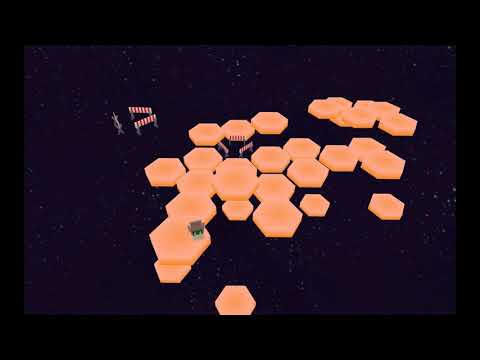
Among Stars and Robots is our third Ludum Dare-entry together but we have been working on games together for almost a decade now. We decided from the start that we wanted to target a WebGL build that would work on as many devices as possible, which meant we had to go low poly and simple materials only. This would also let us bang out a lot of varied content in a short time.
As usual we spent the days leading up to the start brainstorming ideas for the various themes that were up for voting in the last round, only to scrap all of them the moment the final theme was revealed. We quickly settled on the idea of programming a robot with a looping set of instructions. After dividing out some tasks we both went to bed to get to work early the next morning. If there’s one thing we’ve learned over the years is to eat, sleep and shower for a more enjoyable and productive game jam experience.

What went well?
We are very happy with the end result of this jam. The development process went smoothly without either team member feeling blocked by the other at any time. The first thing we made was a custom level editor inside of Unity. Any waiting time could then be spent brainstorming new levels or iterating on existing ones using this editor.
The biggest contributor to the end result was probably our planning process the first night where we mapped out a Minimum Viable Product and having a strongly established art style to adhere to which really helped us stay focused and keep the scope of the game down.
The code this time around was relatively simple, there are no animations other than simple tweens and no (significant) custom shader magic going on. Instead we focused on making the core mechanic interesting and the presentation really juicy. This is why we put a lot of focus on the level transitions for extra visual flair which from the feedback we got has been one of the most appreciated aspects of the game.
Trying to learn our lesson from our last attempt at Ludum Dare (Pull the Levers from LD46) where a lot of people struggled due to the lack of a tutorial, this time we tried to add better tutorialization in the form of three introduction levels and a simple animation in the first level to explain the controls, as well as an infographic on the itch page. But, as it turns out, this still wasn’t enough.

What went bad?
As mentioned above, the tutorials didn’t manage to help players all the way to success. The first problem was the detector command which is introduced in the third tutorial level. This command is significantly different from other two commands previously introduced (turn and move forward) which are both very simple to understand. Players initially tended to dismiss the detector command as something that would not be needed to complete the level. The level was then solved either by trial and error or by consulting the included infographic. In conclusion, this command definitely required much stronger in-game tutorialization.
The second problem was our difficulty curve. Once players got past the tutorial they were introduced to the hub world. The idea was that the initial position and view direction of the player would guide them to the easier levels but this didn’t work because first and foremost, we messed up the actual ordering of the levels. Second, players did not seem to care and just went to whatever level caught their interest. Many did not even realize they were in a level select world. Luckily we implemented a home button that would let players return to the level select without completing the level so if they got stuck they could try another one instead. The level select definitely needs some kind of indicator for how hard each level is so players can progress in a more logical manner without getting frustrated.

The third problem was some simple but very important UX features we failed to implement. Between levels there is a variable amount of commands allowed in the player’s loop but there is no indicator of that, so many players thought it was the same for all levels and got stuck on the ones that required more commands than normal. The other problem is that you can change the loop while it is running, but changes do not apply until you click stop and start again. Many players tried to change the loop and got confused why the robot kept repeating old commands. Both of these are easily solved and with hindsight it’s obvious that we should have prioritized it a bit more. Fixing these problems solves a lot of headache for the players.
Another mistake we made was including too many patrolling police robots in our levels. Just like the player, the police bots execute commands of their own, but there is no real way of telling which commands they execute. As a result their behavior is very hard to predict and forces the player to resort to trial and error in order to beat the level, which is not something you want in a puzzle game.

What next?
So what’s next for Among Stars and Robots and what lessons should we take with us? There’s definitely a point to be made that we need to work even more on our sense for difficulty scaling and progression. There’s a clear improvement just looking at our Ludum entries where our latest game is by far the best in terms of difficulty and tutorialization but there’s still a lot left to do.
Had we done more testing with someone outside the team before release we probably would have been able to catch those few UX problems and prioritize them so that’s definitely something we will look at in the future.
As for what else lies in store in the future we will see. We are both overwhelmed with the positive response we have gotten so far and the game feels like it could turn into a really fun full game so it’s definitely on the table to make a full production game out of it.
We hope you enjoyed reading this post-mortem about some of our experiences from this jam, if you want to try our game check it out below and let us know in the comments of some of your own ups and downs from this event!
https://ldjam.com/events/ludum-dare/47/among-stars-and-robots

 Most of the gameplay loop is in, just need to flesh out some more content. First time making somewhat of a puzzle game so will be interesting to see how my puzzle designing goes.