LD26 April 26–29, 2013

HUGE POST MORTEM PICTURES

Sorry for the size of them. I just wanted to do another post mortem in comic form (sometimes I  just skip the whole Ludum Dare and just make the comic :) see  the real world).

Anyway, here are my thoughts about LD26:

post mortem part 1

post mortem part 2

And if the comic wasn’t clear, here is the subtext:

Things that went right:

Positive attitude: I decided that there could be nothing wrong with the theme. The problem would be me. So I just had to be positive, so when my least favorite  theme was chosen I didn’t despair but relaxed and just accepted any idea  that would or would not come.

Music: I made music for the previous Mini Ludum, but those were on the spot unedited improvisations. This time I had three (!) tracks made in Reaper and even did two retakes on the guitar (and used my C64!).  And having a premade playlist with energizing music helped as well.

No compromise: I had some OK ideas that were very doable in 48 hours, but I went for the idea that looked undoable but made me go ‘YEAH!!’.   I also wanted some cartoons as  intro and ending(s) so there would be a story and I planned time for that.

I was MAD! This idea (of the gamer having to program his entities who then went on their way)  was in my mind for a year but felt to big to do. Now I have something that (sort of) works in 72 hours! I can  expand on this.

I made a last minute change to go with FlashPunk so I had no hassle with the graphical side.

Things that went left:

No preparation.  I decided to use Flash CS6 and FlashDevelop together but at some point I couldn’t get my program to compile anymore, some weird Java Error. Luckily after a lot of  searching I found a workaround, but it cost me a lot of time.  And I still don’t have a solution.

Having a game where a GUI is important. I have almost no experience with making a GUI and the result was terrible. The biggest thing to fix in a post compo.

Butt ugly in-game-graphics. I always thought ‘I can make cartoons so I can do graphics’, but I really need practice (or a team member) to make a game look good.

No planning, no idea how far I was.  It just was a mad dash forward and after the deadline I found out that some key features did not work right at all.

The game is hard to win or lose, so I expect hardly anybody to see the endings.

Conclusion

I don’t think I will be high on any category but for myself this was the  Ludum Dare that gave me the most satisfaction: I’m still in a wonderful afterglow (or is that sunburn?).

Now back to playing all those games that look so much better than mine ;-)

http://www.ludumdare.com/compo/ludum-dare-26/?action=preview&uid=14225


11

This entry was posted on Wednesday, May 1st, 2013 at 11:24 am and is filed under LD #26. You can follow any responses to this entry through the RSS 2.0 feed. You can leave a response, or trackback from your own site.

Highlights So Far

I have now rated ~1/20 of all the games in the Ludum Dare (112). People are starting to ask for highlights, so here are some. I’ve tried to go for a variety of interesting things here, rather than a list of what I think is objectively best.

MATAR!

OK, let’s just get this one over with. It’s dumb, but I laugh every time I play it. I promise that my other mentions will be less silly.

Seed

Seed is a very interesting action/puzzle game that requires you to manage your view of the top and bottom screens. It has a great atmosphere and a novel mechanic. It also looks fantastic.

Hidden Squares

This puzzle game is basically impossible. It is, however, undeniably cool. It’s a lot of fun to just play around with.

Tinge

Tinge is a nice place to be for a little while. No more, no less.

O.R.M.

A brilliant little strategy/arcade game. Play it once to understand how it works, and you will see that it is a work of extreme cleverness. I still don’t see what it has to do with ontology however.

The Epicly Short Adventure

For sheer polish and mechanical entertainment, this one is hard to beat. Also, Bioshock.

Werewolf In Space

Do you like game theory? It will be very helpful in this very tiny but curious game. I advise that you play it a few times!

Triage: The Life of a Combat Medic

My colourblindess rather precludes me from this one, but it alludes to some great concepts in story/narrative.

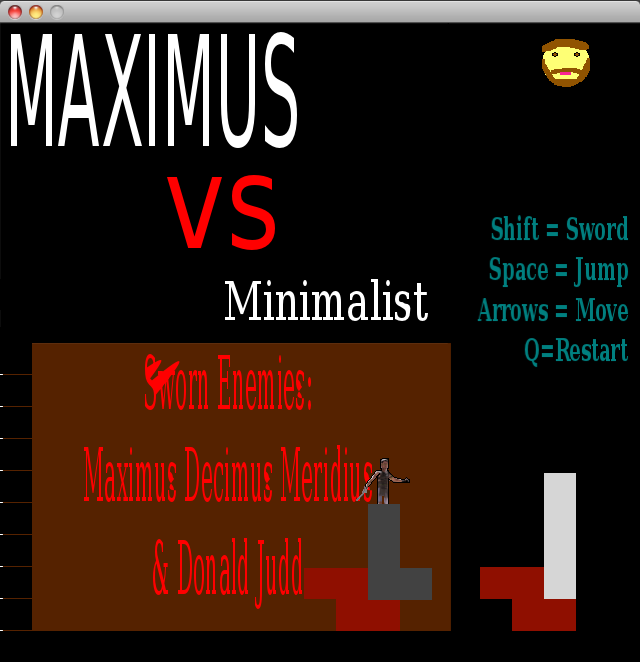
Maximus Minimalist

I lied. This one is silly too.


I played many other interesting games, but the more I list the less likely people are to play them. So I’ll stop. For now.

Mustache Armies – Artworks.

Hi, my nickname is Sephy.
I’m a French 2D designer – you can see my work on my website.

I joined the TurboDindon team for the 26th Ludum Dare. It was a very great experience, I love my teammates.

We finished our game ‘MUSTACHE ARMIES‘.

Feel free to play, share and rate for us!
http://www.ludumdare.com/compo/ludum-dare-26/?action=preview&uid=5611

(My personal record is finish the map using 10 unities)

You can discover below a few graphic researches, artworks and assets I’ve designed. My mate Raz did other graphics as main unities, backgrounds and logo. Graphics have been inspired by minimalist paintings and shapes. Not everything has been implemented.

Mustache Armies - Artwork

I hope you’ll like it.

Sorry for my bad English.

Tags: artwork, assets, game, Ludum Dare 26, map, robot, Shoot, tank, vector

Comments

bakudas
01. May 2013 · 23:14 UTC
awesome!
mclax2
26. Sep 2013 · 09:51 UTC
а как её скачать

A live-streamer improved my entry… live!

zmore

Ludum Darer JellyCakes has been live streaming his playing-and-rating efforts of entries in Ludum Dare 26. He’s an excellent reviewer: testing each game very thoroughly and fairly. And he’s hilarious. After giving my entry a good run through its paces he concluded with a crazy live mashup: LMFAO vs My game’s laser gun!. Might not fit the theme of “minimalism”, but dang… it’s awesome!

For Unity users: Stop using the standard Character Controller!

Hello there everyone, it has been a very good Ludum Dare. But the only thing I was disappointed about is the amount of people that use the First Person Character Controller prefab from Unity’s Standard Assets. So, I’ve listed some reasons why you should not use it.

Evilness at its best.

At LD #25 YOU were the villain. Now THIS is the villain!

1. Standard MouseLook is buggy and horrible.

The standart MouseLook script is terrible and should not be used. First, it is imprecise. For some reason, a minor movement makes a glitchy hop to another direction, I don’t really know why. Also, the standardsensibility is too great. Sensibility should be configurable by the player.


2. Your player cannot be a physical object.

With the standardCharacter Controller, you are not a physical object. If you add a rigidbody component to it, things get buggy. It’s no use. The movement script makes the physics by itself, and the physics are unrealistic. The acceleration is off and I don’t even know what else. Try adding force to yourself, it is impossible since you are not a physical object.


3. You don’t do the scripts.

So, how can you adjust anything on the scripts that come with it if you don’t know how they were done and why they were done that way? The answer is simple: you don’t. Make your own first person walking and MouseLook script, it’s easier than you think, you’ll learn a lot about scripting and you will actually understand what’s going on, you will be able to tune the movement in the way you like it.


So, do your own basic scripts, it is good for you. If you have trouble with that, check out my Movement.js and Mouselook.js scripts  (they are not perfect) and take a look at RigidbodyFPSWalker. And good luck!

Minimal Complexity – Post Mortem

Ideas

I knew from the start that no matter what the theme was I was going to create a simple clone of the game I’m currently working on. This is obviously not the spirit of the competition, but I really wanted to see how people responded to the basics of my game, since I only have the gameplay systems in place but no design yet (i.e. there is no win/lose condition, no goals, no story, no graphics, …). This is the current version of the game and displays what I thought to be a very interesting system:

Basically, you can create new weapons/attacks by combining the most basic elements that make up an attack. So, in the case of the video above, the two basic elements are projectiles and areas. Projectiles can deal damage, fork (vertically or horizontally), pierce through enemies, reflect on walls, slow enemies, and so on… Areas can deal damage, slow enemies, explode, …. If you combine an area with a projectile, the area will be bound to the projectile’s position (or if it has an explosion modifier, then the area will explode once the projectile comes in contact with an enemy or a wall) and they will both apply their modifiers separately. The main idea is that you can combine all modifiers between projectiles and areas to create new and amazing attacks. Since I really like the idea of combining things, naturally I thought that this would make a great feature in whatever game I created. I’m not sure if I’m entirely wrong or not, but the competition helped me explore some of the issues with it.

Execution

In the first 24 hours I got most of the combinations working with only a few bugs left. I devoted the second day entirely to creating the actual game rules, additional touches and fixing bugs. The rules of the game were simple (or so I thought): you can create whatever weapon you want by combining different modifiers; each modifier has a cost, such that if you go for the most OP weapon ever it will cost you more; the more your weapon costs the bigger your score gets over time; the goal is to kill all enemies while maintaining the lowest score possible.

Back then I should have realized that if it took this many words to explain the basics of the game, it probably was too complicated. But I didn’t. Anyway, I managed to implement this whole deal and this is what the upgrade screen looked like (you can also see the game on the background):

What Went Wrong

The game was too complicated. Usually games have scores that are one layer removed from the things that happen in the game: if you kill an enemy and your score goes up, there’s one level/layer between game action and score number. Ideally you want your game to have no such layers at all as the player should experience the rewards and punishments directly, not through a point system. My game had a three layers deep score system (weapon cost leads to higher score increase rate leads to higher score)! With so much abstraction it’s not a surprise people didn’t understand it!

On top of not being intuitive, I didn’t spend much effort into easing the player into the game. I pretty much said: “here, take all these and have fun!”. A better approach would have been to have the player unlock different modifiers as enemies are killed, or have the player start with all modifiers possible and gradually remove them (which would be really on theme). There are a number of other ideas that would have worked better than just giving the player everything and letting him decide what he should use or not.

Technically, the game was too complicated for two days. While I managed to make it work, I should have had more time to polish it. Adding some neat shaders, playtesting, maybe trying for a better graphical presentation? I don’t know, I just felt like it would have been better if I spent less time working on the gameplay system and more time polishing. 50/50 for each is definitely not the way to go, I think.

The game looks bad. Again, I’m not an artist (at this point I’m feeling like I should spend some time learning how2pixelart) so I’m relying on squares. Many people can make it work. I’ve played lots of great games that also use only basic shapes (especially this LD, given the theme), but somehow I just don’t have the skills to do it like them… I need to work a lot more on my presentation!

While I was more prepared than in the last LD, I should have prepared even more this time. A lot of the first day was spent building a system that I could have build in half (or maybe less) the time. Since I decided to use box2d I spent a lot of time rewriting some wrappers and basic box2d stuff. I should just really make all this into a library somehow. I also didn’t really have a way of making music. Luckily, I was watching quill18’s stream and saw him do it, so I just copied it. He used atrk-bu.py + SchismTracker. I also didn’t read my previous “What Went Wrong” list beforehand. I repeated some of the same mistakes because of that.

What Went Right

I managed to finish the game as I had it in my mind. Again, lists worked to great effect. Although this isn’t that remarkable at this point, since I can probably, technically, finish a lot of 2D games I can think of in 48 hours. The problem lies in polishing and on game design. It’s hard because it’s super highly impossible to remove yourself from being a creator and putting yourself on the player shoes. You can’t possibly realize if something is gonna work or not unless you have some experience.

On that note, I also learned a lot of lessons! I explored some paths and failed, but I definitely have more experience now. Which leads me to…

Lessons Learned

If your game can’t be explained in a simple sentence, there’s *probably* something wrong. It doesn’t mean that it won’t work, it just means that it could be simpler. Also, people won’t read text. Don’t expect them to.

Presentation matters a lot. People will not feel compelled to play your game if the presentation isn’t amazing. This sounds obvious when I say it but it’s easy to forget. You’ve worked so hard on all aspects of your game that sometimes presentation feels secondary, but it is one of the most important things you can focus on. Don’t forget it!

Fail often. Suddenly the advice from Edmund McMillen in the video below makes so much sense. Only through failure you’ll have enough experience to know what works and what doesn’t. This further increases the value of things like One Game A Month and Ludum Dare itself. Make lots of games so you can learn a lot!

Community

The LD community is usually super fair and nice about their comments. I’ve mentioned previously how sometimes it gets too nice (i.e. feedback isn’t really feedback, it’s just people saying what they liked about your game, even though they may have disliked way more things), but there’s nothing I can do about this. Most people do try to give valuable feedback so it’s not so bad.

The one issue I’ve noticed on this particular LD was the cheer number of people who simply didn’t understand what they were supposed to do in a game. I’ve mentioned in the previous section how people don’t read text. That’s okay, sometimes I don’t really read text either and just jump in to try to play the game. But some games are really simple to understand and still a lot of people don’t seem to get it. A great example of this is 0 by Cosmologicon, which had this exchange in its comments section:

I’m really surprised that game developers have this much trouble understanding some simple games. I can’t really imagine what it’s like to release a game for real for thousands of people, only to have a huge number of them simply not get what they’re supposed to do. And it’s really annoying to play games that hold your hand too much too. So I guess, again, it’s a matter of experience in knowing how much should be explained and how much should be left as exploration to the player.

Conclusion

This was a great experience. I certainly learned a lot of stuff and took from this LD way more than from the previous one. If there’s one thing I should remember is that I should release more games. Of course, I’m just not gonna release some shitty games just because, but it helps to set deadlines (say, 2 months) so you have to experience having to cut stuff and having to work with what you have. Hopefully I’ll have more experience and I’ll be more prepared for the next one! See you there! Or not, I mean, any one of us could die at any point… That would certainly decrease our game making abilities.

Ludum Legacy – All 2347 Games, Tweeted One Per Hour

Just a quick post to let Ludum Dare raters and reviewers know about Ludum Legacy, a twitter bot set up to post one LD48 game every hour. There are so many games, this takes us into August – the time of the next Ludum Dare!

Follow Ludum Legacy here!

Well done for a great LD as usual. See you in August

Tags: Ludum Dare, twitter

Comments

01. May 2013 · 13:52 UTC
Great idea! And illustrates just how impractical it is for one person to attempt to rate every game. (I’m not saying impossible, just impractical)

Standalone builds are here!

Super Rope Dungeon
Super Rope Dungeon just got standalone builds (Windows/Mac/Linux) for people who couldn’t play in the browser or just want more immersive experience!

Grab it here!
Or watch the video:

Nova Jump Playthrough

Okay, I’ll admit it Nova Jump is pretty difficult, as I set out to pass Nova Jump without dying… and fail miserably…


Play Now

Equilibria – Post Mortem

So here is my Post Mortem for Equilibria. which can be found at my entries page here. As this was my first LD I am quite satisfied with the outcome: I finished in time and most of my ‘I like to have it in’-stuff actually made it in the game. Unfortunately a few things were left out and got scrapped during the last few hours.

The Developent Process (iteration one)

Got up at 6 AM, saw the theme and tried to come up with some good idea. As minimalism was actually one of my least favorite themes during the voting process, I knew that it was not going to be an easy task for me. After a few cups of coffee, my first concept was to interprete minimalism in terms of ‘reduce to the bare minimum’ and apply this to the sensual information of the game itself – namely color and music. The phrase that stuck in my head was something like “the empty screen is the goal” thus making the reduction process the actual gameplay: the player would start with some sort of chaotic sound and color system which he would have to tune down by neutralising sounds and colors, leaving only one color and one sound at the end.

Exploring the first concept

Some brainstorming and exploration of the first concept which turned out to be either not fun at all or overly complicated. And yes, the litte colored dots are M&Ms…

As nicely this idea was in my head, as difficult it turned out to be to actually make a game concept out of it. At first I tried toying around with a puzzle-like game where you would have to throw color and sound particles at corresponding boxes to make them explode, thus removing more and more color and sounds from the game screen. But as the hours passed I did not see any progress so I scrapped this idea, make some more coffee and started fresh – at about 1:00 PM.

The Developent Process (iteration two)

The next idea was based on a different interpretation of ‘minimalism’: I thought of ‘minimalism’ as somehow describing the entropy of the game world. Going back to my earlier “the white screen is the goal” idea, this would mean that all color is somehow equally distributed. I then started toying around with the ideas of dual and opposing concepts like ‘light’ and ‘dark’, ‘black’ and ‘white’, ‘night’ and ‘day’ and especially ‘low energy’ and ‘high energy’ and pretty quickly came up with the concept for Equilibria. I wanted a game where the player had to maintain some kind of energy balance, originally I wanted to make the game into more of a zen-like experience, but it somehow got a life of its own and soon I had enemies added and some energy transfer laser beam. So now I had a concept at about 3PM on the first day.

The Implementation Phase

From that point the whole thing mostly boiled down to a ‘how fast can I get everything that´s in my head into code, sounds and graphics”. As I was using libgdx as game the underlaying development library and artemis (entity component system) as a coding paradigm it went pretty smooth at first. I did not have too much experience with both, so a good portion of the time I spent ‘learning by doing’ thus browsing for tutorials and investigating unexpected behaviors. Many hours were dedicated to ‘why does this stuff not show up on my screen’-related problems. Note: camera transformations are a *** in the *** – especially at Saturday at 3 AM in the morning.

Map import, textures and raycasting

Left: first working map import where for each tile I managed to create a physics body in Box2D. Middle: simple textures assigned to physical objects. Right: experiments with raycasting for later usage with the laser beam

Graphics:

As I wanted to keep the graphics simple, I did not spend too many time on it. I designed a tileset for the level with OmniGraffle (great tool for making vector graphics on a mac) but in the end did not use it as for the antialiasing made the whole stuff look really ugly. So I just used simple white squares as building blocks for the level. As for the additional eyecandy I spent approximately 2 hours designing the particle effects and writing my own particle-creating and -rendering code which went surprisingly well. I had a little bit too much fun toying around with the particles in the end, but well… particles… particles everywhere… wheeeeeee!

Music and Sound:

I started pretty late on these, guess it was about 9 PM on Sunday. I used SunVox and sfxr. As for the music I aimed for a simple and melancholic theme which I think went pretty well. Before the LD I thought about using real-world-instruments to spice the computer generated stuff up a little, but as I did not have enough time left to comfortly start this workflow, I kept it to the artificial instruments. As for the sound effects I at first tried to use sfxr but the results were too ‘comic’ like and I did not find them fitting so I created the laser and collision sounds in SunVox as well.

Last few hours:

I spent the last hours refining the game flow, adding a title and a instructions screen, creating some winning condition and test everything. Had a last-hour problem as my Screen transitions started to get messed up after two consecutive games. Bugfixing took far too long due a bad mix of sleep-deprivation and to much caffeeine.

Tools of the trade:

libgdx, artemis, Box2D, OmniGraffle, tiled, SunVox, sfxr and way too many cups of coffee

What went right:

  • Using libgdx, a library I had never really worked with before was a risk but it turned out to having been a good idea. It is very powerful and can speed up your development process rapidly. Only downside is, that some parts are not very well documented.
  • First time I used physics in a game (Box2d) as well – something I wanted to do for years and now finally did. Yey!
  • For the most part I managed to keep my code clean and well structured. Only at the end some – maybe inevitable – ugly parts got in. But mostly I am satisfied with the result code-wise.
  • Lesson learned: entity component systems are great when developing games. First time using one and its amazing.
  • It is unbelievable how much is actually possible in such a short time, some kind of lesson learned here too.

What went wrong:

  • It took far too much time for me to come up with an idea and a working game concept. I think the time I used in developing and thinking about the first concept had better been put to polishing the actual game. I have to improve here in terms of being more quick in throwing away an idea if it does not work.
  • I started too late thinking about a winning condition. I had a rough draft of the mechanics of ‘transferring energy’ but did not think it through in terms of  “what happens when enemies are overcharged? What happens when they are absorbed?”. Next time I have to force myself to really think this trough before, and not in the last hours.
  • Actually I wanted to use some fancy lighting using Box2dLights but did not manage to get it running in time.
  • Some gameplay mechanics and cool ideas had to be scrapped in order to get everything finished in time.

Summary:

Overall for me it was a challenging, inspiring and absolutely great experience!

So if you have not yet tried my game, I would be glad if you do. It can be found at my entries page. And please feel free to leave a comment. Looking forward to hear your opinions :).


Ninja Instinct – Post Mortem

Because a lot of people have done a post mortem of their game, I decided to do mine.

Screen02

First what is Ninja Instinct ?

It’s my first game in Ludum Dare compo. I’ve already done Ayond a long time ago in an old Ludum Dare jam. Ninja Instinct is a simple plateform game were every thing is made of black cube. The only way to finish the game is to guess the level intention or just remember where you failed. To help you, can throw shuriken, the sound of the impactcan give you clues on the danger of an object.

The tool I used :

Gimp 2 and Construct 2

What went right ?

The engine: I’ve made the game with Construct 2, I didn’t use it at all before. I was amazed on how simple and how fast you can create something. It allowed me to make something good with the time I had, and export it to HTML5.

The idea: You can think it’s a bad or a good idea for a game to make everything look the same, but it saves you a lot of time with the graphics. I just had to do a little Ninja on Gimp 2, and every thing else was just sprites done directly in the engine.

What went wrong ?

The time: I was pretty busy this week end, so I had to make a very very simple game and I couldn’t make a lot of content.

What I failed to ?

To exploit the idea: I tried to make a lot of different situations but I think I could add a lot of other thing, like NPCs and different kind of ennemies. I also wanted at the end to make the game only with shadow play, but it was too late.

What’s next ?

Probably make a 2.0 vers: At the beginning I thought my game was poor and the idea sucks, but with all the comment I had, I think the concept of the game need a second thought. Maybe if people are really interested, I can make a new version with more ideas, more content and better graphics.

For the next Ludum Dare ?

I will try to find a team, because “It’s dangerous to go alone !” and have all the time I want.


Links:

Ninja Instinct: http://www.ludumdare.com/compo/ludum-dare-26/?action=preview&uid=12650

For the one interested, my old LD jam, Ayondhttp://www.ludumdare.com/compo/ludum-dare-23/?action=preview&uid=10934

Edit!!!

Hi,
now are available the IOS and the Linux Version of SUMOMiMAL.

Enjoy.


sumomimal_screenshoot2

Rainworks – Late LD48 Entry

Sometimes life kicks you while you’re down, and sadly I was caught up during the LD48 weekend. So I spent the last two days putting my original idea together.

Rainworks is a simple water-physics type puzzler with a happy theme to it, while trying to stay true to the minimalist theme. Inspired by wanting to make something happy after the Boston incident to inject a little joy back into my life.

You can play it here: http://dreamwinter.net/dev/rainworks/ 

I plan on updating it to 30+ levels, including  a level selector, adding some new mechanics,  and making some tweaks.


Out Of Light Post Mortem.

ClosingScreen

Well, I made my second entry to Ludum Dare. Now is the time to deconstruct it and say what went well, what didn’t and generate some points to learn from the whole experience.

What went well?
I finished. Got to be an important one. I kept the game simple, I didn’t let the feature creep set in.
I learnt from previous mistakes. Last LD, I tried to use LWJGL, which I wasn’t and still am not comfortable in, this was a BAD idea, trying to learn a library, especially one as complex as openGL and do a game jam at the same time, don’t mix too well. This time I used Slick2D, which I have become very familiar with.

I was happy with the rough, blocky lighting effect I created for the game, I was really happy that I could cast shadows using ray casting. I was happy with the level from bitmap, loading technique.


What would I change?
Well, for starters, I would more than likely, change the zombies, to allow diagonal movement in their path finding. I would probably have added more sound effects for the zombies, because the repetition of the same sound effect, became a little annoying. I would also have added a sound for the potato and health pickups. I may have increased the light radius, decreased the drop of ammo and increased the potato drop, because I think, the drop rates were a bit off at times. If I’d of had more time I may of added some way of finding where they key to the next safe room was without having to search all the really dark rooms, because I think some people might have found that a bit tedious!

Points to think about:

-Keep it simple
-Don’t browse youtube so much!
-Get the Ludum Dare weekend off work if possible.

Thanks to everyone who has already played my game and rated and commented. Anyone who wants to give it a go, it can be found here:
http://www.ludumdare.com/compo/ludum-dare-26/?action=preview&uid=17911


Building a Better GIF

I’ve recently become interested in creating animated GIF screenshots of my games. I was having a few issues with both file size and image artifacts. Here’s what I learned about how to make better animated gifs for when you want to put in a little more effort to make it look as good as possible.

  • Even if the camera normally moves it should be locked in a stationary position for the GIF, this will greatly reduce file size.
  • Record the video using FRAPS with frame rate set to 60 or 30 and set to Lock framerate while recording.
  • Open the video in VirtualDub.
  • Select Video / Frame Rate  and in the box for Convert to fps enter “30” if you had recorded it at 60.
  • Instead of exporting it for Virtual Dub as a GIF, export as an image sequence.
  • In Gimp use File / Open as Layers then select all the images.
  • Scale the image to the desired size.
  • Select Filters / Animation / Optimize (for GIF)
  • Export as a GIF and set the delay between frames to 33.

Here is the same video exported from virtual dub as an animated gif versus the more complicated method. As you can see there is much less flickering and banding issues in the second image for about an extra 50% increase in file size.

Exported as a GIF

Using the improved method

QTris – All after

I didn’t really knew that I will participate this year at all :D. Anyway, got bored and picked up my phone to give it a try (since my parents are pretty aganist coding 48hs next to computer lol).

This year theme was Minimalism. “Hm… it sounds a bit like all the Win8 and Metro stuff. That’s flat design…” – I thought. Cuz I do love 8bit things, decided to make a Metro-like Tetris. As you can see from the result, it went more pixel style, and that’s fine. My IDE of choice was AIDE, not because I specially like it, but since no other usable exists on Android. All the stuff looks like this:

QTris in AIDE

QTris in AIDE

So I just launched the IDE and loaded sample Tetris app (yeah, bended the rule – that’s why it’s in Jam, not 48h compo). Since it was 3D-looklike, I’ve opened Pixel Paint and edited it a bit:

QTris - Graphics #3

QTris – Graphics in Pixel Paint

I have crafted an icon, too:

QTris icon

QTris icon

After some tweakings, adding music and debugging (with alot of bugs still present), it finally went in roughly 3 hours into this:

QTris Screenshoot

QTris in action! Yay!


Well, that’s my first time LDing, so I think it has went quite good. Next time I’m gonna start on time (not 5hrs to end) and do my best.

See you next LD!

Mono Post-mortem

BACKGROUND

4

Mono is a puzzle platformer about a colorless mime who wanted to keep the world minimal. Collect all the colored cubes to help Mr. Mime remove all the colors in the world and make it monochromatic.

Play it here: http://www.ludumdare.com/compo/ludum-dare-26/?action=preview&uid=21974

I worked on the programming and level design, while my friend Dave made the art. I made an “I’m In” post for the tools we used. Also, we were miles apart during the event, so we had to talk and send files and do everything online.

STORY

I am a big fan of minimalist digital art and typography, especially those minimalist movie posters thing.  So when the theme minimalism came out, I was like HOLY FUCK YES THIS IS GONNA BE EASY!!! Only, a few moments later, I thought well making minimalist typography posters and stuff is easy, but we’re not making freaking posters here, we’re making a video game.

I spent a few hours thinking for a minimalist game idea. My girlfriend and I spent the whole afternoon on a coffee shop just brainstorming. I figured, well we could take a common video game, like a shmup or an infinite runner, and just use minimal graphics such as geometric shapes. But I didn’t want that. I wanted a game about minimalism, not a game that has minimalist graphics.

a

We couldn’t meet up for the event, so I had to send this image to explain the game idea.

Finally, I came up with an idea about taking out colors from a world, or like turning the world grayscale/black and white. I told Dave about this and he replied, “Hey what if our main character is a mime, like that one episode in The Powerpuff Girls.” Yes! That was exactly what I thought. That moment was a bit awkward though, you know, watching a lot of Powerpuff Girls episodes and all. Hahaha 😛 Anyway, so we started. Except that was already about 14 hours past the theme announcement.

Day 1 – Core mechanics. I was able to make a basic platformer as well as our color thing mechanism in less than a few hours. Also, I had a couple ideas for levels. The mime sprite was ready as well.

Day 2 – I spent some hours on fixing the buggy collision, but got no luck. I didn’t want to keep working on something difficult for a long time, so I just went on to do something else – level design. I had to learn how to use Tiled and how to integrate it to Slick2D. The Tiled wiki was great though along with some online tutorials. Mime animations were also ready. About 75% done now. So far so good except for the collision.

Day 3 – I still couldn’t fix the collision problem so I thought, to hell with it. I also added a monster to the game, which resulted to more interesting levels. Polishing, sound effects, main menus, tileset sprites, more levels and Mono was finished 3 hours before the Jam deadline.

asd

Evolution of Mono

THE BAD

  1. I had no experience with making a platformer before, and I had no time to learn and apply a physics engine, so I just made a really really simple jump mechanism. It looked bad, but hey it works.
  2. The collision is very inaccurate which ruins some levels. I also didn’t have time to fix it.
  3. No music :(
  4. Time. 10+ hours could have been enough time to solve # 1, 2 and 3.

THE GOOD

  1. A lot of players loved the gameplay. The take-out-the-colored-blocks concept worked well and allowed for some interesting level designs which I didn’t really expect at first. Although this was my first time designing levels, I was able to make 10 puzzly ones.
  2. Sprites and animations, especially the mime, looked great and minimal at the same time. Also, the levels with 3+ colors looked nice.
  3. Though I had to learn Tiled map editor during the event, it helped so much with level design. It also worked perfectly with Slick2D.
  4. We finished it! That alone is a really really huge achievement + bragging right for us. 😀

This is our first time joining Ludum Dare and it has been a wonderful and fun experience for us. We surely are not going to miss LD27!

Get Rid of Shit! – Post mortem

So this was my third time entering Ludum Dare, but only my second entry.

Get Rid of Shit!

In the game, salesmen will come to your house and place shit you don’t need. So you need to get rid of it before the shit starts stacking.


GOOD

– I manage for the first time make a game under 48 hours.

– Learned Haxe.


BAD

– Time, I planned something else but I got distracted with stuff around me.

– Programmers art..


Short and sweet 😉

Now keep playing games and rate!

Tags: haXe, LD#26, post-mortem

Comments

TijmenTio
01. May 2013 · 16:18 UTC
If you want to get better at making graphics, there are tons of pixelart tutorials on the internet! 😉

Speedrun of MinimizeArt

I uploaded a speedrun of my game: MinimizeArt. This might help some of you who were having trouble. You can find the entry here. Also, don’t forget to watch the Timelapse.