TIMELAPSE!
Well, that took way longer than i thought it would to upload, but here it is, my timelapse!
https://www.youtube.com/watch?v=Ifvk_MK5Hhs
Well, that took way longer than i thought it would to upload, but here it is, my timelapse!
https://www.youtube.com/watch?v=Ifvk_MK5Hhs
WOWZ, I made a timelapse…..
10 hours (give or take) making this game. WOO!
If you’re stuck on a specific level or just want to see what Shattered Worlds is about, we’ve put together a trailer and playthrough video that will help:

Has your interest been piqued? Then check out Shattered Worlds, a puzzle platformer with a twist. All feedback is much appreciated.
You could only carve and inventory was hidden, it is the case no longer.
http://www.ludumdare.com/compo/ludum-dare-30/?action=preview&uid=37031

At the beginning of the day, the team had advanced work at home so we had a lot of ideas and we debate and share them.Once it was quite established, we returned to work in an individual way. Silverio, with Estanislao, fulfilled a merge to unify changes. Estanislao corrected mistakes of the code and added the sound controller. The illustrator, Francisco, began to realize all the drawings to computer with the graphical tablet; and Carlota dealt with the whole part of communication and continued with the diary of Binnacle.


Warmageddon is a simple RTS with two camps: God or the Devil; the way the game was made I expected most of the victory to be on the Devil side (if you are to try the game alone, you are going to play the devil). To get a bit of data back, I implemented some basic google analytics and the results are surprising me :
Yup, God is winning one third of a time, even though he is much less played! That means that there is more people playing it 2 players than I hoped, and I wish to thank you all for that!
Now, why not try it and rate it?

Images that moves!

This was my first Ludum Dare after having watched many from the last two years from the sidelines. I finally felt like I had a solid weekend to concentrate on my entry, so it was go time. I am mostly happy with what I finished with, but I thought I’d write up a post-mortem to detail everything and, of course, get some more exposure for my game.
Language:I love JavaScript and am glad I went with HTML5 and JavaScript for my entry. Honestly, I don’t know what else I would have used anyway. I have a little bit of Unity experience, but not with their 2D stuff and I didn’t want to spend time learning that.
Libraries (Processing.js): I have a lot/hate relationship with processing.js. I was introduced to it on Khan Academy in their CS area and liked the wrapper around the Canvas API that makes it easier to work with. Begin able to quick draw rectangles, text, etc makes prototyping any type of grid-based game a breeze. However, processing.js has some limitations and I ran into issues with needing to clip the single image I had for tiles to paint a single tile. I ended up using raw canvas commands to do that, which is frustrating. That said, if you haven’t messed around with processing.js, I’d recommend heading over to Khan Academy and running through their tutorials. It’s pretty decent.
Sound (jfxr): I have loved playing with bfxr over the years and jfxr is, in my mind, even better. I only wish it exported directly to mp3 or ogg. I also wish I would have listened my audio on regular speakers. I used my headphones the entire time and didn’t realize how low the sound really is in the frequency range. Played on crappy laptop speakers, they sound pretty harsh. I also wish I would have had time for music. I think music adds a lot to games.
Graphics: I’m glad I spent a little bit of time on these. I could’ve just done something using processing.js and shapes, but spending the extra time on actual sprites is much better. They’re not going to win any awards, but they’ve renewed an interest in pixel art I used to have and never explored. That alone makes it worth doing them.
Programming: I’m mostly happy with my code and structure. I could expanded on the OOP some more with a tile class, but because none of the tiles really varied from each other too much I didn’t find it necessary. I’m sure I’m polluting the global namespace too much as well, but I can live with it for what it is. The main challenge I had was collision detection. It wasn’t until the end that I looked up how to do proper box/box collision, but I should’ve done that from the start. Instead I just measured left/right and up/down from the player’s center point, but only in one direction at a time. So, you can be high enough over a tile so that your pivot point doesn’t touch it and it’ll let you move left/right into the tile even though you’re x value is inside it. Ah well, what are you going to do? I suppose in the end this comes down to doing research early on and getting the core mechanics working properly before you start fleshing out the bells and whistles.
Time: This really bit me in the butt. I had set aside the weekend for the comp, but life happens and I didn’t get to focus on the comp as much as I had planned. I pretty much worked until Saturday morning around 7am EST and didn’t get to jump back on until 12AM EST Sunday morning. I ended up spending the whole day Saturday with friends and family, which is great of course, but I should have managed that time a little better. In the end, if I had another 3 or 4 hours I would’ve been able to get in 5 more levels which is what I really wanted. Instead, I wound up with 5, 3 of which are tutorial levels so the game is very, very short.
Summary: All in all, I had a great experience and I am looking forward to the next Ludum Dare. In addition, I’ve been continuing to work on the game after the competition. Below are before/after pictures of a single level. Here is hoping I can keep this momentum going turn this into a full game. 


after two team entries (LD28 and LD29 with LeafThief whose great game from LD30 can be found here: http://www.ludumdare.com/compo/ludum-dare-30/?action=preview&uid=3923) it was time for a solo entry this time.
my goal was to focus on artwork as much as possible. coming from the programming/game design corner of the business, i knew that i had those two areas covered and it was time to improve my drawing skills. usually i use simple 2d/3d objects for my prototypes but this time i wanted to improve on the visual end of the game.
after i got the initial game design done and prototyped (see gif below) i started up pro motion and watched/read a couple of pixel art tutorials.

i decided on a style with not too many pixels/character because i thought that this might minimize the margin for error 😉
at first i created the two main characters (see image below) and afterwards i worked on the smaller army characters.

I did a livestream of this process at http://www.twitch.tv/ddrei/c/4993048 – the video shows that i am not really fast but i am quite happy with the result.
here are the smaller characters:

what went well (in my opinion)
what did not work so well
all in all i am very pleased with the result and to quite some motivation out of it. i hope you enjoy the game at least a tiny bit!
you can check it out at http://www.ludumdare.com/compo/ludum-dare-30/?action=preview&uid=23131
please let me know what you did like and also what you did not like in the comments. see you next time! <3
if you are interested in my other game develop activities you can follow me on twitter: @iossif
People seem to love the music for our game. So due to many requests, we have uploaded the song to YouTube.
Keep in mind that if you haven’t played the game, you should play it before you listen to the music
then,
Rock on
Here’s a bit of a look at how the graphics for The Ghosts You Left Me progressed.
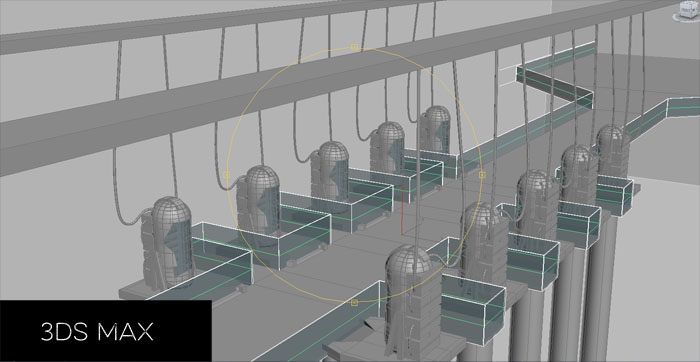
1. I first worked on the cryo pod, as this was the main point of interest for both the room and overall storyline mechanic. First I gathered some reference images of various cryo pods, abandoned rooms and sci fi rooms. The cryo pods ranged in shape from very rectangular, “industrial” looking ones, to curved and slick sci-fi ones. I settled on a look between the two, with a cylindrical shape as the base and form added around it with hoses and random-shapes-that-would-theoretically-do-fancy-medical-stuff. It took a good while to come up with the initial door shape in 3ds Max, I basically started all over twice after not liking what I came up with. Finally it started to take shape, and I played around with some bits of infrastructure around it – namely, the walkway. After a little bit of playing around I decided I liked the thought of the entire walkway floating in a large, tall room. I duplicated numerous cryo pods around and thought it made the room look much more interesting, rather than having just one. The room started to take shape just from trial and error and after about three hours or so I ended up with the mesh ready to import into Unity.
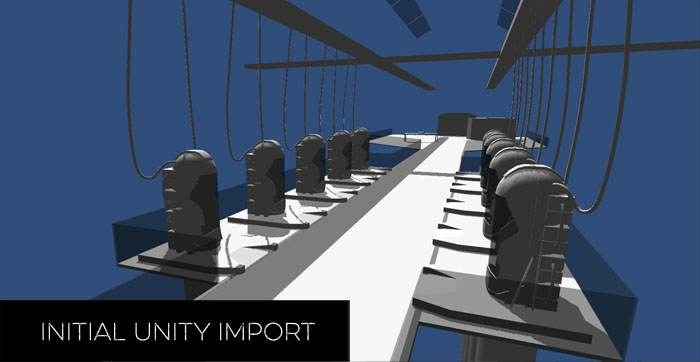
2. Now the mesh… into Unity… fairly straightforward. Here’s how it looked on initial import with nothing changed. Some incorrectly flipped normals here zzz!

3. I then went and added materials to all the objects. Seeing as I was limited on time, none of my models were going to be unwrapped, and I instead used simple diffuse/specular materials and relied on the lighting and particle effects to make them look nice. In the end these simple materials were actually enough to give the atmosphere that I wanted. Textures would ONLY have worked if they were done well, and in the time frame available that’s not really possible for me at my current levels; I think sub-par or standard textures would have actually detracted from the overall aesthetic. Either do it simply, or do it well – is my usual motto.

4. I then briefly played around with some lighting – this is just using a standard directional light. The light coming in from the ceiling windows looked quite nice. It started to look quite dark (P.S. On the Ludum Dare blog it’ll look wayyy darker due to the white background around it… but full screen it’s not as bad)… but I thought this felt more natural somehow. It was an abandoned, empty room essentially. You had to feel alone, and it felt more realistic to have a minimal light source. At this stage it was starting to come together however it didn’t feel quite right yet, until…

5. I started baking the lightmaps. This made the scene a lot more natural, in my opinion, as the previous lighting had all kinds of specular reflections which wouldn’t be there in real lighting. Now I’m actually quite a noob at this and it took a good few attempts at baking (slow zzz) until I got something I was okay with. Unfortunately I still don’t know how to get the lightmaps to be higher quality, as there is a lot of banding and low resolution artifacts in the final lightmapped scene which is quite noticeable. Still got a lot to learn. Anyway, the effect of the overall final scene was a combination of this lightmapping process in addition to some particle systems I added to give the room some dynamism and a bit more mood, instead of being completely static.
With regards to performance, this scene was actually not as bad as I thought it would end up (based on the naked eye, I did not run profiler or FPS tests) and webplayer compression did such a treat on the large lightmap sizes; however in a real deployment where I have more time I would definitely try to optimise things like the particle systems and the lightmap resolutions. The meshes themselves weren’t too bad with their poly counts and the room is quite minimal, but the objects could probably still be joined and batched.
Et voilà! There’s one I prepared earlier!
Hopefully this was interesting to some of you. I will be posting up more postmortems on the other aspects of development in the coming days.
– Camille
Tags: postmortem
This was the first time I used my new html5 toolkit I developed in the previous months. I was a little nervous about that, as I finished some important parts just hours before the start of LD.
After trying several ideas on paper, I stuck with a “connected cannons” concept, which is something I like to explore further. After about 8 hours of experimenting with different variations I had a finished looking game, and submitted it. I was pleasantly surprised to get multiple comments almost immediately, and the positive comments encouraged me to go on.
By the end of the day I had the game features pretty much down, but had this niggly feeling that I hadn’t tapped the full creative potential of my LD weekend. I kept thinking about other games that I wanted to make. Since my game was chaotic and trippy anyway, I thought about adding subgames at random points in the gameplay, with a contrasting style: neon (modern) in the main game, coarse pixels (retro) in the subgames. The subgames were going to be about my personal fixation with shooters. The idea is that the player can go into a subgame to save his/her ass when shields are low.
I quickly created some “programmer drawn” concept pixel art, which looked more satisfying than usual because I had decided to use only 6×6 pixels (8×8 with outline).

2/3 into the weekend, my game was about finished, with different types of cannon mirroring, 4 enemy types with variations, and 30 difficulty levels, and I had the feeling that putting more work in it would hit the “law of diminishing returns”. Time for subgames! I created a Frogger clone and the code for warping back and forth. I still had two hours left, so I created a Pacman clone as well.
The good!
The bad!
The game looks something like this:

And… the subgames go something like this:

So, this time I worked with my friend from Nice Penguins and my game will be on another acount.

You can find out here on the account of the Nice Penguins :http://www.ludumdare.com/compo/ludum-dare-30/?action=preview&uid=28578
This is my crew for making videogames : http://nicepenguins.tumblr.com/
Hope you’ll enjoy it 😉
This is our game for LD30, I could not update the game’s description until now, but here I want to share the link to it..
It is a puzzle/adventure plattformer, we had a lot of ideas but not enough time.. although we are not unhappy with it :)!
After LD30 we want to stick with the development.
And now: Try to escape from those aliens by solving the puzzles !
http://www.ludumdare.com/compo/ludum-dare-30/?action=preview&uid=33928
This was my second LD, so I took it with a more relaxed mindset than the previous one. I aimed for the 48h challenge but if I didn’t have something playable I could always enter the jam. Eventually I’d submit Elyseus for the 48h compo 😀

Tools used:
This was my first Ludum Dare using Unity.
For the graphics I used Photoshop as always.
For the music I used Music Creator 6 and my trusty midi keyboard.
Sfxr and Audacity for the sound effects, with some recordings of my own.

What went right:
Music and sound are hard to get right in so little time. In my last Ludum dare I didn’t even had time to make music. So for this one I gave it more priority.
The first morning I dedicated it to make some music to set the general mood for the game. I originally intended to make another variation for the underworld music, but left it as an optional goal which sadly I didn’t met. But overall I think the music fitted just well enough.
I also wanted to make some satisfying combat sounds. The sounds for the main enemies’ bones exploding deaths were made from a combination of Sfxr explosion sounds and a recording of some dirty cheap dice rolling 😛
The “clink” sound for the shield mechanic, which at first wasn’t even planned to exist but I had to implement it because the combat was so frustrating, was made by hitting my coffee maker with a pen!
Also, the world change effect worked surprisingly good, although it’s a bit incomplete. I wanted to fade the enemies from both worlds to be able to see what was coming, but only got it halfway and the appearing enemies just pop around when you are already in that world, so sometimes it’s a bit unfair.
What went wrong:
The main idea behind Elyseus was a lot bigger in my head, and big is always bad for a jam. For instance I originally planned to have a more simple combat to be able to make it quickly so I could make more features. Features which initially included online play invading other people’s games Dark Souls style… But that was way too much. So I focused on making sure what I did was at least fun to play.
The base objective of the game eventually ended as a cyclical infinite battle with the only possible ending being death. I wanted to make a more positive ending, but didn’t have enough time or any good and clear idea for it.
The other critical point was that to make the cyclical aspect, you could fight against another hero and without online implemented, I had to make an A.I. and A.I. is difficult to make. I spent the majority of the last day trying to make that work, even as shitty an A.I. it ended up being…
Conclusion:
It’s always a learning experience. At the end of it I had a playable game. In my opinion not enough fine tuned as I wanted but playable nontheless. I hope you have fun playing it! I want to know what you think!
Here’s the link to it: http://www.ludumdare.com/compo/ludum-dare-30/?action=preview&uid=36237
Tags: compo, postmortem, unity3d
Hey, I would like to take the opportunity to talk a little bit more about our game Uninhabitable..
A lot of people want to know more about the story line, And to be honest we are working on it 😛 We are figuring out little details about the lore..
But i will tell you a bit of the background story : Humanity is ruining earth and earth is in its dying days. So some governments decided to do an exploratory
expedition. Couple of years later, Earth got word from the exploratory team that they have found an earth like planet. Even though it is not 100% like earth.
Some of the resources can be used to “Revive” earth.. So they governments decided to build a Warp Portal, that can be used to ease the travel time between the two worlds.
While the portals where being build earth lost communication with the exploratory team. But that did not really matter to the governments, Because all that they needed to do is finish the portal
and they would have access to the new world. But they did not realize that the other planet was inhabited by an hostile alien race. Thus making the planet uninhabitable to us as humans.
So that is the back story. And i am glad we did the game for ludum dare.
The Future of the game:
We decided that this is something that we would like to work on. So we decided that we will be making this game into a multiplayer survival game.. With PVE in mind.
So for example, At night the gravity would change on this planet and get much lower. Thus allowing you to “Farm Items” but at night is also when the “Aliens” come out to play.
Thus you would need to work in a group to fight them off.
That is just some of the things we had in mind… And i assure you that we will make this game into one epic experience for our players.

Here is a map one might find useful for now

Please try our game Here
Hey, guys!
I’ll be livestreaming some Ludum Dare games in about 30min. You can send in your game here, and I’ll get to it as soon as possible I’ll start off with a couple that I already played and liked, and when the submissions are in, I’ll get to yours.
Don’t be a stranger, join me on Twitch!
That was a suprise! Nature Trial got a mention on Joystiq!
We were already pleased with how the game turned out, but it’s quite exciting and affirming to receive attention from the gaming press!
Ludum Dare 30 was our first time participating in the main dare, although we did take part in mini LD #53 as a warm up for our first proper dare. Despite taking part in the Jam we opted to limit ourselves to 48 hours anyway out of preference (and to allow ourselves the bank holiday Monday to relax).
So how did it go?

Things went much more smoothly this time (compared to the mini LD back in July) for two reasons:
As a result, we’ve ended up with a game which feels quite complete. We had the time to implement all our mechanics, multiple levels, splash, ending and game over screens, and aside from an issue with the controls, we managed to achieve a good level of polish.


We’re very pleased at what we managed to produce in 48 hours and with the feedback we’ve received so far, so we plan to expand the game further, the first items on the schedule will be the chopped content listed above, then we attempt some of the following:
This has been a really positive experience for us, the community is very supportive and we’ve received a bunch of helpful critique and plenty of kind words already. If you haven’t played Nature Trial yet, please do and give us some feedback!
Overall I’d say that the process of failing at mini LD #53 and examining how others managed to succeed taught us a lot and really helped us to improve.
Ludum Dare is the perfect environment to fail in, as there’s so much support to help you grow stronger. Thanks girls and boys!

As the title says, this was my first LD, and I’m proud to say that I actually “finished” a game.
I was streaming for almost 30 hours, here’s a 5 minute timelapse video of the weekend:
The game I created, HexConquest, is a turn based strategy game, made with Unity.
Here it is
When I woke up on saturday, the competition was already 7 hours in, and I tried to come up with an idea as fast as possible. The first idea was a strange tower defense game, but I tossed it pretty fast. I could reuse the tile generation code I created for the tower defense game for my second project. The second idea was to create a playing field controlled by different fractions, and the player should use his units to conquest the enemies’ zone to connect his main world to others. As you see in the list below, I didn’t get to actually implement the “zone”-thingy, that’s why the theme may not appear obvious…
I didn’t make a plan (one of the things I want to do different next time), so it was pretty chaotic. I spent a lot of time with the pathfinding, so I had to do the A.I. (a topic on which I don’t have any experience with at all) and game objective in a rush and couldn’t even start creating sound/music anymore.
Saturday:
Sunday:
The game has some serious usability problems, few bugs and calls for an overhaul. Until the next LD, I will spend time to improve everything and implement all the features I wanted in the beginning.
As I’m only a hobbyist developer, I learned more over a single weekend than I learned in all the months I was using Unity before, most likely because I never finished a game and never had to deal with every subject of development.
This was the first, but definitely not the last LD for me!
PS: Thanks for all the feedback on my game, it helps a lot.
Tags: LD30, ld48, postmortem, retrospective, timelapse
The beginning of the second day we met the whole team to obtain ideas about the project, which theme was Connected Worlds. After that we made a brainstorming and we get two possible ideas.
The first one we called it “Ships”, about a ship that was travelling through planets joining antennas, by what Connected Worlds was achieved. During the trip the character would find such enemies as asteroids, enemy ships or spatial garbage. The aim of the game was the conquest of planets.
The second idea was called “Connected Worlds”, about a climber that was climbing the different letters that form the word “W-O-R-L-D-S” up to achieving Connected Worlds. Finally, we decide to do a mix of both games, so that there was staying the better of every idea. The result was a game for web platform that treats of an astronaut that he was travelling connecting the antennas of diverse worlds, which were the letters of the word “WORLDS”.
Once everything was established, every component of the team worked in an individual way. Fran, the illustrator, realized several sketches in paper of the drawing of the astronaut for his later choice; Estanislao realized the design of the structure of the video game and the creation of the repository git of the project; Israel realized the sound search; Silverio created the first prototype and created the controls; and, finally, Carlota fulfilled the tester of the first prototype and she is the manager of the Diary of Binnacle.
t the beginning of the second day we met the whole team to obtain ideas about the project, which theme was Connected Worlds. After that we made a brainstorming and we get two possible ideas.
The first one we called it “Ships”, about a ship that was travelling through planets joining antennas, by what Connected Worlds was achieved. During the trip the character would find such enemies as asteroids, enemy ships or spatial garbage. The aim of the game was the conquest of planets.
The second idea was called “Connected Worlds”, about a climber that was climbing the different letters that form the word “W-O-R-L-D-S” up to achieving Connected Worlds. Finally, we decide to do a mix of both games, so that there was staying the better of every idea. The result was a game for web platform that treats of an astronaut that he was travelling connecting the antennas of diverse worlds, which were the letters of the word “WORLDS”.
Once everything was established, every component of the team worked in an individual way. Fran, the illustrator, realized several sketches in paper of the drawing of the astronaut for his later choice; Estanislao realized the design of the structure of the video game and the creation of the repository git of the project; Israel realized the sound search; Silverio created the first prototype and created the controls; and, finally, Carlota fulfilled the tester of the first prototype and she is the manager of the Diary of Binnacle.


