LD30 August 22–25, 2014

Postmortem on HONKO’s WORLDS!

Hello! Designer/programmer/artist here. Here’s a little write-up on my Ludum Dare Jam entry, Honko’s Worlds.
It is a dungeon crawling game where you shoot enemies with beams, collect gold, potions, special weapons and keys.
It plays a lot like one of those top-down zelda games.
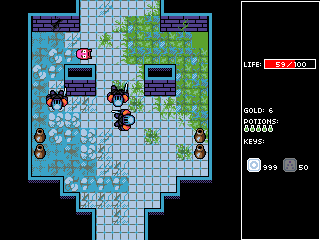
screenshot2

You can try the game here:
HONKO’s WORLDS

I started making the game planning it to be a competition entry, but decided to make it a jam entry halfway through the second day when it became clear the game wouldn’t have enough content by the 48 hour deadline. On the third day, now that it was a Jam game, CBoyardee offered to make music for it, and made three great tracks.

I am very happy with how the game looks, and with many of the game’s enemy encounters. Those I think are its strongest points, it turned out really good.
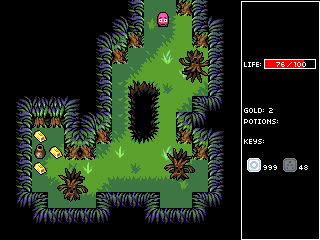
screenshot3

But many, many issues came from a lack of foresight and planning in general while I was doing this. I only had the vaguest idea of what the game should be during the first day, I was like on autopilot. I knew I wanted to make some sort of top down dungeon crawler, but that was it. Most of the ideas came together through pixel art: I was just drawing game-ey things (monsters, tiles, keys…) and imagined how they could fit together as I did em. I should have stopped and should have taken a walk or something, to get those thoughts straight and order up some more solid idea.

The biggest mistake, a consequence of this improvisation thing, was planning a much bigger maze than what I had time to finish and polish. Once I was done making a basic shell of a game, I started sketching up a plan for the dungeon’s maze, and made it really huge. I always underestimate how much time it takes to actually put those rooms together, even when the rooms are simple.

Here’s a map of the game I was planning:
map of the game

That maze I drew up and then proceeded to implement is about three times bigger than the final entry’s size (which is already pretty big!!)
Most of that larger maze actually works gameplay-wise and is filled with enemies and items, but I didn’t have time to give it any tiles/graphics! When there were just a handful of hours left, I blocked off the unfinished 2/3rds of the game and focused on adding to that first third instead.
As I mentioned in the original post though, you can actually visit that huge unfinished section of the game by exploring the finished section completely and finding two gold keys (their locations are marked with two Xs in the map above)
The unfinished area starts just north of the two consecutive gold gates. Of course, without tiles to see where the walls are, that area is more or less impossible to explore. If you reach that unfinished area at all, you can consider the game beaten!
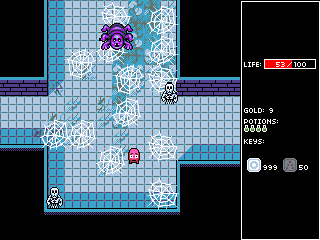
screenshot4

One of the biggest consequences of all those cuts to the game’s maze is in relation to the theme (the theme of the Ludum Dare competition was “Connected Worlds”). The gold keys you can find in the current maze were supposed to be hidden in “side worlds” with their own enemies and visual styles, but I had to cut all of that. The idea was to have this castle be a “hub level” of sorts, from which different worlds were accessible.
To access a new world, you have to find silver keys within the hub level, which opened the way to one of the side-worlds.
To make progress in the overall game at a higher level, you need to collect gold keys in those side-worlds. This would let you access a larger portion of the castle. Those gold keys mark your overall progress in the game.
Its quite frustrating to see how many hours I spent laying down walls and enemies for those unfinished sections. If I had kept the maze small, the game would have had a lot more content, could have been a lot more complete!

One good consequence of cutting off so much of the big maze however: I could take the unique enemies I designed for the cut-off areas and place them all in the smaller game, making the enemy encounters feel very diverse. My original design, by comparison, was probably way too repetitive with its enemies.
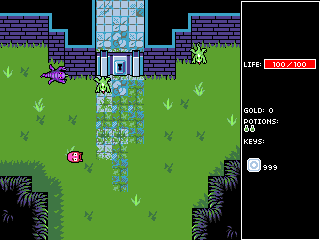
screenshot1

Some other regrets with the result:
The subweapons. They are pretty generic, they don’t have much diversity, just extra damage, some spread shots and some projectiles that fly a bit further. I thought of the subweapon thing on the second day of the jam, but only started to implement them in the final few hours, so they’re not really elaborate. Ideally, I would work on them further, to make them feel more like magic spells. Something that is exciting to find, where collecting a lot of them feels like you are really expanding your inventory of actions. Some weapons could have non-combat applications, like freezing a lake to allow passage or breaking through a weak wall. Some could have special effects over the enemies hit, or have defensive applications. But this would also mean I would need to add some means of managing your subweapons inventory. Perhaps you could only hold 10 of those weapons at any given time, and could store them in some storage space accessible at save points. Speaking of which…

Save points. The game has no saving or checkpoints, and that’s a huge bummer. I just didn’t have time to implement those. I was already cutting off so much from the idea and had so much more to fit in, saving was just never on my radar throughout the jam. I need to make saving a higher priority in my jams in the future, it really sucks to lose 20 minutes of exploration all of a sudden!

Gold. There is absolutely no use for it in the game right now, its just some sort of score. Of course I thought it would have some use at some point, but it never coalesced during the jam. I would definitely add a shop that sold unique subweapons and potions, or could maybe upgrade your main weapon, or raise your maximum life.

All in all, I am pretty happy with this game despite all the flaws, and with some more work, it could turn into a solid little indie title. I have a lot on my plate right now, but I might revisit and spruce this up a bit sometime in the future.

I also put up a time lapse of the entire process of making the game: The pixel art, the design, the programming and even the last-minute sound effects.
You can watch it below:

thumbnail of timelapse
TIME LAPSE VIDEO

Tags: honko, map, pixel art, postmortem

Conversation Postmortem

State of the art graphics and hair simulation.

PLAY CONVERSATION!

Hello everyone! I’m Arhan, a young game developer from Turkey and this is my third Ludum Dare entry so far. So far, it’s been a pleasure creating games along a lot of creative people who loves video games as much as I do, and for my third success in Ludum Dare, I feel like I managed to come up with a unique idea, albeit coupled with ugly, boring graphics.

After consecutive flops in Ludum Dare 27 and Ludum Dare 29, I knew that I had to produce something in this summer edition of my favourite game jam competition. I was awake at 9.00am in EET, which is five hours after the theme was announced. Connected Worlds, you say?

GOALS

I had a couple of goals that I wanted to accomplish for this edition of the jam. These were:

  • Game should only use mouse movement and LMB. I wanted the game to have simple controls for a possible future mobile port. I succeeded in my goal, and the game will be playable with only one finger when I eventually port it to Android.
  • I should not use the first idea that pops up in my mind regarding theme. Connected Worlds! Space! Planets! Aliens! Controlling characters in different worlds! That was just the first 60 seconds of me thinking right after I saw the theme and I immediately put all these elements into my “forbidden” list. Don’t get me wrong, space is cool, aliens are awesome, I enjoyed every entry with multiple different characters stuck in multiple dimensions. It’s just that I knew these ideas were going to be overused for this theme, and I didn’t want my game to feel like “that other game you played, but with worse graphics”. Although it’s worth noting that my game could easily be themed into a space game.

screen1

WHAT WENT RIGHT

  • The Idea: Basically, in this game, you’re trying to keep a group of people together by conducting successful conversations in pairs between them. I won’t get into details, but the idea and the gameplay concept is, in my personal, biased opinion, a solid one. I feel like I have succeeded in making all game mechanics feel natural and related to the story. A good conversation keeps people together, while a bad conversation makes them repel each other. Characters which are too close to each other collide and push each other away in order to protect their “personal space” in a way.
  • Prototype: I was quick to put the first prototype out and to decide that the core idea is fun enough to pursue for the rest of the weekend. This was something I was unable to do in the first two succeeded attempts of Ludum Dare for me.
  • Time Management: I briefly followed Pomodoro principles to use my time more efficiently during the weekend and I feel like they helped me a bit.

WHAT WENT WRONG

  • Time Distribution: While I believe I managed to use my time efficiently, I insisted too much on implementing a few more gameplay elements (some of which went to garbage afterwards), resulting in a lack of attention in all the other details of the game, which will follow this entry.
  • Graphics: Couldn’t find the time to draw decent faces for the characters, a decent conversation line, animations for all kinds of events related to getting and losing points, and so on. Heck, those lousy eyes, nose and mouth were added to the game literally in the last hour.
  • Gameplay Polish: My game lacks polish in every aspect of it, but gameplay is the most critical of them. Currently, the game is hard as hell and controls are rarely well understood among players. Moreover, the game is boring in my opinion, because I wasn’t able to tweak the gameplay to make the player feel like he’s/she’s accomplishing something. This could’ve been easily avoided with more attention to detail and less attention to additional elements that ended up not making it in the game.

screen2

CONCLUSION

I’m happy to put out yet another successful entry for Ludum Dare. I feel that I’ll get rather low scores thanks to lousy graphics and rather boring gameplay which is also hard as hell. However, I’m really happy with the core concept and I’m thinking about taking this game further and making a better version of it at some point.

It’s been an awesome game jam, big thanks to all the gaming community here and the organization. See you later in December for Ludum Dare 31. Keep playing!


PLAY CONVERSATION!


Constellation – Post Mortem

LD #30 was not only my first participation in Ludum Dare, but also a first time when I published a game to a wide audience. I learned very much when I was making new game and when I was getting ffedback after I submitted it. If you would like to play my game, it can be found here: Constellation  – the game about restoring and destroying connections between worlds.

Title screenshot

I’m not an experienced game developer and don’t have much programming bachground, and making games is just a hobby for me. About an year ago I started to explore this area, at first – for practical purposes (I need to make several simple games for a website of educational organisation, where I work), and then I saw, that I can use it to express my own ideas. Mostly I work using Stencyl 3.1 with its visual programming, but work on developing my programming skills beyond this level.


Destroyed constellation (level selection)

Tools used:

Stencyl 3.1

Paint and Inkscape on PC and InfinitePainter on tablet

sfxr

Good things: 

– I made a finished game, that has a plot with the beginning, the end (actually, two endings, although with only small difference) and something inbetween. I also added some interesting details, like two wearpons, that differently affects on different enemies.

– I managed to make instructions and explanations part of the game (so people can understand, what is happening, even if they don’t read the description)

– I am confident with graphics I made in short time (I expected that it woud be more difficult and will take much time)

– Using Stencyl 3.1 really saved me much time at initial stage of making a game. The only problem with it is that compiling a project takes long (several minutes). But it turns into a nice working rhythm: while it compiles, I draw sprites or backgrounds, then check the result of compilation… than add what I’ve drawn… etc. So it was nice for working solo.

Bad things: 

– I choose the idea, that cannot be fully realized in 1 or 2 levels. To clearly show the idea of restoring right connections between worlds to form a constellation, I need more levels: initially I planned to made 5-6 words with two levels in each, but this was unrealistic. So I finished 3 worlds (one of them presented with 2 levels, others – with 1)

– I didn’t have enough time to make sounds and music. I see, that music can add much to the mood of the game, and have a tool to make it (Music Maker Jam), but just didn’t have time. So I managed only to add two sounds generated with sfxr – one in the intro and one when the player loses life.

– I also didn’t have time to draw animated sprites.

– Some people reported in comments, that the controls in my game aren’t very good. I think I need to read some documentation about Stencyl and Box2D to find, what is the problem. (As for me, controls aren’t ideal, but they don’t make game too hard or boring or unplayable)

– Two-wearpon system was good idea in general, but some players commented, that they finished the game using only one gun. Now I see, how to made the system more balanced, and maybe use this idea later.

Level 3

What to do next?

I don’t know now, if I will make improved version of my game Constellation or not. I made a version where I fixed some bugs and typos, mentioned in the comments, but I don’t know, if I want to spend time on polishing it (adding music, more levels, better graphics. improving controls etc.) Probably, yes (at least, music and animations), because it is always sad for me to leave ideas in such half-embodied state. Probably, not now, because I have some other projects to work on. In any case, I hope I will have time to took part in next LD, because this was a great experience for me, and I found several other creative ideas for later use, when I was working on this game. I also had wonderful experience playing and rating games made by others. Thanks to all, see you at next LD!

====Some links:====

My game

Post-LD-version (no new features, just several small fixes) (direct link)

My blog (it is in Russian, but maybe somebody here will be interested :))

Tags: post-mortem

Luna

Hey guys! Guess what? I’ve made a game. I hope you play, comment, rate and like it!

Schermafbeelding 2014-08-25 om 02.36.30


Schermafbeelding 2014-08-25 om 02.37.50

Schermafbeelding 2014-08-25 om 02.37.28

Click HERE or here or HeRe to play it!

Ludum Dare #30 Games with Ythmevge, Week 3

Hello, In addition to creating Games, I also record YouTube Videos. I started a new series this week for Ludum Dare 30 Games, it will run until September 15th. Each week I will have videos for at least five games.  The release Schedule is Mondays at 3pm PST.


Youtube Playlist

Week 3:


Week 1:

Introduction

Connected we Run by Sandcrawler

Alter Axis by sylarisbest

Shadows by apiotrw

They Were Just Pixels by Ohems

Taxi Space by DrCicero


Week 2:

Provider Bob by Cryunreal

Pilgrimage by Follett

Groups of Seven by 7Soul

Intergalactic Delivery Services Corporation by sP0CkEr2

This Way! by Accidental Rebel


Tags: Videos

I dream of post-mortems

Ludum Dare #30 was my fifth successful Ludum Dare, which brings me to a 50% success rate. Yay! Time for a post-mortem.

By the way, you can also play my game.

What went right

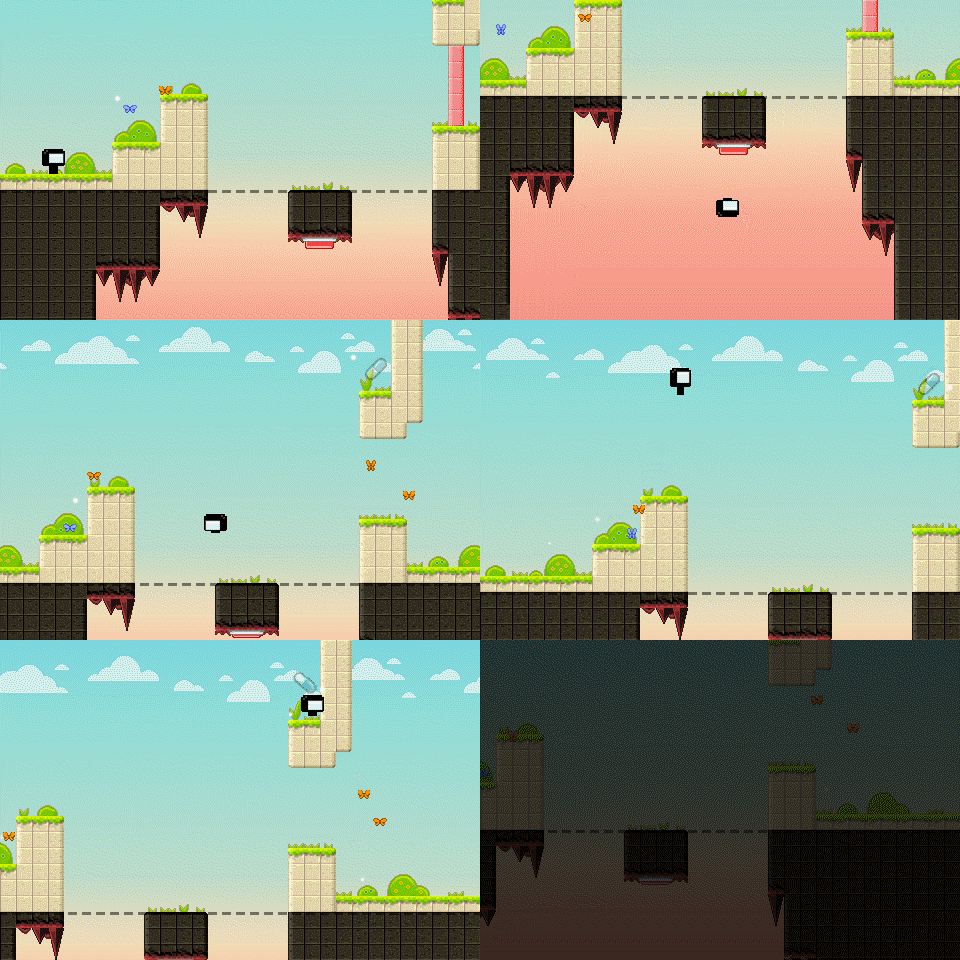
The engine. I wrote the engine in C++ this time, and took notes from an article called “Programming M. C. Kids” Iz-Tavares and Chang. The platformer physics turned out rather well, and the game feels responsive but not crazy. There was even enough time for some tricky shader effects, and I’m going to show those off in a GIF:

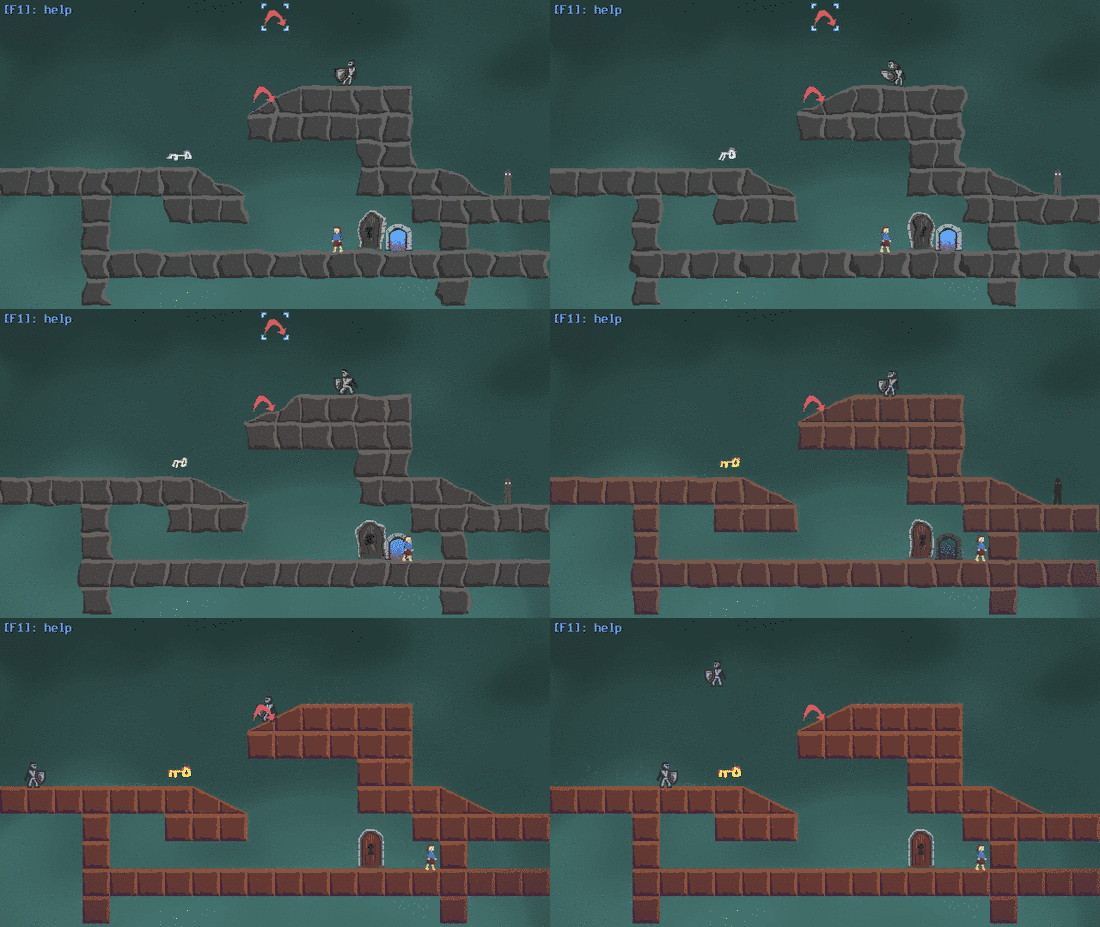
Dreamless Gameplay

Dreamless Gameplay

Core gameplay. Once the gameplay concept got to its final, simplified form, I could focus on implementing it and writing levels. The level format was just ASCII text, so I could crank them out pretty quickly, and I ended up with 9 levels.

Sound effects. Just a couple hours with a microphone (and some music software) were all it took. There are 13 sounds with an average of 5 variations each, and the engine picks a variation at random each time a sound is played. The effect is rather nice, especially for the footsteps.

Dialogue This was the last piece of code implemented, but it gives crucial context to the game. The writing isn’t great, but I’m really glad it’s there.

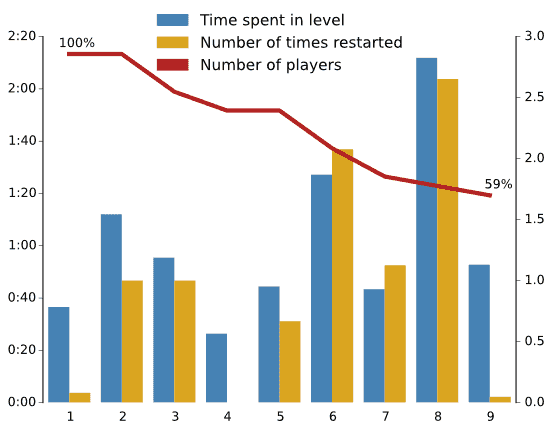
Analytics. I keep a record of every time a level is beaten or restarted, along with a couple other things. Here’s a chart of the statistics for each of the 9 levels. You can see that about 60% of the players who start the game finish it, and players who get to level 8 restart it 2.5 times, on average.

Chart of level data

Analytics for “Dreamless” by level

What went wrong

No tutorial. The game doesn’t exactly throw you into the deep end, but it does very little to tell you what you’re expected to do. This was painfully obvious once I watched someone else play the game. For everyone who played my game: thank you for taking the time to figure things out!

The worst part is the double jump. I was careful to make it so you could beat the game without the double jump, but there are some places where you have to restart if you don’t know about the double jump.

Slow start to the project. Looking at the commit logs, the game didn’t even respond to input until 16 hours into the contest, and jumping didn’t work until 21 hours had passed. I spent the time refactoring, messing with base code, and other things that don’t make games.

Not enough time on graphics and music. With only an hour and ten minutes left to go, I cranked out a music track and a bunch of sprites. I spent less than 10 minutes on music, and that’s including the time it took to start up the sequencer. I picked out two chords (Cm9 and Gm9), hit record, and rendered the result to disk without editing it at all. I even used the default patch you get when you start a new song!

Special Thanks

Special thanks to Obsolete Entertainment, who put footage of gameplay for Dreamless on YouTube. In general, thanks to everyone who posts videos of the games they play!

Tags: postmortem

OrcaJam

Well,  instead of Ludum Dare I did OrcaJam.    It was my first real-live game jam and it was great!  I met some awesome like-minded people for the first time in my life and I made a pretty cool game in 48 hours too.

For some reason I make a lot of games that are about drugs and beating people up…   I may need help.

Click here to check it out on OrcaJam.

Click here to check it out on OrcaJam.


Comments

abayb
09. Sep 2014 · 12:13 UTC
Oh man those graphics are great! Can I ask, how did you manage to get it to look like each pixel was a tile, with light shadows? Also, is there a tool in photoshop or whatever graphics software you used to get that pixel noise?

If it wasn’t a tool, I would love to know how you pulled it off. Thanks a lot! Great game.
Suese
20. Apr 2015 · 19:46 UTC
In GIMP I used ‘scatted HSV’ I believe.

“Parallel Worlds” (jprogram’s version) walkthrough

Walkthrough (Click it to see in full!)

Need some help? Sure you do! I’ve made a walkthrough for my game to give you assistance on finishing the game — but try to use it at the last resort because it’s more funner that way! :) For your convenience, I’ve added the walkthrough as a screenshot to the game’s description page so you don’t have to find this post for it. 😀

Haven’t tried or rated “Parallel Worlds?” Now’s your chance!

–Try and rate Parallel Worlds here!–

Thank you very much for your support!

Tags: ld48, walkthrough

NAILER – Native Application Installer / Launcher

I’ve been working on some software that is meant to reduce the effort it takes to test native applications. I’m sure many of you know how most native games here are released – they’re packaged together in an archive that has to be opened and fully extracted before running the game. Many people are possibly turned off by the amount of work it takes to run a simple game, some might even avoid testing such games.

To tip the scale towards native games (in the name of the undisputedly superior experience and technological variety such games can provide), I’ve developed an application that can generate a self-extracting archive. But it’s one that supports building custom user interfaces and doing background extraction of game files so that games can be opened with just one click.

This is how the interface can look (it’s fully customizable):

First game package ever built (Windows version of my LD30 game: Connected Worlds – The Adventure) (Dropbox mirror)

More info (source, SDK, backstory) at blog.sgscript.org.

Now is the Time!

Hello all!

I have noticed something while playing games this Ludum Dare. A lot of people are making web games. And one of the reasons this is, is for simplicity. If you click on a link to a game, you can start playing it! But sometimes you need something like Unity, or Java, and some people don’t have those things. I have made a tutorial on basic Web Game Development that you can watch here. This uses pure HTML5 and JavaScript. It is very simple to use and understand, can be distributed very easily, and is very useful when participating in Ludum Dare! If you haven’t learned web development yet, and you want to compete in December, watch this video! You may find it is easier than it seems!

– Gandalf1209

‘The Veiled World’ Autopsy and Post-Comp Version

BulletTime

I had a ball taking part in my second Ludum Dare this year. More than anything, I’ve been impressed and humbled by the great quality of games on display. I’ll write another post soon to enthuse about my favourites but first I thought I’d say a little about my own experiences.

Right from the start, I eschewed any thoughts of doing anything clever or complicated with the theme and just went for a very straightforward and literal approach. The Veiled World is therefore the story of four stereotypical characters who stop a cliched monstrosity from taking over a generic fantasy world. Once I’d boiled the story down to it’s raw materials, I found I could have a lot of fun by just being as stupid as I liked with the details.

Similarly, the gameplay is nothing new. Jump, shoot and flip between parallel dimensions. It’s hokey but I tried to make it as extreme as I could to turn the hokiness into a virtue. I think it worked in some ways better than others…

THE GOOD:

– I tried to give the combat a Vlambeer-style crunchiness and I think it worked pretty well. The screenshakes and hit physics give the right amount of feedback and make the fights feel satisfying. The variety between the four weapon types also worked well.

– The sound effects. I did everything with my mouth or objects found on my desk (tweaked in Audacity) and it worked surprisingly well. It’s amazing how forgiving the brain is when it has a visual cue to go along with a sound. The sped-up sound of a man blowing a raspberry suddenly seems the perfect noise for an axe hitting flesh once you put it in context.

– The voice-overs. I had fun with these. Most of the positive reviews I’ve had have mentioned my pronunciation of the characters’ names. :)

– The art style. I’m loathe to call it art really but I think it worked out well in the context. It looks appropriately old-school and it works that way, especially with so much blood splatter on the screen.

THE BAD:

– Opinion has been divided over the control system. I quite like it but then I spent a long time playtesting and getting used to it. A lot of players have found it too twitchy and difficult to manage, which I think is fair comment. I changed it quite a lot for the post-comp version.

– Many people have found the game to be frustratingly difficult. Again, I overlooked this because I’d spent so long playing it as I went along. I knew where all the platforms were so didn’t have to put up with frustrating falls and long climbs up again as many players did. The enemy AI was also a little too vicious.

– No music. A little music would have gone a long way, I think, but I lacked both time and talent in this regard.

– The title screen and cutscenes are pretty awful. Nothing much to be proud of where presentation is concerned.

– The font is hideous. Time ran out before I could change it. That said, it has a sort of goofy appeal of it own, I guess, if you’re in a forgiving mood.

THE UGLY:

– There was a bug which caused all the gnomes to fly up into the air if you pushed the up arrow. It was stupid of me to overlook it but kind of fun when someone pointed it out to me.

TVW5

Terrible font…

***


POST-COMP VERSION:

Altogether, I was happy with the way it turned out and happy enough to think of expanding it into something a bit fuller. So the post-comp version has better controls, special abilities for all four characters, an endless arena mode and a few coats of extra polish. It’s the game I had in my mind when I started but didn’t quite get to make within the time limit.

Fact2

The wizard now dispenses Hot Facts

arena2

Are you not entertained?

The post-comp version is available here: http://panurge.itch.io/the-veiled-world

Any feedback will be welcomed with open arms.

5

This entry was posted on Tuesday, September 9th, 2014 at 11:27 am and is filed under LD #30. You can follow any responses to this entry through the RSS 2.0 feed. You can leave a response, or trackback from your own site.

Ludum Dare to Believe! S:2 Ep. 9!

Hey everyone! We are the Button Masher Bros!

Judging draws ever closer… you know what goes good with judging?

IT’S LUDUM DARE TO BELIEVE! Ep. 9!

With so many submissions, there was absolutely no way we could play them all.

Special thanks to our friends at Reddit, twitter, and youtube who all stepped up to give us suggestions – you guys are the BEST!

If you like the games you see, be sure to check them out of Ludumdare.com and let the developers know what you think!

**Today we will be highlighting**:

Title: Heart Star
Category: Comp Entry
Creator: Adventure Islands

Title: Savior: Saver of Souls
Category: Compo Entry
Creator: John Drury

Title: The Lion’s Song

Category: Jam Entry

Creator: LeafThief


Finally, we’d love to hear what you think!

You can comment on the episode linked above, comment in this thread, or tweet us at:

@ButtonMasherBro – Show

@MathBlasterRitz – Chris

or @jwowBMB – Josh.

See you next week for the final week of Ludum Dare to Believe! Good luck everyone!

Comments

World transitions: Manipulating viewports in Spirit Shift

This post is originally from here.

Spirit Shift was made in 3 days for the Ludum Dare 30 game jam, based on the theme of ‘connected worlds’. After a couple of hours of discussion we worked out what we were going to make: an infinite runner where the player can (and has to) phase-shift between worlds rapidly. Since this was the core mechanic of the game we wanted it to look fluid and not confuse the player. I had done some GameMaker tutorials a few years prior and remembered a little about having multiple viewports, so I knew it would be possible and a lot easier than coding it by hand. It took a day and a half.

Tunnel Vision

Once I’d done a couple of GML tutorials and read through some of the documentation (something I’d be doing a lot of over the jam), I got some basic platforms generating and moving across the screen. Turns out GameMaker doesn’t support having multiple rooms active, so I ended up having 3 separate ‘lanes’ spaced vertically across a single room. When the player shifted worlds it would just be a case of moving them up or down to the appropriate lane.
After mucking about with views for a while I knocked up the following prototype:

Centre portals


This is how we originally pictured the world portals. The idea was that you’d almost be going through a tunnel, as each world shift caused the next one to expand out and fill the screen. At this point the shifting only worked the first time, so in the following demo video I have to restart the program each time:

The main (yellow) world expands out of view, the next (cyan) world expands to take its place, the last (green) world follows suit, and a temporary fourth view expands from nothing in the centre to take last place. At least, that’s what seems to be happening. In truth GameMaker doesn’t allow a viewport to be larger than the window, so to get the main view to expand I actually keep it the same size and shrink the game area it represents, essentially zooming in. Having now worked it out, this trick became very useful later on.

A world of problems

With the prototype in place we started working through the design issues apparent in the way I was doing things so far.

  1. Having the portals in the middle of the screen drastically limited the play-space. Although GameMaker supports sprite depth, views themselves override this. Even if the sprite depth for all of the cyan platforms is set so that they appear in front of the yellow ones, the viewport itself takes precedence and completely covers everything behind it.
  2. It’s ugly. Having the viewports overlap each other minimizes the total area they take up, while giving us the ‘tunneling’ effect of going into the screen as they expand. Unfortunately it just doesn’t look good with those hard edges. We could have had clever bordering artwork to smooth the transition, but a hole in the world is a hole in the world.

Addressing the first issue was pretty easy. All I’m doing is linearly interpolating between the position and size of each viewport to its target position and size, meaning I can actually place them any way I want and the transition will still smooth out over the same (arbitrary) time period. Here’s the expansion demo again, this time coming from the top-centre of the screen:

The sticking point is that second problem: it’s still ugly. The artists on the team were (rightly) concerned about what the backgrounds were going to look like overlapping in that way, or if we would even want backgrounds with a system like this.

A fresh perspective

After some more discussion we agreed on a kind of roulette system, mocked-up here by one of the artists:

view mockup

Not only is this much better aesthetically, it actually improves the gameplay too. Since each viewport has the same width but different heights, I had to widen the area of the game world shown in each port in order to preserve aspect ratio. This had the knock-on effect of allowing the player to see further ahead in the world they’re about to shift to, helping them plan ahead.
The final breakdown for the portal heights had the main port taking 5/8ths of the window height, the next port with 2/8ths (1/4) and the last one with 1/8th. These are roughly the same proportions as the mock-up.
The only downside to this approach was that it made transitions more complicated: I now had to morph not only the viewports but the areas they represented too. Here’s what happens when the player shifts:

  • The main viewport slides down off the screen.*
  • The next viewport slides down, expands vertically and zooms in to replace it.
  • The last viewport slides down, expands vertically and zooms in to replace that.
  • A temporary fourth view slides in from the top.* Once the transition is complete, the temporary view is disabled and what was the main view now takes last place.

*Sort of.
In much the same way that GameMaker doesn’t allow viewports to be larger than the window, it also doesn’t allow them to occupy space outside the window. A ‘sliding’ viewport is actually vertically shrinking or expanding while zooming in or out. This is functionally similar to the expansion zoom trick from earlier. As one of my lecturers likes to say: in videogames programming, everything is a hack.

39966-shot1

Above is a screenshot from the final game. Below is some footage of the transitions, with the time per transition increased fourfold for clarity. Below that is gameplay of the final game, so you can see how it ended up.
The last thing I’ll say about the viewports is that whenever you shift you’re actually discarding that world and generating a new one at the top. Having a temporary fourth lane was too much hassle for a jam game, so once the transition is complete you can actually see the new world pop in over the old one at the top. Since the backgrounds are detailed and the player isn’t focusing on the top of the window at that time, I think we get away with it. Look out for it in the videos below.

Ro-bat on the App Store!!

Ro-bat was a game I made originally for a last-day-of-the-year Jam (nothing official) on 31 December 2010. A few months back I started working on an iOS version with extra stuff, and that game just went live on the App Store!

https://itunes.apple.com/us/app/ro-bat/id892389144

Action_2

This is my first “commercial” game!
For those of you wondering what happened to my entry of last years october challenge then, well, I wasn’t able to finish it in time, but I PROMISE it will be finished for this year’s october challenge. (It’s almost finished)

Galeas: the very very late postmortem

banner

I tried to do this thing earlier, and Ifinally found some motivation to write it. As someone who never wrote a post mortem before or even competed in this jam, it might be interesting to reflect the things I did well, not so well and simply bad.

The idea was pretty simple: a connection between the old and new world. I started with making a moving boat, a sea and some islands. I didn’t have a real plan of some sort, because i hadn’t enough time to work out my idea. I continued coding, making art and doing other stuff until I ended up sunday night with the current game: galeas.

WHAT WENT WELL:

  • Artwork. I’m not good at making pixel art, but i managed to make some decent sprites in quite a short time. I had some code lying around that i made for another game, which i recycled to make some cute particles to make the world more alive. It was also an excuse to not having to animate my sprites.
  • people told me the game feels polished. one advice: screenshake, menus and particles!
  • Simple sound effects are great for making a game feel more alive. thank you sfxr!
  • Well, I finished it! This is probably the most important thing for me and it feels great. Congratulations to you if you made it too!

Knipsel  SCREENSHOT2

WHAT WENT NOT SO WELL:

  • balancing combat is hard! the combat is pretty simple: you have 6 cannons which you fire all at the same time, and need some time to reload. the range is quite short, but the enemies have a pretty long range. You have to get close to the towers to hit them, but that makes it harder to evade their shots. The thing is that players try to kill all the towers, but there aren’t a lot of reasons to kill them! Anyway, you should try to figure out a good strategy for the combat, because it can be pretty rewarding to kill a lot of towers.
  • Music. I need to learn how to make some sweet tunes.
  •  I had to make a few, maybe a few to many bugfixes post compo.
  • Releases. my game only has a download for windows. I should have made a OSX build. the problem with love2d is that it’s not possible to make a web release.

My scribbles. Most of them are to-do lists, because I like crossing out tasks.

that should wrap it up. thanks for reading!

you can try my game here!


APOLLO Postmortem

APOLLO_2

Play/Rate the game here!

In general I’m really happy with how APOLLO turned out, and I’ve gotten some great feedback on it already :) Just thought I’d do a quick summary of how things went this time around, how I improved over previous LDs and hope to improve in the future.


What went well / improvements made:

  • Aesthetic – I was able to nail the feeling I was going for with this game, through the look, sound, and how it plays. One of the things I’ve noticed in the past is how I stay deep in my comfort zone when it comes to visuals for my jam games, but I think I did an ok job of pushing things a bit further this time around.
  • Sound – Though I didn’t compose original music for the game (it uses a track called “Past the Edge” from incompetech.com), I’m proud of what I did with the sfx. In the past I’ve fallen back on basic SFXR noises, and though I did use SFXR in my workflow, I think I did a much better job this time of creating sfx that fit into the mood I was attempting to create.
  • Gameplay and originality – My 2 previous LD games suffered from a lack of originality imo, they each ended up being somewhat similar to gameplay mechanics that already exist. I feel like with APOLLO I was able to create a game that was entirely about my idea, and didn’t need to borrow gameplay concepts to round out the experience. I’m sure there are games out there it’s similar to, there almost always are, but I think I created a much more unique game than my previous LD entries.


What didn’t go well / areas to improve:

  • Perceived complexity / learning curve – I wouldn’t say APOLLO is an especially complicated game, but due to the UI and presentation it can come off that way. The main problem is that a new player is bombarded with a lot of information, and for some people this is pretty hard to process. I didn’t want to make a straight up tutorial, as I wanted part of the game to actually be about learning how to navigate the world and use the actions available to you, but some easing the player into the world would probably have helped a lot.
  • Visual clutter – Mainly, too much text. Kind of ties in with the previous point, there is just a lot of text onscreen at any given time. I personally like the aesthetic that this gives to the game, but to a player it can certainly be overwhelming. A goal I’ll set for the future is to try and do better at only showing the player what they need to know, and create better focal points on the screen.
  • Pacing – I actually really like how slow-paced the game ended up being, but I’m marking it as an area to improve because I think it’s important for a jam game to be really easy to jump in and start playing right away (something that I think really helped NXTWPN10). I think it would have been possible to do this with APOLLO without sacrificing the slow, looming feel, by doing more to grab the player’s attention right at the start and not forcing them to hold up and analyze a quite dense screen’s worth of information before making their first move.


That’s basically what I’ve been thinking about regarding APOLLO since the jam finished! Making it was a really fun experience, and of course getting to see people’s reactions to it was even more fun. Many thanks to everyone who gave it a try!

Tags: postmortem

Connected We Run Postmortem

My Entry into Ludum Dare 30 is a little game called Connected We Run. It is an endless platformer game, that you control both characters using the same controls.


What Went Wrong

  • Lack of theme inspiration, some themes you can get really excited about, and others just fall short. This was definitely one of the themes that lacked excitement for me.
  • Clouded direction, the resulting game suffers from a lack of solid direction. Initially the game was going to be a platformer that you would control the two characters to reach their goal platform/door (similar to Beyond The Horizon by Lazdo) I ended up scrapping that idea really early because it resembled two of my past entries to much (Through The Blue Sea LD23 and its “sequel” I Threw The Red for mLD34) At that point I thought about Endless runners, and decided to go in that direction.
  • Platform generation, The first day of the game I spent a good chunk of time getting the platforms to behave the way I wanted them. I wanted the dark and light characters to only collide with their respective colored platforms. A platform not of the matching color you would simply pass under. In the end it never felt right, the light character could jump up into the dark platforms, but it served limited purpose to do so. Then on Sunday morning I decided that the player should just be blocked into their respective sections. And that led to the breaking of my platform generation. (Up to that point you could jump ontop of any platform)
  • Platform generated except the first five, nobody has mentioned it in a comment but it is one of the things that has bothered me, the first five platforms were positioned by me to fill the time before the generated platforms reach the player. I did it this way to simplify the player spawning (There is none, and that is why the Restart button didn’t work)
  • Speed of the platforms, The speed was intended to start slow and slowly build up speed. It does build up speed, but at such a slow rate it is hard to notice.
  • Title screen, While the title screen show a lot of good information, it could also be improved visually. I really like on the end screen where the text is mirrored. I am glad that I found time before the end to add in a title screen, because what it was in the initial submission was barren and white.
  • Restart Button on the end screen, initially there was one but when I updated it before the compo ended (adding music, sound, and a title screen) I had to remove the restart button because it was not functioning at all. So I inserted a message in its place to refresh your browser to replay, I didn’t think it was a big deal in a 48 hour Ludum dare game, but several comments have mentioned it.
ld30_1

The initial title screen when first submitted

What Went Right

  • Global Leaderboard was a great idea for this style of game, I have used them in the past, and always declare the base code for one, but it has been a while sense using it. The Leaderboard as several people have pointed out has no semblance of security, its just a page that gets queried with your name, score, and the game ID.  I have never had the response to any of my past entries that I have had to this one, so I have never bothered with any attempts to secure my Ludum Dare leaderboard. That may change soon.
  • The score, although there have been some criticism of it seeming to be random, I enjoy the range of numbers that it produces. The score is calculated based on the times of the character. The first of the two characters that go out becomes the multiplier. Then when the second character goes out the score is calculated. (Lowest Time * (character 1 time + character 2 time)) So while you can continue to play after one of the characters is out, your score will ultimately be lower than someone who took both characters farther.
  • Music and sound was a last minute addition, in fact I submitted before there was any music or sound, and ended up finding some time after to add them in. I think they both add a lot of the game, and it wouldn’t feel quite the same.
Gameplay begining screenshot

Gameplay begining screenshot

Other Thoughts

  • One of the other criticism has been that when one of the characters fall out the game should end. I made the decision to keep the game going and to use it as a scoring system because of how I defined connected worlds. There was a blog post that I saw early on (I didn’t save the link) that showed several different images of connected worlds. The post looked at the definition of Connected worlds, and how it differs from a mirrored world. I then came up with my definition of how the connected world works, and build from that. The platform generation is independent and different in each world, so I felt that the characters should be able to function independently of one another.

Future

I think I almost always say I am going to continue the game in my postmortem, and then I rarely do. But I’m going to say it again, I will be making a postcompo version of the game, with fixes and improvements largely to the title screen, platform generation, leaderboard, and overall increasing the speed of the game. What is going to be different this time is that I will be making a Youtube video series of the improvements to the game. The series will start on Monday September 22nd, after I finish up the Ludum Dare 30 Games series.

Tags: postmortem

Triple Threat –

Why this game ? I had this idea for almost a year(initially a board game) but wasn’t getting an occasion to develop it(probably because of other games(college projects)). What this game is about ? As the theme for ludum dare 30 is connected worlds, I tried my best to make the game as per the theme. The game depicts a fight between three worlds. Three worlds fighting with each other to decided who’s superior. The tokens can only move to the world’s which are connected to the block it’s already in/ Problems Faced The initial(and primary) problem was the user input, I was not able to find a solution on how to move the tokens. Solution – Created the red blocks for each block and turned them into buttons with each button hard coded with a function (there was no time for experiment). The player turns were not in proper cycle. e.g. if all the tokens of a player are removed and his turn comes, he cannot move his tokens, hence, the game wouldn’t progress. Solution – Solved using Boolean values and permutation & combination. Link to the game – Triple ThreatHUD

The Final Week!

So, here we are! The final Week! 😀

I want to thank you Ludum Dare, because this type of competition stimulates (me and other 2000 people) to create something unique and push out creativity without thinking too much.
It is something that we can’t do with our long run project, so this is an amazing way to unplug for a while.

This is my second LD so far, and in this round I’ve made something new and challenging to me:
A game that tells a story.

And this is the result: Bipolar World!

Bipolar World


A story about a Bipolar boy and his eternal fight between Anger and Happiness. 

Click and Play Bipolar World!


I know it isn’t perfect, but it’s finished, so I’m happy anyway. :)

Thank you Ludum Dare and good luck to Everyone!
I hope to join even the next one!

Alessandro

Contested Systems

I’m posting this in the hope that it will make my jam entries show up in my author page.

Here is my game: Contested Systems

ContestedSystems_0

Please leave a comment if you give it a go.

Thanks!