LD16 December 11–14, 2009

That’s No Moon

So here’s a screenshot of my miniLD-16 inspired project. This is mostly just my hexplanet demo with a new tileset drawn from the miniLD palette. I don’t really like the stripey pattern (unexplored land), I need to do something about that.

Hex Moon

Hex Moon

Most of the work here isn’t visible in the screenshot — I ported the hex demo to OpenGL ES, using proper VBO’s and shaders instead of the immediate mode crap it was doing before. This screenshot isn’t running on the iPhone, but it could be. This is running on linux using the PVR SDK in OGLES emulation mode. I’m finding it to be a quite nice SDK, btw, if you’re doing any iPhone graphics stuff and you’re not using it, you’re missing out.

This will probably be my last screenshot of this as a mini-LD entry, and I might not get a chance to work on it much in the next few months as I’m trying to ship a completely different iPhone project but I do hope to get back to this one, I think it will be a lot of fun and worth finishing.

Comments

26. Feb 2010 · 17:13 UTC
Definitely cool. :)
26. Feb 2010 · 17:23 UTC
Wait… you can’t tessellate a sphere with regular hexagons! Is there a neat trick to how you got that to work?
01. Mar 2010 · 10:56 UTC
This looks great! It’s really nice that you managed to creating a tiling that works over the whole sphere!

MiniLD16 First Day: Combo Trader

I started late, last night at 7pm, and I’m going to work until 7pm Saturday.  So now I’ve had just over 15 hours of possible work time. Of course, I’ve used very little of that–how much I’m not sure.

I have done something at least. My goals will have to be a little scaled back, but I do have a working framework for the majority of the action part of gameplay.

Before I go into what I want this game to be, here’s a link to the current version and a screenshot.

TradeBuilder screenshot 1

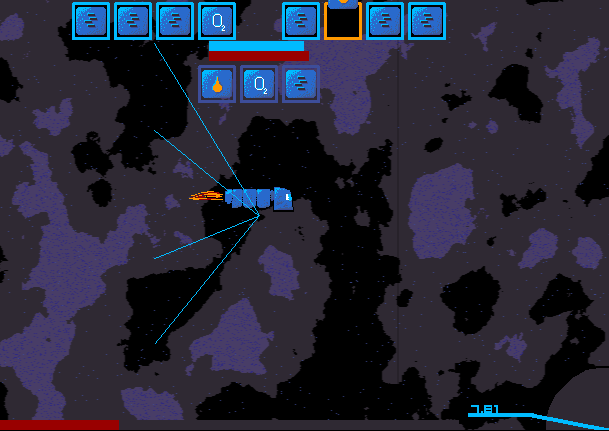
The screenshot doesn’t do a great job of describing it. The goal (for now) is to go as fast as you can. You can do this by combining two “fuel” boxes and one “oxygen” box (yes, that’s what they’re supposed to be). If your bar is full of oxygen, you get a big speed boost and it’s all randomized. Any order can be used in the fuel-oxygen combination, but if you combine anything other than 2 fuel and one oxygen, your speed decreases. Your ship also decelerates over time. And for now you can ignore the “you’re going to fast” message, because I haven’t implemented damage yet. There will be enemies and weapon combinations eventually, as I put in damage.

Eventually I’m going to make the game live up to the “trade” in the name by making this sort of arcade side-scroller take place between planets, between which you carry cargo.

And as for the rules, I’m sort of breaking the palette one. As you can see in the screenshot, when moving fast the background gets blurred. I just put this in to make tearing less noticeable, but maybe I’ll remove it later with different backgrounds for different general speed categories.

Oh, and don’t bother trying to win, all that happens is that “You won! Congratulations!” appears in the text box in the lower left and the distance remaining goes negative.

Hope the game will turn out to enjoyable.

Comments

27. Feb 2010 · 17:27 UTC
Looks like a really cool idea. It took me a while to get used to the controls and figure out what I was supposed to do, but it’s an interesting mechanic for speeding up, and the art looks pretty cool.

MiniLD 16: Combo Trader

Here’s my game. Late on my goal of about two hours ago, but a lot of that time was spent finalizing stuff (embedding fonts, testing on other computers, uploading the right version…) and it’s ready now, I think, to share.

ComboTraderScreenshot

Here’s a link to the webpage to play it.

The goal of the game is to speedily progress through a stage, without dying on the way. Additionally, after each stage you can buy commodities to make money when you finish the next stage. (You are a freelance trader.)

Controls and combinations:

Basically, to finish a stage you have to use combinations of ingredients accelerate your ship and destroy enemies so they don’t destroy you.

That said, note that the boxes that hold your ingredients are arranged so that they can be easily used with the number keys (1-4, 7-0). You have to combine three ingredients to perform an action in Combo Trader, and the order doesn’t matter. When you combine three ingredients, it does something depending on the combination it matches, and the boxes that you took the ingredients from are refilled with random ones.

Here are all the combinations so far:

  • Two fuel, one oxygen: Gives your ship a speed boost.
  • One fuel, one oxygen, one bullet: Fire four lasers at enemy ships.
  • Two bullets, one oxygen: Destroy a bunch of ships, as long as they’re behind you. (Reasoning to this: you are firing bullets without the power of the fuel, so you can only hit things behind you. Not physically accurate, but it works well enough for the game.) This combination is overpowered.
  • Any three of a single type: Has no effect on your ship. This is useful if you have too many of a certain ingredient.
  • Any combination not listed: Slows down your ship. The ingredients are still thrown away (so you can get better ones) but your ship is slowed about the same amount that three boosts (fuel+fuel+oxygen) would accelerate it.

On to the interface.

  • In the lower-right corner, there’s a speedometer, which displays your current speed, with arbitrary units. Your ship goes at speed “5″ if you don’t boost, and will gradually return to this speed over time, so you need to keep boosting to stay fast.
  • The big bar along the bottom is a progress bar. Once it is filled, you progress to the next stage. (More on stages later.)
  • On the top is the bar of ingredients. The three boxes in a row below it are the combo bar, which will hold the ingredients as you press their corresponding keys. When this fills up with three ingredients, the ingredients are combined and the bar empties.
  • In between these two bars are two solid bars: the top shielding and the bottom armor. If armor runs out, you’re dead, but your shield slowly recharges. It is best to destroy enemies using the combat combinations before they can damage your armor, as your armor only regenerates after a full stage.

The stage system I put in for now is a bit weird. When you complete a stage, there’s a Trade screen, where you see how much you earned from selling boxes and buy them for the next round.
How the system works:

  • You start out with no packages, and do a dry run. When you press ’1′ on the main menu and see the interface described earlier, you are in the dry run.
  • After completing your first stage, you see the trade screen. Press the number keys to indicate which slots you want to use to carry boxes to the next trade screen. Slots that are carrying boxes are covered with red symbols that look like an X and a + combined. In the next stage, you can still use the ingredient you see under the symbol, but in doing so you drop the cargo, and cannot sell it to make money at the next trade screen. (1 unit of money buys a box, and they sell for 5.)
  • After ten seconds (indicated by the countdown in the upper-right), the next stage begins. After completing this stage, you see another trade screen. The stage, trade screen, stage, trade screen sequence repeats until you’re bored or flash player succumbs to a memory leak I didn’t plug.

So there it is, my game of quick reflexes, tactical thought, and lame pixel-art graphics! Maybe I’ll clean up the source code and continue it later.

Comment with any question and I’ll clarify, this post was kind of rushed and I might have missed some things. :)

0

This entry was posted on Saturday, February 27th, 2010 at 9:50 pm and is filed under MiniLD #16. You can follow any responses to this entry through the RSS 2.0 feed. You can leave a response, or trackback from your own site.

Math is harder than the Tank!

Well,…actually I tried to build a nice game with the codebase I created on miniLD. Well,…haha! I started with a tank-training scenario and in that I “just” wanted to build a method that let then tank-“tube” lookAt a certain point. My engine somehow cannot handle this if the tube is child of a node that already has a rotation,…Well,..I failed in this. So I really was killed by math. I tried and thought and thought and tried…a bit too confuse I have to admit…so my weekend-project stuck right at the beginning. But if you want to start the tank-training you can give it a try here:

http://thomas.trocha.com/games/tank/tank.html

At the moment the game violates the color-constraint…I will change this at the end. Here a screenshot:

tank

Have a nice week,…

Comments

31eee384
01. Mar 2010 · 21:29 UTC
I’m probably not qualified to say this, but this idea might let you call “lookAt” without mathematical fuss. What if you made a tank position node (that never is rotated), then have both the tank body and tank turret be individual nodes within that one? Then you could call lookAt on the turret node, because the parent node isn’t rotated! I don’t know which engine/library you’re using but from the text of this post I thought I might be able to put forward this idea if you hadn’t already thought of it.

The Redneck’s Manifesto

I’ve decided to make my views on the subject of games as art known.

The text referred to in the title appears after the rant. It is a self-descriptive piece, and very ranty, but I personally think that it’s a perspective that needs to be addressed.

It’s no secret, I don’t think, that I’m not sophisticated. I’m not high-brow, I’m not much for fine art, and I don’t like conceptual… Well, anything.

I don’t drink fine wine, nor do I want to. I don’t go to art museums, and never will if I have my say. I enjoy the works of the former Blue Collar Comedy troupe. (Who talk about such heady subjects as the anaesthetics given during colonoscopies and mole-covered relatives)

I played Passage, but found it incredibly dull, and didn’t enjoy Gravitation much more. (Okay, I admit, Silent Conversations was pretty fun) I like Metal Slug, Urban Terror, and Custom Robo.

I am here to declare my place in the indie game developer community. I am here to defend storyless shooters, here to preserve stupid fun, and to be a champion of  chopping up generic monsters in a generic dungeon as a classic to be revered. I am here to speak against haughty elitism, stories that pretend to be games but aren’t, and a-priori work simply for the sake of appearing clever.

I’m a redneck, and I’m proud.

Thank you.

—MrDude

Comments

01. Mar 2010 · 14:04 UTC
Agreed. It’s like how some people just throw big blobs of paint at a canvas and pretend that’s art. There always will be some suckers to believe them and give them the attention (and money?) they want.
01. Mar 2010 · 16:16 UTC
I don’t get why people keep deciding they need to rant on art games so much. It’s perfectly okay not to like them and all, but why pick on art games in particular? Surely there are lots of other games you don’t like, too.
09. Mar 2010 · 14:38 UTC
Wow, speaking of Passage, I totally forgot about Jason Rohrer. We are totally on opposite sides of the artsy game divide. I went to school where he lived and read one of his books. I wonder if he still lives there?
01. Mar 2010 · 20:24 UTC
I just felt like it needed a counter-rant :)
03. Mar 2010 · 07:32 UTC
I can sympathize with this point of view (played Passage twice; thought that there have been much better treatments of the same subject). There are people who will verbally crucify you, condemn you as a philistine, etc. if you confess to not liking a game that is considered part of the Respected Canon of Art. It’s worth stating that this is a perfectly respectable point of view to hold.
03. Mar 2010 · 14:50 UTC
Taking pride in ignorance is silly and not a positive character trait at all.(Not about not liking art-games, more about self identifying as a red-neck and making the claim of not thinking)
XIX
03. Mar 2010 · 17:29 UTC
how to combat art games
09. Mar 2010 · 11:38 UTC
I don’t think anyone really hates ‘artsy games’ as such, even if they say so. It’s the same thing with art. You can hate specific pieces and styles, and that’s fine. Others (especially the artists whose work you’re demeriting is how they make a living) may say that you just don’t understand their work. That’s exactly it. There are different ways to appreciate art, and there’s no right way. Some people just can’t appreciate abstract art and think that everything should be as realistic as possible. Some people look at an abstract piece and say “I see what you did there” or “How did you do that?”. Some people like to buy paintings or games that encourage altered states of mind (if you catch my drift). Some people think owning/playing certain art makes them cool to their friends. All we can do is be supportive to game devs who make artsy games. If you don’t like it, then don’t play it. Then, if you ever come up with an artsy idea that intrigues you, you won’t feel lame for ranting about them previously. Just consider how nice Bob Ross was. Could you imagine him slamming Jackson Pollock? My point is to avoid comments which encourage infighting and don’t say things you might regret. Other than that, express away!
10. Mar 2010 · 10:25 UTC
Oh and one other thing that annoys me about those artsy games. Making your game have huge pixels doesn’t make it more artistic, it just makes it more pixelated.
11. Mar 2010 · 09:17 UTC
While some good pixel art certainly exists, 95% of the time it’s used as a justification for crappy graphics: “No, my programmer art isn’t bad. It’s retro!”

Ludum Dare 17 – April 23rd-25th Weekend

I’ve received a few requests now, so here’s the announcement nice and early.

Ludum Dare 17 is scheduled for April 23rd-25th weekend. Themes can be suggested on the wiki. Specifics will be announced as the date gets closer.

without a reason – finished

Sorry I’m late.  Couldn’t make it last weekend, and this weekend was spent between making this and getting caught up in the Canada/USA men’s hockey game.

This is my game

This is my game

Controls are 1234 7890, and it’s a 2 player game.  Things collide with each other when they are of different color and are not blending into the background.  Instructions are in the ReadMe.  This game started off as a game about strategy and ended up more a game about everything being completely unmanageable.  Or maybe it’s just me.  I’m terrible at this game is what I’m trying to say.

This is my first Ludumdare entry, so any constructive criticism is welcome!

http://www.ludumdare.com/compo/minild-16/?action=preview&uid=1752

Also I maintained an off-site journal about the making of, because I didn’t think of just putting it up on here.  You can read it here:

http://www.faqr.org/ryan/tbc/?cat=49

MiniLD #17 teaser: uncertainties

So I had this great MiniLD idea, but it turned out that HybridMind completely ripped it off, without even knowing it!
Also, since he did it a month before me, it’s not really a ripoff, just bad luck for me. Stupid MiniLD booking a year in advance…

So here’s what we’re gonna do: I’m going to tell you what I had in mind, and if enough/any people are interested (despite the close resemblance with the previous month’s Mini), we’ll go with it anyway.
If not, I’ll find a new idea shortly. Maybe you could even chose between the two themes.

So, here it goes:

Constraints

Dear, dearer and dearest LDers,

in anticipation of this coming event, and giving in to my never-ending love for the golden times when awesome games held into 1 MB cartridges, I prepared for you a tiny game engine, humorously named:

Retro (the Recursively and Erroneously Titled Retro Object)

It is a simple and very constrained game engine with a Lua and C API, offering the following characteristics:

– Low resolution (160×100) with 1-4 zoom, plus smooth scaling algorithms
– Palette based (8 colors including one optional transparent)
– Old console like input: arrows, A and B buttons, start button (mapped to keyboard, and partial gamepad support)
– Total source + assets shouldn’t weight more than 1 MB

It presents as binaries (for GNU/Linux and Windows, MacOS X if a good will makes the port) to which you feed a Lua source file in which you define callbacks such as update(), keypressed(), etc, and use an API that allows you to:

– Load images/palettes
– Blit images to screen
– Write pixels to screen
– Modify palette on the fly
– Load sound files
– Play sound files
– that kind of stuff

For those who do not desire to learn/use Lua, I intend to make a similar C API, so that it could be used from any C-friendly language (but then it requires you to compile the game yourself, thus limiting portability).

In fact, if you don’t like the engine at all, you can even make anything you want, provided that you stick to the constraints and use no library other than simple IO (basically SDL + standard C/Lua). The idea was just to give the same basecode to a bunch of wizard gamedevers and see what happens.

So there it was. Feel free to express yourself in the comments of this post so that we can decide together what is the better option. Also, the engine is almost entirely coded but it still needs a big evening to finish things up,so if no one is interested, I’ll probably play the lazy card, and just announce a one word theme.

Let me know, LDers!

Comments

mjau
08. Mar 2010 · 21:54 UTC
I like the idea, but the timing could be better, yeah. Still, if you can’t come up with a good alternative, it’s much better than the lazy option.
08. Mar 2010 · 23:10 UTC
I don’t really like the idea, since it seems like a lot of people would have to spend time learning how the engine you made works and either learn LUA scripting or learning the API you provide. Mostly, it just feels like saying “you must use game maker” or something.
Gopher
08. Mar 2010 · 23:37 UTC
Sounds like an idea I was toying with myself you had me until “lua.” I’d likely enter anyway, but if you stick with this theme a C api would be highly appreciated.
09. Mar 2010 · 00:40 UTC
Come on people. “It’s bad because I’d have to learn something”. That won’t fly. Learning Lua in the context of this specific basecode/framework should be a lot easier and more focused than learning it in a general bottom-up way for making your own game from scratch. If a small example game (shoot the invader) is posted to show how it’s supposed to be written/used, then it wouldn’t take many minutes to figure things out from looking at that code. Quick links to required compiler/tools would also be good.

Can’t say if I will join or not, but I definitely like the premise of many small retro games being made under similar technical restrictions. A compiled “pirate cart” should be possible if this is done properly, I’m sure. Neat selection menu in appropriate visual style, launching games seamlessly.
Gopher
09. Mar 2010 · 03:29 UTC
I’ve used it before, I’m just not a big fan of Lua, but that’s entirely a personal objection. Otherwise I like the theme. I dunno about actually releasing the actual api early, since it doesn’t sound like he intended there to be any theme other than the contraints of the “platform,” but releasing some kind of function reference for the api in advance seems like a good idea, assuming such a thing exists.
Tenoch
09. Mar 2010 · 05:18 UTC
Thanks for your first comments. A few precisions that I forgot to mention in the post:
09. Mar 2010 · 20:15 UTC
If there is a C API, then you can use any language you want. :)
09. Mar 2010 · 20:29 UTC
I actually really dig this idea, especially if (as DrPetter mentioned) we can build the whole weekend’s collection of games together into one big (well, little) retro pirate cart-like thing. Very sexy.
Sos
10. Mar 2010 · 06:37 UTC
Sorry for being straight, but I won’t do it thisway. I want to have fun making a fun game about fun stuff, as opposed to scratching my head for ideas that would fit in a tiny screen using tiny set of colours.

DIY game selling system!

Hi,

I just set up a community website.

ghbrvlowabrvfladberogvlwrvfwlo games

It’s aim is to enable game developers to sell their games in a neat and hopefully profitfull manner.

Unlike e-commerce websites, it works in a different manner. It values quantity over quality, by accepting all the games you post there. The games are accepted until 700MB limit is reached. when that happens, I will assemble a CD ISO containing the games, a neat autorun menu for them, and a booklet for printing. Then I will distribute it online (probably through torrent protocol), so everyone can burn it and sell it themselves.

I think you guys made many games, that you think are of too low quality to sell, and this is the opporturnity.

I’m really looking forward to see some LD games there. also, tellme what do you think of this idea.

PS. It’s the catchiest domain name ever :)

Mini LD #17: Retro engine released!

Since several persons on the compo blog and the IRC channel seemed interested in my original idea, despite the closeness with the previous Mini, I am hereby releasing the aforementionned Retro engine!

Weee!

Source code, Linux binaries, Windows binaries

As you can see, it lacks terribly of Windows binaries. I’m terribly sorry, but couldn’t get my cross compilation thingy to work. It usually goes flowlessly, but here I’ve been battling for an hour, and I gave up.

EDIT: Thanks to Sos, we now have Windows binaries. Yepee! Thanks a lot to Sos. All hail Sos!

If someone with a good heart would like to, it can be built as follows: compile io.c retro_lua.c and lua_api.c into retro.exe. That’s all. But you’ll need dev libs for SDL, SDL_Image, SDL_Mixer and Lua 5.1

First one to publish a windows binary will win my eternal gratitude, and a cake*

Both source and Linux distribution contain full documentation (I hope), and an example game to help you get started.

And, as promised also, there is (a bit more) than a week before the actual Mini LD, which will therefore be held on the week end of the 20-21 of March 2010. No worries though, we’ll have the usual “take 48h when you want” policy, or even more if you like.

Okee. I hope I didn’t forget anything. Of course, don’t hesitate to ask questions on IRC and in the comments. Meanwhile, I’m gonna catch some z’s (I just love this expression, sorry).

Yours truly,

Tenoch

* The cake is a lie.

Comments

31eee384
12. Mar 2010 · 03:35 UTC
Great! I have no idea what I’m going to make yet, but I guess that’s a good thing.
Sos
12. Mar 2010 · 09:03 UTC
Heeeeeeeeeeeeeeeeeeeeeeeeeeeeeerewe go :)
Endurion
15. Mar 2010 · 14:14 UTC
Thanks, but what makes you think VS Express can’t do libs?

Choose Win32 project, on the next dialog in Application-Setting choose “Static Library”.
13. Mar 2010 · 03:15 UTC
I’m using 64bit Ubuntu 9.10 and get the error “./retro: error while loading shared libraries: liblua5.1.so.0: cannot open shared object file: No such file or directory” when I try to run retro. This is especially odd since /usr/lib/liblua5.1.0 clearly exists. I can also enter the Lua interactive interpreter just fine where it says I have version 5.1.4 installed. I’m not sure what to do to get this to work.
13. Mar 2010 · 14:31 UTC
Rebuilding it worked. Thanks.
sfernald
13. Mar 2010 · 20:22 UTC
Well, late to the party, but I have another option as well.
sfernald
13. Mar 2010 · 22:32 UTC
Oh, can I have some of that cake too then??
sfernald
14. Mar 2010 · 20:50 UTC
Here is one more version.
micpringle
15. Mar 2010 · 11:50 UTC
Anyone been able to get this up and running on a Mac yet ?
Reid
18. Mar 2010 · 06:53 UTC
Wrote up a little something. Not really feeling well right now. So, let me know if anything is cockeyed or doesn’t work. I’m running 10.6.2 on the most recent revision of the 2.53GHz, 320GB mac mini (if that matters).
31eee384
16. Mar 2010 · 02:44 UTC
This wasn’t big enough to add a new post for, so I’m putting it in a comment.
31eee384
20. Mar 2010 · 00:44 UTC
Will there be an official start post re-stating the rules, or should I just go ahead with stuff?

Photos+Video from the Ludum Dare Meetup @ GDC 2010

LD01

Thanks everyone for coming out and making the meet-up such a huge success. We had more than 20 people show up, 19 of which stuck around for a gathering where we brought disorder to the Moscone food court. Hit the jump for pictures and video.

#gallery-1 { margin: auto; } #gallery-1 .gallery-item { float: left; margin-top: 10px; text-align: center; width: 33%; } #gallery-1 img { border: 2px solid #cfcfcf; } #gallery-1 .gallery-caption { margin-left: 0; } see gallery_shortcode() in wp-includes/media.php LD01 LD02 LD03
LD04 LD05 LD06
LD07 LD08 LD09

0

This entry was posted on Monday, March 15th, 2010 at 12:15 am and is filed under LD - Misc. You can follow any responses to this entry through the RSS 2.0 feed. You can leave a response, or trackback from your own site.

Robot Wants Kitty Rocks Kongregate

Mike “Hamumu” Hommel‘s recent Ludum Dare game “Robot Wants Kitty” is rocking the charts at Kongregate. This post-compo version features music by DrPetter, and numerous enhancements to the original game.

Kitty

http://www.kongregate.com/games/Hamumu/robot-wants-kitty

As of right now he’s #2 on the monthly top games, with well over 350,000 plays! Wow!

Show your support! Go to Kongregate, play it, and give him 5 stars because you love Kitty. You do love Kitty, right?

Comments

17. Mar 2010 · 18:29 UTC
Was #1 nonstop until a couple days ago… grumble grumble. Feel free to play and rate the game that IS #1, because it’s not as good as Robot Wants Kitty! Of course, a bunch of the games rated below me are better than mine, so don’t rate those.
Xenthar
18. Mar 2010 · 07:09 UTC
Very good game! Good level design! :)
31eee384
19. Mar 2010 · 23:33 UTC
Played, rated. Best flash game I’ve played in a very long time. Favorited, for what it’s worth.
20. Mar 2010 · 19:48 UTC
Noooo! It’s 4th! But congrats on breaking 400k.

Mini LD #17: Go!

Since I finally managed to wake up, I guess it’s time to officially launch the compo.

Theme: Constraints (déjà vu?..)

To participate in the competition, you must use the provided “Retro” framework (links at the bottom of the post):

Retro (the Recursively and Erroneously Titled Retro Object)

It is a simple and very constrained game engine with a Lua API, offering the following characteristics:

– Low resolution (160×100) with 1-4 zoom, plus smooth scaling algorithms
– Palette based (8 colors including one optional transparent)
– Old console like input: arrows, A and B buttons, start button (mapped to keyboard, and partial gamepad support)
– Total source + assets shouldn’t weight more than 1 MB

If you don’t like Lua, there is a C API as well, but you’ll need to compile your game yourself, while the Lua based games should be (hopefuly) portable. If you like neither of them, you can also program your game in any language/platform, provided that you stick to the given constraints (and use no external library other than what is provided by standard Lua/C)

Note: the Retro thingy doesn’t actually check if your game weighs more than a MB or not. Furthermore, there seem to be problems with “light” music formats like XM, so if the size limit is exceeded because of music, it’s ok.

Note 2: remember to read the documentation! It containts important and valuable information. The packages also contain an example game.

Optional themes: Cute but Evil or Legendary Cosmic Monsters

If you have no inspiration whatsoever, you can use this secondary theme list to get you started.

Schedule

It’s a Mini, so don’t worry too much about time limits. Take 48 hours when you can/want or even a bit more if you feel like polishing your game.

Downloads

Thanks to the community, we have several Retro binaries to use. They should be compatible.

Source, GNU/Linux (32bits), Windows (MinGW)Windows (MSVC + more options), Windows (LuaJIT version), Mac OS X

See previous post + comments for more details

Final words

Oh well, have fun :)

Good luck!

Comments

Sos
20. Mar 2010 · 11:15 UTC
Using indices instead of pointers makes things tough (e.g. procedural stuff). I’ll try to modify that, if I fail I’ll go with using allegro instead of your lib.
20. Mar 2010 · 18:07 UTC
Nice engine. 😀 However, so far today all I’ve got is a vague idea and a title screen I drew in 5 minutes in paint. I am not good at productivity.
Six
20. Mar 2010 · 21:43 UTC
Fun little engine, I’ll be trying to chip something out in Lua during spare time in the week. Also, in playing around with it a little I’ve found 2 good ways to crash it :)

-putPixel with negitive x or y coordinates = instant crash.

-putPixel with x or y largers than WIDTH-1 or HEIGHT-1 (respectivly) will loop to the other side eventually, but often causes a crash when you try to exit.

Anyone else found any problems so others can avoid them?
31eee384
21. Mar 2010 · 20:13 UTC
If people want to fix the memory leak, it’s actually really easy if you are using the source.

My Compo Game in Progress

I don’t know why, but I seem to do better when there are constraints when making a game. Somehow I think the pixels and the limited palette inspire me to try harder for some reason. Been focusing on the artwork and sounds for my game all day. Not a big fan of Lua, but it makes it really easy to test the art and animations in game.

The game I’ve come up with is based on the question, “Who would win a battle between a wizard and a warrior?” Thus, the name of it is Wizard Vs. Warrior. I’ve decided to make it a kind of adventure. You are a warrior that has to kill the “evil” wizard. I think I got the idea (or at least the inspiration) from Conan the Destroyer actually. Simple concept, but I’m having a ton of fun with it. I’ve got a lot of the graphics done and soon I’ll start putting it all together. This game has been so fun to make so far. Hope I’m able to finish it.

This one has lots of cool pixel art. Here are some screenshots:

screenshot2

screenshot1

Comments

21. Mar 2010 · 11:30 UTC
You didn’t get the idea from Wizards & Warriors (one of my favorite games, by the way)? Kuros vs. Malkil ftw

Progress, just missing the actual game part

Had something I wanted to try at this sort of low resolution, and after reading through a paper and a fair bit of fiddling I’ve got the basics working. Not exactly an original idea, but I thought a nice improvement would be to actually try and make it fun. Am I being vague enough here? A screenshot might help a few people catch onto what I’m talking about:

Screenshot

Anyway, will try to add more tomorrow, as it’s far too late already.

Falling (FAIL)

Ok, so I only had about two hours to attempt this, so I tried to keep it as simple as possible.

It looks cool, but unfortunately all you can do is fall, there’s no collision or anything, and the scrolling is messed up.

screenshot
However, I didn’t read the docs ahead of time and didn’t realize just how constrained the constraints were. My initial plan was to just use a large image with the whole map predrawn, and use getpixel for collision. But retro engine wouldn’t load large images, or allow getpixel, or blit a partial image. So I had to draw all the tiles. I don’t blame the engine — I just should have taken a closer look before i started, and I probably would have gone with something more putpixelly and less blitty.

On the bright side, it was a good excuse to play with TileStudio and I figured out how to get maps of it and into lua. And it was pretty much the first time I’ve played with lua in years.

Anyways, the whole mess is here:

falling.zip

But it’s not worth downloading, unless maybe you want to use the .tsd file for tile studio.

Still, overall, fun idea and i like the contraints. I wish I had the full weekend to work on this. Next month, I’ve got LD17 blocked off on the calendar, looking forward to that.

FLUDONG – Po(ng)etry in Motion

Image7

There’s a few buggy bits, I somehow got it crashing when you try to do smooth scaling, the code became a beast and I have no idea how well it’ll run on other computers. Many more tweaks that could be made, but it’s done enough to throw it out there. It’s pong with fluid dynamics, kind of like plasmapong in that I used the same paper for the fluid dynamics code, however I tried to actually make the game side more pong-like and fun to play (I always found that plasmapong was beautiful to look at, but the game wasn’t exactly ‘fun’).

I did find out pretty quickly that even at low res, it’s probably not the best idea to do fluid dynamic simulation in a scripting language. Luckily the LuaJIT version of the engine that sfernald posted in this comment (you can download a bare version here, minus the example game) actually did provide a huge speedup and made it playable on my compy.

You can download the actual game code here, just throw the files in the same folder as the LuaJIT executable and run that. More tasty pixel fluid dynamics after the jump.

(EDIT: replaced rar after fixing a small problem, where it told you you lost when you won, and added 2 more palettes. On a side note, sometimes when running it goes very slow for me, in which case if I close and start again it’ll normally be fine)

Image0

Image1

Image5

Image6

Image2

Image3

Image4

P.S. SEKRIT CODE!

Comments

allen
22. Mar 2010 · 20:04 UTC
Wow this is pretty cool. It’s like a retro version of plasma pong.
23. Mar 2010 · 11:48 UTC
Pretty nifty. Though I thought it froze up when I scored, it turns out I just needed to press ‘start’ again.
Gopher
23. Mar 2010 · 12:50 UTC
I had the same reaction, thedaian. The fluid effect looks great! I felt compelled to keep playing until I won, and apparently I’m terrible at pong, so that took a while…
Tenoch
26. Mar 2010 · 04:44 UTC
Awesome! A 48h Plasmapong. It’s true that the low resolution was a good context for heavy field dynamics. And as the others said, it is actually fun to play.

Great work!

Half an entry

Didn’t get to work on this as much as I intended this weekend, but I like the concept so I”ll probably try to finish it later.  I’m fairly pleased with the progress but I’m embarrassed at how terrible the code got, and shocked at how quickly it got there. First thing when I resume, I think getting the bugs out of the cable code is going to require completely rewriting portions of it to be rational.

unfinished game
:edit: forgot to link the zip earlier. Click pic for download; includes the statically-linked win .exe, but the main.lua file should(?) run with any working retro setup. :edit2: smaller zip, omits RetroEngine.exe

Poached the concept from the #17 suggested themes… hopefully the theme won’t win, or I’ll end up feeling silly next month. Going to be a puzzle game where the player is working their way through a derelict ship trying to get it’s systems back online using only their collection of trusty Omnicables to transfer power, air, and fuel between systems.

Comments

23. Mar 2010 · 11:50 UTC
This looks like a pretty fun concept. If the theme doesn’t win for LD17, maybe you should finish up the game and do something with it.
Gopher
23. Mar 2010 · 12:46 UTC
thanks thedaian, I’m planning to finish it up regardless, at this point I’m mostly debating whether to fix this incomplete compo entry or just start from scratch without retro. The code is really just horrifyingly terrible and needs to be rewritten, and the retro engine was great for a compo but if I’m planning on distributing it outside the contest it won’t register as a plus to most players, so I’m leaning towards leaving this version as-is and restarting the idea in python. I’m tempted to go on about the planned features, but I find the more I do talk about them, the less likely I am to implement them, so I’ll just say I should have another version (whether in lua/retro or not) later this month, which will actually be playable and won’t have the string bugs this version has. The LD48 entry might not have been finished, but as a proof-of-concept prototype of the design I’d call it a success :)