LD18 August 20–23, 2010

AVOIDAL – Post Compo Version!

AVOIDAL – Post Compo Version!

AVOIDAL - Post Compo Version

I’ve made a bunch of improvements to AVOIDAL since the compo and I’d love your feedback!

Play the post compo version of AVOIDAL here

The LD48 official compo version for judging is here now

Changes to the new version:

  • Added 1 second of invulnerability if you take damage (this helps a ton!)
  • Rebalanced the difficulty curve to make it progress a tad slower
  • Mines spawn a tad further in from the edges to help player not get stuck on walls as much
  • Reworked How To Play screen to be simpler and clearer
  • Changed ‘Energy’ to ‘Health’ in UI
  • Fixed some sound volume and playing issues
  • Added a nice visual effect of little random twinkling stars in the background

I’m gonna keep listening for feedback and working on this game but I think it is pretty close to me calling it done at this point. Thanks for the great feedback I’ve gotten already to everyone who left me comments on my rating page.

Tags: avoidal, feedback, flash, improved, postcompo

Comments

PsySal
25. Aug 2010 · 01:42 UTC
Great, I really like it. The game does a nice job of balancing “avoid” vs. “get near to”, really the blue and red stars are the core of the gameplay.
Sparky
25. Aug 2010 · 06:32 UTC
This is fun :). I’m glad to see you taking the time to develop this further. Sorry I wasn’t on earlier today- I was playing Go with a friend. I’ll be around tomorrow, however. And you can always reach me via email: septagon at gmail dot com.
Eckolin
26. Aug 2010 · 19:10 UTC
The highscore pages are very slow for me.
28. Aug 2010 · 08:34 UTC
@Eckolin: Awesome–glad to hear it. I’ve been really enjoying playing this version too. Getting near to wrapping it up! Mochi support still hasn’t gotten back to me with any tips as to what is lagging the leaderboards though. It crashes my flash debug player from the IDE. Works online but lags like hell. I didn’t change anything is the weird thing it just stopped working far as I can tell.
Eckolin
30. Aug 2010 · 18:09 UTC
One more thing… Clicking resume moves the robot to the center of the field, from wherever it was, which might be a dangerous path. Is this an unintended feature?

New Server

My game has been moved to a different server with plenty of bandwidth.
Now hosted here

First Post-competition Build

Hi folks- I’ve been refining my Ludum Dare 18 game since the competition ended, and I’m ready to release another build. This is still an early version. The game will see some major changes before it’s done. Changes in this build include:

  • lots of tuning
  • wider field of view
  • circular view
  • indicators which display the direction to castles
  • improved notification when our castle is attacked
  • improved animation for the tiny creatures (the ones that come out of the creature pumps)
  • pulsating bubbles
  • green enemy bubbles
  • carried castle pieces now form a train behind our character
  • transition animations for castle building

http://vacuumflowers.com/temp/bubble_tag_current

SS-2010-08-25_04.03.52

The next step is a major one- I’m going to alter the flow of the game so castle upgrades are rarer and more significant, and also focus on making sure there’s more of a swing between offense and defense. To accomplish this, I’m currently thinking I’ll add destructible protective walls around castles. These walls would bear the brunt of most attacks, protecting vulnerable turrets and other components. Walls could be repaired by expending resources, which would be collected during exploration. More builds soon!

Comments

25. Aug 2010 · 13:51 UTC
Amazing work. I just love the “look” of the game. Walls would be fabulous.
Sparky
27. Aug 2010 · 21:21 UTC
Walls are in! I’m making a few more changes, and I’ll upload a new build later today.

Mind Control Monster Madness – The Postmortem

Okay, first off, I’m going to say this shouldn’t really be a postmortem as such. Why? Because I’m going to develop my game from here into something much better! So it’s not really dead yet :)

Mind Control Monster Madness

Anyway, the final game, in my opinion, was pretty ropey. Mostly the controls were horrible, with the camera zooming off from here to there whenever you click on something. But also the game lacked a lot of clarity. The gameplay isn’t explained very well at all, and it’s very hard to tell when you’re clicking on a monster and when you’re clicking on land. This is all stuff I fixed up for the Jam version, as best as I could. I still think it’s hooribly awkward to play though.

Mind control to Major Tom...

I thought it was a disaster when I submitted it on Monday morning (or Sunday night depending on where you are!), but playing it again now I can see a lot of value in it. The rock-paper-scissors mechanic on the monsters works a treat, and because they differ in other attributes (most notably speed), it makes it weighted in a way that’s quite interesting to play.

For example, dragons are the fastest monsters, so you normally want to get them first. You can use them to beat up the Godzillas. But you need a certain number of Godzillas on your side to beat up the turtles, otherwise you’ll get screwed by turtles. You can’t mind-control every enemy fast enough, so you need to start fights to defent your control tower. This means that you need to think on your feet at all times, and judge what’s the most pressing issue on the fly.

the monsters in action

That, to me, is nice gameplay, and it’s a shame the concept doesn’t really shine through because of all the other issues with the game. That’s why I’m going to work on it more and make a decent game out of it.

So what went wrong?

Time. Time is the enemy of us all! I think I suffered a dent to my productivity due to travel. I spent 8 hours travelling on the Saturday, to Cambridge and back, to spend time with the Cambridge Friendship Club, who were jamming for the weekend. And, of course, while I was there, I spent a lot of time chinwagging. But I do not regret that at all! It was great to meet everyone, I had good fun getting to know other developers, and it was motivating to be in the same place as a bunch of other people working on their own projects. Without other people around to chat to I would have gone stale very quickly!

The train journey wasn’t too bad. Instead of starting programming right away, I planned out my ideas on the train, thinking through each aspect until I was happy with my ideas. But other than that it is hard to program while on a train or metro. I managed a bit, but didn’t really get stuck into it.

Was I too ambitious? To be honest, I don’t think this was a massively ambitious project. It was fairly simple, and there weren’t many gameplay elements to consider. The problem is the indirect control style. You don’t move your guy by pressing a button and he moves. You have to choose a monster monster, and click on something to tell him to do some command, and he’ll work out the rest himself. All the elements, the user interface, the AI, the camera controls, and so forth, were very much intertwined. If I’d made a platformer and the enemies’ pathfinding didn’t work it would be fine, but if the pathfinding were bust in this game then the whole thing would be unplayable.

The pathfinding, simple as it was, was buggered for so much of development, mostly because of silly typos of single forgotten lines.

So I think in that respect, I wasn’t overambitious on the amount of content required, but having so many elements that needed to intertwine and work together meant that it was only very late on when I had some thing that was playable at all. I spent a lot of time wrestling with some nasty bugs, some of them caused by tiny little things (like forgetting to put a “break” in a “switch” condition), and by the time it all came together I was too tired to really make it all user-friendly, making the whole game look awful.

But I don’t regret doing it like that, because at the end of the day, had it all come together then it would have been great fun. Maybe I just needed a couple more hours earlier in the day, or maybe a shorter train journey. But ultimately I took a gamble. I knew I was making a game that would either work great or not work at all. The gameplay was self-generating and didn’t need a lot of content (graphics, dialogue trees etc.) to make it work. And this time it didn’t work. The game was fine, but the interface makes the whole thing a struggle to play.

I’m glad I gambled, because now I have a game that could be developed into something really cool. Looking back I’m much happier than I was about it when I submitted it. I thought it was complete tosh and was actually quite depressed about it! I’m glad I don’t feel that way about it now 😉

The game was a failure, sure, but a failure I’m very happy with, because it was so close to being a resounding success.

Tags: postmortem

Comments

25. Aug 2010 · 10:10 UTC
Also the colours are all really pale. I don’t know why I did that… ^^;

Windows and Linux static builds

I’ve just gone through the pain of booting an old WinXP box that would want to upgrade (and so, with some reason, I’m sure there is a reason, would eat up all my RAM and start swapping like hell) without asking me, installing python, PySFML and cx_Freeze (well, I agree, that’s more complicated than “aptitude install python2.6 python-sfml”, but hell, is that so hard? I mean, when your system isn’t responsive because of Windows Update…).

As a result, you have a Windows build! (and a Linux static build since I wanted to make sure everything was ok before attempting to build the Windows version)

http://www.ludumdare.com/compo/ludum-dare-18/?action=rate&uid=2432

My Timelapse Video

I didn’t quite have enough time to finish even with the extra jam day.  I am still working on it and I hope to bring it to completion relatively soon. In the meantime, enjoy this timelapse video of me working on the game.  It covers 32 hours worth of work over a span of three days.  More information is provided in the YouTube video description.

Link to ArmchairArmada's LD18 timelapse video

Link to ArmchairArmada’s LD18 timelapse video

Tags: desktop, timelapse, video, youtube

Stop That Hero! Ported to Win32!

I’ve updated my LD final entry page, but I wanted to let you know that I finally created a Stop That Hero! Windows port (2.2MB)!

Now you have no excuse not to play! Well, assuming you don’t use a Mac. Or some other OS. Then you have an excuse.

0

This entry was posted on Wednesday, August 25th, 2010 at 1:29 pm and is filed under LD #18 - Enemies as Weapons - 2010. You can follow any responses to this entry through the RSS 2.0 feed. You can leave a response, or trackback from your own site.

Postmortem: “The Enemy of my Enemy is my Heat-seeking missile”

So its been a couple of days since my game went up, and I thought it was high time I did a post-mortem. To give a bit of background: this is my 2nd flash game ever (number 3 is in the works), and was my first time doing a Ludum Dare, so I’m fairly new to the whole experience. Overall (spoiler alert!) it was an awesome experience that I’m looking forward to repeating(end spoiler).

The game can be found here – I’m looking to polish it up and do a re-release, so any suggestions are more than welcome.

Now, onto the experience:

Part 1: Brainstorming

My brainstorming session involved me, a whiteboard (pictured below), and Google. The first thing I did was to break down the theme into its two important points: Enemies, and Weapons. Ultimately, the idea of enemies proved to be the more interesting of the two.

Brainstorming!

Brainstorming!

Then I looked up google for sayings about enemies and weapons, and noted the most interesting down. The two that stuck were ‘Know your enemy’ and ‘The enemy of my enemy is my friend’. The first implied a game where you turned your enemies into weapons, but you had to figure out who your enemies actually were. The latter made this more interesting by suggesting a complicated web of alliances which.

These two basic ideas are what informed ‘The enemy of my enemy is my heat-seeking missile’. Essentially, the idea is that you find out who your enemies are, find out who their enemies are, and turn them into heat-seeking missiles so they kill your enemies.

At first, I wanted to use a mechanic of asking people questions to find out their allegiances, but this struck me as way too complicated and messy for a 48 hour game. This lead to the idea of using a colour-based detector for allegiances, and so the ‘allegiometer’ was born.

I’m pretty happy with the basic ideas that came out of this initial brainstorming stage, though they may have been slightly too complex to explore in terms of level design and balancing (the programming aspect turned out to be fine). Which leads us to the next stage:

Part 2: Coding and all things new and shiny…

I should probably mention at this stage that this is my first game that required any level design or sprite animation (I’ve done the graphics programmatically in the past). At this stage, I was putting off the graphics, but one of my first steps was to find a decent level design program and test it. I ended up using Ogmo, and am ridiculously happy with it as a level editing tool.

I got a framework together (using flashpunk as a base) that would read in the map, place the player and the bad guys in and have them interact. I’m really happy with my collision and basic movement code – I simply got it working in a way I hadn’t really done before.

At about hour 10 I hit a bit of a brick wall. First, there was a few dodgy dependency-based bugs (the kind of ‘include’ loops you expect in C or C++, not in Actionscript), and secondly, there was trig. At this stage, I have to emphasise how much I hate trigonometry. I’m not bad at maths, and really enjoy most math-based aspects of game programming. Trigonometry is not one of them, and it seems to come up every god-damn time. There’s too many cases that I never seem to get right the first time, and it often degenerates into guesswork as I get more and more frustrated.

In this game, the trig problem was the angle to point the missiles at as they were rising (so they’re pointing at the target at the top). Ultimately, I got it working if the target was below them but not above, but it took so long that I needed to just leave it and move on.

Overall, I’m pretty happy with the code base I made. There’s some real dodginess in the scoring screens (magic numbers galore), as they were done really late, but otherwise it’s a fairly elegant system.

Part 3: Graphics, (aka why there are Summersaulting Robot Ninjas)

At about hour 13, I started working on the graphics. I first tried to do silhouetted stick figures, but without a tablet (hell, with a tablet might not have helped) I suck at drawing, so Robots it was!

Robots were easy, and I’m pretty damn happy with how they look in the end, considering the timeframe and my ability. One or two frames in the transformation into missiles were a bit dodgy, and there’s a lack of a jump animation.

The lack of tilesets was probably a good move given the timeframe, but the simplistic nature of the graphics did hurt the game a little. It’s something I’ll definitely look into in the future.

I’m particularly proud of the summersaulting ninja robots that emerge from the terrain (this was half animation, half programming)…

Part 4: Level Design

This is the part that probably suffered the most due to the short time frame. I managed to create 20 levels, which was great, but without any playtesting, the difficulty curve was way off and the explanations of mechanics untested. In addition, any playtesting I did was kinda defunct, as I knew what the allegiances of all the robots were (as I had just placed them). So yeah: no playtesting = bad.

I think the levels I came up with demonstrated a decent range of the ideas that could be explored with the mechanic, but often I erred on the side of too easy (apart from a few of the later levels, which go the other way) or on the side of too guess-like. The mechanics of the game can make it easy for levels to devolve into guesswork, and that’s something that I worked to avoid, sometimes more successfully than others.

Part 5: Mechanics/Conclusions

In terms of the overall mechanics of the game, the problems are more in omissions than in alterations: a ‘duck’ feature would be good, and different types of robots would allow me to better emphasise types of gameplay.

One thing I didn’t really get to explore was the idea of the colour wheel. The colours used are the primary and secondary painting colours (not digital colours), and a colour will befriend colours that are next to it, and be enemies with all the others. Even though this was never really used in the game, the decision to do this allowed me to have a pretty nice choice of relationships within levels without ever giving up on consistency.

Another issue is probably the ease of simply killing the evil robots, and the rigidity of the win conditions. Sometimes I should have made it so that the level ends after the timer counts down, and other times it should have put a loss condition of when certain required resources were destroyed.

Overall, I was really happy with this game as a 48 hour attempt. I’m really interested in feedback so I can fix it up (particularly anything on particular levels and their difficulty), so let me know if you have any.

Comments

snowyowl
26. Aug 2010 · 08:34 UTC
I loved your game! The allegiometer wasn’t as difficult to work out as you feared, since the robots didn’t change allegiance if you restarted the level, so you could spend the first pass scanning all the robots and then just restart and shoot the ones you don’t like.
pdyxs
27. Aug 2010 · 02:06 UTC
Thanks! Great to see you enjoyed it, and thanks for the feedback.

Journal via archaology

Since this was my first Ludum Dare, making the game Alpha Channel, I didn’t make an effort to post my progress as it happened. However, through the magic of git, I’ve pulled some old versions up and seen how things developed. Interesting to see how the game progressed and if you have git you could also look at the progress made throughout the development via the repository at github.com (if you were very bored, of course).

I’m using my local time, not that of the competition, in the entries.

Day 1, 8:46 am: Created the project

The competition had started too late the night before (3 am my time), so I didn’t stay up. I got up early to eagerly discover the theme and was really happy that it was one of those I’d voted up because it sounded potentially inspirational for a game (the more vague themes were not as interesting to me).

I can’t think of a name, so spooner_ld_18 becomes the working title. I have several ideas at this point and bounce them around my friends, but soon decide that I want to:

  • Use Gosu/Chingu libraries on Ruby. I’d used these a bit for another long-term project I’d started, but that was more GUI-based than real-time.
  • Pixellised (partially from style, but mainly to allow me to rapidly create graphics that didn’t look terrible).
  • Not a platform game (just too many of them about).

I wouldn’t actually start coding for a few hours, until I’d formulated a bit of a plan. I decided to make a game where you played a wizard who was being attacked by monsters, but who could somehow control those monsters in order to survive. Although the game-play didn’t change much from this initial blueprint, the concept would actually change to fit the initial “placeholder” graphics!

Day 1, 2:00 pm: First “playable” version

The sprites would be 8×8 and zoomed out, so 1 game pixel would cover 4×4 screen pixels, but I decided to use simple blocks for prototyping; I’d be able to draw the sprites properly later…(but never would :$).

The “monsters” were red blocks, which they stayed throughout the whole development. The wizard was white, turning grey when he was controlling a monster. A controlled monster was blue and sprites could still overlap each other, which didn’t look terrible in this “blocky” version, but I knew would be terrible when the sprites were actually drawn. I was showing health and energy (the time you could keep control of a monster) in numbers at top of the screen, but this was pretty impossible to keep track of while playing. I was, at this time, planning to replace the health/energy numbers with bars later on. The screen was initially green, to represent grass, not a computer screen!

journal_first

Day 1, 3:00 pm: Sound effects

The first sound effects were added at this point, being created in sfxr. The main impetus for this was wanting aural feedback for taking damage. I didn’t spend a long time on this, but I felt I’d got the sounds pretty right within a short space of time. As it happened, I got some grief from people playing my game in the end, because the sound effects were too loud, mainly because I was being quite slack in how I played them (every Pixel contact generated a separate sound, so if lots of objects were touching, the sound got quite loud).

Day 1, 4:00 pm: Bad pixels

Because levels were a bit flat, I decided to add randomly placed obstacles, originally called Bad Pixels. They’d be something to hide behind and to avoid since they would slowly damage any Pixel pushing against them. This was also the point at which I prevented the red Pixels from overlapping. This was also the first time I considered my game objects to be Pixels, rather than wizards and monsters, I think.

journal_bad_pixels

Day 1, 8:00 pm: Transparency is life itself

Again striving for feedback in the game, I set the alpha channel of each Pixel proportional to its current health. This made the health shown at the top of the screen irrelevant and since I had already put the large level (0001) indication in the background of the game, I was just about to move the score into the background as well. Energy would soon be indicated by the blue colour channel mainly so I could remove all those numbers on the status line.

Also the first point that I drew a link between player and controlled enemy, which was to be a place-holder for some sort of fancy electricity or particle effect, but which I never actually got around to improving upon.

journal_transparency

Day 1, 10:15 pm: Exploding on death

Added some particle effects that made it look like the Pixel was breaking into 16 pieces that shot off in different directions. The sound effect had been there for a while, but I thought it would be nice to add an effect for this rather than just have things disappear. Unlike the rest of the visual and aural effects I added, this was more aesthetic than for improving the feedback given to the player.

At this point, the player had a lot more health and could pretty much barge through the levels without actually using the enemy-controlling effect! I had to tone this down later, since it made the main point of the level pointless and the game pretty easy once you realised.

journal_death

Day 2, 1:30 pm: Particle effects on contact

To make it much more clear where contacts were being made, and therefore where damage was being done, I added some simple particles along the edges of contact. Half of the particles would be created in the colour of one contactee; the other half the other colour. Again, this was added because it needed to be added for player feedback, rather than as a flashy effect in itself.

journal_particles

Day 2, 2:14 pm: Finally decided on a name

Struggling with a name, I’d come up with “Pixhell”, but then found that name was already used by other things. I wondered what was the most important thing to the Pixels characters in my game and that was the alpha channel (this respresents health; Pixels fade out before finally dying in a shower of particles). So…”Alpha Channel”. Not going to win any awards for great titles, but I feel it fits the game well.

Day 2, 5:01 pm: Added a high score system

I considered adding an online high score system, since the framework for one was available in one of the libraries I was using. In the end I chickened out, since I felt that such a system would be very likely to fail as well as taking a unnecessarily long time to implement and test). In the end, I just showed the current high score at the bottom of the screen and the current score at the top, the player’s best score just being stored in a local text file. I think that implementing the online high score system was the thing I really missed out on. My friend ippa’s game used it, and I think it did encourage some players to play it more so they could beat each other. Probably the first thing I’d add if I was continuing development…

journal_high_score

Day 2, 11:30 pm: v1.0 (Windows only) – Three and a half hours within the time limit (well, that was when I committed the final version; my actual upload was a bit later).

Finally finished, though I’d barely changed anything in the evening, since I was just play-testing it and tweaking numbers here and there to correct the balance. I tweaked the difficulty as the levels progressed and replaced the font with one that was more boxy, since that was more in-keeping with the game’s aesthetic. Watch a game-play video of this iteration at youtube.com.

alpha_channel_04

Day 4 (after event): v1.1 – Entry ported to Linux and OS/X

Unfortunately, the very boxy font I’d chosen for the initial release, which worked fine on Windows, was so badly displayed in Linux (only the top half of the characters were actually shown) that I need to pick a new font that was consistent across all three platforms. The first font I’d used didn’t display as I wanted it to on OS/X, which is one of the reasons I’d replaced it originally, so I ended up with this one. I don’t like it as much, but it is still mostly in keeping with the overall style and ensures that all 3 OS versions look identical.

alpha_channel_os_x

illumynate post-mortem

I’ve taken a few days of a break, and now I’m ready to come back and write a post-mortem!

Play illumynate here

This was my first LD, and I didn’t really know what to expect. I’ve only ever finished and released one game before, so I was pretty worried about what I would get done in 2 days.

My goals, before the competition:
-I wanted to make a game that I would want to play
-I wanted to make a game that I would enjoy making
-I wanted to finish a game
I’m happy to announce that I was able to achieve all 3 of those!

The preparation

I decided I would enter the competition about 4 days before it started. I knew for certain that there was no way that I would be able to design a game engine as well as a game in the time allotted, so I really wanted to try to learn a framework that would do some of the engine stuff for me, namely flixel, since I have a soft spot for pixelly games. Getting flixel + flashdevelop installed and working, as well as going through the tutorials, were unquestionably the best uses of my pre-compo time. I also learned how to use some accessory programs, like sfxr, Mappy, and GraphicsGale, which I would end up using. By the time the theme was announced, I was comfortable with using these tools the way I would need to during the competition.

The idea

I’ll admit, some of the idea of my came was conceived before the theme was announced. I had two ideas for games, each which could be tweaked to accommodate several themes. My first idea was a tower defense game where the player couldn’t place turrets; they had to control a little guy with a gun, and use the impact of the shots to push the creeps into tiles that would convert them into towers (enemies as weapons), and pushing more creeps into the same tile would slightly change the turret depending on the type of the creep (evolution). My second idea was a cave crawler, where the player had two weapons- a flashlight and a gun, fighting trolls, which would encompass darkness, claustrophobia, hidden depths, and anachronism.

Basically, the theme was announced, and I realized that I really didn’t want to make the tower defense game. The cave game sounded much more atmospheric and interesting, so I went with that. I threw away the gun from the design, and put in different types of enemies who reacted differently, that the player had to use as tools.
The story of the game was one of the last things I came up with. What would be at the end of the cave? A damsel in distress? A rare artifact? Nothing? Once I decided to use notes as a storytelling technique, however, the current idea (and ending) just jumped into my head, and I liked it.

Making the Game

The actual creation of the game went pretty smoothly. I created the player, the fog/flashlight, then the enemies, and by the end of the 24hrs I had pretty much every class I would need finished. The second day was designated to finishing the details- the story, the level design, and the art. I got plenty of sleep each night, (5-7 hours), but I made up for it by taking very few breaks- even at meals I had a notebook with me, doodling and scribbling ideas. The only notable break was when I went out with my family to the Renaissance Festival, which did a brilliant job of clearing my mind.

I spent a lot of time on optimization, which ended up being overkill, since the .swf ran ~2.5x as fast once ran it outside of flashdevelop.

As the time counted down, I still had a ways to go. Eventually I only had 5 hours to finish everything up, and it wasn’t very polished. It wasn’t until 2 hours from the deadline that I had someone else test my game, which was a terrible mistake- I learned I had to fix a ton of bugs, make a bunch of tweaks, and clarify a lot of the gameplay, with not much time to do it.

I didn’t spend much time evaluating the gameplay. In all honesty, before I submitted my game, no one had even played it from beginning to end. As a result, I wasn’t sure if the game was any fun. I’m still not sure of that. But whatever, it was a great experience making it.
I plan on tuning gameplay a bit based off of feedback, fixing some bugs, and adding sound/music, after which I’ll release a final version of it somewhere!

What I learned

-I can make a game in 48 hours
-Have someone else playtest for bugs as early as possible
-Frameworks help a lot
-Autotiling is awesome
-Breaks and sleep are important
-Test early and often to fine-tune gameplay

Thanks to everyone who played my game, especially to those who gave me feedback in the comments!

Comments

sfernald
26. Aug 2010 · 21:54 UTC
I have a question. How are you getting the Mappy FMP files converted over to XML? Is there a utility for that or something?
sfernald
26. Aug 2010 · 23:44 UTC
Thx so much. That solved my problem!
Zillix
27. Aug 2010 · 00:07 UTC
Go ahead, and good luck!

I missed the whole thing!!!!

My f****** internet died just when i was about to see the theme. And i’m still connection-less. Im in a cibercafé =(

I would cry if i werent in public.

Well… that was my third attempt… you can “not win”, but some times you also “EPIC FAIL”.

Bye, i gonna get a chansaw to kill Arnet. =P

Comments

25. Aug 2010 · 17:30 UTC
Lol, that really sucks! Total failure at the worst possible moment… :/

Replying to comments

@ LoneStranger

“Is that a Lego setup on the left shelf? Is it a battle or some kind of scene?”

Yes it is! Allow me to get kiddy for a second or two. That is actually my main sci-fi base. On the right top shelf is my custom Jedi temple (which is partially covered by plastic trash. On the farther LEFT, out of the picture, is my castle fortress. In the center, behind the laptop, is a slightly trashed town set up.

@Spiridion and Osgeld

No, it’s more of a time thing. I go to church on sunday mornings and evenings. So that means get up 9-ish, church for 2+ hours,  dinner, nap, dishes (maybe), bout an hour left, then church again. So I really had no time at all left. Also, any bad programmer art is better then my bad pixel art.

@alistair aitcheson and madk

Thanks for the suggestions! Although, if I’d use a starfield again, I’d probably just go with one color. Maybe white. Though pink does sound lovely.

@everyone else who posted on the quitting thread

Thank you! It’s nice to see this sort of encouragement. I’m gonna really gun for it in december and try and make a game in time. Thanks again!

Comments

xhunterko
27. Aug 2010 · 04:35 UTC
checking something………..

check run

Ah, to no longer have a time constraint

Now that I don’t have to rush to get everything done, I’m going through and redrawing everything in Fromulus.  Everyone seems to think it’s got good art (and I do, too), but it could certainly be better.  I was definitely rushed to get it all done in time, so now that I no longer have the pressing time constraint, I can do things the proper way.

The obvious first place to start is with the character graphics.  Fromulus in the old version was in a profile view, which was certainly easier to draw in a short time, but not as good to look at as a 3/4 view.  The enemies are already drawn in 3/4, so it makes even less sense for him to be in profile.

Here is a comparison shot of Fromulus’ old casting animation versus his new one:

Fromulus Cast Comparison

The most important difference is that I increased his saturation quite a lot.  On top of this, I got rid of his single-color border and used darker versions of the color being outlined.

So, what do you think?

Comments

25. Aug 2010 · 21:28 UTC
I like the one on the left more. The game is played from the side, so profile vie makes sense.
26. Aug 2010 · 00:33 UTC
I like components from both of them. The colours from the new character ‘pop’ a bit more. At first glance, I still preferred the old character because I could picture him in the context of the game. But if the rest of the graphics were also redone with similarly bold (or for backgrounds, washed-out) saturation, then the colours from the new character are nicer.

Please try out

Hey guys
We made an Jam-Game, so our game is not in the list to be rated, so it would be very nice if you try out our game and leave some comments. This would help us to improve our games and our iteration.

Here is a link to our game: LINK

Thanks a lot
glethien for BazingaProductions

All Compo Entries Source Code Verified

Just wanted to let people know that the source code for every single compo entry has been verified and is available for download.

That’s 172 games, all with source code, for your learning pleasure.

I’d like to request that if you did a jam entry to consider uploading the source as well, if you can, because it is just cool to do so.

Comments

26. Aug 2010 · 03:06 UTC
Awesome! Thanks for doing this!
26. Aug 2010 · 09:19 UTC
Great news! It’s good to know the fiasco from LD #17 isn’t going to happen again! 😀
26. Aug 2010 · 10:25 UTC
Wow, this is a herculean task. You deserve a mountain of cookies.
26. Aug 2010 · 15:49 UTC
Good work!
sfernald
26. Aug 2010 · 15:53 UTC
No cookies, but I want to drink your milk shake!

Alien Super Mega Blaster in XBLIG playtest

“Alien Super Mega Blaster” in play test  and can be downloaded and installed on your XBOX for those of you with an XNA Creators Club account.

XBLIB Play Test Web Site

http://tinyurl.com/23h3cr6

Same gameplay as LD18 submission, just changed a couple classes to allow the game to  be controlled via a game pad and added a splash screen for selection of the active controller.  The last remaining change was to tweak the rendering to allow the 800 by 480 resolution to be displayed centrally on a TV screen.

The windows compo version is still here  and appreciate all the feedback: http://www.ludumdare.com/compo/ludum-dare-18/?action=preview&uid=1516

Conquest Post-Mortem

And another competition has gone by… Awesome fun this one…

Time for a quick postmortem of my entry, Conquest:

What Went Right

– Theme: My first impact with the theme was “I hate this one”… On retrospective, it is an awesome theme, really made me think out of the box
– Initial concept: although it took me 3 hours, I got an idea that really got me excited and thought it fit the theme
– Excitement throughout: I was excited with the game the whole time, instead of being excited for 2 or 3 hours and then losing momentum.
– Tracing: the idea to trace over the graphics made by Oryx for the Assemblee competition for the characters was great: it allowed me to save time and have something passable visually.
– Music: I was scared of leaving the music for the end, and with good reason… didn’t have much time to do it, and had to use WolframTones… Although my first tries didn’t yield anything decent, after a bit tweaking the parameters I got something that while it isn’t Mozart, it’s passable for 48 hour game music…
– Cutscenes: While not terribly interesting, I really love doing those small cutscenes, they add to the flavor and they’re fun to program (even though they took me 2 or 3 hours to get right)
– Using my LD framework instead of my engine: I was going to participate on the jam instead of the compo, but looking at the idea I had (and the fact I thought I would take 10 or 12 hours completing the game) made me go for the compo. My engine wouldn’t have given me any advantage over the framework anyway…

What went wrong

– Time managment: What I thought it was going to be a 10 hour development cycle for this kind of game turned into 28 hour… So my managment and estimation was appaling.
– Family visiting: Although I love having people over, having family visiting on the weekend took away some time I could have spend programming… thankfully my wife did most stuff by herself, leaving me with just entertaining the guests… while I wasn’t running towards my office to program a couple more lines (jeez, I sound like an addict… :) )
– Bugs: Ran into some bugs after the deadline, which meant the game seems more buggy to everyone than it seems to me… :\

What went “meh”

– Thousands of ideas flowing through my mind while I programmed the game… This is a mixed blessing… I look at the game as it could be, while people will look at the game as it is… :) Lots of ideas made me be excited about the game the whole time, but it also was source for some frustration, since I couldn’t put everything I was thinking off…

The game has circa 2000 lines of C++ code, and the framework about 17000 (most of it 3d related and stuff I’m not using though).

Tools used:

Code: Visual Studio 2005
APIs: DirectX 9 (Feb), FMod, Win32
Graphics: Photoshop CS4 (mostly traced from Oryx’s pack for the TIGSource Assemblee compo), 3d Studio Max 2010 (for title screen)
Sound: WolframTones (very awesome, only had 20 mins or so to play with it), Midi Converter Free (online free midi to mp3 converter)
Blogging: Zoundry Raven, Internet Explorer
Reading LD: Omea Reader
Listening music: Winamp

I’ll probably want to play around with this idea for a bit longer, add some of the ideas I’ve had during the development… Hopefully I’ll post the new version in the future, albeit I don’t know when, since I’m starting a new job next week… :\

Protractor – Post mortem

Last week I participated in Ludum Dare 18 and after some intense work delivered an interesting little game called Protractor, here’s a link to my competition entry.  Leading up to the comp I played some winners of the previous Ludum Dare to get a good feel for what I could hope to accomplish.  I prepped my dev environment, picked up groceries, and set up a special SVN branch for this comp so I could make engine hacks or workarounds without any worry about breaking other projects.

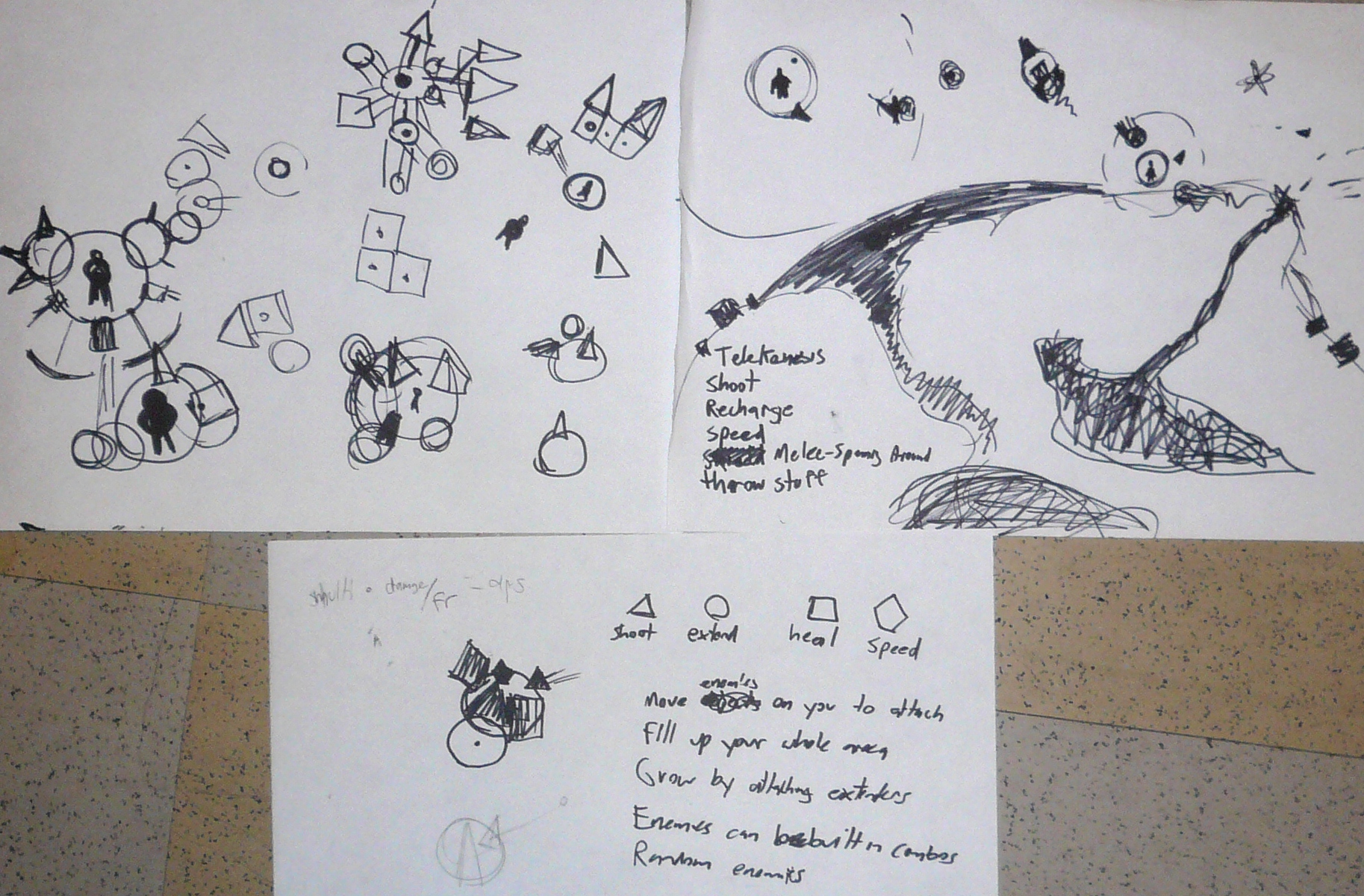
On Friday night when the theme was announced I just sat there and thought while scribbling some ideas on paper.  I wanted to do something with physics and attaching enemies or weapons to yourself.  At first I was thinking of doing a round planet with humanoid figures using telekinesis.  I started to set this up in code but wasn’t really feeling the idea so I just went to sleep.

sketch

Saturday morning I took a quick look at games with a similar concept for inspiration, specifically TUMIKI Fighter and Captian Forever.  My design is based on simple abstract shapes so they are easy to recognize on form alone allowing for the color to represent health.  I also planned on having random weapons with random colors and lots of trails all over the place.  For color values I have it set up so I can randomize over HSV space to get away from the RGB kind of look.

Building off the clean project in my game engine I set up an object oriented structure where there’s a base class shared by the player and enemies, a base class shared by all part types, and everything derives from a GameObject which is part of the engine.  By about 3 PM Saturday I had the player moving around with the ability to pick up parts and attach them.  But so far the only part was a weapon and it was always the same default weapon.  I took at least 2 hours to put some polish on that system with grabbing and attaching the weapon parts.

Around this time I did a little art pass: tweaking colors, particle systems and other visual aspects.  I threw in an enemy that just randomly tried to pull parts to it and shoot.  By the end of Saturday night I wanted to have all of the core functionality in game so I could take the next day to add better AI, polish, balance and tweak.  So I trudged along adding the other 3 part types in a very rough state.  Around midnight Saturday night I posted a screen shot to demonstrate the core functionality.

snapshot_00371

Sunday I started out by just tweaking lots of little things.  There needed to be some background for movement reference so I just threw in an extremely simple particle system of gray squares.  I worked on the AI a bit and improving their tractor beam use a little.  I made them move around pretty much randomly in near the player.  I tried having them turn to aim but that isn’t very reliable because of their poor ability to configure their ship so I just made them cheat and rotate their weapons directly.  There just really wasn’t enough time to make any kind of real AI at this point.  For all this time I just had the player spawn in next to some parts and an enemy that I had all placed in the editor so I added logic to randomly spawn in enemies and parts out of view of the camera.

snapshot_0049-550x501

This felt good enough so I wanted to spend some time adding random weapons to add both visual flair and gameplay depth.  As a simple balance measure all weapons have the same DPS with different firing rate, bullet damage, and bullet count.  Other aspects like speed, spread, and color are just randomized.  It seemed like a big part of this game was reading where damage was coming from and going too so I had an idea to make bullet size proportional to their damage to facilitate a quick visual read.

As the deadline loomed I started to freak out a little becuase there were only a few hours left and I harly spent any time actually playing my game.  So I took a while to just play and polish random gameplay issues.  I experimented with several different control schemes but decided to go with the simplest which seemed like a good enough choice given limited time.  I threw in some random large solid black boxes to both add an interesting element to game play and visuals while also making the world feel more solid to the player.

With about an hour left I focused on sound by adding more firing sounds and a tractor attach sound.  I scaled fire sound frequency by bullet damage so weaker weapons sound higher pitched to make it sound a little more dynamic.  In the last half hour I just tried to play my game only tweaking a few minor things.  I had a score display of how many enemies were killed with high score tracking but decided to remove it a the last minute.  Adding a scoring system can add a lot to a game but it can also detract if done incorrectly.  I like the idea of just providing a pure experience without the need for imposed goals. The implicit goal of growing your ship is as motivating a factor as any.

snapshot_0086

It’s was hard to come up with a name for my game in such a short period of time.  I went with Protractor because it sounds sort of abstract and mathematical while also containing the word tractor for tractor beam.  I’m happy with the way my entry turned out and after playing it for a bit since then it still seems to hold up pretty well.  Next time I’d like to try to get some testers lined up, people offered but I was so focused on working that I didn’t take the time to contact anyone.  Also I’d like to plan my time a little better so at the end I have more time to just play and tweak.

It’s impressive how well put together the Ludum Dare competition is.  The judging phase is currently in progress and it’s great fun playing everyone’s game and doing my best to judge.  It’s sort of like playing Wario Ware on a grand scale.  Thanks to everyone who put it together and congrats to those who successfully delivered a game.

Tags: post-mortem, protractor

Comments

26. Aug 2010 · 12:51 UTC
thanks for this post mortem. Liked the way you are using your particle engine to generate these trails. Good idea.