Preparation
For this Ludum Dare 29 I teamed up for the first time with my brother, with whom I have collaborated in game development since I am ten years old. But in the last eight years we only produced one game together, so it was a good opportunity to produce something together one more time!
I will discuss in this post the jam from my point of view, and he will do the same very soon.
A few hours before the theme announcement we discussed and thought it could be fun to do a tower-defence game, since we had not yet created such a game. It was also clear that if the theme was not fitting, we could find another genre of game to create.
For the jam he chose to go with Clickteam Fusion 2.5 Developer, since it allows a very rapid development (at least in the first stages of the game 😉 ). Therefore the game would most likely be 2D (and I have very few experience with 3D games), and I had the choice between pixels/vectors/pseudo-3d for the graphics. In already created some graphics for LD jams in Illustrator and also in Gimp, and both were satisfying in the overall aspect, but it takes a lot of time to create something that seems polished and original. So this time I went for 3D renderings that we could use in a 2D game. In fact, our last project was done this way, and looked really nice! It’s also a lot easier to make some artwork for the menus and titlescreen in 3D since it only needs a few change of camera and lighting.
I had not used Blender in years, so six hours before the theme announcement I decided to install the latest version of Blender, and quickly see how the particles system was working, and also the animation (which I never learned before) with bones and key frames. I quickly drew a low-poly pine-tree, and duplicated it using particles system in order to generate a quick procedural map.

It is the same technique that I used later for grass/rocks/crystals generation.
Saturday
After the theme announcement we quickly came on the idea of ants, since its the season where they are invading all the surroundings (and even the house from time to time).
My first objective was to design a good first character, a basic worker ant. It took me the until the middle of Saturday afternoon to achieve a good result:
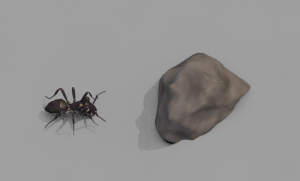
I also did the following animations: idle/walk/attack/die. As the animation bones are separated from the mesh, I could use most of the animations with little modifications for the other type of ants.
The rest of the afternoon and beginning of the evening was spent on designing a first level.
All the particles (rocks and grass) where generated on the map using some weight maps of the base mesh. I learned a lot from this Blender tutorial: https://cgcookie.com/blender/2012/09/20/creating-realistic-grass-in-blender/ . In the next screenshot you can see the weight map corresponding to the density of small rocks. I had a weight map for the density of rocks, one for the size of rocks, and two similar maps for the grass.

Since our playground is underground I could not produce realistic grass, and by luck my grass was not generated realistic at all! It would have been a problem if I really wanted realistic grass, but in this cas it is producing a strange line effect which gives a small sense of strangeness to the overall mood, so I decided to keep it that way and not spend too much time tweaking the grass properties.

The next idea I had was to create some lava. This is the resulting work of my first day:

Sunday
I was not satisfied with the aspect of the lava, since it was more looking like a glowing ketchup. So on sunday I spent more than two hours just on producing better textures for the lava, and changing various settings (emit, raytracing, glow) which were not satisfying either. For the whole graphics creation I always compared the renderings to real photographies, to achieve a similar looking thing. And then I thought again of particles! Particles are the key to pretty things! And after half an hour I had this result:

The rest of Sunday was spent designing and animating the soldier units, the queens (red and black), and also some turrets (ant-lion, destructible rock, spider-web, a ground bug…). Every unit/turret was rendered in 8 directions for every animation, and later used by my brother in the actual game. End of second day screenshot:

Oups I forgot I designed the second map meanwhile too 😀

Monday
Monday was then the day for producing music, level design maps, testing, sounds effects, and some artwork for the titlescreen, menus, victory and defeat screens. Thanks to the quick map ornaments (using particles), it was very quick to produce a third map: create a base grid layout, deform the mesh a little, add particles, think of a new environment (purple mushrooms), add some lighting and it’s done! In fact most of the time was waiting on the rendering (7 minutes for the biggest map).
I took some hours in the afternoon (not enough for my own expectations) to produce a first music, and also the “defeat theme”, which is the best of the three tracks in my opinion, but since the game is too easy to play no one has heard it probably 😉
At that point its the end of Monday afternoon, and the game was not really working, some path-finding problems, and I tried to not put any more pressure on my brother. Therefore I took some time polishing the graphics, and doing the artwork screens. Two hours before the end of the deadline (1 AM here) I went in the garage to record some sounds effects: for the ants attack sounds I used various gardening tools, such as a machete, a saw, gardening shears, some secateurs… for the ants birth I wanted a popping sound, so I took an empty plastic box of medication which has a nice sound when opening quickly. For the sound recording I used a Zoom H2n which is very convenient for recording anything anywhere with a good sound quality. Then I took some time to polish the sounds in Cubase (add a small delay on the secateurs sound), and normalize all sounds.
That was almost the end of my work for the jam. The last half hour was dedicated to testing and preparing the submission post with nice screenshots.
Conclusion
I’m quite satisfied with the looks of the game, and with all I could learn about Blender, animation, rendering techniques (use of mask, composite renderings), particles, animations… The gameplay is overall satisfying, we were just a bit frustrated to remark that a small change in the last hours disabled the enemy queens to drop soldier ants, so the game was too easy. But the game was working, so it was not a too big deal.
Like almost every other Ludum Dare jam I entered, I think we (my team) spent too much time on thinking of (and implementing) difficult gameplay mechanisms, and not enough time actually playing or testing the game. But maybe this is how this short-time jams work. It’s also a good opportunity for experimentation, so I’m not saying it’s necessarily bad to think about different gameplay mechanisms than what we’re used to.
One more thing that I need to be careful about is how the game is presented to the player, and how to help him discover the mechanics quickly. For example in our game, we forgot to mention anywhere that the player controls the black ants and have to defend the black queen. We had no time to implement the units/turrets descriptions, and I even forgot to mention them in the description of the game during the first day.
To conclude, I think it was really nice, the sleep management was very good (although too much excitement prevented me from sleeping much), the work flow was also good, so I’m really looking forward for next the next jam! And maybe with a bigger team!
The jam game is available here http://www.ludumdare.com/compo/ludum-dare-29/?action=preview&uid=36462, and a new version with less bugs and 3 level difficulty will be released very soon (maybe even today!)


