LD20 April 29–May 2, 2011

Everything new

Well, I finally made some progress in finishing up all my main chores for the competition.

That being the port to windows and finally uploading my timelapse video. Check out the game page for the windows version and the timelapse.

Oh and as I heard there were some problems with the windows version, please let me know if you also encounter any problems running my game, so I can try to fix it somehow.

SINGLEHANDEDLY: Post-competition update!

DOWNLOAD HERE!

What’s new in this update?

Well, there’s an AWFUL LOT. Thanks to all the people who played, this update is for YOU!

  • The entire escape sequence has been fixed to be tons better. Sound isn’t as awful and the enemies still spawn.
  • The in-game timer works now, so you can actually do competitive runs through.
  • Added a whole hidden new area and fixed one of the hidden guns.
  • Tweaked the final boss fight. More fun.
  • Fixed a minor thing with the whole map.
  • There’s a hidden boss in the hidden area. You can only get to this boss if you haven’t got the spreadshot yet.
  • Tweaked difficulty levels to be a more steady challenge and made easy mode not as easy.
  • Even a bit more than I’ve listed here. Have fun!

Comments

elbowroom
07. May 2011 · 16:31 UTC
Hi, I’d like to report a bug..

First time to play the game.

In the room where you get the first ‘non secret’ clip extention.. the one with the three lava pits where the middle one is hidden under a ‘trap door’ or a false floor platform.. there is a part where if you headbut the ceiling you see a small secret area.. just like the one with the secret life extention.. well if you jump there you get an instant game over with no explanation? ? ?
elbowroom
07. May 2011 · 17:23 UTC
A winner is I :) just finished the game.. did not gind any other bugs.

good times

Disqualified! For I am a muppet.

Doh! I thoughtlessly picked one of the stock Unity skydomes, forgetting that this is ART and should therefore be made by ME. Oops.

So “Lonely Fortress” has accordingly been moved to the Jam. Apologies and thanks to all of you who took the time to rate it.

On the plus side, since it’s no longer being judged, I’m uploading a new version with a quick and dirty fix for the bug where you could get stuck with your head inside a block. And I plan to continue developing it into a full game. Gotta keep busy until LD21 rolls around!

I’m looking to start a dev team

Hi, my name is David and i am looking for people interested to be in a small dev team. I am a good programmer in AS3, but i suck at making chiptunes even though i play guitar and know how music works and such. I also am TERRIBLE at spriting/graphic design. So in this dev team of mine would be:

Me: Lead Programmer
?: Chiptune/music developer
?: 8-bit/what ever matches the game artist

if you think you qualify and you are interested feel free to comment or find me on twitter (dsv101). Thanks,

dsv101

Comments

07. May 2011 · 00:28 UTC
What’s the pay going to be like? I’ll need to know if I plan to pass this on to some artist folks I know.
07. May 2011 · 00:40 UTC
You wouldnt be payed until we sold or licensed a game. Which i have never done yet due to not having any artistic abilities. I am unknown to the world and plan to come out of my shell and be noticed.
sfernald
07. May 2011 · 14:25 UTC
I think LD needs a forum just for this kind of thing. So people can connect easier.
08. May 2011 · 21:37 UTC
Hey, your music isn’t really my style but it is good so your in! I lean more towards chip music. But you are definitely good! Like i said i’d be doing flashgames, i hope you are in the irc so i can talk to you. hit me up on twitter. Where can we talk?
Mikhail Rudoy
08. May 2011 · 23:12 UTC
Hello, I’m also a programmer, so I really don’t have much to contribute in terms of what you don’t have yet. However, I am still offering to join you because I could help get work done and could bring thoughts and ideas to the table. On the other hand, it would also help me get some experience working on games with others and help me get into better working practices (i.e. I’d finally start commenting my code). Win-win :)
08. May 2011 · 23:55 UTC
i am not looking for another programmer, sorry. I dont use Adobes products either, i dislike them. Although i use there flex sdk :) If you do sprites that would be good.
Mikhail Rudoy
09. May 2011 · 00:57 UTC
No, sadly I don’t. Oh well. I was just thinking that it would be very convenient if you did take me, plus the post says “Lead Programmer” which I chose to interpret as meaning other programmers welcome as long as I lead. :)
09. May 2011 · 01:18 UTC
thanks, i guess if i ever need help ill ask you.

Small edit to Take This Penguin

Due to several people suggesting it, I made a post-compo version of Take This Penguin that doesn’t start at the title screen each time you die. Link is on the entry page for it. Hope you enjoy it!

Entry Page

Red – bug detection help!

Hi,


I heard some reviewers mention, there is a bug in my game Red that freezes the game after the objective is complete.

Please check the game if you have a sec and see if it freezer during the second level.

If the bug does happen, please comment and include the version of flash you have.

You can check here which version you have. Thanks


ER

A Colorful Man Post-Mortem

This post-mortem presented to you as a series of random observations and comments.


My original idea for the game came as a sort of pacifist Zelda. It would be just like the Legend of Zelda game, except you’d never get any of the weapons.


I wasn’t trying to be funny at first. With this post, however, I realized that there was a potential for humor in the plot, and went with it.


Honestly, this wasn't intentionally funny. I just needed an excuse to not give the player the super-weapon yet.

I can’t really point out something that went wrong this time. I suppose I wasted too much time and didn’t get around to implementing a boss fight, so there’s that.


I started seeing someone between the last LD and this one, so I got to dedicate the game to her. That was cool.


The reason for the super-weapon:

SPOILERS BELOW


I wanted to give players a chance to destroy the puzzles and annoyances from previous rooms, a sort of vicarious revenge upon the game. Also, a lot of the people will stop playing the game for a bit so that they can say to me. “MOTHERFUCKIN’ RAINBOW CANNON” or something along those lines.

SPOILERS END


Autotracker-C is AMAZING. USE IT!


Taking part in the community is so beneficial! Getting feedback is helpful, and giving helpful feedback leads to all sorts of warm fuzzies.


My puzzles are so unchallenging! I have no idea how to balance them, since being the one who designed them gives me a bit of an advantage.

Change of Heart Postmortem

Well, let me tell you my foray into game building this time was an interesting one. My goal was to create a dramatic movie experience using just audio and music.

While everyone else in the competition was busy playing with game ideas or throwing together some code for their game infrastructure or perhaps even creating a level editor, I was just trying to fight back writer’s block. I had about 15 pages of narration to write (and that was after cutting the initial scale of my game in half) and initially I had allocated about 6 hours to do it. I was planning on being done by the time I went to bed that night, but when I was too tired to work any longer, I had only a third of the story written!

In the end it took me about 12 hours and it was still unfortunately a pretty rough draft but I had to go with it. The end of the narration definitely suffered compared to the beginning when I was able to add so many extra details, but that’s life in a 48 hour competition. At this point it was 1pm on Sat. and all I had to show for it was a stack of papers.

Luckily I was prepared for the recording session. I had done a test the day before and knew exactly what I wanted to do even though I had never narrated before. Of course, the fact that I didn’t have time to even rehearse the material meant the narrations didn’t come out as well as they could of. And of course it’s harder to narrate than you may think. Sure a paragraph or two is simple, but when you are reading page after page, the mistakes add up and so you end up doing everything several times and then have to go back through all that later and sort out what is good and what is not. There is just a ton of painstaking processing involved with audio.

In order to get the best possible sound, I shut down my pc and got rid of every possible sound in the room. I recorded the audio using logic pro with my mac mini. I recorded through the preamp of my Mackie mixer and through a comp54 compressor (which is an amazing reproduction of a neve compressor). I used a Shure sm7b microphone which was the one that Michael Jackson actually used to record Thriller. It works as well for voice as it does for music. So I was pretty confident that technically the narration would come out well and it did.

So I finished the recording and then that evening (maybe 4pm) I exported everything to my pc and put the chapters together using Cubase 6. Cubase is by far my favorite daw; it really is the best there is if you are using midi and virtual instruments and don’t want to feel limited with what you can do. I had originally planned on scoring the narrations using my prophet 08 analog synth, but I realized there just wasn’t going to be time to do all the tweaking necessary to get the sounds I wanted (I did use it for that intro sound though), so I fell back to using Omnisphere, which is a software synth in a class by itself. I had never scored a narration before (a lot of firsts here). I tried several different techniques during the process of creating the 12 different scores (which is a heck of a lot of music to try to create in such a short time). I think from the first one I did to the last one I definitely improved quite a bit. I hate the first one (chapter 1) and plan on redoing it for the iphone version. My favorite is the helicopter flight score. Well, that and maybe the score of the hive with all of the gross creature sounds. I found my process was getting much more elaborate during these last few scores. I spent the rest of the night working on the scores, maybe to 3am.

Next morning I was on schedule but immediately things went horribly wrong. I had used Unity in the last LD to make a nice little 3d game, but man when I tried to use it for the simple purposes of this game, I was just fighting it the whole time. All I wanted to do was a simple fade, but I was jumping hoop after hoop and things weren’t coming together. It was noon and I had nothing, so I switched immediately over to flashpunk which I had used to make a game last year. Thank god I did. I didn’t even have flashdevelop on my computer, so I had to download it all and follow the flashpunk instructions to get it all working, but that only took about 10 minutes. Almost immediately things were working and I was coding the game. The actual code was about as simple as could be, so I won’t spend much time talking about it.

The final big hurdle I hit when I was all done and testing was that I found that flashpunk (probably flash actually) was very picky about the sample rates of my mp3 files. In order to upload the game to Kongregate I had to get the game under 10MB so I had to make the sounds mono and as low a sample rate as possible. I had done all the final wav files at 96k and I was having a heck of a time getting wavelab to convert the 96k wavs to small mp3 files that flash would actually accept.

I finally ended up creating the mp3 files in Cubase actually, which I think gave me a higher quality sound in the end. I went with mono, 32kb, 11khz and I liked the quality of the output, but ran into a huge problem. It was really affecting the volume levels of the different tracks. I had the music much quieter than the narration and in some cases the output mp3 had actually silenced the music. So at the last minute I had to go through my projects and adjust the volume levels, bringing up the volume of the scores so you could actually hear them in the mp3.

That’s it. Overall, to be honest, I’m just amazed I was able to complete it. There were several times when things weren’t going right that I considered just giving up. But I think I continued because with this project I choose to do the things that I enjoy the most, writing and making music, and so that’s why I was able to persevere. I know a game like this is sure to be rated poorly, I knew that going in and accepted it from the start. Even if my voice was like Orson Welles and my prose like Hemingway I wouldn’t have a chance. And yet I really think there is a niche for this kind of game. Sure it falls more under interactive fiction than game (it is less interactive than dragon’s lair even), but there’s almost limitless potential for the number of epic stories I can tell. I almost see it as a way to bring game-players back into fiction.

If you feel like listening to a good story, check it out. It is a dark, apocalyptic science fiction / survival horror thriller that will depend completely on your imagination. I’m working on a mobile version now that will have some beautiful artwork and a bunch of other features as well (not to mention a re-write or two). I should warn you that there is a ton of profanity so I would say if you don’t like listening to audio books or if strong language or gross imagery disturbs you, then stay very clear of this one.

Change of Heart
http://www.ludumdare.com/compo/ludum-dare-20/?action=rate&uid=258

Super Shotgun Deathrace Postmortem and Timelapse

This was my first Ludum Dare – I went into it feeling completely unprepared, and finished the compo with a game I’m pretty happy with. I’m going to attempt to describe how that happened.

What Went Right

  • The Toolchain. I made a rather risky move going into this LD. I decided to use a game engine I’d never tried (Flixel) in a language I haven’t used in years (ActionScript 3) in an IDE that doesn’t run on my OS (FlashDevelop) Crazy, right? Actually, I don’t think it could have gone better. Flixel’s handling of basic motion and collisions is far more intuitive than any physics engine I’ve tried, and the engine as a whole seems perfectly tailored to quickly prototyping games. Due to some of the awesome features in Flixel, I ended up using Photoshop as my map editor, which worked quite well, and is something I’ll be thinking about doing more of in the future.
  • The code. The one piece of advice I got before Ludum Dare was to not get caught up in the code. That’s a problem I’ve had in the past (I’ve got a number of game prototypes that are more engine than game, nearly all of the utilities I’ve released have about 3x the functionality that can be shown in their UIs) but with the looming 48 hour deadline, I was able to ignore best practices and just get sh*t done. There’s dead code, unused variables, methods copied from class to class, and not a comment in the entire program. But it works, and ultimately that’s all that matters.
  • Music & Sounds. The audio ended up being much less of a hassle than I’d initially thought it would be. For the music, I used Garage Band on iPad which has a feature called “Smart Instruments” – I gave it a couple chords, and it gave me back a groovy baseline. I spent about as much time making the music as I did trying to get the .mp3 to loop properly. For most of the sound effects I just decided to record them myself. I grabbed my iPhone, went in to the quietest room of the house and made zombie noises for a few minutes. It was fun, actually.

What Went Wrong

  • The Theme. At least initially, I had no idea what to do with this theme. I didn’t want to wind up with the same idea as everyone else, so the obvious ideas of a zeldaish game or something where you only win if you’re holding the MacGuffin were out. I spent probably 4 hours tearing my hair out and contemplating leaving the competition before scrawling down “you start in a portal like chamber where you don’t get the macguffin, then you fight zombies or something”
  • The Graphics. Unlike the code, where I only did what I needed, as I needed it, when it came to the graphics – I didn’t really have a plan. I started the graphics before starting the code, which was a mistake – but the bigger mistake was starting the graphics before I’d nailed down what the game was going to be. I wasted a lot of time on graphics I didn’t end up needing, or which just didn’t look right (all the walk cycles) I’m relatively happy with where the graphics ended up, but it took too long to get there.
  • Planning. I didn’t really know what my game was going to be until after I was 3/4 of the way finished, so I didn’t even have a todo list until the last 12 hours. I’m pretty good at flying by the seat of my pants, but I think a little pre-planning would have helped. You know, trying to set a couple milestones, researching the engine I was using a little more, that kind of thing.

And if you read all that, here’s your reward! I’ve uploaded a Timelapse of the development of Super Shotgun Deathrace which you probably shouldn’t watch until after you’ve played the game

Tags: postmortem

It’s dangerous to “go” – Puzzler Postmortem

Let me tell you about my first ever 48 hour Ludum Dare experience!  I made a top-down puzzle game where you, the player, control the movement of both a green Link-like guy and a kitten at the same time.  It is dangerous to “go” alone! Take this [kitten].  “Go” as in, yes, “going” to the bathroom.  In this puzzle game you have to collect TP for the toilet and litter for the litter box!

Play the game – Click here for my game’s competition entry page.

I’ll go through my experience chronologically as I talk about how my game came together, and then I’ll also tell you about the process of making each of my levels if you don’t mind spoilers.

Part 1 – How 48 Hours Turned Into a Game

Ok, so Friday night the theme was announced. When I saw it, I simultaneously felt like I had to do something Zelda-like, while also not wanting to do anything so literal.  The direct reference to such a classic game put me in a bit of a mental bind.

I started brainstorming ideas. For inspiration, I grabbed from the internet both the Zelda screenshot and the famous meme image. I actually had them up on my screen during the whole contest!
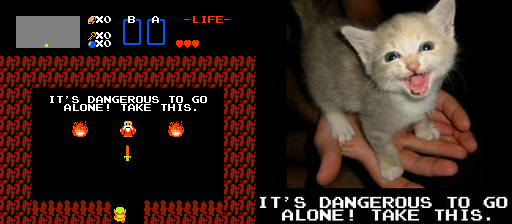
Dangerous Duo.
Inspiration: The Dangerous Duo

Some Zelda parody ideas popped into my head right away, but because you can’t reuse existing Zelda graphics for Ludum Dare, my ideas basically amounted to “recreate Zelda,” and that seemed a little impractical in 48 hours. There was one particular moment from the first Zelda that I kept thinking about:
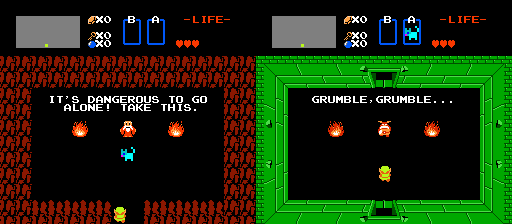
Dangerous Joke.
Kittens are made of meat…

For more inspiration, I started to read everybody’s blog entries, and I was amazed by all of the clever interpretations of the theme.  I started to think about each word in the theme individually, and tried to figure out how I could play off of it. It was then on Friday night that playing on the word “go” hit me with an idea: I’d been wanting to do a simple classic top down puzzler for awhile, so what if I did something with needing to “go” to the bathroom.  I figured the player could be a little Link guy like from Zelda, and there could be a kitten companion (like from the meme) at the same time.  Visions of pixel toilets and pixel litter boxes flashed in my head.

More after the jump!

But I didn’t stop brainstorming at that idea.  I also looked at past Ludum Dare winners, and how they related to the theme.  Then I looked at the Wikipedia list of video game genres.  Within probably an hour I had a list of maybe 15 ideas.  I was able to down-select based on scope pretty quickly, but I was left with 3 or 4 ideas that I really liked, including the idea that I ended up picking.  I decided to let my unconscious marinate on these ideas for awhile, and I played some Portal 2 with a friend, and then went to bed.

Saturday morning I got up and did my typical Saturday routine.  I walked to get some coffee and a pastry.  I got home, and I setup the shell of a top-down game using the Akihabara HTML5 game engine.  I still hadn’t picked my final idea, so I picked up pencil and paper to do some sketches and explore the ideas a bit more.  I got out a tablet of graph paper and started to doodle thoughts and level diagrams and game elements for my top ideas.

Dangerous Doodles.
“Look! Doodles! I went to class!”

This ended up making the decision harder, because with pencil-to-paper my unfiltered creativity was creating ideas for these games with too much scope, and then I would get concerned that my ideas were too big and not suitable for the 48 hour time limit, and that it would be very difficult to make enough game content by the deadline.  The pressure of the 48 hour competition hit me a bit at this point, which was late Saturday afternoon by now.  Trying to address my concerns about being able to design enough levels by hand in 48 hours, I burned another hour or more by visiting the procedural generation rabbit hole… I even started to implement the A* search algorithm to help me test the difficulty of procedurally generated level content.  Luckily, I stopped myself from continuing down that path.

I gave myself a break to de-stress and remember that this was fun!  I had a good conversation about my different ideas and the pros and the cons of each with some friends.  Two ideas were left as top contenders, with my friends favoring one idea.  I headed back to the keyboard determined to work on their favorite, and then an odd thing happened: I felt confident about their second favorite idea, my very first idea… the puzzle game about “going” with a Link guy and a kitten.

It was getting to be late Saturday evening at this point, but I started doing sprites for that game.  I burned an hour or so doing some higher polish sprites than what ended up in the game, only to realize that I’d made them without any of the game requirements figured out.

Abandoned Tiles.
Abandoned tile art.

I totally knew better, but I think I just needed to do something other than program or think conceptually at that point.  I took a step back and thought about what my levels would be like.  I knew that I wanted the whole level to fit onto the screen all at once, so that ended up dictating a certain tile size and sprite size (that was of course much different than the ones I’d already drawn! lulz!).  Having lost some more time, but still feeling like drawing graphics instead of coding, I decided to ratchet down the fidelity of the sprites even lower. I had the idea to go with big, blocky, 16 color graphics of a ZX Spectrum or perhaps CGA flavor.  I googled to get authentic color palettes. I had committed to tile dimensions that would allow for fitting reasonably complex levels all on-screen at once.  I then proceeded to have a very focused session of pushing pixels.  I drew the different wall tiles, the TP, the toilet, the litter, the litter box, the guy, and the kitten.  The guy wasn’t green like Link yet.  At this point, my Saturday was over and I went to bed.

Original Tiles.
The original tileset.

Sunday I woke up. Coffee. Donut.  It was go time!  Akihabara helped me quickly add basic level map loading, sprite animation, and tile collision.  The first real big game coding hurdle was the movement of the kitten in relation to the guy.  I had actually imagined a game where the kitten followed the guy’s exact path at a delay of four or so tiles behind.  This was going to create its own set of puzzles because the player would have to consider where the kitten would be when the guy was 4 moves ahead.

I started out intending to code this behavior. I began with a basic kitten to go with my basic guy.  The first kitten logic I ended up adding was the same logic as the guy… literally a copy/paste/tweak.  This meant that whatever input the player gave the guy, the kitten got, too.  That behavior is not terribly exciting in an empty level when both guy and kitten just move up or left together in unison, however by luck I was testing the game using a level that had some rooms with walls to run into.  This being the case, I saw that when the guy is up against an obstacle while the kitten is not, or vice versa, the two start to move out of sync — and that’s when the lightbulb went on.  I remembered playing games that felt like this.  It felt right.  I started to get different puzzle ideas around this behavior, and knowing that it was already late Sunday morning, I just went with it.  I decided that this was working, and this was how the kitten would move, and that was that.  And that’s how this guy/kitten control logic ended up in the final game.

Test Level.
The Testing Level

Now it was time to add the puzzle elements.  Besides the guy and the kitten, there would be a roll of TP, a bag of litter, a toilet, and a litter box.  The guy would have to pick up the TP and the bag of litter first, and then only after that the guy would have to make his way to the toilet and the kitten would have to make its way to the litter box.  I’d considered making the rules such that the guy and the kitten would have to reach these goals simultaneously, but I already had puzzles in my mind that would take advantage of this not being the case.  In fact, I made it so that when the guy is locked into the toilet, or the kitten is locked into the litter box, they become an impassible object, which creates its own puzzle possibilities.

At this point, I had the basics worked out, but only had the one test level finished.  Oh, I should mention that I was defining my levels in ASCII using Akihabara’s help.asciiArtToMap() method.  This was a nice, quick visual way to throw levels together for testing that were easy enough to tweak.  I was using TextMate as my editor, and I put it into Overwrite Mode to make editing the ASCII levels even simpler. I did have at least one mix up along the way though… to hilarious effect.

ASCII Level Editing.
My ASCII level editor! ;)

Oops.
Oops…

Around this time in my retelling of the story was when I posted to the Ludum Dare site about not being sure I would finish.  However, with the game mechanics in place, I found it was fun to throw some levels together, and I got into the flow! I do wish I had committed to this particular game idea sooner so I would have had another whole day to do levels.  My lesson for my next Ludum Dare might be to just go with my first idea, start building, accept any serendipity, and get the first working level done while minimizing scope as much as possible before adding or expanding anything.  I’d try to do that by the end of Saturday, and leave Sunday for exploration!

So now it was getting late on Sunday.  Besides making the levels that ended up in the competition version of the game, I also worked out a basic intro sequence based on the theme.  In this intro an old man in a cave with fires gave the player the kitten.  Drawing the old man in red, as a nod to Zelda, made me realize that the player’s guy should not also be red… and obviously he should have a green outfit like Link!  I was surprised I hadn’t thought of that before.
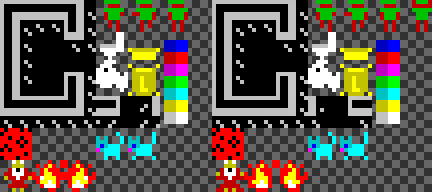
Final Competition Tileset and Jam Tileset.
Final Competition Tileset (Left) and Jam Tileset (Right)

For the competition version of my game, I used the default dialog functionality from Akihabara, which was a bit off from the Zelda experience.  For the Jam version, I had time to animate the fires, make the dialog more Zelda-like, and even let the guy pick up the kitten and hold it over his head!

In Part 2 I’m going to talk about the levels themselves.  Warning! If you read on there will be level spoilers!  If this is where you leave me, thanks for reading!  I’m thrilled that I participated in Ludum Dare, and I’m really happy with what I managed to accomplish in 48 hours.  I’ve learned some lessons, and I hope to do even more for the next Dare.  If you’d like to play more levels for this game, let me know!  If there is interest, I certainly have ideas for how to continue the game from here.  Also, my tools if you are curious: Akihabara HTML5 game engine, TextMate, Photoshop CS4, CFXR, GarageBand with the magical8bitPlugin, Audacity, graph paper, and a pencil.

Play the game – Click here for my game’s competition entry page.

Part 2 – The Levels

HERE BE SPOILERS.

HERE BE SPOILERS.

HERE BE SPOILERS.

HERE BE SPOILERS.

My original design for level 1 had no danger, and it also really did not present any logical puzzles to the player.  The player could simply steer both the guy and kitten over to the TP and the Litter, and then drop the guy off at the toilet and the kitten off a the litter box in any order.  It was meant to just teach the player the basic point of the game in a simple way.  I play tested my original level 2 with friends, skipping this simple level 1, and they understood the point of my game just fine!  Level 2 had a tiny puzzle built into it, too, so it was more fun.  I ended up trashing this original Level 1, and making my test level 2 the game’s new level 1.  I’m glad I did this, because the puzzle in that new level 1 taught the player so much more about the rules of the game and how to control the characters.

Original Level 1.
Very first Level 1… didn’t make the cut.

Specifically, in this new level 1 from the final game, the player learns that the kitten cannot pickup the TP or the bag of litter, and that the guy cannot pass through the kitten.  The player also learns how to separate the guy and the kitten because of this, which is a key lesson for solving the puzzles.

Real Level 1.
Real Level 1.

Level 2 is the first level to add lava to create some danger for the player.  It’s pretty much the same solution as level 1, but the player has to now pay attention to what the kitten is doing when it is separated from the guy.  I placed the lava somewhat randomly, although I avoided putting lava too close to where the player would probably be trying to separate the kitten from the guy.  I guess I was trying to moderate the challenge in this level, since the player is still learning.  I could have put a long river of lava along the right wall to make this level more difficult.

Level 2.
Level the Second.

Level 3 is the first level where the order that the player solves the puzzle matters.  A kitten in a litter box full of litter, or a guy on the toilet with TP, becomes an impassible obstacle, and the player may learn that the hard way on this level.  I’ve gotten feedback that there’s no way to restart this level when you mess up, however you can simply commit suicide by driving the kitten into the lava.  I agree that there may need be to be a reset for some puzzles, though.  I placed the lava somewhat randomly again, and just play tested the level myself based on my haphazard lava placement to get a feel for how hard it would be to play.  I have more of an intuitive understanding of the lava placement than any sort of hard and fast rules.  I did make some of the lava gaps tight so that navigating would require the player to arrange the guy and kitten in particular ways.

Level 3.
Level #3.

Level 4 probably starts out looking pretty simple to the player.  They have to figure out how to rearrange the guy and kitten from being left-right of each other to being top-bottom from each other, and then it is another puzzle where order matters.  Having the bottom wall and far left wall be solid with no lava makes this level a bit less challenging than it would otherwise be.

Competition Level 4.
Level 4 from my competition entry.

For the Jam version of my game, I made somewhat aesthetic changes to Level 4, but by adding pillars and moving them around I believe I probably made it a little bit more challenging for a first time player to understand how to rearrange the guy and kitten… and they are also a little bit less likely to accidentally get the guy and kitten in the solution order right away when the pillars are moved like this.

Jam Level 4.
Level 4 from my Jam version.

Finally, Level 5, which only appears in the Jam version of the game, really ramps up the difficulty by having the entire left and right sides of the puzzle being lava.  There was originally only two paths through the lava towards the items below, one for the guy and one for the kitten.  I felt that this made the puzzle too much like the others where it was about the player figuring out how to separate the guy and the kitten.  So, I added extra paths through the lava in order to make the player think a bit more about how to solve the puzzle.  I put items in tantalizing places that encourage the player to not pay attention and accidentally plunge the kitten into the lava.  I also put extra TP and bags of litter into this map for the first time as to make identifying the correct paths through the lava less obvious.  At first I had the toilet and litter box goals just out in the open in the bottom part of the map, but then I realized I could move these up into the lava and have the player re-enter different paths from the bottom, which would be less obvious and more fun.

Jam Level 5.
Level 5 from my Jam version.

Each level that I added basically evolved from me understanding a new situation that could be presented to the player based on the basic rules and limitations of the game world.  I was trying to exhaust the possible puzzles I could present to the user with the mechanics I had before adding any new puzzle elements, like other dangers.  I certainly could make a ton of just slightly different maze levels like level 5, but I wanted to understand the different basic ways I could trip a player up, so I’ve have more paint brushes in my level design arsenal.

Thanks for sticking all the way until the end!

Well, that’s all I’m going to ramble on about. Thanks again for reading!  If you’d like to play more levels for this game, let me know!  If you have any questions or criticisms, those are welcome, too.

Play the game – Click here for my game’s competition entry page.

Quaintbrush – Featured on jayisgames.com

Neat! Quaintbrush was featured today as a jayisgames.com Weekend Download.

Check it out:

http://jayisgames.com/archives/2011/05/weekend_download_184.php

I’m taking on a relatively big project

I never finish my games. There are exceptions of course, but even now, I have urges to let Minions or Champions or whatever I’m calling my LD0 catchup game fall into the past. I managed to finish two games when I was in middle school. Ugly, ugly things. My code for those two games was the most unprofessional thing I have seen to date, and the result wasn’t pretty. I got them sponsored, but I think games were easier to get sponsored back then. After a long break from game making, in 2009, I finished another game. It was pure mediocrity. But it was an improvement.  It’s still sitting on FGL waiting for a sponsor.  But my code was cleaner. And this year (school year; sorry but I go to school and that’s how my perception of time is ordered), I finished my miniLD25 entry, Blind, and my LD20 entry, The Legend of Zelda on Budget Cuts. I consider them to both be successes at least in terms of good coding practices. And in between this all, numerous, various projects have fallen into neglect and died. But this year, it’s not as bad as before.

So the question is: why? What changed? And I think I have the answer: both LDs, I was motivated to sit down and finish the job. In all cases — whether it was working through the night and till the deadline, or … scratch that “or”, I did that both times :) — I had a specific goal and a specific time period to finish. My other projects almost all got too ambitious. Each of these times, the project was exactly what I expected. Each time, I counted on spending part of the weekend working on the game, and got that exact amount done in practically the whole weekend. But I did get it done.

So I need to motivate myself. I need to set clearer goals and duedates. So I am resolving to take on a medium sized project (I’m not quite ready for major yet), and finish it before the summer is out. I haven’t decided what it is yet, but there are plenty of options. Note that I said project, but not game. I’ll get back to this in a minute.

This school year, I got a lot more serious about programming than I was before. I plan to double up on two CS classes next year. I will be taking the two semester AP compsci course, and the two single semester systems level programming and computer graphics classes. This means that on entering systems and graphics, all my classmates will have taken the AP class and I will have not. In order to be allowed to take the class, I have to learn Java and familiarize myself with all the standard data structures common to most languages. And this must be done by the start of class, so I have the summer to finish. This might be my project.

I also want to learn two (and a half) other languages/programs. I want to learn python, and also Unity in one form or another (most likely using javascript or Boo). The half is that I think mathematica might be worth knowing. Learning one of these properly might be my project.

Of course, I might simply make a rather complex game.

So why am I telling you this? Not because you have to care (though that would be nice) and not because I want to vent about how I never finish anything (though let me tell you, it really sucks), but because there’s no taking it back once someone reads this (assuming the amount I have typed does not scare every prospective reader away). This is it. I’m committing to doing something, and no more needs be said.


Mikhail Rudoy

P.S. Someone please remind me how to add the more tag so that I can edit it in and edit this postscript out.

Comments

Finity
08. May 2011 · 04:07 UTC
Let me know if you need a mirror for your entry. I can throw it up on my site. (paul.zaczkowski@gmail dot com)

Postmortem… The Last Robot Standing

Let me start saying that this is my second LD (previous one was LD17). Before entering to LD20 I watched the keynote and I “almost” cried: It’s great to be part of this.

So let’s start the postmortem of The Last Robot Standing…

Before knowing the theme

I wanted to make an isometric game like the ones I played when I was a child. I still remember the day when I played Knight Lore a game made by Ultimate (aka Rare) in 1984 for the Sinclair ZX Spectrum game.. it was the first “3D” game I had played and the graphics and gameplay were incredible.


The name of the game engine of Knight Lore was Filmation. So my goal was to make a Filmation engine-like game for LD20.

More information here:

http://en.wikipedia.org/wiki/Knight_Lore

http://en.wikipedia.org/wiki/Filmation_engine


My reaction to the theme

At the begginning I didn’t like the theme. I remembered I vote against it. But majority rules :)

It was hard to think about a game that was original and my first take was to refuse to use the “take this” part of the theme as part of the gameplay.. I wanted to use it for fun only instead of getting an object like a gun or something like that. That proved to be very hard 😉


Tools

I used:

Coding: Game Maker 8.1

Graphics: Paint.net

Music: ChordPulse + GXSCC

Audio: Audacity (I recorded my own voice for “sfx”)


Game development blog

The first day I was working on the engine. I wanted to have a map made of 8×8 isometric rooms, with two height levels made of fixed and movable objects.

I started with a basic 2D map and gameplay:


Then I changed the “draw” methods to make it isometric, I had already experimented with isometric graphics so it wasn’t too hard.


I added then movable objects using the chapter “Pushing boxes” in the book “The Game Maker’s Companion: Game Development: The Journey Continues”

Then I added jumps to the main character and movable boxes stopped working. Also, calculating depht was very hard and it was more like a trial-and-error solution rather than a bullet-proof algorithm.

It took hour to realize the movable objects weren’t solid objects so that was the reason I coudn’t jump over movable objects.

After that I implemented enemies. Enemies were very simple, they have an initial direction and speed and an arm rule (left or right). If they collide they use the arm rule to find a new direction.

After implemented enemies, I broke the movable objects code again :( I came up with terrible hacks to solve it 😉
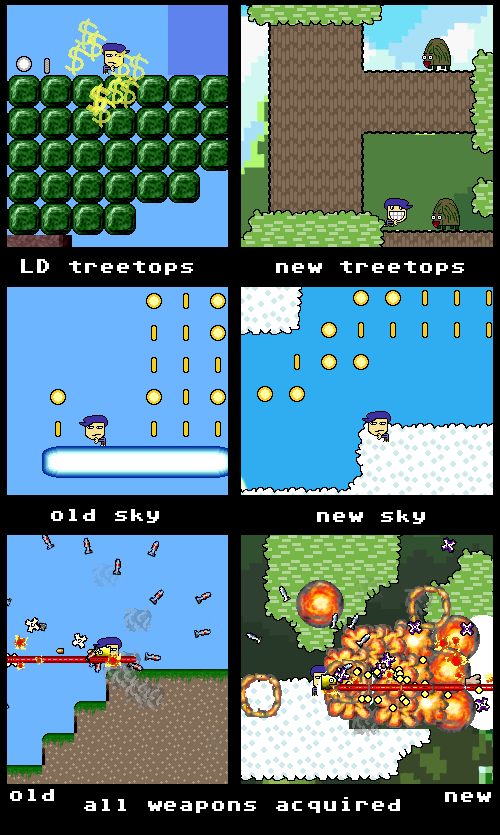
I changed to a B&W (actually 4 colors) look and feel, and I added a B&W TV “filter” (actually it’s a transparent sprite). That was the end of day one:

So starting the second day, I had a pretty decent engine but not a theme-related gameplay.

Eventually, like 6 hours before deadline, I decided that the object was going to be a music or mp3 player that the hero would use to listen to music during the game.

In a couple of hours I put together four “songs” using ChordPulse (a relatively unkown “band-in-a-box”-like application) and then I saved the songs as MIDI files and gave them a 8-bit treatment using GXSCC.

A couple of hours before deadline I decided to use the movable blocks to push enemies against mortal blocks (spikes). It was hard to make the enemies instances to remember that they were killed when entering again to the same room, but I could solve it.

One hour before deadline I came up with an idea for the game ending…. so the game now had a story :)

What went right

The tools: I have become very proficient in Game Maker. It is simple to use. Now with version 8.1 it was easier to edit rooms. For the graphic style Paint.net was great and for music…

The music: I really love ChordPulse and GXSCC. I could put together 5 songs that I’m very proud of. The songs are not great compositions but I think they are simple and add value to the game. This is the “final battle” tune (it’s simple but I really like it):

Final Battle song

The engine: I can’t believe I actually wrote a filmation-like engine… I wish it was 1984 and I would have been rich 😉 Of course the engine is super simple, but I think it’s a good start

The gameplay: I really liked the gameplay.

What went wrong.

The music: I really would have liked to have more time to compose more and better songs.
The graphics: I’m not very good at graphics, I’m mainly a programmer so my graphics are very blocky and geometric
Few game elements: the hero, fixed blocks, movable blocks, mortal blocks and one type of enemy.. but I couldn’t do more in 48 hours
Few rooms – small map… again I couln’t do more in 48 hours.

Conclusions

I really liked this LD, I’m proud of finishing a game in 48 hours and I will continue working in my isometric engine.

I hope you enjoy playing the game as much as I enjoyed making it.

My entry

A gameplay video in spanish

Good luck to all participants

Tags: postmortem

Some questions…

Hello there,
I just found out about LD from Notch (the creator of Minecraft). I think its a great idea, and I’m gonna try to participate in the next event (August?).
Anyhow, does anyone here think its against the rules of the competition to take the Platformer Kit in XNA and heavily modify it (add features, use custom art, etc.) and then submit that as your game? I mean, if you add a story and completely redo the art and stuff, its not the same game at all. I’ve been learning C# for a while, but only made 2 games or so. I find that getting started is the hardest part, but once I’m past that I’m fine.

Thanks,
Varmitharen

I THINK POTATOES ARE AWESOME LOLOL

Comments

08. May 2011 · 18:28 UTC
I’m no expert on the rules (having just unintentionally broken ’em myself), but they do say that “game code and content” must be created in the 48h. As I understand it, the distinction is that you can use pre-existing ENGINE code (eg. GameMaker’s scrolling tilemaps, Unity’s renderer and physics systems), but all the custom game code – character movement, puzzle mechanics, enemy AI – must all be your own work.
Varmitharen
08. May 2011 · 18:34 UTC
Basically, the Platformer Kit is a kit designed to help you get started with XNA. It has some basic level design, some AI, etc. If this is not allowed, I guess I’ll just have to participate in the Jam. I doubt I’ll know enough to make it from scratch even by then.
natpat
08. May 2011 · 19:33 UTC
Yeah, it’s every 4 months, so in August sometime :)
08. May 2011 · 19:41 UTC
Yep, August. It’s so far off… :(
stqn
08. May 2011 · 23:06 UTC
As long as the XNA platformer kit is available to anyone before the compo starts, you can use that.
huhwhozat
09. May 2011 · 00:56 UTC
Note this addendum taken from the rules page:
AyCe
09. May 2011 · 02:46 UTC
Another one inspired by Notch? Welcome 😀
Varmitharen
09. May 2011 · 05:37 UTC
Yeah, it does include some basic AI and stuff. I guess I’ll just enter the Jam. Hopefully by December (right?) I’ll know some more about coding games and will be able to enter the normal Ludum Dare.

Thanks everyone!

If anyone else has some thoughts about whether it should or should not be allowed, please comment.

Attack of The Heavenly Bats – improvement report

So, not being satisfied with the completion rate of my LD entyr, i decided to work on it some more and upload it to a Flash hosting site. I spent waaay mroe time improving it than I intended, and people are still pointing out bugs, which I’m trying to hunt down.

Anyways, I’m pretty much satisfied with what I got now, and I already spammed some flash-hosting services with it.

So, what’s changed:

Level redesign
LD version didn’t even use half of the 128×128 tile grid, the improved version utilises almost all of it.

Graphics upgrade
Added many new tiles, redrawn some enemies, added flickering effect to bullet to distinguish them from other stuff. Also, parallax background (yay!)

Final boss
Added a boss, and a pretty hard one. Actually, it’s the only hard thing. Or…

No future mode
When you beat the game, you have an option to test your skills in ‘no future mode’ (a cake to anyone who figures where this term comes from) IMO it’s unbeatable, but who knows….

Explosions
I aimed at having a lot of explosions in this entry, and all I had was some dust. I fixed this by adding loooooooooooots of explosions.

Plot
Now it has an intro, therefore a plot. It might not be an epic one, but it comes with a twist 😉 Also, I made the character talk. Talking animation was done during the LD, but there was no code to wrap it around.

More weapons
Haha, no, that’s a lie.

Game balance + physics update
I updated the physics a bit, so that you have more control over the character, and balanced the game so it might actually get tough at some point. I took my time to reply the game thousand times to balance it properly.

Music
Actually, music is the very same cause I couldn’t push myself to change it after listening to it so many times, even tho I know it’s shit 😛 But I added intro music (not mine, tho). Ok, I changed the music track due to lots of comments saying it’s shit :P. I spent about 2 minutes making the old track so no wonder 😛 Anyways, the new one should sound much better.

Now let me nag you with this lengthy comparison:

And try it there:

Kongregate

Newgrounds

Original LD entry

Also, it’s awaiting approval on other sites I spammed with it. Wish me luck with that!

Comments

08. May 2011 · 22:23 UTC
“No Future Mode” is from Legend of Mana, am I correct?

(now waiting for cake)
09. May 2011 · 20:01 UTC
This game kicks butt.

Back Against the Wall – A Postmortem

Is should note that I’m developing my entry, Against the Wall, into a full game. You can check out my progress on the game’s new site. I’ll post a non-compo webplayer there in the near future.

Now for some self-analysis: On the Friday evening of the competition, I initially tossed around a number of ideas that in retrospect look like the ramblings of a madman. The best one was about a herd of cattle that get telekinetic powers and rampage through a city. Not wanting to do the animation for that, I eventually settled on something simpler: a 3D platformer where the player must climb something by using a special item that forms ledges. I was hoping for something Mirror’s Edge style with the platforming, but the eventual hasty execution of that game mechanic left something to be desired.

I made a bunch of boxes, wrote some C# code that made them react to the player’s input, and limited this input by requiring the acquisition of a special item. What the item was, I had no idea at this point. I was wavering between a tk glove or a magnetic device before calling it a magic wand and moving on.

Saturday began with a texture hunt. I grabbed a digital camera and took pictures of some marble and granite surfaces in a nearby park. Other elements photographed were a blue bath towel, a bookcase, and a random metal box. I applied the stone textures to the boxy models which I created the night before with Blender.

For the procedural world, I bit off more than I could chew. The number of bricks that would exist on even a small chunk of the wall would quickly add up into the thousands, causing my PC to chug. I spent almost all of Saturday on this feature.

Sunday started with mesh creation. I made a model for the quest giver and faced him away from the player’s starting point, so that the player may initially think it was a human silhouette in the distance. I pinned a note to him (that pops-up and goes away far too quickly) that quoted the theme of the competition, and placed the wand in front of him. I crafted the city-ledge high above the player, made fake walls for the unplayable areas, and scripted some code that would trigger the player’s “winning” of the game. Problem is, I didn’t test it. The blocks that I had placed in a gap under the city that were supposed to be movable were prevented from moving due to a glitch. Imagine my surprise when I found out that my compo entry couldn’t be beaten!

The take-away? Primarily, I need to budget my time better. I spent almost all of Saturday on my ambitious procedural generator. Placing the bricks by hand would have been well enough and would have taken less time. I should have focused more on the platforming gameplay and level design. Second, I should have set aside the last few hours of the compo for testing my game. Instead, I left everything to the last moment, resulting some major bugs. Third, I went into an eleventh-hour panic when I couldn’t log into my server and Dropbox was my only alternative, then panicked because I did not load it in the right compression format, then panicked that I didn’t initially put up a webplayer, ending-breaking bug, etc. In other words, I need to chill out.

The competition was a fun challenge, and its constraints forced me to think outside the box and make something unique and interesting. My objective now is to flesh-out the game world with some story, add a variety of gameplay mechanics, and form this mess of hastily assembled code into a game.

Please take the time to play and criticize the compo entry. If you like what you see, you can follow my progress on Against the Wall ‘s site.

Comments

Mikhail Rudoy
09. May 2011 · 02:32 UTC
Best of luck. When you finish please post here on LD! I was very excited by the idea when I saw it first, and frankly a bit disappointed by how uncomfortable it was to play the final result :(. I really don’t mean to insult, and in your defense, I’m sure that this was a result of the 48 hour constraint. And now that you have removed that time constraint, I would be VERY interested in the result.

Post Mortem – Bonifaco’s Bazaar

Screenshot

This was my second LD and I’ve partaken in numerous Allegro Speedhacks before so I was quite used to the format and knew what I was getting into. I also had the fortune to have a completely empty schedule for the entire dare, so I could go into it 100%.

I choose to go with AS3, because that what I program in daily but I hadn’t used Flixel before. In retrospect it absolutely speeded up my development but  I don’t think I will use it again as it didn’t really match my coding style. All in all I’m pretty happy with the outcome even if it came out a bit too difficult.

You can try out the game here:
clicky

What went wrong
- scope
The original idea had way too many features that of course didn’t make it in the end. I had planned everything from magic weapons to hordes of different enemies but in the end only melee and ranged weapons. In addition to this every little fighter is simulated with too much detail. They have damage levels, different weapon skills, and other preferences that the player never sees. This could all have been removed with out affecting the game, saving a lot of time.

- balancing
When the game eventually was playable I realized that it would be a nightmare to balance. All the little things that controlled the fighters, merchants and soldiers made the inner workings way too complex. Changing on variable had unforeseeable results which in the end kept me from even trying.

- scheduling
I sat working way too many hours without taking any breaks. Not good. This made me very tired and I had difficulties tying everything together in the end. 

What went right
- idea
The idea of running a shop came almost right away and I was quite fond of it. I hoped that the supply idea and the whole balancing act as a weapons supplier would work good enough to build around. It did work out fairly well I think and I think the choices presented to the player are interesting enough with room for improvement. 

- graphics
I aimed pretty low for the graphics and just wanted to have something that was recognizable. I used breaks in coding to spend time on improving the graphics and I think it works well for what it is.

- difficulty
Even if the game is set at ‘developer difficulty’ and it wasn’t really intended, I must say I quite like it that way. It is relentlessly difficult, but still fair enough to the player and it always feels doable to win. At least next time you play.


That’s it! As I’m currently reviewing and rating all the entries I’m amazed by the rich and creative spectra. Good work all!

3

This entry was posted on Monday, May 9th, 2011 at 10:55 am and is filed under LD #20 - It's Dangerous to go Alone! Take This!. You can follow any responses to this entry through the RSS 2.0 feed. You can leave a response, or trackback from your own site.