I’ve been meaning to write this postmortem for a while, but keep putting it off because my thoughts on it keep changing. After watching a few people play my game first hand, I think I’ve finally figured out what worked and what didn’t.
If you haven’t played it yet, then please go and play it, going by the number of comments I think that having a game beginning with ‘W’ means most people haven’t tried it. Thanks.

So, what went right and what went wrong?
Right: Animal companions
I knew when I saw the theme that I wanted to do a zelda-like game. I’ve not done one before so it would make for an interesting change, but I thought there’d be a whole bunch of zelda-like games, so I needed a ‘hook’ to make it different. That’s where the companions come from.
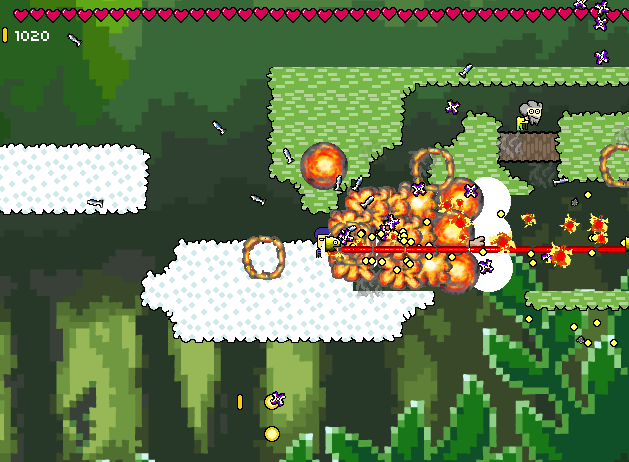
Each companion grants you an offensive ability and a puzzle solving ability. For example cats give you area-of-effect fireball bursts which can kill enemies and melt ice barriers. Ice weasels give you line-of-sight ice bolts which can kill enemies and build ice bridges over holes. Snakes cause room-wide earthquakes that can flip switches behind obstacles, and birds let you jump over enemies or objects.
And they all look different too! I spent a lot of time drawing different walking animations and idle animations, so it does genuinely feel like you’ve got a different companions helping you though the world.
Right: World navigation
Originally the game was going to only have single-screen, non-scrolling rooms. However on the first day I decided that would be too limiting, so rooms can actually be any size – if they’re smaller than the screen they’re centered, and if they’re larger then the camera scrolls around with the player.
Transitions are based on early zelda games, and although tricky to get right I really like how they came out. With single-screen rooms and no transitions you don’t really get a sense of walking through the world, but with the transitions you seamlessly go from one room to another so you actually feel like you’re exploring a single giant space.

Right: Graphics
There’s definitely prettier games in this LD, but I’m very pleased with how the graphics came out. Yeah, the low-fi pixely look is pretty over done these days, but it means I could get a lot of pretty decent graphics done very fast and keep everything looking consistent throughout.
This is by far the most art-heavy LD game I’ve done – an animated player character (in four directions!), four unique NPCs, four unique companions (with walking and idle animations), three enemies, plus the environment, gui and effects. In total there’s 120 unique sprites!
Right: Dungeon
There’s two ‘dungeons’ in the final game, the tutorial and the proper dungeon. The tutorial seems to work really well – everyone I watched got though it with only minimal head scratching and it explains everything it needs to.
For the actual dungeon my main goal was to make something non-linear so players would feel like they’re exploring something, rather than just following a long corridor. I think it pulls this off well – in fact I suspect it’s too non-linear, which overwhelmed some players. A smaller, easier dungeon to start would have been good but I didn’t have the time.
Wrong: Setting
Since the original inspiration was The Thing, the ice base theme fitted well when I was trying to think of non-zelda-like settings. However the combination of lack of time and lack of drawing skill meant I ended up with a fairly vague environment that didn’t really look how I wanted it too.
Originally I’d planned on having separate indoor and outdoor sections, but lack of time sunk that idea – I just didn’t have time to draw another set of environment graphics and the required code to hook them in.
Readability was a big factor too, and one area where the low-res look causes issues. Everything is drawn to be obvious as to what it is, and to be visually distinct from each other. Adding in extra environment detail would have made the puzzle elements of the gameplay harder to grasp.

Wrong: Dungeons
Quite simply, I ran out of time. I actually had two full dungeons designed on paper, but it took me over two hours to physically type in the first one (rooms were just text files with Xs and Os to designate walls and buttons, etc.) and make sure it was solveable, so I didn’t have time to add the second one. (Oddly, the one in the actual game is the second one I designed).
Because of this, the one dungeon that is in wasn’t properly playtested. Which brings me to…
Wrong: Balancing
Again, I ran out of time. Two things are pretty obvious now:
1. The player’s walking speed is far too slow. It probably needs to be about twice as fast.
2. The game is far too hard.
The first is a problem because it frustrates players, and means they give up as soon as they die. The second is more tricky to pin down.
Partly it’s because it’s an exploration/puzzle game, and so I obviously know the correct route through the dungeon. I find it really, really easy. But if you don’t know the route, it’s really, really hard. I should probably have made the dungeon more linear (or had a ‘starter’ dungeon). Also, I think being able to die was a bad idea. If you die you have to start the game from the beginning, but to compensate I gave the player lots of health and lots of places to heal themselves. I think instead I should have given them less health (maybe three hearts?), but made ‘dying’ just place them at the start of a room again, with full health.
Conclusion?
So there we go. Overall I’m very happy with it, it’s by far the most polished LD game I’ve managed, with by far the most content. I’ll probably go back and tweek things, and add in the missing dungeon (assuming the judging result doesn’t say that everyone actually hated it).
If you’ve played the game, I’d love to know if you agree/disagree with anything above.
Thanks.