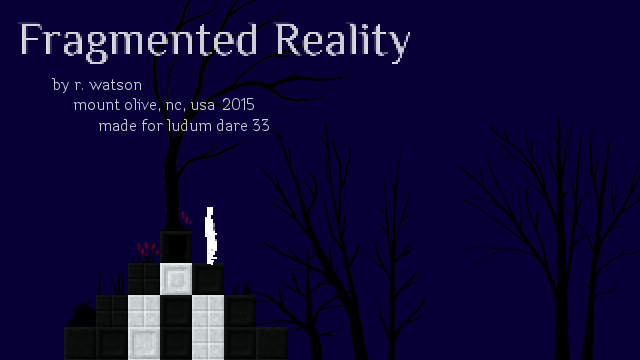
Abelian – Done!
44 1/2 hours into the compo, I’ve finished my first LD entry!

I’m pretty happy with the result, although I can think of a lot more content I could add if I had the time.
The official entry is here
44 1/2 hours into the compo, I’ve finished my first LD entry!

I’m pretty happy with the result, although I can think of a lot more content I could add if I had the time.
The official entry is here
Just finished! I would’ve liked more time (who wouldn’t?) to add a bit more polish, but I don’t think I can do anything useful in the four hours that remain. Best case scenario is that I don’t break something, so it’s time to put it out there and move on.
In Fragmented Reality, you’re tasked with escaping the mind of a madman. Can you break free of his dream?


I struggled with this theme initially, and went back and forth between two games before settling on this one. I think I made the right choice, but I wasted a lot of time. To accommodate, I had to scale back the artwork from my original vision.
This was my third LD and I think I’m starting to learn how to optimize my workflow.
This is my fourth LD, and I think I’m starting to get a hang of figuring out what I can and can’t accomplish in 48 hours. This time around I had a bit of luck on my side. My wife gave me the idea for a similar game a long time ago, but I just never got around to doing anything with it. With a few tweaks, the idea was able to fit the theme. Usually I waste a few hours with a game that doesn’t work out. For this round, I was able to get straight to work.

Snow, squirrels, and pandas!
I got the basic mechanics for “Panda and Squirrel” working by the end of the first evening. This is the whole game, without the “face”:

Saturday, 3 am
What went right:
What didn’t go well:
Next time around I’d like to experiment with more complex mechanics. One problem I consistently run into is not enough time to test. There are a lot of “why didn’t I think of that yesterday?” moments. This time I didn’t make a total mess of the code, so maybe I can incorporate a few of those ideas into a proper post-compo version 
Tags: post-mortem
Hi everyone~
I enjoy reading everyone’s post mortems, so I felt I should add my own to the mix. My game was Evolution Dungeon, a small roguelike adventure.
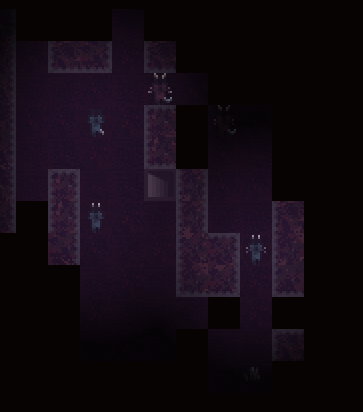
What was intended: I wanted an RPG that used DNA/evolution for advancement, rather than levels or experience points. This was my interpretation of the theme (as your characters inherit better genes, their appearances change). Of all the LD games I’ve made, the actual gameplay for this game is closest to what I imagined. There are three genes which contribute to characters’ abilities in battle using a rock-paper-scissors like relationship. When an enemy has been defeated, you can merge one of your character’s genes with the opponent’s. The merge averages each color’s points.
Things that went well: Level progression turned out pretty well, although there is a pretty steep penalty for leaving a level before it has been played out.

I’m happy with the maze generation algorithm. For the amount of time I had to work on it, it generates a pretty nice variety of floor plans and features. It’s not a great algorithm, but it should be a good base for one.

The basic process is this:
Since each doorway has an equal probability of being selected, the generator tends to clump rooms in a blob (such as in the two illustrations above). Given the modest 32 x 32 canvas, this is probably okay. A probability distribution that gives higher weight to doorways further from the starting point may spread things out a bit. I’d also like to have more types of features. The maze generator took up a lot of my 48 hours as it is, so I should be glad I got what I have working.
What didn’t go well: The art is very dark. The main reason for this is that I had planned to include dynamic lighting. But I ran out of time to add light sources.
As a few people commented, it’s not immediately obvious how to advance. Since each gene (red, green, or blue) is strong against one other color and weak against another, one strategy is to have each character specialize. The lack of power-ups makes this strategy hard to employ in early levels. You can only regain health by being reborn. You often just need to take whatever you can get.
Another popular comment–control. The multiple character mechanic was inspired by a game called Exile: Escape from the Pit. That game had two movement modes. A “battle mode” let you control your party’s characters individually. Otherwise, you could merge them all into one tile and move as a group. That seemed like it would be too clunky in this game, given the frequency of battles. Designating one character as the leader and using pathfinding may have been a better solution. This might have simplified control transfer, too–since it’d be a non-issue for general exploring.
Moving forward: This was one of my favorite LD games to work on. Although I don’t think it’s my strongest entry, I think it has more potential for further development than other games I’ve put together. In particular, there are currently no special moves. The three genes merely affect the probability of hitting an opponent, and certain visual features (claws, tail, horns). There’s some opportunity for more variation in the characters, as well as the environment.
Aether Mine was a tedious game to work on, but I had fun with it and I'm pretty pleased with the judging results.
First, a thank you to everyone who rated and left comments! Also, a shout-out to @cosine who left this screenshot of her colony in the comments, admittedly better than any of my own--

Criticism was much appreciated, since this is an idea I'd like to refine and maybe turn into a full game some day. 46 is a new record for graphics for me. I'm not sure how anything else stacks up against past ratings, except mood. 4th was my best mood (LD33), but otherwise I think this was one of my stronger entries into the compo. I'm happy for that, since my last LD entry was one of my weaker ones.
So, what to take away from the experience? As usual I think I was too ambitious, but at least I knew I had a tendency to take on too much and had some plans to scale back already in mind. That would be my advice to new LD participants: Make your plans, but also have a plan on how to scale back. Something will go wrong and cost you time, so have a list of things you can cut and an idea of how to handle the missing features. My best LD entry was a complete game with a beginning and an end. This game never intended to have an end, but as a consequence, could've used more variety to keep it interesting longer. But I think I cut the right things, even though some of the missing features were mentioned in the comments.
My original vision was a "mini Sim City". I've been playing quite a bit of Cities Skylines recently, and I had my own ideas for a city builder in mind. The end result was closer to an idle/incremental game. It's impossible to lose, and as such, while there is some strategy in building quickly and efficiently, there isn't any in surviving. That's the one thing I'd change going forward--build on the strategy elements. The framework for having individual simulated citizens is present, but as of now the game is more of an interactive spreadsheet. A revised game would emphasize managing individuals, construction of the colony, effective defense, and have some defined goals to shoot for.
I finished my compo entry, "Oregon Trail: Hot Pursuit". Call it "turn-based racing edutainment". I tried to recapture the Apple ][ version I played in elementary school.

Entry: https://ldjam.com/events/ludum-dare/41/oregon-train-hot-pursuit
Results are in! I almost didn't participate this time around, but my wife said she'd be disappointed if I didn't make a game. She seemed pretty excited about it, so I couldn't let her down. I don't remember exactly where I got the idea from. I was watching some of the LGR Edutainment Month reviews and at some point must've put rockets and Oregon Trail together. I drew the rocket cutscene and the rest of the game planned itself.

From the start I wanted a parody of the Apple ][ version of Oregon Trail... the one I played in elementary school where we had to double up on computers because there were only enough for half the class. Your party was doomed from the get go if your partner insisted on spending all the money on bullets. Oregon Trail--Test of Friendships.
This was my best rated LD game since I started with LD 31. First place in humor? Exciting! Thanks to everyone who played and rated!

Usually I like to go all out with game mechanics and code. I'm a programmer, not an artist, musician, or designer. I like solving programming challenges. But this game was what I needed--an excuse to be silly. It's not the LD game I'm the most proud of, but it was the one I had the most fun making. I like to think that shows.
What Went Well-- I didn't lose much time to hunting down bugs. From the start I had a good (and accurate) idea of how long each piece of the game would take. Planning is very important. I spent my first hour creating a roadmap of the entire game, and I knew exactly what to cut if time started running short. I had a reasonable scope for this project. Everything I felt was an important feature did get implemented... even the little hunting minigame.
What Didn't Go Well-- Balance. I threw the difficulties in at the last minute as a last-ditch effort to strike a balance between the two ends of the difficulty spectrum. I think it turned out okay after I put that selection in, but I can't claim it isn't luck. Variety. It's a parody of Oregon Trail and racing games. Well, mainly Oregon Trail. As a child of the 80's and 90's, I grew up on a lot of edutainment games. There were plenty of opportunities to poke some fun at the more absurd parts of the genre. Unfortunately, I had to pass them up. Maybe next time.
Closing-- Congratulations to everyone who participated. See you next time!
This is the first time I've participated in Ludum Dare since the 'combine two genres' theme. My last game was a parody of edutainment. This time I took the "serious route" and built a small simulation that models the two facets of dealing with the global pandemic.
I've been swamped since had to move all of the math classes I teach online, but this project let me stay productive and also participate in LD.
"Covid Conundrum" is in the same vein as Maxis' "Sim Health" from the mid-1990s. It's not so much a game than it is an interactive model. My goal is to illustrate how exponential growth works in "real world applications", and maybe help some of my students better understand the terminology they see in the news.
Of course, it's not likely to be very accurate. The numbers are based on 'best guesses' that approximate those in reports from rural North Carolina counties. It's open source, though. So if anyone disagrees with the model parameters, it's easy enough to change them and re-run the experiments.

I'm generally happy with the result. It's an agent-based model that simulates 10,000 individuals. I'd like it to be better tuned to real-world observations on a larger scale, but I think I did okay given the time constraints and how much we currently know about virus transmission.