ronin748

LD29

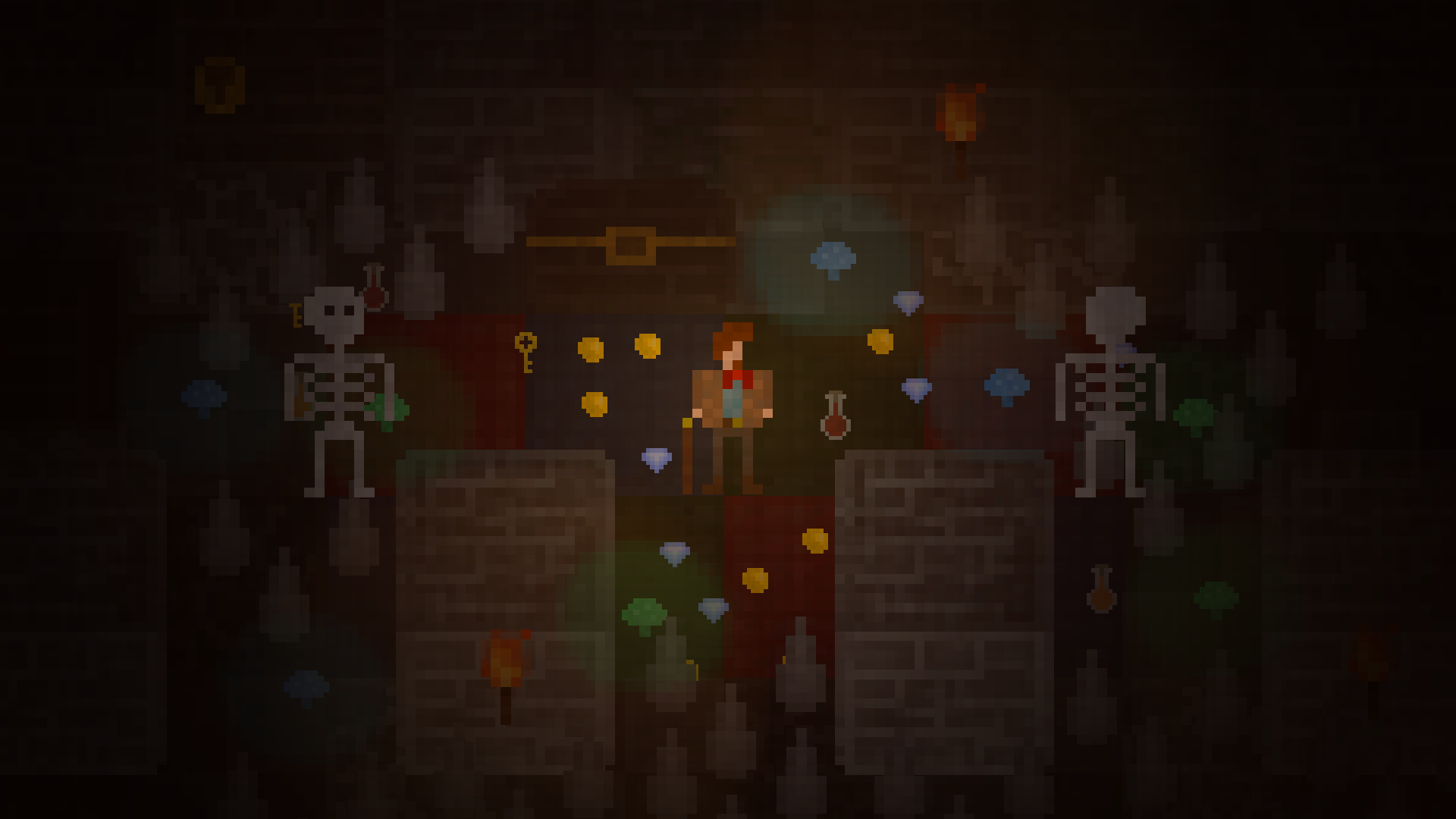
Herbert Crawler – An unfinished first entry

000946

Due to the lack of time and several other factors, my first attempt at making a game for Ludum Dare was left rather unfinished. In Finland the competition starts at 3:00 am and I lost a few hours because of that. The first day was just making the engine and some of the core mechanics. I ordered a new Wacom tablet just before LD and drew most of the art on the second day. The animations were also coded that day. I couldn’t spend the third day just making the game. When I got home I made a test level and coded the AI for the skeletons. I made the sounds and last finishing touches at around 1:00 am and got only four hours of sleep.


I didn’t use the time as effectively as I could have. I also had trouble finding inspiration and ended up making a pretty generic dungeon crawler. With C++ it took a long time to get the mechanics coded. The competition is also a lot tougher physically than I thought and I underestimated the time needed to make a game like this with my inexperience. I think it’s best to keep the concept of the game simple and get the ruddy thing finished rather than trying to aim too high.

The game can be played here:

http://www.ludumdare.com/compo/ludum-dare-29/?action=preview&uid=28876

Tags: Herbert Crawler

Comments

10. May 2014 · 20:03 UTC
Nice work, the art looks great! Next time I would suggest you to use one or several finished frameworks/engines to speed-up the process. You would want to spend very little time on the engine code and just get the core gameplay up as fast as possible, preferrably something playable already on the first day if possible. Then you can add more content and mechanics as well as polishing everything. Sounds simple enough, but it takes a lot of practice, and it’s very easy to get stuck for too long on some details.
11. May 2014 · 03:47 UTC
Your concept art has a distant resemblance to Gregory House, MD.

LD31

Herbert passed the $1 mark and I’m in!

2014-10-31 01_59_16-Greenshot

So it appears my October Challenge game “Herbert Crawler” has already made a couple of dollars. I suppose I’m a proper indie dev now? No? Well, it looks like I will be making more gubbins in a few weeks with LD31 just around the corner.

I will probably be using:

– C++

– OpenGL and/or SDL 2

– Visual Studio 2013

– Photoshop CC

– sfxr

You can get said game here:

2014-11-06 19_47_27-Embed Herbert Crawler Post LD Edition - itch.io

Tags: LD #29, ld #31, october challenge 2014

LD33

Maybe in, made a game for this other jam

screenshot2

Over the summer I participated in the A Game By Its Cover game jam, which just ended yesterday. I made a game called Eternal Eski based on a fake cartridge I found on famicase.com, and it’s about building spaceships and controlling them by typing various commands into the ship’s computer. As a result of this I’m currently quite tired, but if I find the theme interesting I’m likely going to do LD too.  I’ve been doing a lot of Dart + WebGL stuff for AGBIC, so I think I’m probably going to step away from C++ for a while. Raw WebGL is certainly a challenge, but if I prepare sufficiently it should be fine.

I will be using:

– Intellij IDEA

– Photoshop

– sfxr

– Dart + WebGL

Oh, and here is a link to my AGBIC game if you want try it out.

Tags: Google Dart, Ronin748_, webgl

LD34

Not sure if going to make it, but trying

status

Trying to do WebGL and Dart again, and it has turned out to be a bigger task than expected. Everything has to be done from scratch, but nevertheless WebGL is a really powerful tool. I now got the rendering working after a long and tedious battle involving stuff like depth buffers, and I can finally render simple shapes (such as cubes in this test, using placeholder textures from a previous project). This is my first time making a 3D game, so I’m really not sure if I’m going to submit it. There isn’t even a game yet.

Tags: Google Dart, webgl

Revenge of the Ducks finished!

screenshot3

At one point it seemed that there was no way that I was going to make it using Dart and WebGL, but here we are! It’s my first 3D game, and LD really gives me the motivation to finish what I start. I was able to use both themes, and my thought process was the following: growing -> growing up -> growing old. You only have the right and left arrow keys. I went completely silly this time. You should always remember to feed the ducks when you go to the park or you’ll regret it.

Play it here

I might also upload a timelapse of the creative process behind this masterpiece.

Tags: Google Dart, webgl

LD36

Tech Raid progress

I’m making a game called Tech Raid using my own engine written in C++ and OpenGL. It’s set in an ancient alien spaceship and your task is to loot the place. I guess I was kind of inspired by Gravity Falls. Have a screenshot of the current state of the game:

screenshot2

Tags: C++, opengl

Comments

aciliketcap
28. Aug 2016 · 15:37 UTC
Hi, do you have your engine code somewhere? Like github?

LD 44

Doing Ludum Dare with Vulkan

As usual, I decided to learn something new for Ludum Dare. Last time I learned Go, really liked it and wanted to use it a second time. Learning Vulkan had been on my bucket list for a while, so this was the perfect opportunity to do it. Why use Go + Vulkan? Go is garbage collected after all. Well, what could go wrong?

Screenshot from 2019-04-19 11-43-22.png

Some weeks before LD44 I started writing a Vulkan renderer in Go (vulkan-go). I knew I would have to get this done beforehand as Vulkan is very verbose. You essentially start by selecting your physical GPU and then specify everything you want to do explicitly. There are swap chains, render passes, graphics pipelines and lots of different buffers. You have to allocate memory for your buffers and copy the data onto your GPU. All of your draw commands have to be recorded to a buffer beforehand. Doing all of this is both liberating and restricting. I actually settled on using the same command buffer for the entire game, with a separate draw buffer so that I wouldn’t have to re-record anything of the fly. By Friday I had the core renderer done that could render colored triangles in only 1600 lines of code. I decided to use my LD40 WebGL engine as a base for this one.

20190427064610.gif

After the theme was announced, I got to work on depth buffers, texture loading and obj parsing. Now I could finally render textured triangle meshes! The rest of the engine was much easier to do as I could essentially copy stuff over from my previous engine. I ended up adjusting a lot of the physics code as physics simulation is something I’ve always struggled with. I definitely wouldn’t recommend doing your own 3D physics as this is generally a difficult problem to solve. I use convex hull intersection for collision detection. You can calculate convex hull intersection simply by taking a dot product of all the faces and figuring out whether a vertex is inside or outside. This can be used for concave stuff as well if we assume that all geometry is convex locally. Only do intersection on the closest triangles and you should be good. The physics simulation itself just calculates the velocities directly, does a position correction and adds some damping. I wouldn’t get involved with iterative methods or LCP. You just hope everything doesn’t explode.

Screenshot from 2019-05-01 00-20-07.png Screenshot from 2019-04-28 12-53-07.png

I settled on a game idea fairly quickly as I thought this would inform my technical decisions. The game would be about a grim reaper’s job collecting souls and trying to make ends meet financially. I didn’t want to make levels manually so I had the crazy idea of generating the levels procedurally. First I started by generating random 16x16 triangular meshes, but pure randomness just doesn’t look very nice. So I created an implementation of the venerable diamond-square algorithm. Chunks of size 16x16 would be generated and then stitched together at the sides to make a continous level. Continous generation of chunks would make for an infinite world. I struggled with this a lot and you can still clearly see the edges of the chunks. I had never created infinite 3D terrain, so I’m still pretty happy with it.

The actual gameplay was very rushed as I had little time left. Balancing was a guessing game and I ended up leaving lots of bugs behind. I had no working Windows machine, so cross-compiling took a bit to figure out. In the end it all worked out and I’m pretty happy I did it. The Ludum Dares that leave me learning something are the best.

https://ldjam.com/events/ludum-dare/44/worked-to-death

This is what procedural generation was made for

Wandering around aimlessly in an infinite 3D world is actually pretty fun!

ezgif-2-f5249ee58151.gif

You can try my Go + Vulkan game here: https://ldjam.com/events/ludum-dare/44/worked-to-death
There's also a writeup of the technical implementation here: https://ldjam.com/events/ludum-dare/44/worked-to-death/doing-ludum-dare-with-vulkan