zeh

LD23

Hello void!

Why Hello!

So as I was saying, Ludum Dare 24 will be my first Ludum Dare compo. I’m pretty excited! So excited, I’m writing this one post here to start things the right way.

I don’t know exactly what I’ll be doing. I guess I’ll be waiting for the theme announcement on August 24th before I decide.

I know, more or less, which platform I’ll be using, though. I want to create a Flash/Actionscript project, using Adobe AIR, and the Starling Framework. I haven’t used this framework yet, but from the demos I’ve seen, it has an amazing performance (it’s a library used to leverage Stage3D in Flash, that is, use GPU acceleration more easily). It will be also good to be back an ActionScript project; that way I can focus on making the game functional, rather than learning a whole new platform.

No 3D, though. All 2d.

I want the target to be multi-touch devices (maybe especially tablets); my main compilation will be as an Android APK. I may have something on the desktop/web too (since it will be Flash after all), but if I rely on multi-touch input, this may get tricky (I’d have to add a simulation layer for things like pinching and rotating).

I just want to create a kind of a frantic touch-based game where you use your fingers to control… something, like a map from above, with little Actor AIs. Code-wise, that’s what I want to focus on: self-sufficient AI.

What I have in mind right now is a game where you see a battlefield from above, and you have your own little dudes being constantly spawned. You can’t control your own little dudes; they’re independent. You can, however, control some parameters like their spawning rate and maybe their classes, if they have that.

Objective wise, I’m thinking something where you have to get your dudes to a certain point of the screen and do something, either reach the objective or retrieve a goal.

In my head, it looks a little bit like DotA, where the lane creeps sorta help you, but you don’t control them. The difference is that in DotA you have your own hero to control; I’m thinking something more macro.

Control of the dudes could be done by forcing grouping (e.g. tell them to “wait” at a certain point of the path, then releasing them) and changing the route they take. Maybe allowing different routes to the objective. Other than that, they’d be on their own.

The first idea I had was of a game where you had a sort of a tactical Team Fortress 2 game, where you could spawn different classes and they had to reach an objective. A kind of a “Tower Defense”-style game in reverse. That’s why I think you could have different classes of creepers… say, a bunch of “Scout” creepers rushing, but then meeting a bunch of “Heavy Weapons” enemy creepers. Oops.

Objectives could be varied. Team Fortress 2 also shows this pretty well: certain modes can change the game radically. Arena, Control Point, CTF… they’re all very different, even with just a few small rules changed.

Which all also remind me of Battlefield’s “Conquest” mode. For that control of your dudes would be more fine-grained (e.g. select a few of them and send them to a control point) but still sounds fun.

A lot of ideas. Nothing set on stone but it’s a good exercise. Too bad I only have one weekend for it, but it should be enough for a cool prototype.

Visually I think it’ll all be extremely simple, and retro-looking – Geometry Wars/Radiant Style. This would allow me to focus on the game experience rather than creating graphics (even though I think the graphics could still look great), and make it work better in case there’s an immense amount of actors on screen.

In the end, the image I have in mind is of something scribbling on a tablet frantically while his/her troops execute his/her orders. That’d be fun.

Comments

Puzzlem00n
21. Jul 2012 · 00:12 UTC
Hey, welcome to the community! I’ve got to say, my first impression on you was: “Zeh? Cool name!” Seriously, very memorable.
28. Jul 2012 · 11:39 UTC
Welcome Zeh! I’ve been a Flash developer for the part 6-7 years (most of that was at a company called Indusblue in Toronto), so of course you’re familiar to me as the creator of Tweener :)

LD24

Declaration of Intentions

As Ludum Dare #24 draws closer, I supposed I’d set my own limits and state what I’ll be using here (as it’s part of the Ludum Dare compo rules too, of course).

  • The language will be ActionScript 3.
  • The IDE will be FDT 5.6. The Flash IDE won’t be used (maybe for packing some vector art as embedded SWFs, but not as an actual development tool).
  • The compiler will be Flex SDK 4.6, with AIR SDK 3.3.
  • Image editing will be done in Photoshop, if not generated in real time.
  • The target platform will be Android, distributed as an .APK file. But since this is Flash afterall, it’ll also run on the web with a few conditionals. But I’m targeting a multi-touch input, so I’ll have to wait after the theme is announced before I know how well it’ll work on the web. I’ll probably use the “porting” time to do it after the compo time is over. (While an iOS version is actually trivial, deploying and installing device-independent development .IPAs isn’t, so I won’t be spending any time on that.)
  • As a general framework, I’ll be using the Starling Framework, which I have used and is everything I expected it to be: simple, fast, and easy.
  • I’ll be using a collection of general libraries I use on pretty much all my ActionScript 3 projects. That is open-source and pubic, and can be found in GitHub. I’ll also be using a separate tweening engine that is somewhat kept separated from my generic libraries but is also something I use on all my Flash projects.
  • For audio (if I have time to include it), I’ll be using sfxr. Audio is not very high in my list of priorities, however.

See you there!

Guys, guys, I think I’m on to something here

What do you think? This is… well, it is something.

I just have a faint idea of what this is actually is though. I guess that’s the point!

Edit: “Survival of the Tastiest”? Brillante!

Comments

NedortGames
25. Aug 2012 · 13:28 UTC
i`LL GUESS ITS ABOUT ANTS AND FOOD

Food fight!

Kinda, sorta, getting there.

Low FPS is because of sprites that never get cleared out of the World. Like sauce projectiles that go on forever.

Can I take your plate?

Time is running out, but objectives are falling into place and things are getting scratched from the to-do list. Right now, I’m working on the “bill”, as seen below.

My attempt is to have a game set on a dinner table where customers see their pasta flying around and fighting each other in an attempt to conquer each other’s plate. In other words, just your usual Italian bistro experience.

The Evolution theme works on top of that, by allowing you to evolve your pasta over time (the whole idea is about the “evolution of pasta”). That’s not working yet though; right now it just spawns different types of pasta on every plate, to test the gameplay mechanics.

But anyway, what I’m trying to do is to have visual game representations that are as metaphorical as possible. For example, since each plate has to be “conquered” by a number of flying pasta pieces (think Battlefield’s “Conquest” mode), you need a way to indicate which team (or “customer”) owns that plate, and what’s its status if other pasta pieces are trying to conquer it. Instead of having some abstract graphical representation, everything is indicated on a “bill” next to a plate. It makes actual state readout somewhat difficult (e.g. some bills are actually upside down, you have to rotate the tablet or the table using gestures), but I’m counting that as part of the game’s physical context.

Things are not looking good…

…as the approach of the deadline means the inevitable drop of very important features. I’ll be happy if it works as a game now. It doesn’t mean, however, that things can’t be a little bit funny and lighthearted.

Did you know that Charles Darwin was a foodie? That take, hipsters.

Also, he may or may not have founded an Italian bistro called “Carlos’ Bistro” in Rome, where he debated the merits and evolutionary mutations of the Pasta. That’s still up for debate as we don’t have enough proof that he didn’t. Teach the controversy!

LD25

I think you should subscribe to the Game Developer magazine

Once in a while I find something surprises me by both the fact that it exists and because I’m probably the last person to know about it, hell, why didn’t anyone tell me about this before?!?!?!?. As of recently, this something has been the Game Developer magazine.

Game Developer Magazine cover

The Game Developer magazine is a thin little publication – with both print and digital (PDF) versions – with articles on the craft of, well, game development. The surprising part, however, lies on the pure quality of the magazine’s content, packaged in what seems to be an independent, honest-to-god straightforward bag of game development goodness.

Consider this. You’re looking at your game elements’ life cycle update() and postUpdate() methods, and wondering how should each method deal with each specific step of the frame update cycle, and whether you’re doing the right thing. You’d like to discuss this with someone else. And then you open the magazine and you find someone talking about the same subject for 4 or so pages. It’s unadulterated programming porn.

(This actually happened yesterday.)

More importantly, you don’t have to be a professional game developer to appreciate the content offered in its monthly installments (hell, I’m not one myself). However, if you need to do any kind of visual programming, or if you’re really just interested in the art of game development, this magazine is the real deal; it covers it all, from art to programming to marketing. And because it’s so thin – it’s usually around 80 pages – it’s easy and quick to read it every month. The noise is nowhere to be seen.

The magazine is available in really cheap subscriptions. You can preview a sample online too.

You have no excuse. Go subscribe for it now.

(This is a cross-post from something I’ve posted on my personal blog earlier this year but that I find bears repeating)

Fry Fleshlings Fast – Post mortem

It’s been nearly a week now, so I figured I’d post a post-mortem about Fry Fleshlings Fast, my Ludum Dare #25 entry for the theme “You Are The Villain”.

The game is an ActionScript 3-game compiled in Flash. It runs online, or as Android AIR installs (I guess it could work as iOS installs too, but, you know, it’s a pain in the ass to create all certificates for that and only people with jailbroken phones would be able to install it since it’s not an App Store release, so why bother).

The original idea I came up with was a game where the player acted as an invading Alien overlord. You’d have a top-down view of a map and your task was to kill everyone below. For this, I envisioned a mechanic where you would have actors – the fleshlings – roaming around a map, going from checkpoint to checkpoint. The player would have the ability to cut their paths short (by using lasers) with the objective of getting everyone to move to the same general area, where you could then drop a meteor attack on top of them, killing everyone. The challenge would be in using as few lasers as possible.

Although the systems were different (using point- and line-based roaming paths, rather than a two-dimensional plane), the whole idea was heavily inspired by Jezzball, a very simple yet addicting game for Windows 95.

Early screenshot showing the internal map/waypoint editor I had to build for the game

Early screenshot showing the internal map/waypoint editor I had to build for the game

What went right

Reusing code: although I failed to do a post about it prior to starting the project, in this project I reused much of the code I developed for my previous Ludum Dare game attempt, Survival of the Tastiest. While much of the code is, of course, garbage – many shortcuts were taken – a lot of the support code and more abstract frameworks for handling objects and Starling entities came out very handy for this new project.

I now feel like, for a Ludum Dare project, you can’t plan on working on a new engine and a new game at the same time. Unless it’s a very unique but simple mechanic, it’s just a lot of effort that means you can’t get both really right. It’s better to develop an engine with a simple game layer on top of it, or to work on a cool game idea based off a well established engine. Of course, this is not something I did right this time around – I was developing both again – but having somewhat of a starting point helped.

Over time, it’s likely that my own entity engine – which doesn’t have a name – could shape up pretty well. There are many well known, polished engines for games in Flash out there, of course, but having one of your own is a great learning tool and, with time, allow you greater freedom since you can tweak and change it to fit your needs better.

Programming a system I enjoyed: I never get to spend my (full-time) programming job on game-like systems anymore, and while creating this game I was dead set on creating a point-based pathfinding and routing system that allowed for routes to be created and cut dynamically during gameplay. I love the code I produced for that – one where I didn’t take any shortcut on – and it makes me happy knowing that no I have this additional library to carry with me whenever I need it. I believe challenging systems like that are what I do best – rather that repetitive tasks – and I was a great joy to get this working from the group up. This made this Ludum Dare effort really worth it.

Not worrying too much about the idea: truth be told, until Saturday at noon, I didn’t even know if I was going to participate in Ludum Dare at all (because, like I said, I had other work to do). So I decided not to fret over it. I was thinking of ideas and discussing them with my girlfriend and friends, but not going crazy over it. Maybe because of that, the idea came naturally and I started implementing a few hours later.

Screenshot showing a debug view of the game, including map waypoints as I tested the path cutting mechanic. Roaming Fleshlings are also visible.

Screenshot showing a debug view of the game, including map waypoints as I tested the path cutting mechanic. Roaming Fleshlings are also visible

What went so-so

Scope: with my previous game attempt, I had a very audacious plan that failed to materialize in a game; it took so much effort to get something playable done, that by the time it was ready, I didn’t have enough time to make it easier, more approachable, or just fun. It was an engine, but not a real game. With this entry, I made sure to think smaller – creating something that could be accomplished without a lot of effort. This was also made more important because I actually had Emergency Real Work to do that same weekend, so I wanted to spend just a few hours with the Ludum Dare entry.

In the end, while the scope of the game was much better aligned with a Ludum Dare project, it still failed to materialize into a fun game. I only spent 6 or so hours with it, and I feel the results were more or less the same: there’s a game engine in there, but it’s not that challenging, or fun. It’s a gimmick.

Still, I think that, given enough time, it could be pivoted to something more fun.

Testing the final assets and the laser animation and smoke particle system (heavily inspired by Faster Than Light, I must add)

Testing the final assets and the laser animation and smoke particle system (heavily inspired by Faster Than Light, I must add)

What went wrong

Assets: Even if I decided to use simple assets this time around, I ended up spending too much time creating graphics, animation frames, and map textures for the game. Sometimes, it’s better to have extremely simple assets and concentrate on everything else.I’m convinced my next game will have circles, triangles, squares and lines first and foremost, and no animation frames. But then maybe it’ll finally have audio.

Not giving enough time for testing: the gameplay concept was something kind of unclear, and my problem was assuming it would just work. It’s only later in the development process that I realized it wasn’t the case. The mechanic was there – you cut paths down, limiting fleshlings to a given area – but it wasn’t fun. For one thing, their behavior was too unpredictable (they would take random paths once they reached a path connection) so the idea of funneling them into a common area never worked out. It would be better if they had clear rules – for example, when reaching a connection point, if there’s a clear path ahead of them, take that instead of turning the corner randomly – or if the map had additional mechanics, like one-way routes (maybe by deploying signs of some sort).

I feel like the need for those changes would have came out earlier in development if I was focused on getting a prototype working, rather than on getting a game working. I heard this is how World of Goo has come to exist: they developed a simple prototype over a week to see if the mechanic would work (as a part of a large, a-game-a-week effort), tweaked that as necessary, and only then decided to create a full game with its unique but fun mechanic.

Much was dropped: once again, I had to drop a few features that made the game less cool than I thought it could be. The end-game meteor attack was removed – the new objective was just to kill everyone with lasers themselves – and potential new weapons were never seriously considered. In way, this made the game interface better – I didn’t need a HUD for weapon switching, so the map could take the whole screen – but it also meant it was a bit repetitive.

Roaming Fleshlings and their bounding boxes (or their blood) when testing the killing mechanic

Roaming Fleshlings and their bounding boxes (or their blood) when testing the killing mechanic

Conclusion

This game was great in that it taught me one thing: I normally plan a system and then try to develop a game out of it. Maybe, given enough time, this can be a solution; but it means you need to give time to work on the gameplay after the system is complete, because at first, it’ll only be an engine of possibilities.

Many lessons learned for the next Ludum Dare. I like to believe I’m getting better. Code-wise, it has been a lot of fun, but maybe one day it’ll also be fun gameplay-wise!

LD26

I’m in

I’m in again for Ludum Dare #26. This time around I’ll be creating something in Unity, which is a platform that I’ve only recently started learning. That’s a good excuse as any, right?

I’m not sure what specific technologies (as in, libraries) I’ll be using. I’ll probably be porting some of my Java-, ActionScript-, or JavaScript-based libraries to C#, but overall only creating something simple to get to know the platform better.

I’ve also decided to finally add some sound to my entry this time around (my previous entries were all silent). For this, I’ll be using usfxr – my Unity port of the sfxr/as3sfxr engine (I’ll hopefully write a bit more about this prior to LD #26, so more people can use it if they need dynamically generated, randomly mutated audio).

Good luck everyone!

Introducing usfxr: generate audio effects dynamically inside Unity games

In preparation for the next Ludum Dare, I’ve playing around with Unity for the past few months and there’s something I’d like to share with other aspiring game developers.

My previous Ludum Dare games where created in Flash, and while I was somewhat happy with my coding effort, the games didn’t have any audio. I decided to make things different next time, and have some simple audio feedback on whatever I built.

To get myself acclimated with the language, I decided to port Thomas Vian’s as3sfxr to Unity. What’s as3sfxr, you ask?

This short video from Flash on the Beach 2010 has a great explanation. In a nutshell, however, sfxr is an engine for dynamic generation of game-like audio effects. Thomas ported Tomas Pettersson’s original sfxr to ActionScript, creating a nice API for dynamic audio generation. This API was the basis for usfxr – and really, much of the code in usfxr is a direct translation of as3sfxr, albeit in a more C#-friendly, Unity-happy way.

In practice, what does usfxr do, though? It allows you to publish a game with no static audio assets (all effects are defined by a parameter string), and to generate small variations of the same audio in real time, thus making the audio playback a bit more colorful.

Code for a normal audio effect looks like this:

SfxrSynth synth = new SfxrSynth();
synth.parameters.SetSettingsString("0,,0.032,0.4138,0.4365,0.834,,,,,,0.3117,0.6925,,,,,,1,,,,,0.5");
synth.Play();

While “mutated” versions of the audio can be played like so:

synth.PlayMutated();

The library is a pure code port, with no GUI whatsoever (you can generate audio strings in as3sfxr‘s GUI, copy it, come back to your C# code, and paste the string). Other than that, the biggest difference is that audio data is (almost) always generated on a separate thread, so the need for pre-emptive caching is diminished.

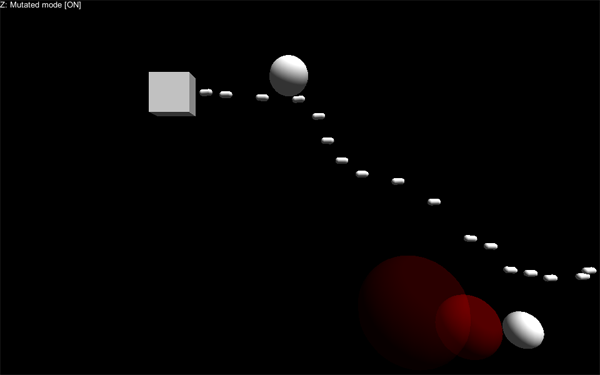
I have an example of usfxr in action in a (terrible-looking) Shmup example (requires Unity web player):

usfxr SpaceGame example

The full code is available on GitHub. I’ll probably fix a few more things – mainly write proper documentation, add a different sample, and maybe make it faster – but overall it’s working. And obviously, I’ll be using it on Ludum Dare this weekend.

Some input would be welcomed, of course – I’m not a experienced Unity developer.

This post is a shortened version of something I’ve originally published on my own website.

You’re getting there, Dave

After many a nasty culling bugs, I’m finally getting to the point where things work.

Space

Trying to get a game out of this

I like the sensation of floating in space. Minimalistic in terms of experience, I believe. Still no game. Working on space walking physics right now.

Space

There’s something wrong with the pod interior, Dave

For my Ludum Dare entry, I’m actually using content found elsewhere on the Internet (I suppose this means I’m being part of the jam, not the compo). Still fun. Unfortunately while it makes things faster, using “free” models usually mean you have to ignore certain missing features. In this case, the pod doesn’t have an interior.

Space

I’m finally getting to a point where I know what to do to make it a “game” though.

2001: A Space Oculus

Finished my jam entry. Not bad for a weekend on a platform I hadn’t used before.

Try rescuing Dr. Frank Poole from the emptiness of space in 2001: A Space Oculus (requires Oculus Rift).

Space

Controls are somewhat hard. I was going for a QWOP-style control, but I’m not sure I made it fun.

Regardless, a noclip/free mode is included in case you just want to float in space and look at the ships.

Comments

29. Apr 2013 · 02:44 UTC
Just tried this out on my rift. Awesome work!

LD27

I’m in

I’m again. This will be my 4th Ludum Dare.

Last time I used Unity, but this time around I’ll be once again creating an ActionScript game. While it’s great to explore technologies that I’m not very good with, I think I’m going to try making an actual game this time!

For coding, I’ll be using FDT. For compiling, I’ll be using Adobe AIR 3.8 beta.

Code-wise, I’ll be using my generic, public code that I’ve been sharing on GitHub. Many of it includes game-related classes made especially for Ludum Dare, including a new GameLooper, and a a game input abstract class.

For third-party libraries, I’ll be using Starling for rendering and Nape for physics. I plan on having levels of some kind; I’ll be creating those levels with the R.U.B.E. Box2D editor, and loading them into my game with my R.U.B.E. loading function.

For audio, I’ll be using static files from sfxr. Art will be created with Illustrator and Photoshop.

I’m not sure of the target platform yet. It’ll be Flash, so this means either as a desktop app, a web game, or an OUYA/Android game. My recent prototypes have been targetting desktop and OUYA, so hopefully that’s what I’ll do.

I will be broadcasting my progress on my Twitch.tv channel.

Game on!

I’m done

Whether the game is, is another story entirely!

My entry for Ludum Dare #27 Jam is Hijack Humans Hastily, an spiritual successor to one of my previous games, Fry Fleshlings Fast.

Hijack Humans Hastily

You can play it online, or watch the video below (warning: I forgot I was recording all my audio input, so it has some music being played by mistake).

Overall it was an OK game for me to make. It’s nothing super but it’s more well round than my previous entries, I think. More on a post-mortem soon.

Hijack Humans Hastily – Post mortem

Hijack Humans Hastily was my compo entry for Ludum Dare #27 under the theme “10 seconds”. It was a game developed in pure ActionScript 3 (using Adobe AIR), with the OUYA as its main target but with a web version available (given the platform). Here’s a short gameplay video:

Here’s the mandatory post-mortem, with a few development snapshots scattered around the article.

First physics bodies

First physics bodies

What went right

Reusing stuff I already knew about

In my previous Ludum Dare entries, I’ve rarely re-used many systems. I like to build my own stuff. In fact, so far I’ve refused to use full-fledged engines, and while I’ve used Unity previously, it was mostly an excuse to force myself to get acquainted with it.

Particles for thrusters

Particles for thrusters

This time around, I had decided ahead of time that I would be using AS3 and a couple of frameworks for certain features (Nape for physics, Starling for GPU graphics). I had no engine, per se, but I complemented those by developing several additional libraries for game controller input, game looping, and physics level data loading (most of which are open-source and posted on my blog). I was certain I’d spend more time working on a game, rather than working on systems for a game (which, as fun as it is in itself, doesn’t make a good Ludum Dare entry).

Using image assets

Using image assets

The strategy worked pretty well. While I still had to use a pretty amount of time getting basic stuff working (due to my lack of knowledge of some Nape features, for example), I felt I was actually building a game earlier than on my previous entries.

More particles

More particles

Art was straightforward

I loved doing the art for the game, even though I hadn’t been drawing in a while. While a bit was dropped and unused (specially background art), I think the simple aesthetic I reached was pretty flawless even if it wasn’t brilliant.

Image assets being added

Image assets being added

What went wrong

The idea

Getting a game idea is always the hardest part for me, specially under pressure. I spent the whole first semi-day of the compo (Friday) doing nothing other than dicking around online, or reading, just because I couldn’t figure out an idea. The idea Saturday morning – of a flying UFO capturing humans – was a mechanic I’ve been thinking of for a while, but to be honest I didn’t have the gameplay challenge or the relation to theme figured out for a while.

Making the UFO landable

Making the UFO landable

Features were dropped (surprise)

While I tried having a smaller scope, some features were dropped out of the game. There’s only one level, for example, and while it’s randomized and it’s all based in easily configurable parameters (size, assets, etc), I never had the time to add actual level progression and assets for more levels. The current level used (city-ish) is a mix of my two initial levels ideas, park and city.

Adding human targets and background art

Adding human targets and background art

Worst of all, I couldn’t even begin to implement the enemy A.I. In the best Choplifter fashion, the second level of the games was supposed to game enemy tanks that would shoot at you. They would not do any damage, but their projectiles would throw you out of balance and make control a bit more difficult.

Making humans capturable

Making humans capturable

Not enough time for bug testing/QA

While I didn’t run into any huge problem, my entry still had some issues I had no time to test. Those include some bugs related to web playback (losing 3D context when switching between fullscreen, for example), and some OUYA pitfalls I wasn’t aware of (having the game suspended by the system puts it in an unplayable state when restored). Those are things that are likely easily fixable, but were noticed too late.

Adding building obstacles

Adding building obstacles

Conclusion

I think this was probably my most well-rounded Ludum Dare entry so far. I’m pretty happy with how it turned out, and I spent plenty of time watching my own time-lapse video of the development process. It’s great seeing it slowly transform before your eyes.

Still, the relative smoothness of this Ludum Dare made me realize something. Ludum Dare is a lot more about the content, and I’m not sure I’m very happy with it.

Because of the limited time, it’s better to have a great idea, create a lot of content and gameplay, and test it out until you have something fun. Some of the compo and jam entries I’ve tested were really fun to play, more than just being an interesting concept that could become a game.

In my mind, I like to use Ludum Dares to explore new mechanics – mostly in the form of new code – and almost as an excuse for learning something. And to be sure, I’ve done a lot of that; all Ludum Dares have been a great experience, even the ones where I didn’t have anything very playable in the end. I learned a lot in a short period of time.

Still, having to be forced to spend more time with content and gameplay is something bums me out. Having to ignore bugs unless they’re showstopping, and having to get things to work fast (as opposed to right) is something that, over time, I’ve almost forgot how to do. Nowadays, I like to get a cool system to work as a stepping stone. In a way, it’s almost as if gameplay is secondary to that (in that it comes after that, not that it isn’t important).

Something else made me realize that. Over the past few months, I’ve been slowly developing a game prototype on my free time. It makes me really, really happy. I take my time to get some things right – be it gameplay, animation, or lower-level systems – and it’s very rewarding. I do one thing at a time. Putting a pause in developing that to do Ludum Dare #27 was good in technical terms – I ended up learning several features I plan on adding to my game, such as ray casting in Nape – but I also realized I wanted to get some things right rather than just getting them done. For example, my starling shape utility classes – to transform imported Flash Sprites and MovieClip into Starling textures – is a mess. It works, but there’s a lot of edge cases where it doesn’t work as intended, or where there’s a lot of redundant code. And I’ve used it in 3 projects already, with no actual time for refactoring them and making them elegant.

I know the usual solution for Ludum Dares it to use an engine. Some might say I should have used Flashpunk, Citrus, or any other engine. And they would be right. But the reality is that it wouldn’t have been as much fun for me. As weird as it sounds, to me, Ludum Dare is an excuse to write something from the ground up. Not just to get something done, but to appreciate the journey of development. And I’m sure that, for many people, seeing something done is what motivates them over everything else. It surely motivates me. But I’m starting to realize that I care too much about getting systems right. Maybe it’s an annoying developer thing. My own professional work is always done on tight deadlines, make no mistake, but over time I’ve learned to balance it all and use time well to get something that’s mostly right from the get go. It normally means a better, more stable project in the long run.

I’m very grateful for everything I’ve done and learned. Ludum Dare is an awesome idea. But I’m not sure what I’ll do with the next Ludum Dares. I might do them, but maybe as part of a team, or maybe without submitting anything. I may use it as an excuse to build a “demo” of a system – e.g. my game controller classes, which need a few additional features – rather than an actual game to be played. We’ll see.

Tags: as3, LD27, post-mortem, postmortem

Public service announcement: Full Game Developer Magazine archive available online

Game Developer

Available for free on the GDC Vault. This is an incredible (and sadly missed) magazine. I recommend any aspiring, hobbyist, or independent game developer peruse through this archive. Many insightful articles for all fields related to game development.

I previously wrote about how you should subscribe to this magazine. Alas, the magazine is now gone, but you can read everything in PDF form.

Comments

21. Sep 2013 · 03:31 UTC
Wow I miss this magazine. Thanks for telling us about this!

LD29

I’m in!

I suppose Ludum Dare is about to start, so before the site crashes, it’s probably better for me to make my first post for this edition!

This time around my focus will be learning – I’m going to use Unity, which is not something I’ve used a lot, and probably some of my Unity code like usfxr for dynamic audio generation and some of the shaders and code I wrote for dynamic generation of flat-shaded meshes with fake occlusion. I’ll probably create some kind of tile-based, isometric kind of game, but I’ll wait until I know the theme so I can decide for sure.

Good luck to all!