LD24 August 24–27, 2012

The Lost Laboratory – Post-Mortem

So ludum dare 24 is over and The Lost Laboratory finished. It’s time for a retrospective.

A quick overview of what went right and what not:

What went right:

  • Planning the game
  • Coding
  • Graphics
  • Audio
  • Testing

What went wrong:

  • Content
  • Interface

It was really motivating to only have 72 hours to make a game. I worked 33 hours in total on the game.

It was really fun to explore the theme.  At first I didn’t like the theme because I could only think of generic approaches to it. But after an hour of  idea generation I finally found something which made me think “This might actually be really fun”. After having a closer look at it I noticed that it might be a little too ambitious. This brings me to my first what went right point.

Planning the game 

To get something playable in the 72 hours I had to cut features. The goals that I set for myself have been: 1 animal, 1 ability, 1 other room and the core mechanic which included the Genalyser, the Dnapter and a visualization  of the progress. I had all this done by the end of day 2 which was really good, as I could spend the little time I would have(I could only work at night on the last day) on polishing the game.

 Coding 

Another thing that went right was the coding. I knew allegro, boost and C++ very well and having a basic framework also helped a lot. I didn’t run into any problems. Bugs got fixed pretty fast and no crash issues. I haven’t done a game like this before but I could use my experience to solve all coding demands. I didn’t have to make any workarounds either as I made the engine myself so I didn’t feel like I was pushed in a direction I don’t want to go. I like to use the new C++11 features especially auto. I also found out that I could combine an stl map with an enum class and have an array with a readable index which can’t go out of bounds this way without using defines or casting to int. I love it when I discover a new way of using something 😀

For everyone who’s interested here are the tools and libraries I used for coding:

  • Code::Blocks (svn 8248)
  • Mingw 4.6.1
  • allegro 5.0.7
  • boost 1.48

Graphics 

I’m really happy with the graphics, although I could’ve done a better job with the tiles. I don’t do graphics that much but it worked out pretty well. The style I choose for the graphics is pretty simplistic which made making the assets a little easier. Still it took me around an hour per asset, with some exceptions. It was really relaxing to do art from time to time. Animating also went really well. I like Paint.Net more and more now. But I still wish there would be some features from the normal Paint and from Photoshop, but it’s ok. I just need to learn the hotkeys. It’s annoying that I can’t select multiple layers and work on them.

My tools:

  • Paint.Net (for pixel art and animation)
  • Paint (for quick pixel art)
  • Photoshop CS4 (for larger art)

Audio

This is one of the things that went reeeeeeally well :D. I guess this is the case because I had a dedicated sound artist. All sounds were done in the last two hours or so. He did a really good job. He even dished an amazing background track out in no more then 10 minutes. I wonder how the audio would’ve been if he had been there for the whole 72 hours. Here’s a little post mortem from him:

Hey guys, i’m SeniorHeuser.

I’ll just add my two cents about the audio editing and sound design (well, 2 hours aren’t really sound design but whatever :) ). I was sent a textfile by Kayelgee listing the sounds he needed with information about frame delays and frame counts, a working build of the game and most importantly the opportunity to replace the files „live“ while working on the sound effects and music. That helped a lot and that’s one of the many reasons i like to work with Kayelgee. The sound effects were put together in Adobe Audition 3.0 using free sounds from the internet. The background music was scrammed together in a sugar-induced 10 minutes creativity flash using Mixcraft 4 and my good old Yamaha Clavinova CVP-35 which apparently went quite to his satisfaction :) So THAT went well.

What went wrong:

I was not happy about how the effect for the bunker door sounded but time was not on my side, so… I never did sound effects in such a limited amount of time. That said i was shocked how fast one can run out of ideas and sources for sounds. Note to self: Gonna need a good outdoor mic! :) Definitely a field i will spend more time on ’cause it was a lot of fun being time restricted in a creative manner. Really looking forward to polishing the game post compo!

Testing 

Having a few friends who tested the game helped a lot. The feedback I got fixed a few issues. Different pc configurations, different knowledge and different gaming behavior helped me to fix bugs, typos and awkward design decisions. Yet some design decisions weren’t questioned and ended up being left in the compo edition even though they were bad, BUT ludum dare people are also testing the game and pointed out some interesting sutff. I’m really grateful for every comment you leave.


It’s time to get to the bad guys. The things which went wrong.


Content

As the project was so ambitious and I only really had 2 out of 3 days to work on it the content ended up being a little thin. I would’ve loved to have multiple abilities, multiple rooms, multiple animals and more . But time was short so I decided to have a minimalistic content, but enough to show how the core mechanic works.  So it’s one of the few things that I would’ve liked to work a little more on.

 Interface 

Yes the Interface went wrong. I was so focused on everything else that I made a few design decision which made the interface a little awkward. You have to click multiple times on the Genalyser when you’re holding a cat even though you can’t do anything else then decompose the cat once it’s inside. The Dnapter is missing a List where you can choose which ability you want to upgrade including a indication of how far your research is. The player has an interaction range, yet it’s not shown. Even though the player has to get close to something there is no keyboard button to interact. That’s everything which should’ve been fixed or didn’t exist in the first place. I should have thought more about these things. But at least these issues can and will be fixed in the post compo release at some point.

 Conclusion

So much good stuff a little bad stuff. Overall I’m really happy about how the game turned out. I like it’s idea. It has so much potential I really want to take it further. As this ended up being so content -poor I’m not expecting too high scores except for audio. I’ll be happy with everything that gets at least 2 stars 😀

If you haven’t played The Lost Laboratory yet head over to the game and play it, rate it and leave a comment. I’m happy about every feedback. If you like the idea then stay tuned and watch out for further releases. If you want to be one of the first to get new informations then follow me on twitter @cp_kayelgee .

Tags: post-mortem

Nom’s evolvathlon timelapse + stats

It was an entertaining experience watching my own timelapse.  I believe that, if you know about what you see on a timelapse, it becomes more interesting.  The tools you see me use are the following:

  • xterm (IDE)
  • vim (text editor),
  • Gimp (sprite editor),
  • Inkscape (vector editor),
  • Evolvotron (texture generator),
  • as3sfxr (sfxr as3 port).

By looking at the timelapse frame by frame, it was also possible to analyse the time I spent on different aspects of the game. I counted one frame simply as 30 seconds.

TOTAL: 1032 min = 17.2 hours Background textures: 23.5 min Tiles: 21 min Sprites session 1: 43 min Sprites session 2 (shading): 28.5 min GFX TOTAL: 116 min = 11.2% of total Text boxes: 31.5 min = 3.1% Audio: 17.5 min = 1.7%

I spent more on graphics than I thought, a solid 2 hours.  Still it’s only 11% of total time, so there’s not that much to optimize there.  I spent very little time on audio, only 1.7% of total, so I shouldn’t be afraid of spending a little more time there.  Most of the rest is spent coding (about 2/3, I did not count these frames because there were too many), and playing the game (about 1/3 of the time).

Tags: timelapse

Go Back – level creation

One of the first thing that we solved after getting the basic mechanics working, was creating levels. We knew that if we wanted this to work, we had to have polished levels that were enjoyable. A quick level editor would be sweet.

Sadly, I didn’t have time to create a level editor. So we did the next best thing: we created the levels in Maya. This was amazing for 2 reasons:
1) The artist had more time than I had, I was kinda busy coding features.
2) Testing levels was blazing fast. Don’t like a level? Delete and rebuild.


What we did was create a default cube, this cube would be the same one as the artist would use in Maya. The script I wrote would read out all the level meshes from a certain directory and loop over all the cubes in that mesh. If these are named “Sticky” or “Bouncy”, they would be tagged in the script as their respective type. Simple and easily expandable. The only downside my script had was that it doesn’t allow for a single level to be reloaded, it would have to go over all the levels to rebuild them. The process only takes half a minute or so, so this wasn’t worth the time to fix.

On average we went through 3-4 iterations of each level, with some exceptions (level 9 and 16 come to mind, they were probably changed at least 8 times).

Play Go Back here

Myxolous – Postmortem

Play Myxolous

I’m pretty happy with how Myxolous turned out.  I was aiming for a “hands off” approach to an RTS, and that’s what I got, for better or worse.  While I’m glad that I was able to complete a game, and even work in a lesson at the end,  Myxolous does have a couple flaws.

What Went Right

– Because I used basic geometric shapes, I was able to quickly model stuff in 3D, add in a cel shading effect, then throw in a quick 2D render.  For the amount of time I spend on them, the game looks great.

– The speed at which GM let’s you create games always amazes me.  I was able to finish most of the graphics, and nail the gameplay engine the first night, leaving all of the second day to fine tune the mechanics and polish menus and things.

– The message.  Believe it or not, I even managed to work some criticism of civilization in the game, and were a couple emergent moments in the gameplay that I think really fit.  For instance, I like how at the close of the game, enough stone has spawned and the remaining forests are so dense, that any Myxos unfortunate enough to go near them are many times stuck there for life…just like real life!

What Went Wrong

– The game is a little too simulation heavy, and player agency isn’t exactly clear from the beginning of the game.  It’s not until the first game is almost over that you really see how important your limited actions are, as a whole game can hinge on a single successful lightning storm spell.  I think alot of people probably didn’t play long enough for the game to get into full swing because of this.

– The sound.  GM: HTML5 is a pain with handling sounds, and due to some last minute bugs, I decided to not worry about any sound, which detracts from the game a little.

Thanks for reading this and playing the game…see you next time!

Probes of fury post mortem

So i completed my first ludum dare and i learned a lot. trough my “failure” so here are the lessons i learned in hope that i an whomever reads this will not repeat them.

1.Gamedesign should have been done ahead of time
Though i did have an idea it’s important to work trough a few ideas beforehand, especially when it comes to planning.
The main error i did was that i had like two hours at the start of the compo to shoehorn in the theme into an already existing idea and thereby making it too bloated.
The original idea i had was this helicopter sim in where you fly around shooting guns and rocket creating majestic explosions, destroying buildings.
But then came the theme “evolution”, i paniced and made up a story about a small mars probe that suddenly gained sentience and had to evolve itself by collecting parts from other probes sent to destroy you in order to survive.
What i should have done was to come up with a handful of base ideas that could each fit a few the final 20 themes, then plan each of them so that i the game will be made in time and that i know what kind of pieces i need beforehand.
Really if you have done the planning correctly all you need to do is follow the plan and do exactly as it says.

2. Keep up the phase
Anything not critically important  that takes more than 1 hour is not worth doing, seriously, i spent two hours on collision detection three on the terrain and at least 4 on making the bullets fly properly, not to mention setting up  the enemy spawning system and so on.
Now while reinventing terrain generation and collision detection is all fun in itself, that’s at least five hours i could have spent coding the AI, upgrade system and making more 3d models, all of which i now never got around to.
So note to self, next time if my toolkit cant do it or if i have to invent it, it’s not going to end up in the game at all.

3, Finish the game the first day.
After the first day i had my probe running around, terrain generated, camera working, collisions working and so on, that is to say not that different from the final product.
You will probably need at least 5-6 hours at the end to tidy things up and make it presentable which leaves you with like half a days worth of coding the second day, that is not a lot of time to code major parts of the game, not to mention if something goes horribly wrong and you have to spend time fixing it.
So if the game is not functionally finished the first day it will probably not be at the end of the second day.
If you do it that way you will have things to add instead of having to cut things from your design, not to mention more time to polish.

4. KISS
As in Keep It Simple Stupid, my game idea turned out to be pretty complicated, i mean there is a reason why a majority of games are 2D and pretty low fi.
And while i think i could have completed it properly given two more days, it should really have been done after the first one.
I think that if you want to keep it simple enough then imagine making an NES game with all it’s limitations.
So next time it’s either going to be a proper tile based 2D game or something like it.

5. Practice makes perfect
I have to say that i was pretty unprepared for this, although i once made a simple game in six hours this was compleetly different.
Before next time I’m going to attempt to train myself making a specific game type in a single day and you should too because that’s really what you have to work with, if it takes any longer than it’s not going to work and your design is too complicated.

6. Make sure your tools and procedures are up to date
I spent over an hour attempting to export a 3D model to an OBJ file, turns out that my modeling software doesn’t really agree with me that texture-coordinates are important, they are BTW.
What i should have done is make sure that i had a firm grasp on how to do the export properly.
Second mistake with the 3d models was that it utterly refused to export normal values which i also thought was important, so i had to go into a second application to generate those, in the end that was unnecessary since i didn’t have any lighting anyway (see, there goes the importance of planning again).
Third tool mistake was terrain generation, generating a flat plane with some random bumps in it shouldn’t be a problem, but it is if you have to do it from scratch, in the end i could just as well have made another 3D model and loaded it, but no i had to try to make it free roaming.
Well that failed and i was down another few hours and i was left with an impressively complicated construct using geometry shaders and a heightmap.

7. Choose your platform wisely
I chose windows using openGL and c++ which is pretty much the ultimate default choice for any game development.
That is for general game development, Ludum dare on the other hand is different beast altogether.
Don’t get me wrong, windows and c++ is really great, powerful and supreme in most regards, it’s also the platform i am mostly familiar with.
But it does have the slight problem with system bloat and you needing to basically code for every eventuality and hardware combination, which is good if you want to make a great game, but not in 48 hours.
So for the next one i might have to take the plunge into java or html5+webGL, either way it will have to run in a browser.
I’m just saying if it runs there it will run anywhere and i don’t have to worry as much about strange bugs popping up on other peoples systems.

8. Make it fun not good
Great gamedesign prioritizes fun, my initial game design idea was also fun, but not once i had to cut it down to size.
Always start with a very simple idea and work yourself up from that.

So those are the main lessons i learned, but on the bright side i did learn a lot of what my toolkit really needs for the next few versions, and that is really what i set out to do in the first place.

Advancer: Timelapse & Post-Mortem

Game can be played here.

I actually ended up skipping sleep on the second night, because I realized I would not be close to getting finished if I slept. I don’t really regret it, the closer it came to the deadline, the more awake I felt so it turned out alright.


What went right:

Flashpunk– This is the second time I’ve used Flashpunk for Ludum Dare. I didn’t run into any problems with this.

Graphics– The nes style graphics were pretty quick and easy to make while still looking good.

World design– I think I did a good job at making a fun world to explore, with the world expanding with every evolution.

Concept– When I started, I was just making a platformer where your character could evolve into different beings. I pretty quickly thought up a better idea of the game itself evolving through different era’s of gaming. (Oddessy > Atari > NES > SNES. I didn’t start on the snes era, however…). I’m planning to continue working on this and develop the concept further.
What went wrong:

Planned world map

Basic Engine– I spent more time then I’d like to admit trying to make a simple, non-glitchy platformer engine. I’m not very good at it.

Scope to large– I intended to make the game world even larger and add shops and additional abilites, etc. Right up until the deadline I was still trying to add new content.

Enemies– The game only has 1 enemy type and 1 boss, and their movement patterns just have them moving left and right. I would have liked to have many enemies and a good boss or two.

Coins– Coins were originally going to drop from defeated enemies, and you could use them to purchase new abilites (Thus, evolving your abilites), example include charging your sword for higher power and range, the ability to attack upwards/downwards, etc.


What now?

I will continue to work on the game, then I’ll release the game as I intended it to be. The finished version will have the 16-bit evolution that I didn’t have time to make, as well as the ability the switch between the different era’s at will. It should allow for some interesting levels and puzzles.


Tags: post-mortem, postmortem, timelapse

Comments

rxi
31. Aug 2012 · 18:30 UTC
Do I spy the NES colour palette image in the time lapse? I’ve been trying my hand at coding a NES rom and was using that palette earlier today since it lists the colours and all their coinciding hex values on top of them, which is quite useful!

Arcade Dev Kit!


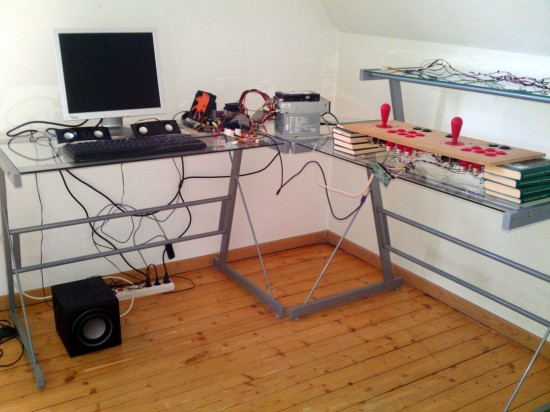
I’ve just finished building my very own Arcade Dev Kit!

this is huge fun – who yould have guessed making stuff for two players on the same machine bashing aroung a joystick would be so awesome ?

(also, this is possibly the best thing you could do with an old crappy PC lying around) 

Tags: arcade

made a search engine

hey guys, it mohammad, and its been tough a little.

ive done a little programming, but then i was experimenting with some gamemaker funtions, and made a search engine.

honestly, i would’ve just keeped this to my self after realizing 300 posts a day wasnt a good thing. espcially when a few comments and posts shown that i can be a little douchy, but now i just want to point out key things going on in my life. so i came out strong, and made this program for you guys, because if anyone will uderstand app and game deveopment, its you guys.

so i got my guts, and made this app for you guys.

i would’ve made a teaser trailer too, but when i did it for other things, i got posts declaring me as “annoying” so i cooled it off with the webcam. i just wanted to make a few laugh and a few smart a**ed comments. but now ill just put the game up for 1 or 3 to see, so i really dont care. i just want feedback, ok? thats why i make posts.

so…here it is. https://docs.google.com/open?id=0B2Hj8tfbtIyod3N5V0V3NUFvUTQ

oh ad btw, from now on ill be using google docs. its slower but WAY better than uploading.com.

transitions happen.

Comments

mohammad
31. Aug 2012 · 01:36 UTC
comment removed for various reasons.
Doft
31. Aug 2012 · 05:26 UTC
search_engine.exe? Really?

31. Aug 2012 · 18:57 UTC
What is this I don’t even
mohammad
01. Sep 2012 · 21:45 UTC
Ok, when I make a game, ill share it, thats why we have the MINI-LD’s and the compo’s and stuff.

When I make an experimental application, like the one I said was in development recently, ill make a post about it. Not make it into the compo or jam or anything like that.

This was a BLOG post. To BLOG about my status. So I BLOGGED about this program.

Like I said, no need for hate.

Human Evolution – Time to Post Mortem

Hello to all,
I’m really happy to be here and to have participated in this nice event, but most of all I am very pleased to have successfully completed something that even I had doubts finish. My game “Human Evolution” is simple, trivial and childish, but I did it and it is running at 100% XD


You can find the game here: HUMAN EVOLUTION

Post Mortem


What went right:

IDE/Language: I used Construct 2 for my first ludum dare and it was a nice experience, is fast and easy, and I had little to think about as I designed the game.

Idea: The idea came to me on the morning of August 25, I woke up, had breakfast and I did not think about anything but just this guy running through the historical ages without the slightest explanation XD

KISS: The survival guide for the game jam has been very useful, I had on my smartphone my TO-DO list, I had it all planned and it helped me a lot .. even though I have not met exactly.


What went wrong:

Graphics: I’m not an artist, this is my biggest weakness .. maybe I should focus a bit ‘and seriously study the pixel art, I know something, but as you can see from the game at some point (with the time he was about to run out) I preferred to hurry, and I drew badly as a child of 3 years ..

Loosing Time: On the second day I lost quite a bit ‘of time that could be used to make better designs, but because of the many images that were created I became lazy .. and at one point I even started to play with the nerf guns in home with my brother .. losing one hour and a half  XD

Calculation of the difficulty: In the rush to complete the game, I did not look at your increase in difficulty as the player continues through the ages, the increase in the speed of the character is much lower than I had thought and testing in the final stage no one has and I pointed out I did not mind because of my attention to the graphics to be completed.


What Now? 

Well now I just have to tell you something, do not let nothing and no one to stop you from doing what you like, do not expect pats on the shoulder or encouragement by the people beside you .. just do it.
Send them all to the hell if necessary, but do it.


sincerely

Umberto

Comments

mohammad
31. Aug 2012 · 18:43 UTC
construct?

that silly HTML gamemaking program?

pfft.

Yellow Dog Post Mortem

The game can be played here. Also, I’ve got my time-lapse here.

This was my first ever attempt at Ludum Dare. I’ve kind of watched it the last 2 or 3 times, and a few weeks ago, I saw this one was coming up, so I decided to participate.

A bit of background about me: I’m not a professional game maker. My 9-5 is as a tech director at a branding agency. I mostly design and develop websites along with various other digital projects. I’m paid for being creative, and to me, it’s the best job in the world. I have a background in graphic design, and I used to be really fluent at AS3 back in the days it was acceptable to use on the web.

This game is my second ever game project. Well, sort of. I launched an iOS game this January as a test to see if I could do such a thing, and I’ve been building a platformer as a save the date card for my fiancé (Katie) and I’s upcoming wedding, and when I was an teenager my brother and I were obsessed with ZZT. Anyways, I’m new to the gamedev world.


The Process

The week before the competition I had several game ideas based on the themes were being narrowed. I had something for “Don’t Go Outside“. If it was “Abandoned” or “Survival“, I had a cute little concept that I kind of liked. I even had half an idea if “1000 Kittens” was the chosen one. When “evolution” was announced I was dumbstruck. I sat there just with an empty mind for several minutes. Over the course of that first hour or so I just kind of thought… and thought… and thought.

I trashed probably 4 or 5 potential concepts in the first hour or so. I threw out several ideas that seemed too easy. Things that I thought everyone would go with. I threw out concepts that I couldn’t wrap my mind around how to code. I talked to Katie about it and we talked about some of the ideas I had earlier in the week. My idea for “Abandoned” dealt with the loneliness and boredom a dog faces when it’s owners leave for the day. Lots of sleeping, walking around, barking at stuff. Getting it trouble for getting in the trash or drinking out of the toilet. Getting praised for barking at strangers. One look at Olive, our yellow lab, gave me the encouragement that was needed:

I jumped into photoshop and mocked up a sprite. I programmed some basic movement skills, and by midnight on the first night she was walking around in a really simple house.

Over the course of the next two days I stayed up later than I have in years, drank a ton of coffee, and programmed with the ferocity of 1000 suns. I took only a few short breaks, and by the time I was done I was completely wiped out. For the majority of the weekend, Olive slept by my feet as the keyboard was clacking.


What went right

Preparation – I prepared for LD24 by clearing out my home office, setting up the computer so there were no last minute surprises, and working in a language I was comfortable with. I made sure that I had nothing else pressing over the weekend. Plenty of soda in the fridge, plenty of coffee left, etc.  I didn’t need to leave the house the whole weekend, though a few quick breaks helped my mind from feeling congested.

The Graphics – After I drew the first sprite of the dog sitting, I knew I was on the right path. Even though there wasn’t a single line of anything programmed, the idea felt concrete. I decided to go with an ultra low resolution sprite. I think it was 10×10 pixels. I figured it’d be less work because of “Hey! Less pixels to draw!”. I don’t know if that actually turned out to be the case, but I think I really like the aesthetic.

The Logic – Sometime during the second day I wrote out the flow of the dog’s motivation. “If the dog doesn’t need to go potty, and it’s not hungry, it should find something to do.”, “If the dog is really hungry, it should bark at the player because it’s angry.” It wasn’t a ton of code, but adding it made the dog feel alive. There was enough randomness that I didn’t know what it was going to do. The different stages of it’s life dictate different things. When it’s a puppy, sleeping and boredom take precedence over everything else. If you fulfill his needs as a pup, he’ll get bored less often as an adult, and should be easier to manage. If you take him outside when he needs to potty as a puppy, he’ll do it on his own as an adult.

The Interface – Through the first 80% of the project the interface was really basic. White words and buttons on a black background. It was functional, and looked fine with the basic pixelized graphics, but did nothing for the appearance. Setting aside an hour or so to design an nice looking interface (and adding a background) really paid off.

What went wrong

Getting Realistic – About halfway through Saturday I assessed my progress. I looked at what I had done thus far, and looked at what I still had ahead of me. I scrapped a ton. No more house full of details. No more cut scenes. I couldn’t figure out pathfinding with the system I had already built and rewriting it wasn’t an option at that point. So, I got rid of any obstacles. Simplifying everything made it far easier. I could see the light at the end.

The Volume – Alright… So, I didn’t test the volume at all before I published it. I made the sound effects in cfxr (the mac version of sfxr). I didn’t compare the volume to any other games, and I honestly didn’t know what I was doing. I was working in a vacuum. Turns out they were way too loud.

Last minute changes – As I wasbug testing I fixed a bug that caused the little flyout graphics to not go away on some computers. In the process I caused a bug where sometimes when the dog is an adult, it’ll be flipped the wrong way when it’s eating and appear as if it’s eating an invisible bowl of food. I didn’t know about this bug until it was too late. There’s another bug where if you clicked the buttons too much, those actions would be queued, and the dog would spend the rest of the time walking through your motions, even if it’s pooping 12 times in a row.


So, that’s it. I’m really proud of what I made. I surprised myself several times, and I think that’s what LD is all about. After the game was submitted, Olive was really happy that I finally had time to pay attention to her. Little did she know, in a way, I was the whole weekend.

Once everything is reviewed I’ll fix the bugs in the game. I’ll probably also spend a day tweaking things according to the feedback I’ve received. I’ll add in a bit more things to do, lower the volume on the sound effects, etc. But then, it’s on to other projects. I’d be lying if I said they didn’t include my dog in some way or another.

Tags: first-timer, post-mortem

Some people rate but don’t comment. My thoughts.

Personally, I don’t care half as much about getting ratings as I do about getting comments. And not just the positive ones, but any constructive comment. The comments I get on my game are mostly constructive, so that’s amazing.

It isn’t always easy coming up with something to say about the game you’ve just played and rated, but everyone has spent hours and hours on their game over the weekend, and we didn’t do it just because we were bored. Perhaps we wanted to learn, perhaps the theme inspired us, perhaps there was something we just really needed to say with the game, but there is always a reason, and because of this, there is always something to say. And if there isn’t, perhaps we havn’t given the game enough time.

Why are we rating each other’s games? The first reason should be that we’re interested in what other people have done over the weekend, but if I’m honest, for me that’s only part of it. I’m also rating other peoples’ games because I want my game to be played and commented on as well. I can only expect that other people rate games for that same reason.

The voting system makes games with less ratings, by people who rated a lot of games more visible. But what this system measures is ratings, not comments. I have been playing games, I have been rating them, and I have been thinking of something to say for every single one of them. Sometimes I said what I liked and didn’t like, and sometimes I just commented on the way the theme was used, if that’s what stuck out for me, but I left a comment either way.

I was going through this proces of rating and commenting on games, and noticed my game had appeared on the front page again. I was happy, waiting for karma to do it’s work.

5 people rated my game, and then my game left the front page again. I was excited! What did the people who rated my game think of it? I clicked on my game and scrolled down for the new comments.

No new comments.

Of the 5 people who rated (and presumably played) my game, none of them left a single comment. Needless to say I was disappointed. Was my game that uninteresting? Did it not work for them? I’ll never know, because they didn’t leave a comment.

And just like that, the sense of community I always feel when entering Ludum Dare, got just a little bit less.

I don’t know if leaving a comment should be required. I can understand some people are perhaps too shy to leave a comment. But leaving a comment should be encouraged! With the way the system is now, your game is only on the first page for a minute at most. Sometimes you’ve rated and commented on quite a lot of games to get there, and to see that your game is once again practically invisible between the 1400 other games, without having received even a single comment was a bit depressing.

Perhaps the system should check for comments, and not just ratings?

(to clarify: 32 people rated my game, 20 commented as well. More than 1/3 did not comment.)


Video walkthrough!

Okay, I spent the past two days bashing my head against the keyboard trying to encode video directly from my game, Digital Generation. The result? A video walkthrough! It’s also a bit of “developer’s commentary” for the game.

I don’t know how to embed videos into posts. Digital Generation Walkthrough (Youtube)

Tags: walkthrough

Comments

mohammad
31. Aug 2012 · 12:30 UTC
i made a post like this…but more douchy…er.

AND GOT MAULED BY FRICKEN EVERONE!

Influenza – Post mortem

I spent the first four hours of Saturday coming up with an idea for Evolution. It was a tricky theme, but eventually I settled on something similar to a simplified version of Spore. After working for the entire day, I had almost nothing to show for it. My idea just wasn’t working out. Frustrated, I realised that I would have to sit this one out, there was no way I could release a quality product in this short a time.

I spent the next few hours watching TV, eating food, lounging around. I became more and more disappointed at my early departure. I felt the need to program, to be making games, to be part of the competition. So I started thinking of new ideas, ones that could be implemented in about a day. That’s when I came up with the concept for Influenza.

You are the flu and you have to spread your disease to other people in a building. You complete the level once you have infected a certain individual. You can also spend points to upgrade your strand, that’s where the theme will come in.

I set out with high hopes. It was a lot of work, but if I applied myself, I might pull it off. I worked into the early hours of the morning, but eventually had to give in to sleep.

Influenza

WIP I posted on twitter, 12 hours before the deadline.

I worked for most of the last day, but at 2:30am (30 mins before deadline) I realised that I wouldn’t make the deadline and gave up a second time.

I posted on the site that I had failed this time around, and someone said that I should enter it into the Jam. I considered it, and although I had another project to complete by the following day, I went for it. It was now 4:00am, and I had been working on it for 20 hours already, but it couldn’t take more than a few more hours of work though, right?

Wrong. I only finished it at 6pm. 34 straight hours of working on this thing.

I’d be lying if I didn’t say it was grueling but it has paid off. I’ve been getting some great reviews and feedback.

Next time I’ll plan a little better, make sure I have an idea that I feel is sure to work.

Thanks for reading. Give the game a go if you like. I really appreciate any feedback, I like to hear how people think I can improve the game, should I decide to work on it further.

Here she is! Done and dusted.

See you next LD!

Post ortum

I don’t like the term “post mortem”. It means “after death”, but actually I perceive it more as birth than death when you finish a new game. So I write “post ortum”, for ortus being the Latin word for birth.

I went to the Internet on Saturday around 10 am and saw the theme “evolution”. First I thought I would not participate in this compo, because I had hoped for another theme (preferably “creation and destruction”), and I could not easily come up with an idea fitting the theme evolution. But then it occurred to me that a game in which you would play different types of animals, starting as a rather old life form and gradually becoming something newer from a biological point of view, would fit the theme. Since however there is a time limit of 48 hours, I abandoned the idea of covering many life forms, and instead opted to have only two stages of evolution.

I fired up MS Paint to draw some sprites and started with a dinosaur, then a fish, a kraken, a seastar, a jellyfish, a crab, and was quite pleased with my results since I am well aware that I am not a talented painter, but the images looked better than I had expected. So I copied the files onto my netbook, started MS Visual Studio 2005 and copied the base code which I had posted to the Ludum Dare blog earlier into a new directory. Using this base code I spent about 8 hours, interrupted by lunch, coding the fish stage. I do not remember having had any major difficulties, basically everything went smooth. I had some ideas on the behaviour of the individual characters and was pretty pleased when I tested the result. I decided that this would be stage 1 of the game, and you would pass it by surviving 5 minutes. First I made the player start with 3 lives, but I found out that the game is rather hard and so I increased the number of lives to 5. As a matter of fact, I have still not managed to survive 5 minutes myself. Sometimes I almost managed it, but in the last minute I was killed.

On the second day I implemented the dinosaur stage. I started with coding the random level generator, then I implemented the movements of the dinosaur (I remember having had minor problems with the jumping behaviour), then I fired up MS Paint and created sprites for the two types of enemies that appear in this stage, some kind of worm and a lion. I implemented the algorithm whether and what enemy appears, the enemy behaviour, and then I found out that in some cases it was inevitable to lose a life because of the placement of the enemy. So I changed that by adding the rule that an enemy must appear only if the platform he is located at is either above the previous one, or if several previous platforms have had the same altitude. Now this stage of the game is perfectly fair, you can complete it with zero life loss if you are a good and careful player. Work on this stage took me about 4 hours. This makes 12 hours of work on the game altogether.

In the feedback I received mostly collision detection was criticized: the rectangles around the enemies are sometimes pretty large compared to the area the sprite seems to occupy. OK, the next time I make such a game, I’ll improve on that. Apart from that the feedback was mostly positive and I am very happy about that.

How it went: Bear Selection

This is in all regards a post-mortem just with a different name. A post mortem implies that the game is dead, but from the comments I’ve got the game has potential and any thing with potential is very much alive!

Bear Selection(Web)

Bear Selection(Web)

The Good

+Stuck to the original concept, a sandbox world where creatures evolve and the player can only indirectly interact with them.

+Mutations can be clear to see, creatures start moving differently or go really fast

+Images are a million times better than I imagined MS paint could produce.

+Getting my brother to draw the creatures, allowed me to work on coding creatures larger than a pixel and some fresh direction in how to implement the images into the game.

+The world is dynamic, creatures can eat foliage and starve if none is left.

+The sparkline graph library made it easy to add a population graph: http://omnipotent.net/jquery.sparkline/#s-about

+The similar syntax between C and Java Script made learning a bit less painful.

+Web based, so that it is accessible to more people. Surprised to find it even runs on android browsers!

The Bad

-No collisions between creatures and creatures, or creatures and tiles leads to fish walking on land!

-No audio of any kind

-Pace is a bit slow and the limited interaction can make it boring.

-Didn’t have time to add terraforming or player activated events like meteorites or forest fires.

-First two days were mostly spent learning object orientation

-HTML-5 Canvas means not supported by IE

-No credits, no loading screen

-No entities like, eggs, blood splatter or fire. Despite the fact the graphics art was made.


Still all in all it was a mostly postive experience and a good game considering it was my first LD entry and my second ever game (first for the language, being web based, object orientated and non-ASCII graphics) so all in all it was a great success and learning experience for me.

You can play it and rate it here: http://www.ludumdare.com/compo/ludum-dare-24/?action=preview&uid=15698

Tags: First entry, first-timer, post-mortem, web game

IO VUOLE ZEN: Post Mortem

This was my first LD and my first complete game, so I was quite nervous. The theme was boring, nothing challenging. And this is why I had no ideas until seven hours after the beginning of the competition. After seven hours I began. I made two or three random things, then the game started evolving by himself. I didn’t need to think what I should have done next, I simply knew it. In an absolutely logical way, from chaos and non-sense, a game was born.

Right things:

Surprisingly barely everything. I slept a lot during the competition, the game was made in 24-25 hours, but I still had time to fix tons of bugs.

-Story: I managed to create a sufficient story in no time. I’m proud of it.

-Mechanics: I seriously like a lot how the mechanics are implemented and how they are linked to the story. They are exacly as I wanted them and that is the most positive thing of the whole game.

-Graphics: I made every sprite in a different way and with a different style. That was quite entertaining. And not meaningless.

-Audio: I never made music before this LD. It has been difficult, very difficult, but I like what I have done. And I hope you enjoy it too.

Wrong things:

-Stencyl and me.

I’m not able to program a game so I used Stencyl. I knew it well and I thought that I wouldn’t have had problems. I was wrong. Many inaccurancies and billions of random bugs,  billions. But I wouldn’t have been able to make the game without it. So I love and hate Stencyl at the same time.


I loved making a game for LD and I’ll surely partecipate again in December.  😉

P.S.: I’m not English, so my English isn’t good. I’m sorry for it.

The House Post Mortem

First things first Play and Rate it here : http://www.ludumdare.com/compo/ludum-dare-24/?action=preview&uid=8389

If you do THANK YOU 😀 All response is appreciated!

Almost a week has gone by since Ludum Dare and finally I’ve got some time to write a post moretm.

So let us jump straight in to it!

  • What went right:
  • Good teamwork. We spent the whole weekend together instead of collaboration via Skype. I think this was a big help for the motivation and the creativity. Who wants to let their team down?
  • We knew our tools which made us work quickly and effectively. Even if this was our first game written in JAVA, before we have used Game Maker. (Except for git!)
  • We created the core mechanism in the first day.
  • Good collision detection this time! We are very happy and if we may say proud of it!
  • We learnt a lot!
  • We had lots of fun! 😀


What went wrong:

  • Hard theme, we didn’t come up with an idea that matched the theme exactly!
  • Learning how to use a version system (Git) is not the best thing during the compo! On the other hand we know it know!
  • AI is hard!
  • some fatal bugs!
  • Somehow the menu for the game would work. The background for the menu was drawn in eclipse but when we exported it to a jar it didn’t work!?!? Althoug we used the same method as with all the other assets and that worked fine!

I (Dals) is working on a post-compo version that will remove most of the bugs and hopefully contain more levels 😀

If you want you can check out the timelaps of the development here!

Well I think that’s it for now. Already longing for the next Ludum Dare! Till then, keep jaming 😀

~DalsGames


Vox – On Steam Greenlight (previous entry to Ludum Dare #23)

Hi people,

Just wanted to let you know that I have put Vox on the Steam Greenlight process.

http://www.steamcommunity.com/sharedfiles/filedetails/?id=92967555

What was originally started as an entry into the Ludum Dare competition a number of months ago, during the april competition, is now being made into a full ambitious game!

Would really appreciate it if you could visit the game page and hopefully show your support (favorite and rate up) and this would make me very very happy indeed, and I would be forever indebted to you! :)

As always if you want to follow my voxel engine tutorials or articles, they can still be found at the site:

https://sites.google.com/site/letsmakeavoxelengine/

I am happy to hear any feedback you guys have, or answer any questions you might want to ask.

Thanks!

AlwaysGeeky

Tags: alwaysgeeky, cubes, gamedev, indie, minecraft, progress, SuccessStory, tips, vlog, Vox, voxel engine, voxels, youtube