LD24 August 24–27, 2012

Post Mortem: “Just like evolution”

The Concept: What to make?

SimEvo was going to be  (or might still become) a game that tries to simulate actual evolution, from a species point of view – with the player directing focus, travelling with the evolving species, and trying to find the most successful branch.
Why go for simulation, and not some more easy to grasp 1-2-3 upgrade system? I guess it is sort of the educational side that I like. Try to get some of the common misconceptions about evolution out of the way. That, and it makes the game feel more real, based on actual concepts that you can look up, instead of some made up ruleset.

The Process: How it got made

For this, my first Ludum Dare, I had a whole weekend free. And I got off to a pretty good start. The tools were working, I liked my concept, had a good grasp on how to do the visuals of the game, and some good mechanics put down on paper.

Over halfway through the weekend though, I realised that my concept was too much, so I dedicated the rest  to making the parts that I did have work. That took most of the Sunday. In the last four hours, I tacked some things I should have started earlier, like how to score the player, or a way to start a new game from within the game. (restarting is not really a nice option)

I read later that one great way to plan this is to tale one day to make the game, and then take another to tweak/balance it.  And I now understand why that is a good idea.

The programming was a bit messy here and there, with some small bugs in the final version I knew of. But the one major bug I found later on is that the ‘new game’ button was broken! I rushed it in the end – it does not reset the state properly, so all tries after the first one will result in very quick death because of starvation. Fixed that a few days afterwards, but it kinda killed any early reviews.

The Reality: What got Made

Yup, some critical ‘game’ features were unfinished – I should just say: the game is half-finished. Oh woe me time :/ Too ambitious, in hindsight. But I got enthusiastic about the concept, and that counts too.

One of the mayor things I did not have time to finish was a`prey & predators` system, which would give you more things to do as a player. (most current stats involve predation, so also of things in the DNA pool are useless atm)

Also wanted to do more feedback for the user on the stats, as one comment on the game points out, without understanding what they mean, the simulation is a mystery system.

In game (partial):

  • Migration – Follow your species to another biome, and see if they thrive better there (partial: migrating is free atm, and species capabilities are not enforced: you can live in the deep sea as a winged bird)
  • Mutation – Select new DNA from the gene pool to be better suited for the environment (in game) resets every time the mutation counter hits 100% (in game)

Not in game:

  • Natural selection – If more than % of your species dies in a short time, you can select new dna from the pool for free
  • Point-mutation – Option to promote random evolution of current DNA stat (+1, -1 on semi-random stats)
  • Vestigiality – Option in gene-pool to remove DNA parts from your species
  • Flee from predator – Don’t like your current predator species? Try to get another one… (might be better, might be worse)
  • Find new prey – Your prey getting low on stock? Try finding a new prey species
Other things, that would love to have put in there, but were already out of the original scope:
  • More visuals for the species body – you can already drag the body parts around (hidden feature almost, no hint that you can do it) – Like special colors / iconic glyphs for certain types of DNA parts
  • Would have loved to make a picture for the background for each biome (12ish) only got 3 done.
  • Other species being simulated, just like your species
  • Events! Make lots of things happen to the environment – from comets to droughts and more. Would have been a good point to introduce more humor into the game.
If you would like more details of what got cut / the stats & details, look at my comments here:
http://www.ludumdare.com/compo/ludum-dare-24/?action=preview&uid=15925

The Gritty: Technical Details and Tools

Making stuff is almost as much about the tools as about the concept. Without them, you will not get there, and what they can do guides what is possible in a short timespan.

I used Moai (http://getmoai.com), as I have been following its progress for a while, and liked their base game loop and Lua scripting focus. I had tried out the engine a little bit before, and it looked good for a go, even if Windows support was not tip-top (Moai is mainly a mobile focused engine). It also was picked up by two hot kickstarter projects: Double Fine Adventure, and Shadowrun Returns.

Yet during the two days of the Dare, I encountered some serious but not game-stopping bugs in the engine, and could not find if they had fixed it. To my astonishment they had moved their issue handling away from Github, to a closed third party system. That sucked. It moved from a free source game engine with open development, where outsiders can contribute, to a closed system. Issues reported by others were largely ignored, and no clear path of progress.
I pretty much decided after seeing that – if they keep it that way -, that this will be my last project with the engine.

Aside from its change in direction, I did like the lua environment – it was very flexible. Still loved the simple but fps independent game loop. GUI creation was ok, but a bit clunky, a GUI system in the engine would have saved me quite a bit of time.

TL;DR Version

Had an ambitious concept, learned that 48h is really 24h + polish, and found out some useful things about my toolchain: that I probably want to change it. Ludum Learning Experience +3, Ludum Fun +1

Got a linux native game that needs testing?

Well, i’ve basicly given up on ludumdare’s search feature, it’s utterly useless since it finds every single game that so much as mentions linux in any way (it finds games that say “sorry won’t work on linux” and “let me know in comments if it works on linux”) and half the people that “do” have linux version requires a 6 hour install procedure to get all the interpreters installed.  If anyone has a linux native game that needs testing, go ahead and leave it in the comments here and if i havent already I’ll check it out!  Now that’s NATIVE games though, i don’t want a bunch of java7 and love2d games linked here, I can’t run those! So binary only.

Comments

quasist
03. Sep 2012 · 01:25 UTC
Please, let code monkeys have some fun ^_^
Dietrich Epp
03. Sep 2012 · 02:53 UTC
Since I saw your post, and in response to some comments on my game, I’ve released native Linux binaries. I know they work on Debian, but there’s a good chance they work on other distributions as well.
rxi
03. Sep 2012 · 06:37 UTC
I get the feeling no linux users have been able to run my linux version since I’ve had a few comments about it. To be honest it put me off even making a linux version in the future, as if providing a version which doesn’t work for most people who try it is just wasting their time. That being said, feel free to give it a blast:
03. Sep 2012 · 07:41 UTC
What did you mean by : Should definitely make a post-compo version?
heuermh
04. Sep 2012 · 01:26 UTC
Just to clarify, is that a hate on JDK 7 specifically or java games in general? I ask because I use linux primarily (64-bit linuxmint cinnamon) and did throughout LD24, except for a Mac to run the Pickle sprite editor.

How I rate an LD game

Browse around the entries until I find a game that looks interesting.

As much as I’d like to, I really don’t have enough time to try out all the entries.  Having a title or especially a main image that stands out really makes a difference.  I have subjective taste and preference in the type of games I prefer, so if you happen to make a game that looks like something I’d like to play, obviously I’m more likely to play it.

How to do well:

  • Have an interesting title or screen thumbnail.
  • Show some wit/originality with your title.
  • Make that thumbnail communicate the essence of your game play.
  • The one surefire way to get me to rate a game is, if you rate me.  I will always check out your game in return.  So rate my game!

Read the entry description.

If you took the time to write up a good description, I will give you the courtesy of reading it.  I want to understand what I’m about to play before I start.

How to do well:

Describe the game in detail, especially how to play and what the goal is.

Also, be sure to describe your level of experience as a game designer/developer.  I take this into account when offering feedback in my comments, but I try to score every game on an absolute scale.  I try to be honest in my comments about what works and what doesn’t, because otherwise how else are you going to learn how to get better?  But at the same time I don’t want to discourage someone new who may not yet have a lot of experience. If I do give you some negative feedback, keep in mind that the fact that you participated at all, and especially that you were able to complete a project in 48 hours is a real feat.  Like finishing a marathon, it doesn’t matter if your time is world class, just finishing is an accomplishment to be proud of, and nothing I can say to you can to take that away.

If there’s a build that I can play (Windows or Web), I try to play it.

Like the LD instructions say, if I can’t play it, I don’t rate it, leave a comment explaining the problem I had, and moved on.

If the game really looked good, I may come back and try again later to see if the bug might have been fixed.  But it’s very likely that I won’t remember to do that.

How to do well:  

  • Make sure you test your game and get it working when you submit it.
  • Respond quickly to feedback if someone tells you they couldn’t play it.
  • Have a web version if at all possible.
  • If you do require a download, avoid making it require installation — just let me unzip and run an .exe.  I don’t want to have to go to the Control Panel afterward to remove it, and I don’t want it in my start menu.

Play the game long enough to feel like I’ve given it a fair chance.

The amount of time I give to a game depends a great deal on how good it is.  I don’t have a lot of time to begin with, and if a game doesn’t give me a good first impression right away, I’m not going to give it very long before I give up on it.  If I suck at the game at first, I’m going to keep playing it, but if the game sucks, I’m only going to give it a minute or two, tops, before giving up and going to rate it.

How to do well:  

  • Don’t have a lengthy introduction or backstory.  I want to play right away.  Any story elements you put in the game should unfold as I’m playing.  If you do have a lengthy backstory, make it skippable.  If I have to sit through it every time I start a new game, I’m not going to play it more than twice.
  • Don’t make the mistake of thinking that subtlety is the mark of a good game.  Chances are I’ll miss out.
  • Make sure that the game presents itself to the player in a way that makes it apparent what you’re supposed to do, and what the controls are.

Think and reflect on my experience

I take some time before I rate.  I think it’s fair to let the experience sink in and waiting gives me a little time to collect my thoughts.

Rate and Comment

Categories

I have to rate every game according to a consistent scale, or else the ratings don’t work for comparing one game to another.  I don’t always rate in every category.  I generally try to, but if there’s nothing to rate, like if you have no sound in your game, I will not rate it for audio rather than give it one star.  Unless of course the game is really hurting for lack of audio, in which case I might give it 1 star.  It depends somewhat on how important I feel the thing that’s missing is to the success (or failure) of the game in question.

  • Overall: I don’t treat Overall as an average of the other categories; this category in my opinion reflects the overall feeling I got from the experience of playing the game.  You could have no sound and shitty graphics, and I might still give you a high rating if the game was good and I enjoyed playing it.
  • Innovation: This might be the toughest category to do well in.  It’s really tough to come up with an idea that hasn’t been done before, and makes for a good game. If you manage to pull this off, congratulations.
  • Fun: Simple enough, how much fun did I have from playing your game?  What makes a game fun?  Mainly I think it comes down to the challenge curve and the aesthetics.  If you are capable of doing only one well in the time allotted, go for a good challenge curve.  Don’t make the game too hard at first, give the player an easy introduction to playing the game.  Don’t punish the player for making mistakes.  Play is about exploration and experimentation.  If I do something I wasn’t supposed to, it’s OK to give me a little negative reinforcement, but keep it light — don’t make me start the level over.  Give me a chance to get right back where I was quickly and try again.  If you have a challenge that is really tough, consider offering some kind of cheat so that if I just can’t get past it, I can still experience the rest of your game so I can give the whole thing a fair shake.
  • Theme:  How much did the theme inspire your design?  Sometimes it just comes together for you perfectly, and sometimes it doesn’t.  If you created a great game but it doesn’t fit the theme, I’ll still rate you highly in the other categories, but you won’t get a good theme score.  Weak theme scores often result from making a game within an established genre, and simply applying a veneer of theme without thinking about how to create a game that integrates deeply with the theme on a mechanical level. Conversely, a game that does well with the theme integrates it deeply with the mechanics of the game play, and does so in a way which creates a fun, challenging, interesting, and/or rewarding play experience.
  • Graphics: There are a lot of ways you can have good graphics.  So many factors, in fact, that it’s tough to put into words.  The main thing is that your graphics have a unified, consistent aesthetic.  Simple graphics can be fine.  Graphics that successfully emulate a classic game system, such as the NES or original Game Boy, often go over well.  Good sprite animation and pixel art really do it for me.  Doing something novel, such as scanned photographs or drawings, can give a great effect if done well.  Lighting, shading, particles, blur, glow, and other eye candy, if well done, will enhance your score.  If you do something with 3D models, they should be well done.  This is much more difficult to accomplish.  Getting textures and lighting effects done well is critical to pulling off good 3D graphics.
  • Audio: If you have music, I’m more inclined to rate you a star higher than average, but your music has to be good.  It not only has to fit the style of the game, but it needs to not be annoying when listened to repeatedly.  Sound effects should fit the action on the screen, sound pleasing, and go together well with the other sounds in the game.  Also you should make sure that anything that should have a sound effect, does. Audio cues are very important to convey information in most games.  Some games don’t need audio, but they are few and far between, and there almost no games that can’t be enhanced with effective use of audio. Some games make special emphasis on audio, such as music games, and if a game integrates the sound effects or music into the game play especially well, they get top ratings.  Most games with good audio get 3 or 4 stars, but a huge number of games that I rate don’t exceed two.
  • Humor:  A lot of games don’t go for humor, and that’s fine.  If you do try to make a funny game, I’ll rate you in this category; if you obviously didn’t, I rate it N/A.  If you did go for something funny, I rate it according to how funny I thought it was.
  • Mood:  In my opinion, mood and humor really could be consolidated into one category, but as it is, I rate this category based on the overall mood.  Was the designer going for a particular mood?  Were they successful?  How well did the various elements of the game contribute or detract from this mood?
  • Missing category: Controls: I really wish Ludum Dare would add a Controls category.  Controls are so critical to a fun, effective play experience, and it is not trivial to implement responsive, intuitive controls.  Unless your game is very novel, it should probably implement some standard control scheme, such as WASD or arrow keys.  Supporting multiple input methods is a plus — if I can play it with a gamepad instead of the keyboard, I will try to do so.  I often don’t bother to try this out, though, so be sure to note it in your description if the game supports a gamepad/joystick.  A lot of the time I play games on my laptop, and for the reason I often suck at games designed to be played with the mouse.  Because of this I don’t much care for games where you control movement with keyboard and aim with the mouse.  But I try not to hold that against the game when judging it on Overall and Fun.

If I have anything at all to say about your game, I’ll leave a comment. I like to say what worked for me as well as what didn’t.

What else?  Oh, I wish that LD would add a feature to the site so that when I submit my ratings, I have the option to share the game I played and my rating of it on social networks.  Twitter, Facebook, Reddit, whatever.  We all have a lot more friends in our circles who play games than people who build and rate games for Ludum Dare.  If we could harness our friends and get deserved attention to games that we enjoyed, it would really do a lot for our community.  While I can manually share these games with my social networks, and do, I’d really like it if it were more convenient/easy to do so.

Comments

johnfn
03. Sep 2012 · 01:26 UTC
Hmm, yes, a controls category would be nice. But it seems like it might not apply in all cases. What would you rate a text adventure for controls? Then again, not applying in all cases certainly didn’t stop the LD guys from putting in Humor and Mood.
03. Sep 2012 · 02:07 UTC
johnfn, what would you rate a text adventure game for graphics and sound? There’s always N/A.
03. Sep 2012 · 07:16 UTC
Good article – you’ve articulated many of my own thought processes. The fact is that there are more games than we can feasibly review. Unfortunately, with such volume, things have come down to “judging a book by it’s cover” to an extent, i.e. does the game’s thumbnail look “pro” or “attractive” and does the game have a web version.

Pincers post-mortem

First of all, the end product :)

Download and rate Pincers

This was my first successful LD (and the second I participate in). I have received a lot of positive feedback, I’m quite happy with the results and most of all, it was a lot of fun.

Last time, for LD23, I started out but quickly ran out of steam and had to abandon. That experience was useful nevertheless, since it allowed me to learn the Löve framework, which I have used this time too.

The inspiration from flOw should be obvious as that was my starting point. I’m also fond of RPGs, so I put in a progression system based on those. Your body is composed of different parts (segments) and each of them improves to a maximum level 6. You have life, energy, speed, friction (or inertia) and attack strength, and those are updated from your segments types every time you level up. After a certain number of level ups (depending on your size), you grow a new segment of a type according to what you ate until that moment. There’s no goal. It’s an exploration game. But it allows for different play styles, depending on how you evolve.

Quick stats rundown: the game is about 1400 lines of Lua code, it runs with the Löve framework version 0.8, graphics were made with The Gimp and all 7 sound effects were cooked with sfxr. I estimate I put in about 18 hours of development time (assets included).

Title screen

What went right

  • First and most important, I completed a game, which is an important milestone for me.
  • The idea was simple, which I think was essential to be able to implement it. Sure, there are a lot of things left in my backlog, but I was able to reach a point where the game is playable and is fun.
  • I’m satisfied with how the game plays, and that it allows for different play styles.
  • The AI is almost non-existent, yet their behavior feels natural (but see below).
  • I think the game is balanced with respect to progression speed and the different stats. Leveling up doesn’t take too long, yet you can die very quickly if you become overconfident.
  • sfxr is godsend. The effects are pretty basic, but the game wouldn’t have sound if not for it.
  • Live code reloading helped in keeping the development dynamic. Even the simple approach I took (I know there are better techniques) worked very nicely. Trying new code without having to start again from the beginning is awesome.
  • I’m very happy with the resulting code base. It’s simple code, with few explicit optimizations. It’s something I can continue to work on without too much hassle.
  • From very early in the development I made a script to build the distributables. That’s one thing less to worry about when nearing the deadline.

What went wrong (or rather not so well)

  • Lack of discipline and stamina. After finding out about the theme at Friday 10pm, I went to bed at around midnight, but then I woke up Saturday at 1pm, and all Saturday I couldn’t really focus on the development. Progress was not that bad, but I could have done a lot better. I need to work on self-discipline if I want to build something bigger next time. Also, while I worked in short bursts (like I normally do), I ended up Sunday completely burned out. Having submitted one hour before deadline, I didn’t even try to keep on adding stuff.
  • Keyboard controls are not good, and mouse control takes a bit getting used to it. That’s the most recurring complain I got from the comments. I should have probably removed keyboard controls altogether. I play tested using the mouse and I think this should be played with the mouse after all.
  • Energy is unused, but there are items to replete it and it’s in the UI. I planned to implement a skill system (depending on your composition you’d gain a new/improve an existing skill every X levels) but it fell out of my schedule. The fact that the UI and in-game elements are there make the game look unfinished and unpolished.
  • No music. It would have added a lot to the mood of the game. Learning some composition is high in my priority list for the next LD.
  • AI is dumb. Creatures have two basic rules (stay near their “zones” and try to eat red pills when life drops below 70%), and the rest is random movement. Again, lack of time, and lack of motivation at the end.
  • While I think the leveling system and progression speed is ok, it’s not really clear what’s going to happen when you level up. There’s a small indicator of the next type of segment you’re gonna get (right next to the level progress bar), but I don’t think anyone would know what’s its purpose.
  • No endgame, no bosses. While I love exploration games, I feel that a boss here and there adds to the challenge. And gives the player a sense of accomplishment when she defeats it.
  • While I’m quite happy with the graphics, the desaturated and bright palette results in dull graphics. In particular, screenshots are quite bad, which make for a bad first impression on the game. Somebody also commented that the initial grey background looks wrong. I couldn’t agree more :)

What’s next

I’ll definitely keep working on this game. I have a long list of things to try/add (better AI and skills are the most prominent items). I’ll try to post updates here.

All in all, I had a great time. Right now I’m playing and rating other people’s games. There’s some awesome stuff  in here. In any case, I’m looking forward to participating in the next LD.

Till next time, and thanks for playing!


Evolution of the Flying Pinatas post-mortem

Hello world!

PLAY MY GAME!!!!!!!!

This was my first Ludum Dare and I made something I’m proud of. It just happened so that on the weekend when I decided to make a game in 48 hours, friends and family came from the whole world to see us, and unrelatedly, our local house of culture held a festival with free shows and free wine and cheese. Anyway, even if I couldn’t code all the time, I had fun. I wanted to submit to compo, but nothing was ready in time, so I “jammed”.

After I finished my game and submitted it I have found out that my commitment is supposed to extend after the initial 48/72 hours. After that there is testing and evaluating, wich is difficult work! I try to play each game as thouroughly as I can and give a nice constructive or encouraging comment. Some games that are flash or html5 are easy to test, since there is no downloading, others are more hard.

Anyway, I have made a game about a Mexican that chases overgrown flies in a biotech laboratory with a bat, and candy falls out, so…

I used html5/javascript.

What went right:

The Ludum Dare and its community : It is so awesome! I would have never done what I did without it! The IRC channel was pretty friendly when seeking advice. I have also seen some really great games out there, lots of innovation and lots of fun. Lots of great ideas.

-Modular programming : This was the case or never that proved that modular programming and object orientation and inheritance was the way to go. I have passed most of the first day creating my “game engine” if you shall permit, made all the base “classes” (the base prototypes to be correct, but nobody would understand), and other boring work, but the last day was the day when I turned this everything into a “game”. The modularity of most of my code made it really easy to add stuff, and would make it really easy for me to extend the game!

-Graphics : I have made a nice set of graphics, even if not totally complete, is well integrated, where no image that shouts out, or so it seems to me, but you can go and check :)   …

-Flies reproducing: This is kinda’ related to modular programming, but the evolution system I made for the flies could be easily transformed to add more parameters or even to make a separate species.

-Time lapse: This may seem quite ordinary, but for me, viewing my time lapse seemed so empowering! Like watching your past self code in fast-mo!

My super-duper optimised javascript binary array grid manager that I made for the compo seemed to work really well. It makes things faster and more memory efficient by using typed arrays. You can find an explanation in my previous post: http://www.ludumdare.com/compo/2012/08/23/binary-data-in-javascript/ I am thinking about submitting this to git-hub but I’m using mercurial, HELP!


What went wrong:

I Got ideas late : the moment I saw the theme, my brain seemed to stop working. It took me roughly 24 hours to actually get the real idea. The first day I was actually just building a generic tile-based environment. Only when in the evening I got tired of doing math and started doing graphics, I got the flash for the idea I currently have.

-Time : I didn’t have much time, and my timelapse showed that I spent part of my first day just watching videos and listening to music on Youtube. I should use time-management next time. And motivate myself with a great idea early.

-Not really a game : well, even if it is a game, nothing happens if you kill all the flies. There is no end and, like, no beginning. I wanted to add an intro and something that happens at the end, or maybe a boss or something, but I didn’t have time.

No goal there are candies in the game but they give you nothing, yet.

No audio : I was going to add music. in fact, for the last few hours I was working on a song to add to the game. Unfortunately I didn’t finish it untill the next day, and then I also realized that adding music in html5 is still really complex.

What’s next:

-Music: I have my song already, but I should integrate it and see what people think, yet it is hard to make it optimally work on all browsers.

-More evolution : making flies fly away from the player would be good. Also adding different types of flies.

Level system this would take some time to integrate, since I would need to redo the whole code.

-More graphics

Would I be able to make a full game based on this? What I hoped was that Ludum Dare would push me on the path to eventually making a great game. For now on I play other peoples games.

Play my game:     http://www.ludumdare.com/compo/ludum-dare-24/?action=preview&uid=13310   and comment and rate please.

Is it worth reviewing all the games?

So I’ve come to understand that the default rating on list of games to play is calculated so as to be unaffected by a coolness above 100. Is there any point to rating games after this point, I mean, other than to help the community along? I’ve got a measly 51 ratings so far and I would love more feedback. However for each rating I get my DR goes up, which puts me further away from being even shown the by ratings page. Am I missing something here?

Comments

dr_soda
03. Sep 2012 · 01:50 UTC
Once you have been rated 50 times, it’s over. You won’t be back on the front of the ratings page again. The only way to get more than that is to either aggressively market your entry or to hope it makes one of the “my favorite games” lists that get posted ever so often and goes viral.
Milo
03. Sep 2012 · 01:51 UTC
I’ve heard that the affect of rating games is something like decreasing your default rating by 50sqrt(coolness), which happens to give ~50 ratings to be expected and would have it be so that you’d have to rate 4 more games to get one more rating on yours. I think that this intentional (since it more evenly distributes the ratings), so I think there is a reward other than helping the community, but it’s kind of small.
johnfn
03. Sep 2012 · 01:52 UTC
I’ve noticed a lot of people giving me ratings back just for rating their game, so that’s one possibility. It also seems like a lot of random people see me commenting on posts and review my games from there, because I’m almost positive I haven’t been in the top of the ratings page in a while. Long story short, people are really nice and will review you almost any chance they get. 😀
Evil Cult
03. Sep 2012 · 09:27 UTC
If you rate a load of games you will get onto the most coolness page which is one I have a look at from time to time when rating. Also putting a nice polite comment with something constructive in there works well too :)

One Last Chance : Post Jam User Testing

It’s been a crazy week since finishing the Jam. Since PAX and PaxDev were in town, and because these are such social venues, I decided to take my trusty Nexus 7 out on a trip to the convention center.

And what did I do with my Nexus 7 at the convention center?

I bugged convention-goers and asked them to try out my LD24 game on my tablet!

Of those who were okay with it, I recorded their play sessions for study on how they interacted with the game, the device, and what trouble points they encountered. I also asked about improvements, concepts, and how the whole thing “felt” and got a wide variety of very keen observations, praises, and criticisms. Pretty much the whole week has been filled with such activity, and as such the only improvements I’ve had time to make were UI-related and adding a bit more narration from the main character to help flesh out the missing pieces.

However, I now have a lot of good feedback from “the man on the street” as to what they think of the idea.

And Then There Was Pong (and then breakout, and then space invaders, and then another game)

So I finally got around to writing one of these post-mortem/compo whatchamacallits and, looking back in a retrospective light, I probably should have chose a slightly better concept, especially for my first time.  When the theme was announced, I sat there behind my computer and thought, “You know what I should definitely do?  I should make 4 games in 48 hours and then tie them all together with transitions.”   This temporary lapse of sanity lead to literately down to the last minute (and a few minutes after) coding.

So without further ado, What didn’t not go right:

-I finished a game for the first time in 48

-I ended up with a product that was really pretty cool

-I didn’t die of sleep deprivation

-Because of my retro-esque theme, I didn’t have to worry for hours about graphics, which also plays into…

-Sound, if there is anything that has ever stopped me from finishing a game more than graphics its sound.  But with pong and space invaders as parts of my game,  sound design wasn’t really a problem.

What didn’t do definitely not didn’t go wrong

-My concept,  a mash up of several games getting progressively more advanced, did not lend itself well to a game jam.  Particularly because of the mash up of several games part, which requires several games to be made in 48 hours.

-Another issue with the down to the wire coding was the total lack of  testing.  I think I tested the game cover to cover 3 times.

-GUI, I have nothing to say about how bad that was, apparently your not supposed to throw that in as an after-thought.

-The lack of a replay button was something I spent the next hour and a half after the deadline thinking about, that’s another thing that’s usually a standard among games.

-Scaling up was impossible.  If I wanted to add another level, I would have had to spend 8 hours coding an entirely new game.

This is a game that is definitely going on my shelf, and I’ll probably end up adding more levels to it over time.  Over all this was an amazing experience, and I look forward to next time.

A few words about my first LD

It was very exciting to make a game. But I had no much experience in
making games and in using gamejs(which I choose as 2d graphics framework).
And the theme wasn’t what I waited for, particularly. However, I think
crazy idea about battle of The Last Creationist and Dr. Darwin which I
choose made all the work fun enough so technical difficulties
was not so annoying. Worst problem I had was a jump bugs,
it’s exist for now, actually.
I haven’t done all the things which I was going to do. For example
I planned to make enemies more dangerous, so they could be shooting at
the St. Marwin. I had a simple soundtrack at the moment when most
code was ready, but I couldn’t attach it right way, music wasn’t working
fine, so it was not included in compo version.

Also I had terrible internet at the moment, look at this guys:

64 bytes from 8.8.8.8: icmp_req=1866 ttl=46 time=47090 ms
64 bytes from 8.8.8.8: icmp_req=1867 ttl=46 time=46847 ms

This is what I called: “A ping that lasts a life” =)

Anyway this was my first LD and it was awesome. I’m looking
forward to take part in the next compo. Also I’m feeling that
making games is a one of my favorite things. Thank you, folks
for the great amount of cool games and for your feedback.
Thank you, LD. Good luck, everyone!

P.S.: Here is my Time Lapse and Main Theme which not included in compo version.

Hosting servers with Google App Engine

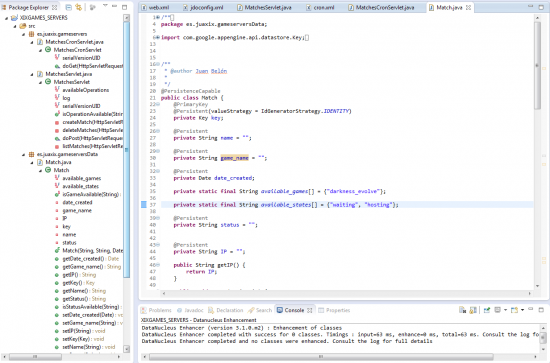
I thought that players would need other players ip’s to play matches ,and some of them would prefer to hide that so I created in one day a Google App Engine WebApp with a set of servlets to store the ips of the users whose create servers from the game so other players can connect directly by fetching the list via XML and populate a hud list to easily select one of them.

When the server is created, only in Windows,OSX,Linux native versions (I need to create sockets and I cant do it in the browser right now ), the game send a XML petition to the GAE servlet of game matches server application and store the name of the server (given by the player) with the IP of the petition, so, then, other users check the list of available servers and select one of them (there is no limit at all) then connect and in about 2-5 minutes the server is deleted from the list with a cron task that check the creation date. If the server disconnect the game send a cancel server and the match is erased from the list also.

The Match class used in the matches server

So, I think the hardest part is to find a balance between the streaming load and the number of users in a game to be able of handle connections and avoid lag , if it is well done you will have a great user gameplay experience.

Hope this help to other people.

Next: I’m thinking in add an AI for players who want to play solo… I have adquired this book

Play the game with GAE matches hosting here

Tags: gae, game networks, google app engine, network, videogame server

Host Gator Is Awesome!!! VLOGS(Post Mortim) And DSLR’S

had a few hosting related issues and my website is currently down D:(my fault) all though i would just like to say that host gator has awesome support.

Also sorry for not putting out the vlog i said i would i have been very bizzy this weekend, although i will be buying a dslr tomorrow and will upload a vlog/post mortem of that in the next few days.

Comments

03. Sep 2012 · 08:52 UTC
Good to know that they have good support. I shied away from them in favor of Amazon, because HostGator follows the present trend of offering “unlimited” bandwidth and then defining “unlimited” pretty arbitrarily.

Future Rabbit Post-Mortem

This was our first Ludum Dare entry. I think for the most part things went really well. We hadn’t tried anything with using the cross stitch art for graphics beforehand so we pretty much had to wing it. We first started with planning all the assets we would need. Then, we made the cross stitch patterns as pencil on aida (aida is the fabric). We used some of those sketches as placeholders while waiting for final assets.

Rabbit Sprites

Each “stitch” nicely worked out to be a 5 x 5 image, so we basically figured that each “cross stitch pixel” is actually 5 “real” pixels. After each asset was ready, we’d scan them in, remove the background in Photoshop, and prepare the sprite sheet. Since the fabric isn’t really stiff, there usually ended up being some distortion which we needed to fix using distort in Photoshop. Removing the fabric background was also time consuming and difficult to get perfect. After all the sprite sheets were created, all the image assets were managed in Flash and exported as an asset swc – all development was done in FDT.

What went right

  • Scoping: We picked a pretty simple idea and we were able to execute everything we wanted to before the competition ended. Sure, there were additional things we would have liked to have added, but I thought it was great we didn’t have to drop any features.
  • Art Style: We were really happy with how the style came out. We didn’t do any test with cross stitch assets prior to the weekend, so we had no idea how it would look until we were done.
  •  Reusables: I was actually happy that I didn’t use any frameworks and that pretty much everything was coded from scratch for the competition. The only libraries I used was a tween engine I had created a year or so ago and a really simple sprite sheet class I had done earlier. Creating something from pretty much nothing over 3 days was pretty rewarding. Additionally, I came up with a nice sprite sheet to text generator that I’ll be able to reuses for future projects.

What could have been better

  • Complexity: Our game is pretty simple –  a little too simple. Would have been nice to add some extra game mechanics to make it more than just shooting and jumping.
  • Theme: I’ll admit the theme/story is a bit forced.
  • Asset Prep: The hardest part of working with the cross stitch was straightening the scans. The fabric kind of skews a bit, so it took a little work to correct this.

Raw Sprites

You can play & review our game here.

Tags: post-mortem

Alien Automata: another post-compo game in 48 hours


A videogame concept made in 2 days. September 1-2, 2012 Version 0.1 Last weekend John Wilkinson, Dave Alleca, and I made a game for Ludum Jam. The theme was “Evolution.” We brainstormed ideas, including mixing Conway’s Game of Life with Space Invaders. We expected it would be too chaotic. This weekend I wanted to make another game, and sessions of Conway’s Life monopolized my imagination.

http://finegamedesign.com/alien-automata

Development Log

Instead of a postmortem I wish to provide a journal of my thoughts and actions during this Ludum Dare. One of the things I like about Ludum Dare is watching other people’s creative process in action through their blog entries. Unfortunately I was too involved in my own creative process to blog about it during the event. So I am writing this after the fact, using my best recollection of the events. I felt I had a pretty successful Ludum Dare and want to share what I think made it successful.

Edit I just realized that this post takes up a huge ammount of screen space. Probably because it is an almost hour by hour account of my actions during this Ludum Dare. I have copied the main text to my webpage, here is a link:

http://www.monkeydev.com/unity/ld24/devlog.htm

Tags: devlog, postmortem, SuccessStory

For the Point’n’Click fans… HVB is now on Android !

Hi all !

We’ve been pretty silent until now but we made a game for the Jam called Happy Vegan Birthday, which you can play here:

http://www.ludumdare.com/compo/ludum-dare-24/?action=preview&uid=11779

So that’s kind of an old school point’n’click done in Unity, with a little story that I let you discover. You can also play it on Android.

Let us now if there something wrong, feel free to comment !

Cheers, here’s a little screen shot !

Comments

juaxix
03. Sep 2012 · 17:16 UTC
I do really like this game :)

[post-mortem] Evolvin Gen

So here is my first port-mortem, covering an entry that I made for Ludum Dare 24 compo “Evolution”. The entry is not other but Evolvin Gen. If you don’t know, Evolvin Gen is a simple puzzle game where blah blah blah..

What went right:

  • Idea. I found a way to created game that matched both theme and skill.
  • Library. New version of LibGdx works like charm. Adding effects is relative easy and its project setup mechanism is like something that created by 2.5m tall wizard with long red beard, using his staff that made from heart of dragon. It’s great man!
  • Sleep. The game itself was not really hard to build. With that fact I could get enough sleep, longer than previous LD.

What went wrong:

  • Idea. What? but you said it went right! Yeah I figured out gameplay that matched the theme, but it’s not the first. Third! I changed my gameplay so many times. The first one was something-devour-another. Too mainstream. The second one was narrative game (kinda like VN) that telling about evolution. My english is too poor. So, here I am.
  • Graphics. In the end of game, I should provided a sprite for each result. My first attempt was drawing a guy with tentacles and bald grandma. However the time was tight so I just made them as text-only.
  • Bug. If you score 100% which is quite hard to obtain at least for me, my game will show you a beautiful exception. I can’t regenerate it yet, but I want and willling to fix.
  • Layout. Someone said that they can’t figure out how to play. Well, it’s by clicking the text. They’re button, functional receiving input. But the lack of “clickable-feel” made it… be unnoticed. Lesson obtained!
  • GWT. If my GWT base worked well, a HTML5 version would be available.

What’s next:

Dig libgdx more, fix the bug if I can, and setup my GWT asap. Have fun and wait for next LD.

Axolotl Pop Post Mortem

Axolotl Pop!

I decided I wanted to do the Ludum Dare some time ago.  However just prior to it I did another jam, and got really enthused with the idea, continuing it past when I had intended.  I consider the game, Inside Busters to be a pretty good success.  Though, because of it I was completely drained for the first day of Ludum Dare and had no motivation to do anything at all.


Because I had wanted to participate pretty badly, but was so creatively drained, I comprimised.  I decided to do the 72 hour jam, and not follow the theme too strictly, instead opting to push myself in other ways that I was a little more enthusiastic about.  So I chose right off the bat to make the game playable on Android, the Web and Windows.  I hadn’t yet released an Android game, so figured, why not?


Though I have done several jams before I have never recorded any of them, and thought that while I’m pushing myself in different directions I might as well give that a shot as well.  It was a somewhat interesting experience and is surprisingly satisfying to watch in reflection.  Having a log of what you did and how long it took is most enjoyable.  The timelapse bellow goes for 10 minutes but was made with over 20 hours of footage, and that is with content missing that I forgot to film.

I aimed very consciously to target the Android platform first and foremost.  In this regard I think I was rather successful, the game plays pretty nicely on the phone and I made a lot of comprimises to ensure this.  Where I think I failed the most was keeping to the theme, now that I’m not a zombie from burning myself out I can think of numerous more inventive ways of exploring evolution.  But when faced with the jam and many hours lacking in sleep the most I could think of was, “… Something about Axolotls”.  This dissapoints me a lot as evolution is a pretty great theme and I didn’t really do it justice.


As with all jams I aimed to provide a very polished end product and I think I did a fairly good job in this regard.  The game certainly feels complete with no errors and a lot of tweaking to ensure everything feels good.  Next time I am going to take special care to rest up before the jam so that I can really explore the theme as I was a little dissapointed in myself in that regard.  However, all in all a pretty successful jam where I learnt a lot of technologies and managed to try things I might of otherwise not.


I’m very curious what people thought of the game on Android (which is now available), and how well it runs on their devices.  So if you have time, feel free to get the game here.

If you would like to try the game online or download it my entry is available here.

Rise of the Meebas Dev Diary

I thought I’d get into the spirit of Ludum Dare and write about my entry, Rise of the Meebas. This is actually more of a rough development diary, peppered with some insights and cool, EXCLUSIVE behind-the-scenes goodness!

In South Africa, Ludum Dare begins at 3 in the morning. This leaves 2 choices: to power through and see the theme announcement, hoping to go to sleep and lucid dream oneself a mind-blowing game idea, or to wake up really early.

I chose the latter, which really would’ve worked if I had woken up early. By the time I had a brunch in me, I was still entirely at a loss for ideas. “Evolution” was a great theme, but sometimes one tends to get obsessed with trying to design something too clever. I had something similar happen to me for my LD#22 game, and like Rise of the Meebas, I ended up with a game that contained the initial sparks of a good idea, but was left lacking good, solid, fun gameplay.

I spent a majority of the Saturday getting the basic movement mechanics and a few graphical elements into Unity. I’d settled on an idea in which you had to move a number of amoeba-like balls around a level, and the more you moved each one the closer you got to evolving the movement of the group as a whole, after which you could overcome obstacles and reach the exit. I wanted this to have a similar feel to those levels in Braid where moving left rewinds time, and moving right progresses it. In other words, having the player carefully evaluate where and when to move around the level, with some reflex-based platforming gameplay.

With this in mind, I spent the end of the day designing some levels on paper, which helped lock in something of the puzzling aspect to the level design. I also very quickly hacked together an amoeba model, which in its froggy/fishy/impy look, made me decide that these were “‘Meebas”.

Sunday morning began with something that totally sums up the strange creative spirit of Ludum Dare. About 2 hours before I woke up, the bells from the church across the street started chiming. As I lay in bed half asleep, I thought “this would be kinda cool to have as eerie cave music”, followed by the realization that my laptop was sitting next to my bed, and “hell yes, I can do this!”. So I flipped it open, fired up Garage Band, and managed to capture the last 30 seconds or so of the bells.

I felt like a game-making McGuyver. It was moments like these that made me really appreciate the rule that says all assets should be created by hand. In some way this forces us to attempt a number of unfamiliar disciplines, and more often than not, discover that we aren’t bad at them! That being said, my spacey, ravey church bells song was not a hit, but it was good fun having a go at putting a track together.

I also completed the rest of the modeling, texturing and animation of the Meeba character. I was happy with the way the animations turned out in the end, but again, the process of getting them in was bizarre and fueled by desperation. Firstly I tried using 3ds Max bones, but as something went wrong when I imported the animation into Unity, I made the wise decision to go with what I knew worked: A full biped. This has some strange results when you realize biped is generally designed for animating people:

What they don’t teach you in animation school

So after this creative misuse of biped, I moved onto making levels. This was another one of the areas of development that went well, simply because I gave myself enough time for it. Although my idea wasn’t really developed fully enough to be an intriguing puzzler, I was still able to convey the gist of the gameplay through the levels and tutorials. I also had time to put some detail into the levels, including various colored lights to indicate exits (green/blueish) and dangerous areas (red). I’d made a stalactite prefab and discovered that by tweaking its mesh colliders, I was able to turn it into a fun level obstacle. I probably got carried away positioning the stalactites so that your Meeba could fall – flailing and grunting – and crash into them on its way down.

Ultimately, this was an exhausting, fun and successful Ludum Dare! Although it sorta goes against one of the fundamental tips for making a great LD game, I found it useful to work on what I could art- and code-wise while I let my very vague initial gameplay idea develop. There came a point where I was running out of time, so had to go for what I though might be halfway decent, but if I hadn’t, I simply wouldn’t have had enough time to finish.

What went right:

– The art and graphics. I tried to create a really interesting, colorful and funny mood while working quickly on each asset, and I think it worked well.

– Leaving enough time to design levels, add tutorials, and bookend the game with a menu and game over screen.

What went wrong:

– Initially having an idea that didn’t hold too much promise of fun and interest. It’s still in need of an overhaul, and I think a post- post- post- post- compo version might start blending into something of an arcade or even RTS-flavoured platformer.

– Church bells, apparently 😛