DeathBySnail

LD20

I’m Out :(

So it turns out that i’m completely demotivated this weekend. Due to a mixture of issues cropping up, including a poor design choice, external deadlines, and programming fatigue, i won’t be completing a game this weekend.

I’ll be giving it another shot in the next compo. I’ll have no assignments due, and will hopefully be in a less stressful mood.

See you next time!

-DeathBySnail

Comments

30. Apr 2011 · 12:06 UTC
:'(
jagttt
30. Apr 2011 · 14:29 UTC
high five for programming fatigue! I think know how you feel.
VirtualVoid
30. Apr 2011 · 14:40 UTC
i’m demotivated too.

A journey through hell

Hello Ludum land!

A mini-LD devoted to dialogue was just the kicker I needed to get back into making stuff. I have yet to create a meaningful story in any game i’ve made, and this is the perfect time to make one!

The game I am making will consist of nothing but animated text, like the modern interactive fiction stories which are scattered around the net. This allows me to throw away my biggest weakness – drawing, and concentrate on something I believe I am capable of delivering well – an immersive story.

So, here’s the pitch:

The game is a story of the player’s trials in the darkest reaches of the world.
There are three paths the player can take – the soldier, the priest, or the child. Each path focuses on a certain type of test (the soldier has tests of strength and cunning, the priest has tests of faith and wisdom, and the child has tests of courage and temptation).

There will be plenty of choices to make, and the chosen route will make the game differ significantly.

The most interesting aspect to solve will be how to structure the dialogue so that it is as flexible as possible. That, and making an animated text system which is highly configurable.

I’ll be using familiar tools – C++ with an embedded Lua interface, and either SFML or HGE for graphics purposes.

“The guilty one is not he who commits the sin, but the one who causes the darkness.” – Victor Hugo

Comments

12. Jun 2011 · 00:10 UTC
Sounds very cool – your idea to focus on your strengths (prose) is smart. It would be cool to pepper the text with all sorts of Victor Hugo quotes! Also, my humble advice would be to write the entire adventure using only ONE of the three paths first, then add numbers two and three if you have time. This way if you have trouble finishing, you have one complete path rather than three half finished ones. Good luck! Can’t wait to play your game!

MiniLD #27 – designing a dialogue tree

So I thought i’d share the way I am structuring the dialogue in my game.

I am using a node graph architecture – each piece of dialogue exists as a node in a tree. Each node can have several child nodes, representing the next piece of dialogue. A child node can be any other node – including itself, or the parent of itself. This allows for recursive dialogue (“try to open door” -> “door won’t budge” -> “try to open door”…..)

Node graph

Throughout the life cycle of the game, a pointer to a dialogue node is used to track the “current node” – this is the piece of dialogue which is currently being executed, and switches to the next piece when it is able to do so. A disadvantage is that it cannot execute more than a single node at any one time – i.e. only a single piece of dialogue can be displayed.

If a node has a single child, the dialogue switches directly to the child node when the current node has finished executing. However, if it has multiple children, the choices are displayed for the player to choose from. The choice selected then becomes the new dialogue node.

To fill these nodes with content, and link them together, a description of each node exists in a table Lua-side.

node table

All of the nodes listed in the AllNodes table are created and linked together at run-time automatically. To create nodes, you just place new node descriptions in this table, and specify the names of the child nodes.

The first prototype build, which shows the dialogue tree in action (with only a small part of the Soldier path complete) is available here:

Journey through hell – prototype

Next step – text effects! more content!

-DBS

LD22

I’m in!

It’s cold and everyone is ill, looks like it’s competition time again!


This time i’m going to be doing something a little different. Instead of using my usual tools (C++ and HGE / SFML), i’m going to use my favourate scripting language, Lua, alongside an interesting engine called Love (Link)

This is because last time I did this competition, I felt so used to the process of making a game in C++ (considering I do it for a living), that I felt uninspired and that I wasn’t learning anything. With a language I don’t know all about, and an engine i’ve never touched before (but admired), this should help motivate me to finish!

Your cuddly gastropod friend,

-DBS

LD23

I’m in

Okay, let’s give this another shot. Haven’t submitted a game since LD19, but after GGJ and Molyjam, i’m rolling on top of a wave of success.

Engine: HGE as always (C++)

Paint.NET for graphics

FL Studio for sound


I experimented with other engines, languages and libraries, but this is the setup I keep coming back to.

9 hours

Progress is slow at the moment, but here’s what I got so far:


“This town ain’t big enough for the two of us!” (literally)


LD24

I’m not in :(

I’ve been looking forward to LD24 since, well, LD23. However, I have within the last week or so developed symptoms of RSI (likely to do with excessive crunching), so it’s looking unlikely that i’ll be in any shape to take part this year :(

Good luck to everyone who enters!

LD25

LD25 – I’m In

Okay, so this will be the first Ludum Dare that i’ll have entered with RSI. I’ve entered 5 times, with 3 successful entries, but this time will be harder. I’ll have to take a lot of breaks so I don’t end up injuring myself, but I’ve never felt so adamant about making a game for a LONG time.

I’ve used C++ and HGE in the past for all entries, but I think i’ll switch it up a bit. I’ll be using MOAI so that I can code in a familiar language (Lua), as well as having some cross-platform capability.


Here’s to a successful weekend!

LD25: Day 1

Hi LD!


This morning started off rough. After an hour in, I was already getting wrist pains, intense enough for me to stop and convince myself that I wasn’t going to be able to do this.


4 hours later, I decided to give it another go, this time using my wrist braces. Fortunately, these braces gave me enough support to allow me to continue my work.

For a first attempt at using MOAI SDK, i’m suprised at my productivity. Within hours I had a Zelda-like room system, a highly usable event system, and dialogue!

Day 1

Day 1


Looking forward to tomorrow, where i’ll spend time on adding more rooms, the combat system, Audio, and then Polish!

LD25: finish!

Okay, so i’ve reached a point where i’m quite happy to submit. It’s been a fun couple of days, and a big confidence booster for myself, knowing that I can still make games with my injuries!!!

If only I had more time, it turned out to be a lot shorter than I expected and there are no sound effects (apart form some dynamic music). Where I planned to have dozens of rooms, each containing all sorts of doors and switches, I ended up with ten rooms, and just a couple of doors and buttons.

Nevertheless, This is the first event-driven game i’ve ever made myself (i’ve always done short one-screen acrade games), and it feels amazing to do something like this from scratch in a completely unfamiliar engine.

Red Legion – VIEW

boxCap2

LD25: Web support via NaCl

So the plan was to write the entire game in using the MOAI windows host, submit that, and then port over to the Chrome host, resolving any issues along the way.

Unfortunately this is more difficult than I had expected (due to unidentified errors) and so i’ll have to give up on this. Next time I really need to test all platforms at frequent intervals during development.

Red Legion: A post-mortem


RED LEGION was the fifth time i’ve entered this competition, and the fourth time i’ve come away with a completed game. However, many things were different this time around:

  1. This was the first time i’ve done a game jam with RSI. This has been plaguing me since the end of summer, and consists of chronic pain after long sessions of sitting down typing at a computer. You can imagine why this is such a problem for competitions like these.
  2. This was the first time i’ve left my comfort zone and tried a new engine. Whilst C++ is my primary language, and i’ve made many games using HGE (Haaf’s Game Engine), I decided to work in Lua, using the newly created MOAI engine. This allowed me to prototype faster in a more high level language, as well as have the option to port to other platforms (I have a complete version of this entry on my Android device :D).
  3. This was the first game i’ve made which followed a storyline, and didn’t all take place in one large space. My other entries to LD are purely an arcade affair.
  4. This was also the first jam i’ve done using a standing desk.

Point (1) was a big mental block to get over. How was I supposed to do anything awesome in 48 hours if it would likely damage my hands in the process? Besides, I was banking on “end of the world” being the theme and had trouble thinking of something cool.

So the first four-five hours of day 1 was spent in the nearby park, feeding squirrels. It was there that I had the idea for a double-agent attempting to extract information from a companion, and decided to at least give it a go. So I put on some wrist braces, and started to type.


It’s so easy to prototype in Lua. Within hours I had a basic walk animaton (the one that is in the final game), as well as the ability to seperate the game logic into rooms. Each room had it’s own list of events that were processed one by one in a seperate thread (NOTE: i’d barely done any multithreading before, yet I used it extensively in this!). This allowed all of the logic to be compartmentalized into lots of small components.

Very soon I had dialogue working, and the ability to give commands to actors, such as “walk there, then turn around and say something, then put your combat face on and attack X…”.

These fundamental systems made up the majority of the game. All I needed next was an idea for a combat system. The one I settled on is quite simple, but gives a sense of urgency to the player. With that done, I could simply use the event system to randomly spawn enemies at set points in the game, and I had a full framework to work from.

However, the dawdling at the start and some arrangements for Sunday evening meant I was beginning to run out of time. I had about five rooms done, and no sound. I had spent too much time trying to get the rooms looking nice (they didn’t turn out so well, but they are quite detailed for someone with my lack of artistic expertise) that I hadn’t enough time to implement all the features I had planned. I was gunning for ~20 rooms, and ended up with only 10. I had only two instances of working doors, and one button (which was meant to be a tutorial, but turned out to be the only button in the game). So scope was a big issue for me in the project.


For how short a time it was made, the music and its underlying systems turned out well. The bassy beat gives a sense of emergency, whilst pulling in a bit of a solo and some drums when combat kicks in made it feel even more actiony. However, I kind of rushed the last part of the lead track, and it makes me twitch when I listen to it (it just sounds horrible to me). I also didn’t want to experiment using compressed sound files in case they didn’t work, so I ended up with two wavs, effectively doubling the zip size!

I also failed to include sound effects, which I believe could have made it feel a lot better to run and punch.

My initial plan to work in windows and port to OS/X and Chrome NaCl ALMOST worked. There are reports that the OS/X version has trouble with dialogue, and the Chrome version didn’t run at all. However, as I said earlier it appears to work a treat on Android (apart from the combat system, as it’s impossible to “press X” when you don’t have a keyboard!).

So in closing, good project, just need to scope better next time. And I know there will DEFINITELY be a next time, as i’ve now proved that it takes more than typing ridiculously fast to come out with a good game.

LD26

LD26: I’m In!

Looking forward to next weekend!

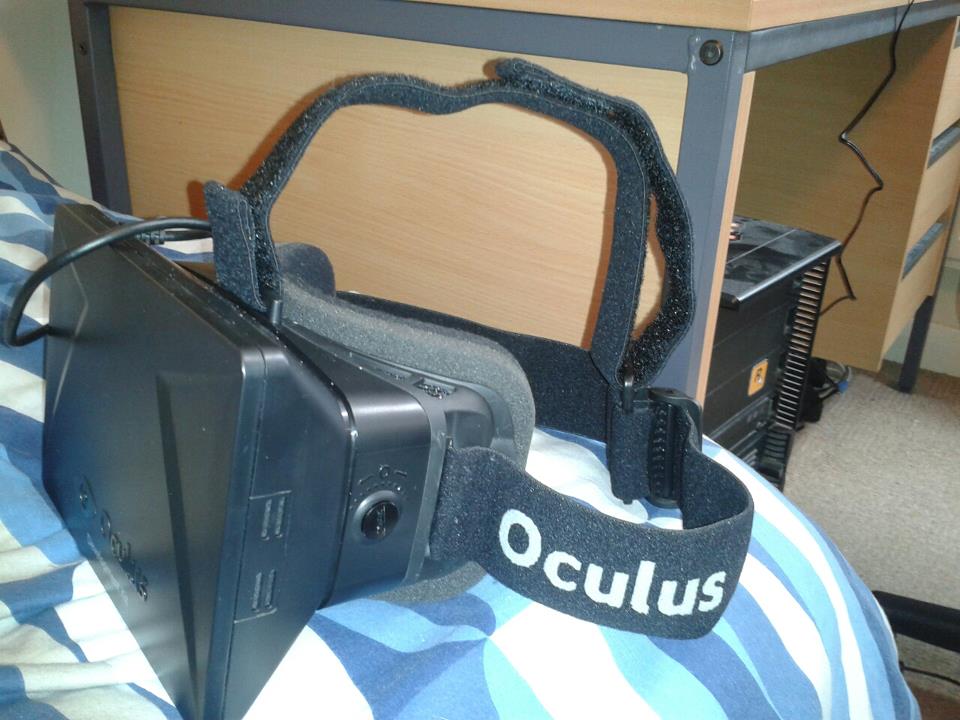
I’ll be using the same setup as last time (MOAI + Lua).  Unless My Rift dev kit arrives, then I may be persuaded to make a VR game! :)

Ludum Dare: VR Edition

I Recieved my Rift Devkit on monday – totally rewriting my plans for this weekend!

Engine: Ogre3D

I understand this will make whatever I make unplayable for the majority of voters, but i’ll release a video of the completed project along with the exe for anyone lucky enough to have one of these kits to try.
935540_10152767366685527_270463953_n

Desk Setup


Ready for the theme announcement – Good luck guys!

164972_10152773240160527_773779324_n

Progress!


Okay, my first idea didn’t pan out so well. Figured i’d scale back and make a minimalistic maze.

screenshot04272013_143019651


Already feeling sick due to motion sickness. Can i last the weekend? Stay tuned!

LD26: complete!


Youtube demo HERE.

After a few ups & downs, several refactors later i’ve reached a point where i’m happy to submit. I can no longer tell the difference between reality and virtual reality anymore – time for some R&R!


screenshot04282013_175858447

Comments

28. Apr 2013 · 15:42 UTC
Wow, that’s really cool! I’ve never heard of the Oculus Rift before.. Interesting piece of virtual-reality technology. 😀

LD28

Progress report

12 Hours In

12 hours in. Still looks pretty basic, but i’ve done most of the backend work, as well as a bit of the script. Need to finish the script off, and polish pretty much everything.

(The aim is to vote for who killed the king. Because, you know, justice.
You play as the guard. Left click a character to denounce them.)


12hrs