LD24 August 24–27, 2012

The Lost Laboratory – Post-Mortem

So ludum dare 24 is over and The Lost Laboratory finished. It’s time for a retrospective.

A quick overview of what went right and what not:

What went right:

  • Planning the game
  • Coding
  • Graphics
  • Audio
  • Testing

What went wrong:

  • Content
  • Interface

It was really motivating to only have 72 hours to make a game. I worked 33 hours in total on the game.

It was really fun to explore the theme.  At first I didn’t like the theme because I could only think of generic approaches to it. But after an hour of  idea generation I finally found something which made me think “This might actually be really fun”. After having a closer look at it I noticed that it might be a little too ambitious. This brings me to my first what went right point.

Planning the game 

To get something playable in the 72 hours I had to cut features. The goals that I set for myself have been: 1 animal, 1 ability, 1 other room and the core mechanic which included the Genalyser, the Dnapter and a visualization  of the progress. I had all this done by the end of day 2 which was really good, as I could spend the little time I would have(I could only work at night on the last day) on polishing the game.

 Coding 

Another thing that went right was the coding. I knew allegro, boost and C++ very well and having a basic framework also helped a lot. I didn’t run into any problems. Bugs got fixed pretty fast and no crash issues. I haven’t done a game like this before but I could use my experience to solve all coding demands. I didn’t have to make any workarounds either as I made the engine myself so I didn’t feel like I was pushed in a direction I don’t want to go. I like to use the new C++11 features especially auto. I also found out that I could combine an stl map with an enum class and have an array with a readable index which can’t go out of bounds this way without using defines or casting to int. I love it when I discover a new way of using something 😀

For everyone who’s interested here are the tools and libraries I used for coding:

  • Code::Blocks (svn 8248)
  • Mingw 4.6.1
  • allegro 5.0.7
  • boost 1.48

Graphics 

I’m really happy with the graphics, although I could’ve done a better job with the tiles. I don’t do graphics that much but it worked out pretty well. The style I choose for the graphics is pretty simplistic which made making the assets a little easier. Still it took me around an hour per asset, with some exceptions. It was really relaxing to do art from time to time. Animating also went really well. I like Paint.Net more and more now. But I still wish there would be some features from the normal Paint and from Photoshop, but it’s ok. I just need to learn the hotkeys. It’s annoying that I can’t select multiple layers and work on them.

My tools:

  • Paint.Net (for pixel art and animation)
  • Paint (for quick pixel art)
  • Photoshop CS4 (for larger art)

Audio

This is one of the things that went reeeeeeally well :D. I guess this is the case because I had a dedicated sound artist. All sounds were done in the last two hours or so. He did a really good job. He even dished an amazing background track out in no more then 10 minutes. I wonder how the audio would’ve been if he had been there for the whole 72 hours. Here’s a little post mortem from him:

Hey guys, i’m SeniorHeuser.

I’ll just add my two cents about the audio editing and sound design (well, 2 hours aren’t really sound design but whatever :) ). I was sent a textfile by Kayelgee listing the sounds he needed with information about frame delays and frame counts, a working build of the game and most importantly the opportunity to replace the files „live“ while working on the sound effects and music. That helped a lot and that’s one of the many reasons i like to work with Kayelgee. The sound effects were put together in Adobe Audition 3.0 using free sounds from the internet. The background music was scrammed together in a sugar-induced 10 minutes creativity flash using Mixcraft 4 and my good old Yamaha Clavinova CVP-35 which apparently went quite to his satisfaction :) So THAT went well.

What went wrong:

I was not happy about how the effect for the bunker door sounded but time was not on my side, so… I never did sound effects in such a limited amount of time. That said i was shocked how fast one can run out of ideas and sources for sounds. Note to self: Gonna need a good outdoor mic! :) Definitely a field i will spend more time on ’cause it was a lot of fun being time restricted in a creative manner. Really looking forward to polishing the game post compo!

Testing 

Having a few friends who tested the game helped a lot. The feedback I got fixed a few issues. Different pc configurations, different knowledge and different gaming behavior helped me to fix bugs, typos and awkward design decisions. Yet some design decisions weren’t questioned and ended up being left in the compo edition even though they were bad, BUT ludum dare people are also testing the game and pointed out some interesting sutff. I’m really grateful for every comment you leave.


It’s time to get to the bad guys. The things which went wrong.


Content

As the project was so ambitious and I only really had 2 out of 3 days to work on it the content ended up being a little thin. I would’ve loved to have multiple abilities, multiple rooms, multiple animals and more . But time was short so I decided to have a minimalistic content, but enough to show how the core mechanic works.  So it’s one of the few things that I would’ve liked to work a little more on.

 Interface 

Yes the Interface went wrong. I was so focused on everything else that I made a few design decision which made the interface a little awkward. You have to click multiple times on the Genalyser when you’re holding a cat even though you can’t do anything else then decompose the cat once it’s inside. The Dnapter is missing a List where you can choose which ability you want to upgrade including a indication of how far your research is. The player has an interaction range, yet it’s not shown. Even though the player has to get close to something there is no keyboard button to interact. That’s everything which should’ve been fixed or didn’t exist in the first place. I should have thought more about these things. But at least these issues can and will be fixed in the post compo release at some point.

 Conclusion

So much good stuff a little bad stuff. Overall I’m really happy about how the game turned out. I like it’s idea. It has so much potential I really want to take it further. As this ended up being so content -poor I’m not expecting too high scores except for audio. I’ll be happy with everything that gets at least 2 stars 😀

If you haven’t played The Lost Laboratory yet head over to the game and play it, rate it and leave a comment. I’m happy about every feedback. If you like the idea then stay tuned and watch out for further releases. If you want to be one of the first to get new informations then follow me on twitter @cp_kayelgee .

Tags: post-mortem

Nom’s evolvathlon timelapse + stats

It was an entertaining experience watching my own timelapse.  I believe that, if you know about what you see on a timelapse, it becomes more interesting.  The tools you see me use are the following:

  • xterm (IDE)
  • vim (text editor),
  • Gimp (sprite editor),
  • Inkscape (vector editor),
  • Evolvotron (texture generator),
  • as3sfxr (sfxr as3 port).

By looking at the timelapse frame by frame, it was also possible to analyse the time I spent on different aspects of the game. I counted one frame simply as 30 seconds.

TOTAL: 1032 min = 17.2 hours Background textures: 23.5 min Tiles: 21 min Sprites session 1: 43 min Sprites session 2 (shading): 28.5 min GFX TOTAL: 116 min = 11.2% of total Text boxes: 31.5 min = 3.1% Audio: 17.5 min = 1.7%

I spent more on graphics than I thought, a solid 2 hours.  Still it’s only 11% of total time, so there’s not that much to optimize there.  I spent very little time on audio, only 1.7% of total, so I shouldn’t be afraid of spending a little more time there.  Most of the rest is spent coding (about 2/3, I did not count these frames because there were too many), and playing the game (about 1/3 of the time).

Tags: timelapse

Go Back – level creation

One of the first thing that we solved after getting the basic mechanics working, was creating levels. We knew that if we wanted this to work, we had to have polished levels that were enjoyable. A quick level editor would be sweet.

Sadly, I didn’t have time to create a level editor. So we did the next best thing: we created the levels in Maya. This was amazing for 2 reasons:
1) The artist had more time than I had, I was kinda busy coding features.
2) Testing levels was blazing fast. Don’t like a level? Delete and rebuild.


What we did was create a default cube, this cube would be the same one as the artist would use in Maya. The script I wrote would read out all the level meshes from a certain directory and loop over all the cubes in that mesh. If these are named “Sticky” or “Bouncy”, they would be tagged in the script as their respective type. Simple and easily expandable. The only downside my script had was that it doesn’t allow for a single level to be reloaded, it would have to go over all the levels to rebuild them. The process only takes half a minute or so, so this wasn’t worth the time to fix.

On average we went through 3-4 iterations of each level, with some exceptions (level 9 and 16 come to mind, they were probably changed at least 8 times).

Play Go Back here

Myxolous – Postmortem

Play Myxolous

I’m pretty happy with how Myxolous turned out.  I was aiming for a “hands off” approach to an RTS, and that’s what I got, for better or worse.  While I’m glad that I was able to complete a game, and even work in a lesson at the end,  Myxolous does have a couple flaws.

What Went Right

– Because I used basic geometric shapes, I was able to quickly model stuff in 3D, add in a cel shading effect, then throw in a quick 2D render.  For the amount of time I spend on them, the game looks great.

– The speed at which GM let’s you create games always amazes me.  I was able to finish most of the graphics, and nail the gameplay engine the first night, leaving all of the second day to fine tune the mechanics and polish menus and things.

– The message.  Believe it or not, I even managed to work some criticism of civilization in the game, and were a couple emergent moments in the gameplay that I think really fit.  For instance, I like how at the close of the game, enough stone has spawned and the remaining forests are so dense, that any Myxos unfortunate enough to go near them are many times stuck there for life…just like real life!

What Went Wrong

– The game is a little too simulation heavy, and player agency isn’t exactly clear from the beginning of the game.  It’s not until the first game is almost over that you really see how important your limited actions are, as a whole game can hinge on a single successful lightning storm spell.  I think alot of people probably didn’t play long enough for the game to get into full swing because of this.

– The sound.  GM: HTML5 is a pain with handling sounds, and due to some last minute bugs, I decided to not worry about any sound, which detracts from the game a little.

Thanks for reading this and playing the game…see you next time!

Probes of fury post mortem

So i completed my first ludum dare and i learned a lot. trough my “failure” so here are the lessons i learned in hope that i an whomever reads this will not repeat them.

1.Gamedesign should have been done ahead of time
Though i did have an idea it’s important to work trough a few ideas beforehand, especially when it comes to planning.
The main error i did was that i had like two hours at the start of the compo to shoehorn in the theme into an already existing idea and thereby making it too bloated.
The original idea i had was this helicopter sim in where you fly around shooting guns and rocket creating majestic explosions, destroying buildings.
But then came the theme “evolution”, i paniced and made up a story about a small mars probe that suddenly gained sentience and had to evolve itself by collecting parts from other probes sent to destroy you in order to survive.
What i should have done was to come up with a handful of base ideas that could each fit a few the final 20 themes, then plan each of them so that i the game will be made in time and that i know what kind of pieces i need beforehand.
Really if you have done the planning correctly all you need to do is follow the plan and do exactly as it says.

2. Keep up the phase
Anything not critically important  that takes more than 1 hour is not worth doing, seriously, i spent two hours on collision detection three on the terrain and at least 4 on making the bullets fly properly, not to mention setting up  the enemy spawning system and so on.
Now while reinventing terrain generation and collision detection is all fun in itself, that’s at least five hours i could have spent coding the AI, upgrade system and making more 3d models, all of which i now never got around to.
So note to self, next time if my toolkit cant do it or if i have to invent it, it’s not going to end up in the game at all.

3, Finish the game the first day.
After the first day i had my probe running around, terrain generated, camera working, collisions working and so on, that is to say not that different from the final product.
You will probably need at least 5-6 hours at the end to tidy things up and make it presentable which leaves you with like half a days worth of coding the second day, that is not a lot of time to code major parts of the game, not to mention if something goes horribly wrong and you have to spend time fixing it.
So if the game is not functionally finished the first day it will probably not be at the end of the second day.
If you do it that way you will have things to add instead of having to cut things from your design, not to mention more time to polish.

4. KISS
As in Keep It Simple Stupid, my game idea turned out to be pretty complicated, i mean there is a reason why a majority of games are 2D and pretty low fi.
And while i think i could have completed it properly given two more days, it should really have been done after the first one.
I think that if you want to keep it simple enough then imagine making an NES game with all it’s limitations.
So next time it’s either going to be a proper tile based 2D game or something like it.

5. Practice makes perfect
I have to say that i was pretty unprepared for this, although i once made a simple game in six hours this was compleetly different.
Before next time I’m going to attempt to train myself making a specific game type in a single day and you should too because that’s really what you have to work with, if it takes any longer than it’s not going to work and your design is too complicated.

6. Make sure your tools and procedures are up to date
I spent over an hour attempting to export a 3D model to an OBJ file, turns out that my modeling software doesn’t really agree with me that texture-coordinates are important, they are BTW.
What i should have done is make sure that i had a firm grasp on how to do the export properly.
Second mistake with the 3d models was that it utterly refused to export normal values which i also thought was important, so i had to go into a second application to generate those, in the end that was unnecessary since i didn’t have any lighting anyway (see, there goes the importance of planning again).
Third tool mistake was terrain generation, generating a flat plane with some random bumps in it shouldn’t be a problem, but it is if you have to do it from scratch, in the end i could just as well have made another 3D model and loaded it, but no i had to try to make it free roaming.
Well that failed and i was down another few hours and i was left with an impressively complicated construct using geometry shaders and a heightmap.

7. Choose your platform wisely
I chose windows using openGL and c++ which is pretty much the ultimate default choice for any game development.
That is for general game development, Ludum dare on the other hand is different beast altogether.
Don’t get me wrong, windows and c++ is really great, powerful and supreme in most regards, it’s also the platform i am mostly familiar with.
But it does have the slight problem with system bloat and you needing to basically code for every eventuality and hardware combination, which is good if you want to make a great game, but not in 48 hours.
So for the next one i might have to take the plunge into java or html5+webGL, either way it will have to run in a browser.
I’m just saying if it runs there it will run anywhere and i don’t have to worry as much about strange bugs popping up on other peoples systems.

8. Make it fun not good
Great gamedesign prioritizes fun, my initial game design idea was also fun, but not once i had to cut it down to size.
Always start with a very simple idea and work yourself up from that.

So those are the main lessons i learned, but on the bright side i did learn a lot of what my toolkit really needs for the next few versions, and that is really what i set out to do in the first place.

Advancer: Timelapse & Post-Mortem

Game can be played here.

I actually ended up skipping sleep on the second night, because I realized I would not be close to getting finished if I slept. I don’t really regret it, the closer it came to the deadline, the more awake I felt so it turned out alright.


What went right:

Flashpunk– This is the second time I’ve used Flashpunk for Ludum Dare. I didn’t run into any problems with this.

Graphics– The nes style graphics were pretty quick and easy to make while still looking good.

World design– I think I did a good job at making a fun world to explore, with the world expanding with every evolution.

Concept– When I started, I was just making a platformer where your character could evolve into different beings. I pretty quickly thought up a better idea of the game itself evolving through different era’s of gaming. (Oddessy > Atari > NES > SNES. I didn’t start on the snes era, however…). I’m planning to continue working on this and develop the concept further.
What went wrong:

Planned world map

Basic Engine– I spent more time then I’d like to admit trying to make a simple, non-glitchy platformer engine. I’m not very good at it.

Scope to large– I intended to make the game world even larger and add shops and additional abilites, etc. Right up until the deadline I was still trying to add new content.

Enemies– The game only has 1 enemy type and 1 boss, and their movement patterns just have them moving left and right. I would have liked to have many enemies and a good boss or two.

Coins– Coins were originally going to drop from defeated enemies, and you could use them to purchase new abilites (Thus, evolving your abilites), example include charging your sword for higher power and range, the ability to attack upwards/downwards, etc.


What now?

I will continue to work on the game, then I’ll release the game as I intended it to be. The finished version will have the 16-bit evolution that I didn’t have time to make, as well as the ability the switch between the different era’s at will. It should allow for some interesting levels and puzzles.


Tags: post-mortem, postmortem, timelapse

Comments

rxi
31. Aug 2012 · 18:30 UTC
Do I spy the NES colour palette image in the time lapse? I’ve been trying my hand at coding a NES rom and was using that palette earlier today since it lists the colours and all their coinciding hex values on top of them, which is quite useful!

Arcade Dev Kit!


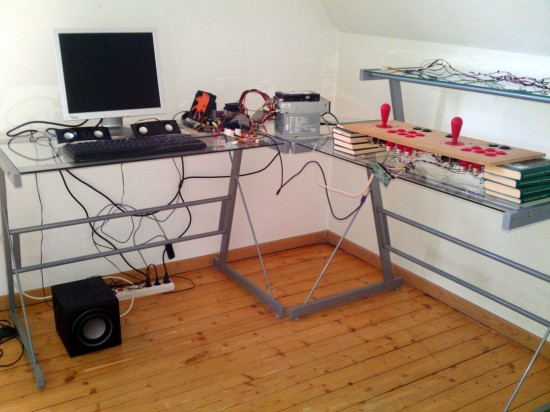
I’ve just finished building my very own Arcade Dev Kit!

this is huge fun – who yould have guessed making stuff for two players on the same machine bashing aroung a joystick would be so awesome ?

(also, this is possibly the best thing you could do with an old crappy PC lying around) 

Tags: arcade

made a search engine

hey guys, it mohammad, and its been tough a little.

ive done a little programming, but then i was experimenting with some gamemaker funtions, and made a search engine.

honestly, i would’ve just keeped this to my self after realizing 300 posts a day wasnt a good thing. espcially when a few comments and posts shown that i can be a little douchy, but now i just want to point out key things going on in my life. so i came out strong, and made this program for you guys, because if anyone will uderstand app and game deveopment, its you guys.

so i got my guts, and made this app for you guys.

i would’ve made a teaser trailer too, but when i did it for other things, i got posts declaring me as “annoying” so i cooled it off with the webcam. i just wanted to make a few laugh and a few smart a**ed comments. but now ill just put the game up for 1 or 3 to see, so i really dont care. i just want feedback, ok? thats why i make posts.

so…here it is. https://docs.google.com/open?id=0B2Hj8tfbtIyod3N5V0V3NUFvUTQ

oh ad btw, from now on ill be using google docs. its slower but WAY better than uploading.com.

transitions happen.

Comments

mohammad
31. Aug 2012 · 01:36 UTC
comment removed for various reasons.
Doft
31. Aug 2012 · 05:26 UTC
search_engine.exe? Really?

31. Aug 2012 · 18:57 UTC
What is this I don’t even
mohammad
01. Sep 2012 · 21:45 UTC
Ok, when I make a game, ill share it, thats why we have the MINI-LD’s and the compo’s and stuff.

When I make an experimental application, like the one I said was in development recently, ill make a post about it. Not make it into the compo or jam or anything like that.

This was a BLOG post. To BLOG about my status. So I BLOGGED about this program.

Like I said, no need for hate.

Human Evolution – Time to Post Mortem

Hello to all,
I’m really happy to be here and to have participated in this nice event, but most of all I am very pleased to have successfully completed something that even I had doubts finish. My game “Human Evolution” is simple, trivial and childish, but I did it and it is running at 100% XD


You can find the game here: HUMAN EVOLUTION

Post Mortem


What went right:

IDE/Language: I used Construct 2 for my first ludum dare and it was a nice experience, is fast and easy, and I had little to think about as I designed the game.

Idea: The idea came to me on the morning of August 25, I woke up, had breakfast and I did not think about anything but just this guy running through the historical ages without the slightest explanation XD

KISS: The survival guide for the game jam has been very useful, I had on my smartphone my TO-DO list, I had it all planned and it helped me a lot .. even though I have not met exactly.


What went wrong:

Graphics: I’m not an artist, this is my biggest weakness .. maybe I should focus a bit ‘and seriously study the pixel art, I know something, but as you can see from the game at some point (with the time he was about to run out) I preferred to hurry, and I drew badly as a child of 3 years ..

Loosing Time: On the second day I lost quite a bit ‘of time that could be used to make better designs, but because of the many images that were created I became lazy .. and at one point I even started to play with the nerf guns in home with my brother .. losing one hour and a half  XD

Calculation of the difficulty: In the rush to complete the game, I did not look at your increase in difficulty as the player continues through the ages, the increase in the speed of the character is much lower than I had thought and testing in the final stage no one has and I pointed out I did not mind because of my attention to the graphics to be completed.


What Now? 

Well now I just have to tell you something, do not let nothing and no one to stop you from doing what you like, do not expect pats on the shoulder or encouragement by the people beside you .. just do it.
Send them all to the hell if necessary, but do it.


sincerely

Umberto

Comments

mohammad
31. Aug 2012 · 18:43 UTC
construct?

that silly HTML gamemaking program?

pfft.

Yellow Dog Post Mortem

The game can be played here. Also, I’ve got my time-lapse here.

This was my first ever attempt at Ludum Dare. I’ve kind of watched it the last 2 or 3 times, and a few weeks ago, I saw this one was coming up, so I decided to participate.

A bit of background about me: I’m not a professional game maker. My 9-5 is as a tech director at a branding agency. I mostly design and develop websites along with various other digital projects. I’m paid for being creative, and to me, it’s the best job in the world. I have a background in graphic design, and I used to be really fluent at AS3 back in the days it was acceptable to use on the web.

This game is my second ever game project. Well, sort of. I launched an iOS game this January as a test to see if I could do such a thing, and I’ve been building a platformer as a save the date card for my fiancé (Katie) and I’s upcoming wedding, and when I was an teenager my brother and I were obsessed with ZZT. Anyways, I’m new to the gamedev world.


The Process

The week before the competition I had several game ideas based on the themes were being narrowed. I had something for “Don’t Go Outside“. If it was “Abandoned” or “Survival“, I had a cute little concept that I kind of liked. I even had half an idea if “1000 Kittens” was the chosen one. When “evolution” was announced I was dumbstruck. I sat there just with an empty mind for several minutes. Over the course of that first hour or so I just kind of thought… and thought… and thought.

I trashed probably 4 or 5 potential concepts in the first hour or so. I threw out several ideas that seemed too easy. Things that I thought everyone would go with. I threw out concepts that I couldn’t wrap my mind around how to code. I talked to Katie about it and we talked about some of the ideas I had earlier in the week. My idea for “Abandoned” dealt with the loneliness and boredom a dog faces when it’s owners leave for the day. Lots of sleeping, walking around, barking at stuff. Getting it trouble for getting in the trash or drinking out of the toilet. Getting praised for barking at strangers. One look at Olive, our yellow lab, gave me the encouragement that was needed:

I jumped into photoshop and mocked up a sprite. I programmed some basic movement skills, and by midnight on the first night she was walking around in a really simple house.

Over the course of the next two days I stayed up later than I have in years, drank a ton of coffee, and programmed with the ferocity of 1000 suns. I took only a few short breaks, and by the time I was done I was completely wiped out. For the majority of the weekend, Olive slept by my feet as the keyboard was clacking.


What went right

Preparation – I prepared for LD24 by clearing out my home office, setting up the computer so there were no last minute surprises, and working in a language I was comfortable with. I made sure that I had nothing else pressing over the weekend. Plenty of soda in the fridge, plenty of coffee left, etc.  I didn’t need to leave the house the whole weekend, though a few quick breaks helped my mind from feeling congested.

The Graphics – After I drew the first sprite of the dog sitting, I knew I was on the right path. Even though there wasn’t a single line of anything programmed, the idea felt concrete. I decided to go with an ultra low resolution sprite. I think it was 10×10 pixels. I figured it’d be less work because of “Hey! Less pixels to draw!”. I don’t know if that actually turned out to be the case, but I think I really like the aesthetic.

The Logic – Sometime during the second day I wrote out the flow of the dog’s motivation. “If the dog doesn’t need to go potty, and it’s not hungry, it should find something to do.”, “If the dog is really hungry, it should bark at the player because it’s angry.” It wasn’t a ton of code, but adding it made the dog feel alive. There was enough randomness that I didn’t know what it was going to do. The different stages of it’s life dictate different things. When it’s a puppy, sleeping and boredom take precedence over everything else. If you fulfill his needs as a pup, he’ll get bored less often as an adult, and should be easier to manage. If you take him outside when he needs to potty as a puppy, he’ll do it on his own as an adult.

The Interface – Through the first 80% of the project the interface was really basic. White words and buttons on a black background. It was functional, and looked fine with the basic pixelized graphics, but did nothing for the appearance. Setting aside an hour or so to design an nice looking interface (and adding a background) really paid off.

What went wrong

Getting Realistic – About halfway through Saturday I assessed my progress. I looked at what I had done thus far, and looked at what I still had ahead of me. I scrapped a ton. No more house full of details. No more cut scenes. I couldn’t figure out pathfinding with the system I had already built and rewriting it wasn’t an option at that point. So, I got rid of any obstacles. Simplifying everything made it far easier. I could see the light at the end.

The Volume – Alright… So, I didn’t test the volume at all before I published it. I made the sound effects in cfxr (the mac version of sfxr). I didn’t compare the volume to any other games, and I honestly didn’t know what I was doing. I was working in a vacuum. Turns out they were way too loud.

Last minute changes – As I wasbug testing I fixed a bug that caused the little flyout graphics to not go away on some computers. In the process I caused a bug where sometimes when the dog is an adult, it’ll be flipped the wrong way when it’s eating and appear as if it’s eating an invisible bowl of food. I didn’t know about this bug until it was too late. There’s another bug where if you clicked the buttons too much, those actions would be queued, and the dog would spend the rest of the time walking through your motions, even if it’s pooping 12 times in a row.


So, that’s it. I’m really proud of what I made. I surprised myself several times, and I think that’s what LD is all about. After the game was submitted, Olive was really happy that I finally had time to pay attention to her. Little did she know, in a way, I was the whole weekend.

Once everything is reviewed I’ll fix the bugs in the game. I’ll probably also spend a day tweaking things according to the feedback I’ve received. I’ll add in a bit more things to do, lower the volume on the sound effects, etc. But then, it’s on to other projects. I’d be lying if I said they didn’t include my dog in some way or another.

Tags: first-timer, post-mortem

Some people rate but don’t comment. My thoughts.

Personally, I don’t care half as much about getting ratings as I do about getting comments. And not just the positive ones, but any constructive comment. The comments I get on my game are mostly constructive, so that’s amazing.

It isn’t always easy coming up with something to say about the game you’ve just played and rated, but everyone has spent hours and hours on their game over the weekend, and we didn’t do it just because we were bored. Perhaps we wanted to learn, perhaps the theme inspired us, perhaps there was something we just really needed to say with the game, but there is always a reason, and because of this, there is always something to say. And if there isn’t, perhaps we havn’t given the game enough time.

Why are we rating each other’s games? The first reason should be that we’re interested in what other people have done over the weekend, but if I’m honest, for me that’s only part of it. I’m also rating other peoples’ games because I want my game to be played and commented on as well. I can only expect that other people rate games for that same reason.

The voting system makes games with less ratings, by people who rated a lot of games more visible. But what this system measures is ratings, not comments. I have been playing games, I have been rating them, and I have been thinking of something to say for every single one of them. Sometimes I said what I liked and didn’t like, and sometimes I just commented on the way the theme was used, if that’s what stuck out for me, but I left a comment either way.

I was going through this proces of rating and commenting on games, and noticed my game had appeared on the front page again. I was happy, waiting for karma to do it’s work.

5 people rated my game, and then my game left the front page again. I was excited! What did the people who rated my game think of it? I clicked on my game and scrolled down for the new comments.

No new comments.

Of the 5 people who rated (and presumably played) my game, none of them left a single comment. Needless to say I was disappointed. Was my game that uninteresting? Did it not work for them? I’ll never know, because they didn’t leave a comment.

And just like that, the sense of community I always feel when entering Ludum Dare, got just a little bit less.

I don’t know if leaving a comment should be required. I can understand some people are perhaps too shy to leave a comment. But leaving a comment should be encouraged! With the way the system is now, your game is only on the first page for a minute at most. Sometimes you’ve rated and commented on quite a lot of games to get there, and to see that your game is once again practically invisible between the 1400 other games, without having received even a single comment was a bit depressing.

Perhaps the system should check for comments, and not just ratings?

(to clarify: 32 people rated my game, 20 commented as well. More than 1/3 did not comment.)


Video walkthrough!

Okay, I spent the past two days bashing my head against the keyboard trying to encode video directly from my game, Digital Generation. The result? A video walkthrough! It’s also a bit of “developer’s commentary” for the game.

I don’t know how to embed videos into posts. Digital Generation Walkthrough (Youtube)

Tags: walkthrough

Comments

mohammad
31. Aug 2012 · 12:30 UTC
i made a post like this…but more douchy…er.

AND GOT MAULED BY FRICKEN EVERONE!

Influenza – Post mortem

I spent the first four hours of Saturday coming up with an idea for Evolution. It was a tricky theme, but eventually I settled on something similar to a simplified version of Spore. After working for the entire day, I had almost nothing to show for it. My idea just wasn’t working out. Frustrated, I realised that I would have to sit this one out, there was no way I could release a quality product in this short a time.

I spent the next few hours watching TV, eating food, lounging around. I became more and more disappointed at my early departure. I felt the need to program, to be making games, to be part of the competition. So I started thinking of new ideas, ones that could be implemented in about a day. That’s when I came up with the concept for Influenza.

You are the flu and you have to spread your disease to other people in a building. You complete the level once you have infected a certain individual. You can also spend points to upgrade your strand, that’s where the theme will come in.

I set out with high hopes. It was a lot of work, but if I applied myself, I might pull it off. I worked into the early hours of the morning, but eventually had to give in to sleep.

Influenza

WIP I posted on twitter, 12 hours before the deadline.

I worked for most of the last day, but at 2:30am (30 mins before deadline) I realised that I wouldn’t make the deadline and gave up a second time.

I posted on the site that I had failed this time around, and someone said that I should enter it into the Jam. I considered it, and although I had another project to complete by the following day, I went for it. It was now 4:00am, and I had been working on it for 20 hours already, but it couldn’t take more than a few more hours of work though, right?

Wrong. I only finished it at 6pm. 34 straight hours of working on this thing.

I’d be lying if I didn’t say it was grueling but it has paid off. I’ve been getting some great reviews and feedback.

Next time I’ll plan a little better, make sure I have an idea that I feel is sure to work.

Thanks for reading. Give the game a go if you like. I really appreciate any feedback, I like to hear how people think I can improve the game, should I decide to work on it further.

Here she is! Done and dusted.

See you next LD!

Post ortum

I don’t like the term “post mortem”. It means “after death”, but actually I perceive it more as birth than death when you finish a new game. So I write “post ortum”, for ortus being the Latin word for birth.

I went to the Internet on Saturday around 10 am and saw the theme “evolution”. First I thought I would not participate in this compo, because I had hoped for another theme (preferably “creation and destruction”), and I could not easily come up with an idea fitting the theme evolution. But then it occurred to me that a game in which you would play different types of animals, starting as a rather old life form and gradually becoming something newer from a biological point of view, would fit the theme. Since however there is a time limit of 48 hours, I abandoned the idea of covering many life forms, and instead opted to have only two stages of evolution.

I fired up MS Paint to draw some sprites and started with a dinosaur, then a fish, a kraken, a seastar, a jellyfish, a crab, and was quite pleased with my results since I am well aware that I am not a talented painter, but the images looked better than I had expected. So I copied the files onto my netbook, started MS Visual Studio 2005 and copied the base code which I had posted to the Ludum Dare blog earlier into a new directory. Using this base code I spent about 8 hours, interrupted by lunch, coding the fish stage. I do not remember having had any major difficulties, basically everything went smooth. I had some ideas on the behaviour of the individual characters and was pretty pleased when I tested the result. I decided that this would be stage 1 of the game, and you would pass it by surviving 5 minutes. First I made the player start with 3 lives, but I found out that the game is rather hard and so I increased the number of lives to 5. As a matter of fact, I have still not managed to survive 5 minutes myself. Sometimes I almost managed it, but in the last minute I was killed.

On the second day I implemented the dinosaur stage. I started with coding the random level generator, then I implemented the movements of the dinosaur (I remember having had minor problems with the jumping behaviour), then I fired up MS Paint and created sprites for the two types of enemies that appear in this stage, some kind of worm and a lion. I implemented the algorithm whether and what enemy appears, the enemy behaviour, and then I found out that in some cases it was inevitable to lose a life because of the placement of the enemy. So I changed that by adding the rule that an enemy must appear only if the platform he is located at is either above the previous one, or if several previous platforms have had the same altitude. Now this stage of the game is perfectly fair, you can complete it with zero life loss if you are a good and careful player. Work on this stage took me about 4 hours. This makes 12 hours of work on the game altogether.

In the feedback I received mostly collision detection was criticized: the rectangles around the enemies are sometimes pretty large compared to the area the sprite seems to occupy. OK, the next time I make such a game, I’ll improve on that. Apart from that the feedback was mostly positive and I am very happy about that.

How it went: Bear Selection

This is in all regards a post-mortem just with a different name. A post mortem implies that the game is dead, but from the comments I’ve got the game has potential and any thing with potential is very much alive!

Bear Selection(Web)

Bear Selection(Web)

The Good

+Stuck to the original concept, a sandbox world where creatures evolve and the player can only indirectly interact with them.

+Mutations can be clear to see, creatures start moving differently or go really fast

+Images are a million times better than I imagined MS paint could produce.

+Getting my brother to draw the creatures, allowed me to work on coding creatures larger than a pixel and some fresh direction in how to implement the images into the game.

+The world is dynamic, creatures can eat foliage and starve if none is left.

+The sparkline graph library made it easy to add a population graph: http://omnipotent.net/jquery.sparkline/#s-about

+The similar syntax between C and Java Script made learning a bit less painful.

+Web based, so that it is accessible to more people. Surprised to find it even runs on android browsers!

The Bad

-No collisions between creatures and creatures, or creatures and tiles leads to fish walking on land!

-No audio of any kind

-Pace is a bit slow and the limited interaction can make it boring.

-Didn’t have time to add terraforming or player activated events like meteorites or forest fires.

-First two days were mostly spent learning object orientation

-HTML-5 Canvas means not supported by IE

-No credits, no loading screen

-No entities like, eggs, blood splatter or fire. Despite the fact the graphics art was made.


Still all in all it was a mostly postive experience and a good game considering it was my first LD entry and my second ever game (first for the language, being web based, object orientated and non-ASCII graphics) so all in all it was a great success and learning experience for me.

You can play it and rate it here: http://www.ludumdare.com/compo/ludum-dare-24/?action=preview&uid=15698

Tags: First entry, first-timer, post-mortem, web game

IO VUOLE ZEN: Post Mortem

This was my first LD and my first complete game, so I was quite nervous. The theme was boring, nothing challenging. And this is why I had no ideas until seven hours after the beginning of the competition. After seven hours I began. I made two or three random things, then the game started evolving by himself. I didn’t need to think what I should have done next, I simply knew it. In an absolutely logical way, from chaos and non-sense, a game was born.

Right things:

Surprisingly barely everything. I slept a lot during the competition, the game was made in 24-25 hours, but I still had time to fix tons of bugs.

-Story: I managed to create a sufficient story in no time. I’m proud of it.

-Mechanics: I seriously like a lot how the mechanics are implemented and how they are linked to the story. They are exacly as I wanted them and that is the most positive thing of the whole game.

-Graphics: I made every sprite in a different way and with a different style. That was quite entertaining. And not meaningless.

-Audio: I never made music before this LD. It has been difficult, very difficult, but I like what I have done. And I hope you enjoy it too.

Wrong things:

-Stencyl and me.

I’m not able to program a game so I used Stencyl. I knew it well and I thought that I wouldn’t have had problems. I was wrong. Many inaccurancies and billions of random bugs,  billions. But I wouldn’t have been able to make the game without it. So I love and hate Stencyl at the same time.


I loved making a game for LD and I’ll surely partecipate again in December.  😉

P.S.: I’m not English, so my English isn’t good. I’m sorry for it.

The House Post Mortem

First things first Play and Rate it here : http://www.ludumdare.com/compo/ludum-dare-24/?action=preview&uid=8389

If you do THANK YOU 😀 All response is appreciated!

Almost a week has gone by since Ludum Dare and finally I’ve got some time to write a post moretm.

So let us jump straight in to it!

  • What went right:
  • Good teamwork. We spent the whole weekend together instead of collaboration via Skype. I think this was a big help for the motivation and the creativity. Who wants to let their team down?
  • We knew our tools which made us work quickly and effectively. Even if this was our first game written in JAVA, before we have used Game Maker. (Except for git!)
  • We created the core mechanism in the first day.
  • Good collision detection this time! We are very happy and if we may say proud of it!
  • We learnt a lot!
  • We had lots of fun! 😀


What went wrong:

  • Hard theme, we didn’t come up with an idea that matched the theme exactly!
  • Learning how to use a version system (Git) is not the best thing during the compo! On the other hand we know it know!
  • AI is hard!
  • some fatal bugs!
  • Somehow the menu for the game would work. The background for the menu was drawn in eclipse but when we exported it to a jar it didn’t work!?!? Althoug we used the same method as with all the other assets and that worked fine!

I (Dals) is working on a post-compo version that will remove most of the bugs and hopefully contain more levels 😀

If you want you can check out the timelaps of the development here!

Well I think that’s it for now. Already longing for the next Ludum Dare! Till then, keep jaming 😀

~DalsGames


Vox – On Steam Greenlight (previous entry to Ludum Dare #23)

Hi people,

Just wanted to let you know that I have put Vox on the Steam Greenlight process.

http://www.steamcommunity.com/sharedfiles/filedetails/?id=92967555

What was originally started as an entry into the Ludum Dare competition a number of months ago, during the april competition, is now being made into a full ambitious game!

Would really appreciate it if you could visit the game page and hopefully show your support (favorite and rate up) and this would make me very very happy indeed, and I would be forever indebted to you! :)

As always if you want to follow my voxel engine tutorials or articles, they can still be found at the site:

https://sites.google.com/site/letsmakeavoxelengine/

I am happy to hear any feedback you guys have, or answer any questions you might want to ask.

Thanks!

AlwaysGeeky

Tags: alwaysgeeky, cubes, gamedev, indie, minecraft, progress, SuccessStory, tips, vlog, Vox, voxel engine, voxels, youtube

Clickable grid of 1.406 kilogames! And wallpapers!

I made a webpage where all 1.406 kilogames are arranged in one big grid, you can mouse over them to see titles/author, and you can click to go to the entry page for that game on ludumdare.com! With this many games I thought it’d be worth trying a different way to browse through them all.

CHECK IT OUT!

I’d like to do more to make browsing/rating games a bit less painful, so if you have some ideas, leave a comment!

I also kept up my tradition of making desktop wallpapers out of the games!

screenshots of all 1406 games

good luck finding yours

The wallpapers in various sizes:

Ludum Dare 24 Postmortem

Ludum Dare 24 started nearly a week ago, enough time to think it through and
write up the postmortem for “Literally: Earth Shaping”. This was my second LD
and overall I am very happy with how it progressed. The final result was not
much of a game this time, but I am much happier about the process than last time.

What went right

Base engine written before start of compo

I spent the week before this Ludum Dare refamilarise myself with Java and
learning LWJGL. I started the compo with an engine that could draw textured
sprites and play sounds. I could also present menus that produced satisfying
click sounds. This start spring boarded me forward at the start of the compo,it
really gave me a good boost considering the theme.

Pixen

I discovered Pixen in the aftermath of LD22. It is probably the best dedicated
pixel art tools on OS X. Pixen is quite limited in its ability, as an example
you cant set a colour scheme to use across multiple files. In the end it is a really
useful tool.

What went wrong

Integer Positions

So I built my own engine and it was a really good idea. There was one issue that
cropped up over and over again though. I used integers to store the location of
Entity’s. This made life really difficult when it came to moving things around
the screen. If anything hit (0,0) then it would never move again.

Overall my use of types in java was a constant issue. I used floats all over the
place. In reality floats should have been a cast down from a double in the
OpenGL calls and not used anywhere else. Java is silent about casting between
faults in certain cases, this coupled with the pressure of the compo made life
a night mare.

Update your tools

While Pixen was a brilliant tool for the art I needed it was not at the latest
version until about halfway into the compo. I has a crash just after finishing
the “Play” button and lost about an hour of work. When this happened I decided
to find and install any pixen updates. The updated pixen was a mile better and
I managed to created the play button in about 20 minutes. The lesson here is to
make sure your tools are up to date before the start, you will be able to work
a lot faster.

Sleep

In the 48 hours I had maybe 3 hours sleep. This is against the popular wisdom,
but I was good on my first LD and I wanted to see how this would go. Starting
straight out was a good idea, but I should have taken advantage of Saturday
night. Sleep is good for you.

Simple Mechanics

48 hours is really not enough time to think thoroughly through and implement
complex game mechanics. I have definitely learnt that lesson now, its just a
shame I had to use this LD to figure it out. I started with good yet complex
ideas, but instead of implementing just enough to get going I did the whole
thing in one fell swoop. If I had only included two or three of these ideas I
could have created much more of an accomplished game.

Sound creation

I really did not know how to use SFXR at the out set and that never really
improved. I also have no real skill in sound creation and so didn’t get around to
creating a sound track. Something to definitely fix for the next LD.

Version Control

I wish I had taken better advantage of version control and other tools. This
would have given me data to create some awesome graphs in the aftermath of
Ludum Dare.

How we turned a LD 23 failure, into a LD 24 success.

Our first Ludum Dare was LD 23 and from a first timer perspective it was success. But it was mostly a success because of the lessons it taught, not the final product. Thankfully, LD 24 was a huge success! Ancient Ruin has received mostly positive feedback and to me it was success, not just for the final product, but also for implementing the lessons we learned from LD 23 and using them for LD 24.

Here are the lessons we learned from our first LD, Honey heist, and how we implemented them into our LD 24 game Ancient Ruin.

Put in the hours

LD 23 Lesson Learned : We worked hard on LD 23, but we could have worked much harder. We wasted most of the second day and probably worked a maximum of 6 hours on any given day. This left a lot of work undone, most notably the controls.

LD 24 Lesson Implemented: This time around we probably put in 12+ a day. We got a lot more done and there was a bit less stress when it came down to crunch time because most of the assets were done and ready to go.

Start balancing the gameplay halfway through the last day

LD 23 Lesson Learned : The major complaint we had with Honey Heist was the controls. We knew this before hand, but we just left it to do later. Later never came. We were so busy and under so much stress under crunch time that there was no time to do this.

LD 24 Lesson Implemented: This time we had a discussion mid way through the last day to go over the gameplay and start tweaking it. Luckily we did this, because we ended up tweaking the gameplay right to the very end. Had we not done this we probably would have wasted time on features that weren’t as important.

Sacrifice perfectionism in favor of good enough 

LD 23 Lesson Learned : I wasted countless hours trying to make the art in Honey Heist perfect. This led to a lot of frustration and probably made the overall look of the game suffer.

LD 24 Lesson Implemented: This time around I decided to get the art to “good enough” and move on to the next thing. This kept frustration to a minimum, kept the work pace going and allowed me to get a lot more done. Once I have all the assets finished, I can always go back and improve upon it after.

Take breaks

LD 23 Lesson Learned : Working non-stop drove my frustration level through the roof. I remember being so frustrated working on the art the whole time. Then I realized I wasn’t taking breaks, which I normally do.

LD 24 Lesson Implemented: For Ancient Ruin, whenever frustration would set in, I would remember that its time to take a small break. Sometimes this even meant taking a break from one piece of work and working on another. This seemed to work out well as my frustration was pretty low and only came back towards the end when there was no time for breaks.

Now for the lessons learned from Ancient Ruin LD 24

Start working on the gameplay at the beginning of the last day

LD 24 Lesson Learned : Starting the gameplay halfway through the last day helped out a lot, but we still ended up working on it till the last second. Gameplay after all, in my opinion, is king.

Have all assets done before the last day

LD 24 Lesson Learned : Having this done will allow you to work on the gameplay on the last day. If you have time after, you can always add more.

You can get a lot more done in 3 days than you think!

LD 24 Lesson Learned : It’s amazing what you can accomplish when your motivated and have a deadline. This LD opened up my eyes to the fact that I could be working much harder and getting a lot more done. Even playing other peoples games amazes me of how much content can be created in 3 days.

I’m sure there are more lessons to be learned as I analyze the situation more, but for now these will do. I got to say, I’m happy that something like Ludum Dare exists. Not only is it a fun experience with a great comunity, but it can teach you some life lessons as well. I can’t wait for LD 25!

4

This entry was posted on Friday, August 31st, 2012 at 3:30 pm and is filed under LD #24. You can follow any responses to this entry through the RSS 2.0 feed. You can leave a response, or trackback from your own site.

15 min Post-Mortem “Paprika Blue”

Eating my bagel sandwich on break at the cafe I wash dishes at.  Got 15 mins.

Preparation:  Prior to ludum dare I was working on a project Grand Law, where I learned several useful animation techniques which definitely became useful during LD.  Eugene and I planned several games before LD, it was high energy as we anticipated the weekend, none of those games got off the ground but we had channel our excitement somehow of working together again I suppose.  I remembered last LD, it took me 48 hrs to settle on a visual style, so I decided to try to pin one down before the compo, a visual style that hopefully would help set us apart.  Finding that visual style didn’t really happen, but I know I wanted to try something different with graphics, something that wouldn’t be tiled based like many games I’ve tried to make, and the first thing that came to mind was Aquaria.  We looked at the editor, and decided to make one of our own and design for Entropy was born.

Day 1:

I had my head against the wall still frustrated mulling over the design, was it going to pixel art or hi-res, nothing came out right except our initial painted background seen in the game.  I didn’t have the editor to play around with the whole day.  I felt fairly unproductive, knowing the rest of my team was working hard on their own stuff, music and the editor/engine.

Day 2:

Finally somewhere:

I think the tree was the initial asset to come out, and set the rest of the visual style down for the project.  The editor was available at this point, I gawked for an hour really happy about it, it wasn’t finished, but I could rotate and place images anywhere within it to get a feel for what I was going for.

Just some unused assets for the fox, eventually settling on the last one seen in the game.  Our initial idea for the story was a creature shunned by his peers, he evolved much slower, constantly being rejected, eventually surpassing them and winning their favor yadee dada.  never made it in the game.  You could say that our graphics were constantly evolving (???) that wasn’t really intention so however you want to quantify it.  I don’t think we really aimed to match the theme but to make the best possible game we could in 3 days, I don’t even know if we realistically aimed for the 72 hours.  I certainly didn’t.

Day 3

The big day, we were all tired, and in the last hour, honestly it was tired yip yip yay, not the same excitement as the last LD.  We made 4 levels in the span of 20 minutes before submitting.  We cut out 3 of the levels that we weren’t happy with.  I think part of the reason we weren’t so exubherant this time, was because we knew we had a lot more work to do.

And that’s where we are now, we’ve been constantly at work, recovering from the weekend, and pouring everything into building this game up.  We’re not quite there in seeing the complete picture, but it’s coming.  Eugene’s been adding some awesome features to the editor, like zooming, scaling, color/alpha effects.  I’ve been sitting in the backseat thinking mostly of design and drawing a few more assets haha design’s important okay!  Without the restriction of the weekend we can take this project any which way and I think its precisely that, that I’m struggling with this.

You can play Paprika Blue here:

http://www.ludumdare.com/compo/ludum-dare-24/?action=preview&uid=15325

Thanks for Plaaaaaayyyyiinnnng

-Keo

6

This entry was posted on Friday, August 31st, 2012 at 4:03 pm and is filed under LD #24. You can follow any responses to this entry through the RSS 2.0 feed. You can leave a response, or trackback from your own site.

Post Mortem

I really understand the advice I’ve heard before of figuring out what you want to do before hand, and tailoring it to the theme once its announced. I still had no work on the game I ended up doing more then 18 hours in.


UI

I got the game functioning technically, all the game logic is there and win conditions work but the UI is awful. I know its awful because I didn’t really get to finish it. There is little feedback on what is actually going on and that is frustrating.


AI

I also never got a chance to add AI so its a hotseat game. This is probably going ot cut into the judgability a lot since judges won’t necessarily have someone to play with or be willing ot hotseat with themself.


Outside tools are useful

The tools section was very great. The pyxel tool helped me a lot with the images. It will also make upgrading the graphics easy.


so Figuring out what direction to go and how to do it was the biggest problem, but the tools section here on the LD site was very helpful once I got going.


I am slowly updating the LD entry as time allows with my post compo version here: https://dl.dropbox.com/u/61777182/Geomancy/WebPlayer/WebPlayer.html

500 years : Post Mortem

500 years is my first LD but also the first game Jam in which I manage to make the game in time. The game is basically a simulator in which there are 1-4 tribes on an island and depending on their profile (ex : friendly or aggressive), they shall interact with the other tribes differently. As the player, you can’t control a tribe. However, it is possible to unleash disasters “like a trolling god”.

You can find a link to my enty here!

Here’s a little diary of how the game was developed:

  • Day 1 :

I guess we can consider that day 1 started at 3 am when the theme was announced. I stayed up late until that time just to get a small idea before starting the game the next day. By the time I was to bed, I had 2 main game ideas. The first one being about some guy trying to go back in time to kill Darwin and prevent the invention of Evolution. The second idea was what later became my game.

I spent most of the first day trying to decide what idea to take. In the late afternoon, I decided to start working on the menu system since it would be the same no matter what I would later choose. It was only at the very end of the day, not too long before going to bed that I finally chose to do the simulation. My main argument being that it would probably be harder to make so It was perfect to do some experimentation.

  • Day 2 :

The second day was probably the most unproductive day of the Jam. That day, I spent most of the time working on the AI for the tribes. It was the first time I had tried to program an AI (but that’s not an excuse) and the program I used (Game Maker 8.1) was making things very difficult at some moments. Game Maker is a wonderful program when it comes to getting started in game making, but for me it was quite frustrating because objects are not handled the way they are in other languages. So my code ended up being very messy.

By the end of the day, the AI was working but with a few bugs, and all the sprites were done. I had to choose between submitting the game as it was and make it for the compo, or work on it an extra day for the Jam. In the end, I chose the Jam because there was a lot of polishing that could be done, and also I hadn’t implemented as many features as I wanted.

  • Day 3 :

On the last day, I spent a bit of time working on the AI some more and managed to remove several bugs. The rest of the time was dedicated to programming several features I wanted to see in the game (ex : disasters, pop messages, sounds). I had to change the link to my submission a couple times for correcting typing mistakes. My last edition almost killed me. Only 30 minutes were left and I had to refresh the page many times before I could do anything. But in the end, I somehw managed to get it done.


The good :

– the AI : Even though it’s the first time I did such complexe AI and there is huge room for improvement, I quite satisfied of the result.

-the Menu : It’s probably not amazing but I think it’s good enoughfor the little time I spent on it.

The bad :

– The game may be a little fun at the beginning. You can troll the tribes as much as you want but it quickly gets redundant.

– When I think about it there isn’t much that you can actually do. It lacks features.

-Even when looking close, It’s very hard to say if a human is a worker or a soldier in the game.

The ugly :

– The graphics : I spent probably 1% of the time on them. The only sprite I think is almost satisfying is that tile set for the island. And that’s just because I randomly tried some filters on GIMP.


Conclusion :

I guess that for a first LD, I’m quite satisfied because I could at least release something. There is still a lot of work that can be done.

I’ve had lot’s of fun making ‘500 years’ and I hope you’ll have as much fun playing it.


PS : I have decided to start working on a post-compo submission. So far, I’ve done maybe half of what I want to add.

I’ve got an idea: The Quest!

So the plan is :
1. Find a hilarious picture.
2. Think of a comment to this pictire
3. Play the game and rate (and/or put comment)
4. Tweet/PM/mail/comment me that combo with tag/subject “LD24CQ” !!

There is quite big possibility for that this pic will be ingame signed with your nick.

How about that ? Huh ?:D

OK, a REAL lag fix

What a pain it is to fix this lag… I’m not a very good programmer, so my brain hurts from this trial and error of fixing this annoying lag in my game, making it impossible for everyone for getting to the end. Alright, there are no more particles in the blaster! I hope it works alright now…

For those of you who played it and never reached the end, and want to reach it, you can play here (the end is not even worth getting, it’s just a last minute cutscene)

http://www.ludumdare.com/compo/ludum-dare-24/?action=preview&uid=14205

 i’m a lagbot

LD24 – week 2 challenge

I challenge all of you to take the first steps now for October.

Be preemptive !

Right now you did it! You have your game up for LD24 and are under judgement by the community.

Right now you are getting great feedback on your effort and your prize.

While the code is fresh in your head and you already have the gears working start taking the October challenge early.

Maybe not the whole game ready for market, but how about tackle some of the small bugs and features you really wanted to get in and know need to be there in that game.

Create a new Post Compo Branch tonight. Right now. Fix 1 thing add 1 feature. do it before October and get a list ready for then. I have played so many games if I had the money and you were charging me I would be broke.

A lot of you turned in gold.. or at least you turned in lead with a chance. Take that chance. Start now.

-TigerJ

6

This entry was posted on Friday, August 31st, 2012 at 8:42 pm and is filed under LD #24. You can follow any responses to this entry through the RSS 2.0 feed. You can leave a response, or trackback from your own site.

Postmortem: Planetary Overseer

Well, it seems like a good time for a postmortem, having gotten a little feedback.

What Went Well

  1. Originality, theme-connection. The product I made this time is fairly unique from ones I’ve made previously: this game is fully based on the theme and is very original. I’m proud of this and I think it results from a pretty simple rule I try to follow and think that, this time around, I achieved: The game must relate to the theme even before any assets are made.
  2. Respect for Evolution’s Elegance. This is a bit of an odd thing to have come out of a game jam, but I have a new respect for how awesome evolution is. My code has nothing in it that says a whole species should be able to gain new, positive traits if they are introduced via mutation, but that happens. It was really rewarding to, after a few hours of work, be able to see a beloved theory in action.
  3. More confidence. I had only one day for this dare, but it turned out to be one of my favorite experiences with the Ludum Dare. Also, what I made is genuinely something from my own imagination, not a copy of anything else. Really, that’s why I love this competition: I get to have an idea then realize it.

What Didn’t

  1. Graphics. I cannot draw fish. At least, in this amount of time, I can’t. I probably should learn something more about making graphics some day, but it’s not really what I’m passionate about. In general, at the end, I felt I’d done something cool, but didn’t really want to polish, therefore, I didn’t polish.
  2. Goal of Gameplay. I think that what I have is a neat toy. You can play around with it and try things out, but the goal isn’t very strong – making the most mutations doesn’t really give the depth of gameplay I wanted and was really just a thing of “I don’t know what to do. I don’t have time to figure it out.” I still don’t know an appropriate goal.
  3. Focus. I wasn’t at all focused this time around. I think this was really mostly a thing of circumstance though; I wasn’t able to start until about the midpoint of the competition, and even then, I’d been away from home for a while, so there were other things I wanted to do (and then I did them). I felt sort of like I couldn’t do more at the end, even though I could see areas for improvement that I could accomplish before time was up.

Vol

Just realised I have forgot to do a “I did it” post so here it is, delayed and all.
You can check out the game here:
Vol on Ludum Dare

This was my second LD and I’m pretty happy with how everything turned out. I went in wanting to make something that feels, looks, and sounds a little different than normal (or just crazy) and I think I did pretty well with that.

I also wanted to focus more on presentation this time, and unfortunately I had to make the decision of sticking with the theme more or polishing what was already there. I chose the latter though I’m happy I did.

Oh and here’s the time-lapse:

Until the next LD!

~ Thomas

Tags: compo, final, ld24, time lapse, time-laspe, timelapse, unity3d

PostMortem — Robot Panic

If you haven’t yet played Robot Panic, you can find it here.


The Good:

Map graphics

The graphics on the tiles of the map looked better than had initially hoped. It was my first time using an atlas for the entire terrain, and the actual graphics turned out well as well. The character graphics are another story all together. If there i something I would change it would be to add more diversity to the tiles and textures, even more tile types, which leads me to my next point.

The Gameplay

The games has pretty much the same gameplay as most other platformers, but it meshed nicely with the theme without grinding too many gears. I now wish I had explained it better in-game, though, as a few people were confused about certain things.

The Level Design

I like the first and only (for now) level layout. The (notedly Metroid-like) layout is the part of the game that got the most compliments. Though some players didn’t always know exactly where to go, it was a very simple level with challenging puzzles. I don’t know if I made it too difficult or not, but I prefer difficult games. The level was probably my subconscious telling me that I have played too much I Wanna Be the Guy.


The Bad:

The Physics and Bugs


These are the same category because almost every bug in the game is physics related. Thinking back on it I should have relied less upon the built in physics engine and more on making my character controller do exactly what it was supposed to. Bugs are like hydras. Whenever you destroy one, two more take its place. Most notably, the worst bug in the game is the fact that the character’s responsiveness is somewhat spotty when it comes to jumping. The most annoying bug is the fact that players get stuck on walls. This bug was created in an attempt to fix a physics bug where too much force was applied when holding the move buttons and gravity had no effect on the character.

The Music

I’m happy using Moonlight Sonata, but it doesn’t fit the theme of the game. It was chosen because the game’s difficulty was bound to make people angry, and the music would calm them down. (That’s the reason I came up one to hide the fact that the music is only there because it’s public domain). If I had more time I may have composed something myself that would be more fitting to the theme.


The Ugly:

The Character Graphics

I know what’s crossing your minds, and is even still crossing mine: “Come on! An unanimated sphere? REALLY?”

The character was not originally a sphere, nor was it unanimated. It was a quite nice looking robot made by my artist, but something was wrong with the rig and it didn’t animate very well in the engine. Take a look here. In the end we counted our losses after spending a while on the problem and put in a sphere. A low-poly, unanimated sphere. If the animation had worked, the game would look so much better. Too bad.

Iterate – Post-mortem Backgrounds.

First post-mortem about our game Iterate.

You can see below the backgrounds graphic researches – just one is currently integrated to the game. The others will be soon for the V2 (OFF LD)!

Sorry for our bad English speaking. Next time we’ll show you all designs, sprites and FXs!
Rate for us!

DOWNLOAD Iterate v.1

The blog of the artist.

Super Difficult Charles Darwin? – Post mortem

The game: http://www.ludumdare.com/compo/ludum-dare-24/?action=preview&uid=8333


As I read the comments for my entry it was clear one issue was constantly being highlighted: level of difficulty.

I have distilled the main perspectives I’ve gotten in the feedback into 2 main opinions:

  • “It was too difficult, and I would have enjoyed the game more if it wasn’t as difficult”
  • “It was difficult, but it was fun so I played anyway”

Now at a glance it would seem the solution is simple, make it less difficult so everyone can enjoy the game!
However I have some experience and logic to suggest difficulty is actually very crucial to the genre I picked for this LD.

WHY IS THIS GAME SO HARD? 

This is actually 2 good questions:

  • For what design reason is this game so hard?
  • Are the right things making the game hard?

I made Super Charles Darwin with a very specific type of 8bit/16bit console era game type in mind, just like the title suggests.
In these type of games such as the Megaman and Contra -series the design logic of the difficulty is quite simple:

  • Memorization: enemy placements are constant, environment is deterministic
  • Timing: right moves at the right time, to me playing a Megaman 9 level resembles a rhythm game surprisingly a lot.
  • Strategy: alternate routes, risk/reward tradeoffs for upgrades

So we can see that the amount of “live decisions” in these games is actually fairly small, since you have a reasonable expectations of everything being the same each playthrough.
The central challenge instead lies in being able to piece together one of the right sequences from the numerous trial and errors and then being able to execute on it. This is the reason why save states for example eliminate most of the challenge from these games. It is not that hard to memorize a short sequence of events and the right timing pattern for it. It only becames a challenge when you have to remember everything and a long pattern of events.

UPSIDES

So what does a designer get by alienating their audience with this nonsense?

  • player can experience a true sense of achievement, overcoming what indeed at the start was an impossible obstacle 
  • high stakes, having limited checkpoints/lives increases the emotional price of each playsession, creating memorable moments
  • player investment, well made hard game is nearly never boring
SO YOU DID ALL OF THE ABOVE? Most likely not. My main concern was trying to make the action fun enough that dying repeatedly wouldn’t deter the player from trying again. I also originally wanted to implement a traditional lives system, but settled instead on having the player always being able to start at the beginning of the current level, as I don’t want to take the earned progression away. All in all, I’m fairly sure that among the games I’ve done for jams etc. this one has the most people playing it all the way through. And similarly probably the most number of people quitting on the first parts of the first level. As one final note I thought the music and sound was very important in keeping the “mood up” in a game where you inevitably die tons of times. So I actually cut some time from content to make the audio as good as I could in the time I had.

EOT

Evolution Curmudgeon

Well, while still in my work trip, I managed to set aside sometime to rate some games.

Given that I’m currently on a linux netbook with a tiny screen, the amount of games that I can try out is rather limited, even if you don’t account for work and things like that.

Nevertheless, I managed to rate about 10 games today, and I want to highlight this one:

Social Evolution

Social evolution is a “pick up the right items” kind of game, where bad and good upgrades fall from the right side of the screen, and you must pick up the good ones. The gameplay and mechanics are rather simplistic, but the art style of the game was very remarkable. I recommend playing this game to realize what kind of cool graphics you can make over a simple pixel base.

If you want me to rate your game (a comment is always attached!) feel free to comment below! If your game is windows only, it will take about 10 days before I can rate (when I get back from my trip), but I promise I will!

Cheers, and thanks for all the games.

Tags: rant, reviews

Comments

Cake&Code
01. Sep 2012 · 04:32 UTC
Sweet spotlight! We’ll definitely be sure to check it out, it looks interesting.
Jorjon
02. Sep 2012 · 03:49 UTC
Wow! I didn’t notice this post. Thank you very much :)

Shit! It’s evolving Post-Mortem

Try the Web-Version!

This was the first time ever for me to successfully complete a Ludum Dare. I have tried 4 times before, but never was able to finish. The reasons varied from other real-life distractions and no good ideas to simple exhaustion. And also this time it felt the whole time like I will not be able to finish it or submit something really bad not even close to the theme. But with a week now to look back, I have to say that I am pretty happy with the result. The story and the feel to the game is more then I could have expected to develop in about 35 hours (including breaks but not the sleep).

Already a few days before the LD I decided to go with a ray-casting-based 3D game in a Wolfenstein-like fashion if I would somehow get the game to match the theme in some way. So, I briefly read an article on ray-casting to get the idea and the math straight …at least in theory. Also, I wanted to do 3D but the problem is that you can easily get caught in the art-trap: doing highly polished graphics that take up a lot of time. That’s why I love pixel-art: It has a great visual style but (depending on the resolution) requires not so much effort. Well, that sounds wrong; great pixel art takes a lot of time but you know what I mean: You can have a visually pleasant game with rather simple and fast pixel art. Would I have used OpenGL, you often get lost in detail because you can display a lot of detail (one of the previous failed attempts made me realize this).

Result of day one: basics renderer including texturing are working.

Come the announcement of the theme, I was sure that I made the wrong bet because I could not immediatly think of a good gameplay idea. I decided to proceed with implementing the raycasting-based renderer and postpone this problem to a later point in time. This lead to me spending basically 1.5 days of the time on implementing  the renderer; i.e. rendering perspectively correct walls and sprites, getting the math straight and implementing all edge-cases. I was sure that I would not be able to finish this time. Espacially because thinking straight and doing the math got hard after one day and I struggled a long time to get the textureing and sprite-rendering right. And I also discovered a bugs that got my rendering spiral out of control once I went out of the defined bounds of the world. But I learned a lot from these two things:

Result of day 1.5: Everything is almost finished (main-menu, story, weapon animation, level, sound) except the sprite-rendering

  1. Having to tackle a “hard” problem (it was hard for me at that point) actually made me get frustrated and push the problem aside a lot of times. I did not get the sprite rendering done before 4-5 hours in to the end of the compo. This lead to the situation that I was doing everything game-related that I usually have the least fun with: doing menus, sound, story, optimizing the mechanics, nice graphical gimmicks. In the end: improving the overall atmosphere of the game. I did all of this in quiet fast succession. In between I always tried to tackle the hard problem but failed or was not motivated to do it. So, 4 hours to the deadline I have a “polished” game that was only missing one core element: the enemies; because I had trouble getting the sprite rendering right. Then I got back to the problem and was so motivated to get this finally done because it was the only thing left for me to release an actually pleasant game for a 48h compo. And I finally cracked it.
  2. I realized that you sometimes get blinded by problems that are no actual problems you need to care about. As said, the rendering went haywire once I exited the bounds of the game world. Some trigonometry where I though there is a symmetry or math itself takes care of it but actually wasn’t. After struggling with it for an hour I came to the realization that the player will never be exiting the game world. Why would he? Per definition he keeps in the game world. So, I just implemented the checking that the player cannot run past the bounds of the world and everything was fine. This is not the solution that makes the math-addict in me happy because I know there is some wrong thinking in my calculations but for all practical purposes it does not matter.

Game development is almost over; the sprites animations of the blobs are finally rendered correctly.

So, actually everything went good in the end. Also the story was ok and somewhat in line with the theme. I guess you can always push a shooter in  the direction of a theme if you want but I was not happy at first with going this easy road. But as I did not have any good gameplay ideas, I got pragmatic and am quiet happy now that I did. Otherwise, it would have been another failed LD with the excuse of having no good ideas.

Once the sprite-rendering was working, the low-resolution art style again came to my rescue: the blob with it’s two animation frames was done in zero time and I could focus on improving the feel of the gameplay. What sounds are played when the blob get’s hit? How many times do I have to hit the blob? When is it getting to hard/easy? How many blobs and where are they located in the level?

I actually did not spend too much time on this questions because there was still one final thing that I never did before (due to always dropping out)  but actually turned out easy: Actually releasing the game. A quick question in the IRC revealed that most people use dropbox to host the download, so I went with that too. Especially because you can also host a static website (which I did not know). So, packaging the game as a Java applet to run in the browser should be an easy task in theory… Also in practice: I never before developed a Java Applet (maybe once in a Java course at university) but was hoping that it would be easy as my game was based on AWT as the window system.  And I was not going to be disappointed: Embedding the game-frame within a JApplet and done. It was so easy, I was impressed. While doing this I actually lost track of time and noticed while writing my final progress post that I was minutes away from the deadline. I guess it was because I really wanted to package the game as a web-version to make it as easy as possible for everyone to try it. No download and bad feeling to start some random executable on your local system. (Side note: I still don’t understand why not more people make this a higher priority in the choice of their dev tools/language. The exposure of the game gets so much better.)

Looking back, I am happy to have finished the compo with a game I feel is not too bad for 48 hours and me knowing that I can do this; there is no excuse anymore to drop out of future LDs.

If you are interested, I also made a timelapse:

Evoquarium – A Post Mortem Analysis of Design and Development

Evoquarium Title


Before now, I had never participated in Ludum Dare despite hearing so many good things about it, especially over the years I have been following Notch’s development of Minecraft.  After finally giving in to myself at the last minute, I decided to give it a go and do the best I could.  I had a great overall experience getting back into game development after quite a long hiatus (over a year) of developing various tools, which are mostly for League of Legends players, and other GUI-based projects.  The 48 hours I spent making Evoquarium were filled with some of the most fun, tense, and stressful moments I have had in quite a while.  Nevertheless, I would give Ludum Dare a 10/10, would do again.

The Game

For those who haven’t played the game yet, you can find it here.  It’s an arcade-style asteroids-type shooter where you evolve yourself with dropped “evos” to change various aspects of yourself in order to survive.

I have also continued development to greatly improve what I finished with at the end of the competition.  You can find this new version and and watch for new updates coming out daily on my website.

The Design

When initially designing the game, I had went through a couple ideas before setting on the current one.  The first idea, which is still one of my favorites, was to make a game based around some concepts in Flatland, specifically the concept of the number of sides on a shape.  The idea was to continuously evolve the world around to a more “perfect” state, which means increasing the number of sides a certain shape has, an idea core to the social structure of Flatland.  The enemies were to be more “perfect” shapes than you, while your goal would be to break through the existing social barriers by evolving yourself and the environment around you to be equal or more perfect than the current set of enemies, possibly even to the point of evolving out of the confines of the 2D space and completely shattering the social shackles of living in a world like Flatland.

But alas, I decided the design was waaaaay too ambitious for 48 hours as well as being unable to come up with core mechanics, such as the evolution of the environment aspect, and continued on my idea generation to come up with a much simpler design.  I eventually settled on the current and very basic design: you run around a map, shoot enemies, and pick up their dropped evos to evolve yourself to the traits the killed enemy had while living.  In some ways, the current design reflects some of my original ideas.  Most prominently, you are a simple shape with a certain number of sides who travels through a world and evolves by killing enemies.  The basic mechanic for evolution of your character also carried over from my original idea.  However, contrary to the thrown out ideas, there are a couple that I came up with specifically for the new design, although not all of them got added or finished in the 48-hour competition version.

The largest idea I wanted to focus on is exploration.  I have always found the exploration of large and new worlds to be extremely fascinating and full of excitement (one reason why I am so passionate about space and space exploration).  In regards to game design, I wanted to encourage exploration of gigantic randomly and dynamically generated maps, and where each time you start up the game you get a new experience.  My current focus of development is to create regions of the map that may affect your character in some way (such as decreasing movement speed or damaging over time) as well as generating enemies that have some specific trait in common (such as fast movement, health, shooting speed, etc.).  Each region would also contain a mini-boss at the center (which is actually incredibly hard to find) to hopefully give a few mid-point goals for the player before facing the still unknown final boss.

I also wanted to give the game a somewhat retro arcade feel.  The gameplay is very basic, top-down, and feels a lot like Asteroids (which I played on my calculator in high school ALL THE TIME).  The graphics are also very simple: they’re pixelated and contain a lot of different colors, although keeping each toned down to keep the feeling a little modern.  The style did cause some problems during development, which I’ll discuss later on.  The audio was also an important element to the style of the game.  Although I used the tools everyone else used for sound effects (in my case Bfxr), I feel they fit really well with the rest of the design.  For the music, I wanted to emphasize the feeling of being only a small entity in the large world, so I found a piece of deep and ominous music that I think perfectly fit what I was going for (note: I did not make the music, I found it on this wonderful website).

The Development

To develop Evoquarium, I decided against the use of my own custom LWJGL-based engine in favor of Slick2D.  Before the competition, I had only barely used Slick once before abandoning it to create my own engine (which was a hard decision to make), so I started out knowing almost nothing about the specifics on how to use Slick.  Although this obvious drawback slowed down development in the beginning, I was eventually able to get going rather quickly with only a few minor hiccups down the road.

Because I am a programmer, I have almost no artistic abilities with images or sounds, so when developing games, I always lack in the all-important artistic categories.  With Evoquarium, however, I decided to try and overcome my artistic limits and create something with as little art as possible.  The final competition build of the game only used three images, sized 2×2, 4×4, and 12×12, and were used for the two different sizes of pickups and the bullets.  The character rendering, which uses no external sprites or textures, was probably the most time-consuming part in development.

The character rendering system was designed to create a n-sided shape with consistent pixelation at any size without the use of external textures or sprites.  The system works by using Slick’s primitive rendering methods to draw to an off-screen image, which is then resized 2x and rendered to the screen.  Although a very simple idea, implementation took much longer than expected.  Not knowing exactly how the continuous rendering of primitives would affect performance, I originally developed the system to create and store pre-rendered off-screen images for the player and each enemy.  Each entity in turn uses two different images, one for the filled portion of the character and one for the outline.  It is with this creation and storage of multiple off-screen images that all my problems were created.  I quickly learned that the creation of an off-screen image (FBO) takes a good deal of time, even for small images.  My solution was to create a “bank” of these images before the game starts and continuously recycle their use for storing shape image data.  This solution is present in the competition version of the game, which is very noticeable by the long load time.  It was only after the competition ended that I realized the system only needed one off-screen image which could be drawn two by the player and each enemy at render time.  This fix to the system greatly decreased the loading time of the game and the possibility of a number of serious bugs and memory issues down the road.

After releasing the game, I feel that I was not able to accomplish what I had originally planned for the game, but did a fairly good job for the 48 hours I was given;  never got to make a good non-developer looking UI nor did I get the chance to expand on the idea of exploration, but everything else looks great!  I have gotten great feedback and have fixed a lot of the problems people were having: turning speed too high, attack sound effect volume too high, etc.  I look forward to getting even more feedback on how I can improve this game and any others I may attempt to make in the future!

The Lessons Learned

I learned quite a few things from this experience, both in game design and programming in general.  Here’s a short list of some of those lessons:

  1. Come up with a bunch of different ideas and weed out the ones that are too complicated for the time given.
  2. Learn the framework or library you are using before you start development.  I spent the bulk of the first night getting used to using Slick, which could have been avoided.
  3. It’s probably better to cut back on some of the prettification to focus on developing gameplay to a better state.
  4. Lern 2 draw

I can’t wait to make another game for the next Ludum Dare in December! :)

Infected Cell – Post Mortem

Infected Cell is my first LD, i have previously entered 2 MLDs, and have gathered it is  expected to do a Post Mortem. The game is a basic Shoot em’ Up, in which you play as a cell trying to help apes evolve into humans. You can buy a few upgrades with DNA collected from killed enemies.

Entry Link


Summary

I stayed up until the theme was announced, laid down some base code for rendering and went to bed a hour or so after the theme was announced. I set alarm and woke up early, 7-8 hours later, I was set and ready, I decided on a Binding Of Isaac, type Shoot em’ Up. I spent a long time with a black screen, a white square you controlled, blue square bullets and red square enemies. I then got to work on most of the art, I had already planned the entire game, so i drew everything I needed. I added the background and started on the bosses, I had the basic system with one boss after the next. I started work on new non-Boss mobs, then added Sound FX using sfxr, and made them flash when hit. I went to bed late and then couldn’t continue until late afternoon as I had family round. With only 7 hours left, I started work on some music, then menus and levels. Spent a lot of time fleshing it out into a full game, and then, submitted it.


Good

I finished it even though I spent only about 12-13 hours on it

The graphics and gameplay and fun

It’s a complete game with music and sound fx


Bad

The upgrade system is bad and hard too tell how much DNA you need

The AI, I said to myself I would get back to it, but never did

The music loop, it’s too short and a bit repetetive


Overall

A good first entry, a few bugs for Mac OS X, but overall good and constructive feedback. Pretty happy with how it turned out :)


Complexitivity: My game’s biggest flaw

Try out the game and rate it here.

The past week has been great. I managed to gather a lot of really helpful criticisms and suggestions about Complexitivity. This gave me insight of what the game’s strengths are and where it falls short.

The biggest flaw that seems to be keeping the game from being great is its low lasting appeal.

“It’s fun for awhile”

I seem to get this often just like in my previous LD attempt. I always manage to come up with a fun core mechanic but fail to sustain it for a long time. Sure there were those who enjoyed it and played it for a few times, but according to the statistics, some just played it once and then moved on.

As can be seen above, there were those who played the game a couple of times. Some were very skilled that they don’t need more than 4 tries to get the top positions.

From what I learned above, it is the high score that motivates more playthroughs.  I believe, however, that this is not enough as noThere should be something else that should hook the players.

What is my solution? I’m not sure yet. But at least I know now what to improve upon on my post-compo build.

Comments

02. Sep 2012 · 05:58 UTC
I had fun playing during the competition in a mode before you had the level in, where getting the power-up was all you could do to repair the stage. When I played again with the levels it kinda seemed like it would keep going for too long before it became difficult. I think that’s the main issue… the game isn’t hard enough.

Post-mortem with the most-mortem

It’s always fun when LD time comes around. I stop what I’m doing and start looking at all the various new languages and frameworks out there, and of course I feel the tug. Clojure had its womanly grasp on me for a while. Then I was heart-struck by a Monkey. CoffeeScript beckoned with its smooth curves and warmness.

But I was pissed this time because I didn’t finish my last entry for Tiny Worlds. And I had a great idea for that theme, with an interactive fiction about an experiment with nano bots. If you didn’t get the experiment under control, it would lead to the destruction of the whole planet. But I just couldn’t get to the finish line with TADS 3, or at least with my knowledge of it. Spent too much time just trying to figure out how to do things and looking stuff up.

So for this compo I was determined to create the decent interactive fiction game I couldn’t last time. So I went back to a language I was familiar with, Inform 7, the language I had used to make a crappy fiction game maybe 4-5 competitions ago. This time the week before I read and worked through the only book available on the subject, Creating Interactive Fiction with Inform 7. In retrospect, that worked out well, because though you can build things with just knowing pieces of a language, it is really helpful to at least know about all of the parts of a language.

For instance, Inform 7 had this concept of scenes that the book really didn’t touch on until the end, but it was a critical part of my game and allowed me to make it much more narrative than it would have been otherwise. There are separate chapters in my game and the state of things changes heavily between them, creating a tight narrative focus.

So to make a long story short I felt Erebus and the Terror came out pretty well. It was my best IF by far. I knew how to add the synonyms to keep people from getting too frustrated and I wrote in enough actions that people were surprised how well the parser could follow them.

It was not perfect though. After I laid out all of the rooms, I got sidetracked with implementing ship directions, ie, port, starboard, etc. But I ran into a bug with it and finally I realized I was as confused as heck with the directions and so would everyone else probably. So I just tossed the concept and I’m sooo glad I did.

I would definitely use Inform 7 again. In fact, I might go back and port what I have of my Tiny Worlds entry to see if I can finish it.

If you like survival horror or science fiction, you might want to give it a try.

Erebus and the Terror

UPDATE:

I wanted to mention one more thing because I think I glossed over the most important thing I gleaned from this LD. That is that out of failure can come success. My failure to finish the IF game in ld23 was direct motivation for my success in ld24. I switched back to a language I had more success with, and I was determined to be more prepared so I invested in the purchase of a book and I spent a week working through that book before the ld. There’s no way my entry would have been as well done without having taken these steps of preparation. And there’s no way I would have bothered to do that if I had not failed at ld23. So take note in that, and if you failed in ld24, use that as motivation for ld25. Carry that failure with you and I guarantee that you will be more prepared and have more success as I did. I think it’s true that we really learn the most from our failures, if we open ourselves up to them and embrace them.

Jump’o’lution PostMortem

So it seems to be the time to write my post mortem. We did the game as a team of 3 pepole. As always the workload at my job peaked in the weeks before LD. So i had no time to prepare my self and the tools.  We met at 9 in the morning, discussed our idears and started to setup our work environment and took a closer look at the engine we wanted to use ( melon js).  We had a rough idea what we wanted an so we started.


What went right (in short):

  • Teamwork!
  • Stability of the game we nearly never had broken builds
  • The idea
  • Tools

What went wrong (in short):

  • the preparation
  • the definition of our goals
  • the communication outside of the team


Conclusion:

The teamwork on this was great. Everyone was supportive and helpful. It was really fun to do this project. We managed it to have mostly stable builds. That helped to test the sprites. It was the right choice to use git on this. A rather special challenge was to get Tiled running on one of the Computers. Had no admin login for that so we used a vnc remote connection. The preparation was a problem. We could have saved a couple of hours if we had testes our development environment.

During the making of the game we just had a rather rough idea we where following. Looking back i think we should have defined more goals for us. The game is hard to beat. That is a thing i like and a thing close to the theme. There could have been sooo much species bud they never made it. We picked that up on our “death sceen”. An other great thing would have been a second level, to show the evolution of the player.


I’ve upped the Cage Flight frame-rate

Played Cage Flight yet?  You ought to ;)

The framerate is set by the server, and people were complaining that I’d set it too low.  I’ve reconfigured the server to run at 12 fps, but its hosted in Sweden and is there’s a lot of latency over the Atlantic to contend with.

So I’ve also published instructions on how to run your own server.  If anyone can run a server at a higher framerate in North America, that’d be awesome!  Please post link :)

Social Evolution Post-Mortem


PLAY
 :: RATE :: TIMELAPSE


You need to socially evolve to get the girl you want. To have money, a car, popularity, etc. That’s what I tried to tell in my last game.

 Warning: This is intented to be a parody game, so please don’t take any advice in the game into the real life 😉

In this post-mortem, I’ll try to explain what things of the development process made me mad, what made me sad, and what made me glad.

It’s not a fun game!

At least for the last 30 minutes, the game wasn’t fun. That was driving me nuts through all the development process. I was thinking “I need to make this game fun, but how?”. Finally at the last moment I decided to make the “power-ups” come from the right side on a random basis. Before that, they were static.

This wasn’t my original idea

Indeed it wasn’t. I wanted to make a more strategic game, in which you had to train yourself to get more girls, and eventually you could get Lucy, the girl you always wanted. Of course, that was out of the scope because of the short time. 

I only had 24 hours

I woke up at around 8pm (yeah, I know), looked up the theme, and tried to think something cool. Obviously, nothing cool came about, or only ideas related to genetic algorithms, which I didn’t have the time to implement. At the end, I could have made a better and more balanced game with those extra 24 hours.

I’m (still) not good at pixel art

Not a bit. I lost too much time drawing and redrawing the characters and the background, and even though didn’t come with something cool. This is definitely something I need to improve for the next projects.

I had many versions before the “final” art

I couldn’t use my framework

My framework was on process on refactor when I learned that LD was the next day. So for obvious reasons, I couldn’t use it, and had to stick with plain Actionscript.

The Resource Maker saved lot of time

Indeed it did! If you haven’t checked out, my Resource Maker can process a folder and generate a Resources.as file which contains embeds for the assets found in that folder. I made a simple *.bat with a call to Resource Maker, hooked it on the pre-compile process, and I didn’t have to write a single embed line :)

I was well organized

There is something I’m more and more aware of: TODO list are a win. After I had some idea of what I wanted to do, I wrote a TODO list on a text file with what I needed to make in order to complete the game. Next, I had to stick to the plan, adding and removing things as necessary. After 12 hours, I was already implementing sounds and music, since the core game was already finished (although it was still boring).

 No interruptions

I wasn’t interrupted at all (except for going to sleep, going to the toilet and sleeping). That was a good thing since I was fully concentrated on the development.

Good prior sleep

Since I woke up at 8pm Saturday, I already had a full sleep. So all I needed was sleep only 4 hours during the development.

Good post-render effects

I followed this tutorial to make my fancy post-render effect. It took me around 3 hours to implement it, and it was well worth it :)

A quick comparison between normal mode and “fancy” mode

Easy music maker

Since I’m not a musician, this tool helped me a lot for the music. What I needed to do was to generate good sounding music, and put them together in a sound file.

Walkthrough

Tags: as3, evolution, flash, jorjon, ld24, post-mortem, postmortem, social evolution

Gems of the Evolving Land – postmortem

This is the first time I really finished a game for the compo and I am myself satisfied with it, so it deservs a postmortem! :)

Story time…

I had nothing what I wanted to learn on this LD so I decided I will actually try to do a game this time. I chose to use Processing what I didn’t used after I learned it on the Octobers LD, so I refreshed my knowledge  in it and went shopping. Bought a lot of stuff and now the amount is proven to be enought. I didn’t slept before the compo because I had real life in the way and the theme anouncement is at 3 am here. I managed to be up by wanting to beat Notch so badly – someone posted a gif where Notch is dancing…

After the theme anounce I had now idea what to do because I thought everyone will make pokemons and misinterpret evolution with upgrading, so I rejected all this kind of stuff that came in to my mind. After some time I had an idea to make an evolving land – because land can evolve :) – and I always wanted to make a tilebased game. So I started to partition the window into tiles – used OOP design from the begining. First I tought I made an L-system what will evolve but I didn’t made one before and didn’t know this is a slow algorithm. So after drawing some fractals with it I finally decided to sleep a little.

After waking up – about 3 or 4 hours later – the idea of using a Game of Life algorithm imadiately banged me in the head. So I started implementing it and played a little with the  random seed and the rules. Some times later I found out I can make mountains and lakes evolving with it. This was so cool but I wanted forests there too. At first I made properties for the tiles that can hold resourcesand the forests but shortly I realized forest must be seperated because it would be bad if I can’t had forests and resources at the same time on a tile. Then fiddled some with it and put up a video.

Now from this point everything was clear for me. I started to implement a zoom function – which is the textured play view now – but I have ran into a very nasty bug which took me 3 hours to fix. After I added the rest of the functionality – like blowing up things – and made another video quckly and went to sleep.

The last day –  overslept a little – I made some gfx – with non seamless tiles – and posted a pic. After I saw my game – this was the first time I considered it a game, beore it was a simple algorithm – with textures I redesigned the code to be more modular so I can add other screens. Made the gfx for the HUD and the menu. And it’s done – about 2 minutes before the end of the competition!

What did I do right?

Closed all social sites and stuff except the #ld48 hashtag and mentions on twitter and the ludumdare channel on irc. I checked others once saturday and once sunday but didn’t red anything just what was sent for me personally and I was interested in. Also I didn’t wached any videos on YouTube just check once everyday and added new videos to the watchlater list.

Found a way to keep myself in a feel of wanting to make a great game before the compo. Mainly I wanted to beat Notch but I saw later on twitter he isn’t very motivated – that time my game was enought motivation for me though.

For every idea in my mind which took me a minute to think through I sad “Too complicated get the f*** out of my head!”. This way I managed to keep it simple and get the best ideas first almost always.

I managed to drink just as much beer so my mind is creative but at the same time I can constantly concentrate and work.

…and what not?

I was stuck with the L-system too much because I was tired and couldn’t get my mind to move on and because I like fractals too much. 😀

I messed an LD up with a nasty bug and now I wasn’t able to think through what can be the cause. And basically the code is run by magic still. I don’t know why that part of the code is working. I was so desperate I just moved around code mindlessly into ifs/elses and out and added +1s or -1s randomly to everythin, rewritten the whole thing a few times and voila! Magic! XD

After compo stuff

I made a walkthrough video of my game.

I started a review series where I try to review 5 games a day – battling with my bad english – selected mostly from those games which creators rated mine. Here is the list:
http://www.youtube.com/playlist?list=PLDA5CBD08ABBD9DA8&feature=view_all

Be sure to like the videos and rate my game to get into the reviews. Also subscribe so you get notified of the new episodes, and share so others can watch too!

Tags: GotEL, postmortem, review, story, video, walkthrough

post-compo version

I’ve done some updating today based on feedback and things I didn’t get a chance to finish up.


http://dl.dropbox.com/u/61777182/Geomancy/WebPlayer/WebPlayer.html

LD24 MuTaTrIs (Updated entry)

MuTaTrIs:

Everyone knows the world-famous Tetris. What if blocks could change over time? What if those blocks were… mutating?
Be careful while making lines, now the rules are changing!

About:

Hey everyone!

First of all, I’d like to apologize for all of those who’d have tried to play my game and got loading errors.

I have now something which should be functional for most recent web browsers.

You can check out my game over here: http://www.ludumdare.com/compo/ludum-dare-24/?action=preview&uid=6851

Enjoy and feel free to comment :)

Bells© the video editing program!

ok, BELLS© the video editing program, will come out much sooner than expected. this is thanks to the idea of extensions on gamemaker, allowing MUCH MUCH MUCH more functionality than EVER before. also, i will be linking my bank account to google checkout, or something like that, so that i can get money like never before. also, ill be seeing to publication and releases of demos of my program VERY soon! im not however, going to use steam greenlight, because thats for games, and who cares about programs.

but NOTE! until i find the right extension, it seems like recording the video and saving it as one will require something like hypercam or camstudio or debut or something to record your video and save it to a file. sorry :(   .

ps: if this annoyed you, im sorry, this is just bells© and ill be releasing it sooner than i can.

oh and by the way, BELLS© was put to work a few posts ago when the prices for adobe® after effects seemed out of reach for those who really needed it, so i came up with the development of BELLS©, a cheap video editor that can be ran as a .EXE while running GML scripts into it for optimized performance. made for the community of any kind, i just feel that programs that provide cool functions, but at an expensive cost, is ridiculous, so i want to show adobe® that money isn’t required to be talented.

because you cant sue somewon for the same concept.

Comments

sfernald
02. Sep 2012 · 04:30 UTC
What’s up dude? Don’t mean to offend but why don’t you start a blog rather than post all these things here?
Jorjon
02. Sep 2012 · 04:49 UTC
A video-editing program written in GameMaker better than anything Adobe have made? Oh boy I can’t wait to see it. You are going to be millionaire, you are going to be more rich and famous than Notch.
02. Sep 2012 · 05:42 UTC
Haha, yeah sorry, but at your age making a video editing program is perhaps… gratuitously optimistic.
02. Sep 2012 · 12:33 UTC
*weeps quietly*
Vic
02. Sep 2012 · 13:07 UTC
I understand that you need support, but please understand that this site is for game development. You are currently just setting yourself up for disappointment, because it can’t be fun to get so much negative attention. I am sure people will give you much more love and support if you develop games and show them.
02. Sep 2012 · 17:12 UTC
In case it helps, I’ll repeat what everyone else has said here. Ludum Dare, is, unfortunately, not a personal blog. Posts must be about games, the competitions here, or something more specific related to people here or something (a.k.a. my post about you.) If you’d like to post something else, you’ll have to do it elsewhere.
sfernald
02. Sep 2012 · 17:30 UTC
ur da beest tiper in da wourld!

keyp et awp!

i wesh i couad b leek u!
mohammad
02. Sep 2012 · 19:44 UTC
thanks!

i know i speak the best english!
02. Sep 2012 · 20:00 UTC
I’m sorry, you’re right. Everyone’s a hater! Trust no one!
mohammad
02. Sep 2012 · 20:07 UTC
that, was THE best explanation of who i am.

only because it explained what i didn’t know about myself.
02. Sep 2012 · 20:10 UTC
A hater who despite wanting to make progress in life doesn’t actually bother to make any of it, so he blames everyone else, and even when he’s terribly insulted, doesn’t bat an eye at what that says about him?
mohammad
02. Sep 2012 · 20:35 UTC
I cared about the first comment above.

same here.

because it explained what i didn’t already know about myself and put it in the most understandable way possible.

come’on, how did this start about my father. i should just delete the post altogether.

i WANT to f*** succeed. but i don’t want it to be one of the other.

my father just did it the wrong way, that’s all.
mohammad
02. Sep 2012 · 20:49 UTC
screw it!

ill just delete and remove the stupid stuff about myself so i can start fresh.

sound good puzzlem00n?

PS: im kinda looking for validation.
mohammad
02. Sep 2012 · 19:47 UTC
trollface

my work here is done 😉
sfernald
02. Sep 2012 · 20:49 UTC
Time to ban this dude. How the hell is he editing our comments?
02. Sep 2012 · 21:11 UTC
Mohammad, if you’re looking for validation, then I think you need to get out of here. Delete all your stuff, take down your entry (PoV can help with that), and come back in a few years when hopefully things make more sense. Goodbye, we’ve done all we can for you.
mohammad
28. Sep 2012 · 13:01 UTC
Iv’e seen adobe.

Iv’e seen adobe.

I feel like an idiot trying to beat them.
mohammad
08. Oct 2012 · 22:03 UTC
Guys remember how I said i’ll do this in gamemaker?

Yeah well, FUCK THAT. So i’ll be doing it in C++ Visual instead.

The Darkness evolve – Post mortem

What I did in 16h

I made my game for Ludum Dare #24 in less than a day. It caught me by surprise, I read the news that the contest had begun the second day and sat at my computer and started drawing textures for models, Run the Game Engine Shiva3D and then I composed a simple scenario and I remember that I was very clear about what I wanted to do, a kind of evolution of planets, something dark with a touch of Mario Galaxy :)

What went right

I built up the scene, get some free sounds modified and a simple music (atmosphere) and wrote the AI’s, behaviours and HUD scripts in the speed of light, but something bothered me and totally stucked me , a common math problem with free rotations in 3d axis.

What went wrong

The final hour arrived and I had to post the game with 2 bugs: camera and control, users started to test the game and all they said was good things but complied about the bugs, so I kept working on the game until I got a version with less bugs, without the gimbal lock in the control and a better camera, still to be improved…

What a lovely community

I was very surprised with so many comments, when I started to rate the games, I found there was lot of fun games, mine is more like a weird experience said some guy 😀 ,I love the touch of humor the users distillate here in the Ludum Dare, I was so used to getting bad reviews of my games in other networks, that this experience of have opinions of people with such passion and professionalism really left me overwhelmed and makes me think all this has a really good purpose to work and deploy a good game for the people, and I love to create new experiences, emotions and travels to other world, those kind of stuff, thank you !

The game evolves too

After reading and talking with other users I found that my game need a whole new point of view, so, one of them said me that it needed another player, I liked the idea and I turned the game into a multiplayer conquer for evolve experience in Space, dark matter is waiting!

Play and rate this game

Tags: darkness, evolution, evolve, game, internet, multiplayer, multiplayer game, netsphere, xixgames

Post mortem: Move Forward

First i want to thanks for all comments and plays! Really apprieciate it!

So here goes post mortem.

1. What went right

I’m really happy with sum of all worktime put into the game.  I’ve managed time well and sleep just about right amount to
be aware of the surrounding and work. And I lost  some weight which was a big suprise for me, who would’ve thought :)

2. What went wrong

In short, planing. I’ve lost too much time doing graphics. Big mistake was creating whole scene instead of preparing reusable assets to create bigger locations. I also didn’t focused on puzzles so in the end game feels shallow. I should focus more on interesting gameplay and longevity.

3.What’s next ? 

I’m currently working on finishing game and want to create something bigger and fun. I’ve learnt a lesson and I try to setup  better workflow to manage longer game. I don’t have to much to show as i’m developing tool which will automate lightmap baking and asset management within blender. I hope it will speed up location creation and allows me to spend more time on creating puzzles and story.

Little post ld shot:

Link to the entry


Presenting… Web Static!

Hello everyone! Hope you’ve all been having fun playing games; I know I have! 😀 I would just like to announce that my entry, Static, is now online in applet form thanks to Thotep and his awesome tutorial. So, if you’ve ever wanted to turn your browser into a old-fashioned static-filled tv-screen etch-a-sketch-inspired sandbox, then come on down and play Static. Create, evolve, enjoy!

Mr. Moustache

Comments

mohammad
02. Sep 2012 · 14:49 UTC
THAT…IMAGE…is burned into my BRAINS.

Cage Flight: Post Mortem #2 (the graphics guy)

At the ungodly hour of 7am on Saturday 25th August we found out the theme, and had a bit of a brainstorm whereby we arrived at fighting, in space, in a cage. Obvious really. 

To play Cage Flight: http://www.ludumdare.com/compo/ludum-dare-24/?action=preview&uid=10313

For a more technical post-mortem see http://www.ludumdare.com/compo/2012/08/30/cage-flight-autopsy/


We started a bit behind due to time zones, and we had a bit shorter anyway as although the deadline for jam entries is not until Monday evening, Monday is a work day for both of the team. But that’s no excuse, we still had plenty of time to build a game. Our team this time were:

Concept: Joint between Will (http://www.ludumdare.com/compo/author/william_edwards/) and me, with him having final vote

Coding: Will

Art & Audio: Me

Special thanks: A guy called Philip (Dev in 0AD) for timely advice, Glest community for play-testing and gameplay videos


Start

Not a bad start. For a moment our hearts sunk as going in we’d assessed Evolution as one of the more challenging themes as it implies characters having to evolve. But despite the initial glumness we suddenly made the association to Natural Selection and Survival of the Fittest and saw that that can be misinterpreted to me conflict, combat and generally fun/cool things. We put aside our ideas of simulated deer populations and focused on the essence of conflict, one against all combat to the death. Um, in a cage, in space. In parody of MMA/UFC, we called it Cage Flight. It’s a multi-player in-browser flight-combat game, quite arcade and really basic in the sense it’s just you against everybody.


Graphics

This wasn’t really a challenging graphics assignment for me. Unlike the LD23 entry which was two days of solid drawing (http://www.ludumdare.com/compo/ludum-dare-23/?action=preview&uid=10313). Overall we are quite pleased with the graphics; they give it the feel we wanted and look decent enough. Of course we’d do more and better if we had more time.


2D graphics

I did the game intro flash within the first couple of hours. I had a brainwave to pay homage to the Streetfighter logo:

It’s not a straight copy of course, but by-eye that’s the feel I wanted to give it. A bit comic/pop-art, a bit retro and not taking itself too seriously. To balance the Streetfighter bias at the beginning, I made the death splash a Mortal Kombat reference. We also had a splash for winning but it isn’t used as the player just plays until they are either killed or close the browser window.

At the end we also had the idea of combining the intro flash with the help menu, so we added a graphic to show the keyboard controls. Except that we kept changing the controls as we play tested so I kept having to re-do it.


Models

We opted for G3D models created in Blender. This is the format Glest RTS uses so we are familiar with it. It’s not the best format in some respects but completely adequate. A few tricks I employed to speed up the mass-production of models:

a) All models use the same base texture. It’s a 256×256 PNG with no transparency or team color etc. I don’t do the typical way of skinning models, I can’t explain it but an ex[erienced blender artist would think it’s quite basic what I do, but it’s quick.

b) Each model is an evolution of one of the previous ones. Not starting from scratch. I manipulate base meshes like cubes and cylinders, and never use sculpting. Everything is by eye.

c) Little re-work; generally I make it up as I go along and live with the results.


We intended to have 8 ships – I wanted to have a pre-game lobby where you pick your ship and maybe even your camouflage scheme. Each ship would have different stats, so you would chose firepower against armor etc.  Will didn’t think it added anything so we just made the player have a random ship. All the ships perform equally. Also, firepower and armor became irrelevant – due to time we went for 1 hit 1 kill which played better anyway.

Early iteration of ‘Rhino’ space fighter, and in-game version. Every time I tweaked the texture it was applied to all ships.

The design of this ship is influenced by helicopter gunships and mechs


Audio

Not my thing but I’d found Audacity and Bfxr. Great for sound effects. I made masses of sound effects for power-ups, explosions and collecting coins. The only one we ended up needing was the lasing zap (yep, we know lasers don’t make sounds).

We had planned to record human voice for intro and narrative. We tried but my microphone wasn’t up to it and I couldn’t figure out how to remove background static. So frantically I searched for text to speech programs and found an online version of Mary text to speech engine. Great, very pleased with the results!


Things we dropped

  • Client-side slerping
  • Coins, credits and scoring. Health points, power-ups
  • Ships having distinct flight/combat charactristics
  • Explosion effects
  • Winning criteria and flash, high-scores board
  • Cockpit-view


Good and bad

Well the graphics were a success, and well within the time limits. We didn’t have time to add explosions, particles or better laser effects (currently draws a line programmatically).

During the build our main pains was around Quaternions. See Will’s autopsy for details of that. Due to that we ditched some features but actually simple is better anyway.

In the final play our main problem is simply server FPS. Our server was running at 8 FPS and now 12 FPS. From feedback people are expecting more.

Another problem is that it’s multi-player. That was what we set out to build, but it means that if you join the game and no one else is in, there’s not much for you to do. A third problem may be the flight controls. They are configured for things like speed and turn rates to be cumulative, and I think some people may mistake this as lag or general unresponsiveness.


Evolved version

Are we going to continue building the game with credits, health points, player personalisation, high-score keeping, client side drawing… no. We are deep in playing and rating other people’s LD submissions and already we are inspired to build completely different games.

BRING ON LUDUM DARE 25!!!! 

Decided to make a graph

Of all the feedback I have gotten so far on the game.


Obviously many people thought the invisibility was annoying or frustrating (spelled it wrong on my chart), it is the game, its the entire story and removing it would make the game really bad.

After that, gameplay being simple, basic, good enough in close second, then the most positive of comments the ‘Interesting Concept’s.

This made me feel proud of my game, and all the time I spent on it.

Originally the game was going to be like the part of Heavy Rain, where you are in the mall and your son goes missing, but alas my graphics and programming knowledge are not up to that level yet, maybe next time. :)

Link to Submission

Keep playing,

Gabe

Unnatural Selection – in hindsight

Well overall I was more pleased with this one than I have been with any LD previously. I started with this design document:

The original idea was that you had been sent to an infant world, which was under threat from space baddies – intent on removing every trace of life from the planet.

As part of the galactic wildlife conservation society you feel this just isn’t fair on the potentially intelligent species that is currently evolving on the planet. So you set down to give nature a helping hand.

The original idea was that you had to find primordial ooze and drop it onto the creatures to mutate them, then get them to breed. They would become more powerful and intelligent until, by invasion time, they would able to defend themselves.

Well the final game turned out a bit (but not a lot) different :) You’ll have to play to see what I mean!

My biggest mistake was doing my own terrain system for this game. I ended up with terrain that has visible seams. I should have just used Unity’s terrain. (please don’t fly off the edge of the world!) Hopefully somebody will appreciate the fact that I tried to roll my own :)

The screenshot above, illustrates this – but it also shows the system I’m most pleased with. The floating billboards around your ship show in which direction to find the nearest creatures.

I left in a silly bug that stopped the invasion mechanics from working, most of the time. Most people who played never got to see this situation:

I’ve since uploaded a bugfixed version, please do check that out if you decide to play the game. thanks to everyone who has played and commented so far. I probably won’t do a full post-compo version but will probably do one more LD with the same base code – as I did with  the HTML5 MMO games I made for the last two.

Play and rate Unnatural Selection here

Post Compo Version and Soundtrack of TOWER of Evolution added

TOWER of Evolution

I just added an Post Compo Version with Title screen, updated Soundtrack, Pause Menu, Highscore and lots of bugfixes!

http://www.ludumdare.com/compo/ludum-dare-24/?action=preview&uid=10298


Download Soundtrack: Mp3 | Ogg


I hope you feel the groove. This soundtrack is now my Ludum Dare hymn.

cheers
SiENcE

Tags: html5, javascript, MelonJS, schattenkind.net

PROBLEM BI ONE HEEEEEEELP!

WHEN I LOG IN TO RATE GAMES IT SENDS ME TO WORD PRESS AND WHEN I RETURURN TO LUDUM IT ASKS ME TO SING IN! HHHHEEELLLPPP

Comments

Orni
02. Sep 2012 · 17:45 UTC
1. don’t panic

2. don’t write CAPSLOCK!!!

3. you didn’t made a game for Ludum Dare, did you? you can’t rate without having made a game

4. if you did make a game (and didn’t post anything about it, which isn’t nice) then try Ctrl+F5
laaph
02. Sep 2012 · 19:20 UTC
I second Orni’s 1 and 2:

VIDEO: 19 games in less than 15 min

Video of me playing games (Thank you Jorjon!):

Games roughly in order:

3 Little Pigs by brita_
Alpha by fatality674
B M S darkstarmatryx
A Conglomerate of Pixels by creative630
Detective Darwin by jarnik
Dissolution by Sergey Mohov
Dragonkin by EVObobiniki
Egocell by jam Adbook
EVO-00 by 1kyyrma
Experiment X by XmmmX
Game Console Story by Eldaryze
Homo Vermes by madflame991
Lab Experiment Demo by Threef
Lepton’s Quest by rustybroomhandle
Adventures of Hermanni by samoojamies
Monster Mash by MadcoreTom
The SuperBugs by Josh @ Dreamland
Warspace by TaslemGuy


Please rate my game!
http://www.ludumdare.com/compo/ludum-dare-24/?action=preview&uid=5150

Leave a comment if you want me to rate your game and if you want to be in the next video. Be warned! If you can’t tell from this video, I SUCK at platformers.

Susan

Tags: video

Comments

Jorjon
02. Sep 2012 · 19:40 UTC
Great! To embed a Youtube video just place the URL in a new line, with no other text around.

Post Mortem: Out of the Sea

Banner

Thanks for the banner, tidbit!

Creating our Jam entry, Out of the Sea, was a balanced melange of fun, frustration, and reward. Let’s take a look at where all our time went.

We have 4 days, because in our time zone, EST, the theme was announced at 9pm, and we consider the time between 9pm to 12pm to be the first day.

Day 1: Brainstorming. Plus the intro screen was created. By this point we know that it’s going to be a sidescroller, it’s going to be sea-themed, but not really much else. Also looked around for a few public domain resources. We couldn’t have done it without ReusableArt.com and FreeSound.org.

Day 2: Programming. We had a physics engine lying around, so why not build something with awesome physics? I found that a lot of LD entries have poor physical interactions and often suffer from a lot of glitches for this reason. At this point I’m quite glad I took the time to create a physics engine before hand. By the end of the day, we have a general visual style, the hand-drawn, misplaced vintage look, as well as a general gameplay style, the slightly out of control salmon that has some pretty strange evolution issues. This hasn’t been implemented fully yet by this point, though.

Day 3: More programming! But after the core parts were done, it’s time to add some better graphics to replace these placeholder images. Lots of graphics work done that day. Of course, some time was also spent integrating these into the game itself, so programming sessions were sprinkled around.

Day 4: Polish. End screens, control responsiveness, color coding, different obstacles, and physics tweaks. It actually somewhat resembles a game now! Time to write up the posts, take screenshots, compile the timelapse, etc. Finishing 6 hours before the deadline, we submitted it to catch bugs before we ran out of time. Good thing, too, I had a frustrating time locating and fixing a bug in the graphics libraries that just made a grey screen appear. Fixing is an understatement, really, I’m glad that part of the graphics library could be rewritten within the time limit. Everything’s good!

Afterwards: Time to play some other games! Wow, so much creativity! So much fun! A great way to unwind after a busy weekend. Of course, another issue would rear its head after release, but it turns out there’s a simple workaround. All’s good. After a game of Ace of Spades, it’s back to work. Post-competition, it’s time to release the game elsewhere! There’s a lot left to do, but it can wait for now.

Advice? I haven’t got any. This is just our first time. I think we did pretty well, though, so something must be going right.

Timelapse:

And of course, I’ve recorded the entire thing in a timelapse here. You might prefer this if reading a wall of text isn’t your cup of tea.

Red Planet, a Post Mortem

Ludum Dare 24 was a blast,  here’s a look and what went right/wrong along the way for Red Planet.

***Spoiler Alert***  Enjoyment of playing Red Planet comes from the ‘Twilight Zone’  ending;  If you haven’t played it yet, don’t read on, it will ruin that bit by doing so.

RIGHT!

I visualized the end first-  an astronaut stepping out onto the newly green Martian surface, no space suit,  slowly fades away into the green waves of the new life form… An ode to the feel of an old EC Comic book.  From there I just went backward.  The AI came from needing dialogue, eating and showering simply connect you, as a player, to the life of your little pixel friend.  I put it all out on paper in the form of thumbnail sketches and a timeline.


I think I may have had some tea and dimmed the lights before I recorded.  I pictured myself on Mars and hit record. I recorded 2 “songs”,  one, a atmospheric bland track, the second a more upbeat “chase” track with heart-beat type sounds.  When implemented,  the first atmospheric track plays constantly, the second fades in over it when triggered by “scare” events.  I think this bit was the most successful of the project, and also the fastest to complete, weighing in at only an hour at the most.

I did sprites and animation directly into Photoshop with my Wacom.  Freehand with a Wacom is not my first choice, but the alternative would not have allowed for half as many assets.  I kept things simple and easy to read.  I avoided adding too many frames and too much mechanical detail in the station. Some pieces are ugly, but all serve the purpose of furthering the story.

WRONG!

The number one complaint of Red Planet has been, “Bro, this is an interactive story.” or “Dude, where is my freedom?”.  Initially I had written in a few item puzzles, (the taser gun remains as an example) but wrote them out due to being a little tough.  I felt the strongest point of this game was the story, and if some folks didn’t complete the story, they won’t be seeing the full picture. I grew up playing old Sierra adventures, and I only remember the stories of Roger and Graham, certainly not the illogical value-stretching ‘put this in this and press this’ puzzles.  It raises an interesting point as to where the line is between telling a story and interacting a story…  I don’t think Red Planet was entirely successful at walking that line.

The text scrolls way too fast for some folks.  This could have been corrected by a “Space when read” function, although that would raise the spacebar-mashing count considerably.  Again, this points out the major flaw with the linear progression.


Death as an official ending.  I think some people were confused by being killed as a reward to completion.  I still like the idea, but perhaps could have clarified that this is the ONLY ending you can get.

Thanks for playing, and if you haven’t, try the game here:  http://www.ludumdare.com/compo/ludum-dare-24/?action=preview&uid=8563.

-Buffalo Phil

I LOVE LUDUM DARE.

Whew. With that out of the way, let’s get on to the Post-Mortem.

But first, for the obligatory action picture!

Despite what the Professor may think, 48 hours to develop a game may be one of the best ideas I’ve ever encountered. I learn more in those 48 hours than I do in whole months.

What went well:

  • My dialog writing. It was Saturday night, I hadn’t slept well the previous day but I was feeling full of energy because I had a ton of coffee a bit earlier. In this weird hazy sleepy/alert state I got on a roll and wrote pretty much ALL of my game’s dialog in the space of an hour or two. It started from a little seed where the professor made fun of the protagonist because he couldn’t even jump. I realized that the mechanics of a pretty dumb protagonist + annoyed professor could be hilarious, and I ran with it.
  • My graphics. Finally. I’ve churned out a lot of crap graphics in past Ludum Dares. I’d always tell myself “I’ll come back and finish it later…” and we all know how that turns out ;-) I am very satisfied with these graphics, with the exception of the clouds on the upper background. I obsessed over almost every tile that I drew, going through many iterations and tries until they looked good.
  • Prioritization.  I’ve had big issues prioritizing what needs to get done in the past, especially LD23. I came up with a really great solution about halfway through. The way that I prioritized was that I kept a huge list of things that I needed to fix in order of priority. Top was most important, bottom had crazy stuff like “KILL INNOCENT CREATURES”  (don’t ask).  Whenever I had a new idea or something that I should fix, I added it into the list at the correct priority. On the final day, I went as fast through the list as I could, from top to bottom. This REALLY helped – it probably saved the game from disaster.
  • The level design. That was a surprise. I’ll get back to this.

What went poorly:

  • My sleep. I slept a total of 11 hours during LD: 7 on the first day, 4 on the second. I just can’t function without sleep, and I’m sure that I could have done better with more sleep. I’m not sure how to fix this though. I woke up going “OH MY GOD IT’S LUDUM DARE!!!!!!!!!!!” and was unable to get back to sleep. Too excited. :D
  • Scope creep. Holy crap, you should see all the stuff I had planned. Lava, monsters, death, multiple soundtracks, different areas… what was I smoking?
  • Scope creep. I know I just said this. It was that bad. At the 24 hour mark I was seriously considering giving up. I knew that I had absolutely no hope of completing my game. Instead, I totally changed my game, trashing TONS of features that I had planned. (A good example of this is how, when you switch to Ice, you make grass icy. This used to have a gameplay effect, but then I decided it was too much work and tossed it out. I kept the ice because I thought it was cool.) I tossed all my crazy and epic level plans, and instead made levels incredibly simple. I decided to toss any hope of making this a serious game and wrote tons of silly dialog… which was actually a huge success.
  • Music. This is depressing, because my production skills have really improved since LD23, and I wanted to know what people thought. But I forgot to schedule some time to do it on the first day or early second day, and we all know what happens to things that we put off in LD. :)
  • Sound effects. I tossed these in last minute, and it shows. Pretty much everyone hates them.
  • Animations. These are really important for a game to appear polished. I totally forgot to do them.
  • UI. My God, EVERYONE hates the card selection screen. I remember thinking to myself while writing the game, “wow, this screen is annoying to use.” Why didn’t I fix it? I think what happened is I designed it before I had my priority system in place, and then after that I had a learned blindness to how annoying it was to use.

What I learned:

  • Levels you make to be hard are impossible. Levels you make to be medium are impossible. Levels you make to be easy are perfect. In LD23, I made some really hard final levels. I don’t know how many people beat them. I think most people just gave up. This time, I made tons of REALLY simple level designs… and most people are saying “wow, the level design was just right!” That’s truly eye opening.
  • Have a very high sensitivity to things that seem wrong. If something ever seems wrong, immediately jot it down so you can fix it later. If you notice the controls are slippery at one point and don’t fix it, you’re going to get used to it. But people who play your game wont – they’re not going to play your game long enough to get used to it. Fix it ASAP!
  • Your first test of a gameplay element is the one that matters. The first time I tested my card selection UI, I was like “Wow, this blows!” But after dealing with it 50 times I was like “Huh, this isn’t so bad.” Of course, no one other than me is going to deal with that screen 50 times.
  • Get at least one beta tester. If you can’t see the problems from the upper two points, this is the 2nd best solution. One guy who tested my game afterwards immediately suggested a fix to the card selection UI – put arrows below to mark which ones were used. It was so obvious that I facepalmed. That is the power of a second pair of eyes.
  • Implement the biggest stuff ASAP. Later  you’re going to be bogged down in minor bugs, and you won’t have time.

If you read all that, I am truly impressed! If you just skimmed the bold parts, well, that’s pretty good too. Thank you for reading. Here’s the game!

8

This entry was posted on Sunday, September 2nd, 2012 at 9:29 pm and is filed under LD #24. You can follow any responses to this entry through the RSS 2.0 feed. You can leave a response, or trackback from your own site.

Post Mortem: “Just like evolution”

The Concept: What to make?

SimEvo was going to be  (or might still become) a game that tries to simulate actual evolution, from a species point of view – with the player directing focus, travelling with the evolving species, and trying to find the most successful branch.
Why go for simulation, and not some more easy to grasp 1-2-3 upgrade system? I guess it is sort of the educational side that I like. Try to get some of the common misconceptions about evolution out of the way. That, and it makes the game feel more real, based on actual concepts that you can look up, instead of some made up ruleset.

The Process: How it got made

For this, my first Ludum Dare, I had a whole weekend free. And I got off to a pretty good start. The tools were working, I liked my concept, had a good grasp on how to do the visuals of the game, and some good mechanics put down on paper.

Over halfway through the weekend though, I realised that my concept was too much, so I dedicated the rest  to making the parts that I did have work. That took most of the Sunday. In the last four hours, I tacked some things I should have started earlier, like how to score the player, or a way to start a new game from within the game. (restarting is not really a nice option)

I read later that one great way to plan this is to tale one day to make the game, and then take another to tweak/balance it.  And I now understand why that is a good idea.

The programming was a bit messy here and there, with some small bugs in the final version I knew of. But the one major bug I found later on is that the ‘new game’ button was broken! I rushed it in the end – it does not reset the state properly, so all tries after the first one will result in very quick death because of starvation. Fixed that a few days afterwards, but it kinda killed any early reviews.

The Reality: What got Made

Yup, some critical ‘game’ features were unfinished – I should just say: the game is half-finished. Oh woe me time :/ Too ambitious, in hindsight. But I got enthusiastic about the concept, and that counts too.

One of the mayor things I did not have time to finish was a`prey & predators` system, which would give you more things to do as a player. (most current stats involve predation, so also of things in the DNA pool are useless atm)

Also wanted to do more feedback for the user on the stats, as one comment on the game points out, without understanding what they mean, the simulation is a mystery system.

In game (partial):

  • Migration – Follow your species to another biome, and see if they thrive better there (partial: migrating is free atm, and species capabilities are not enforced: you can live in the deep sea as a winged bird)
  • Mutation – Select new DNA from the gene pool to be better suited for the environment (in game) resets every time the mutation counter hits 100% (in game)

Not in game:

  • Natural selection – If more than % of your species dies in a short time, you can select new dna from the pool for free
  • Point-mutation – Option to promote random evolution of current DNA stat (+1, -1 on semi-random stats)
  • Vestigiality – Option in gene-pool to remove DNA parts from your species
  • Flee from predator – Don’t like your current predator species? Try to get another one… (might be better, might be worse)
  • Find new prey – Your prey getting low on stock? Try finding a new prey species
Other things, that would love to have put in there, but were already out of the original scope:
  • More visuals for the species body – you can already drag the body parts around (hidden feature almost, no hint that you can do it) – Like special colors / iconic glyphs for certain types of DNA parts
  • Would have loved to make a picture for the background for each biome (12ish) only got 3 done.
  • Other species being simulated, just like your species
  • Events! Make lots of things happen to the environment – from comets to droughts and more. Would have been a good point to introduce more humor into the game.
If you would like more details of what got cut / the stats & details, look at my comments here:
http://www.ludumdare.com/compo/ludum-dare-24/?action=preview&uid=15925

The Gritty: Technical Details and Tools

Making stuff is almost as much about the tools as about the concept. Without them, you will not get there, and what they can do guides what is possible in a short timespan.

I used Moai (http://getmoai.com), as I have been following its progress for a while, and liked their base game loop and Lua scripting focus. I had tried out the engine a little bit before, and it looked good for a go, even if Windows support was not tip-top (Moai is mainly a mobile focused engine). It also was picked up by two hot kickstarter projects: Double Fine Adventure, and Shadowrun Returns.

Yet during the two days of the Dare, I encountered some serious but not game-stopping bugs in the engine, and could not find if they had fixed it. To my astonishment they had moved their issue handling away from Github, to a closed third party system. That sucked. It moved from a free source game engine with open development, where outsiders can contribute, to a closed system. Issues reported by others were largely ignored, and no clear path of progress.
I pretty much decided after seeing that – if they keep it that way -, that this will be my last project with the engine.

Aside from its change in direction, I did like the lua environment – it was very flexible. Still loved the simple but fps independent game loop. GUI creation was ok, but a bit clunky, a GUI system in the engine would have saved me quite a bit of time.

TL;DR Version

Had an ambitious concept, learned that 48h is really 24h + polish, and found out some useful things about my toolchain: that I probably want to change it. Ludum Learning Experience +3, Ludum Fun +1

Got a linux native game that needs testing?

Well, i’ve basicly given up on ludumdare’s search feature, it’s utterly useless since it finds every single game that so much as mentions linux in any way (it finds games that say “sorry won’t work on linux” and “let me know in comments if it works on linux”) and half the people that “do” have linux version requires a 6 hour install procedure to get all the interpreters installed.  If anyone has a linux native game that needs testing, go ahead and leave it in the comments here and if i havent already I’ll check it out!  Now that’s NATIVE games though, i don’t want a bunch of java7 and love2d games linked here, I can’t run those! So binary only.

Comments

quasist
03. Sep 2012 · 01:25 UTC
Please, let code monkeys have some fun ^_^
Dietrich Epp
03. Sep 2012 · 02:53 UTC
Since I saw your post, and in response to some comments on my game, I’ve released native Linux binaries. I know they work on Debian, but there’s a good chance they work on other distributions as well.
rxi
03. Sep 2012 · 06:37 UTC
I get the feeling no linux users have been able to run my linux version since I’ve had a few comments about it. To be honest it put me off even making a linux version in the future, as if providing a version which doesn’t work for most people who try it is just wasting their time. That being said, feel free to give it a blast:
03. Sep 2012 · 07:41 UTC
What did you mean by : Should definitely make a post-compo version?
heuermh
04. Sep 2012 · 01:26 UTC
Just to clarify, is that a hate on JDK 7 specifically or java games in general? I ask because I use linux primarily (64-bit linuxmint cinnamon) and did throughout LD24, except for a Mac to run the Pickle sprite editor.

How I rate an LD game

Browse around the entries until I find a game that looks interesting.

As much as I’d like to, I really don’t have enough time to try out all the entries.  Having a title or especially a main image that stands out really makes a difference.  I have subjective taste and preference in the type of games I prefer, so if you happen to make a game that looks like something I’d like to play, obviously I’m more likely to play it.

How to do well:

  • Have an interesting title or screen thumbnail.
  • Show some wit/originality with your title.
  • Make that thumbnail communicate the essence of your game play.
  • The one surefire way to get me to rate a game is, if you rate me.  I will always check out your game in return.  So rate my game!

Read the entry description.

If you took the time to write up a good description, I will give you the courtesy of reading it.  I want to understand what I’m about to play before I start.

How to do well:

Describe the game in detail, especially how to play and what the goal is.

Also, be sure to describe your level of experience as a game designer/developer.  I take this into account when offering feedback in my comments, but I try to score every game on an absolute scale.  I try to be honest in my comments about what works and what doesn’t, because otherwise how else are you going to learn how to get better?  But at the same time I don’t want to discourage someone new who may not yet have a lot of experience. If I do give you some negative feedback, keep in mind that the fact that you participated at all, and especially that you were able to complete a project in 48 hours is a real feat.  Like finishing a marathon, it doesn’t matter if your time is world class, just finishing is an accomplishment to be proud of, and nothing I can say to you can to take that away.

If there’s a build that I can play (Windows or Web), I try to play it.

Like the LD instructions say, if I can’t play it, I don’t rate it, leave a comment explaining the problem I had, and moved on.

If the game really looked good, I may come back and try again later to see if the bug might have been fixed.  But it’s very likely that I won’t remember to do that.

How to do well:  

  • Make sure you test your game and get it working when you submit it.
  • Respond quickly to feedback if someone tells you they couldn’t play it.
  • Have a web version if at all possible.
  • If you do require a download, avoid making it require installation — just let me unzip and run an .exe.  I don’t want to have to go to the Control Panel afterward to remove it, and I don’t want it in my start menu.

Play the game long enough to feel like I’ve given it a fair chance.

The amount of time I give to a game depends a great deal on how good it is.  I don’t have a lot of time to begin with, and if a game doesn’t give me a good first impression right away, I’m not going to give it very long before I give up on it.  If I suck at the game at first, I’m going to keep playing it, but if the game sucks, I’m only going to give it a minute or two, tops, before giving up and going to rate it.

How to do well:  

  • Don’t have a lengthy introduction or backstory.  I want to play right away.  Any story elements you put in the game should unfold as I’m playing.  If you do have a lengthy backstory, make it skippable.  If I have to sit through it every time I start a new game, I’m not going to play it more than twice.
  • Don’t make the mistake of thinking that subtlety is the mark of a good game.  Chances are I’ll miss out.
  • Make sure that the game presents itself to the player in a way that makes it apparent what you’re supposed to do, and what the controls are.

Think and reflect on my experience

I take some time before I rate.  I think it’s fair to let the experience sink in and waiting gives me a little time to collect my thoughts.

Rate and Comment

Categories

I have to rate every game according to a consistent scale, or else the ratings don’t work for comparing one game to another.  I don’t always rate in every category.  I generally try to, but if there’s nothing to rate, like if you have no sound in your game, I will not rate it for audio rather than give it one star.  Unless of course the game is really hurting for lack of audio, in which case I might give it 1 star.  It depends somewhat on how important I feel the thing that’s missing is to the success (or failure) of the game in question.

  • Overall: I don’t treat Overall as an average of the other categories; this category in my opinion reflects the overall feeling I got from the experience of playing the game.  You could have no sound and shitty graphics, and I might still give you a high rating if the game was good and I enjoyed playing it.
  • Innovation: This might be the toughest category to do well in.  It’s really tough to come up with an idea that hasn’t been done before, and makes for a good game. If you manage to pull this off, congratulations.
  • Fun: Simple enough, how much fun did I have from playing your game?  What makes a game fun?  Mainly I think it comes down to the challenge curve and the aesthetics.  If you are capable of doing only one well in the time allotted, go for a good challenge curve.  Don’t make the game too hard at first, give the player an easy introduction to playing the game.  Don’t punish the player for making mistakes.  Play is about exploration and experimentation.  If I do something I wasn’t supposed to, it’s OK to give me a little negative reinforcement, but keep it light — don’t make me start the level over.  Give me a chance to get right back where I was quickly and try again.  If you have a challenge that is really tough, consider offering some kind of cheat so that if I just can’t get past it, I can still experience the rest of your game so I can give the whole thing a fair shake.
  • Theme:  How much did the theme inspire your design?  Sometimes it just comes together for you perfectly, and sometimes it doesn’t.  If you created a great game but it doesn’t fit the theme, I’ll still rate you highly in the other categories, but you won’t get a good theme score.  Weak theme scores often result from making a game within an established genre, and simply applying a veneer of theme without thinking about how to create a game that integrates deeply with the theme on a mechanical level. Conversely, a game that does well with the theme integrates it deeply with the mechanics of the game play, and does so in a way which creates a fun, challenging, interesting, and/or rewarding play experience.
  • Graphics: There are a lot of ways you can have good graphics.  So many factors, in fact, that it’s tough to put into words.  The main thing is that your graphics have a unified, consistent aesthetic.  Simple graphics can be fine.  Graphics that successfully emulate a classic game system, such as the NES or original Game Boy, often go over well.  Good sprite animation and pixel art really do it for me.  Doing something novel, such as scanned photographs or drawings, can give a great effect if done well.  Lighting, shading, particles, blur, glow, and other eye candy, if well done, will enhance your score.  If you do something with 3D models, they should be well done.  This is much more difficult to accomplish.  Getting textures and lighting effects done well is critical to pulling off good 3D graphics.
  • Audio: If you have music, I’m more inclined to rate you a star higher than average, but your music has to be good.  It not only has to fit the style of the game, but it needs to not be annoying when listened to repeatedly.  Sound effects should fit the action on the screen, sound pleasing, and go together well with the other sounds in the game.  Also you should make sure that anything that should have a sound effect, does. Audio cues are very important to convey information in most games.  Some games don’t need audio, but they are few and far between, and there almost no games that can’t be enhanced with effective use of audio. Some games make special emphasis on audio, such as music games, and if a game integrates the sound effects or music into the game play especially well, they get top ratings.  Most games with good audio get 3 or 4 stars, but a huge number of games that I rate don’t exceed two.
  • Humor:  A lot of games don’t go for humor, and that’s fine.  If you do try to make a funny game, I’ll rate you in this category; if you obviously didn’t, I rate it N/A.  If you did go for something funny, I rate it according to how funny I thought it was.
  • Mood:  In my opinion, mood and humor really could be consolidated into one category, but as it is, I rate this category based on the overall mood.  Was the designer going for a particular mood?  Were they successful?  How well did the various elements of the game contribute or detract from this mood?
  • Missing category: Controls: I really wish Ludum Dare would add a Controls category.  Controls are so critical to a fun, effective play experience, and it is not trivial to implement responsive, intuitive controls.  Unless your game is very novel, it should probably implement some standard control scheme, such as WASD or arrow keys.  Supporting multiple input methods is a plus — if I can play it with a gamepad instead of the keyboard, I will try to do so.  I often don’t bother to try this out, though, so be sure to note it in your description if the game supports a gamepad/joystick.  A lot of the time I play games on my laptop, and for the reason I often suck at games designed to be played with the mouse.  Because of this I don’t much care for games where you control movement with keyboard and aim with the mouse.  But I try not to hold that against the game when judging it on Overall and Fun.

If I have anything at all to say about your game, I’ll leave a comment. I like to say what worked for me as well as what didn’t.

What else?  Oh, I wish that LD would add a feature to the site so that when I submit my ratings, I have the option to share the game I played and my rating of it on social networks.  Twitter, Facebook, Reddit, whatever.  We all have a lot more friends in our circles who play games than people who build and rate games for Ludum Dare.  If we could harness our friends and get deserved attention to games that we enjoyed, it would really do a lot for our community.  While I can manually share these games with my social networks, and do, I’d really like it if it were more convenient/easy to do so.

Comments

johnfn
03. Sep 2012 · 01:26 UTC
Hmm, yes, a controls category would be nice. But it seems like it might not apply in all cases. What would you rate a text adventure for controls? Then again, not applying in all cases certainly didn’t stop the LD guys from putting in Humor and Mood.
03. Sep 2012 · 02:07 UTC
johnfn, what would you rate a text adventure game for graphics and sound? There’s always N/A.
03. Sep 2012 · 07:16 UTC
Good article – you’ve articulated many of my own thought processes. The fact is that there are more games than we can feasibly review. Unfortunately, with such volume, things have come down to “judging a book by it’s cover” to an extent, i.e. does the game’s thumbnail look “pro” or “attractive” and does the game have a web version.

Pincers post-mortem

First of all, the end product :)

Download and rate Pincers

This was my first successful LD (and the second I participate in). I have received a lot of positive feedback, I’m quite happy with the results and most of all, it was a lot of fun.

Last time, for LD23, I started out but quickly ran out of steam and had to abandon. That experience was useful nevertheless, since it allowed me to learn the Löve framework, which I have used this time too.

The inspiration from flOw should be obvious as that was my starting point. I’m also fond of RPGs, so I put in a progression system based on those. Your body is composed of different parts (segments) and each of them improves to a maximum level 6. You have life, energy, speed, friction (or inertia) and attack strength, and those are updated from your segments types every time you level up. After a certain number of level ups (depending on your size), you grow a new segment of a type according to what you ate until that moment. There’s no goal. It’s an exploration game. But it allows for different play styles, depending on how you evolve.

Quick stats rundown: the game is about 1400 lines of Lua code, it runs with the Löve framework version 0.8, graphics were made with The Gimp and all 7 sound effects were cooked with sfxr. I estimate I put in about 18 hours of development time (assets included).

Title screen

What went right

  • First and most important, I completed a game, which is an important milestone for me.
  • The idea was simple, which I think was essential to be able to implement it. Sure, there are a lot of things left in my backlog, but I was able to reach a point where the game is playable and is fun.
  • I’m satisfied with how the game plays, and that it allows for different play styles.
  • The AI is almost non-existent, yet their behavior feels natural (but see below).
  • I think the game is balanced with respect to progression speed and the different stats. Leveling up doesn’t take too long, yet you can die very quickly if you become overconfident.
  • sfxr is godsend. The effects are pretty basic, but the game wouldn’t have sound if not for it.
  • Live code reloading helped in keeping the development dynamic. Even the simple approach I took (I know there are better techniques) worked very nicely. Trying new code without having to start again from the beginning is awesome.
  • I’m very happy with the resulting code base. It’s simple code, with few explicit optimizations. It’s something I can continue to work on without too much hassle.
  • From very early in the development I made a script to build the distributables. That’s one thing less to worry about when nearing the deadline.

What went wrong (or rather not so well)

  • Lack of discipline and stamina. After finding out about the theme at Friday 10pm, I went to bed at around midnight, but then I woke up Saturday at 1pm, and all Saturday I couldn’t really focus on the development. Progress was not that bad, but I could have done a lot better. I need to work on self-discipline if I want to build something bigger next time. Also, while I worked in short bursts (like I normally do), I ended up Sunday completely burned out. Having submitted one hour before deadline, I didn’t even try to keep on adding stuff.
  • Keyboard controls are not good, and mouse control takes a bit getting used to it. That’s the most recurring complain I got from the comments. I should have probably removed keyboard controls altogether. I play tested using the mouse and I think this should be played with the mouse after all.
  • Energy is unused, but there are items to replete it and it’s in the UI. I planned to implement a skill system (depending on your composition you’d gain a new/improve an existing skill every X levels) but it fell out of my schedule. The fact that the UI and in-game elements are there make the game look unfinished and unpolished.
  • No music. It would have added a lot to the mood of the game. Learning some composition is high in my priority list for the next LD.
  • AI is dumb. Creatures have two basic rules (stay near their “zones” and try to eat red pills when life drops below 70%), and the rest is random movement. Again, lack of time, and lack of motivation at the end.
  • While I think the leveling system and progression speed is ok, it’s not really clear what’s going to happen when you level up. There’s a small indicator of the next type of segment you’re gonna get (right next to the level progress bar), but I don’t think anyone would know what’s its purpose.
  • No endgame, no bosses. While I love exploration games, I feel that a boss here and there adds to the challenge. And gives the player a sense of accomplishment when she defeats it.
  • While I’m quite happy with the graphics, the desaturated and bright palette results in dull graphics. In particular, screenshots are quite bad, which make for a bad first impression on the game. Somebody also commented that the initial grey background looks wrong. I couldn’t agree more :)

What’s next

I’ll definitely keep working on this game. I have a long list of things to try/add (better AI and skills are the most prominent items). I’ll try to post updates here.

All in all, I had a great time. Right now I’m playing and rating other people’s games. There’s some awesome stuff  in here. In any case, I’m looking forward to participating in the next LD.

Till next time, and thanks for playing!


Evolution of the Flying Pinatas post-mortem

Hello world!

PLAY MY GAME!!!!!!!!

This was my first Ludum Dare and I made something I’m proud of. It just happened so that on the weekend when I decided to make a game in 48 hours, friends and family came from the whole world to see us, and unrelatedly, our local house of culture held a festival with free shows and free wine and cheese. Anyway, even if I couldn’t code all the time, I had fun. I wanted to submit to compo, but nothing was ready in time, so I “jammed”.

After I finished my game and submitted it I have found out that my commitment is supposed to extend after the initial 48/72 hours. After that there is testing and evaluating, wich is difficult work! I try to play each game as thouroughly as I can and give a nice constructive or encouraging comment. Some games that are flash or html5 are easy to test, since there is no downloading, others are more hard.

Anyway, I have made a game about a Mexican that chases overgrown flies in a biotech laboratory with a bat, and candy falls out, so…

I used html5/javascript.

What went right:

The Ludum Dare and its community : It is so awesome! I would have never done what I did without it! The IRC channel was pretty friendly when seeking advice. I have also seen some really great games out there, lots of innovation and lots of fun. Lots of great ideas.

-Modular programming : This was the case or never that proved that modular programming and object orientation and inheritance was the way to go. I have passed most of the first day creating my “game engine” if you shall permit, made all the base “classes” (the base prototypes to be correct, but nobody would understand), and other boring work, but the last day was the day when I turned this everything into a “game”. The modularity of most of my code made it really easy to add stuff, and would make it really easy for me to extend the game!

-Graphics : I have made a nice set of graphics, even if not totally complete, is well integrated, where no image that shouts out, or so it seems to me, but you can go and check :)   …

-Flies reproducing: This is kinda’ related to modular programming, but the evolution system I made for the flies could be easily transformed to add more parameters or even to make a separate species.

-Time lapse: This may seem quite ordinary, but for me, viewing my time lapse seemed so empowering! Like watching your past self code in fast-mo!

My super-duper optimised javascript binary array grid manager that I made for the compo seemed to work really well. It makes things faster and more memory efficient by using typed arrays. You can find an explanation in my previous post: http://www.ludumdare.com/compo/2012/08/23/binary-data-in-javascript/ I am thinking about submitting this to git-hub but I’m using mercurial, HELP!


What went wrong:

I Got ideas late : the moment I saw the theme, my brain seemed to stop working. It took me roughly 24 hours to actually get the real idea. The first day I was actually just building a generic tile-based environment. Only when in the evening I got tired of doing math and started doing graphics, I got the flash for the idea I currently have.

-Time : I didn’t have much time, and my timelapse showed that I spent part of my first day just watching videos and listening to music on Youtube. I should use time-management next time. And motivate myself with a great idea early.

-Not really a game : well, even if it is a game, nothing happens if you kill all the flies. There is no end and, like, no beginning. I wanted to add an intro and something that happens at the end, or maybe a boss or something, but I didn’t have time.

No goal there are candies in the game but they give you nothing, yet.

No audio : I was going to add music. in fact, for the last few hours I was working on a song to add to the game. Unfortunately I didn’t finish it untill the next day, and then I also realized that adding music in html5 is still really complex.

What’s next:

-Music: I have my song already, but I should integrate it and see what people think, yet it is hard to make it optimally work on all browsers.

-More evolution : making flies fly away from the player would be good. Also adding different types of flies.

Level system this would take some time to integrate, since I would need to redo the whole code.

-More graphics

Would I be able to make a full game based on this? What I hoped was that Ludum Dare would push me on the path to eventually making a great game. For now on I play other peoples games.

Play my game:     http://www.ludumdare.com/compo/ludum-dare-24/?action=preview&uid=13310   and comment and rate please.

Is it worth reviewing all the games?

So I’ve come to understand that the default rating on list of games to play is calculated so as to be unaffected by a coolness above 100. Is there any point to rating games after this point, I mean, other than to help the community along? I’ve got a measly 51 ratings so far and I would love more feedback. However for each rating I get my DR goes up, which puts me further away from being even shown the by ratings page. Am I missing something here?

Comments

dr_soda
03. Sep 2012 · 01:50 UTC
Once you have been rated 50 times, it’s over. You won’t be back on the front of the ratings page again. The only way to get more than that is to either aggressively market your entry or to hope it makes one of the “my favorite games” lists that get posted ever so often and goes viral.
Milo
03. Sep 2012 · 01:51 UTC
I’ve heard that the affect of rating games is something like decreasing your default rating by 50sqrt(coolness), which happens to give ~50 ratings to be expected and would have it be so that you’d have to rate 4 more games to get one more rating on yours. I think that this intentional (since it more evenly distributes the ratings), so I think there is a reward other than helping the community, but it’s kind of small.
johnfn
03. Sep 2012 · 01:52 UTC
I’ve noticed a lot of people giving me ratings back just for rating their game, so that’s one possibility. It also seems like a lot of random people see me commenting on posts and review my games from there, because I’m almost positive I haven’t been in the top of the ratings page in a while. Long story short, people are really nice and will review you almost any chance they get. 😀
Evil Cult
03. Sep 2012 · 09:27 UTC
If you rate a load of games you will get onto the most coolness page which is one I have a look at from time to time when rating. Also putting a nice polite comment with something constructive in there works well too :)

One Last Chance : Post Jam User Testing

It’s been a crazy week since finishing the Jam. Since PAX and PaxDev were in town, and because these are such social venues, I decided to take my trusty Nexus 7 out on a trip to the convention center.

And what did I do with my Nexus 7 at the convention center?

I bugged convention-goers and asked them to try out my LD24 game on my tablet!

Of those who were okay with it, I recorded their play sessions for study on how they interacted with the game, the device, and what trouble points they encountered. I also asked about improvements, concepts, and how the whole thing “felt” and got a wide variety of very keen observations, praises, and criticisms. Pretty much the whole week has been filled with such activity, and as such the only improvements I’ve had time to make were UI-related and adding a bit more narration from the main character to help flesh out the missing pieces.

However, I now have a lot of good feedback from “the man on the street” as to what they think of the idea.

And Then There Was Pong (and then breakout, and then space invaders, and then another game)

So I finally got around to writing one of these post-mortem/compo whatchamacallits and, looking back in a retrospective light, I probably should have chose a slightly better concept, especially for my first time.  When the theme was announced, I sat there behind my computer and thought, “You know what I should definitely do?  I should make 4 games in 48 hours and then tie them all together with transitions.”   This temporary lapse of sanity lead to literately down to the last minute (and a few minutes after) coding.

So without further ado, What didn’t not go right:

-I finished a game for the first time in 48

-I ended up with a product that was really pretty cool

-I didn’t die of sleep deprivation

-Because of my retro-esque theme, I didn’t have to worry for hours about graphics, which also plays into…

-Sound, if there is anything that has ever stopped me from finishing a game more than graphics its sound.  But with pong and space invaders as parts of my game,  sound design wasn’t really a problem.

What didn’t do definitely not didn’t go wrong

-My concept,  a mash up of several games getting progressively more advanced, did not lend itself well to a game jam.  Particularly because of the mash up of several games part, which requires several games to be made in 48 hours.

-Another issue with the down to the wire coding was the total lack of  testing.  I think I tested the game cover to cover 3 times.

-GUI, I have nothing to say about how bad that was, apparently your not supposed to throw that in as an after-thought.

-The lack of a replay button was something I spent the next hour and a half after the deadline thinking about, that’s another thing that’s usually a standard among games.

-Scaling up was impossible.  If I wanted to add another level, I would have had to spend 8 hours coding an entirely new game.

This is a game that is definitely going on my shelf, and I’ll probably end up adding more levels to it over time.  Over all this was an amazing experience, and I look forward to next time.

A few words about my first LD

It was very exciting to make a game. But I had no much experience in
making games and in using gamejs(which I choose as 2d graphics framework).
And the theme wasn’t what I waited for, particularly. However, I think
crazy idea about battle of The Last Creationist and Dr. Darwin which I
choose made all the work fun enough so technical difficulties
was not so annoying. Worst problem I had was a jump bugs,
it’s exist for now, actually.
I haven’t done all the things which I was going to do. For example
I planned to make enemies more dangerous, so they could be shooting at
the St. Marwin. I had a simple soundtrack at the moment when most
code was ready, but I couldn’t attach it right way, music wasn’t working
fine, so it was not included in compo version.

Also I had terrible internet at the moment, look at this guys:

64 bytes from 8.8.8.8: icmp_req=1866 ttl=46 time=47090 ms
64 bytes from 8.8.8.8: icmp_req=1867 ttl=46 time=46847 ms

This is what I called: “A ping that lasts a life” =)

Anyway this was my first LD and it was awesome. I’m looking
forward to take part in the next compo. Also I’m feeling that
making games is a one of my favorite things. Thank you, folks
for the great amount of cool games and for your feedback.
Thank you, LD. Good luck, everyone!

P.S.: Here is my Time Lapse and Main Theme which not included in compo version.

Hosting servers with Google App Engine

I thought that players would need other players ip’s to play matches ,and some of them would prefer to hide that so I created in one day a Google App Engine WebApp with a set of servlets to store the ips of the users whose create servers from the game so other players can connect directly by fetching the list via XML and populate a hud list to easily select one of them.

When the server is created, only in Windows,OSX,Linux native versions (I need to create sockets and I cant do it in the browser right now ), the game send a XML petition to the GAE servlet of game matches server application and store the name of the server (given by the player) with the IP of the petition, so, then, other users check the list of available servers and select one of them (there is no limit at all) then connect and in about 2-5 minutes the server is deleted from the list with a cron task that check the creation date. If the server disconnect the game send a cancel server and the match is erased from the list also.

The Match class used in the matches server

So, I think the hardest part is to find a balance between the streaming load and the number of users in a game to be able of handle connections and avoid lag , if it is well done you will have a great user gameplay experience.

Hope this help to other people.

Next: I’m thinking in add an AI for players who want to play solo… I have adquired this book

Play the game with GAE matches hosting here

Tags: gae, game networks, google app engine, network, videogame server

Host Gator Is Awesome!!! VLOGS(Post Mortim) And DSLR’S

had a few hosting related issues and my website is currently down D:(my fault) all though i would just like to say that host gator has awesome support.

Also sorry for not putting out the vlog i said i would i have been very bizzy this weekend, although i will be buying a dslr tomorrow and will upload a vlog/post mortem of that in the next few days.

Comments

03. Sep 2012 · 08:52 UTC
Good to know that they have good support. I shied away from them in favor of Amazon, because HostGator follows the present trend of offering “unlimited” bandwidth and then defining “unlimited” pretty arbitrarily.

Future Rabbit Post-Mortem

This was our first Ludum Dare entry. I think for the most part things went really well. We hadn’t tried anything with using the cross stitch art for graphics beforehand so we pretty much had to wing it. We first started with planning all the assets we would need. Then, we made the cross stitch patterns as pencil on aida (aida is the fabric). We used some of those sketches as placeholders while waiting for final assets.

Rabbit Sprites

Each “stitch” nicely worked out to be a 5 x 5 image, so we basically figured that each “cross stitch pixel” is actually 5 “real” pixels. After each asset was ready, we’d scan them in, remove the background in Photoshop, and prepare the sprite sheet. Since the fabric isn’t really stiff, there usually ended up being some distortion which we needed to fix using distort in Photoshop. Removing the fabric background was also time consuming and difficult to get perfect. After all the sprite sheets were created, all the image assets were managed in Flash and exported as an asset swc – all development was done in FDT.

What went right

  • Scoping: We picked a pretty simple idea and we were able to execute everything we wanted to before the competition ended. Sure, there were additional things we would have liked to have added, but I thought it was great we didn’t have to drop any features.
  • Art Style: We were really happy with how the style came out. We didn’t do any test with cross stitch assets prior to the weekend, so we had no idea how it would look until we were done.
  •  Reusables: I was actually happy that I didn’t use any frameworks and that pretty much everything was coded from scratch for the competition. The only libraries I used was a tween engine I had created a year or so ago and a really simple sprite sheet class I had done earlier. Creating something from pretty much nothing over 3 days was pretty rewarding. Additionally, I came up with a nice sprite sheet to text generator that I’ll be able to reuses for future projects.

What could have been better

  • Complexity: Our game is pretty simple –  a little too simple. Would have been nice to add some extra game mechanics to make it more than just shooting and jumping.
  • Theme: I’ll admit the theme/story is a bit forced.
  • Asset Prep: The hardest part of working with the cross stitch was straightening the scans. The fabric kind of skews a bit, so it took a little work to correct this.

Raw Sprites

You can play & review our game here.

Tags: post-mortem

Alien Automata: another post-compo game in 48 hours


A videogame concept made in 2 days. September 1-2, 2012 Version 0.1 Last weekend John Wilkinson, Dave Alleca, and I made a game for Ludum Jam. The theme was “Evolution.” We brainstormed ideas, including mixing Conway’s Game of Life with Space Invaders. We expected it would be too chaotic. This weekend I wanted to make another game, and sessions of Conway’s Life monopolized my imagination.

http://finegamedesign.com/alien-automata

Development Log

Instead of a postmortem I wish to provide a journal of my thoughts and actions during this Ludum Dare. One of the things I like about Ludum Dare is watching other people’s creative process in action through their blog entries. Unfortunately I was too involved in my own creative process to blog about it during the event. So I am writing this after the fact, using my best recollection of the events. I felt I had a pretty successful Ludum Dare and want to share what I think made it successful.

Edit I just realized that this post takes up a huge ammount of screen space. Probably because it is an almost hour by hour account of my actions during this Ludum Dare. I have copied the main text to my webpage, here is a link:

http://www.monkeydev.com/unity/ld24/devlog.htm

Tags: devlog, postmortem, SuccessStory

For the Point’n’Click fans… HVB is now on Android !

Hi all !

We’ve been pretty silent until now but we made a game for the Jam called Happy Vegan Birthday, which you can play here:

http://www.ludumdare.com/compo/ludum-dare-24/?action=preview&uid=11779

So that’s kind of an old school point’n’click done in Unity, with a little story that I let you discover. You can also play it on Android.

Let us now if there something wrong, feel free to comment !

Cheers, here’s a little screen shot !

Comments

juaxix
03. Sep 2012 · 17:16 UTC
I do really like this game :)

[post-mortem] Evolvin Gen

So here is my first port-mortem, covering an entry that I made for Ludum Dare 24 compo “Evolution”. The entry is not other but Evolvin Gen. If you don’t know, Evolvin Gen is a simple puzzle game where blah blah blah..

What went right:

  • Idea. I found a way to created game that matched both theme and skill.
  • Library. New version of LibGdx works like charm. Adding effects is relative easy and its project setup mechanism is like something that created by 2.5m tall wizard with long red beard, using his staff that made from heart of dragon. It’s great man!
  • Sleep. The game itself was not really hard to build. With that fact I could get enough sleep, longer than previous LD.

What went wrong:

  • Idea. What? but you said it went right! Yeah I figured out gameplay that matched the theme, but it’s not the first. Third! I changed my gameplay so many times. The first one was something-devour-another. Too mainstream. The second one was narrative game (kinda like VN) that telling about evolution. My english is too poor. So, here I am.
  • Graphics. In the end of game, I should provided a sprite for each result. My first attempt was drawing a guy with tentacles and bald grandma. However the time was tight so I just made them as text-only.
  • Bug. If you score 100% which is quite hard to obtain at least for me, my game will show you a beautiful exception. I can’t regenerate it yet, but I want and willling to fix.
  • Layout. Someone said that they can’t figure out how to play. Well, it’s by clicking the text. They’re button, functional receiving input. But the lack of “clickable-feel” made it… be unnoticed. Lesson obtained!
  • GWT. If my GWT base worked well, a HTML5 version would be available.

What’s next:

Dig libgdx more, fix the bug if I can, and setup my GWT asap. Have fun and wait for next LD.

Axolotl Pop Post Mortem

Axolotl Pop!

I decided I wanted to do the Ludum Dare some time ago.  However just prior to it I did another jam, and got really enthused with the idea, continuing it past when I had intended.  I consider the game, Inside Busters to be a pretty good success.  Though, because of it I was completely drained for the first day of Ludum Dare and had no motivation to do anything at all.


Because I had wanted to participate pretty badly, but was so creatively drained, I comprimised.  I decided to do the 72 hour jam, and not follow the theme too strictly, instead opting to push myself in other ways that I was a little more enthusiastic about.  So I chose right off the bat to make the game playable on Android, the Web and Windows.  I hadn’t yet released an Android game, so figured, why not?


Though I have done several jams before I have never recorded any of them, and thought that while I’m pushing myself in different directions I might as well give that a shot as well.  It was a somewhat interesting experience and is surprisingly satisfying to watch in reflection.  Having a log of what you did and how long it took is most enjoyable.  The timelapse bellow goes for 10 minutes but was made with over 20 hours of footage, and that is with content missing that I forgot to film.

I aimed very consciously to target the Android platform first and foremost.  In this regard I think I was rather successful, the game plays pretty nicely on the phone and I made a lot of comprimises to ensure this.  Where I think I failed the most was keeping to the theme, now that I’m not a zombie from burning myself out I can think of numerous more inventive ways of exploring evolution.  But when faced with the jam and many hours lacking in sleep the most I could think of was, “… Something about Axolotls”.  This dissapoints me a lot as evolution is a pretty great theme and I didn’t really do it justice.


As with all jams I aimed to provide a very polished end product and I think I did a fairly good job in this regard.  The game certainly feels complete with no errors and a lot of tweaking to ensure everything feels good.  Next time I am going to take special care to rest up before the jam so that I can really explore the theme as I was a little dissapointed in myself in that regard.  However, all in all a pretty successful jam where I learnt a lot of technologies and managed to try things I might of otherwise not.


I’m very curious what people thought of the game on Android (which is now available), and how well it runs on their devices.  So if you have time, feel free to get the game here.

If you would like to try the game online or download it my entry is available here.

Rise of the Meebas Dev Diary

I thought I’d get into the spirit of Ludum Dare and write about my entry, Rise of the Meebas. This is actually more of a rough development diary, peppered with some insights and cool, EXCLUSIVE behind-the-scenes goodness!

In South Africa, Ludum Dare begins at 3 in the morning. This leaves 2 choices: to power through and see the theme announcement, hoping to go to sleep and lucid dream oneself a mind-blowing game idea, or to wake up really early.

I chose the latter, which really would’ve worked if I had woken up early. By the time I had a brunch in me, I was still entirely at a loss for ideas. “Evolution” was a great theme, but sometimes one tends to get obsessed with trying to design something too clever. I had something similar happen to me for my LD#22 game, and like Rise of the Meebas, I ended up with a game that contained the initial sparks of a good idea, but was left lacking good, solid, fun gameplay.

I spent a majority of the Saturday getting the basic movement mechanics and a few graphical elements into Unity. I’d settled on an idea in which you had to move a number of amoeba-like balls around a level, and the more you moved each one the closer you got to evolving the movement of the group as a whole, after which you could overcome obstacles and reach the exit. I wanted this to have a similar feel to those levels in Braid where moving left rewinds time, and moving right progresses it. In other words, having the player carefully evaluate where and when to move around the level, with some reflex-based platforming gameplay.

With this in mind, I spent the end of the day designing some levels on paper, which helped lock in something of the puzzling aspect to the level design. I also very quickly hacked together an amoeba model, which in its froggy/fishy/impy look, made me decide that these were “‘Meebas”.

Sunday morning began with something that totally sums up the strange creative spirit of Ludum Dare. About 2 hours before I woke up, the bells from the church across the street started chiming. As I lay in bed half asleep, I thought “this would be kinda cool to have as eerie cave music”, followed by the realization that my laptop was sitting next to my bed, and “hell yes, I can do this!”. So I flipped it open, fired up Garage Band, and managed to capture the last 30 seconds or so of the bells.

I felt like a game-making McGuyver. It was moments like these that made me really appreciate the rule that says all assets should be created by hand. In some way this forces us to attempt a number of unfamiliar disciplines, and more often than not, discover that we aren’t bad at them! That being said, my spacey, ravey church bells song was not a hit, but it was good fun having a go at putting a track together.

I also completed the rest of the modeling, texturing and animation of the Meeba character. I was happy with the way the animations turned out in the end, but again, the process of getting them in was bizarre and fueled by desperation. Firstly I tried using 3ds Max bones, but as something went wrong when I imported the animation into Unity, I made the wise decision to go with what I knew worked: A full biped. This has some strange results when you realize biped is generally designed for animating people:

What they don’t teach you in animation school

So after this creative misuse of biped, I moved onto making levels. This was another one of the areas of development that went well, simply because I gave myself enough time for it. Although my idea wasn’t really developed fully enough to be an intriguing puzzler, I was still able to convey the gist of the gameplay through the levels and tutorials. I also had time to put some detail into the levels, including various colored lights to indicate exits (green/blueish) and dangerous areas (red). I’d made a stalactite prefab and discovered that by tweaking its mesh colliders, I was able to turn it into a fun level obstacle. I probably got carried away positioning the stalactites so that your Meeba could fall – flailing and grunting – and crash into them on its way down.

Ultimately, this was an exhausting, fun and successful Ludum Dare! Although it sorta goes against one of the fundamental tips for making a great LD game, I found it useful to work on what I could art- and code-wise while I let my very vague initial gameplay idea develop. There came a point where I was running out of time, so had to go for what I though might be halfway decent, but if I hadn’t, I simply wouldn’t have had enough time to finish.

What went right:

– The art and graphics. I tried to create a really interesting, colorful and funny mood while working quickly on each asset, and I think it worked well.

– Leaving enough time to design levels, add tutorials, and bookend the game with a menu and game over screen.

What went wrong:

– Initially having an idea that didn’t hold too much promise of fun and interest. It’s still in need of an overhaul, and I think a post- post- post- post- compo version might start blending into something of an arcade or even RTS-flavoured platformer.

– Church bells, apparently 😛

Mech attack postmortem

I really enjoyed this competition,it was my first time competing and think I did very well. Next time I will make the controls easier to handle and post the link to the right version(derp).Anyway had a blast and hope to continue the development of this game.

Tags: postmortem

Motavtion

Ludum Dare,sitting there for the first five minutes hitting yourself because you have no idea what to do, and the last five shitting yourself about how slow the game is uploading.

Tags: motivation

Fall Of The Ark PC version / Thanks!!!11

Hey guys,

1. I just updated my entry page with a downloadable PC version for those who were having trouble with the web version.  I didn’t make any changes to the game code or anything so both web and PC versions are identical.

2. Thanks for everyone who commented and gave suggestions! I really appreciate it! Hopefully sometime in the near future we’ll have a much more fleshed out version for you guys!

Legacy of Lavern – Post Mortem

Its some days after the Ludum Dare and I had some time to think about the development. As I wrote in the last post, I am happy that I finished it, but there is plenty of room for improvement.


The GUI design and graphics took me longer than expected, because I had to draw more stuff. This was because otherwise the player would not have sufficient information about the game state. A thing not to underestimate.

The player mechanics were a bit more complicated than expected. This took me also longer to implement. Especially the movement of enemies and the player together (speed, timings) took a bit longer. The tweaking, though still not perfect, took a long amount of time.


I was a bit faster with the map, since the game ended up being a bit shorter than expected.

I also cut away all sound, music and additional effects.


Lessons from this LD:

– Planning and re-planning is a very good way to reach the goal of finishing something

– Graphics can be more simple to save time for graphics

– Some gameplay elements should be optional and only be implemented when there is time


You can watch me programming the game on youtube:

http://youtu.be/MFWtGSbBbYs


Tags: post-mortem

Spence Unearthed This

picture of himself from ’87 while at Lincoln Junior High.  He thought you would get a kick out it.  The mustache is amazing (especially for a junior high student).

If you were wondering, Spence was nice enough to star in my most recent LD entry Slime Groove.  I really don’t have much to say about my effort here other than thanks to everyone who left a comment, played my game, and of course participated this round.  I now hand the rest of this post over to Spence.

Spence firing the Slimebuster gun in the game Slime Groove.

“Thanks Chris.  It was a blessing to work with you.  Your professionalism, your insight, your trust in me to execute a scene and experiment; all of this really helped me tap into my character and make Slime Groove I truly think a great game.  I also want to thank my co-star Sandy.  She is a master of the acting craft.”

The beautiful Sandy in the game Slime Groove.

To tell you the truth acting is easy in a game like Slime Groove.  The set, the props, our costumes–all of it really makes it easy to immerse yourself into the story.  It really is amazing the effort that went in to all that.  Some of the props and sets took hours to make, I mean the whole game took 48 hours to make!  That is a long time, but well worth the wait.

Chris told me something very interesting once while on the set.  He said that unlike his previous Ludum Dare entry he was going to build this game from the outside in.  Meaning I think he started with the art and animation and put a lot of time there.  Once he had the art down only then did he move to the gameplay and other items.  I don’t know if this works for other game makers, but Chris seemed happy with the results, even though he wanted to do so much more if the time allowed.

I look forward to the next Ludum Dare and I hope to once again work with Chris.  Until then you can follow his work on twitter @cacciatc and www.dullahansoft.com”

Now with a goal… kinda

Thank you all so much for all the feedback you’ve given me on Ninjural Selection! :)

By far the most common complaint has been the lack of a goal. So that’s what I’m giving you now!

Play the updated version of Ninjural Selection!

Now there is a randomly generated “goal” invader, which you must try to get the actual invaders to look like. The game keeps track of the current “best” invader, the one that most closely matches the goal, and shows you how close it matches (for example, 75%) and highlights it with a spotlight.

There’s not much strategy – just find the best invader, pound eggs out of it in the hopes of mutating something even better, and kill the others to make room for them.

With the current invader size (8×8) it takes a long time to actually reach 100% of the goal. And right now, nothing happens when you reach it, other than a congratulatory message. But my plan is to have multiple randomly generated levels, where the invaders start small and get bigger with each level you complete.

The game is still far from done! We’ll see if this goal can be made fun. It would certainly help if the environment was laid out better, and if it were easier to kill invaders that you choose and make eggs for the invaders you choose. I’ll probably have to adjust the way shooting works and how the invaders separate from each other, among other things…

Let me know if you have any ideas. Suggestions are welcome! 😀

Comments

mohammad
04. Sep 2012 · 00:43 UTC
A goal would be a new feature.

That’s against the rules, Jam or not.

Not even I resorted to that.
04. Sep 2012 · 13:03 UTC
Nice 4bit graphic style. I def. Have to check this out!
04. Sep 2012 · 15:55 UTC
Thanks, SiENcE, let me know what you think! :)

Adaption: The Postmortem You Won’t Read

Aha! I’ve now reverse psychologically tricked you into reading this. You shall all now do my bidding. Mwahahaha. I mean… You won’t do my bidding. Yeah. That’s bett- …worse.

Continuing on with my established style for postmortems, I’m going to go through this thing first with a development summary, things I succeeded in, and lessons I learned to end it. So, let’s begin.

Summary- Just before going into this one, I felt pretty good. I’d just finished my second game ever, Placeholder, for the warmup, and that was a pretty good boost of confidence. During the time the competition began, I was at a car dealership with the family, which was fine, because I was just going to brainstorm anyway for an hour. I was trying desperately to get a signal so I could read the theme on reddit, and when I got it, I was hit with a bombshell. EVOLUTION. WHAT?! THAT WAS NEVER SUPPOSED TO WIN! I had mentally prepared for all the themes, quite literally, except for evolution. In the end, I think it was McFunkyPants’s book that pushed Evolution over. He mentioned it, saying “maybe it’ll win” with a wink, and, albeit unintentionally, rocked the vote a bit. Well, it was gonna win sooner or later, I suppose.

So, my first idea was beating up Charles Darwin.

Yeah, no.

My REAL first idea was a game that evolved depending on how you control it. The game would start off with a rectangle that would become your character or something else entirely… It would be vague to allow transition to other genres. Epic, but was it something I could make? I immediately told my brother and mom the idea anyway, though. My mom’s reaction was, “That’s impossible.” It was, wasn’t it?

So, I went with a choose your own adventure platformer. Fun, right, and sort of evolving as in evolving thought. Here’s that mind map:

First Idea


After a while, I realized this was boring me to death.

So, I decided to go back and think through using the other idea. Risky. But, as I said in another post, I realized throwing away that first idea was a tip for people who wanted to be winners. And I knew I should do what felt right, regardless of whether something would come out of it.

So, I mind mapped that. I no longer have the same map from those early stages, but it involved several games the final version did not include, such as an asteroids clone branching off the shmup if you kept up held down (you have to in asteroids), a more open metroidvania coming from going right instead of left (get it?), a short grue-related text adventure, a game where you threw the block against the walls to try and cause a certain amount of damage within a shot-clocked period of time, a point-and-click adventure where the rectangle is a keycard, and a few others I’m likely forgetting. I was in love with the project’s concept.

On the first day, I began by making all the arrow-based gamestates work in their basic forms, without level design. I did this to an extent. The first day was wrapped up with the platformer working, the rpg character moving, and the ship moving around the screen with its rocket. The bullets were still buggy when I went to sleep.

Day two, I got the ship mode working first and foremost, fixing the shots (I’d like to thank Michael James Williams’ tutorials for teaching me how to make bullets work right in the first place) and making the ships spawn from the ceiling. I also designed a few platformer levels and called that part done. But the turn-based rpg was the killer. It needed a lot of work. I wanted it to be like the one in the LD23 keynote, where you avoid the enemies, then get a sword to kill ’em with. At the time, I envisioned rooms connecting all of the different parts of the map. But I didn’t know how to leave the enemies in memory, so they’d still be there when you returned to the room. Bugs galore were getting in the way of things, and by the end of the day, I realized I had an incomplete game to submit.

With only a flicker of sadness and that feeling of failure, I went for the Jam with a happy, relaxed attitude. When I went to bed, I thought of just using a camera and one big room for the rpg. It worked marvelously, although it was a bit of a trouble to traverse it quickly, I realized. But I couldn’t fix it, speeds were hardcoded. More on this later.

I spent the last few hours working on the topdown shooter and recording some extra sound effects. (BEEEEwoooaw “FAILURE.”) In the end, I had about two and a half hours left for one more mode. After almost starting on it, I decided to submit. I’d rather not break something last minute.

Comments immediately showed that the game is way too slow. Indeed, this is true. You see, in the beginning, everything moves a set speed. This speed was designed to create a realistic jump, blast off, and rpg move all in the same key presses. I decided this speed so early on that it was going to be impossible to change without editing the values of all these other gamestates. My numbers were hardcoded, and it was not a smart move. I had no room for tweaking.

Other than that, comments have been positive on the overall concept. (Not counting RawBits, who apparently sees no connection with evolution here.) There is a glitch on certain systems with entities not updating at the same speeds (thus causing bullets to lag behind ships), which I apologize for, these bugs are not present on my computer.

All in all, I’d call this one a grand success.

Fail!

I said it was a success! *sigh*

Successes-

  • I made a game I thought I could never finish. Sure, it took extra time, but who cares?
  • My first experimental title. I call it this because… Well, it has that feel, man.
  • I got that old entities system to do something it’s worth using for. (Previously, I’d been using it in ridiculous ways, like in Empty, for example, make the player move. That’s what main.lua is for! Kinda.)
  • In fact, I used a lot of libraries in ways they’re supposed to be used for the first time.
  • This isn’t directly related to the game, but I feel like a lot more people know my name by now. Like I’m starting to become a recognizable person instead of another newbie to ignore, you know?

Lessons Learned-

  • It’s okay to pull back to the Jam. I don’t know how many people I’ve seen who say “I ran out of time” in their compo entries. The Jam’s there for a reason, people!
  • Tips and guidelines are for people who don’t like having fun.
  • Make sure things are tweakable. You don’t want to get trapped into a game where the variables just don’t work in your favor and you can’t fix it.
  • Mind mapping does rock after all.

Some Inconspicuous Notes

Alright, I don’t want a firestorm to start in the comments over this, whether it be good or bad, but something should be written. A while ago, I made that post about Mohammad. I asked people to help him out with his dad, but he ended up getting help on a lot of other things, too. He got pretty mad at some people, and returned some pretty enraged comments. PoV then threatened to have him banned for this, and causing all the commotion in the community. So, PoV called for everyone to calm down and reset. The next day, Mohammad posted something else off topic, people still got mad at him, he got mad back, and some people said he ought to be banned. I got mad at him over this really bad move, and he then asked if it would be better if he left. I said yes. I figured, at the rate this was panning out, he would be banned anyway. And so, Mohammad said his goodbyes, and that he would keep communication to a minimum until the ratings were over and then just disappear. I was prepared to write a whole post on this decision to tell him to leave, until I realized I was really just frustrated. I took it back today, and now Mohammad’s here to stay with a better attitude. And I even got him to write with capital letters. In summary: PoV, situation neutralized, reset complete. :)

The Future

So, I have a lot of plans for the future of Puzzlem00n Development. I’m going to focus on branding myself and the site, but details will be withheld until I have time to make a post on the subject. Until next time,

-Puzzlem00n

Comments

mohammad
04. Sep 2012 · 01:30 UTC
Adaption: The Postmortem The Size Of A Harry Potter Book.
04. Sep 2012 · 01:53 UTC
As much as I think it’s ok to go to jam, I think people should try to stick to the 48 hour period, as the jam is kinda an extra thing… also, it’s pretty hard to do well as a single person who made all their assets against a team who can use free assets other people have made in their game.
sfernald
04. Sep 2012 · 02:06 UTC
I am fine with mohammad if he acts maturely and shows fellow ludumdarers some respect. Changing peoples’ comments on threads he starts isn’t really going to encourage others around here to make friends or respond to him though.

Robo[R]Evolution: A Post-Mortem

Robo[R]Evolution Logo

Robo[R]Evolution was a very exciting game to make, despite things getting very stressful before the end of the 72 hours. Overall however I had a ton of fun working on my first Jam game. If you haven’t played it yet, give it a try! People really seem to like what we’ve made.

 WHAT WENT RIGHT

  • Pretty graphics- Skyler spent a lot of time making TELEBOT look cool and spiced things up with a lot of vibrant color and animation.
  • Music- Besides working on art, Skyler also put a decent amount of time into making the game’s 10+ minutes of music really add life to the game.
  • Theme interpretation- A lot of people chose to make robot-themed games based on the Evolution concept but we got our earliest ideas nearly 15 minutes into the competition, so there wasn’t much time wasted on coming up with stuff to do.
  • Story- Joe’s writing was fantastic and definitely added to the general feel/mood of things each time TELEBOT evolved.

WHAT WENT WRONG

  • Time Management- It was hard to get things done in a timely fashion. Nate got sick on the 2nd day and needed extra rest, and without any direction Skyler got a bit distracted for a few hours.
  • Bugs- Despite the extra 24 hours, Nate had some serious issues programming some key features before time ran out, leading to corner cutting. Luckily he had just enough time to throw a hotfix out before the submission hour ended!
  • Balance- First the game was WAY too easy- then the hotfix made it WAY too hard. The post-jam version fixed some things but there is still work to be done.
  • Pacing- At first, the game was going to be 100 waves long, but it ended up taking almost an hour just to get to the first story advancing sequence at wave 20! So that was quickly fixed before the first release.
I hope you enjoyed reading this brief breakdown of Robo[R]Evolution’s development. There is still work to be done, however! We will put out a big content update within a few weeks to add more polish and goodies into the game, so keep an eye out! Until then, please feel free to try my game & leave a comment/review. Thanks!

Tags: Ludum Dare, Ludum Dare 24, post-mortem

Tiny Evolution Adventure Post-Compo version

Tiny Evolution Adventure Logo

The game’s Ludum page: http://www.ludumdare.com/compo/ludum-dare-24/?action=rate&uid=11391

I’ve made some adjustments for my Ludum Dare entry Tiny Evolution Adventure, the original game is a bit unpolished because I was running out of time, but the post-compo versions have many small fixes:

-Fixed bug that prevents level 2 exit from working sometimes.
-Adjusted controls and difficulty.
-Edited intro text.
-Bigger bite detection area.
-fixed level 3 parallax background

Post-Compo version is playable at Kongregate and Newgrounds. The original unedited entry is playable at Stencyl.

Tiny Evolution Adventure Screenshot 3

Tiny Evolution Adventure Screenshot 3

Tiny Evolution Adventure Screenshot 4

11

This entry was posted on Tuesday, September 4th, 2012 at 1:55 am and is filed under LD #24. You can follow any responses to this entry through the RSS 2.0 feed. You can leave a response, or trackback from your own site.

Evolution of Monsters – A Postmortem I Never Wanted To Do.

Ok, Maybe you’ve seen me do stupid posts about my game and Bells©, where alot of you either nicely, Or like a very angry man, told me to f*** it off with these posts. Well, ill get into that later. For now it’s onto my game! *NOTE: Please, Before you make a comment about recent arguments, Let me just say i’m sorry for any recent action taken onto you. But if you don’t like my posts all together, And want me to leave, Then please, Nor I or anyone else likes this kind of feedback.* Anyway, With that out of the way, Lets get started! My game, Known as Evolution of Monsters…Surprisingly was made after my ranting was taken out on a sound editing program. Let me get down to how it started, My father, As you know, Wanted to go out…And the theme was 6 minutes away from being announced, So we got into a HUGE argument, Where I kept on begging him not to take me out. In the end, My oldest sister decided to stay, And that got my face stuck to the screen. When the theme was finally announced, My heart freaking SANK DOWN TO MY TOES. I had worked on my piano for a HOUR before it started, because I would need it later on. I expected Abandoned, But sadly…THAT MADE IT SECOND IT LAST! Then for the next 3 hours I kept making posts and ranting about the worst idea ever thought by the Community, EVOLUTION!!!

Then I loaded my music editor and screwed with it. I made a cool sound with it and immediately got my idea: A Horror! Then I loaded blender and got to work! (After a few basic tutorials…) and I successfully made my first model. Then my Second (Much more scarier!)

and then my Third. (The one in the game.) But as time passed, I quickly realized that the compo was too far for me. My chest heaved. :(

I was going to do more ranting, then I realized I had the Jam. I really want to do the compo and show I wasn’t a wimp…But time went out to Lunch! So I had no choice, The Jam it was. But I had already made models and sound, and I didn’t want to scrap the idea to a 2-D game, So I downloaded an engine on the GameMaker website. I knew how desperate I was, So I went with it. Edited it, Made a couple sprites, And loaded it. All that was left was levels… But I only had 2 Hours left…So…I…Published it how it was. 3 Levels, A bunch of glitches, (And Puzzlem00n put a link to the outdated version). So I fixed it up, And put it up for those who care. My dad, however,Was not a big fan of my work, And we got into a “Deep” conversation, In which he asked the fellow Ludum Community to deal with this problem. And…It got out of hand…With poV making a “Unexpected” appearance…And…I’m gonna let the story talk for itself. BUT I DONT WANT COMMENTS ABOUT THIS CHAT. ITS OVER WITH AND ALL COMMENTS ON IT WILL BE REMOVED. I DO NOT want to get into another argument. Anyway most of the comments said my game was “Hard” but fun! If you ask me, This was my first ludum, And thats what I want to hear :)  .

“game over?”

BARRELS! ~pewdiepie!

Watch where you step!

-The positive

-Besides positive comments, I felt alot more…Enlightened…By this post!

-I now know how to model with Blender and will be looking into more tutorials!

-Now know more about 3D with GameMaker!

-The negative :(

-Nearly got banned :(

-Lost alot of good reputation (If I had any!)

-Became an enemy with ALOT of other programmers.

?Missalinous?

-Got a walkthough!

-Got a Channel!

-Learned how to use Caps!

play it here! http://www.ludumdare.com/compo/ludum-dare-24/?action=preview&uid=14064

Comments

05. Sep 2012 · 17:40 UTC
Go caps!

Post Compo Version

I thought this game was actually pretty cool, so I have continued working on it in bits and pieces

http://www.ludumdare.com/compo/ludum-dare-24/?action=preview&uid=5405

I’m not sure what on earth made me think I could get all of this done in 48hrs

I did however come up with an ‘engine’ that will help me revitalize all the previous LD entries. So in effect I will eventually get 3 games for the code of 1 !!

Space Ham gameplay video

I made a gameplay video (this is the post-mortem version, but the only difference from post-mortem is music and menu icons in top right corner, and a few small fixes. Gameplay is the same.) of my game Space Ham, which you can play and rate here. It takes a while for the action to pick up, as you can see in the video, but once it does, it’s a game about surviving from being eaten by your own clones. The more ham you eat, the more clones you spawn, and eating ham is essential to get a good score, so the game has a nice feedback loop where you’re in control of how fast the game will evolve, and how hard it will get. Enjoy.

Sorry, i was late! – Walkthrough


http://www.ludumdare.com/compo/ludum-dare-24/?action=preview&uid=14271


Looks like some people have problem to finish my Ludum Dare’s game, even if puzzles and minigame are quite easy. So i made a video to show you how to beat the game: http://www.youtube.com/watch?v=-201iKnE2dY&feature=youtu.be

I hope this will be useless, and everyone can finish the game by themselves, but you can’t say.

Comments

Datw
04. Sep 2012 · 12:03 UTC
My problem was that on the last level the tnt didn’t show up (but it still counted down and exploded), and the button wasn’t responsive in any way I tried (And I tried a hell lot of ways….)

“Usability” Voting Category

I’ve been thinking that there was something missing from the Ludum Dare voting categories (and apparently I’m not the only one). Mr. Zarzecki gave me an idea as to what that was, but I think I’ve found an answer that’s a little less specific and a little more versatile (imho): “Usability“.

You know that game that has the great graphics, catchy chiptune soundtrack, and unique ideas, but is let down by its controls? Have you come across a game that is great once you get it going, but is a pain to get running? Or perhaps you’ve just played a game that looked fine, but ran at 4 frames per second?

Usability is a category that defines the user’s technical experience of the game, or how easy it is to actually use, never mind play. It includes everything from the player’s experience in unzipping, installing, or loading the game (EDIT: read my EDIT!), to the UI, controls, and framerate. It incorporates the user’s interactions with the program, outside of the game itself. It could even include how easy the menu is to navigate, or how awkward it is to get the game running on your calculator.

I realise that I’m new here, and that it is totally not my place to make suggestions like this. However, I think that Ludum Dare could really benefit from an addition like this. Perhaps my fresh new perspective is an advantage?

If you like the idea of Usability, or have a suggestion for an alteration (or a completely new category, whatever) feel free to shout about it in the comments. Zed (of Flibble fame) also has a suggestion for a new “Narrative” category, if you want to discuss that too. Or, if you have the power to actually make this happen, I beg you to at least consider it.

So. Usability. That’s my jam.

-iandioch

EDIT: Okay, a problem in my original idea has appeared, and that is in my mentioning of the installing/unzipping experience being included into the Usability score. This of course would be completely biased to web games, which would limit people to Flash, Java, etc. I’m sorry guys! That didn’t occur to me at all when this idea first popped into my head. So that element obviously cannot be included into it. But I still think we need this category, or something similar (“Polish” as one person suggested? But it doesn’t include controls).

A Small Request

Hello Guys, Mohammad here with one small request from the community. I’m making a  Fighting Game based on the Ludum Dare Community…And I was wondering if you guys could send me a full picture of your icon or you in a few fighting stances so i can implement them into my game. My E-Mail is here: [email protected] /* */ (I Check My Spam Too!) As I will be picking the best pics or the most recognizable.

And if your wondering about the game, Its totally free and will be used for no commercial purpose other than your entertainment.

I’m just asking for a icon that the Ludum should need to be remembered by.

Complexitivity (Post-Compo): The basic core mechanic

Try out and rate the original game here.
Try the post-compo version here.

Ever since I have determined that my game lacked “lasting appeal”, I spent the last few days experimenting with a number of gameplay mechanics to add to the existing one. There were some that were interesting (like one idea where you can fight the virus directly by shooting its core) but most of them detract from the basic player experience that I want to retain. And that is the tension of dynamic platforming.

Most of my decisions so far was dictated by my desire to retain the core mechanic. My rule of thumb right now is if the player is not jumping around all over the arena, then there’s something wrong with the design.

New additions:

With update 1.1, I’ve introduced a new pickup-item: The recovery node. This replaces the repair node in terms of functionality. Picking this up will recover nearby tiles and increases the points to reach the next level. On the other hand, picking up the repair node will add one “repair bullet” which you can use to repair tiles at will. By having two separate pickups, each with their own risk-and-rewards, I am forcing the player to choose under pressure which can add more to the tension.

I have also changed the way on how a repair bullet works. Before, tiles are restored at random which made the resulting platforms very unexpected and risky. With this new change, the immediate surrounding neighbors are the ones that are restored forming a nice big platform which is very helpful to save you in tight situations.

Update 1.1 summary

  • Picking up repair node (wrench and screwdriver icon)  gives you one “repair bullet”
  • Picking up a recovery node  (the bandage icon) increases your points to get to the next level
  • Repair bullet now restores tiles with a definite shape
  • Placed a “bullet” counter at the top of the crosshairs
  • Some performance and code improvements

Try out the post-compo version here. If you still haven’t, please rate the original entry here.

Comments

05. Sep 2012 · 06:10 UTC
If you want people to play the game several, you need to reduce the amount of time it takes before the game becomes challenging from the start. It’s kinda boring waiting around for the game to become hard after you’ve been at the difficult stage of the game.
Accidental Rebel
05. Sep 2012 · 12:47 UTC
Thanks for the comments. Yes, I am aware of this. I’m planning to have a difficulty selection screen for those who want the game to be hard from the very start.

Coolness and Judging People’s Entries for LD24

This time around I saw a lot of good games with a lot of great art styles! Unfortunately I didn’t see much use of distinct music in a lot of games, but they were still nice.

Some things I noticed were:

ABSOLUTELY NO FIRST PERSON UNITY GAMES HAD A PAUSE SCREEN EXCEPT FOR MINE!!!

(with the exception of Accidental Rebel’s Complexivity )

I ALWAYS have a pause screen in my games and for some that I played, it wasn’t even possible to quit without Force Quiting the App.

Please people think about BASICS in a first person game.

However most people nailed the graphics style, and that was nice.

Anyways thats me rambling, play my game HERE and happy gaming! <3

Tags: judging, rambling, review, unity, unity3d

Comments

mohammad
05. Sep 2012 · 02:01 UTC
umm check my game?
laaph
05. Sep 2012 · 16:35 UTC
As someone who is not wholly confident that I will finish the game in the weekend, fancy features like “pause” get last priority and probably won’t be completed (nor attempted) until after the compo. Or in this example, where I pretty much have ignored everything I planned to do after the compo, completely ignored.
sorceress
05. Sep 2012 · 17:41 UTC
Mine pauses while the window is minimized… at least I think that’s what I did. :/
05. Sep 2012 · 17:54 UTC
I don’t really think pausing is necessary myself… It’s helpful, but not a staple.
05. Sep 2012 · 18:11 UTC
No it’s necessary! (If its a first person game)
06. Sep 2012 · 14:32 UTC
“ABSOLUTELY NO FIRST PERSON UNITY GAMES HAD A PAUSE SCREEN EXCEPT FOR MINE!!!”

‘Additive’ post-mortem (spoiler: I had fun!)

Introduction and special thanks

This was my first LD, and I came here fully expecting to faceplant from over-ambition or poor time management. But I submitted my puzzle game, ‘Additive’, polished and complete with hours to spare. It’s the first complete game I’ve ever done, and it’s gotten more positive feedback than I had dared to dream, and the process of making it shoulder-to-shoulder with all you other fine people (especially on IRC) was awesome.

Before I start the post-mortem, I want to thank ‘Cake’ from IRC for giving me a quick pep talk around six hours into the compo, when I was feeling particularly unprepared. I also want to thank all of the IRCers who complained that my first release candidate was too cryptic, and especially ‘Tau’, who played through the entire thing and deliberately found ways to break it. My game would be half of what it is without such playtesting. On with the post-mortem!

Part 1: The pre-feedback post-mortem

This is actually the second post-mortem I’ve written for Additive. The first one, written immediately after submission and before voting opened, can be found here. Its salient points are:

What went great

  • I knew my strengths and weaknesses at the start of the competition, and this guided me towards reasonable ideas and goals.
  • Making a puzzle game was a great decision because the very nature of a puzzle game works against feature creep.
  • I used a notebook to organise myself and work through problems.
  • I set some time aside to brainstorm ideas.
  • I developed a quick way to make levels, which was more efficient and accessible than building the game board in Unity’s editor.
  • I avoided crashes by limiting sugar and caffeine intake.

What went poorly

  • It was very difficult to design puzzles.
  • The game is not colorblind-friendly because I had a hard time letting go of the aesthetic I had developed. This is not the kind of developer I want to be!
  • I didn’t have enough time to deepen the game’s mechanics.

Part 2: The post-feedback post-mortem

 More things that went great

  • I decided on a feature lock after the first day. By the end of the first day I had a working game. The second day was dedicated solely to polish and level creation: no gameplay changes allowed.
  • I did early testing. Sticking the game up on my Facebook delivered exactly zero constructive criticism. Posting the game on IRC for fellow devs to play got me immediate blow-by-blow feedback, and my time budgeting on Day 2 allowed me to work on every single one of the issues that were raised.
  • I put a lot of effort into visual player feedback. I changed the buttons on the main menu at the last minute to make them look more buttony and clickable. There’s a nice marker to indicate the selected block. The marker and the selected block pulse with color. Blocks animate towards their new positions instead of just teleporting over.
  • I spent even more time on aural feedback. When you click on a block, it makes a sound. Deselecting a block makes a different sound. You get a different sound again when you try to make an invalid move. When blocks combine, the sound they make depends on the outcome. Sound makes a game feel alive and reactive. Skimp on graphics before you skimp on sound.
  • I think I picked a fairly cohesive style. The game is an exercise in minimalism (like I said in Part 1, I knew I was bad at art). Its presentation was informed by the effect of parenting a spotlight to the camera and tilting the camera 45° towards a plane. I felt that an understated look deserved an understated and elegant sound, so I used single piano notes in GarageBand iOS for sound effects. The game would have been a dissonant mess if I had used SFXr.
  • Having the tutorial levels was a good idea. It gave me the opportunity to dress the game up with prose, and it also communicated the essence of the game efficiently and enjoyably. It became even better when I added explicit instructions on suggestion from the IRC testers.

The only other thing I can think of that went poorly

  • The black squares imbalanced the game. It was intentional that you’d be able to walk the black squares around in the last level, gobbling everything up with wild abandon. I didn’t know that this was possible in the other levels, and the game’s difficulty suffered as a result. Some of the levels have black squares adjacent to each other because I was actively trying to avoid this exploit. If you poke through my timelapse and my source code, you’ll see that I actually did have other ideas for color combinations and win conditions (some of them were actually suggested by players in the game’s comments), but I knew that the game was already pretty good with black squares as they are, and I had no time to change the mechanic and playtest it to my satisfaction.


In all, I’m incredibly proud of what I made. It turned out far better than I expected, and the experience is invaluable. I am already feeling the itch for some rapid prototyping, so you know I’m going to be back in December. Thanks for reading, and don’t forget to play Additive if you haven’t already!


A surprise for you, dearest reader!

I’ve uploaded pictures of the dev notebook entries I made during LD24 to Additive‘s page on my website. It starts the day before LD, and ends with the list of things I wanted to address in this post-mortem.

Tags: journal, notebook, post-mortem, postmortem, SuccessStory

Comments

Cake&amp;Code
05. Sep 2012 · 15:48 UTC
I’m glad I was able to help you out and get your game going! And for 48 hours, you did a pretty stellar job too. :)