Looks that I don’t have life… but actually I have!

I 76 points
I’m going to bed, I’m really tired -_-. I would like release the source code of this. Good night.
I 76 points
I’m going to bed, I’m really tired -_-. I would like release the source code of this. Good night.
The reviews of Tundra King are in!

Apparently it’s a fun, original sandbox …AND terribly confusing! 
Thanks to the awesome cross platform power of libgdx, my game RogueOut, the unholy offspring of Rogue and Breakout now has a web port and Android port.
The web port is here. It runs well on the latest versions of Firefox and Chrome.
The Android port is here. It’s a bit rough and ready, but it works.

RogueOut
http://www.youtube.com/watch?v=Dtz5yM2KQB8&feature=youtu.be its the AAA mode of the game, making it feel like a genaric shooter, the trailer has dubstep, that is all.
My Post-Mortem is a featured blog post on Gamasutra! Wohoo!
In other news, I’ve added more links to the post to give credit to all the commenters I took quotes from. And to fix a few typos.
Sorry it took so long! Here is my time lapse for my game I DIED.


Tags: animated gif, final, LD#26, post-mortem, screenshot, unity, unity3d, video
Same as the last post I wrote, this is a variety of interesting games. Not necessarily the most complete, or most polished, or even my personal favourites.

Hehe..he. Ok, on to new stuff.

I like to call this “Rampart the puzzle game”. It’s way harder than you might think.

A very cool action/arcade/strategy game.

I think that this is effectively Call of Duty. This interests me.

It’s a bit hard to follow at times, but this is a text adventure about academia. If you have the vocabulary for it, it contains many secrets. It contains many messages about school.

It’s a puzzle game. It’s a good puzzle game. Do you like puzzle games? Play this puzzle game.

I don’t like how much I DO like the overarching structure of this game.

It’s a bit long, but there is a thing…and when you get the thing…it’s pretty cool when you get the thing.

It’s a bit too hopeful for me, but this game is an interesting take on what a totalitarian state would feel like. It has multiple endings and it looks cool.
Will I post more? Maybe
[stextbox id=”alert” color=”c0eceb” bgcolor=”000000″]

Hello everyone, this night I’ll be streaming playing and rating some ludum dare games together with my girlfriend. If you would like us to play and rate your game just post it on the chat, we’ll be happy to play them.
** NOTE **
I’ll be playing games on a Macbook so I won’t be able to play Windows or Linux games. Sorry.
Join us at http://www.twitch.tv/ilovepixel/
[/stextbox]
Hi
Public Service Announcement
If you are one of the people who have played Mandala, and you received an orange flavoured candy from a little girl, please leave a comment. As many as 10 players may have encountered the girl, but I think only 1 or possibly 2 actually received an orange flavoured candy from her. I’m just curious to know who. I kind of think of that as being the “goal state” of Mandala, so if you received the candy: you beat Mandala!
Post Mortem
This was not only my first Ludum Dare (you can probably tell) but also my first video game (you can probably tell), and I do have some thoughts.
My Ludum Dare started with @karlnp — a stranger I met in a cafe — saying “just do it” about 24 hours into the compo.
The Plan:
I knew I should make interactive fiction right away. Mainly this is because I’m not familiar with any game engine or any graphical programming interface; it is also because I love @aliendovecoat. I think Howling Dogs may have been one of those formative nest experiences for me: when I googled interactive fiction, that was the first hypertext game that came up. I played it, and it was exactly the sort of thing I wanted to create. Moody, expressive, delicate, and at times nonsensical. At that time, I set out to learn Twine and Inform (both)… but didn’t get far before school got busy! So while interactive fiction was the only option I could really see for myself, I also didn’t want to take the time to learn enough Twine to be able to make a multiplayer game (I consider Mandala to be “multiplayer”). Apparently it is possible, as the master demonstrated, but I only had 24 hours!
So originally I thought I would make a minimalist multi-user maze, in which players would be able to leave hints and directions on the walls in chalk. The whole maze would be fading away, so that consistently clearing the maze would require co-operation (via the chalk). Clearing the maze would heal the world a little bit. This is a cool idea, and I think I may try to make it next, but when the idea for Mandala being a message about (my opinion of) the effect of tourism on secret places… I new that was what I would be making. I considered including the chalk and message leaving, but in the end I didn’t have enough time anyway (and what form would it have taken?).
So the plan was: implement a bare bones multi-user interactive fiction engine with the only tool I am decent with (Ruby on Rails); write a work of interactive fiction.
Problems:
Make things easy for yourself. I spent a lot of time upgrading the method of input. When I started I thought, “oh whatever I will just edit the database seed file and write content directly into the db”. After writing a tiny nothing of a hello world I realized that wasn’t going to cut it (and it took about a half-hour to write!). So I spent a while adapting things so that I could write the content into a yaml file, and then load that into the database. Yaml is much easier to edit than… active record. I thought that would make things much easier, and so I proceeded to spend 2 hours writing the four rooms that make up the garden. Two hours for four rooms!? I quickly realized that what I really wanted was to be able to write prose with a minimal markup and process them into something database readable. After a few hours I had it down to the following:
#First Floor of the White House
The white house is much {bigger} than you thought it could be.|20|
–bigger: It is like, really really big, actually.
White marble stairs lead up to the [second floor | Second Floor of the White House].|50|
Which was finally lightweight enough for me to be able to write some serious fiction. At this point… only 4 hours remained. The finished product, the game you can now see some of, is about half of what I had planned. Here, I’ve attached a map of the old Japanese house from my sketch-book:

A quick sketch to guide my fiction.
I don’t want to dwell on this, but basically the area in the middle is the garden. You can kind of see the long hall with shoji screens on the left. In the final game the “rougher” backyard garden is inaccessible, and — strangely — the house has no entrance or exit. My plan was to have the wooden deck continue to that large square in the top right corner, which would be a temple. I just didn’t give myself enough time!
So the lesson I’ll take away is: I shouldn’t over-estimate my ability to tolerate a poor UI. I piddled away about 4 to 6 hours implementing, switching to, and getting frustrated with different systems for creating rooms. At the very start, the first thing I wrote after the cementing the form of the database, should have been a comfortable interface.
What went right:
You did. In a big way.
When I submitted this game I thought to myself: no one will play this, and no one will appreciate it. I’m not even a pessimist at all! Just realistically I looked at what I had made, in terms of the quality of the fiction, size and scope of the world, and the concept and just thought “nah, better luck next year.” I was, and continue to be, so completely thrilled by the volume of traffic (relatively marginal though it is) and the warmth in the comments Mandala received. I even got 1 person from Japan! Woo!
This if anything is what I will take away from Ludum Dare: if I have an idea, and I think it is cool… chances are other people will think so too. The blog that I’ve been writing but never published for lack of confidence is going up; I will write another chapter of Mandala that is longer and more carefully constructed; and I will never again hesitate to participate in a game jam.
Thanks Ludum Dare!
z.
Well folks, I’m finally gonna quit being lazy and make a darn post-mortem! This Ludum Dare I went for the compo (of course ;)) and produced Shoodir. It’s the third game I’ve ever set free to the public and by far my best one. That said compared to some other games made this past weekend it kinda sucks. Anyway, on with the usual poop:
What Went Good:
What Went Bad or I Need to Change Next Time:
So, there you have it. A post-mortem. Overall I’m pretty happy. It’s not a very amazing game, but it’s my best so far. For my third game, I’m pretty happy with it. If you haven’t played it yet and would like to, you can do so here: http://www.ludumdare.com/compo/ludum-dare-26/?action=preview&uid=14147. Enjoy
Tags: postmortem
Right. Post-mortem. My entry for the Minimalism LD was Spark. I must say, I’m proud of myself. I submitted something that works. Now, not a lot of people even liked it or thought of it as a “game” seeing as all you do is hold the right arrow key and move right. So I’ll just do the generic Pros/Cons listing.

Remember this crap?
What went well
What didn’t go well
Now I don’t really care if someone bad mouths something I make. I know what I made. As for the “not a game” bit, we all have our own definition for a “game” so I don’t really take those comments seriously. For next Ludum Dare, I really plan to kick some tail. I’m really looking forward to it like I always do.
Any-who, I’ve made a post-compo version of Spark. It’s more of a “game” while still being a narrative. So if you don’t like reading, please don’t play it. Or do.
Download the post-compo version by clicking the image below.

Slightly less crappy
http://ecoolsagamedev.wordpress.com/ Here we go, game development studio day 3! Tomorrow we will be announcing the estimated release date of “B0xPa1Nt: The Adventure” we cant wait to show you what we have been working on in one week time, and we cant wait to show you what it will look like (*SOON*). We cant wait for all the cool people to show us there ludumdare game tomorrow, and for them to see our second trailer!
IF YOU WISH TO WATCH THE LIVESTREEM BE ON twitch.tv/ecool377 AT 11:30 pst!
Okey, I have been playing 50 games so far, so I felt like doing a small highlight post to share my discoveries ! This is based on my own jugement, and doesn’t mean the games I’m not mentioning “suck” : they just didn’t hook me up as much as those ones.
So here we go !
IAO – Compo
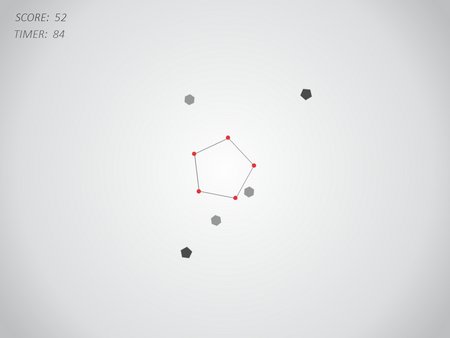
Take the control of a line ended with two red dots. Rotate the line, hit the small “triangle” icons flying with your red dots while avoiding “line” icons, and voilà, you evolve into a triangle. Now, catch the “square” icons. Rince, repeat, evolve.
Minimal yet very interesting gameplay, rising challenge tho the game may be a bit too hard, simple but very elegant graphism (very nice particle effect on catching a symbol): it nailed the theme very well. What really impressed me tho is the jazzy tune, incredibly fitting the game. Plus it’s a web game so you have no excuse not to try it !
Unst – Compo

Click a square to make it move. Green square + red square = death. Fit the green squares in the center. That’s it. With clear rules, good feedbacks and well crafted tutorial levels, Unst seems to be impossible not to understand. I wondered if I could find any challenge.
Boy was I wrong. The game becomes really challenging, maybe even a bit too much as the level rises dramatically on “The chosen one” level, but that’s the point of a puzzle game : getting one’s mind challenged. Simple yet deep, add a tune, you’ve got it right.
Dock zone – Compo

So, you play some schoolgirl fleeing from the rise of a strange, abstract water while picking up pyramids with making plank-bridges. This game got some weird yet very enjoyable style, greatly helped by a very unique audio atmosphere, both calm and disturbing with resonating, dramatic-beat-like footsteps.
Gameplay-wise, the game works quite well, with numerous puzzle levels mostly playing on timing. While not sure about the “minimal” part, I really appreciated the whole lot.
Russian blob – Jam

Let’s start by a warning : the people who made this game are good friends of mine, coming from the same school. But quite frankly, I wish I didn’t know them, so I would appreciate even more the cheer quality of the game without feeling corporate.
There’s so many things right about this game I don’t even know where to start. The game idea is simple : a 2D platformer. It’s also unique : you play a blob which can split into several smaller blobs, allowing you to make more elaborate actions that I won’t spoil as discovering them is really satisfying. The graphic design is very well made, and the music/sfx are both great downright hilarious (I sometimes randomly listen it). Also, there’s quite a lot of levels for a LD entry.
But the best part may be that it’s a GBA game. I’m not kidding. Wow.
Gods will be watching – Jam

I have already seen a billion reviews mentioning that game, so I felt putting it here would be a bit redundant. But the game really deserves it. Yet again, everything is incredibly well made. Manage a team who have to survive 40 days in terrible conditions : the food is lacking, there’s a deadly virus rampaging in the air, it’s so cold you have to lit a fire, everybody’s morale is getting low, you have to repair a radio… There’s so many things which can go wrong that surviving seems to be a miracle. But guess what ? The game is so hard, winning may indeed be a miracle. But it’s not frustrating. Would you fail, it’ probably because you fucked up something. So I hope you’re ready to feel guilty about someone’s death.
But hey, let’s mention… everything else. The graphics are simply gorgeous, the audio atmosphere is excellent and the whole mood of the game is stunning. Some feedbacks may help about which action costs or doesn’t cost action points and the story introduction may seem pointless by parts, but mentioning these “polish” elements just proves how well made the game is.
Also, there’s some other games I’d like to mention briefly as well (-> you should look at them) :
Stalker – Atmospheric point & click with actual pictures, inspired from the book stalker. Immersive.
Sociales Santillana – Minimal “match 3” with a twist : you play on polygons. Enjoyable !
Alien Raid – Very minimal STR. Pummel down aliens. Interesting.
Cottonhead – Cute and gorgeous pixel plartformer, short but refreshing.
TNAFT – Social game : guess which colors people prefer. Addictive. Playable on mobile !
Hubu handler – Pet simulation, incredibly cute and well made. Don’t you DARE slap him, you MONSTER.
Oh, and, if you feel like taking a look at my entry, here is it : YAHG.

Tags: compilation, recommendation, review, roundup
This was our third Ludum Dare and it was the one in which we had to manage the most crisis yet. In the first Ludum Dare we made the game Allel (Top 30) and in the second we made the game Kill The Hero (5th in graphics). With the theme being minimalism, we searched for numerous references and interpretations of it. We decided to look at all aspects of a game in a minimalist way (mechanical, aesthetic, etc.).
Inspired by several recent movies and games addressing it, we decided to take a view on time travel, alternate realities and the links between them. It’s complicated. But we used it in a minimalist and symbolic form. To tell a great story in a minimalist way.
He fell in love with a girl.
She had been dead for years.
But he did not give up.
Minimalist game. Minimalist commands. Minimalist graphics. BIG Story.
A Minimalistic Adventure in Time.
* Great Story;
* Innovative take on time travel;
* Cool minimalistic graphics;
* Amazing 8bit versions of 4 famous songs;
* Experimental game logic;

Mechanics: In terms of mechanics the game is a platformer with minimalism in its controls and also in its challenges which are basically the exploration, interpretation of icons, minimal quests and mouse clicks. The innovative aspect is to see the dimensions all on the same screen and to control the character in various situations, with a link between them.
Aesthetics: The aesthetic part of the game was really enjoyable. Simple as it is, it was very fun to think of graphics, scenarios, characters and icons in a minimalist form. We are used to more elaborate graphics and to make use of this perspective was very fun. We used familiar songs to reference the time where each level takes part.
Story: The part in which we had the most fun was certainly when we were creating a mean to tell a great story in a minimalist way. This little story can make the player travel through many interpretations and we ourselves are willing to further explore this setting.
Technology: We used Photoshop for all graphics. The game was developed in Construct2 and there was a little work to control all the actions of the narrative, besides the 5 “screens” at the same time. One cool thing that we had never used before was the full screen.
>> Click here to download the concept document (Portuguese).

Rodrigo Motta (Design, Direction, Art); Cesar Augusto (Programmer); Bana Gilda (Art); William Polleto (Musics); Trigueiro Jr (Animation).
The Good: To have met a new artist (Bana Gilda) and a new musician (William Poletto). To have achieved the goal of creating a minimalist game in all aspects. To have presented a vision about time travel, alternate realities and the lives of those traveling between them. To have been able to generate an interpretation of the story. To have shown that it is possible to insert great narratives in short games. To have one more game concept that we are sure that can be evolved into a much more complex game.
The Bad: We think that even following the theme, the game may seem a bit poor when in fact there was a lot of conceptual work involved. The initial plan was to work more on the animations, to not be minimalist on them, but our animator had little time. There was still one more element in the narrative, they were the time-police, which we’ll add later.
Walkthrough #SPOILER #ALERT
Initial Feedback: We did it! According to the initial feedback we realized that we were not crazy. Our idea has something unique in terms of mechanics, narrative and graphics were greatly respected by everyone. We displayed the game to several people and all of them saw something artistic and innovative in it! 
“Cool use of theme!”
“Quite artistic game!”
“Very nice and well polished.”
“Very unique gameplay.”
“It’s cool to see people using browser tech at its best.”
Tags: kaiporaLD26
I’ll be playing some Ludum Dare games and do live commentary to the best of my english capabilities:)
If you want to join the fun: http://www.twitch.tv/naughtyloose/new
If you want to add your game to the playlist: https://docs.google.com/document/d/16yk2ZSE0m5HQkmCCcxGaAFe7XHYOViKRazKXvxQj0mY/edit
Cheers!
I wanted to wait some time before making this post. Mostly to get some feedback from players and also to take more time to look back at that week-end.

First, this wasn’t my first game jam but it was my first Ludum Dare et my first solo jam. I’m a programmer and I suck at pretty much everything else (including level design). I mostly make HTML5 games and I’m used to build my games from nothing. So I don’t use mapping tools nor I use canvas libraries.
So before the weekend, I wanted to make my own warmup and check out some tools. I took a look at Construct 2 following the two first tutorials. I found it nice and quite useful for prototyping. One reason I tried it was Rytlock’s Critter Rampage made by ArenaNet as a side retro game to one of their in game event in Guild Wars 2. It’s made with Construct 2 so I saw what could be made with it. Though, the free version seems to be way too much limited to make a complex game.
I also took a look at Tiled. I’ve tried this tool before but never used it for games I’ve made because i didn’t like working with XML. This time I asked myself if there was a way to make a JSON exporter until I found out that this feature was there out of the box. That was a good point.
Finally, I brainstormed a bit on what game to do. I wanted to make a stickman fight game, so either a beat’em all, a platformer or a vs fighting game. The main problem was I wanted a stickman engine to render it in real time and not use sprites. A bit too big for a 48h game with my experience. So i thought about a platformer with stickman sprites.
For the weekend, I wanted to be up for most time. I know sleep is important so I planed good nights of sleep and even cleaned my appartement and prepared better food/drinks than usual. Being in CEST timezone, LD started at 4:00 am. I woke up at 4:30 after a good 9 hours sleep. At first I wasn’t inspired by the theme. But then I remembered my platformer idea and went for a simpler form : take a square. How to move it ? Make it roll. Not quite efficient, circles are better at that. Oh, why the square wouldn’t be jealous of the circles and make it beat them all ? That’s how went my brainstorming phase.
With that idea, I first wanted to see how it would look and if it was any good so I went for a prototype with Construct 2. I made the sprites with GraphicsGale (first time with it) and then imported them. The prototype was ready in 30 minutes and it was looking good. Great occasion to post it already as my entry. As there was a low number of entries, it had a guaranted visibility. Thanks to it I had some early feedback so I knew the idea was good enough.

Then went some long hours on reaching the prototype status with everything coded by myself. Took me most of saturday. I used Tiled to make a test level and see how i could use all the parameters present in the JSON object. That was quick and it took me no time to get the level displayed.

After a not so long night of sleep, sunday brought all the game mechanics implementations, some bug fixing (not much done finally) and all the polishing. The final version was uploaded nearly 30 minutes before the end of the 48 hours. By the way, I didn’t know about the 1 extra hour for submission so I really thought i had to be all set at the end of the 48 hours. Now I know for next Ludum Dare.
And there it is, ^2 is published, with it’s bunch of bugs but I quite enjoy what I’ve made.

Now, the good parts of the week-end.
First I learned well about tools. It made me want to use more Construct 2 or any other game building tool to prototype games. It’s really efficient with only basic knowledge of the tool. And now i think I’ll mostly use Tiled for mapping when the map type allows it. I might check out other mapping tools but I quite like this one. Also I made my first decent sprites and animations (though it was only b&w and basic shapes) and made me discover the tools to make then.
I had the healthiest weekend for a long time. I’ve been doing much more for me than I usually do so I didn’t have to think about it during the jam. It has also been a great time. I didn’t paticipate over IRC but it was nice to read the discusions there and how everyone was progressing.
As for code learning, I’ve found new ways to implement efficiently animations and game state management. Something profitable for my next games.
Finally, as for the game itself, I want to really finish it by fixing the collision bugs, add sfx and music and add some levels. After that, I even have ideas for at least two sequels. I think I’ll try to allocate myself some time to make them. It might even make me start learning about 3D.
But not everything was perfect. Some things I could improve.
First, I should have taken more active pauses. I think I spent something like 35 hours in front of my computer during the LD. I’d say at least for 10 to 15 hour I wasn’t focused on making the game. In these 15 hours, some were dedicated to playing games, reading IRC or else. And I’d say at least 5 hours were dedicated to nothing. Really. Just not knowing what to do. I think in these times I should have just left for a walk or a nap or anything else not taking place in front of the computer.
The second bad point was bug fixing. I postponed it too much. In fact, I made a first rough version which was designed for a specific type of tiles (I didn’t have any roof at first for exemple, so I didn’t bother to make collisions for them). I kept telling myself to fix those bugs but I ended up doing this between midnight and 4:00 am in the night between sunday and monday. I finished by having something but not any better than what I already had so I chose to keep what I had. But now from user feedback, I see a lot of people are facing those bugs and end up in impossible scenarios as then don’t know what to do to get out of the bug. So from now on I’ll add “fix it early” as high priority on my todo-lists.
Last, I’m a bad level designer. One recurrent comment in player feedback is how the level is difficult (starting with the first jump and the first ennemy). I know I tend to be nasty with players when it comes to level design so I’ll try to make it smoother for next games.
And I think that’s all.
Overall, it was a great week-end and I’m very happy with what I ended up doing. That’s one more game developped :). I’ve been wanting to participate in LD for some editions now, maybe 2 years. But every time I had something else scheduled on the LD week-ends. I’ll try to keep free spots for the next ones.
I’ve also made a walkthrough video of ^2. As many player can’t go through first ennemy or get stuck in the first trap, I thought it could help to see how the level can be achieved or at least how the game looks like.
First LD but not first game jam. I’ve been enjoying this week-end and I’m happy with what I did. I learned to use new tools (Construct 2, Tiled, GraphicsGale) and I now know the benefits of prototyping with a tool making it simple (Construct 2). I was organized enough but should have made more real pauses (not being in front of my computer while take them). I should fix bugs way earlier, postponing it ended up in a buggy game. And don’t be too nasty when level designing.
Entry page : http://www.ludumdare.com/compo/ludum-dare-26/?action=preview&uid=21322
Game link (web) : http://maxgun.fr/ld26/
Source on github : https://github.com/MaxguN/ld26-square
Tags: html5, post-mortem
Hello,
I came up what did good and what I’ve failed during the Ludum Dare.
When theme of the LD was published, I felt a little bit disappointed. I hadn’t any idea what to write. In addition, I had no time almost the all weekend. In fact, I started to write my game after the compo deadline.
My idea was very simple, so I was able to finish the game before deadline.
What went good
What I’ve failed
In summary, a few things could have been done better, but for the first participation in Ludum Dare, it wasn’t worst. I managed to finish the game and I am very happy of it.

I really enjoyed working on the game and I’m planning to sell an extended version in Summer.
If you haven’t explored the iceberg yet, start your discovery here.
Tags: exploration, explorer, iceberg, potato
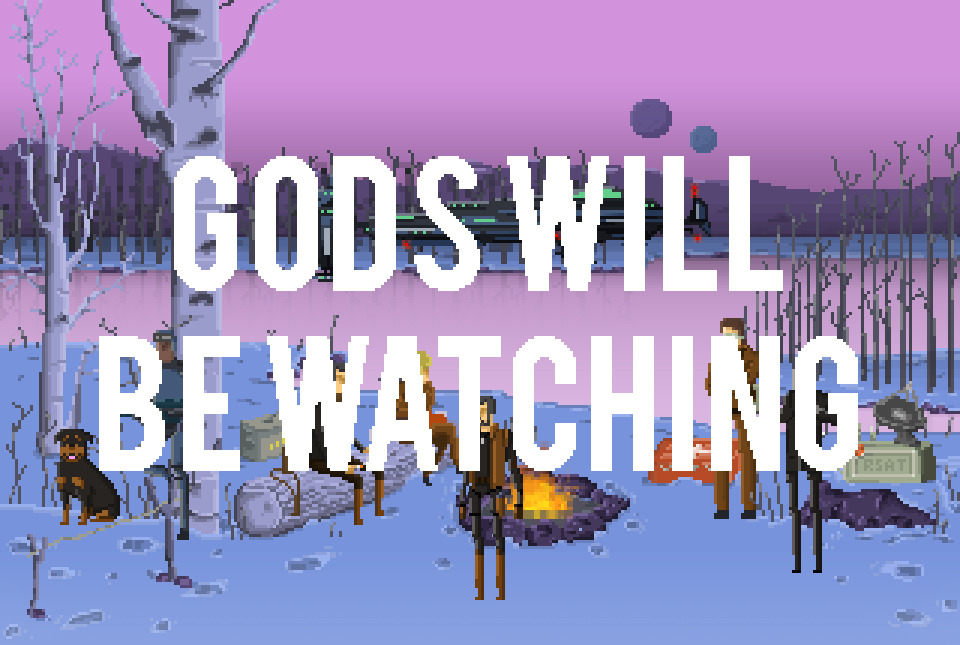
We didn’t expect this. Gods Will Be Watching was our little minimalistic puzzle game for Ludum Dare 26, and we were happy with it, but, seeing it appearing it all over the internet, and receiving more than 10.000 plays per day was totally unexpected.
We are overwhelmed. Took us several days to recover from the 72 hours effort and being able to face all of the blog posts, tweets, mails, gameplays at youtube… we need to thank so many people!!!!
Here’s a selection of GWBW‘s unbelievable (at least for us) journey on the press:
In spanish:
Seeing people playing the game on youtube was something magical:
This mashup video with John Carpenter’s The Thing really moved us :’)
Also the game got featured on Game Jolt!!
We hope so! Since the game got a great acceptance both by press and public, and a lot of people told us they want more, we’d love to expand Sgt Burden’s and his crew universe. A lot of ideas came to us during this week on how to develop the game concept further without losing his essence, and we are thrilled with what we have to offer in the future, so stay tunned!
Twitter: @Deconstructeam !

Tags: Deconstructeam, html5, impactjs, pixelart
I can’t claim to be a huge fan of the theme this time. Minimalism seems too broad and very much something that people implement every LD.
I was at first going to be paying a tribute to some minimalist writer (I read a Raymond Carver short on the first morning of the compo) but I had planned on a point and click adventure since before the compo so I ended up with an homage to fine minimalist cinema instead with Stalker – referencing the Soviet Sci-Fi classic with the same name. If you haven’t seen the movie, make sure to do so. It’s one of the all time greats.

After rating a grand total of 100 games, I found very few takes on the theme Minimalism that I felt were great. But here comes a rundown of them:


Please tip me off if you have found any other games you feel are impressive takes on the theme!

After waiting until 4 AM for the theme, I was a little disappointed it was minimalism. So the next morning I brainstormed for some ideas. In the end I came up with The Void, a horror game where your default view is minimalistic, but enhancing it brought danger with it. If you can see the monsters, then they can see you as well, basically.
So I started out with the end result of my previous LD and stripped all the content so I had a half-assed engine with a rudimentary level editor. Perfect for two days of mayhem, but not without its issues. Since the ‘engine’ is basically the end result of 3 iterations of previous entries all bolted on top of each other with different features, it’s a dirty mess, but it worked!
After bolting even more crap onto it, my entry was done. I’m very happy with the result! Even during development those things creeped me out when they (or I) got too close. So that’s nice 😀
What went right
What went wrong
What’s next
I’ve just released a post-compo version with a level selector and the ability to skip the tutorials in levels 1 and 2. I’ve also fixed a bug where monsters would always see you if you used your goggles and if they were already hunting you, regardless of if you could see them.
I’m also working on a Oculus Rift version, but this is problematic because I don’t have a Rift yet. 😀 So far I’ve managed to get the stereoscopic view into it, and it should use the variables sent by the Rift to render things properly based on the Rift’s setup. It’s also technically possible to rotate your head, but without a Rift to test things with it’s been difficult, and at this point I can’t continue integrating it until I get the device itself. However, optimizing the menus and other things are mostly done, so that’s nice, but I’m stuck now until I finally get mine 
Anyway, here’s my entry, with post-compo download link. And here’s the rift preview vid.

www.twitch.tv/jellycakes1
Someone made a great gameplay video of my game, i need to lie down!
If you haven’t played the game yet, you can play it here.
And an animated .GIF

I have to say – This is my 4th (or 5th?) LD and this theme really pushed the overall creativity level.
So many smart theme usages, so many cool gameplays with so little.
For now, 15 games that really worth mention in my opinion:

Simple resource management nicely done.

Awesome concept and nice interpretation of the theme.

Nice gameplay, relaxing sound and music. A reward at end.

After you figure out its mechanics you just cant stop playing.

Find the path to the food for your ants on an endless world.

Amazing music, furious gameplay. A bit too hard but worth trying.

Amazing music, amazing graphics and a powerful message that it delivers about true minimalism.

A little hard to control but rewarding with nice scenarios and fantastic music.

Clever theme usage, nice graphics and music.

This one is getting famous around there and is in justice, really nice visual, gameplay and music.

Not so polished entry but with original gameplay and lot of upgrades. With more work, the potential of this game is huge.
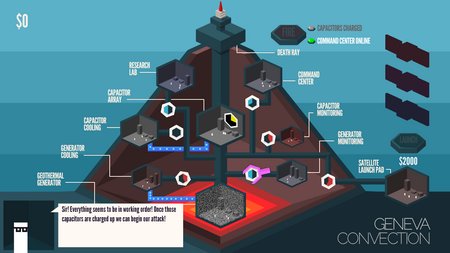
Very fun, challenging, good graphics and music.
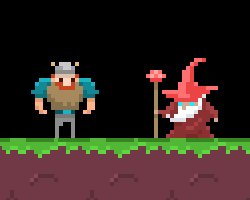
Another very original theme usage.

This is the result of going to another dimension while drunk and this is a good thing to try. Liked this game a lot.

Deep, complex game with lot of powerups and strategy packed in nice minimal graphics.
Hey, everyone! Green Pixel’s artist here! Ludum Dare 26 was a blast and we came up with our Jam entry: Eternal Journey 😀
If you’ve played it and rated it, thank you so much for your feedback! If you haven’t, check it out here and we’d appreciate your thoughts!
We made Eternal Journey with mobile devices in mind (as we have released an iOS title in the past) and we’re happy to read that a lot of the feedback seems to welcome the game – albeit a more finished version – on smartphones 😀
This was our second LD Jam and one thing I realized from LD25 was that I didn’t really learn much artistically – besides learning how fast I could work under a time constraint. So, this time around, I decided to experiment. Why not, right? When I heard that the theme was Minimalism, I thought of triangles and, inspired by games like Vlambeer’s Ridiculous Fishing, I came up with the art for Eternal Journey. Below is a handy screenshot if you don’t have time to play the game 😀

Triangles galore, eh? Now that we’re going ahead with the fully-featured version of the game (that we’re hoping to release before the next LD :D), I’m wondering if I should continue with this triangle-istic style. As a game artist, I’ve only really ever worked with pixel art and it’s the most comfortable style for me. I whipped up a quick mockup of what the mobile, pixel art version would look like (note that the background is largely unfinished :D), seen below:

See the huge difference? 😀 Gameplay aside, which style would you prefer? Do you think pixel art still appeals to the masses or is it played out? Would the semi-abstract triangles fare better in the world of apps?
I’d love to hear your thoughts! Thanks and happy gaming! 😀
Tags: art, pixel art, post-mortem, postmortem

I just released a post-compo version of Less is More? to Newgrounds. The game itself is almost identical to the compo-version, but I added a level editor integrated with the Newgrounds Save Api. Let me know if there are bugs!
Post Compo Version
Ludum Dare Page
I’m only halfway at the moment. I have 2 weeks though. I found out that if I play games all the day and play them till the end, give detailed feedback, etc. I rate 25 games per day. However, on the second day some people had over 100 ratings………
I was playing games randomly: sometimes by the default rating, sometimes just random games from the front page, sometimes games by request… Here are some games I liked those have rather little votes:

A minimalistic horror game, where you have to run away from different-colored eyes.

A one-button adventure game with an amazing story and outstanding mood.

A very innovative yet minimalistic strategy game about pixels.
I’m going to post a more detailed list, but only when I’ll rate another 50.
Tags: review
Hello everyone !
Maybe some of you have already played my entry for the Ludum Dare 26 Jam. A lot of you also complained about the lack of single player mode.
You ask for it, so here it is ! You can now practice the art of dueling at sunset, in SOLO. But don’t forget to try it with a friend, it’s way better. 😀
You can play here : *CLICK CLICK CLICK*

I thought I’d broken it – just updated with linux and windows version [ they were in there before, but I’d not included the HTTP:// bit in the link ]

Play here : http://www.ludumdare.com/compo/ludum-dare-26/?action=preview&uid=20903
Save the potato!
Gameplay Video :
Click link
Tags: LD#26
A long post lies ahead! My game is The One Road, which I wrote in JavaScript for the 48 hour compo.
My game is played in the browser so I can just look at web server access logs. No special logging, I’m just looking at which resources were downloaded.
111 unique visitors. This counts anyone who loaded the background for the battle screen. 38% had referers, with 6% of those coming from Facebook and the rest coming from Ludum Dare.
89% of visitors requested at least one audio file. This means that audio is broken for 11% of visitors. That’s huge! I could figure out no rhyme or reason to the visitors without audio: they used different browsers (Chrome, Firefox, Safari, and Internet Explorer) and different operating systems (Windows or OS X).

There are three background music tracks. Each correspond to a different point in the game. For those with audio, 100% played track 1, 40% played track 2, and 29% played track 3. So under 30% of those who play my game got to the end. Is that a big number? Small?
48% of visitors with audio played the “you died” music, so maybe 52% gave up without dying. Well, it is possible they faced an unbeatable battle: the first gremlin. I’ll talk about that later. Actually, three visitors got to the end without playing the “you died” music. Congratulations to the seasoned RPG veterans out there (or cheaters).
Only 54% of visitors with audio ever bought something (sword, potion, etc.) at the town store. I think the store was not obvious enough, or people tried to get too far in the game without visiting the store. You can’t beat the game without going to the store, it’s simply not possible.

Browsers: 65% Chrome or Chromium, 27% Firefox, 5% Safari, 2% MSIE, 2% other. One visitor claimed to be using Safari on Android. Huh. People generally used up to date versions of Chrome and Firefox: there was a Chrome 18 user and a Firefox 14 user, but almost everyone used either Chrome 26 or Firefox 20: those two specific versions account for 80% of all users. All that time I spent testing on Firefox 10 (yes, seriously) was a waste.

Platforms: 57% Windows, 28% OS X, 12% Linux (except Android), 2% iOS, 2% Android. My game shouldn’t work on iOS or Android, but I want to make it work. Again, this only counts users who got to the battle screen. Windows XP was the oldest with 6% of Windows users and OS X 10.6 had 16% of OS X users.
I focused on the core mechanics of turn-based RPGs: start at a town, go through the overworld, and end at the final dungeon. Defeat monsters to gain XP and gold to buy better equipment. This focus worked well, but…
Balancing the game was tough and took too much time. I expected “Impossible” difficulty to be literally impossible, or at least extremely tedious, but it turns out that it just requires a little grinding, a lot of caution, and some luck at the very beginning. “Easy” should be very easy, but if there’s one thing I learned about Ludum Dare game balance, you should err on the side of making your game easier. If you make it too hard, people won’t see most of it.
The major problem with gameplay is that stupid gremlin you fight on the other side of the bridge. The gremlin has a defense rating of 3, so you can’t harm it unless you buy a sword at the shop in town. Worse yet, if you decide to buy chainmail but no sword, the gremlin can’t damage you either. Oops. I suspect a number of people stopped playing here. I should have made the shop more obvious or reduced the gremlin’s defense rating on Easy.
One user complained that potatoes are overpowered in the game. They actually fill a specific need: they cut short any encounter you’ve already faced, so backtracking is less tiresome.
Two hours in, I switched from C++ and OpenGL to JavaScript and Canvas. That worked out surprisingly well. I did web searches for “how to make a simple HTML5 canvas game”, followed some tutorials, and expanded until I had a game.
I found the core UI in an RPG like this is the menu system. The game used a stack of menus, where hitting escape would pop the top menu off the stack and return to the previous. I didn’t realize how critical it was until I had reimplemented it in four or five places.
The other fundamental piece of code is the tables used to drive the game. There are tables for monsters, encounters, swords, armor, items, spells, and difficulty levels. The rest of the code only has a couple special cases, mostly revolving around the potato.
I also like the battle animation system, which runs a bunch of callback functions in sequence or in parallel to adjust the position of sprites on the screen. For example, one function will generate a tween callback, another function will cycle through sprite frames, and the two of them in parallel make the “sparkle” animation when you drink a potion.
Not much to say: I didn’t want to SFXR everything but recording sound effects was tough. However, the music came out well. I scrapped plans to draw and paint because I suck at that, and ended up pushing pixels in GIMP.
An extra hour or two might have made worlds of difference for game balance. It’s just too tempting to add features right until the last minute, next time I’ll try to save a little bit of time to play before release. Next time, I’d also like to add a little extra analytics code: I want to know how long people play, how far they get, and what strategies they use.
Looking forward to doing this again in August… or even sooner!
Hi everyone, here’s my desktop time lapse during the writing of Minimum Friction, my entry to #LD48. This was a very exciting competition and I am very satisfied with my results. While I did three Global Game Jams, this was my first time on a Ludum Dare. It was also the first time doing a game all alone in such a short time. It’s very different from jamming with friends and is a great way to check our skills to deliver something complete, instead of part of a total.
At first the theme seemed daunting, until I had an idea about a platform game that played around gravity. To make it different, I decided to remove the ground and platforms, both to get a minimalistic game and and to something different. That was a little before I started writing the code.
Some funny things people can notice, I started writing the menus and splash screen. I was trying out the SFML 2.0 library for the first time, so I spent some time playing around with the lib to get the feeling of how input was handled and how to use graphical resources, which is quite different from SDL (which I used for a long time). It wasn’t until late in the night that I started coding a level.
The best I did was in Saturday night: a level loader. This allowed me to do many cool things that would have been difficult to achieve if I used hard coded levels. By Sunday I had a “to do” list that was 50% done for submission (I can’t believe I actually planned multi language support). Credits screen was a late addition, and I had to cut some corners, instead of loading a text and rendering the credits, I used an image and that did the trick. Finally, I fine tuned the levels and by 10PM EST Sunday I uploaded the final version.
If you still have to play it, please check out the Minimum Friction page and let me know what you think! 😀
Wow, a lot of nice games are online and it’s taken me some time to play through even a small amount of them.
Metrocraft is my fourth LD attempt (3rd submitted) and it turned out well for the limited time I had. Never as polished as I would like but it’s nice to see all of the constructive feedback. I fixed the mouse bug so the controls should be much smoother.


Would like to hear more feedback on what types of features and changes you think would make this game much more successful and move away from the simple timed levels that even I don’t like.
Some ideas I have: Creative mode, Score based on time to complete, Obstacles.
You can play it here: METROCRAFT (I recommend downloading the windows version and play on full screen)
Thanks for the support, challenging games and great inspiration!
Enough of the minimal posts, it’s time for introspection!

What went right:
Minimal theme. This was my favorite theme so I was very happy to see it win. It’s specific, yet can influence art, music, and game design. Like everyone else, I rushed to the wikipedia entry and stared at Mondrian’s squares. I read that minimalist art didn’t have to say anything in particular but existed just to look good. I usually have a story and theme linking everything together but with minimalism I didn’t have to worry about that and could remove all meaning and still fit the theme. At one point during the weekend I read someone’s post that said that minimalism was the best theme ever because programmer art was the perfect art for it. I have to agree.
Quick design conecept. While taking in the internet’s examples of minimalist art, I pictured in my head a moving line and manipulating it with a button press. Depending on the location of the goals, the player would end up with interesting minimalist pictures. To keep things fun, I thought of adding pickups to modify what the button does and laying out levels that require obtaining the pickups in a certain order. After I had my prototype I noticed how crazy it was to have the button down and button up work differently. And that’s pretty much all I needed. I think Ludum Dare works well when you have a good design from the beginning that you can focus on and it flops when you start with too general of an idea and have to rush to design something coherent at the end. I got very lucky this time that my design ideas ended up working out.
SVG. Rather than use the bitmap graphics of a canvas library, I chose the Raphael SVG library for web based vector graphics. I decided on SVG because minimalism made me imagine a very clean game. With vector graphics you can rotate and scale to any size without worrying about jaggies or pixilation. It is also very easy to manipulate colors and outlines since you don’t need to create new graphics but simply change the stroke and fills. Unfortunately, I didn’t get to use much of this in the end, but ever since I came up with the design I knew I wanted to take P27 past the Ludum Dare weekend and try and get a complete fully polished game out of it. Hopefully the time I lost implementing SVG will pay off in the future.

What went wrong:
SVG. You probably saw this coming. Pretty much all of the problems and time sinks I had were the result of choosing SVG. I’m going to break them down further in the next items, but know that SVG was the root of them all.
Rolling my own. There aren’t any SVG game engines out, just graphics libraries. This meant I had to program all of the pieces that make a game a game for myself. P27 isn’t very complicated so it wasn’t too bad, but I did lose time on tracking movement and position, handling collisions (thank GOD Raphael computes bounding boxes), and level setup.
Sweating the small stuff early. Since I hadn’t done an SVG game before I had no idea how it would perform. My initial tests showed ugly jitteriness on the iPad. That had me worried that most users wouldn’t get the smooth animation I was looking for. I could fix this by swapping out Raphael’s setInterval animation with some custom css transition code, but that was risky and did I have the time? What about modifying the animation after it had started? SVG animation is mainly used today for interactive pie charts and bar graphs, could I stop it in response to an button press event and change the line’s direction? I think I spent all of the time I saved by coming up with an idea early by worrying over the perfect execution of it. I was afraid of going too far down the road with SVG and then finding some impossibility that would cause me to start all over again so before I started I spent too much time researching every little thing to make sure it would work. In LD you don’t have time to worry, you have to go with gut decisions. Before I started I spent too much time in my head and not enough time putting bits to processors.
That damn line!. My final worry came from the moving line I saw in my head. Even though I already had a dot moving and changing direction, I wanted a revealing line instead. I wasted hours thinking about how to do it and researching how to reveal an SVG path. I found some solutions, but they all sounded too slow and time consuming and I once again I found myself pre-optimizing in my brain. The quick solution I ended up with did turn out okay, and I suppose one could argue that a point is more minimal than a line, but I want a line damnit!

If Ludum Dare were a video game it would be a resource management game. You would have a finite amount of the time resource and have to figure out how to best distribute it among thinking, coding, polishing, making art, and making sounds. Last weekend I spent too much time on thinking and not enough on coding and sound (I will gladly admit the music ended up pretty awful).
In the end, however, I am very proud of the result. It fits the theme in art, music, and design and more importantly can be entertaining to play. The comments from the LD community have been very inspiring. I have a goal of spending the next 30 days fixing it up and turning it into a polished little product (I think it would be perfect for touch control on a tablet or phone). Who know, maybe I’ll even get that revealing line I’ve been looking for.
P27
by hi-scor.es
1 programmer
946 lines of javascript
Libraries:
Tools:
[stextbox id=”alert” color=”a6f4fb” bgcolor=”000000″]
ludum dare so awesome!
[/stextbox]
This is the fourth time I’ve participated on a Ludum Dare, but the first going solo. It was a big challenge as I would have to make everything and I wouldn’t have the support of an awesome team.
First Day

beer beer beer bere brre beretb mdsamda bwqe IDEA!
The first night I was preparing myself with some beers and something to eat, just anxious about the theme. Once the theme was announced I was a bit disappointed, I wanted afterlife to be the chosen one, but at the end an artist is formed by challenging him self.
I spent about 5 hours trying to figure out a game, I made a lot of prototypes which at the end I discarded. Finally I decided to use a very old idea I had, even before I could actually program. I thought the mechanic was very minimalistic, so I just went for it.
The result of that first 4 hours was this :
A very simple version of my actual game which had the core mechanic.
Second Day
The second day was a bit easier for me as I already had an idea, now it was just about polishing and adding more features, at least that’s what I thought first.
As the hours passed I was getting a more robust game, I’ve already added some new levels ( you could actually play with more than just 1 core ) and a couple of effects ( particles and some reduction affect on the cores ).
At the end of the day I just decided to submit my game to ludum dare, saying “yeah it’s playable” plus I thought It would be great to get some feedback before the deadline.
This was the first version of the game I submitted:
After that I just went to bed wishing the best for my game.
Third Day
After sleeping 4 hours I decided to watch how my game was doing on the comments. Great ideas as many errors and ideas were mentioned. I was skeptical about making does changes, but after more comments I noticed it was mentioned very commonly. Then it’s when I decided to just make the changes and added moving cores, this was the result:
http://apps.monkeycoder.co.nz/249/1/html5/MonkeyGame.php?width=800&height=640
I needed to give my game a name, so I just looked at my cat and thought why not call it like him. I like my cat!

origin of the name!
Last Day
The last day I only slept for 3 hours. Fortunately my friend, with whom I am developing indie games, told me to take the day to recover myself. I didn’t do that so I decided to keep working on the game. With just 10 minutes left to submit my game I sent my final version which included a couple of fixes and more enemies. I thought that would have made it a better game.

giffin’
The Good
I really liked making a game all by myself, I felt I could do anything I wanted.
I could finally do a game I wanted to do for a long time.
I believe the mechanic is very solid.
The Bad
I really wanted to expand the gameplay, after a while it gets a bit boring.
Very disgusting source code which had so many bugs.
I wish I could have added better graphics.
I wish I’ve had more time so I could have added more type of defense.
If you haven’t played my game please do, if you could rate it that would be awesome too. My cat would love you for that!
http://www.ludumdare.com/compo/ludum-dare-26/?action=preview&uid=13148
Thanks!
Felipe
www.twitch.tv/ecool377 We will be announcing it at 4:35 Come and watch!
I’m very happy with all the positive reviews I’m getting from you guys. Although I was dissapointed that all the features I had in mind could not be implemented, I realized that, well its Ludum Dare. Anyway, Thank you so much everyone, and if all goes well, and the good reviews continue, I will be sure to make a better Post Compo version with more levels, features, and music.
To anyone who has not played my game yet; WHAT ARE YOU WAITING FOR MAN!!!
http://www.ludumdare.com/compo/ludum-dare-26/?action=preview&uid=20256
Here’s a quick gameplay video of where I hid all the potatoes in The Sentient Cube.
Tags: Katamari, Katamari DA, potato, Potato Challenge, The Sentient Cube
Hello everybody.
This was my first Ludum Dare. I was initially going to enter the Jam with a team, but my friends bailed out at the last minute. It was a good thing, because if I would have done the Jam, I probably would not have finished a game for this Ludum Dare.
I might not have spent as much time on it as other people did, but I used the time that I had wisely.

I invite you to play my game, A-Void. Feel free to comment at the bottom of the page. I enjoy reading all of the comments.
It supports Windows, Linux, Mac OS/X, the Web, and it is made in Unity.
So i got a lot of comments saying that my game was really hard and it IS meant to be that way because the point of the game is to find an easy, minimalistic, way of beating difficult levels. I understand now that it might be hard to grasp the concept, so i thought about making a walk-through but if i did that, the levels would actually be TOO easy. Therefore i decided to make this post with a hint for each level to make it easier to beat.
1. The green circle isn’t the only green thing in the level.
2. The game is programmed so that the character falls until ANY part of him touches gray.
3. Sometimes left is right.
4. For a minimalist, one is enough.
5. Sometimes you’re just too tired to save your own life.
Here is the game:
http://www.ludumdare.com/compo/ludum-dare-26/?action=preview&uid=22050
I have finally uploaded a time lapse video for my LD26 entry, “The Fair King”. Feel free to watch it here!

Clear the stage by dividing the colors by as close as 50% as possible
For me, Ludum Dare is a chance for me to try something that is out of my usual reality. Game making, art creating, very short deadlines. In keeping with this spirit, I decided that I should move myself outside of my comfort zone, and try a brand new game engine, and a brand new platform. I decided to use libGDX for the first time, and make a game aimed towards the Android platform.
I know that it is not best practice to try out new libraries in the 48 hours alloted by LD, but I wanted this to be a learning experience, so I went ahead with it anyway. Here is the usual “what went well” and “what went poorly” breakdown:
It was fun, and I’m happy with the result. Please give me your opinions here.
My Game

Press “Z” is simple. You’re a square and ever-increasing waves of rectangles are assaulting your position. Smash them by pressing and releasing the “Z” button.
This is the first game I’ve made that really centered around and focused on a single mechanic. All you can do is jump. But, strangely, reasonably interesting game-play emerges from that simplicity.
For example: The enemy rectangles can push you around as you try to squash them and if you get to the edge of the screen, you’ll die. Since all you can do is jump (you can’t directly control your drift towards the screen edges) you occasionally have to sacrifice some health so that a rectangle can push you back in the direction you want to go. This health/position tradeoff becomes increasingly important as the speed of the enemies increases.
My frequent co-conspirator Chris Wellons suggested adding a camera shake to emphasize the weight of the player. That simple camera shake and the enemy “pop” particle system really make the game feel solid and crunchy in spite of the simple graphics.
The game does lack “spice”. All that happens as you progress is that the enemies come increasingly faster. This, as shown above, leads to interesting game-play but it also starts to feel repetitive. Introducing more enemy types as the player progresses would help with this. Those new enemy types should also force the player into interesting choices. For example, I could add a flying enemy type that has the potential to block your jumps which would force you to make a tradeoff between taking damage in your jump or taking damage from the enemy that you were jumping to crush (or scheming to avoid both.)
I’m glad I didn’t spend any time on graphics during the compo but I’ve had a little time to experiment post-compo and I think that enemy animations and graphics can also serve to provide some of the missing “spice”.
The Process
Press “Z” wasn’t the game I started the contest with. My first game was a word association game that would ask the player to convert a given sentence into a goal sentence by replacing words with related words from a list. The theme “minimalism” would be captured with a strong contrasting aesthetic and clean typography. It sounded interesting in the planning stages but the prototype (that I spent most of Saturday building) turned out to be terribly boring.
Sunday I began again. This time “minimalism” meant “cut to the essence”. I was thinking about platformers and boss fights and thought it would be interesting to build a platformer that was only about the boss fight. As I was discussing the idea with my wife, we began talking about how the boss-fight would unfold and how the player would deal damage. I used “jumping on their heads” as an example. That got me thinking that a single button game about jumping on things’ heads might be fun.
I was able to prototype the fundamental jump-n-crunch in about 30 minutes. Even though the fundamental parameters (enemy speed, jump height, control loop) made it to the final version unchanged, this prototype also wasn’t fun. The crushing didn’t feel good. It wasn’t satisfying. I added a particle system and it felt a lot better. Then, I felt good enough about the prototype to show it to Chris. He suggested the camera shake and suddenly the game felt fun. I was surprised that pure aesthetics could take a game from dull to enjoyable.
What Went Well
What Went Poorly
This Ludum Dare was a wonderful experience and I want to participate again next time.
Play and rate my game if you’re interested!
Tags: postmortem
I’m not exactly fond of doing this, but the complaints were too strong to ignore. I’ve decided to create a new web build to address the issues below. Let me be clear that you should play the original build and rate it first before playing this one. Otherwise, that’s unfair to everyone.
Played it? Good. Here’s the new webplayer:
It contains the following improvements:
Please tell me in the comments below how these improvements fare to the original build. I really want to work this into a full game in the near-future, so the sooner I know how to improve the game, the better!
And once again, thanks for all the help!
Tags: post-compo, The Sentient Cube
So, as I said I would I made some changes that I didn’t have time to make during the jam.
1. Colors!
2. The ball don’t spawn at the same time now.
3. I changed the musics.
4. You can choose a music from your PC to play.
Play here: http://www.ludumdare.com/compo/ludum-dare-26/?action=preview&uid=18057

When we first found out that this year’s theme was “Minimalism”, the whole team panicked; we had assembled a team eager to exploit our very diverse capacities and strengths, and right from the beginning we were forced to keep it simple. Truth be told, the condition taught us to work under a scheme we had never worked under before so, in the end, we are grateful with the experience.

Click this image to play!
Click here to play Hito’s Main Theme!
Hito is a simple game: the goal of it is just to traverse the world you’re set upon destroying all the platforms before reaching the final door. We like to think this minimalistic idea was what gave us the tone to fit all the pieces around in, and so we did; all aspects of the game, there on, were thought to complete the minimalistic mood: the narrative is all done in haiku, the levels are shaped as the Japanese kanjis for the level number in turn, the music (keeping with the oriental theme) was written in some sort of pentatonic scale and the character was created to be simple, yet endearing. Our efforts turned out to be very rewarding when we experienced the final product and felt everything was in its right place.

The first screen was planned as a tutorial.
We realized, once we had put together this different ideas, that the game-play could become a little repetitive if we just leave it that way, and that’s where the level design helped us. We spent a whole day putting together mechanics and layouts that could not only be beaten differently by each player, but also some that pushed them to think outside the box. From level 3 onwards we added snow, vertivcal segments (obligated for the kanji we based the level’s layout), and darkness to keep the experience fresh and the challenge growing.

The narrative inspired some mechanics and graphics.
We’ve had such an amazing experience making this game, that we are not willing to let it just be a three-day project; we’re still working to bring the game to new heights and correcting every aspect of it that’s brought to our attention, so please, we would appreciate any suggestion anyone may contribute. For us, even though we consider Hito to be a whole game as it is, we’re not leaving it as the work of three days and are looking forward to bring you a larger, better and smoother version of it.

Different mechanics force players to think harder.
So please, play our game and share with others who may like it. You could also give a “like” to our facebook page and leave your comments there, we’d appreciate it.
Hello, LD community!
This is my first post out there, albeit not my first participation, as I’m in LD since the april of 2012.
As we all see, activity dramatically raised here since the last LD and I think it will keep like that. Looking at infographics for LD and seeing how the time to rate every game in LD dropped to some 5 minutes (assuming 4 hours per day), I was surprised by the fact, and also remembered that there is an actual problem for getting ratings for every game in LD. Last time, even my own game didn’t get enough (but that’s more because I didn’t actually care and didn’t rate other games as well — had no time back then). So yesterday I thought about ways to make the rating of games easier anyhow, and here’s what I came up with.
A simple web crawler to gather all the download links for every game.
If you want just the download links to mass download the bandwidth away, you can get them already:
LD26 filtered direct Links.zip – explanation of those is many screens downwards.
So, here are the… Platforms?
[stextbox id=”alert” caption=”Say WHAT?!” collapsing=”true” collapsed=”false”] BARACK OBAMA
Text Tutorial-Walkthrough
"Maniac" level pass through video
"WallPatch" (see info!)
(low resolution)
(OSX) Mono Runtime
(Updated) Mouse version (better !)
(Windows) XNA Redistributable
— PLAY HERE! — (Flash)
— Play now in Browser —
–>Flash version<–
.app
.exe (72 hour jam)
.exe
.exe
.gm81
.jar + source (zipped)
.love (OS-X, Linux if you have love2d installed)
.love (Web if you use CHROME)
.love file – source
.love File
.love Package
.love
.Net 4.0 (might be needed)
.Net Redist
.swf
48h Compo Version
7z (swf + html)
AIE Framework
All Distributions
All Downloads
All OS JAR
All OS
All OSes + souce
All Platforms (source is included)
All Platforms – Web
All Platforms Alternative (if the first didn’t work)
All platforms(Java)
All Platforms
All Plattforms (Jar)
All Source (zip)
All
Alt download
Alternate archives (zip, tar.xz)
Alternative link
Alternative Web (HTML5)
Android (236kb apk)
Android (apk)
Android (enhanced version)
Android (Google Play)
Android .apk File
Android .apk
Android
Android apk direct link
Android port
Android store
Android Tablet (Untested)
Android
Any java platform
Anything With Java
Apk Emulator
Apple IIe
APPLET DOWNLOAD
Applet Source
Applet(Dropbox host = slow)
Applet
Application
Assets
Atanua Download
AtariAge
Awesome Edition (Post Compo)
BBS(Web, Don’t Use Chrome)
BETTER BUT STILL DUMB
Bitbucket Repo
blender windows
Blender(source)
Blog post
Blog-Source
Blog
Bonus Game With No Source
browser
BUG! Online (google code)
BUG! Online (Swf cabin)
Bugfix JAR
Cake’s Timelapse
Choppy Gameplay Video
Chrome (Web-HTML5)
Chrome NaCl
Chrome Webstore
Click here to play (uses Unity Web Player)
Click here to play (Web)
Click Here to Play
Click to Play Now
ClockBot Games
Coding Timelapse (Youtube)
Commodore 64
Compiled Tar with Source
Complete version, post-compo.
Cross Platform (Java)
Cross Platform – LOVE
Cross-platform .jar
Cross-platform Jar
Crossplatform (Jar)
Debian GNU-Linux (Testing)
Demo Gif
Desktop (AIR)
Desktop (Java)
Desktop (JRE6)
Desktop (Windows-Linux-Mac OS X)
Desktop JAR
Desktop
Detailed handbook for 4X veterans
Dev Diary
DeviantArt (my art gallery)
DeviantArt
Devlog Playlist [yt]
DevTwitter(Q-A etc)
Direct SWF link
DOS
Dowload
Download (Includes Source)
Download (including .NET-XNA installers)
Download (jar)
Download (normal)
Download (Original)
Download (small screen)
Download (Win-Orange Screen Fix)
Download (zipped .swf file)
Download all OS (Flash)
Download Game (.exe)
Download Jar
Download Link
Download Source (.gmz)
Download [Linux]
Download [Mac]
Download [Windows]
Download(Recommended)
Download- Java (Cross-Platform)
Download
Downloadable SWF
Dropbox (Windows version)
Dropbox Alternative (HTML5)
Dropbox
Ending Song (for lazy people)
Engine’s Source
Example winning rules
Executable .jar (Windows – OS X – Linux)
Executable .jar
Executable jar
Executable
Exported .gmz
Extended release (Web)
Feed Archive
Final Source
Firefox (Win version recommended)
Flash (1600px width)
Flash (800px width)
Flash (Balance + Leaderboards + LD Badge)
Flash (blog)
Flash (bugfixed)
Flash (Compo)
Flash (Kongregate post-compo)
Flash (Newgrounds post-compo)
Flash (original entry)
Flash (original)
Flash (swf)
Flash – Play Now!
Flash Download
Flash SWF file
Flash(Linux)
Flash
french version
Funny keyboard- Here’s AZERTY keys!
FXs
Game Files (Original)
Game Files Updated
Game Maker- Studio .gmx
Game Map
Game Play Video
Game-Source (Download)
Game
GameJolt (Web)
gamejolt
Gameplay – winning
Gameplay Video (with debug draw)
Gameplay Video
Gameplay!
Gameplay
GBA Download
GBA Emulator
GBA rom + Emulator (Windows)
GBA rom
Generic Jar
Get OST on Soundcloud
Gif demo
Git Repo
Git Repository Web
GitHub (Source)
GitHub Source
Github-Source
GitHub
Glitched
GMK-Source
Google Chrome
Google Play (Free!)
Help
Hints and cheat codes
Homepage
How to play
HTML (Chrome)
HTML File
html(mirror)
html
HTML5 (Chrome and iOS6+)
Html5 (Compo)
html5 (experimental)
HTML5 – Web
HTML5 Web
HTML5-JS Online Link
HTML5
IBM Compatible
Image Gallery
Info
Instructions
IOGraph (5 hours of mouse)
iOS source
iPhone
Jam version (Web)
Jam version(Web)
Jamalaide
JAR (mirror)
Jar file (tested)
JAR File
Jar
Java (should work everywhere)
Java (Win-Mac-Lin-Sol)
Java + src
Java 7 Executable .jar (6.7MB)
Java Applet
Java executable (requires JRE)
Java Executable Jar
Java High-Res
Java Jar (9.5MB)
Java jar (jdk 7) 10MB
Java JAR
Java Low-Res
Java
JavaScript Source
JNLP
Journal
King Indie
Kongregate (mirror)
Kongregate (Web)
Kongregate(Flash)
Kongregate
l
Latest Java
Leaderboard
LEVEL 6
Lin32
Lin64
Link backup
Linus Torvalds
Linux (.love)
Linux (32 Bit)
Linux (32-Bit)
Linux (334kb tar.bz2)
Linux (64 bit)
Linux (64-Bit)
Linux (64bit)
Linux (64bits with Qt5)
Linux (Java Required)
Linux (Java) not tested but should work
Linux (Mono)
Linux (read below)
Linux (requires Blender)
Linux (Source)
Linux (tested)
Linux (untested)
Linux (Wine)
Linux (x64)
Linux (x86-x86_64, w-src)
Linux (zip)
Linux + Source
Linux – .love
Linux – other Unix-like – source (mirror)
Linux – other Unix-like – source
Linux .sh only
Linux 32 bit
Linux 32-bit
Linux 64 bit
Linux 64-bit
Linux 64bit
Linux amd64
Linux Binary
Linux Script
Linux Standalone
Linux x64
Linux x86
Linux(64-bit)
Linux(x64 & x86)
Linux, Mac
Linux-32-64bit
Linux-32Bit
Linux-64Bit
Linux-MacOS
Linux-OSX-Windows
Linux-Source-Love
Linux
Linux32-64
Linux32
Linux64
Live Stream
Longplay
LOVE (Linux – OSX)
LOVE (OSX-Linux)
Love 2d file
LOVE File (for Chrome extension)
Love File
Love
LOVE2D (requires runtime)
Love2D
Mac & Linux
Mac (Java Required)
Mac (requires Blender)
Mac (Rift)
Mac and Linux
Mac Binary
Mac OS X
Mac OS-X
Mac OSX
Mac Standalone
Mac-Linux (LOVE2D)
Mac
MacOS X (Experimental)
MacOS
MacOSX
Making of
Manual
Matlab
Minimalistic (NOT) post-mortem
Mirror (Windows)
Mirror (Windows, OS-X, Linux)
Mirror 2
Mirror(all files)
Mirror
Mobile (soon)
Mono (No Sound)
Mono (OS-X)
Mono runtime (Mac OS X)
Monogame Install
MS-DOS
Multi Java 7 – Windows – Linux – OS-X
Multi platform JAR
Multiplatform – Source
Music
my blog
My website
Native Client (Read notes) may work for some Linux users
Newgrounds (Dumping Grounds)
Newgrounds (web)
Newgrounds
Newgrounds
Non-Compo Version
Notebook
OLD Anything With Java
Online Emulator (JavAtari)
OpenAL (might be needed)
Original Entry (.love) — Buggy!
OS X
OS-X + Kinect
OS-X (.app)
OS-X (.love)
OS-X (buggy)
OS-X (Java)
OS-X (might not work)
OS-X (Not recommended)
OS-X (post-compo r2)
OS-X (UNTESTED)
OS-X (zip)
OS-X + Linux [Post Comp Version]
OS-X + Linux
OS-X – Linux
OS-X and Linux
OS-X Lion
OS-X Mountain Lion
OS-X
OST
OSX (not working well)
OSX 10.7
OSX 10.8
OSX
Other platforms (Mono required)
OUYA-Andorid
OUYA
Packed Jar (Windows-OSX-LINUX)
PC 7Zip 6Mb
PC Zip 9Mb
PC
PDF Instructions for the card game
play (direct link)
Play (HTML5)
Play (web)
Play – (Flash-Web)
Play Game (Web)
Play Guide (PDF)
PLAY HERE (Web)
Play in Browser (Web)
Play in your browser
Play now! (HTML5)
Play now! (Web)
Play on Kongregate
Play on web
Play Online (Flash)
Play online (Maybe with ads)
Play Online [Unity Web Player]
Play Online!
Play online
PLAY
Playthrough (Youtube)
Post Comp Version (New music, difficulty and control fixes!)(Works in Wine)
Post Compo (Easier)
Post Compo (faster transitions between phases)
Post Compo (Kongregate)
Post Compo Version
Post compo
Post dare version
Post Jam Android Port
Post LD optimisation (for those having slow rendering)
Post mortem – Timelapse
Post Mortem
POST-COMPETITION version
Post-Compfaux
Post-Compo ( bug fix )
Post-Compo (Unity)
Post-Compo Enhanced Edition
Post-Compo Enhanced Version
Post-Compo Update
Post-Compo ver [Win]
Post-compo version
Post-Compo Versions
Post-Compo
Post-Jam version (faster)
Post-Jam Version
Post-jam
Post-LD version (v4)
Post-LD- Web source
Post-LD- Web
Post-Ludum – Unity3D
Post-mortem
PostComp version
PostCompo version
Postjam Web (HTML5)
Postmortem
Progress Video
Project ZIP
PyGame source zip
Python (main)
Python 2.7
Python
Python2.7-Mac OSX (Dropbox)
Quick Play [Windows]
Raspbian (560kb)
Raw .love File
Raw flash file
Realistic version
Realtime footage of gamedev
Recorded Livestream
Release trailer
ROM
Runnable Jar File (All Operating Systems)
runnable Jar in zip folder File – Download EXTRACT FIRST
Sandbox [.exe]
Sauce
Savegame(unlocks everything)
Scores
SecurityCare OS
SecurityCreep OS
Seizure
Shadow People
sn web link
Solaris .jar only
Solaris
Soothing Bonus Track
Souce (github)
Soundtrack [mp3]
Soundtrack
Source (.capx)
Source (.fla, direct download)
Source (.gmk ~6.5MB)
Source (.gmk)
Source (.GMZ)
Source (.love)
Source (.rar)
Source (.zip)
Source (18mb)
Source (40.9mb zip)
Source (51kb)
Source (ASP.NET 4.5)
Source (Construct 2 .capx file)
Source (Construct 2 CAPX)
Source (Construct 2 project file)
Source (Construct 2)
Source (Construct2)
Source (Don’t Claim!)
Source (download)
Source (Eclipse Project Folder)
Source (Flashpunk)
Source (fully commented)
Source (GameMaker Studio)
Source (Git)
Source (GitHub)
Source (GM files)
Source (GM-S)
Source (GMStudio)
Source (GNU GPL3) (tar.xz)
Source (Haxe)
Source (I know, it’s messy. Come at me.)
Source (Java-Eclipse)
Source (JavaScript)
Source (Linux, Windows and Mac OSX)
Source (LOVE)
Source (mirror)
Source (MMF2 .MFA file)
Source (MMF2)
Source (Project – CapX)
Source (Pygame)
Source (Python)
Source (repository)
Source (soon)
Source (Stencyl 3)
Source (Stencyl)
Source (SVN; Visual Studio 2010, C#-XNA)
Source (Unity pkg)
Source (Unity)
Source (UnityProject)
Source (very messy – you’ll puke)
Source (view source)
Source (VS2010 Project)
Source (without installers)
Source (zip)
Source (zipped eclipse project)
Source + Map Editor
Source — Twine
Source
Source 1 (Playable)
Source 2 (Playable)
Source Code (Construct .cap)
Source Code (Monkey)
Source Code…
Source Code
Source Files
Source MMF2 (.mfa)
source zip
Source [ CAPX ]
Source [.gmk]
SOURCE [GITHUB]
Source [gm81]
Source [Unity]
SOURCE [ZIP]
Source(FLA)
Source(love2D)
Source(mirror)
Source(rapid fire & maybe fixed)
Source(Unity project)
Source, Windows, LOVE File
Source-Construct2(.capx)
Source-Multiplatform
Source
Sources
Sourcs
Speedrun-Tutorial
Speedrun
SPOILER video
SRC
Standalone (PC – MAC – LINUX)
Starfish Powers Activate!
Steam Workshop
StoryMode Video
STREAM-
Stream
STUPIDER VERSION
SWF(Save As)
SWF
Tabletop Rule + Piece set.
Template Source
Thank you song for those who have played this game
The Dark Acre
TicTacToeTourney Linux
TicTacToeTourney Mac
TicTacToeTourney Win
Tima Lapse Day 2
Time Lapse Day 1
Time Lapse
Time-Lapse Video
Time-lapse
Timelapse (commentated)
Timelapse (Day 1)
Timelapse (Day1)
Timelapse (Day2)
Timelapse (Youtube)
Timelapse -ACTION PACKED-
Timelapse
Timelapse Day 1
Timelapse Day 2
Timelapse Video
Timelapse
Trailer [Youtube]
Trailer
tumblr
Tutorial Video (Youtube)
Tweeter
Twine file
Twitch
Twitter Feed
Twitter
Ubuntu 32bit (560kb)
Unfinished bonus game
Unformatted Text Source file
Unity (Web)
Unity Web Player
Unity Web
Unity Webplayer
Universal (Use if Windows doesn’t work)
Universal JAR
Update 0.2.1 (Flash)
V1.0 Full Zip (Files + Example Rules)
Version 2.0
Vice
Video ( YouTube )
Video (#spoilers)
Video (all 10 levels!)
Video (spoilers)
Video and Source
Video Demo
Video gameplay
Video playthrough (if you get stuck)
Video Playthrough
Video
Walkthough (for those stuck)
Walkthrough (Youtube)
Walkthrough video
Walkthrough
Walktrough
Watch Timelapse
Web & Source
Web ( Unity3D Player )
Web (& Mobile)
Web (1.0 and 1.2)
Web (2 player)
Web (2)
Web (2.7mb)
Web (3 player)
Web (4 player)
Web (600 x 300)
Web (72 hour jam)
Web (72h version)
Web (advanced-minimal)
Web (all)
Web (Alt)
Web (Alternate)
Web (alternative)
Web (Applet)
Web (arrow-keys)
Web (Best in Chrome-Firefox)
Web (bigger)
Web (bugfixed)
Web (Canvas)
Web (Chrome & Firefox) Jam Version
Web (Chrome – Firefox – all browsers made by people provided with brain)
Web (Chrome and Firefox)
Web (Chrome only)
Web (Chrome or Firefox)
Web (Chrome)
Web (Chrome-Chromium Native Client)
Web (Clay.io)
Web (Compo)
Web (Dropbox)
WEB (Dropbox-HTML5)
Web (Firefox audio)
WEB (Flash) 10mb
Web (Flash) v2 with Music-Sound
Web (Flash)
Web (Flash, original release)
Web (fullscreen)
Web (Game Jolt)
Web (GameJolt)
Web (GL)
Web (High quality)
Web (Highly Experimental)
Web (html)
Web (HTML+JS)
Web (HTML5) – Play now!
Web (HTML5)
Web (HTML5-JavaScript)
Web (improved)
Web (Jam)
Web (Java applet)
Web (Java Web start)
Web (Javascript – Best in Chrome)
Web (Javascript) (1200×600) (recommended)
Web (JS-Canvas)
Web (Kongragate)
Web (Kongregate)
Web (laggy)
Web (lobby)
Web (Low quality)
Web (lower res)
Web (May be buggy. Please use Chrome)
Web (Me)
Web (Mirror – Might be faster to load)
Web (mirror)
Web (more buggy, no mouse)
Web (Newgrounds)
Web (NG)
Web (No Level Editor)
Web (No Sound)
Web (Not Chrome)
Web (Not working in some computers)
Web (official)
Web (Original entry-Hardcore mode)
Web (original submission)
Web (Original version)
Web (Original)
Web (Performs poorly)
Web (play online)
Web (post compo)
Web (Post-Compo Enhanced version with checkpoints!)
Web (post-compo with less data for performance)
Web (Post-Compo)
Web (Post-Jam fix)
Web (post-jam)
Web (Postjam control fix)
Web (real size)
Web (Recent chrome or firefox)
Web (Requires Unity Web Player)
Web (runs best in chrome)
Web (Silverlight)
Web (Silverlight)
Web (Slightly better version)
Web (Sound Edited)
Web (standard)
Web (swf) or download
Web (Tested FF, Chrome, IE10)
Web (Tested in Chrome)
Web (Unity Player)
Web (Unity Plugin)
Web (Unity Web Player)
Web (Unity web plugin needed)
Web (Unity webplayer)
Web (Unity)
Web (Unity3D Webplayer)
Web (Unity3D)
Web (UnityPlayer)
Web (UPDATED 4-29)
Web (Updated, POS COMPO)
Web (WebGL required)
Web (webgl)
Web – Flash
Web – PLAY NOW
Web – Silverlight
Web – Unity
Web – Unity3D
Web -!- Buggy and less Features -!-
Web -POST COMPO UPDATE-
Web
Web Alt. Link (Dropbox)
Web alternate in case it gets blammed for some reason
Web and runnable jar
Web Applet
WEB COMPO
WEB ENHANCED (post Jam)
Web Player
Web port
Web Post Compo
Web Post-Compo (Kongregate)
Web Post-Compo
Web Source (java)
Web source
Web Version
Web [Chrome]
Web [Corrected]
Web [Flash]
Web [HTML5]
WEB [HTML]
Web [mirror]
Web(Chrome)
Web(Flash)
Web(HTML5)
Web(Java)
Web(Kongregate)
Web(mac friendly)
Web(post-compo)
Web(Unity)
Web(ZIP)
web-flash
Web-HTLM5
Web-HTML5
Web-Java
Web-Mobile-Tablet
Web
Web2
WebGL (might work, might not)
WebGL
Webplayer (Chrome Only)
WebPlayer
Website (video and screenshots)
Website
WebStart
Win – OSX – Linux (jar)
Win Binary
Win(Fullscreen)
Win(Windowed)
Win(x64)
Win(x86)
Win,Mac,Linux download
Win-32
Win-Linux (Java -.jar)
Win-Linux-OSX – runnable jar
Win-Mac-Linux (jar)
Win-Mac-Linux (Java)
Win-Mac-Linux (mirror)
win-mac-linux jar
Win-Mac-Linux
Win-OSX-Linux
Win
Win32
Windows & Linux (16,6 mB)
Windows (+ Oculus Rift)
Windows (.7z)
Windows (.exe)
Windows (.love)
Windows (.NET 4)
Windows (.py source)
Windows (.rar)
Windows (.zip)
Windows (1)
Windows (1.2)
Windows (1.2, no antialiasing)
Windows (2)
Windows (275kb zip)
Windows (2mb)
Windows (32 bit)
Windows (32-bit)
Windows (32bit)
Windows (32MB .7z)
Windows (48h)
Windows (49MB .zip)
Windows (560kb)
Windows (6.6mb zip)
Windows (64-bit)
Windows (64bit)
Windows (7)
Windows (7zip)
Windows (alt)
Windows (and post-compo version)
Windows (backup)
Windows (Best)
Windows (Binaries Only – Still requires XNA)
Windows (Binary)
Windows (bug fix post compo)
Windows (Buggy)
Windows (can use Wine to play on Linux)
Windows (DirectX)
Windows (Dropbox)
Windows (exe)
Windows (Game Jolt)
Windows (If you can’t play web version)
Windows (Installer)
Windows (Jam)
Windows (Jar)
Windows (Java)
Windows (JRE6)
Windows (kinect)
Windows (Lower Res)
Windows (Mirror GDrive)
Windows (mirror)
Windows (no install)
Windows (No Install, for those with XNA installed)
Windows (non-kinect)
Windows (OpenGL 3.0)
Windows (Optimal)
Windows (Post Jam)
Windows (post-compo r2)
Windows (read info-tips below please)
Windows (recommended for best experience)
Windows (Rift)
Windows (should work in Wine)
Windows (source files included)
Windows (Source Included)
Windows (tested)
Windows (w-src)
Windows (with installers)
Windows (works in Wine 1.5)
Windows (x64)
Windows (XNA Install Included)
Windows (XNA)
Windows (zip)
Windows (~9MB)
Windows + JRE
Windows + Kinect
Windows + Source
Windows – Installer
Windows – Linux – OSX – Solaris
Windows – Linux
Windows – Mac – Linux – Jar
Windows – Mac – Linux
Windows – No Installer
Windows – Os X – Linux (Jar)
Windows – OS-S – Linux
Windows – OS-X – Linux
Windows – Source
Windows — Linux — Mac
Windows .ccgame (requires XNA)
Windows .exe (no setup, requires XNA runtimes)
Windows .exe (setup file, no XNA)
Windows .exe
Windows
Windows 32 bit
Windows 32-bit
Windows 32bit (x86)
Windows 32bit
Windows 64 bit
Windows 64-bit
Windows 64bit (x64)
Windows 64bit
Windows 7 (32 bit)
Windows 7 (x64)
Windows 7 64-bit
Windows Alt (download from Mega)
Windows and Linux (zip)
Windows download
Windows EXE (Works in Wine1.5)
Windows exe + Source
Windows EXE in zip folder File – Download EXTRACT FIRST
Windows Exe
Windows Executable
Windows HD-ish
Windows Installer
Windows Linux MacOs
Windows mingw32
Windows Msi (Installer, XNA setup incl.)
Windows Post-compo
Windows Source
Windows Standalone
Windows w- Source
Windows with source
Windows x32 (includes source)
Windows x32
Windows x64 (includes source)
Windows x64
Windows XNA Reach profil
Windows XNA Reach Profile
Windows XNA
Windows XP-Vista-7 (32bit)
Windows Zip (No XNA setup)
Windows ZIP (OpenGL 3.0)
Windows [ 10 MB ]
Windows [.exe]
Windows [14.3MB]
Windows [Complete]
Windows [Post Comp Version]
Windows [Post-Compo Bug Fixes]
Windows [Requires .Net 4 & OpenAL]
Windows [XNA]
Windows(.exe)
Windows(32 Bit)
Windows(64 Bit)
Windows(all)
Windows(Compo)
Windows(Installer)
Windows(Jar)
Windows(link fixed hopefully)
Windows(Mirror)
Windows(Portable EXE)
Windows(post-compo)
Windows(rapid fire & maybe fixed)
Windows(soundless)
Windows(Updated)
Windows(XNA)
Windows+Source
Windows, Linux, OS-X
Windows, Mac, Linux (Post-LD)
Windows, Mac, Linux
Windows, OS-X and Linux
Windows, OS-X, Linux (Binary)
Windows, OS-X, Linux
Windows, OS-X
Windows- OS-X – Linux (.zip)
Windows-
Windows-fix
Windows-Flash
Windows-Linux (May not work on mac)
Windows-Linux(-Mac untested)
Windows-Linux-Mac
Windows-Linux-OS X
Windows-Linux
Windows-Mac Unity Webplayer
Windows-Mac-Linux (JAR)
Windows-Mac-Linux (java)
Windows-Mac-Linux-Source
Windows-Mac-Linux
Windows-Mac
Windows-OSX-Linux (Source Included)
Windows-OSX-Linux Jar
Windows-OSX-Linux
Windows-OSX-Source
Windows-Source
Windows-Wii-Web-Android
Windows
Windows32
Windows64
Without click-and-hold
www
X == 1
X == 2
X == 3
X == 4
X == 5
X
XNA (Windows)
XNA 4.0 Redist (Fixes crashing)
XNA 4.0 Redistribuable (mandatory)
XNA 4.0 Redistributable
XNA Framework (If needed)
XNA Framework Redistributable 4.0
XNA Framework
XNA Redist (Required)
XNA redist
XNA Redistribuable
XNA Redistributable (needed to play)
XNA Redistributable (Windows)
XNA Redistributable(Required)
XNA Redistributable
XNA Runtime
XNA Runtimes
Xna-Windows
XNA
XPlatform (Love required)
Youtube "walkthrough"
Youtube (Gameplay Demo)
YouTube (older build)
Youtube (Playthrough-Spoiler)
Youtube (SPOILERS)
Youtube demonstration
Youtube Dev Timelapse
Youtube gameplay-tutorial
Youtube Playthrough
Youtube Trailer
YouTube
ZIP (Source)
[Download]
[Flash Download]
[OS-X]
[PLAY THE WEB VERSION]
[Post Compo Version]
[Source]
[Unity web player]
[Unstable, but Better Level Design Version] Web
[Web][/stextbox]
So, “technically”, LD is going as far as making games for a thousand of platforms, including (but totally not limited to) YouTube, Twitter, Video, Kongregate, “48h Compo Version” (I never knew LD has own customized hardware or software for the compo), “All” (A game for ALL platforms? Would be wonderful!), “AtariAge” and even “(low resolution)”. By the way, there’s also an actual Commodore 64 game.
Seriously, I didn’t think that so many people went creative and wrote something instead of the default Windows/Linux/OSX/Web/Source types. Of course, if the game is intended to run in Chrome, it’s important, so no offense there, and if you’ve “accidentally a DeviantArt”, that’s OK, and “Jar” is still comprehensive enough (but that’s for me), and then we have a platform named “Download”, which simply transcends the whole concept of specifying the platforms, and 203 variants of Windows platform, whether it’s being 32-bit, or 64-bit, and/or also works on Wii, and/or is in a ZIP file, and/or works in Wine – everything goes fine! There’s even a “Game” platform. Not bad, and I thought I was playing movies!
I don’t want to insult anyone, but I just want to point out the main idea. Platform is a platform, and system requirements (OpenGL 3.0, XNA, etc, disk space also goes here) are exactly that. Probably LD could use a separate field for that, but it’s clearly up to LD administration. Then, to eliminate the differently named links for different versions, there should be a separate field for the version, where you could write whatever you wish: “revision 2″, “V3.3″, “for AZERTY keyboards”, “And then we had a nice pizza”, “post-compo”, “low resolution”, “with potatoes” and stuff.
So far, I’ve extracted the links, and then filtered all the similar variants to their actual platform. You’re welcome to put those direct links to your mass downloader software to get every game of LD26 which had a direct link:
LD26 filtered direct Links.zip
Those are as of 5th May of 2013, something around 10AM in GMT0.
By “direct link” I mean that it doesn’t link to some page where you have to go through the “Download” button or something like that. I thought it would be like that, but that didn’t come true. “Direct links” here just mean the links as they were in the LD game submission page. For other links, see the full lists here:
But I don’t really think that many people will rate at least as many games as there are direct links. And let’s hope that every game at every direct link can be identified by the contents of what’s there.
Have a good time!
Hello all,
my nickname is Raz and I’m part of TurboDindon Team. If you’re interested, you can see my work here !
For this LD26 we created the game “Mustache Armies” with the TurboDindon team and Sephy, a awesome french 2D artist ! Yes, really! If you don’t trust me, check his website !
So ! For this entry, I created designs for human characters, logo and results screen. It was really interesting to design some characters with simple shapes and minimal colors.
These constraints were really important to accentuate the minimalist style. Minimal paintings and designers were our main reference.
You can see my researches for little characters.

Animation of characters with Autodesk Combustion ( Yes I know, this is an old video software ! , then export to PNG Sequence for GameMaker.

The Results screen:

You can play our game here : http://www.ludumdare.com/compo/ludum-dare-26/?action=preview&uid=5611
Thank you for reading!Hope you like it ! (Sorry for my bad english :s)
Hi there ! For once, I finished and polished completly my entry. All went well, and I’m satisfied by what I did. Whether it’s really good or not will be your judging, but since I had nothing wrong during the 48h, I decided to analyse my timelapse to make some stats about time repartition between the different tasks.
You may want to know that my game emphasis narration (so there are lot of scripting) and is illustrated with normal mapped pixel art (which is a bit longer than classic pixel art to handle).
Competition starts at 4:00am in France (A bit early) so I prefer to complete my sleeping night and start at 7am.
I took 2 pauses in the first day for lunches, I had the chance to have my parents at home this week and they offered and prepared me the food !! I shared some thime with them, 2 and 1 hours breaks were just good, not too long but enough.I need a lot of sleep and the 6:30 hours long night was just mandatory. Could not be shorter to keep efficiency to the best !
Time repartition Data and Graph
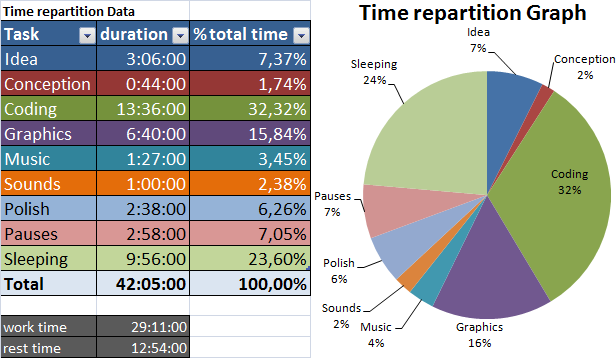
The total is 42h05 instead of 48h because I finished and posted the game 6 hours before the deadline. As you can see, almost 1/3 of the time is kept for sleeping and taking pauses !
If I remove sleep and pauses, the remaining 29h11 are divided this way : Coding (47%), Graphics (23%), Searching idea (11%), Polish (9%), Music (5%), Souds (3%), Conception (2%). Level design and some conception are included in Coding because it was really done in the same time. I did not really had phases were I needed to work level designs only (because of the narrative nature of the game).
Of course, if you did not tried it already, I invite you to play my entry : Long live the King !
The game:
http://www.ludumdare.com/compo/ludum-dare-26/?action=preview&uid=15943
Here’s the walkthrough (spoilers):
Tools used:
Engine: Unity free
Graphics: Photoshop, Flash, SAI
Animation: Anim2d
Sound: FL Studio + Massive VST + Goldbaby drums
The main goal was to field-test my animation system – animation editor and animation playback libraries for Unity.
The animation editor looks like this:

A lot like Flash with layers and nested animation clips, but with float frame values, “bones”/layer hierarchy, double keyframes for sprite changing.
And here’s the usage in Unity:

Fun thing is that you don’t have to manually import textures/sprites for animation, you just drop them into folder named “Sprites” and the system automatically picks them in editor, makes a library in Unity and stores textures into atlases (for now i’m using TK2d for atlas generation, but later i might remove this dependency).
In runtime there are 2 ways of playback – “rigid” – switches frame immediately, and “interpolated” – with possibility to crossinterpolate multiple animations, and overlay multiple animations. Rigid is faster and more useful for simple things like bullets, ui elements etc. Interpolated mode allows to smoothly switch between animations for characters. With overlayed animations in interpolated mode i could make the character shoot in 4 directions while standing, running or jumping, also landing squish was an overlayed animation too, so you could see the character counteracting the landing impact while continuing to run and shoot. And another fun thing is, it can be called with 1 line of code, like:
if(just_landed) anim_inst.OverlayAnimationReuseLayer("land", "stand", ...);
You can use different shaders and materials in one animation, it will create different meshes during playback, and if you use one material it will use the automatic batching.
Anyway if enough people are interested in this system, i’ll release it later.
I also used my polygon editor with some adjustments:

//that’s how you not use it, since physics only works good with convex polygons
In the last day i was kinda tired and sad, so i decided to screw around with FL Studio for some time, and made a simple electro-screechy thing using 4 Massive channels and funk-drums. I think it gave me motivation to finish at least something playable. It’s the first time i’m doing game music.
Wat left:
– I’ve spent most of the time fixing bugs in animation system, finding a way to correctly sort sprites by depth, learning how to use materials and shaders. In other words i ignored most advices about using only reliable tools that you are familiar with (again).
– I like to do detailed sprites and was anticipating to draw something with shading and stuff.
– The game is too short, with very few game objects and only one level (too little time was spent on actual gameplay, most of it went into technical stuff and debugging).
– There are severe memory leaks (materials and meshes) that i haven’t noticed (due to my poor knowledge of Unity) and that may crash your browser.
– It was too stressful.
Wat right:
– I did fix a lot of bugs in animation system, and made it work.
– I learned how to shader.
– Now i know how not to update procedural meshes and materials.
– I’m still new to Unity, and i’ve learned a lot from this jam.
– I did music.
– I managed to finish something playable, YAY!
Timelapse:
!MINIMAL DISCO WARNING! PROCEED WITH CAUTION!
Tags: animation, Cpt. Sqrjaw, editor, polygons, timelapse, walkthrough
Here we are, finally finding the time to write something about The Lamp!
You do not know what The Lamp is? Then check it out! Also, here is a GIF for you!

So, what is The Lamp?
The Lamp is the only object you will find in the room you are stuck into, and it represents both your only hope and your sure doom.
Turn the lamp off, turn it on, watch what happens. Try to survive as much as you can!
Ok, that’s the marketing speech, but what EXACTLY is The Lamp?
Fine! The Lamp is a minimalistic survival horror game.
We tried to make the game as minimalistic as possible while still retaining its ‘survival horror’ qualities: there is a single, square room, there is a single lamp in the middle of it and the goal is always the same: turn the lamp off, then find it again and turn it on, before the monsters can get to you!
Monsters will spawn only in the darkness and will disappear once the light gets turned on again.
Even with such a minimal mechanic, we are pleased with the result! Here are some comments from the players:
“Much fun. At times i felt like I didn’t want to turn off the lights, too scared.”
“Very creepy for a so minimal game!”
“Very enjoyable, I got some thrills playing this one.”
“Great horror game. Simple means achieve tense atmosphere.”
“Very nice atmosphere, pretty scary! Even if it is minimalistic!”
Looking at the comments, we are very happy and proud about the result, as it seems the mood was conveyed successfully! We thank the commenters and everyone who played the game thus far!

The intro screen for The Lamp showing its main character (yes, the Lamp)
Arghhhhh the monsters!
Yes, the monsters.
There are seven monsters in total, each with its own graphics, animation and movement pattern.
If you are really curious, here are ALL of them together, as they would appear under the light:

We are happy with the monster designs: some are more predictable, others more erratic, some can be easily seen and others can’t almost be seen at all!
You want to know what they do? Then play the game!
You are not telling us everything… what about the torchlights?
Ok, we have not been completely honest. The game features one additional mechanic: the torchlights.
In the game, you will find that monsters are attuned to different colors: blue, red or yellow. You will find small squares when the light is on, which are actually torchlights. Pick them up, then when the lights turn off you will have a majestic torchlight in your hands to help you!
Torchlights of the same color as the monsters’ eyes will scare them away, while torchlights of a different colors (and even if the monster has NO EYES) will drive the monster mad and it will charge you even faster!
The problem is: you do not know what torchlights will appear in the light and you do not know what monsters will appear when you turn the light off, so you are left with a few choices: will you get the torchlight? If yes, which one? Are you confident enough that you will find the correct monsters in the dark? This kind of mechanic adds a rock-paper-scissors gameplay element that rewards sheer luck, something you will need to be able to survive!!!

Blue torchlight, yellow monster. Good luck next time, my friend.
Why did you choose such graphics?
Actually, during development, we changed the graphics back and forth between a minimalistic, square-like graphical style to a sprite one. We could not decide until the end which one to choose, so we have a few unused sprites resting in our hard drives.
For example, here is the main character in sprite form
 Yes, he was quite sad, pessimistic and without hope. But still, now he’s just a square, and we think squares can be sad too!
At last, we decided to use the current graphical style, which has been chosen to convey a kind of psychologic meaning. There are a few differences between the light and dark phases in the game:
When the light is on, everything is minimalistic (the room, the player, the items) BUT the lamp is not. What does this mean? Is the lamp real? Does it come from some other world?
When the light is off, the monsters appear. Their eyes are still minimalistic, made of small squares, so to suggest that they too belong to the abstract world of the light. But there is more: if you try to aim one of the monsters with your torchlight you will notice that all monsters actually have a concrete, detailed and animated body.
Some touches such as the steps left by the character and the monsters have been added both for feedback and atmosphere.
There is a contrast between the detail of the monsters and the fact that, for the most part, you will not even see them! We feel this contrast is what helped to convey part of the atmosphere.


Here is how a monster (the dog monster) actually appears in the light. You can see only its eyes in the dark, instead, but you just KNOW it is there and it HURTS!!!
At last, the good and the bad!
Yes, we are at that part of the post.
The good
– the atmosphere was well conveyed through sound and music
– mechanics are simple and the game is fun to play!
– we managed to add a few touches (the time-scorer, the steps, the hint text)
– we added all the monsters we wanted
– I managed to sleep more than last year (and worked on monday as well :P)
The bad
– a few imprecisions in the sound effects make some combinations of sound out of place
– the balance of the monsters is not perfected (we’ll do that)
And what do you think about The Lamp? Come play it and tell us! Click here!
Space Jellyfish.

http://www.ludumdare.com/compo/ludum-dare-26/?action=preview&uid=13748
Please Space Jellyfish if you haven’t Space Jellyfished yet.
Not my game. Space.
this is my second game, and my second Ludum Dare game. is this a coincidence? OF COURSE NOT! LUDUM DARE IS AWESOME!
i was able to add some game design thinking into the game and some people resolved the game that way! i feel so happy about this!
😕 i did try to guide the player through some minimal discovery process. all the cubes are white and black, except for two of them, one with an hint at the end of the level about the solution on the other cube at the beginning.
i like how if you use headphones and pay attention, the music will guide you in a hot cold kind of way.
sometimes you only see a little white square in a place full of black. minimalism is weird, consistence is important, resistance is futile.
the gameplay is good enough, it have some slidy thing that i hate but is my best approach to a platform. the jump is ok.
the lightning mechanic is sexy but needs some manual fixes, the random waiting time was the easy solution.
😕 some people didn’t finish the game because of frustration, i wonder is this is good or bad.
EOF
This is actually not a runes, but a words in Russian.

I’m here – “Я здесь”
Hello – “Привет”

Rain – “Дождь”

Farewell – “Прощай”
Had a lot of fun working on this game. Will try to make something out of it after the compo. Here’s a summary of my compo experience:
What I did right:
What I learned:
What I’ll improve:
Try it out if you haven’t already!

So yeah, this is my 3rd entry at the ludum dare, and I think it’s my best one. I’m kinda proud of it, so here’s the story :
WWR :
– Coding : I made all the core gameplay + the important features within a day.
– The concept : I was afraid the idea of not seeing your character wouldn’t work, but i actually managed to avoid this. The gameplay seems enjoyable ( thanks for the feedbacks :3 ).
– Time management : Coding and art were easy, so I had a lot of time for tweaking (especially hitboxs and level design).
– Music : 1st time ever on fruity loops, I spent about 2 hours making glitchy sounds and made a minimalistic OST for this entry.
– Art : Managing a black and white art like this was really hard, the characters had to be silouhettes on a simple background. Took me a lot of time though D:

WWW :
– Having an idea : Like a lot of jammers, the theme afraid me D:
– The light/shadow system : I had no time coding a light engine for this, especially because of the level design.
– Making a tutorial : I also spent time trying to explain the game to players as they can start not seeing their own character.
What i learned :
– game maker is always more awesome than you think.
– combining ideas/games/concepts is great ( here samurai gunn meets samurai jack )
– fruity loops is friggin’ cool
WTDN :
– I’m actually working on Double Edged extended, with the dynamic loght system I wanted to do, plus some other features I did not make. I’ll try to devellop it for the Winnitron 1000.
So here was my minimal post mortem, now if you’d like to play my entry, the link is here

Ten-minute timelapse of the development of OtherSpace during the 72-hour Jam. As our game didn’t have a soundtrack, I added a commentary (English) track to it instead. Please excuse the “um”s and “er”s, I didn’t plan out a script beforehand!

So I did it ! My first Ludum Dare !!
I’m not really proud of my game, I mean, it’s totally different from what I wanted to do in the first place (I wanted a Rythm game, but someone told me “No, it’s really to hard for a Ludum”, then a little cute plateformer) and I failed a lot of thing >< my physics are totally broken and my level generator isn’t working as expected.. But it was an AWESOME experience !!
I was at Real World Gathering in Montpellier, it was very lot of fun, doing ludum dare with friend, we totally lived together for the 48h (eventhough I have to go back to my flat just to sleep at least 2h, since all the boys were snoring x_x), and i meet lot of people, even see someone I’ve met one month earlier and didn’t expect to see there ! (Well, didn’t expect to see again in any place xD).
I was on twitch, great experience too, lot of fun, people helping you, giving you advice, I think I’ll do it again for any project !
I want to apologize to all the people who wanted to try it, and couldn’t cause of missing dll’s, i’ve fixed it, not the good way (got to pass on a win7 pc because I wasn’t able to do a static version on my Win8 xD) but you can now play it for sure !
So, about the game itself..
What went well :
– “Character” moves, really, first time I got move so smoooth, and I’m so happy with it, also, the color turned well, it’s the only thing I wanted in the first place that is here lol
– learn little thing, like doing a camera
– The event itself !
What went baaad:
– The physics, really, it’s totally messed up, I’ve passed soo many time on the colliding, it was awful, and it’s still working strange..
– The Level generator : it’s a total fail, it created more plateforme than it should (well, in game it’s cool, but in code, it says “15” and it creates 45 (no kidding)), i tried to avoid plateforme being on each other, you can have 5 plateforme on each other xD same for the switch, sometimes, on the same plateforme, you have 2/3 switches…
– Maybe the sound, First I wanted rythm game, but I wasn’t even able of getting a little ambiant music xD
– The version, it was a hell xD but now it’s fixed !!
What I’ll do next:
– first : SOLVE ALL THE BUGS xD
– then, i’ll surely do a HTML5 version, for training, and i think a little game like this is best to play on the web
First, I would like to thanks everyone for playing my game and for the all the constructive comments! I really appreciate the feedback.
It’s almost unanimous that the game very difficult. I was afraid that might happen. This is, in part, due to being the first time I enter LD, and to me just wanting to get something working and ready to release at the deadline.
A couple more thoughts:
For the next LD competition, I need to improve this:
Anyway, here’s a video of how to beat all levels:
[Cross posted from my blog over here: http://www.sampotasz.com/blog/clickreleasedesign/]
In the spirit of making a game in only 48 hours, I’m giving myself 30 whole minutes to write this postmortem. Make more things, deadlines spur action, yadda yadda yadda.
I’m really pleased with and proud of how my game turned out. There are a few things that I’d change if I had the chance to do it over again, but they are far outweighed in my mind by what actually went right! And in a game-jam-first for me, these positives are not just “Hey, I made something and it’s finished and you can play it w/out it crashing!” Artistically, I actually like what I made
So, before focusing too much on the product, I want to look a little bit at the process that got me there. As you may know, the theme for the competition was “Minimalism.” I was excited by this theme because it was abstract and didn’t seem too limiting. Immediately after the theme was announced I did some quick googling for inspiration. MoMa and this page had some good information and a few things stuck out for me. I loved the phrase, “the Minimalists attempted to avoid metaphorical associations, symbolism, and suggestions of spiritual transcendence.” To me, this had echoes of Eric Zimmerman’s “Let the games be games” mentality, and I liked that idea. I wanted to make a game that wasn’t about anything per se, but rather had the feel of minimalism.
To this end, I looked for minimalist art that I liked, and was immediately drawn to Donald Judd, Sol Lewitt, and Carl Andre. I looked and tried to pay attention to how I felt while looking at their pieces (Ed Note: Ugh. Too ushy gushy). I loved the way they drew me in – I wasn’t exactly sure what was going on and I wanted to explore them. I was a little confused, and definitely intrigued. I felt some hidden logic guiding the pieces, but was unsure about its exact rules.
To me, this was all great fodder for a game. I immediately had in my head some interactive piece that is somehow very exploratory. I wanted the user to not be quite sure what was going on when the game started but be drawn in to look further. I wanted a feeling of slight perplexity while playing.
My first idea was for the play to take place on a field of hidden “magnetic” forces. You would be able to see how they pushed and pulled you, but you would not be able to see them directly. The game would not present itself to you – you had to go out and find it. However, when built out, the invisibility turned out to be completely too obtuse for my liking. I made the fields somewhat visible and the game felt a million times better.

On the non-feelings side of things, I also wanted to mirror the repetition that I loved in a lot of the pieces. Variations on a theme. This is where the multiple rooms in the game come into play. Each one introduces a slightly different take on the basic click, release mechanic while still staying very much the same. Additionally, with each variation, I think it enhances the “what exactly is going on?” feeling that I was striving for.
I feel happy with how I captured the mood that I was going for. I think the exploratory aspect of the game works really well, and I’m extremely pleased to see that the game that it is having its desired effect on players. One commenter summed it up rather perfectly for me:
“I don’t really understand purpose, meaning and what you really wanted to express. Nonetheless, the experience was engaging.
I must confess I did not finish the game but I played it for quite a while. There were times I got myself just playing around with the sounds.
Cool!”
And now, I urge you to go experience it for yourself!
Silly question: when rating a game, it says:
If you can’t run this entry, please leave a comment saying so and explaining why. Do not score unrunnable entries.
So, if I cannot run a game, am I supposed to:
There are 2 comments boxes in the same page and I don’t think the instructions are very clear…
I doubt people really care but since my video is related to my Ludum Dare entry, I’ll just post a link here.
So yeah, I recorded me playing my game “Jumper” which I coded in 7 hours and made a gameplay video. 😛 This is a newer version of my game where I added more levels, tweaked them and made somewhat better graphics but nothing in the code dramatically changed.
You can also download my game from my website.
http://ghostid.net/games.php
If you want the older version *The Ludum Dare release*, you can get it from here
http://ghostid.net/news.php?post=4.php
Reviews of my game were mostly favorable, but everyone complained that the game was too hard. Jellycakes played it on his LiveStream and after 200 deaths couldn’t finish it (I can in about 10 though 😀 ).
In the comments, the main complaint was that the player doesn’t move while standing on moving platforms, so I decided to upload a post-compo version with this changed, and also eliminated the running button (it now runs by default), which should make the game much easier. Other than that, everything is the same.
If you haven’t played my game, it’s a top-down platformer centered about jumping and interaction with different blocks, here’s a video of it:
LD entry: ahttp://www.ludumdare.com/compo/ludum-dare-26/?action=preview&uid=22060

This is totally happening, 20th-27th May (that’s this month!) Go here if you’re interested! 😀
Follow @FishingJam if you want to be kept updated!
This was my first Ludum Dare, and I was thrilled to not only finish my game, but actually kind of like it a lot! First things first, big thanks to everyone involved in hosting and running LD, thanks to everyone reviewing games, and a big thanks and congratulations to everyone (all 2437 of you) who finished a game!
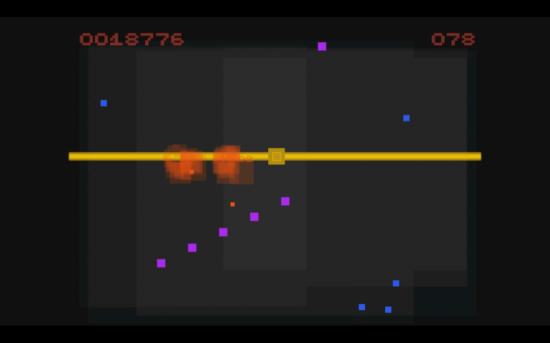
I Dream of a Beam ScreenShot
Minimal Design
I spent about three hours Friday night watching videos of other games. I had come up with several game ideas for most of the top themes from the early rounds of voting, but I distinctly remember thinking there was no way “minimalism” would win… Shows how much I know. I ended up coming up with an idea for a simple shooter with no actual shooting; just a bunch of things that can be cleared with horizontal and vertical lines so that you can position yourself to maximize the number of things cleared with each shot while ‘minimizing’ the number of shots you need to take. I think this idea came through cleanly and it allowed me to finish the main player mechanics quickly and add more depth by adding different types of enemies. Finally, the theme let me save a lot of time on art by using solid colored rectangles for everything.
Audio – A Risk Rewarded
Things were going smoothly on Saturday, I had player movement, particle explosions, basic enemy types and some simple sounds all done. Then, after dinner, I had this mental conversation:
Idealist Me: “This game would be a lot better with dynamic music and sound effects that sync with the music!”
Realist Me: “I’ve never done that… How am I supposed to do that..”
Actual Me: “Oh well, no time to think about it, time to get it done!”
So, over the next 5 hours, I programmed an audio controller that counts the time to play sounds on beat, made some music on iNudge and recorded it track by track, had the controller randomly add and remove tracks during gameplay, then finally sent all audio effects through the controller to sync them with the music. I also got to bust out some math / music theory to figure out the frequency ratio needed to scale the sound effects by 5ths for more dynamic sound.
Somehow, it all worked, and was really awesome. The music isn’t all that good, but it’s passable and syncing the effects with it is a great subtle effect. I have been getting a lot of positive feedback on the sound, and I think it really adds a great extra dimension to the game.
Finish Early, then Polish!
This was the approach I took to making the game. After the audio controller was finished late Saturday night (and I got some sleep), I had a basically playable game. I spent the early part of Sunday throwing in a scoring system, then adding as much polish as I could. First was XBox controller support. I think these types of game are better with a controller, and Slick has the option, so why not? Then I added a simple menu, controls screen, and credits screen. These don’t take that much time, but it makes the finished product look much better. Finally, when all of that was done, I worked on making the game more fun by adding more enemy types. I had horizontal, vertical, and diagonal movers, and, realistically, they should never kill you. So, I added the orange following enemies and added a little bit of random behavior in them so they wouldn’t just stack on top of each other. Then the light blue enemies… They were supposed to be sinusoidal, but they’re also at a random diagonal, so they are actually pretty hard to follow (for me at least). Finally, I added a system to spawn enemies at the end of every 4 musical measures (to sync with the music) and I was out of time!

Uh Oh
Room for Improvement
First, I had sketches for at least four additional types of enemies that did not make it into the game. Oh well.
I have also received some feedback about the player stopping movement while shooting. This was actually not a bug , but a conscious decision. Before I made that change, you could stay alive forever by constantly moving around and spamming shots. You can probably still do that, but this makes it a little harder at least, and I think it looks nicer.
Sometimes the enemies spawn on top of you. There, I said it. OK, well, I did write in a system to make them not spawn on you, but they can still spawn VERY close to you and moving in your direction, so that could be better. I had plans to have a spawning animation so that you can see where they’ll be and plan ahead, but I didn’t have time for that.
Right Tool for the Job?
The other major complaint that I have received is that sometimes the game doesn’t run! Which is bad!!! Particularly, it seems like it doesn’t work at all on OS/X and the applet does not work on Linux (the executable JAR works on Linux, though). I chose Java and Slick largely because I like the idea of code and compile once to get full cross platform support. I want to make it easy for people to play my games. However, something apparently went wrong with bundling and linking OS natives, and I haven’t been able to figure out the problem yet. (I haven’t tried all that hard, sorry).
So, I think I need to switch languages / engine. Right now the plan is javascript and html5. That way compatibility is up to the user and their browser. I am tentatively set on using melonJS, does anyone have other options I should consider?
Submission
Thanks for reading! You can play and rate “I Dream of a Beam” here:
http://www.ludumdare.com/compo/ludum-dare-26/?action=preview&uid=20933
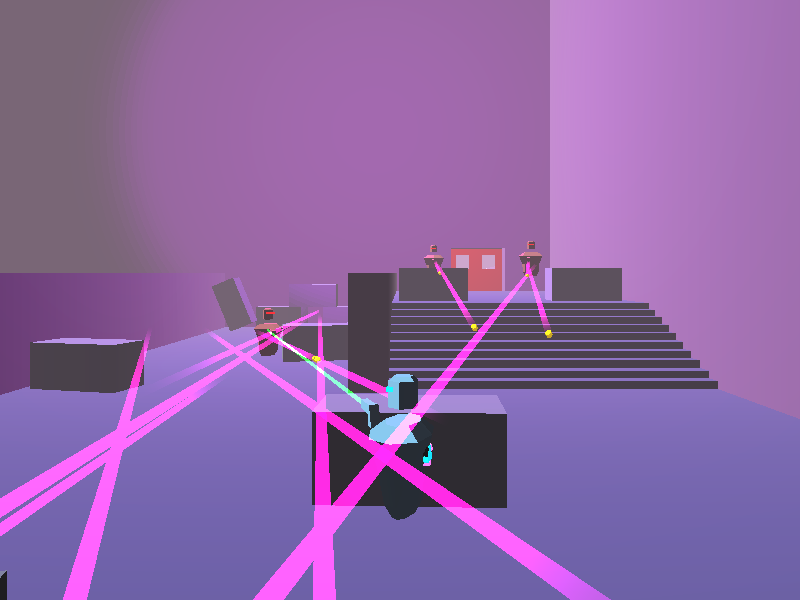
Pink Haze is the minimalist third-person cover-based shooter I created for LD26. This was my second Ludum Dare, and I feel I created a much better game this time around.
The goal was to do everything required for the genre (shoot things, hide behind cover to not get shot) and nothing more. Your interactions are limited to moving around, firing your gun, and most importantly NOT moving or firing your gun. When standing still your character automatically ducks, letting you hide behind cover and out of the enemies’ line of fire. You’ll also recharge your health and ammo after standing still for a few seconds. Aiming is handled automatically as well; you’ll always target the nearest enemy with direct line of sight.

The second room of Pink Haze, complete with navigation graph.
Being agile: The first part of this is to get the bare minimum game up and playing as soon as humanly possible. In the case of Pink Haze I had movement, ducking, shooting, and very basic enemies done within a couple hours. After actually playing my game, I reassessed what needed to be done and it wasn’t what I predicted it would be.
For example, my original plan didn’t have auto aiming but instead both you and the enemies shot straight ahead while moving around to aim. This wasn’t much fun because it was extremely easy to avoid shots (why duck behind cover when no one can shoot you?) but extremely difficult to shoot anything (If you can hit them, you’re already in the line of fire). Being able to play my game very early let me fix many of the troublesome spots I hadn’t thought of. The reloading/healing mechanism, the status indicator on your back, and the character design all came from addressing problems as they came up rather than from initial design decisions.
Knowing my tools: I had a much easier time getting things done this time than I did during LD24. This was due in large part to being more familiar with Unity. It took me just a few minutes to add particle systems, sound effects, etc instead of spending hours trying to learn how to do it on the fly. I also created a quick game for the Warmup Weekend, which made sure all of this was fresh in my mind.
Designing around my abilities: There are some aspects of game development that I’m very good at, and some that I’m just not. Personally, I think I’m a very capable programmer, and I can do some simple 3d modelling, but I’m not terribly artistic in general. From the very beginning I ruled out texturing/2d art, making my own musix/sfx, and having a story-driven game. These kinds of guidelines kept me from trying to tackle something I’d have no chance of completing, and probably wouldn’t be happy with if I did.
Using content generators: SFXR and Autotracker are simply amazing! As stated above, creating sound effects or music aren’t in my range of talents so these tools are the only reason my game has music and sound effects.

Creating the player character in Wings3D
Working harder instead of reassessing the situation: My original plan for the characters was blocky (Minecraft-like) humanoid characters instead of the floating ones that ended up in the game. I spent over two hours failing at creating a run animation before giving up and designing something simpler. In the end my replacement approach only to 30 minutes, and actually works better with the theme, but I still wasted a few precious hours struggling at a task that could easily be worked around.
Last minute additions: Up until an hour before the competition ended, the game had 6 rooms that randomly repeated until you died. This was a bit repetitive, but entirely sufficient. Instead of leaving things well enough alone, I decided to add a final room and an ‘ending’. Unfortunately, after creating the final room I had no time to create an ending, and it simply fades back to the title screen. The never-ending rooms would have been much better than such a crappy conclusion.
Not explaining things well enough: It was pretty clear from some of the comments I received that players weren’t always sure how to play the game, and the blame rests on how poorly I explained it. The mechanics of my game aren’t as self-apparent and easy to understand as they seemed after working on it all weekend. Standing still isn’t something you commonly do in shooters, so players were just running around instead of taking cover and not getting very far. I added more descriptive instructions to the game’s entry page and haven’t heard complaints about it being confusing since.
Overall I’m extremely pleased with my Ludum Dare entry this year. I accomplished almost everything I hoped to while designing it and I feel it was a huge improvement over my entry for LD24.
If you haven’t tried Pink Haze yet, you can do so right here. Enjoy!
It is my first Ludum dare participation ! Really appreciate that !
Here the result in video. If you like it, please test and vote my game !
And for next time, if you have some advises … Feel free !
I was planning to use today to do a minimal (hoho) upgrade on my GUI from hell.
BUT
Without the deadline of the compo (Jam) I totally lost myself in distractions and feature creep. SO I don’t have a post-compo version yet, but a whole lot of ideas to make my GUI 200% better (from “What the hell?” to “What?”).
And to show you my time wasn’t totally wasted:
Before:

Now:

you could of course play my game, but you might as well wait for the playable post-compo
I had this idea after the LD26 …
“I ask myself if anyone did download the sources of the game to learn, mod it and have fun…”
So i came up with this, a proposition for all who want to join this Dare. A Ludum MOD Dare.
What is it?, simple.
After decided a theme for the Dare (and put a date), anyone who want to participate must.
1-Select a game with Sources published for the LAST LD (LD26).
2-Mod the game to match the new theme.
3- Post it! (and give credits to the original author to).
The Mod will be evaluated with this terms.
– Affinity to the new theme
– Closeness to the original game (more similar to the original, better)
Tags: Ludum Dare 26, mods
Just a small update to say thanks for all the awesome feedback so far. I’ve created a “post-compo” version of the game, for download here. It includes a number of fixes to small issues/annoyances with the original 48 hour compo version. I’ll be updating my entry page as well to include a post compo version. And in case you missed it, here is my desktop timelapse.
Thanks!
whilefun
These are my thoughts about the game I made for the Ludum Dare 26 compo. I will focus on what I feel was the most successful aspect of the game and the two issues I feel were the weakest.
I wanted to develop something I felt was complete and I accomplished this.
I have been preoccupied lately with the idea of games as complete creative works. To help me in this thought process I have been toying around with parallels between a painting composed of component parts and a game composed of component parts.


I wanted all of the component parts of my game to support each other so that the sum of the parts was something greater. I am pretty happy with the end result. I feel the game has a completeness to it.
There were a number of components I felt had to be addressed sufficiently to fulfill the goal. Visuals, mechanics, audio, story, and dealing with the medium itself.
For visuals I wanted to integrate the idea of minimalism both on a surface level, in terms of how the game appeared and on a subtler level dealing with the theme and the method of delivery, i.e. the screen and boundaries of the game representing ideas and techniques from minimalist painting. My dealing with the delivery of the game involved blurring the game border both in terms of visuals and mechanics. I also tried to break the game area up in various ways to compliment the visual style as well as attempt to change the players perception of the game area.
As for audio this is one of my weakest areas. I dedicated enough time to work on music and audio that it helped tremendously to have sound that felt intentional. However, I think significant improvements to the audio can be done.
In terms of story and mechanics, I wanted to tell a story in a minimal way. I decided to have the keys(letters) on the keyboard that were used for input, WASD, to also be the characters in the game. I felt this helped complement the game as a whole and effectively deal with the issue of explaining to the player how to play.
In terms of the medium, I tried to resolve this in the visuals, story and mechanics. I already touched upon this above. I will just add that one of my main goals was to tell a narrative through interactivity.
What I would improve.
I failed to develop and implement the audio I wanted.
I wanted audio tracks that played in layers and were played at random times based on a weighting system. Two things prevented this from happening. One is that I did not come up with a sufficient way to implement this in the time I had. The other is that I have little experience creating music. I am still looking for a music creation program that suits me well. With time and research I hope to resolve these issues.
I sacrificed controls for narrative.
The other improvement I feel is necessary is in the controls.
Infernal says …
Apr 29, 2013 @ 6:38am
The only problem I have is the little slide to stop that occurs when you stop input. In the tight spots between two bars, this can end in frustration as you try to park a letter to wait.
Otherwise, very artistic and clean!
I chose to have each character move to the head of the group when the character’s key was pushed. This was intended to convey the story of a familial group, each leading when it was necessary. In order to do this I created an invisible object in the world that was the “hub” for the group. When characters moved it was relative to the hub. The result of this was a slide when input stopped and characters moving at odd angles at times; when the input and obstacles almost all existed as right angles. These issues caused frustrating deaths.
While I still want to marry movement and mechanics to story, I feel I dropped the ball a bit by sacrificing gameplay, and control, for story. While I don’t believe the choice is always one way, player frustration based off poor implementation is something I always wish to avoid, as for example a narrative can be ruined by control issues taking the player out of the game.
Overall I am happy. Ludum Dare is a wonderful event. Thanks to everyone who has given feedback on my game.
Thanks for reading. You can find my Ludum Dare game here: http://supersoul.co/files/Projects/LD26/LD26.html
Sometimes online communities scare me. What are your feelings on the matter?
0This entry was posted on Sunday, May 5th, 2013 at 8:55 pm and is filed under LD #26. You can follow any responses to this entry through the RSS 2.0 feed. You can leave a response, or trackback from your own site.
Hy everybody.
So here’s my first day and I’m trying to find my way…
Because I only have lot’s of ideas, but almost no programing skills, I would like to invite cool people who know more than I do, to have a fun week-end of brainstorming, getting in to the basics and maybe programing. Eventually we can make some progress and a little local LD…
The main idea is to prepare a successful project for the october event.
I can provide three computers, additional a netbook (forget this!), some space to stay overnight, FREE BEER and if we’re not too many people I’ll bake a pizza on saturday night or we can have a barbecue on sunday
There are two possible week-ends:
25/26 of May
01/02 of June
Please reply or tell me how to get in touch with you. There’s already one programmer who will join us.
This has been the fourth time I’ve attempted to participate in Ludum Dare, and it has produced the third LD compo/jam game I’ve released. Now, it’s time for me to talk about it:

What went right:
Actually finishing the game. I was so uncertain that I would finish this game, until the last few hours of the jam deadline.
Transitioning to a new platform. I made all my previous (mini) Ludum Dare games in either Flixel or FlashPunk, which are some really awesome frameworks focused on creating games in Flash, but I believe Flash is starting to become the new ‘Shockwave’, and will slowly be losing support from game developers, as the web, and HTML5, slowly evolves.
What went wrong:
Inexperience with melonJS. I was originally going to use craftyJS for my game, but, a week before this Ludum Dare started, I switched to melonJS, as I had some issued with Crafty (which I also had little experience with). This lead me into…
Nearly giving up. It was only within the last 4 hours of the jam deadline that I decided to take what I currently had, and attempt to turn it into what I consider a finished game.
Ugly code. Because of my inexperience with melonJS, I had a lot of really unoptimized code, and I took many shortcuts, just to get the game working.
What was dropped:
Falling / shooting spikes. I had planned to include falling spikes into the game, but due to my inexperience with melonJS, this was dropped, and dangers in the game were reduced to spikes.
Colour changing character. I originally planned to have the character’s sprite change to white once they entered a dark area. I dropped this, due to the problems I had with inexperience with the engine I was working with.
Checkpoints. Many comments on my game’s page complain about the loss of their powerups once they make a tiny mistake. I had originally considered checkpoints, but they were dropped from the game, as I has no time left to implement them.
I am currently working on a post-compo version of Stykk, and I have cleaned up the code a lot, and I am also going to make it so you don’t lose your powerups on death, making it less frustrating. (I will also include the original behavior as a ‘rage mode’)
Watch my entry page for updates!
So I made a game. I think it’s pretty good. Definitely the best game I’ve made solo. I wanted to not just finish, but to created something very polished. For the most part, I think I succeeded.
Friday I discover the core mechanic of my game. Saturday I perfected the core mechanic. Sunday was for polishing and play testing.
V1 was a physics puzzle game where the moving pieces would paint on the background. I didn’t really like the aesthetics and it sucked, so I scrapped it.

For V2, I wondered if exploring the world of Mondrain would be interesting, so I quickly hacked up a random maze generator:

I tweaked it a bit so that instead of generating a static square, the world would be created as the user moved through it. 
So, it was awesome. Thank you everyone that played my game!
Tags: postmortem
A couple of my thoughts about my first participation of LD:
Don’t Take the Theme Too Seriously
I think I tried to interpret the theme a bit too literary. I thought the game has to be *about* minimalism, which means that minimalism is not about its styles, but the *goal* of the game. What’s the problem with that? It turned out to be difficult to come up with a game design that is about minimalism but still enjoyable. I thought minimalism always involves some sort of design or structural construction, which is a creative act, so the obvious choice for me is to make some kind of puzzle game. But I didn’t want to make a puzzle game! I wanted to make an action game. So this put me into a dilemma. I spent one hour for brainstorming the basic idea in the beginning, but even after that, I wasn’t really sure what I’m going to do.
The first idea that came to me was a trash compactor. Its goal is to minimize the volume of garbage, and it can be a game. But it didn’t much sound like minimalism, so I came up another idea, which is to design a minimalistic house under some condition (think of an artsy house that modern architects design). I was thinking of something like “Art Game” by Pippin Barr. You push materials around and then “play” on it. And then at some point, the materials turned into food, and some crazy insight told me that I should make a platformer on the top of it. Hence the idea of my game “Controlled Diet” has come into reality.
You cannot Learn Your Tools Enough
I used a combination of Windows + Linux environment (I run Arch Linux on VirtualBox on Windows). I edit and compile on a Linux machine and test it on a Windows machine. I used a vanilla Flex SDK 4.6 and Makefile (Yes, I am very old school). I used a shell and Python interpreter, as well as a set of well-known tools (e.g. ImageMagick). Here are things that I think would be useful if anyone uses a similar environment like mine:
git config --global core.filemode false
The bottom line is that the more efficient the edit-build-test-debug cycle, the better. Try to spot the bottlenecks as many as possible and eliminate them.
IRC is Helpful
I had been lurking around the Ludum Dare IRC channel for a couple of weeks, and I can tell that this is a very nice place to hang out. You see a lot of people talking about their ideas. At one point I was murmuring about the need of creating a quad-tree implementation that was necessary for my simplistic physics engine. Then someone in the chat said “a quadtree is overkill for this”, and he was right; I didn’t really need a quadtree for only a dozen of objects. Now I want to thank that person. You saved me a lot of time.
Things that Went Okay
Believe in Your Idea, with Passion
Generally, I think I’m more of an “idea” guy. I wanted to come up with a wacky, eccentric idea and somehow I succeeded in it. I finished my game, and even its not the most fun thing to play, I still enjoyed the whole process a lot. It was a nice challenge, and hope I can do this next time again.
Tags: postmortem
[Cross-posted from Omiya Games blog]
Here’s a dump of all the design decisions I’ve made on The Sentient Cube.
First, the debug level. Always gotta have one for Unity. It’s a great place to create prefabs, and tweak the numbers to apply to the rest of the levels. Also a great place to test stuff, like the water block (top-left), unattainable block (top), bouncy block (top-right, unused in game), ice block (not shown), and rocket boosters (red, left).
How to Play was a nasty one. The first curve is there to give a clear and empty view for the player to practice the controls. It also puts the Goal out of view, making it easier for me to teach the basic objective of the game: collect smaller objects. The first bend is where I scatter the smallest objects, and provide the instructions to roll into them. I’ve put a lot of objects there to show them lighting up as you get bigger.
Proceeding forward, I have this weird bend that stretched all the way to the left. The straight-way itself is intended to let the player practice collecting bigger objects, in a true breadcrumb fashion. It’s also here that I mention the arrow at the top of the screen, that it indicates where the goal is (straight ahead). It’s worth mentioning that I call this bend “weird” because it was also intended to hide a problem: Unity’s default GUI shader draws over all other objects. By placing it to the far-left, the player wouldn’t see the text at the beginning of the level. The shader that corrects this weird overlap is openly available online, but to respect Compo rules, I didn’t copy this shader; I merely hid it.
Level 1 was actually the second level I created, code-named “pyramid.” This level simply acts like a practice level, where the goal was clearly above you, and the objective was simple get large enough to be able to climb up the steps. The bouncing spheres was a small challenge I’ve added to make things a little more interesting, i.e. you have to time it correctly to obtain each sphere. Past that, it’s a pretty generic Katamari level.
In Level 2, I wanted to establish that the Goal could be anywhere. In this level’s case, directly below you! This was actually the first level I created, and you can tell from the knocked over objects I really just zoomed through this. It was the first place, though, where I got a good handle on the amphitheater formation.
In Level 3, I introduce the rockets! I initially intended the rockets to help you fly upwards, but that was nearly impossible to do with the given control scheme. Instead, I found it useful to traverse great distances due to its added speed, and decided to do a level designed to demonstrate just that. To acknowledge that players may simply wants to play around with the rockets, I placed slopes around the Goal to make it easier for them to reach it.
In Level 4, I introduce the water block and the ice block rather haphazardly. This was the last level I created, and I simply had very little time left, so I dumped every new assets I had into it. The walls surrounding the ice is there to prevent both you and the objects you’re trying to stick from falling out, making it easier to collect things. The objects are placed almost randomly, partly because of the chaotic nature of the ice-block. The water blocks were intended for helping you adjust your controls, but in the end, they ended up being pretty useless.
And the Credits. This was actually hard to design, mainly due to tweaking the size of the breadcrumbs so you can definitely grab each text. Other than that, it’s intentionally a breadcrumb-to-breadcrumb level with no other purpose than, well, providing the credits.
Interested? Try The Sentient Cube here, and please rate the game!
Tags: design, game design, level, level design, The Sentient Cube
About a week has passed already, so I decided to polish up a little my LD26 entry, following the feedback I received in the comments:
I’m also making the instructions a little more detailed, but it’s hard to it without spoling the game. It’s a game for players who like to explore and experiment
So, my current ToDo list:
I’d like to get the game a little more polished before abandoning it 😛
So, I’ve got a few favorites from this competition. Oddly, they were mostly games I found on the very first day after submission, totally at random.
Staring Contest

Laugh all you want, but this game pretty much nails the theme. Say what you will about the technical achievement, but I think it’s probably my favorite entry from the entire competition so far.
Fair King

Another game where the simplicity really shines through, and a nice instance of a contestant stretching his comfort zone successfuly. The mobile version is a bit difficult to play, so stick with the desktop/laptop version.
…—…

Playing this one on my phone was a really interesting experience. I liked the thought of an old style terminal interface on my phone… which suddenly was overtaken by a mysterious being.
PRISMA

Judging by the screenshot you would think this to be a creepy entry, and in some ways it might be… but it’s also a really colorful and wonderful entry, that’s wrapped its colors up under a cloak. NEEDS HEADPHONES and is worth it!
Chez Angelou

While this one feels incomplete, and probably off-theme, I enjoyed its style and presentation. I enjoyed the “Catherine” reference at the bar. And I enjoyed the reference to the author’s previous LD entry in the framed portrait of the mediaval world. I hope there’s a sequel forthcoming!

Snape is a simple Unity game involving rolling balls knocking into each other. This is the first game jam where I can confidently say that I’m very happy with the finished product; I didn’t run into any major snags in the development process, everyone who I playtested with appeared to have a lot of fun. My roommate even continued to play it after the competition was over!
I’m definitely going to continue development of this game. The largest recommendation I’ve gotten from everyone is to add multiplayer, so I think I’m going to try to turn it into a casual, local multiplayer, “Mario Party” style game for entertainment centers (think Big Picture). In the meantime though, the game is still being voted on, so rate it here!
After making two post-compo releases of my Ludum Dare 26 entry, I think time has come to take a step back and have a long, hard look at the fruits of my labour. It’s kinda hard for me to be sure what went right or not and where, so I’m just going to list some stuff I did and didn’t do and let you be the judge!
ihavenoideawhatimdoing_dog.jpg
This is my second game jam. First one was Global Game Jam, where my team made a puzzle platformer about E.T. type of dude who could suck the energy out of things and use it elsewhere and there were dead animals… Oh, just check it out if you’re least bit interested, I’ll wait. It’s pretty short and ends in a cliffhanger. I was the programmer, and with no game making experience of any kind I quickly decided to use the program I had heard was friendly to beginners: Game Maker.
It really was an eye opener. Suddenly the little JavaScript and C I had teached myself over the years (but never enough to start a career in web development) became immensely useful, since GML is pretty much based around them. The finished product has it’s quirks, but it mostly works as intended and I was incredibly proud of managing to program it.
So there really was no competition. I’ve dabbled with Unity, but found it dense and since I was going to make 2D game anyway, I thought that time spent learning it’s ins and outs could be better spent elsewhere.
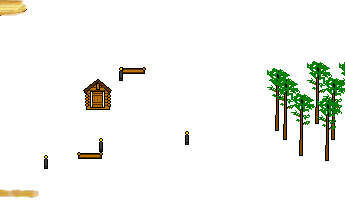
Looks like city building to me!
They were simple, but they were there:
It’s pretty debatable if I achieved any of these goals, but they shaped the decisions I made during the compo from the start.

The key
So, about those goals. It became clear pretty quickly (about that time when I had spent six hours trying to get little dudes to stay inside their huts at night) that I wouldn’t be able to make an engaging strategy experience in the timeframe given. That goal had to go. But I had no time to start from scratch, so I had to do something with the stuff I already had – somewhat working villager AI, handful of sprites depicting said villagers and their environments. There was some element missing.
It was only when I first drew that crude monster sprite I realized what this game could be about: stalking villagers and snatching them in the night. That felt… right. Like I had worked towards it all the time. All design became about making that experience more true, more fun, more varied: bigger levels, staying still (and later moving slowly) to be invisible, speed boost for panicking villagers, towns springing up overnight, hunters and their traps…
This is truly a game that wouldn’t exist if it weren’t for Ludum Dare. The idea didn’t even occur to me until I was halfway through building another game!

“If you ask me, this game could do with a bit more pant pant grr woof”
I’m privileged to have a friend (not pictured, though you can see the actual chat window on the screen!) that tirelessly tests and gives feedback on anything I might be working on. The game would most likely be unplayable, unoptimized mess if they hadn’t pointed my attention towards stuff that simply didn’t work.
Also I am lousy at naming projects. Current title was my friend’s suggestion, and it stuck. Still, now I’m kind of vexed that I didn’t think of using the classic Finnish shareware game naming practice. Mörkö Metsä (Spook Forest) would have been a glorious title.
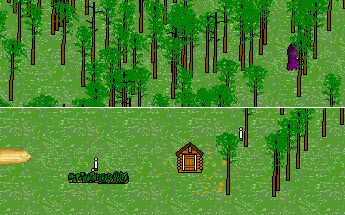
Alas, poor Yorick!
This goes hand in hand with previous item. In it’s earlier incarnations game featured wind, which changed the speed of tree animations, and tracks, which villagers left behind everywhere they went. Both were poison to performance.
I think the original idea with the tracks was that you could follow them back to the villager’s home and go full fox-in-the-hen-house, but since it was already pretty fast to scout the whole level, it became purely cosmetic. Wind was also just fancy way of adding some variety to visuals but it was so pretty! Yet when my tester started to complain about frequent slowdowns they both went. I miss them dearly.

Text file where you try to decipher the code you wrote a couple of hours ago probably doesn’t count.
Making AI is hard. It’s especially hard if you have no idea what your long term plan with it is. Currently villager needs a host of functions, alarms and other objects to make it behave as intended. I feel that this is needlessly complicated and could be written exponentially simpler, if planned ahead. This is where I feel that making a simple map of all actions any given NPC can take could have saved time and made the game run much smoother in the long run.
Then again… when I started making the AI I really had no concrete idea where I was going with the game. Some stuff became apparent only when I thought I had finished it and started on working with other aspects of the game. It’s a feedback loop. Perhaps the only way to make a good AI is to make a full game featuring a shitty AI, and then rewrite the AI.

Bonus points if you can make out what songs I skip outright.
Towards the end of compo I chose the way I spent the time poorly. I implemented ambient wind sounds for the latest release without much effort and what a difference it made for the mood! I could have easily made them during the compo and leave the still hopelessly broken villager AI as is.
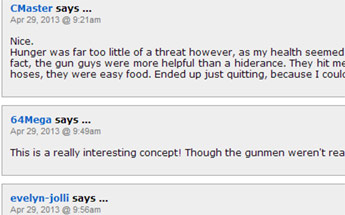
They are completely right, of course.
Balancing the difficulty is a daunting task, and it cannot be done without a large amount of varied player feedback. The few testers that I could muster did their best, but the real trial by fire only came when submissions ended and rating started. The game was way too easy, and by then it was too late to do anything about it. However… if I had left a players some way to change the variables that controlled the aspects contributing to game’s difficulty (enemy spawning rate, health, amount of healing, day length, villager speed…) maybe they would have found it a bit more engaging?
Next time I’m participating in a game jam I’ll put all the variables that make any sense to modify into an ini-file that can be adjusted to suit player’s needs.
Wow, word count totally spiraled out of control! I didn’t plan at all to write this long post. I’ll at least end it quickly: I’m still planning on expanding the game, but for the next update I’m writing the AI system completely from scratch. It can take a while! I’ll be posting any updates on Ginnungagap’s Game Jolt page and my twitter, so if you’re at all interested on seeing how this develops, check them out once in a while.
And if you have not yet rated my entry, please do!
Tags: ginnungagap, post-mortem, postmortem
MINIMALISMAN wish you a nice week and invite you to see the trailer of the game on http://www.adipson.fr

THE TRAILER (direct link) : http://adipson-studio.blogspot.fr/2013/05/minimalisman-trailer.html
I’m sorry that it took some time to get out, but finally there’s a version for 32-bit windows user as well as os/x users. I hope you enjoy the game! Let us play SUPER MONSTER ATTACK!

Well, some of you may have noticed (but probably didn’t) that in the last days I disappeared.
That’s because I failed at LD 26 and I was ashamed of coming back here after failing.
Why I failed at LD 26? Well:
I think 1 was the main reason.
Well, I learned a lot actually. After 5 hours of work (that was hour 12 of LD) I thought I was done. I couldn’t think in nothing I could add or polish. And I think that’s bad, because the game wasn’t “fun”. Well, after 5 hours of work I was already burning in fever too.
Well, wish me better luck next LD.
Tags: html5, LD#26, motivation
Since I hit a 100 rated games, I’ve decided to check my scoring and pick some of the best I’ve yet found, in no particular order:
Potato Dungeon by _Rilem – JAM

Very good platformer (although I wasn’t able to get past the horse).
Square Space by Berkano – 48H

2d shooter combined with mining and building.
Steve Can’t Zen by DaanVaanYperen – 48H

Excellent and funny action game. I laughed (which was very rare while rating).
Syntesthesis by TheFuntastic – 48H

Great concept for musical puzzle game, too bad there’s just few levels and no free play.
Mustache Armies by TurboDindon – JAM

Great platform action game, both idea and visuals are incredible (I’d probably mark this as THE best game I’ve found in one hundred tested.
I made an entry for LD #26 in Scratch and used their website to host the file and the player. It’s a convenient system but unfortunately subject to the whims of their update schedule. For the next few days I’m expecting the Scratch web site to be down as they upgrade to Scratch 2.0.
So I thought I’d post up a quick guide on hosting the Scratch player (the Java player at any rate) on your own web site. Assuming you have a web site capable of serving up your files you’ll need 3 things to make it work:
Your Scratch binary file is the file that you save out from the Scratch environment when you save locally on your own machine. The Scratch applet you can get from the Scratch web site. I grabbed a copy and put it in my Dropbox if anyone needs it:
https://dl.dropboxusercontent.com/u/15225572/ScratchApplet.jar
As for the web page, you’ll need to write that yourself. The most likely thing to go wrong when putting this all together is paths and the folder structure. Here’s the structure I chose:
public_html/Projects/MyWebPage.html
public_html/java/ScratchApplet.jar
public_html/scratch/MyScratchFile.sb
You could use a different structure, but beware that this will mean you need to put different paths into your embed code to make it work. Here is a bare web page template that should work and you can modify to host your own Scratch files:
 <html>
 <head>
 <title>My Scratch Project</title>
 </head>
 <body>
 <h1>My Scratch Project</h1>
 <div>
 <applet id='ProjectApplet' style='display:block' code='ScratchApplet'
 codebase='../java' archive='ScratchApplet.jar' height='387' width='482'>
 <param name='project' value='../scratch/MyScratchFile.sb'>
 </applet>
 </div>
 </body>
 </html>
Terrible terrible terrible!
I hoped to be able to rate a hundred games this time. Unfortunately, I have fallen into a horrible sickness since a week back and I do not start to feel any better, nor do I think I will in the next couple of days.
So in the meanwhile, here are my favourite games (in no particular order) from LD26, out of the 65 I have rated.
#5: Minimalist Dungeon Crawler by Cranky

#4: SINE by ElScootro

#3: The Last Soul by Gaeel

#2: Escape the Minimalism by klianc09

#1: Super 1-Bit Space Arena by Orni

I will hopefully recover in time and rate the hell out of the remaining 2282 games.
Did a quicky continuous 10 seconds clip for the compilation project… should probably have done some editing/snippets of interaction, but this will do.
Intrigued? Play my game!
Also see my Pre/Post Mortem for more details.
Tags: video
I have rate many games already. I also rated many Least ratings games (instead of the default). I see that those getting very low rates are because they have coolness 0, which means they didn’t rate any other game.
What surprises me is that some of them are wondering why they don’t get comments on their games.
As I saw dozens of games with coolness 0, I was wondering if any dev have the actual number of games in that state.
Is this a problem with communication? I mean, maybe those who made a game don’t know they have to rate others to get their game rated as well. Or is it simple laziness? Can we do something to motivate these little guys to start rating other games?
Hi all!
The following message is adressed to french jammers, that’s why it’s in french 😉
Salut à tous,
Dans quelques jours se tiendra une game jam en ligne (type LD donc) à l’occasion du salon Geekopolis qui se tient à Paris fin mai.
La game jam, elle, a lieu du 10 au 12 mai (oui, vendredi prochain) et il reste des places, alors n’hésitez pas à vous inscrire ici : http://gamejam.geekopolis.fr/?p=inscription
Les projets sélectionnés seront invités à venir à Geekopolis pour présenter leurs créations au public et peut-être être récompensés (http://gamejam.geekopolis.fr/?p=workshop)
Vous pouvez participer en solo ou en équipe, alors n’hésitez plus, inscrivez-vous !
So, I managed to participate in my first LD. RGBCMY is very minimal game where you have to absorb colors to be able to pass colored gates and finally reach the target.
What went right
What went wrong
Update
As I only managed to include 5 short levels but got nice comments asking for more, I have now added five more levels which are way more challenging and should keep you entertained for a few more minutes. You can find the download links on the entry page http://www.ludumdare.com/compo/ludum-dare-26/?action=preview&uid=21343.
Conclusion
Ludum Dare is awesome! I’ll definitely be participating again next time.
The voting round isn’t even over yet, but the responses to our zen garden raking puzzle game Aranami are so positive that we’ve decided to make it into a proper game for iOS and Android!
After having weighed the pros and cons of various technologies, we’ve started writing Lua code in the cocos2d-x framework. We considered libgdx but found a $299 Xamarin license (needed to run the Java code on iOS) a bit steep. We also considered Haxe with NME but it seemed a little immature, and lacking good documentation. We also considered playN, but it did not appear to have any advantage over libgdx. So cocos2d-x it is.
Improvements we plan to make, compared to the Ludum Dare version:
Cocos2d-x is a bit harder to get started with than plain HTML5 and JavaScript, neither of us are familiar with the API and neither of us have a lot of Lua experience. But after a day or two of research, fiddling and hacking we’re finally over those first hurdles: we have a rake, and it moves in response to touch, both on Android and on iOS.

So if you haven’t played Aranami yet, go try it now! Any additional suggestions for the upcoming mobile version would be hugely appreciated; you can leave them in the comments to this post, or on the entry page!
While playing through the games for Ludum Dare 26, I found an awesome little puzzler called Fractured by dalbinblue. The game features a really rad song that I decided to remix (with dalbinblue’s permission, of course). Check it out on Soundcloud!
Fractured REMIX by SonnyBone
Also, check out this collection of 15 of my favorite Ludum Dare 26 games… the RAD GAME ROUNDUP for LD26!

Tags: rad game roundup, recommendations, song remix, soundcloud
 www.twitch.tv/jellycakes1
Tags: cakes, games, jelly, jellycakes, livestream, Ludum Dare, stream, twitch
This was my 4th Ludum Dare, and for it I made a game called Complexity, a first person shooter/platformer in Unity3d! Timelapse:
From the start I knew it would be some sort of first person game. In LD24 I had made a puzzle game, which surprised me. After LD24 I tried working on some more action-based mechanics: I had begun work on a 3rd person shooter adventure game and spaceship simulation game.
So with my newfound curiosity of the action genre I wanted to make a game that would prove my profound knowledge of fun mechanics. Like most of my games, it started looking like this:

After the basic movement was achieved I started thinking of a plot. From the beginning I knew there had to be a bad guy, because without a bad guy there would be no purpose to shooting things up! And with the theme Minimalism, I decided early on that you were trying to stop some sort of bad guy from making things too simple. From there I came up with a weapon to counter his efforts — the complexity gun.

Alright, so now I had a weapon. After working on putting some basic shapes together I started a simple AI script. From this I had my enemy. If there was one thing I learned from LD23 it was that the more the character interacts with the level the better — basically keeping the immersion. So I came up with a second purpose for the complexity gun – what if it could shoot objects and make them more complex too? Then I tied this into a gameplay perspective — doors that could only be opened by making them more complex. With these new mechanics I pieced together a level.

Audio and music are pretty self-explanatory, if you want to see exactly how I spent my time on them check the timelapse above!
After working on more important game mechanics such as health and enemy lasers, it was time to work on the final boss! Obviously you all know what it had to be:

Sorry to whoever worked long and hard on that animation 😛
Anyways to add story to the game I quickly came up with a splash screen and tutorial section and after that it was done!

What went right:
What went wrong:
Why don’t you PLAY THE GAME?
Happy Gaming, Ludum Dare! <3
Tags: final, game, post-mortem, postmortem, potato, timelapse, unity, unity3d
Unfortunately, I accidentally deleted all of my timelapse screenshots. So, no pictures This will be brief.
What went well:
– I did music within the first few hours, so that was out of the way.
– I did sounds every single time I made a new feature that could benefit from sound.
– Paint.NET worked great as a level editor!
What went badly:
– I’m not any sort of composer, and I tried to do a complex musical piece. I’ll keep it a bit more simple next time!
– Something went wrong with my input grab methods. They seem to glitch out occasionally, locking you out from controls and sending you into lava.
– Wacky controls. I always struggle with getting these right.
– I think I spent way too much time playing around with the initial engine! It was just so fun D:
You can play it here: http://www.ludumdare.com/compo/ludum-dare-26/?action=preview&uid=15753

A week has passed since LD48 and it’s a good time to take a deep breath and reflect. Rub our sore muscles. Think about what’s next. Weep uncontrollably. Whatever you need. In my case, Mass Splitter went out the door without a hitch! Well, rather, it was well under the maximum number of allowed hitches. It was within hitch tolerance. In truth, there were three hitches: I didn’t get in a main menu, I didn’t get in a tutorial or at least an instruction page, and there was only one level. But all these hitches pretty much have the same cause, that of running out of time, so how comes I haz runs out?
Architect hat mostly unworn
I spent a bunch of time trying to get some view components working with HaxePunk. HaxePunk handles origin a little differently than I would think it should work, so I spent a few hours on my View class, getting the Scale, Origin, and Position components to all work together. Great, they now work together.
I did this because my game has orbs in it, and the active orb has a tube spinning around the outside edge of it. You hold the spacebar to shrink the active orb and start growing a new orb on the other side of the tube. After I got the tube spinning at the right radius around the correct center point I then went to add the new orb. This new orb also needs to be placed at spinning radius from the center, so how do I get the true position of the edge of the tube?
Well I can’t. The tube’s actual position is derived inside the view class, so it doesn’t exist at the component level. So now I’d have to either hack into the View objects to get this information (which horrifies my MVC sensibilities), or just calculate the orbital position myself, which I did. Well gosh, that was easy. And now that I’ve done that I can position and rotate the tube using the same logic, so the tube stops scaling along with the size of the active orb, which is a better look I like anyway.
In essence, I looked at just one next thing to do, rather than the broader landscape. Without putting on the architect hat, I spent a few hours going down a rabbit hole I didn’t need or want. On the other hand, I’ve got a cooler View class now.
Failed to take the time to split up complicated classes
I didn’t universally fail this, but I could probably attribute a few hours of wasted energy because of failing to do this early or at all. In particular my firing system is doing several things rather than breaking it up into different systems. See Ash Entity System / What Went Right.
Not putting more of my personality into my game
Friends often tell me I’m funny. Even fine, up-standing strangers — if not calling me that — have in the least called me irreverent. I try not to listen to other categories of people whose job is to be offended by everything. Anyhow – you wouldn’t know these things about me from playing Mass Splitter. Sure, I don’t have to make humor a central aspect of all my games, but a) it’s clearly desirable in a competition where there’s a category for it, b) there are many kinds of humor besides pratfalls and puns that can serve a dramatic cause. Heard of irony? Sarcasm? Deprecation? Pathos? Impudent contempt? Not that Mass Splitter is a deep example of erudition (it’s not), but it’s better for one’s self esteem to believe your personality is a strength. And if it’s not … well, you should work on your personality. Are you trying to tell me I should work on my personality? Stop staring at me like that.
Ash Entity Framework
Richard Lord’s Ash Entity Framework is really good. It’s an entity component system. I used the Haxe port maintained by Dan Korostelev. It was really fun to learn how to use an entity system and put it into practice. For those who don’t know, apparently those folks at AAA game houses have been using these things for years. The idea is to eschew traditional static object hierarchies for a data-driven composition approach. Richard has some great articles about it on his website.
Everyone seems to approach an entity system differently; in Ash the entity is a fairly generic object. You create a new Entity instance, optionally give it a name, add components to it, and add it to the engine. Usually it’s the job of a factory to create the entities with the components you need, but that’s up to you. Components are simply data-holders that you create, with little if no logic in them. Ash components do not need to derive from any base class, any object could be a component. All the behavior for your game goes into the systems you write, derived from the System class and added to the engine instance driving your game. When you call engine.update(time), all your systems execute in the appropriate sequence. Although Ash provides a signaling capability, Richard recommends you use boolean flags or components as markers to indicate when events happen, so that a component event (such as “this changed”) is only responded to by a system when it executes. Using engine.getNodeList(MyNode) a system fetches a list of entities from the engine that are relevant to it. Nodes are classes that contain one or more components; only those entities holding the components you specify will be returned.
I enjoyed using Ash quite a bit and encourage you to look at my source on Github if you’re interested in seeing one possible way of using the library.
Think smaller
Last compo I thought I picked a small idea but apparently it wasn’t small enough because I couldn’t get it done in time. This one was doable — juuuust barely. I tried to get a playable prototype as soon as possible; I would have liked to go to bed on Saturday night with it playable. Now, that didn’t work. Pthbth. The prototype wasn’t playable until Sunday afternoon, but imagine if I wasn’t striving for earlier! Suck-sess.
Toolkit practice
I’ve had previous practice with HaxePunk, and I started messing with Ash in a previous game I attempted to complete for the 7-day Roguelike. Even though THAT attempt was a failure, it gave me crucial practice that made this submission possible, and also gave me base code to pick at for Mass Splitter. Of course, more practice would be better, so I shouldn’t wait four months for my next game…
BFXR
This audio tool is available in several forms; the one I used is BFXR. Sooooo convenient. Sure, all your sounds do tend to sound video gamey retro screechy crunchy if you don’t post-process them, but a lot of people go for that, and damn if it isn’t quick to pump out some placeholders. (… that wind up being the final sounds when you run out of time)
Shut up, good enough, it’s playable
Shut up, I say! It’s good enough. It’s playable. I’m just happy I got out a game. Would I have liked to get those extra things I conceived of? Of course. Over time, with practice, I’ll be able to meet the goals I think I should be capable of. (I’m a damn perfectionist. I’d be faster if I wasn’t always trying some different way of doing things.)
I finished something playable in time that some people actually liked. Next time I’ll do even better.
Tags: Ash, Ash-Haxe, entity system, haXe, haxepunk, ld48, nme
Preparation
There’s no real way of preparing for a Ludum Dare. The theme on which people make games on is only revealed once the event starts.
So, in the week leading upto LD, I focused on finalizing the tools I’ll be using. I had previously used GameMaker,XNA and Stencyl in varying measures but Unity had always been my ultimate target. Besides Unreal Engine, it is the only top-tier, professional-grade game engine available for hobbyists and indie developers.
Since I had never worked in Unity before, I set myself a task to atleast get a basic feel of its’ features. It was more difficult than I thought. It took me some time to wrap my head around its’ coordinate system, scripting of main camera, particle system and I had to even brush up some of the high-school physics and math concepts.
It was fun and challenging to learn but I knew the real challenge lay ahead.
Challenges Ahead
It was never going to be easy. In that very week, I had THREE back-to-back practical exams. So, I spent Wednesday,Thursday and Friday on them. Also on the day LD was going to start (with the announcement of the theme) I had to give my Senior Year project seminar in the college. So chances were that I was already going to start a good 8 hours later than everyone. Plus, I had a birthday lunch I was obligated to attend to on Sunday and I couldn’t excuse myself out of it.
It only got worse. My Internet provider called up saying the maintenance of Internet would mean it would be down till Sunday morning. Just great.
Basically, if I was planning to aim for the 48-hour deadline, I was already going to have to work with 10 hours less and without Internet to help me. Not a good start for things. I told myself that even if I wasn’t able to finish it, I’ll learn something.
With that positive mentality (hear O Pro-Life Preachers!) I went into the weekend.
Theme
When I woke up on Saturday morning, I immediately checked the site and found that the theme was “minimalism”. Since I had a project seminar in few hours, I had to get ready for that but I kept thinking about the theme and what ideas I could adopt into a proper game that is fairly unique but not too difficult to make.
 Behold my infamous handwriting!
Surprisingly by the time I reached my college at 9, I already had charted a rough concept and I wrote it down. By the time I was done with the project seminar (which was delayed no thanks to the lovely professors of our college) and I had returned home, it was 2. I took a short nap and began at 3.
Timeline
I had decided on a dynamic rhythm game with simplistic two-control scheme that had a rather deep underlying concept but absolutely no exposition. Dynamic in the sense, the players could adjust difficulty of the game through their own actions. Create/destroy musical objects which repeat to form a pattern imitating one’s daily routine.
With the basic premise on paper, I began getting the setup ready. The LD’s “Compo” rules state that all the content — code,art and music needs to be made within those 48 hours. It took me a 4-hour sitting to get the engine set up exactly how I wanted for my game.
I then began coding the individual behaviour of the player “cube” and it was around 10, I could finally start working on the chief concept of the game — recycling objects. This required creating a custom module. Something which a newbie to Unity like me obviously suffered to do.
Unable to find solutions, I decided to plug in my MIDI keyboard and create some tunes in the meantime. A rhythm game needs to have some good tunes after all. I stuck with ambient music as the background soundscape as I felt it was minimalistic and sparse enough to suit the theme.
I used FL Studio for the beats. I really liked the simplistic interface and how easily one could mix. For the MIDI, I used the typical MAGIX Music Maker and stuck with the traditional play-record-mix-master technique to get the appropriate sounds. I liked how I could imitate sounds of a flute and of a violin using a low-pass filter applied onto lower keys of the keyboard.
While I was doing this, I was constantly trying to rack my mind to solve the issue I was stuck on. It was around 3:30AM when the migraines started creeping in and I finally gave up for the night and went to sleep.
New Day, Late Beginnings
I had set my alarm at 6. I snoozed it.
When I next woke up, it was 7:30AM. Ugh.
Within 10 minutes, I was back to work. And tell you what, it took me just 10 minutes to crack the problem that was plaguing me for almost 4 hours last night. Just ten minutes.
Over the next three hours, I was on a roll speeding through the lost time last night. If this were the popular Kairosoft’s Game Dev Story, I would be a programmer “on fire”.
Unfortunately, my mean streak came to an end when I had to go for the birthday lunch. I came back at around 2PM and graciously avoided the comforts of an afternoon nap and set back to doing. I had been feeling weirdly confident since morning. As if, despite all the odds that had been stacked up against me, I was going to do it. At the same time, I was a little wary of being like a hare in the Hare and Tortoise and not getting too overconfident of where I was.
 The workspace
So, I continued working without a break. More tunes were created by 4PM, some of which were recorded live using my iPad and SoundCloud app on it.
Then I set aside everything to work on my primary weakness — art. I believe I have a decent visual aesthetic sense, but when it comes to creating them I’m no good. There’s this inherent phobia that drawing instills in me which seems to sap all the confidence I generally have for other things.
So, I got onto it. Using Inkscape and Photoshop, I created simple designs that described the type of instruments each track was imitating and keeping the color palette fairly simple.
I did not believe that minimalism = black & white. In my opinion, minimalism is something which conveys a deep concept through limited usage of aesthetics and exposition(if used in a narrative context).
So, as you can see the colours I used were a lot more vibrant than what most of the others used for their games.
It was about 8PM when I was done with art and sound. So, I started implementing them into the engine one by one. Surprisingly, art didn’t result in any obstacles. It was Unity’s sound design which gave me trouble as I couldn’t wrap my head around how I should use it to fit the purpose of my own game.
I tried to look up at the Internet.
Still no internet.
I was seeing visions of yesterday, where I was stuck on a problem and without help from the Unity forums, I wouldn’t be able to get past them. But somehow, a few workarounds later, the sounds worked pretty much like how I wanted. I guess that is an important aspect of design as well. “Trying to adapt things as much as possible”.
Late Run
Around 10PM, I had this crazy idea. An idea that could certainly have a positive effect. Now, I despite this being my first time in any game jam, you need not tell me that even entertaining these ideas was basically signing a death certificate. Given the time constraints, you had to stick with the idea you had originally thought. I had managed to do it thus far — but this idea seemed too delicious to not implement it.
So,leaving all my scheduled plan for the game aside, I started focusing on this. It was not before 2AM when I had finally finished this. With the deadline date, just a mere 5 hours away, I decided I needed to wrap up ASAP.
So, as I was finally getting the win/lose conditions implemented, I realized something.
I had not even made the Main Menu.
Again chucking everything out of the window, I frantically set to making the Main Menu, the “How to Play” screen as well as the Win and Lose screens. This took art and some new scene scripting to implement but I finally did it.
 The screenshot at 5AM. With 2 hours left on the clock
The GUI needed tweaking, so I set on doing that.
It wasn’t until 6AM when I was finally done. But then I just recalled that I could make the background music vary according to different “phases of life” or the progress bar atop.
So, I spent another hour doing that. Then, almost frantically, I baked the native version (Windows) of it and quickly set about uploading it on Dropbox. It was just around 7:10AM (the deadline was 7:30AM) that I logged onto the Ludum Dare site and filled up the submission form, describing my game and uploading various screenshots.
I had made it on my first Ludum Dare. I had finished making my first “complete” game and that too within the 48-hour Compo deadline as I had initially aimed. Despite all those obstacles that the world threw at me, I managed to do it.
Post-Mortem
In retrospect, I am rather proud of myself. Not because of the game. But because of the dedication I never knew I had within me. I don’t recall ever waking up for the entire night for something I was working on. On occasions, when I have done that, I’ve done it if I was reading a really interesting novel (The Wind-Up Bird Chronicle),watching a really interesting TV series(Twin Peaks) or playing an addicting game(too many to name).
But never for something related to work or even a hobby. Something where I wasn’t getting entertained. I lost motivation while developing a number of times before and this time I had plenty of opportunities where I could have table-flipped and just quit. But I didn’t. I stuck to my target and that makes me really proud of myself. This past year has been great for a number of reasons and I think I might have found another good reason for that.
What’s better is that the game has received some really good praise from fellow LD-ers and their comments both on the game page and my Twitter were really encouraging. Even the criticism has been helpful since I apparently had messed up on a number of small factors(resolutions on Web browser etc) but it’s all cool.
The best part besides finally having a “finished” game? THE MOTIVATION! I have loads of it now. I had heard people say how a finished game helps and now I am experiencing it first-hand. I’ve already made plans on reviving some of my older “ideas” and seeing if I could implement them. All while implementing some features I left out of the LD48 game due to the time constraints.
So expect to hear more of this “new” side of the old Ansh in the coming weeks.
Of course, here is the game page on the Ludum Dare site. Currently, I’ve managed to port it on all versions — Windows/Mac/Linux as well as Web through Unity without any major issues. I explain the underlying concept and the mechanics much better there. So,it’ll be better if I keep it simple here.
Any feedback is appreciated. I’m new to this and I’ll take any words — praise or criticism alike with a pinch of salt and take it as part of my learning process.
That is all for now.
–Ansh
EDIT: Indie Game Mag featured my game as their “Indie of the Day”
Tags: Ludum Dare, post-mortem, unity


