LD30 August 22–25, 2014

How I made LD game in 48 hours

Hi all. At first – I’m bad in english so I’m sorry if someone can’t understand me =(

I made the game for the LD again and ready to tell how to.

1

My game called “Ordinary Weekdays of Tech Support of Parallel Worlds”.

The main rule is “Be simple”. I well expirienced, so I always knew how meny time I spend on each game component.

As always, I  started with game idea. I spent about 1-2 hours on this. The best practice is to write down all ideas and thinking about “What of them will not realize anyone else”. Then I choose the best idea by criterias: “simple to do” and “interesting to play”.

I like exploration games and made two on last LD. But at this time I had less time so I stopped at simple idea with minimum level design. Yeah, level design – most complex part in exploration games.

In next 2 hours I’ve been programmed game mechanic basis. There is also XBOX gamepad support. And then I started with graphics. It’s easy part for me because I’m expirinced graphical designer. Also wih pixel-art animations. I like animate sprites and can spend slightly more time for this. In time stricitions I always used minimum frames. Often It looks coller than smother ones.

hero_run  player_run

This is example of main character running animation.

Rest of the day I spend on game logic. It’s the portal travel system, port’s connecting, level generating, weapons and bonuses. Also one of complex parts is interface. There are many screen-text which overlay each other. And minimaps on two sides. This idea came to my by a random way when I’ve been thought about screen resolution in my game. At the end of  first day I did the huge part of the game. Except enemies. I prograamed they logic but haven’t time to test it. Only one thing to make in the game at this state was port connecting:

Connect320

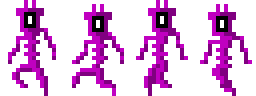
The next day’s morning I stated with enemies. I created four enemy types with special ability, except first dude. First enemy just walking. Here is he:

enemy_walk  enemy_1

ONLY FOUR FRAMES!!!
The second enemy was a blob who exploded on eight bullets when die.

enemy_jump  enemy_2

Third enemy can shoot. And last one teleports on short distance.
When enemies was ready, the game got second gameplay element. This is PORTS PROTECTING.

Enemy320

When game logic was completed I started with audio. I expirioenced in music creation so it was easy part for me. I made three soundtracks: menu, wrong side and right side. The last one I made from wrong side soundtrack. So they are using same notes =)

The situation with sounds was poor. I had to make ABOUT 50 sounds as total! Then I started to assault BFXR. This is genious tool. I made sounds easily and tested them. About four hours.

The next part is “level design”. I tested the game with “special cases” which I wrote. But game needed gameplay and difficulty curve. So I decided to make few difficulties. The differences was in the map generation algorithm and some stats.

The rest part was menu and spalsh screens (intro, win, fail). I made them within 1 hour. Then I reach my deadline… but plans changed and I’ve got extra few hours! So after small rest I started to polish game with extra sounds, bug catching and visual improving.

That’s all, I haven’t thigs that “went wrong”. But I slightly miss with gameplay. It should bew more ACTION. With many and many enemy waves at the same time. But this needs mpre balancing and another ammunition type.
I’ll expand this game at future to make it as this should be.


Intergalactopol retrospective

Intergalactopol retrospective

Well, my team and I shipped a game that I was pretty pleased with this Ludum Dare. Check it out!

Intergalactopol: now in screenshot form

The time has come to dissect the game (and the process) and look at how it worked—I hope you find this interesting.

The Good

I was very pleased with how the sound turned out in Intergalactopol. Having got tired of the identical-sounding sfxr noises, I did the sound effects in Logic Pro, and made sure to keep all the sound effects centred around the key of E, so that they would fit with Mr. Simon Porter‘s music.

The sound of the tractor beam is actually a choir sound taken very low, and most of the “hits” are drumkit or drum machine noises. The music brought it all together.

This time we were working as a much smaller team. Usually we have a team of at least four; it was just Olly and me for this Ludum Dare(plus Simon for the music on the last day). It’s a quite different experience. Much quieter, certainly, though much more immediate. The absence of our game designer and overlord Aaron was felt quite strongly—more on that anon.

Once again we turned to the superb libGDX to power the whole thing. libGDX has recently switched to using Gradle for builds, which means (among other things) builds are much easier to automate. This time around I had Travis CI set up to automatically push builds to my server, which saved a lot of time—in our previous efforts it’s always been a pain having to take a moment out when the non-programmers on the team need a build.

We kept the scope very focused this time around and as a result were effectively finished on Monday morning. We’ve never had this much polish time before, and I think the game feels pretty good as a result of the extra time we were able to spend on the little things.

The Bad

There is a classic problem in game development—as a developer, you know your game too well. If you have the difficulty about right for you, it is way too hard for anybody else. Since my hubris knows no bounds, I thought that even despite that golden rule the game was about right. I was wrong.

The control scheme of the game involves just the mouse: you right-click and hold to grab a planet, and left-click to shoot at a target. This sucks. In fact one bit of feedback that I got was from someone who found the easiest way was to not swing around the planets at all: just to shoot and pray they didn’t crash into anything.

Quite a few people suggested a forward cannon rather than mouse-aiming, but this doesn’t play well. If we’d had more time and more testing (and, let’s be honest, more Aaron), we’d have figured out a control scheme that doesn’t drive you insane—maybe spacebar to latch to the nearest planet and the mouse just for aiming and shooting?

The other problem which I didn’t get time to solve was size. The jar is ~24MB, which is ridiculous given the size of the assets inside. It includes a lot of superfluous libGDX code which I didn’t find a simple way of removing. ProGuard seems to be the standard jar optimising solution, but I couldn’t get it working at all.

In Conclusion

Difficulty with controls aside, I think Olly and I managed to ship a pretty neat game for this Ludum Dare. Let me know what you think about the game and what you think we should have done differently—and I hope this has been an interesting read!

CosmicCom Post Mortem

My game can be summed up perfectly by gnx’s review: “Click things and numbers get bigger“. 

I have been very pleasantly surprised by the reviews. I thought the game wasn’t going to be much fun, but people tend to be enjoying it.

Some good quotes:

  • “Very fun and addictive game”
  • “a nice fun game”
  • “Well done balance and execution”
  • “Having a fun time with this one. :)”
  • “Played it for a long time, not sure why, but I had fun.”
  • “the different buttons have nice thought out synergies”
  • “I enjoyed it even though there is not much of a challenge :) “
  • “…but I like idle games and this one is cool!”

Some criticism:

  • “Aaaah, my poor fingahs. I played that for a lot longer than I meant! “
  • “I felt like a rat on a wheel after a while”
  • “I would’ve liked to see some visual representation…”
  • “I was missing was some sense of reward”
  • “Fingers hurt”
  • ” idle games aren’t really fun and full of creativity…”

What Went Wrong

  • No Time — I had very little time over the weekend, so I only had ~6 hours on Sunday and a few hours on Monday after work. Although I usually submit to the 48-hour competition, I had to submit as a Jam. More time would’ve meant there would have been a lot more features and maybe some nice-looking icons.
  • How it all fits together — I also didn’t have a clear vision of how the UI would look or how the synergies would work between the different currencies (money, customers, satellites, etc.). A lot of it was developed on the fly.
  • Full Testing — I didn’t test the game all the way through until the very end. It made me realize that the game got a bit boring after a while; even I never played all the way through to unlocking all the planets.


What Went Right

  • Work with a known Gameplay style — I knew I wouldn’t have that much time, so I decided ahead of time to create an idle Cookie-Clicker-esque game. I had done this kind of game before for a mini-LD (Conspiracy Clicker), so I knew I could borrow the general concepts and maybe a few lines of code (it’s open source on GitHub). Picking a small scope and a gameplay I was familiar with was the only way I would’ve had a chance at completing anything playable in such a short amount of time.
  • New Last-minute Feature — After the bulk of the development was done on Sunday, I knew it wasn’t much fun. My girlfriend played the game and commented that it was missing “things to buy” like I had in Conspiracy Clicker. At the last minute I added in the Engineers and the Marketing, which help to add another element to the gameplay. Without them, the game would be even more tedious.
  • Exponents — If you’re going to make an idle game like this, make sure you don’t have a linear progression, but instead have some kind of exponential difficulty and growth. I added Math.pow() in pretty late, but it definitely helped.

Enjoy! http://www.ludumdare.com/compo/ludum-dare-30/?action=preview&uid=17861


DAY 1: FRIDAY 22/08/2014

The first day of the Ludum Dare we explained the project and made three teams. Our team is the number two compose by Silverio Cardona Rodríguez, Carlota Texeira Saavedra, Estanislao Castro Nieblas, Francisco Montesdeoca Vega and Israel Fleitas. Once formed the team, each one assumed his role inside the team being set that Silverio and Estanislao were programmers, Francisco the artist, Carlota was support and Israel help the others members.

Dead Weight: Notes on an Android-only Entry

Before the competition I posed the question, “What if our team submitted an mobile only game?”

Really, due to the long approval time for Apple apps, that meant, “What if our team makes an entry that only works on Android?”

Our concern was the tool-chain we use for everyday development which targets iOS/Android (and targets them well) may limit the number of players and therefore the number of reviews. We received mixed responses via LD comments, Reddit and Twitter to the question with almost as many saying “don’t bother” as people saying “I’d play it.”

In the end, we came up with list of three rules for what we wanted to see out of our Android entry:

A good reason to be mobile.

We decided early on, whether it was touch, tilt, camera, etc., our entry needed to be designed to be played on a mobile and not just a mobile version of a desktop idea. We chose a tilt to move, touch to jump platformer with a twist. You control two characters who are chained together and–depending how you have your device turned–you control whoever is on top and drag whoever is on bottom. Flip the device and the roles (and gravity) flip as well.

Dead Weight

Easy to download and play

We posted the APK on our own server and posted it on the Google Play store, making sure that no permissions were needed to download and play. We also targeted Android 2.3.3 and limited the frame rate to 30fps. So, outside of needing hardware accelerated OpenGL, the system requirements remained very low. Th game played just fine on a $50 Samsung Reverb. Some respondents also mentioned adding a QR code to the google play link which we did in our main screenshot.

Dead Weight Screen Thumb

Show me… something

We pushed a YouTube video (which I’m currently re-building) the second we pushed the entry, in hopes that people who couldn’t play would see (and maybe share) our entry. After three days we have 75 views so we are seeing some traction there.

Results

I’d say we are pretty happy so far. We rated about 15 games a day, off and on and would get about 10 ratings a day. Comments are pretty positive, even from those who only watched the video. Friends and family drove our download numbers up, with about 40 total downloads as I’m writing this.

So if you have an Android device lying around, check us out.

Trappy Tomb hits 500 ghosts- you guys rock!

IMG_1474.JPG

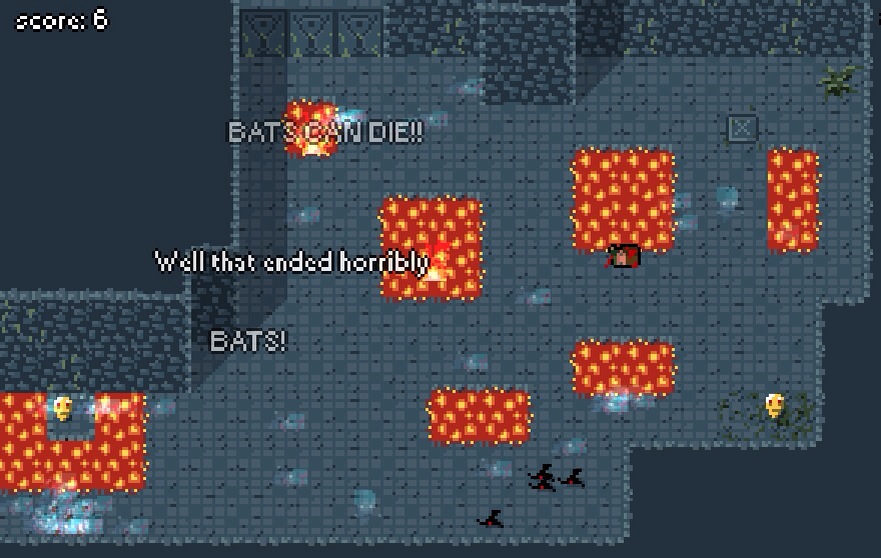
In Trappy Tomb the ghosts of all who’ve journeyed into the tomb are replayed simultaneously as you try your luck against the traps bats and boulders… When you die you can leave a message for everyone else to see and if you win… Well a statue is erected in your honour for all time!

The comments from this wonderful community have been humbling to receive, I can’t tell you how much they mean and how much fun it is watching all the in-game messages people have left – you guys crack me up!

The lava is not nearly as hot as my rage :D

Amazingly over 500 ghosts are now present, forming a ghostly river of doom- if you’d like to join in please do you immortal soul will be most welcome! And of course, I’ll enjoy trying your game too- exceptional standard this LD ;)

PLAY HERE

Signum

LD30 aftermath

This was my 3rd Ludum Dare and my time was very limited. During the whole competition I could only work a few hours each day.
That’s why I decided to join the jam and use Unity (in contrast to LibGDX the last two times). I had never used it and in fact installed it only three days before the contest.
The preconditions were far from ideal but my conclusion is:

EVERYTHING WENT BETTER THAN EXPECTED

Unity was really simple to work with and the integration with Blender is neat. After the first two days I had my the mechanics, game-play, graphics, menus and a prototype level running.

The last day I could use to create more levels, add some eye candy (bloom shaders FTW!) and make everything smoother. Fortunately my friend atombrot contributed with a kick-ass chiptune soundtrack.

Improvements for next time: Allocate more time!

Here a short gameplay video:

Play Signum!

The making of deep orbit

the making of deep orbit

deep orbit was my first game I have ever made from beginning to the end

Now at Android!

This time I did my first 2D game in Unity.

For fear of stumbling on a level I didn’t set an ambitious task. The game was simple and elegant.

The last two days I’ve figured out how to port Unity to my phone. The first time it is always difficult for me. Finally all the problems are behind us. And I’m glad to present you my game on Google Play!

Maybe someone you know children will find this game transistors funny. I would be glad if you take a picture of someone playing my game and put his photo in instagram with #connectSimilar tag.

Connect Similar

Find and select the same transistors in two threads.

Tags: 2d unity, android, connectSimilar

Inkscape & Animations

Hi there o/

I’m currently working on the post-compo version of my LD#30 game which did not receive any polish during the week-end..

I wanted to start with animations, but was kinda disappointed by the current state of Synfig Studio. I use Inkscape and it is awesome.. until you want to animate your drawings. I took a quick look at other animation software, but they either are not free, not available on linux or lack Inkscape’s ergonomics.

So I coded a small tool in Haxe to let me animate things easily in Inkscape: a preview of the current animation at the right framerate, updating itself instantly each time I save my svg file.

Example usage

juxtapose

juxtapose
is an interactive experience in a small world, divided in two.

four travelers are stranded on two halves of the world.
their lives are in danger.
you can help them.
you can explore.
you can simply rest, and do nothing.

all actions will eventually lead to an ending.
their story can end in eight ways.

discover them all.

gameplay21

My timelapse video :D

My timelapse video of this Ludum Dare (#30). It has an awesome and chill Drum n Bass Song :3. Also i want to say that i made my first RTS (Real Time startegy) AI (Artificial Intelligence) Ever :DDD

Dead Land: After Death


menu

I decided to do a post mortem for my game Dead Land. If you haven’t played it you should definitely give it a go. Plus there’s MAC LINUX AND WINDOWS versions so you have no excuses!


THE GOOD


  • Low poly graphics turned out extremely well and almost as easy as my usual pixel art.
  • The characters were quite interesting.
  • I have a base that I could use to make a longer game in the same style.
  • The phasing mechanic worked well (eventually).
  • The music changed nicely between worlds.
  • The game was my most polished so far.
  • There are Windows Mac and Linux versions.

THE BAD


  • I wasted much of day one trying to create my own first person controller in unity because it was originally going to be more of a platformer. I settled with the basic unity one in the end and resigned to do a puzzle game.
  • I also wasted much time on the first day trying to switch between two levels keeping the players velocity etc… but ended up just switching between two places in the same world.
  • Unitys mouse look script is a pain to work with and I’m becoming increasingly aware that some people find the default sensitivity to be too high. I have to make an option screen for that in case of future use.
  • I wasted time making my own font and used it for the instructions screen, it was hard to read so some people didn’t know quite what to do.
  • Other problems with the font.
  • music was slightly repetitive
  • Puzzles were simple give character A item A , Give character B item B etc.. But I’m proud of what I managed. An inventory/ item combos would be cool and more items/ things to use items on. Also a few items that have no use to add an extra level of thought to the game too.
  • There were no sound effects.
  • The cursor displayed on screen at the same as a cross hair causing confusion over which one to use.
  • You can solve a puzzle without hearing the problem. Groove man suggested: maybe let the player click through their request until you can give them the item.
  • The name was poopy. 

IN CONCLUSION


I learned so much this time and one year on from my first ludum dare I’m only beginning to come to grips with time management and scope on ludum dare projects. In future I must improve my user interfaces and find someone to test it near the end to give me an idea what might be problematic for them. I hope I can participate again but by the looks of things this year is going to be pretty study filled (I hope) and the only hope I have is if the next one is during my Christmas holidays which based on the dates last year it has a good chance of being.


endscreen


LUDUM DARE! I LOVE YOU ALL!!!

IRMCO Space Miners Android Version

IRMCO Space Miners

IRMCO Space Miners


Play and rate IRMCO Space Miners here!


I’ve had a few people mention that this would be a good game to port to Android, so I spent some time today porting it over. Please keep in mind this was a quick hack job of a port. The touch interface for zooming in and out of the solar system works, but it’s not as smooth as I’d like. The game also needs optimized. I managed to play a full game on my Galaxy Note 3, but it started getting laggy and choppy near the end of the game. If you have an older android device, it probably won’t work well. I would also suggest sticking to tablets. It was hard to push some of the buttons on my Note 3. Any smaller than that and I don’t think the game would be very playable. If you try the android version, please let me know how it works for you.

I really enjoy this game and want to develop it into a full game, so I’ve been working on that. The new version should be mobile friendly and I’ll be sure to post here when it’s finished. Thanks to everyone who has played my game and gave me your feedback!

Duke Dashington Trailer!

LD Banner Duke Dashington


Hey folks, remember Duke Dashington? My entry for Ludum Dare 27 and Overall 5th ranker? it’s been a while, but I have been slowly developing the game since that Ludum Dare and the finished game is finally getting a full release on mobiles! The game will first come out on iOS, with Android version coming little after. Unlike the compo entry that had single temple and 11 rooms, the full game has 4 different temples to explore and over whopping 100 different rooms of fast-paced puzzling and dashing! The game will be out the 4th of September, in the meanwhile, check out the game’s trailer:

Good News Delivery Co. EASIER VERSION released

Aaaaand RELEASE! Damnit… Ok this one NOW! Damnit… Ok surely OH COME ON!

So Good News Delivery Co. has been very well received, but one fairly consistent bit of feedback is that it’s ridiculously difficult.

So with a few minor tweaks I’ve released a post-48hr compo version and released a web-only build version of it which you can find here (link also available in the original webplayer link).  The changes you can expect:

  • The Pirates have slept in and won’t bother you for a whole minute of gameplay.  After which expect them to warp in frequently as time goes on.
  • More good news is that in their hurry they haven’t managed to activate their shields so you can now destroy them by hitting them fast enough with something, be it your ship or your cargo.
  • I’ve also coated the ship in some experimental substance that makes it really bouncy, which should stop you getting stuck so easily when you hit a planet.
  • The galactic trading standard has lowered the fine for destroyed cargo from $100 down to $50.
  • Cargo should now be pulled in by gravity a bit better, making it easier to release cargo from orbit and have it land correctly.
  • Improved shipping regulations mean that cargo’s tougher than before.  It can now survive two shots of pirate laser fire before being destroyed.
  • Also cargo will now NEVER be destroyed if it hits its destination planet at any speed, so SLAM DUNK IT HOME.

Obviously when rating the game please judge the original version.  This one’s more for if you’ve played the original, but felt you couldn’t enjoy it properly due to the difficulty.  Hopefully this set of tweaks makes it a bit fairer and helps get the general scores people are getting higher than the average QI episode.

So yeah. Here’s the link again and Here’s the link to the original page.

Safe shipping everyone!

Gamecrash fix?

Hey everybody I need your opinion.

The comments to my game showed me that my game crashes in a specific situation. I didn’t notice that in time.

It came out, that I came up with a stupid and way to complicated function after a long hours of coding in the middle of the night.

Now it took me 5 minutes to locate the problem and another 5 to fix that.

I read on the ‘my game’-page that it is allowed to fix gamecrashes wich come from typos or simple misstakes.

Do you think it would be ok to upload my updated version? It 100% identical to the old version with exeption of that stupid function.

What do you think?

Please notice: Being fair is a big deal for me.

thx

sorle

Comments

28. Aug 2014 · 18:54 UTC
Yeah, fix it! That’s the type of thing that rule exception is for.
28. Aug 2014 · 18:58 UTC
It’s my understanding, and I believe also common practice, that you’re absolutely allowed to fix crashes (10 min fix time is not that long either). For more substantial changes, you can always make a post-LD version, which is also quite common. I think the core message here is that reviewers shoukd be able to distinguish between what’s created inside the compo and what not. But bugfixes, again, shouldn’t be a problem.
bushmango
28. Aug 2014 · 19:05 UTC
Please do fix it! It’ll make me and others enjoy your game more, and it’s a minor fix.
sorle
28. Aug 2014 · 19:36 UTC
Thanks everbody. New version is uploaded.

Musical Trade Route Post-Mortem

First off, this Ludum Dare has been a lot of fun. It is fortunate and unfortunate that so many people have participated. The good side is that you get such a vast array of talents all coming to the same place. The unfortunate side is that you can’t play all of the games. The ones I have seen so far have been awesome. Great job everyone!

CW MTR logo

http://www.ludumdare.com/compo/ludum-dare-30/?action=preview&uid=34411

So Musical Trade Routes… It was a little crazy putting this thing together. I am sure everyone feels the same way about their own games :) I am actually shocked at the positive feedback I have been receiving. All of the cool stuff that people seem to like were afterthought things that I threw together in the twilight hours of the competition. I wanted to make my game have an abstract approach to the theme – so far most have not noticed it. I wanted to connect the worlds of poetry and music together. As I knew this would be an abstract theme, I placed in a more obvious connecting trade routes between worlds.

Development:

With only a couple of hours to plan on day 1, I could not think of anything to do with this theme. I came up with some views on how to address the theme and posted them around, but that was the extent. I went to bed a little sad that I would not be participating. When I woke up the next morning, I decided to start looking into linking poetry and music and to make a little space game, just so I would have something to submit. The plan was to work on planning each for a few hours and then see which seemed like a better path. As I continued doing both, the idea of a piano ship evolved. I quickly made some piano music and did my best to make a flight simulation. I had never done either one before, so I am extremely happy with how they came out, even though it is not perfect.

CWspacefiring

I then began to create planets. I was going to leave half of them unnamed and just white circles. Before moving on I convinced myself to just finish naming and coloring so I could say something was done. I threw in some lines between the planets and made it so each planet (0-9) would display its own lines to connecting planets. I finished up the day by making a “difficulty” variable that I assigned to each planet.

CWstarmap2

Sunday morning I woke up and just started banging out some poetry. Haikus seemed like the easiest way to go. All I need was 120 syllables and all ten planets were done:

CWpoetry

I started working on enemies, but just quickly made some meteors. I decided to get done the space combat system. Simplest solution was random spawns based on the difficulty variable. I felt this would make it more interesting because it might interrupt whatever song people were playing and create a new song entirely. I got a chance to play test it quite a few times, so difficulty was adjusted here and there. A few of the polish things that I was hoping to add were a hard mode, music playback and a sonnet. Those who have played it might not have realized that the title screen was a sonnet :)

CWTitle

The good:
Music playback – This has been a favorite for most of the people who have played the game. At the end of each level, you get to hear the music that you played while in flight.
The poetry – Not many have commented on the poetry, but I am actually happy with how it came out. Also at the win screen, you get to read the planet’s Haiku while your own music is playing in the background.

The bad:
Enemies – I wanted so bad to have a lot of enemies, space ships, curving asteroids, other music coming in. That would have been so much fun.
Free Piano – I added this in post-comp. I received feedback early on that a more realistic piano would have been better. In the post comp, I added in more key sets for playing and opened the option for multiple key strokes at the same time. I have not taken the time to make a music playback for free-piano mode, though.
Graphics – I am not an artist. I know the graphics were not fantastic. :)

Future of the game:
I totally want to continue this project. I think it would do well in the mobile market. I even tried putting it on the google play store (https://play.google.com/store/apps/details?id=com.ceosol.MTR). Its free to download. If anything, at least you’ll have a little music creator on your phone or tablet :)
I want to add more to the piano, for sure. Maybe you could swipe left or right to go up and down octaves. You could purchase new ships that have different instruments.
A suggestion was also made with the free piano mode that spawn times could be decreased and you would have faster action happening.

Thank you again to everybody who has tried it out. I was so burnt out at the end that I was thinking the game was absolutely horrible. I am delighted by all of the feedback, good and bad. Keep it coming!

Tags: journal, post-mortem

When Worlds Collide – Postmortem

screen1

My game is called “When Worlds Collide”, and you can play it here. I had a lot of fun during the competition, and I learned a lot too!

What went right:

I had an idea before I started. Usually I try to think of ideas for each of the themes in the final round so that I am prepared. This time, I simply had two ideas that I liked, and fortunately could think of ways to fit them into the themes. So this is something that could have went wrong, but didn’t.

I succeeded in making my game’s code modular and clean early on. Sure, by the end of the weekend it was a mess, but because it began well-structured and easy to modify, I was able to make changes to the game and fix parts that weren’t fun or didn’t work well enough without using up a lot of time.

The game is juicy. Very juicy. The biggest issue my games have (whether they were made for a jam or not) is a lack of visual polish and feedback. I specifically wanted to improve in that area with this game, and I think I succeeded. Images just don’t do it justice.

screen2

The game is fun. That’s what is most important, in my opinion.

What went wrong:

I should have spent more time working. Honestly, I didn’t take a lot of breaks, but I submitted early and didn’t work until the deadline. I was tired. There are a few things I can think of that should have been better, but aren’t.

There are bugs. Well, all code has bugs, so of course this game has bugs. What I mean is that there are known bugs. The are known bugs that have taken so much of my time, and still aren’t completely fixed. In the past I’ve almost always succeeded in fixing every known bug before submission, so this is a huge disappointment to me.

Final thoughts:

In the end, I’m extremely happy with how the game turned out. Many things went right, only a few things went wrong, and the game is fun. I’m considering adding multiplayer cooperative and versus modes, but for now, you could always play cooperatively on the same keyboard. 😉

screen3

Tags: LD30, postmortem, when worlds collide

Blue Screen Playthrough

Just uploaded a video play-through of my entry, Blue Screen. If it looks interesting, you can play the game here!

Comments

Geckoo1337
29. Aug 2014 · 02:22 UTC
Your game is one of my favorites for the LD30th. It’s not always easy to understand this wireframe perspective, but mood is very impressive and oppressive. A really good entry. Bravo ++

Working on Post Compo Networked Multiplayer!

So, for my game “Bounty of Corruption”, I made what was basically a randomly generated shooter game with different themed levels. I’ve always wanted to make a networked multiplayer game, and you can see that I tried local splitscreen in one of my LD games (see: Dungeon Darkness) before.

The following video might take a bit of explanation as to what’s going on, and it’s seriously basic (ie. only movement, with the exception of a couple extra variables):

I am player “TomboFry” playing and hosting a server using the same executable file. “Liddles03” is a friend of mine who joined the server from about 10 miles away from where I live. This test is basically to see how well it performs over a different network (rather than two instances running on the same PC). I’d say it was greatly successful!

When a player connects, they download the random seed and generate the same level as the host.

The circle in the middle of the player indicates whether the person has their left mouse button pressed down. There is a line extruding the circle indicating the direction their mouse is pointing relative to the player. When you press ‘E’, an “ammo” instance is created on both clients, and its speed/direction is determined by random values, which turn out to be the same on both sides due to the same random seed.

PS. Don’t forget to rate my full game, “Bounty of Corruption”

“Press space to start” from the inside

“Press space to start“ is my first entry in Ludum Dare. I thought at first that it would impossible to finish it, as I had less than 15 hours of real coding time to steal from real life. I gave myself two hours to find an idea that met the theme. As an starting point I defined these objectives to the game to follow:

– Easy to understand mechanic. Easy to code. Easy to play but difficult to master.

– Maximum attachement to the theme (my interpretation of the theme).

– Finish.

My tools were: GameMaker, Inkscape and swfmill.

After the muses’ time, I spent about three hours in character design and coding. Other three hours were spent in a “dead end alley”, and involved trying to do things that were unneeded and let me to have more problems than solutions. End of day one. Second day I tried to be more productive. I centered on level design and story. The most difficult moment came two hours before deadline. I had no idea of how to submit a game. Luckily, people in irc channel helped me enough to learn that I had to store the game somewhere, then link it. And 30 minutes passed until I found the submitting button.

PSTS2

What went ok

– Game mechanics are simple enough to understand them in 5 seconds, and controls can’t be easier to understand. Gameplay is interesting enough to keep players  attention turned on during the 10 minutes that lasts. Levels are difficult but not impossible.

– I looked for an strong interaction between text and gameplay. Rooms are divided into story and game spaces, like a very simple book with playable illustrations. The gameplay of a room reflects the story being told, and the story explains what is happening in the game.

The game is short and linear. That allows the player live the story without getting lost in an obscure branch. I don’t expect anyone to give a second chance to my game. Aren’t there more than 2500 entries to try and rate?

Finishing and having lot of fun in the process.

What went meh or wrong

Lack of more detailed graphics, as I centered in the game mechanics.

Lack of sountrack and audio effects. People like them and is something to be rated too.

Lot of ideas that I had no time to develop.

Controls: decision to add momentum to the character speed has raised most of the critics, joined with a very restrictive wall crash system that perhaps raises the difficulty unnecessarily.

Losing a fourth of my time trying to try to do things that worked in a different manner, to return to a solution that worked in the first place.

In conclusion

Even without all the gameplay elements I wanted to implement, I got a finished story, a flexible mechanic that fit well the story and few but (in my opinion) well designed rooms. So within the limitations of the game, I’m very happy with the result.

Making the Post-Jam version

I only spend 7 hours on monday and my game is unfinished.  So, I’m making a post-jam version.

These are  the new backgrounds and the game has better gap generation now:

backgrounds

PLAY CMYK

Ludum Dare 30 post-mortem: Parallel Puzzles

What went right:

I felt like the scope was perfect for the limited amount of time I had this weekend. This was mostly luck, but I also knew when to quit tweaking and didn’t regret it.

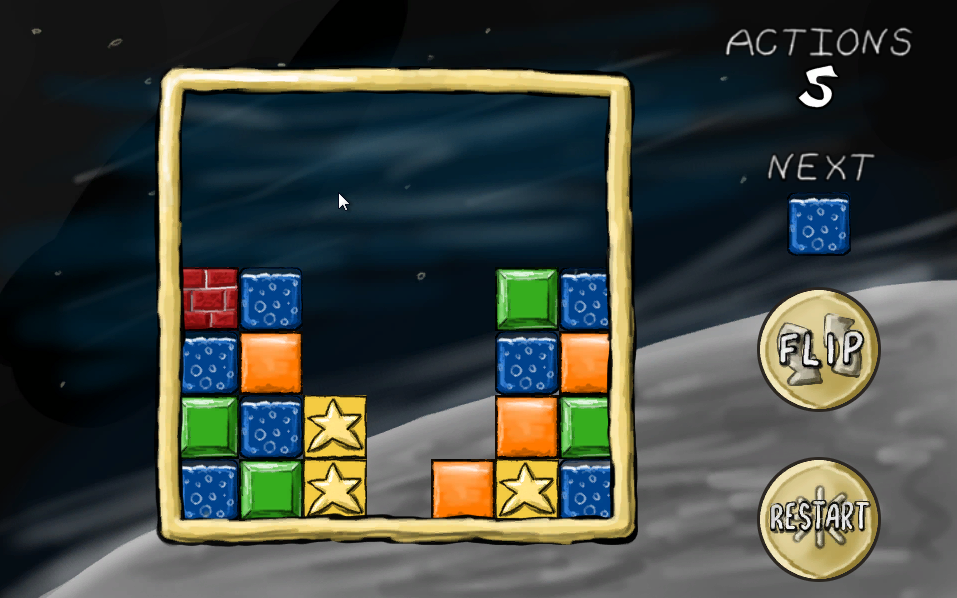
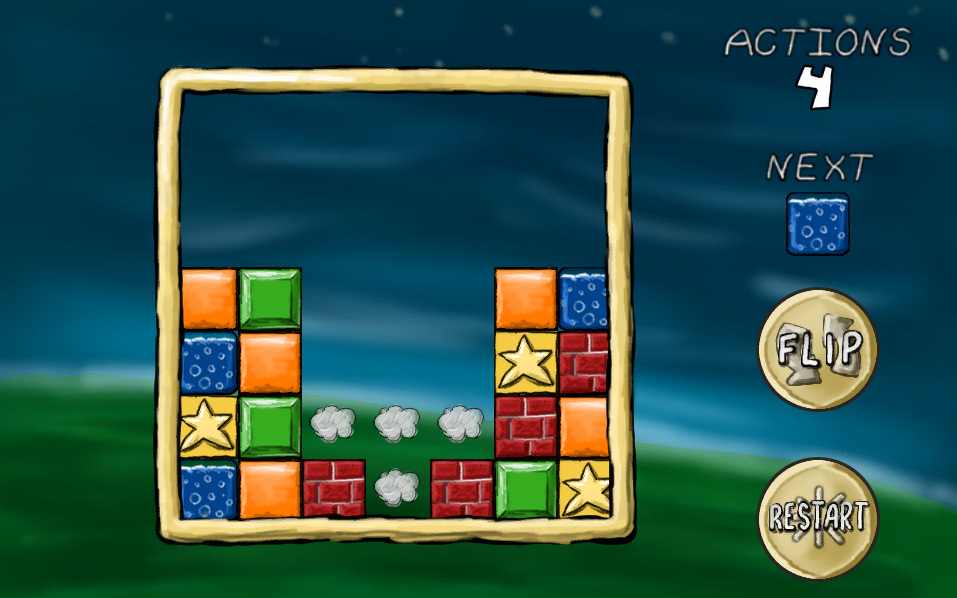
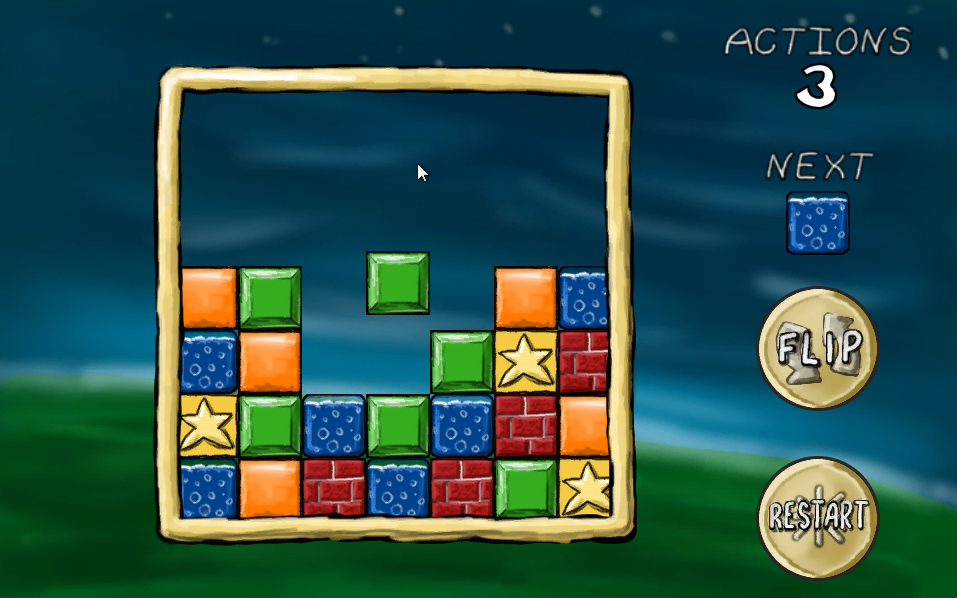
The match-3 and block-dropping algorithms fell into place like magic. To be fair, I’d given it some forethought–I did a quick Unity refresher on Wednesday where I attempted to build the line-clearing mechanic of Tetris with help from this tutorial. However, that’s a much simpler algorithm and I didn’t have an exact plan. It was a leap of faith that paid off early, leaving all of Sunday for polish. (I’d probably remiss if I didn’t mention that the match-3 concept was inspired by the time I spent in SeishunCon‘s digital gaming room this year.)

I’m happy with the art. I didn’t stretch myself stylistically, and it’s not as crisp and detailed as what I’d hoped, but overall it feels pretty slick if you don’t look too closely. I love posting those screenshots because it feels like a “real” game (well, at least to me).

As in the past, adding a GVerb track covers over a multitude of recording sins. I’m going to say this a lot in this post, but this feels like cheating.

Driving 40 minutes back from the Knoxville Game Design meetup is always a good way to start thinking about design and algorithms.

What could have gone better:

I basically shoehorned a puzzle game into the theme. This was premeditated, mainly because I was itching to dip my toe into the genre. It restrained the scope by removing the need for level design, which helped. However, it also felt like cheating the system to start thinking about a game genre so early (especially since I feel like my LD29 entry was a much stronger “Connected Worlds” concept).

Overall gameplay was good, but not great. I’m happy with this in one sense–I didn’t make a ton of explicit design decisions, so I won the “go with whatever’s easiest” lottery. Still, I feel like the “flip or drop” choice is missing something. I enjoy the game, but I restart as soon as I clear out all of the obvious flip combos. Once I have to drop blocks, it’s like I’ve failed. I feel like a “flip or shift” mechanic would have been better.

What went wrong:

Because I wasn’t livestreaming, I tried to do a status update video on Friday night. OpenBroadcaster doesn’t work smoothly on my laptop. I wasted about an hour or so tinkering with OBS on a night I ended up staying up until 4am.

I don’t understand music. Originally, I picked the current chord progression as a base, then played some random notes over it on a second track. Seemed clever on Saturday, but on Sunday I realized it was too chaotic. After talking to Mike at the post-LD meetup, I think I need to study up on some music theory basics rather than hoping a clever experiment will pay off. (I feel like I’m reusing the same chord progressions and I always use a similar rhythm/picking pattern.)

Overall, I don’t feel like I stretched myself like I should have. I stick to the same style musically and artistically because I don’t have a lot of range. I stick to Unity because it’s all I know. To be honest, I’ve had a few good ratings in past LDs, so I avoid the unfamiliar because I want to keep that up. Next LD where I have the time, I need to set a few goals–for example, use Inkscape instead of GIMP, or use a digital tool like PxTone or Bfxr.

Tags: post-mortem, postmortem

Interstellar, Inc. — now with 25% More Lose!

Good news, everyone! Interstellar, Inc. has been updated with a (small) bug fix that unsticks the AI and opens up the possibility of horrible, horrible defeat!

glorious-defeat

Now you can play and enjoy the game that reviewers are calling:

  • “interesting”,
  • “neat”,
  • and “game”

Get trading!

Matters of Perspective uploaded to itch.io!

I’ve uploaded Matters of Perspective to itch.io! Matters of Perspective is my Ludum Dare 30 game about changing perspective from sidescroller to third person to explore eerie rooms.

If you haven’t seen Matters of Perspective, please check it out and let me know what you think!

There has been a lot of positive feedback about Matters of Perspective. I also think the game mechanic can make for some very interesting puzzle-platforming. So, I’ve decided to keep developing Matters of Perspective post-compo! You can follow developments on my Twitter account, @llnesisll.

initial initial2

initial3 initial4

Have you heard of Warmageddon?

Well, you could since I post almost everyday about our 2 players RTS, but in case you didn’t, look at that colorful gif and if you feel like it, go try and rate it

Booom, waaah, oh no an Imp! Flooosh… No sound on a gif? No problem!

Listing the Best Entries

I’ve made a list to myself where I add the best entries in my opinion.
The list has three categories:

Awesome Games
Very Innovative
Awesome Graphics/Sound

I’m streaming while I play so if you think there is a game that I should try out, don’t hesitate to post a link into the chat.

WATCH THE STREAM

Transit Gods Inc. – Post Mortem, a.k.a. LD is about learning!

Try my entry here!

Okay well, I have this stuff which is buggy, almost has no gameplay and was not even made within 48 hours but only in ~10 but somehow I stll can be proud of.

What was bad?

I’d start with it, cause it’s the more. Practically everything went wrong.

– I didn’t even have Internet conection at home, so I couldn’t join the flow of the community with WIP shots and random tweets. It’s pretty important for me, as it’s a major “feature” of Ludum Dare for me.
– My first idea was good, but went bad: it was too far from what I imagined, an beyond a point, it overwhelmed several bugs as well. Finally, I couldn’t even do “basic operations” like return the value of the tile Player is standing on. At this point, I gave up.
– On the second day, I had other things do to (girlfriend visit – so yeah, kinda important!) so  had very little time. Maybe I simplified too much on the contribution itself.

The what was good?

Suprisingly, the most important thing went well.

–  I LEARNT. Both the abandoned and the fina game learnt me somethig bot facts and programming things.

So I learnt:
– that procedural generation is extremely hard sometimes, and even though you wouldn’t think, writin a proper random map generator might take much more time than creating maps by hand.
– that proedural generation is STILL helluva funny!
– that addig features in hurry is like using bubble gum instead of duct tapes. The result is the same.
– that even if ugly, hanging trains are god damn awesome.
– that you can create decently looking people even from 4 pixels.
– that fun can cover the mistakes in gameplay.
– how to create randomly wandering people.
– how to use sound functions in LÖVE properly. It’s the mos important since I was completely lost before.
– how to use color changing functions in LÖVE properly.
– how to create realistic trains (in behavioural aspects)
– etc.

So yeah, finally I learnt in LD#30 that the most important thing in Ludum Dare is LEARNING.

Try my entry here!

Tags: LD30, postmortem

What I should never do again – My LD30 post mortem

Ludum dare is always a great time, although I reach a certain point where I feel some frustration about submitting an unfinished product. But the main responsible for this, is obviously me.

LD30-02

Fuga: a game about space, chemical elements, and music.

For this edition, it was like someone had asked me to make a selection of the biggest mistakes a jammer can do.

 ↓ READ THE REST ↓


Never validate an idea before breakfast

I woke up at 05:30(GMT+2) and I started to think about the theme. I quickly came with an idea of exchanges between planets (a lot of us had the same kind of idea). It sounded cool, I drew some sketches for the GUI, I already had some melody in mind, and I had some ideas about some cool GFX I could have experimented.

I went back to sleep, and I started to work immediately after a short breakfast, without rethinking the project at a high scale for the whole day.
At the end of this first day, I had my “engine” and some graphics, here I asked myself a question: “what exactly is my game ?”

I just realized that my game was barely one. I completely forgot to check if actions made by the players were fun, if the goal proposed was motivating. I freaked out a bit, and found some safety solutions, which implied to cut some of the mechanics I had already worked on and to reform the code structure. And here comes the second point.

Time == code == bugs == loss of Time

Those changes, which should have brought some more life into the game, they also brought some errors (modifying a weak code can be dangerous). In addition, due to distraction and exhaustion, I also create some stupid bugs. I had the feeling I spent my whole day correcting stupid things.

This was not really cheering me up, furthermore I was loosing a lot of valuable time. As a direct consequence, I had to make some cuts – you usually make cuts during a LD – but here I sacrificed important things, such as clarity, coherence and fun.

(Re)Doing everything from scratch

To start from nothing is interesting in term of creativity. I don’t feel limited by the already existing code,  I think I’m more creative in those circumstances. So it’s quite positive.

But redoing everything each time, this is really absurd, boring and time consuming, especially when talking about GUI elements. The problem is I don’t know If I will ever find the courage to make those damn Buttons and DialoguesBoxes in a nice reusable way. In conclusion redoing everything is a serious loss of time when you have only 48 hours.

A nice LD afterall

Even with all this dark forces playing against me, I still managed to have a fun and nice week end. My game, even if not what I had in mind, is unique and playable. I’ve spent some nice moments staring at my code and solving some problems I never encountered before. And now, I’m playing some fantastic games and meeting kind people.

For all of these reasons, it’s ok for me to not make a great Ludum Dare game.

tl;dr

Thought of a game idea, but not of a complete gameplay.
Had to make late changes which creates bugs and errors.
Run out of time because I use it poorly.
I had fun making this game and I spent a nice week end 😀

Tags: LD30, post-mortem

101 games in – My favorite entry so far

Ahhhh!.. my brain!

Ok, it’s not that bad haha!

I’ve played a few games now, and so far I think I’ve found my favorite


Here’s why..

it has gorgeous visuals, the sound is perfect, setting is amazing and everything works so well together! Oh… you can poop too!

The way the game starts is a perfect cinematic experience!

I highly suggest you all try out On the edge of Earth: 5000

And so the journey began

And so the journey began


What a wonderful experience, I can’t wait to see a full game like this. Congrats to Hypnohustla

You made my day!

Dan

My game HERE if you are interested in boring platformers with virtually no story!

I Think I Broke Something Post-Mortem

I Think I Broke Something

Check out the game here: http://www.ludumdare.com/compo/ludum-dare-30/?action=preview&uid=32989

I almost didn’t make it this time, but in the end everything went well. My first participation in Ludum Dare was in the previous edition. I remember that time I was scared because it was a new experience. I had little time developing. My skills as a fast developer hadn’t yet been tested. My last game had taken six months to get ready, so thinking about creating something moderately decent at 48 hours was a real challenge. However, I survived that experience and I was very happy with the result.

This time, things were a little different. The date of Ludum Dare 30 coincided with my vacation, so there was some family activities planned that I shouldn’t or wanted to avoid. That made it nearly imposible to enter the Compo and had me settle with the Jam, even following all the rules of the frenetic 48 hours edition. But my first Ludum Dare had been so rewarding in terms of fun and learning, that I was determined to enter again. When the complex and interesting theme Connected World was announced, it was clear that I would not let it escape.

In my time zone, the theme is announced at 8 pm on Friday, so from that moment I began to think of an idea. Nothing occurred to me, the theme seems terribly difficult so I went to my sisters for aid. We were brain storming for a while until the idea of a frantic RPG where worlds were constantly changing and you have to switch weapon even faster to stay alive came and we found it great. It had that mixture of madness with an air of “it might work”.

Final designs for the Character

Final designs for the Character

When it comes to themes for Ludum Dare I like to stay with the first complete idea that comes to mind. I know that if I think too much I begin to look for detail and I’ll end up finding enough cons to not choose it. So I prefer to begin work immediately on the idea, with a competition like this there is no time to be too insecure with your ideas. Take one and go forward. It is the only way to do it in time.


"I think I broke something" with graphics

“I think I broke something” with graphics

What went right?

Though it seemed crazy at first, the idea began to take shape as it went. Unlike last time, I decided to start with the mechanics and leave the graphics for last. That way I could feel that I had a game ready before making it pretty. The goal was to have the main mechanic ready at the end of day one (Saturday). I was going to the beach on Sunday so I could not participate. I will be back on Monday to tacke tha art and hopefully finish before delivering time at 8 pm. This was fulfilled so well it’s scary. At 6 pm on Monday, I had the game ready and it was time to play test. Watching my sisters getting angry and hitting the retry button again and again with a smile was gratifying. It was proof that the game was just what I wanted: hard and addictive. Happy with the result, but without being able to believe it was done so fast I used the last few hours to create assets, prepare gamejolt page and take some screenshots. I managed to finish everything on time and by 7:50 I was sumitting the game.

Game Over screen and feed back

Game Over screen and feed back

What went wrong?

Although I was happy with the result, as the comments started to appear it was clear that the game was too difficult. I’ve always had a soft spot for hard games, I am a fan of Super Meat Boy (and Edmund McMillen, actually, as you can tell by the similarities of “I Think I Broke Something” with The Binding of Isaac) I also enjoyed the simple difficulty of the infamous Dong Nguyen bird, before all the cloning chaos ruined the experience. I wanted “I Think I Broke Something” to have that: Play, die, be upset and play again thing. I think in a way I did it, but also think I overdid it, many players have said that the difficulty doesn’t let them appreciate other aspects of the game like art and sounds. And that’s something I’d like to correct

Aftermath

Because of this, I thought of creating a post compo version with some adjustments, but when I started thinking about it I realized I had enough material for something else. Something more elaborate, more complex and more fun. So, I decided to take the next step and make “I think I broke something” a fully fleshed out game. You have no idea all the thing I want to add to it and that wasn’t possible with the limited time. So you can be sure that the final version will have enough material to keep you glued for a while. I want to keep the simplicity of design while adding additional content, along with all the feed back I have received from the community, I’m sure I have enough to enhance the experience. First I will finish my current project Taita: Rise of the Half-breed, and them, thanks to Ludum Dare, and have a worthy successor.

Ludum Dare 30 was as frantic as before, but even more satisfying. The community response has been overwhelming, beside the weak points, “I think I broke something” has received many positive comments and that’s rewarding. I’m glad I participated, for sure this new edition was as rewarding as the first. I feel that with every Ludum Dare I become a better developer and although I’m still a long way from the top, there is no doubt that the Jam is the right place to having fun and to learn.

Stay tuned for more progress and expect great things from “I think I broke something” in the near future. Meanwhile enjoy the current version, and remember Play, die, be upset and play again!

Particles Madness!!

Particles Madness!!


Tags: gamedev, I Think I Broke Something, indie, LD30, ld48, Otrora, Portal Madenes, venezuela

Trappy Tomb gets trolled

IMG_2972.PNG

In Trappy tomb you can leave dying messages for other players… All great fun until some trolls moved in and ruined the party! Not to be deterred I’ve rolled back the data – Ludum dare shall not be defeated!!!

Working on moderation but for now it’s here, though slightly hobbled sine no new replays are shown (though they are recorded). Want to join the fun?!

Play Trappy Tomb

Glitched – Post Mortem

Glitched is my first Ludum Dare entry. The story goes more or less like this: you work as an IT specialist for a futuristic company specialising in managing virtual reality worlds. Your friend botches up a simple merge job, causing three worlds to mix together into a glitched mess. Your job is now to enter the world and destroy all of the sources of the glitch so that your friend won’t lose his job.

What I made was an action game, but I wanted to put a spin on the standard shoot and kill formula. Instead of killing enemies, your shots launch them away from you. If the launched enemies hit the glitch, they both cancel each other out, which is good for you. However, if the enemy hits a wall or obstacle, it explodes and launches projectiles that can hurt you. So you really need to aim or run like crazy.  The second mechanic connected (hah) to the theme by having the enemies change behaviour depending on which of the worlds they currently were in (Blue enemies chase you and launch a projectile when hit, Green enemies move fast and fly around you chaotically and Red enemies are slow but periodically shoot projectiles).

Anyways, if you want to play it (It’s pretty short), here’s a link: Glitched

What I Liked About It

-The graphics are pretty good for my skills and the time I had to make them and even though they aren’t anything amazing I still like them.

-I am glad I managed to get the game polished at least a bit: The crystals flashed when interacted with, the Mushrooms made little poofs, the glitch had a particle effect , SCREENSHAKE etc.

-I got the idea very quickly and had a lot of time to work on the game.

What I Did Not Like About It

-I feel like the mechanics aren’t that innovative as I imagined them in the beginning. I really want to make orignial gameplay and I feel this gameplay was still very similar to  a standard top down action shooter.

-The game feels like it’s still missing something, although I suspect I might be put off by how claustrophobic the game space becomes in some levels.

-I keep making action games, I need to finally make something else at some point (So I didn’t really challenge myself).

-I didn’t test the game with anyone, and the game ended up very hard (Remember, if the designer feels a level is just right difficulty-wise, it means it will be too hard for the players)

In the End

I feel like this Ludum Dare went too easily for me. I didn’t really challenge myself and didn’t have any major problems with the game. So for the next LD, I will challenge myself to not make an action game or at least to not make a game that feels like a generic action game.

Did I learn anything? Yeah, I think I did:

-Manage sleep well, it’s best to not lose a lot of sleep as it’s har dot get hings done when tired.

-Particle effects are great for making a game feel better.

-I should use the next Ludum Dare to challenge myself  more and expand my horizons even if it means failure instead of making a bland polished game.

– I need to test the game on someone

Onanigan (Teaser 2)

onanigan

“Do not go, please, they never listen. Why do you think they will do different this time?“

PLAY THE GAME HERE (web win mac lin)

Throwing it out there

So, I’m about to start working on a web-based RPG engine that I hope to have finished in time for LD32. For anyone that might be interested in such a thing, what would you consider to be must-have features? I ask because if I’m going to release something like this to the community, it should be designed with what the community wants in mind.

Great community

There’s something I want to say before I forget to say it: I love this community. This LD and last (especially the former), I made under-featured, incomplete games riddled with problems, either due to time constraints, unfamiliarity with the tools I used, or just plain old bad decisions. Despite that, both times people have left comments telling me to keep going & develop my ideas further. Wow! It’s wonderful to see such a supportive community! And getting that kind of feedback really does make me want to continue. I aim to make the most of my last bit of time before school starts again to make something. I thank you all!

Links – Post LD Stress Disorder

NOTE: First three images are gifs. I’m bad and don’t know how to embed them :(.

So in Links the connection between the worlds was by the pick ups. By picking up one of the Links/?,  enemies do something on the other world, upon their death. Could be:

Suddenly, lava.

Suddenly, lava. (GIF)

Could be something like:

Dat SHMUP classic.

Dat SHMUP classic. (GIF)

And there are a few more like that; bullet burst on the other world, instead of dying, enemies spawn at the respective position on the other world, etc.

But not only. I also added two Links that work upon pickup and stay until you pick up another Link. The best Link in the game is Great Minds, which basically does this:

Pretty nifty, no? Now you don't have to multi-task.

Pretty nifty, no? Now you don’t have to multi-task. (GIF)

Development Process

This was my second LD and I wanted to give it time and really work on it. The last one I did, I felt went relatively well for a first time, but that it also could have gone better. I work on Sundays, so I took a day off work, but I still had a family event to attend on Saturday that killed 4 hours of development time. For the tools usage, I used things I am familiar with. I wanted to churn out a complete game that people could enjoy. So with flixel, paint.net, sfxr, and autotracker, I went ahead on my way.

I didn’t like the theme. But after about 30 minutes of brainstorming I came up with this thing. I can say I am happy about it, but not delighted about it. In hindsight I should have made a game about the Israeli Palestinian conflict, I feel.

Important Design Decisions

So if you give players a static game that doesn’t get more difficult, it becomes an exercise in tedium. Since the game is randomly-generated, I made it gain difficulty over time. The maximum difficulty is achieved after meeting 40 encounters in the game. But it is also impossibly hard. Like, maybe people with 250 APM could play it. I myself couldn’t (not for very long at least). So how do I reset the difficulty? I had thought to have a boss somewhere in there, but I didn’t have a clue how he’d fit into the design of the game since it is a highscore-based arcade shooter. This was the perfect place to use the boss: You can fight him by picking up a special drop, and when you do, it resets the difficulty. Check number one.

Another important design decision to consider was: how do I make the Links an integral part of the game? Powerups are cool but they are hardly the core of shmups. In order to do that, I made it so the Links ARE the score. The more you collect, the higher your score. In doing this, I took a cue from Vlambeer’s Super Crate Box. The immediate benefit in this was that I became able to include both positive and negative Links, as opposed to strictly positive or negative ones. Some links spawn harmful stuff on the other worlds, others are more useful to the player and make fighting foes easy. Check number two.

The last important decision was how the boss was gonna behave. This was the one I am least satisfied with, not in terms of behavior, but in terms of how I relay that behavior to the player. The boss has two attacks, and his eye changes to indicate what type of attack he is about to perform, allowing players ample time to prepare. Someone who is equipped with this knowledge can defeat the boss, someone who isn’t, can as well, but will have a much harder time. The eye animation is not that clear, so this was a failure on my part. Something else to note about the boss was that he could only be damaged by hitting his eye. Here the information was better relayed; the text next to his HP says “Go for the eye, Boo!”, and when you hit his body no sound is made. When you hit his eye, a hit sound is made. It still wasn’t clear enough.

Isn’t he pretty?

Links4

Things That Kicked Ass

1) The game feels complete. With 2-3 more days of polishing it and adding content, I could probably sell it.

2) The theme is an integral part of the game.

3) SHMUPS are nothing original, but a dual-screen one where what you do in one screen affects the other is.

4) Endgame messages to the player are rather insulting in a funny way.

5) 2 great design decisions in the scoring system and the difficulty curbing system.

Things That Got Their Ass Kicked

1) Graphics are pretty bad. They are consistent, which is good, but still pretty bad. On the upside, some people like bad graphics, so there’s that.

2) Soundtrack is great, sfx are on key.

3) Game is pretty difficult, and pretty hard to pick up. My instructions screen could have been clearer, and it’s not readily apparent that you can try the controls before you start the game.

Last Forever

I’m happy with this thing. For a second entry by an amateur who doesn’t get much time to work on games, I feel like it is a polished, complete package (sans the graphics). I don’t expect it to do very well in the compo, but it did well by me. In case you decide to try it, drop me a line!

PLAY LINKS NOW

Ludum Dare 30 Cryptid Showcase – Part 2: With Connecting Worlds, Tribe of the Giant, & Binary System

It’s all fun and games until somebody crashes the Apollo Mail Rocket into a Tribal Giant on a cannabalistic rampage….. HUZZAH! It’s time for more showcasing and game reviewing with Cryptid Showcase Volume 2. Playing through another set of three delicious games. Gotta say I would not have guessed that little tribal creatures would taste like butterscotch, go figure =D.


Games Showcased:

Connecting Worlds by Damian Schloter:
http://goo.gl/v5UBly

Tribe of the Giant by MerlijnVH:
http://goo.gl/DpElcs

Binary System by RogueNoodle:
http://goo.gl/vrwvp3


Stay tuned for the first “Community Centric” episode in a couple of days! Showcasing a game dev community from Kentucky that had a boat load of their members all participate in the latest Jam!

Toodles till then.

–Hugs n Slubbery Chupacabra kisses, Larry

Tags: Cryptid Game Reviews, LD 30 Game Showcase

Favourites so far

Hello Ludumdare friends,

what a bunch of good games are created in this LD!!! Because I’ve rated over 50 games so far I wanted to post a little best of tested 50. So here is my unsorted list:

One Ship Two Ship from 01010111

Heart Star from AdventureIslands

Schrodinghost from Carduus

Hello Worlds from Dustyroom

Trappy Tomb from jimmypaulin

1989 to 2014 from McFunkypants

The World Within from Oxeren

Flicker from PapaCheech

Continue from ratking

Crystalbots:       T-94 from rynti

So that was my unsorted top ten so far. I thank everyone of the devs for their games and hope you enjoyed deving as much as I enjoyed playing.

If there will be any big changes on that list, I will let you know.

ruerob (Nigel – Hero of the Universe).

Comments

tom_maclaren
29. Aug 2014 · 18:30 UTC
Did u TRY that holdiay nightmare game where the seasons connect i loved killing santa its hard but really fun

Game platforms

As I’m working my way through the entries for LD 30 I’m noticing that fewer games are being made in a format which is playable on the web these days. As I’m often short on time and dip in and out of rating entries, taking the time to download, virus check and run an unknown executable file isn’t really viable for me. I also alternate between working on a Windows machine and a Mac, so it’s not always possible to play the majority of Windows-only games. I therefore tend to gravitate toward those entries that have a web version and ignore those that don’t.

What are other people’s opinions on this? Are you turned off by games in a particular format? What holds you back from creating web-based versions along with executables?

Having said this, I have personally started uploading Windows versions of my entries to go along with the web versions, as I know there are likely to be people who feel the opposite way. If you’re looking for a good 2D game framework which compiles to the full range of platforms (Flash, HTML5, Windows, Mac, Linux, Android, iOS and more) I’d recommend taking a look at HaxeFlixel, a popular port and improvement of the original Flixel for Flash written in Haxe and using the OpenFL framework. You can develop your games on Windows, Mac or Linux and usually create versions for other platforms with little to no changes.

Comments

WiErD0
29. Aug 2014 · 19:27 UTC
I guess I agree with that feeling when I am playing other people’s games, but for the process of making it, it isn’t so easy. Making a JAR file is so tempting because you can do it with just the click of a button on alot of programs, and there are rarely any problems. However, if you try to make an applet instead, you run into the thousands of problems with what is and isn’t allowed on certain websites.
WiErD0
29. Aug 2014 · 19:28 UTC
I do have to say, though, I don’t find JARs any more annoying than the (like 40% of) games that run through unity web player, because that takes a good 10 minutes to boot up every time.
grayhaze
29. Aug 2014 · 19:35 UTC
I’m a hobby game developer too primarily, which is why I only use free, open source tools for my development. My primary goal in choosing a language and game framework was to find something which was designed from the ground up to be cross-platform, which is how I came across the tools mentioned in my post.
30. Aug 2014 · 06:39 UTC
I’ve been playing pretty much the same as you. Quite often I’ll come across an entry I’m really interested in playing, but there is no web link. I think I’ve only downloaded two EXE. games so far out of all the ones I’ve played!

R-elink, the post compo edition!

It contains the same 6 levels but I changed all the graphics, aligned the phone with the screen, added better physics and made the game overall more playable. I haven’t changed the music because I didn’t found any songs that would fit the game, that is next, I guess.

Well, what are you waiting for? go play it nowWWWWWWW!!!

Play the post compo edition

“Orange” Timelapse and Post-Mortem

I’ve made a timelapse of the making of my game “Orange!”

As for the post-mortem, there wern’t any real problems this time.

What went right?

  • I had a clear vision of what I wanted to make very early on.
  • I had a good idea  of what was most important, and what could be cut early on.
  • I chose a graphical style that was simple enough so I could get all the assets done.
  • Scripting went smoothly. No headaches.
  • I slept a reasonable amount. (12 hours over two nights) So was able to keep focussed.

What went wrong.

  • I Would have liked to have more time for music.
  • Gameplay could have had more depth and variation, but my focus was on story, so that’s fine.
  • Finding people to test your game in the last 12 hours of the competition is hard. I need to find some people to test my game before the competition starts next time.

You can play my game here: http://www.ludumdare.com/compo/ludum-dare-30/?action=preview&uid=5496

Comments

30. Aug 2014 · 00:26 UTC
Great Game

Disconnect – Post-Mortem

Hey fellow gamedevs,

We are a team of four german students. We name ourselfs “Banana4Life” and have developed the game “Disconnect” for the second ludum dare we took part in. I (Jonas) made a quick LetsPlay of it here:

You can rate and play our game here: Disconnect

But now lets get to the post-mortem. We didn’t have huge problems this time, after we spend half of the time developing a game that we threw away and started over last time. But lets start with what went right.

What went right?

  • The game was playable and apparently fun to play.
  • We had a cool idea from the start up and didn’t change it later on.
  • The graphics and music / sounds were developed steadily parallel to the code and thus weren’t a product of the last minute.
  • We implemented our core gameplay first and after that improved upon it.
  • We partly had a lot of features that we wanted to implement, but we cut the right features.
  • We slept a reasonable amount of time and weren’t completely destroyed after the weekend.

As you see the most important parts went right and I think we did a pretty good job developing the game this time. But we had some small problems anyway.

What went wrong?

  • We spent a lot of time working on collision detecting fixing it over and over but it never really worked.
  • At the end time ran out and the one level we had is pretty short.
  • One of our developers worked remote and wasn’t in one room with the other people which made communication harder.
  • Not all of us could work on the game on the third day, because they had to go to work.
  • The rendering of the walls could have been solved better.
  • Again the collisions were really annoying. Especially with syncing the player positions.
  • We didn’t play enough games

Most of the “What went wrong?” stuff could be solved with more time and maybe some more structured code on my side rendering the walls. (But it worked anyway)

What we want to do better?

  • Meet up all in one location
  • Maybe implement a little framework for the collisions or use an existing framework, because that would be a huge timesaver.
  • Take a day off the next day so everybody can work on the game the whole time.
  • Think a bit more before writing code. (maybe, maybe not)
  • Play more games

So I think we have an action plan for the next time.

  1. Prep a bit more by chosing a physics framework or something like this
  2. Try long enough to come up with a good idea. (Like we did this time)
  3. Make the game.
  4. Play more games.
  5. Enjoy the internet fame.

I hoped you liked our short writeup. Greetings,

Team Banana4Life

P.S.: Play and rate our game please.

My worst entry – Postmortem

This Ludum Dare was interesting, as it was my most ambitious game. And it failed. I should have known.

What went wrong? As always I tried to include an AI, random generation of something (this time a world), a dijkstra-algorithm (and removed it again, it always needed too much time calculating the paths) and fun.

And… it worked! Except for the dijkstra, which was at least bug free, but still not fast enough to calculate paths for 100+ animals every few seconds. And far from fast enough while running on a Pi. I had animals, the player could build rudimenarily, the villagers spawned, there were not exponentially many of them, things were fun (for me).

It was hard work, as I wanted to do a multiplayer game, using Python as a server language (since I love Python) and JavaScript as the client language (since Websites are the most accessible kind of game, and I like JS). That meant writing Python and JS simultaneously, now I can tell: That’s confusing, fun, challenging and confusing. Did I mention confusing? The way to design a program in those languages are close enough, but the syntax is different. Different enough to confuse.

So, what was the problem? For multiplayer in a website I used websockets, which are great for that stuff, it went better than expected. But then again, it was the first project I successfully used websockets for. I found a python library (ws4py) based on another python library (cherrypy) with which I never worked before, and used them. Bad decision. It was sunday evening, three hours before deadline, when I first tried moving from localhost (lo) to local/public IPs/Domains (wlan0, eth0). Didn’t work. The Python socket implementation has a small bug… crashing connections far too often. I changed some parts, sent smaller packets, added small time.sleeps, It made the connection more stable. Then at least one in ten survived and worked. For a game based on an active connection that’s bad. But at least you could reload and play on.

But then not only did the connections crash, but sometimes also the thread handling the sockets. From the library. The bug is in the python standard lib. Without a chance for me to fix the bug. So… It doesn’t work.

What did I learn? Don’t be ambitious. I should have known that. Multiplayer is a lot of work. Use libraries you have already worked with. Did I ever do that? I guess not, but this time that paid out badly. Don’t use two languages at the same time. Make fun games!

So far, see you in december. I’m sorry my game does not work. Neither did using different backends for the websockets work, nor using pypy for the server.

I’m sorry.

Tags: postmortem

Comments

30. Aug 2014 · 02:23 UTC
I think it’s fine to be ambitious, but you need to be able to adapt along the way. If you plan for something easy and simple, you’re gonna get that, but if you plan something very ambitious, you might come up with something amazing, even if the result is not what you originally planned.
jahmaican
30. Aug 2014 · 08:45 UTC
The first rule of using Dijkstra algorithm is – “don’t”, it works very well, but only in theory :) There’s A* that does the exact same thing so much faster and is fairly simple to implement at the same time. And very often you could even use best first search.

Rating games: A Guide?

It’s always pretty exciting to work on a game for  ludumdare. I’ve participated alone and in team and it’s always such a great experience!

I’ve seen a few discussions popping up here and there about the judging/review process. There are several instances where it’s not THAT easy to know how to rate a game!

While I’m not a veteran, during the time I’ve been here I’ve seen people agree on “best practices” that I’ll try to outline below or at least start a healthy open discussion about them! (if I’m wrong in any of them please let me know!)


Take into account  whether the game was submitted to the compo or the Jam!

This will let you rate the game better. I know bad graphics are bad graphics, but compo games can’t be judged with the same “harshness” you would use for Jam games because they were done in less time (48 hours instead of 72), by a single person (not a team) and -in theory- during the competition! (which is not necessarily true for Jam games, where using pre-existent assets is allowed). Same with music, or the level of polish. In fact, every aspect should be judged taking into account whether is a jam or a compo game!


Make sure you read the description!

The “description” is the first and main instance for developers to communicate with future players, so a lot of them will try to post information here that will help you play and rate their game.

I know sometimes there’s nothing relevant in the description, but you’ll find that in quite a lot of games reading the description first will definitely make a difference! Perhaps the developers didn’t have time for a tutorial and you’ll find the instructions there. Perhaps all the audio was taken from somewhere else and they are honest about it in the description (more on this later), perhaps you need to install something before playing the game.  Perhaps the web version has annoying bugs and glitches the other versions don’t have. All of this is relevant and will probably help you judge their game better!


The game doesn’t run? Don’t rate it!

If the game you are trying to play is not working for you, don’t give it a low score!. The most sensible thing to do is leave a comment saying that it didn’t run on your system. If you can provide relevant information (Operating System,  Processor, graphics card, Browser, A message that popped up before crashing, etc) all the better!


Remember that N/A means Not Applicable!

If the game lacks audio, for instance, the best thing to do is to NOT rate the game in that category.  Same with humor, for instance. If it’s an emotional game about a serious topic there’s no reason to give it a 1-star rating in humor when it’s not trying to be funny.


The audio or graphics are not their own? (Open to discussion)

For jam games where assets made before the competition or freely available on the internet can be used this is a really hard topic!. A lot of developers will tell you in the description if there’s something in their game they didn’t make themselves, while others simply won’t, which makes this issue all the more complicatedl! Not really sure what the “recommended course of action” is, but when the audio for a game wasn’t made by the team I usually don’t give the game a score in that category.

If they used a mix between things they made during the jam and things they borrowed from public sources then I try to “judge” the assets they did for the game and how they “blend” with everything else.  It’s a really complicated case (and hopefully uncommon) so I’d truly love  to know what other people do when this happens!


Leave a comment!

Leaving a comment after you’ve rated a game is not only a way to let the developer know you played their entry but also a way of helping them improve their game!  Bug reports, suggestions and feedback in general (e.g: “Loved your game!”) are always welcome by developers and will most likely help them continue working on the game beyond ludumdare. Plus, a lot of people (including myself) will return you the favor!


I think that’s all the advice I can give for rating games. If you know of other “best practices” please let me know and I’ll add them here!
Having said that, go and rate some games!


Tags: advice, judging, Ludumdare

Comments

Donar
29. Aug 2014 · 22:34 UTC
If a game has no sound, does it matter if I give N/A or 1 star? The “Overall” rating is not calculated by the other categories and the game won’t win in the audio category either way.
29. Aug 2014 · 22:55 UTC
Glad to see someone chiming in!

Livestreaming your game

I think I have livestreaming working.  If you’d like to watch me fumble through your game, join me here and let me know.  :)

http://www.twitch.tv/haymanmarc/

Connected Worlds Training Facility – Post-Mortem

The game: Connected Worlds Training Facility

I wrote an article on my website about my Ludum Dare experience. It has GIFs to show my progress throughout the weekend (sorry, no timelapse!). It was my first time taking part and I really enjoyed it. Thanks a lot.

Excerpt:

Last weekend, I took part in Ludum Dare for the first time. Ludum Dare is a game development competition in which you have to make a game in 48 hours. Before the competition, everybody votes on a theme, and this time around the most popular theme was “Connected Worlds.” By the end, I had successfully managed to make a little game called Connected Worlds Training Facility which you can play online.

Taking part had been on my mind for some years. I first learned to code with Game Maker, about 12 years ago, and have been interested in game development ever since. I read a lot of game development books, regularly browsed forums like /r/gamedev and the Stack Exchange site, learned a fair few libraries and tools, and started making some of the ideas that were dancing in the back of my head — but never got far.

I watched many Ludum Dares come and go and always told myself that I’d take part next time. I was also pretty scared that once I left university and started working, I’d never have the time for that kind of thing. Then I left university, got myself a job, and three weeks later took part in Ludum Dare. It’s funny how that happens.

I also give an overview of everything that happened during the competition and my thoughts on how it went and why.

Continue reading.

The first GIF:

A jumping platformer character.

The last GIF:

The finished game.

Dreaming Knight: Postmortem

Finished my second LD a week ago and just managed to get some time to add some post-jam fixes.
Added some enemy-ai bugfixes, all the random art that I didn’t get to in the 72 hours, and FULLSCREEN MODE (that last one’s a big one since you’re swinging the mouse everywhere in this game!).

If you haven’t yet tried my game, give it a shot! (It’s a lot of fun I promise :))
http://www.ludumdare.com/compo/ludum-dare-30/?action=preview&uid=35477

35477-shot2

For the less video-game-playing inclined, I’d describe it as a top-down brawler with RPG (upgrade tree!) and Bullet-Hell (see picture) elements.
It’s got two parallel styles of play (sword or crossbow), 3 bosses, some semblance of story and LEL FUNNEH MEMES for all the humor points. (I’d say they’re relatively tasteful and fitting though…)

I’ll also take this as an opportunity to write a short post-mortem (since I do love reading others on the front page).


Real Life Stuff:

I met up with my old friend Josh for the Apportable meetup in San Francisco, we were planning on doing this event for a while (and he drove all the way from LA to get here – true sacrifice!).
The meetup itself was pretty dissapointing (I think we only say maybe 1-2 other serious teams there), but can’t complain about free food.
We did, however, meet up with our 3rd teammate there, Josephine.

I wish I took some photos of the meetup, but I’ll just have to settle with the dinner-after photo:

10548052_688194937916099_4136138774195406890_o

(bottom-right 3 of the photo).

We spent the rest of the weekend working at Intel HQ in San Jose (Thanks Josephine!).
I also remember being woken up at 2am by the earthquake that made national news while sleeping in a cubicle. Wasn’t too bad in the south bay.
Game Design:

I went in really wanting to do something involving RPG elements.
The main influence I had was a game I played during the last LD called Hanoka:

http://www.newgrounds.com/portal/view/638425

hanoka
(If you haven’t, you should totally play this game. It’s fucking glorious)

And this talk by Jan Willem Nijman of Vlambeer:

https://www.youtube.com/watch?v=AJdEqssNZ-U

(You should also watch this if you haven’t, I’d almost consider it required for anyone making any sort of action game).

We settled on the idea of a dream world pretty quick.
Here’s the general progression:
“Traveling between dream worlds” -> “Stories from multiple people dreaming” -> “Kid in school dreaming about different historical worlds” -> “minigame-based game with different dreams (dead end)” -> “kid sleeping in class dreaming he’s a superhero” -> “kid sleeping in class dreaming he’s a zelda-style knight” -> “the bosses are the other kids in the class” -> “his teacher is the princess”


Progress:

The original idea was 4 directions in the same vein as the 2d Zeldas.
Didn’t take too many in-progress caps, but check out this ridiculously fun looking prototype:

Capture d’écran 2014-08-30 à 01.17.06 AM

Sometime around midnight friday, one of us said “Wouldn’t it be a lot more fun if we just kept out the sword out the whole time?”
After that, it naturally progressed to a sword-follow-mouse and then a swing-mouse-to-swing-sword style of mechanic.
I usually like to have a fun prototype by the first night, so we were making decent progress. Sure, the game was just “green ball swinging grey stick at blue boxes”, but we could tell the “swing sword” mechanic would probably feel pretty great with some knockback, explosions, freeze frame and screen shake (watch the vlambeer video to know why!).

I do also remember spending a LOT of time working against the flixel hitboxes (specifically Flixel Powertools). I remember just being pretty annoyed the pixel-perfect collision not working properly (basically, any time you have an rotation, scale or offset).

The next day we met up at Intel HQ and worked on getting the game feel right, and I think we implemented one enemy (the small spider I think).
We were able to use just about everything the two artists made with little iteration, so kept on a good pace.

Capture d’écran 2014-08-30 à 01.23.45 AM

The day after (Sunday), I was feeling pretty behind so I made a goal of finishing all the enemies (small spider, big spider, jelly, boar) and 3 bosses (snake, spider and fireball). This was basically a day straight of coding/art.
Got all of those done around 2am monday, but was feeling pretty stressed out about the status of the game by then.
Stayed up and implemented most of the UI for the shop.

Woke up Monday 11-am (took the day off work!) ish feeling REALLY stressed. The game at that stage was just 3 untuned bosses, 4 enemies, and a couple of ideas on how to connect everything together.
Luckily, was saved by Josh. Since the art was mostly finished, I had him go on level design (enemy patterns, stats tuning) for the rest of the day. This involved some coding for Josh (first time ever I think?) but mainly a lot of playtesting and number-tuning. He did a really great job (you can tell just by the enemy placement and the balance with powerups!).

Capture d’écran 2014-08-30 à 01.35.32 AM
(Level code written by our artist!).

I managed to finish up the scene transitions, shop upgrades, bugfixes and everything else in the last 6 hours (that was the REAL crunch time!)
Did everything sound effect/music related in the last hour before submission. Luckily, I had a ton of general-purpose sound effects from my soon-to-be-released iOS game SpeedyPups, and some great chiptune music from Joshua Kaplan (from a previous game jam) that all fit really well.

With 10 minutes, added the last sound effects and submitted to the site. Was an intense and stressful 72 hours, but the final product is always worth it afterwards.

35477-shot0

Looking back:

I was really happy with the final product, managed to get in those RPG mechanics that I wanted to play with (with quite a few elements more-than-inspired by Hanoka…).
I only had a couple of regrets:

-Swing mouse to swing sword felt like a little too wonky/unpredictable mechanic to base a game off of
-Story wasn’t really too clear (and ending could have been a little more clever)

and unrelated:

-Didn’t get too much time to talk to an Apportable Engineer (since I actually am using+have a problem with their SDK!)

Will probably try and get this game on FGL once all the Ludum Dare excitement dies down.

Thanks for reading, and see you next LD!

Gimbal Fighter: Post Jam development

Soooo…. we’ve had so much fun working on this that we’ve wanted to keep working on it!

(Please remember to not vote based on this update, this is a post-submission update, but we would appreciate your thoughts!)


Link to Gimbal Fighter!

Frame2

With added effects new enemies, sound effects and cleaned up game mechanics.

Postmortem (Overall) – The Ghosts You Left Me

One of the things that I love about these events is that you learn so much, even more so from your failures than your successes.

Here are some notes from making my entry The Ghosts You Left Me.

What went well:

  • I managed to achieve my goals of good mood, visuals and immersion
  • No problems with deployment or submission
  • When I was working on the game, none of the time was wasted. My work rate was fairly normal. It wasn’t too rushed, until the end, but it was solid production.
  • I had a lot of fun making things from scratch – particularly the audio. You don’t really give much thought to this when you make something normally, using external sources. Grab a texture from CGTextures, grab some audio from Freesound, etc. Making it yourself is an entirely different process and it’s so much more exciting! I had to wander around my house, listening to noises, moving things and scraping things to see if they could produce the noises I was looking for. It was so much fun, and so much more real. Creating things from scratch makes you gain a new level of respect for things that you’d otherwise take for granted.
  • I was incredibly happy to have created something, ANYTHING. It’s sometimes hard to push myself to work on personal projects, but when I do make something I’m usually quite proud of “levelling up” that small amount more.

What went badly:

  • I should have gotten feedback earlier. The first person to play my game was my brother, who I showed it to just after I had submitted it. Watching someone play your game very quickly allows you to see its downfalls. He couldn’t understand the message audio clearly, and didn’t realise he had to click on Locker 3. To be fair though I didn’t have much gameplay to test until near the end, but I definitely need to get someone to play it BEFORE I submit, next time
  • Computer crashed twice and lost a bit of progress… something might have got messed around when I installed a wireless adapter… not a huge issue
  • Started to lose motivation after ~6 hours or so. There was a LAN party going on and I wanted to go, so after a bit of stalling I did go. I think it was more that I wanted some social interaction during that weekend, I felt like such a reclusive hermit staying at home. Because I didn’t really have much to show at that point besides some models, I didn’t feel like I had achieved much yet so it almost made it feel like if I continued that the entire weekend, it would be a waste of a weekend. I needed to get out.
  • Didn’t give much thought to gameplay until about 10-12 hours in out of the 17 total, so it ended up being very simple (which I expected going in)

Playing the entries/ratings:

  • I am absolutely inspired by the amount of talent here, and the quality and originality of some entries – makes me want to try a lot harder next time!
  • It’s really exciting to get feedback on my entry. What I’ve received so far is generally very positive and there’s some constructive feedback as well which I agree with. I find myself checking my entry page numerous times a day to look for new comments (notifications system plis!).

Why I liked Ludum Dare:

  • I needed the deadline that Ludum Dare imposed. I hate pressure, but I’m one of the people who need it in order to get anything done, otherwise I’m too “cruisey” with doing things.
  • I also was motivated by the competition and the excitement of other people around the world doing it at the same time
  • Getting feedback from fellow developers can be so different from getting feedback from others who have less or no experience in game development. They are both very capable of giving feedback regarding what they see, the content, what is bad and what could be better. They can both be impressed, or disappointed. But the difference is that one has a better understanding and appreciation what goes into making it, and how difficult it is to create something under such a short time frame. It’s much the same in different aspects of life really. I value feedback from both groups very much, but it’s very refreshing to get feedback from people who *know*.

Next Ludum Dare:

  • I am DEFINITELY going to enter if I’m free that weekend
  • Focus on more of a balance of nice aesthetics and gameplay, as the gameplay was lacking in my first entry
  • I’d like to try and get more innovative gameplay rather than something that everyone’s already seen
  • A bit more of a plan up-front, and maybe schedule my estimated time allocations
  • Actually think more about the theme when it’s announced or in final voting stages, instead of thinking of an idea beforehand and then trying to fit in with the theme – the most innovative entries I’ve seen are ones which have a lot to do with the theme and creatively used it
  • I’ll probably still do it solo, and alone, but I think taking a 1-2 hour break every 5 hours or so is important to keep my motivation levels up
  • Get people to play it BEFORE I submit

Next steps for my entry?
I would ideally like to continue it. As I mentioned and many people agreed with, it was just an intro to a longer game, and wasn’t really a full game in itself. There’s so much more that could be done, and so much more that I want to do with it. I guess we’ll have to see how it goes with the motivation and setting aside time for it :)

And that’s all for now! Very excited for the next LD, and also excited to see the results of this one. Well done to everyone who put in a submission and best of luck.

Tags: postmortem

Inverted Post-mortem

During Ludum-dare I created an average arcade game taking place between two creatures with the ability to switch places through their worlds.

What happened:
First I woke up and had a large break fast

photo 2turns out wordpress likes to flip images.

then got to my work station

photo 1it sure loves flipping images.

and began creating.

What went right:

  • I got a basic, playable game in under 4 hours
  • The graphics were amazing
  • Beautiful music.
  • Simple and addictive gameplay (I got addicted myself)
  • Awesome particle effects

What went wrong :

  • Two game stopping glitches
  • 1. Impossible to pass through certain spike arrangements.
  • 2. Random death
  • DUMB non-perceptive people have no understanding the gameplay/core mechanics.
  • Complaints of the music being too loud.
  • The particle effects were not noticed, from their low transperency.

What will happen next time :

  • I’ll prepare more time to work.
  • Clear my weekend.
  • Make the music quiet
  • Make the particles POP
  • Get a setup.

What will I do with the game :
I’ll probably make a post-game, I found my self to love it and others aswell, Plus with a little extra content, It’ll run itself and I won’t need to create as much content in the long run.

You promised a timelapse?
Oh, yes here it is.


orane you glad I didn’t misspell orange again?

Afterlife Dance Party Post-Mortem

This was my third Ludum Dare, and although I did Afterlife Dance Party within 48 hours and mostly solo, I decided on the last day to switch to the jam so I could have someone help me with music (John Fio to the rescue!) Now, goals and lessons learned and stuff…

screenshot1

I went into this jam with some very specific personal goals, which I think helped a lot as self-imposed constraints which lead me to come up with an idea relatively quickly.

1) I knew I didn’t have my usual levels of energy for this LD as I’ve been swamped at work, so I wanted to do something around a very simple mechanic that would not involve worrying about the camera, complex input or creating levels.

2) I felt like drawing, so I wanted to do something where I got to make some animations

3) Past game jams have always had me tooling with mechanic balancing, tutorials, and feedback until the very end, which usually leaves the art super rough. This time I wanted to leave myself some time to do a pass of cleanup on my art. Fortunately, this constraint worked rather will with #1.

So how did I do?
screenshot2

Well on all fronts I think I accomplished my goals. The mechanic in the game is incredibly simple 4-arrow key input and a goal of “dodge the things.” Instead of having to create levels I just created a set of spawn rules that got progressively harder, so the core of the game was pretty much finished on Friday night. I had a blast drawing all the animations, and actually left some time to color things, so goals succeeded there as well.

I actually think switching to the jam was also a sort of success. I can do ambient music or very mild stuff if it doesn’t matter if the music is disconnected from the gameplay, but once this idea developed I realized that my skills were just not up to par to write something that would accompany a dance party. Since the initial reason for doing the compo was that I didn’t have energy to spend on more than 48 hours, it was no issue for me to switch over and get help with music. Afterall, the goal was to not spend too much stress that weekend.

screenshot3

Gameplay-wise, there were a few things I was a little sad I didn’t get to. Mostly I wanted to do a pass on spawn rules and tracking to prevent “impossible” dodges, such as if something spawns in the center and on the bottom layer at the same time. I also really wanted to implement diagonal transitions, which would have also helped with this issue, but they proved too scopey for the weekend. I think those would have helped me end up with something that could have been played for a lot longer with a more satisfying ramp up in challenge.

Between now and December I have a couple of goals for myself to prepare for next Ludum Dare:

1. Get more music practice in, and find a tool that I can get comfortable with.

2. I want to do next LD in something other than Construct 2, so get some practice in with Gamemaker or something. Don’t get me wrong, I absolutely love Construct 2, but I want to expand my tools knowledge and learn some different applications.

That’s all for now, thanks to everyone who played my game!

https://www.youtube.com/watch?v=Z98rd5i8vx4

Tags: jam, LD30, post-mortem, postmortem, timelapse

Timelapse!

This was a pain to get done! Failed rendering 6 times after rendering for 4 hours! BUT, now it’s done!

Connector – Post Mortem

Check out this short ‘trailer’ to see what it’s about or play & rate it here. (http://www.ludumdare.com/compo/ludum-dare-30/?action=preview&uid=23493)

tl;dr: if you have an idea but think it’s not fun enough, try it anyway if you can’t think of something better, you might be surprised :)

The longer read

The theme was a tough one again, at least one where it was hard to be creative since the theme described something (of course it can still be interpreted differently) which would result in a lot of visually (in broad terms) similar games. Think of planets, space, a double sided platformer or any side by side worlds where two things happen at once, when you have a theme like ‘chaos’ there isn’t really something that’s described. Anyway, enough about the theme.

After brainstorming a bit we quickly landed on the idea of taking it pretty literal and physically connect planets in space, with the humorous twist that you’re there to provide the galaxy with internet. Connecting planets with an ethernet cable (because why would you do this wirelessly, everyone knows it’s more efficient to just lay a cable!). We figured the rest of the mechanics would come along the way while building the cable physics and topdown spaceship movement.

It didn’t, we wondered at one point what the fun would be just flying around and connecting planets. Would it be time pressure?, Impending doom? Snapping cables? After having the rope physics and movement mostly done on the first day the other two were mostly spent pivotting and prototyping several gameplay ideas. What if you would be attacked by ufo’s and had to connect them to blow them up or had waves of asteroids coming which would screw up your cables and you had to reconnect them? What if it was some kind of tower defense this way that you had to purchase turrets!? (some of which you can see gif’d here)

Eventually we were running out of time and we still (in our minds) didn’t find anything fun yet, so with around 3 hours left on the clock we decided we just build the original idea. Connect the planets, everytime you connect one you get this extra sound track layer mixed. Added to that was the turrets that we built, figuring after you connect more and more planets these ‘enemy’ turrets would come trying to destroy your cable. How to defend against them? Just connect them to your cables / powered planets and they become yours :)

We realised that this was pretty fun after all, it’s not hard but it we didn’t have much time to balance everything out. And to be honest, it’s better to have it a bit too easy than impossible or very hard, especially when someone will play it for a short amount of time.

Our main lesson is learned is, something in your head might not seem to be fun, but if you don’t have any better ideas just prototype it instead of just trying to think of something better. Especially if you’re working with a tight schedule :)

Play & Rate it here

Trappy Tomb Gameplay

In Trappy Tomb the ghosts of all who’ve perished within the tomb haunt it still, will your immortal soul add to the party or will a statue be built in your honour?

Play here…

Trolls invaded and tried to shut it down but we are fighting on 😉 if you earn a statue it’ll appear once I get moderation working! I’ll read the troll-spam so you don’t have to 😉

The LD community has supported me amazingly through this testing experience! A step on the journey I guess- thanks everyone you are AMAZING

jimmypaulin

Heavenly Finger Squad – Post Mortem

heavenly_finger_squad

What went wrong :

  • I started late, sunday morning, so I spent about 20 hours on my game
  • I didn’t prepared much, my coding skills had turned rusty, I lost a lot of time on a simple array problem

What went right :

  • I kept things small
  • I decided to make a single screen game
  • I created all the graphics in one shot, so I had everything ready when I started to code

Play here


Looking Glass Post-Mortem

This Ludum Dare was my 8th time. I’ve come a long way since then.

This time round, I made “Looking Glass”. I’ve been rewatching the Stargate series for the god knows how manyth time, and it’s struck me as just how good the Stargate itself is as a games design device. You get this big circular thing as a barrier between worlds, a “home base”, plenty of room for exploration of mechanics, completely different level and terrain design, so much storytelling potential, it’s why it works so well as a device in the show as well.

I knew I was going to enter the jam from the start, there’s no way I could make the assets needed to in time, so I was either going to find publically available assets or find a 3D artist with time to spare. I didn’t find an artist in time, so I just used some assets I found that were free to use.
I spent the first day making the actual gate effect, it’s a complicated system to be honest, since then I’ve been thinking of ways to simplify it, probably using Rendertextures than the current method.
The basics of it are this –
A custom shader on a material, attached to a plane. This material fills the Z buffer.
A system of 4 cameras
Camera 1 – parented to the outgoing gate (though gates are bidirectional here this is important). Moves relative to the camera relative to the gate direction. Some funky Quaternion Maths going on. Clears to skybox Depth of -4
Camera 2 – same as Camera 1 although it doesn’t clear at all. Depth -2 (so it’d override Cam1)
Camera 3 – Player camera, clears to depth buffer Depth -1, ignores the custom materials
Camera 4 – Directly parented to player camera, Clears to depth, depth -3, culling mask ignores the incoming portal

So what happens is the cameras all move relative to the player, Cam 3+4 are directly, Cameras 1+2 move so they’re always offset by the portal position+rotation. The effect here is that Cameras 1+2 only get drawn onto that material (due to the clever depth shader), however there’s some overlapping with the incoming portal having 2 cameras draw on it, so camera 4 does some absolute magic to make the outgoing portals camera not draw on that. Honestly I can’t exactly explain how it works, I’m not a very good technical writer. We’re basically talking about a lack of something overlapping another lack of something so a something can draw on one lack of something rather than the other.

The effect, however, is rather amazing. We get an effect similar to the portal series of games.

View a video here.

Teleporting was rather easy. Attach a rather thin collider, make sure you grab the players rotation relative to the portal, and set the transform and rotation relative to the new portal. There’s still a rare glitch where the player will come out a bit too far back and be clipping through the portal, but it was a simple fix, I just didn’t have time.

As I spent day 2 and the morning of day 3 quite ill, I didn’t have much chance to implement any real gameplay. This was a real shame, I wanted to make the game about exploration, but with a bit more actual interactivity than I managed.

I made a bunch of different worlds, added an updating “database” with the new fancy Unity UI system, and plopped a few terminals in there to guide the player along a journey of different planets. I managed to add 2 hidden worlds too, dropping a few hints here and there as to their addresses. Someone’s already hacked the game to find them too!

Have some screenshots of the first 2 areas

7905-shot17905-shot2


And don’t forget to play  + rate! Any feedback is much appreciated!
Game link

Crystal Planet – post mortem

Crystal Planet

Entry: http://www.ludumdare.com/compo/ludum-dare-30/?action=preview&uid=29762

Description:

You have to send special signal to make connection to another planet.
Signal is a result of adding multiple lasers with different colors (RGB).
Lasers beam are created from generators(flying balls).
You can apply specific color to generator using crystals and your laser.

Your task is to prepare your SIGNAL similar to TARGET signal.

To change target, press [space].

Gameplay:

I started with idea of making 3d “laser and mirrors” type of game. Where you would have mirrors with different colours, and your beam react different on each one. I even succeed but find it very difficult to control beam direction. After fighting 1 day to make it enjoyable I dropped it. Finally I ended up with concept of split colour to R G B code and make objective to generate given colour (RGB code) to connect to another planet.

Graphic:

After last LD where I fight a lot with creating graphic by my own, I decided that next (this) LD I will start in jam. Possibility to use already created assets so I could spend few hours on creating effects, or level design and then focus on gameplay was good decision.

Audio:

First time I used electric guitar for sounds effect and I’m very happy of it. I planned to spend more time on recording audio, but because of loosing time on first idea that I dropped I could use only audio that I recorded for tests. Anyway final result is ok, and I’m sure I will make something better next time!

Evolve:

I’m thinking about possibility to run over planet, explore new crystals and then prepare special signals. Then each signal could create something, or make special attack for different targets.

Do not hesitate to try!

http://www.ludumdare.com/compo/ludum-dare-30/?action=preview&uid=29762

Tags: audio, color, coloring, Cosmic, game, guitar, jam, LD30, planets, post-mortem, postmortem, progress, screenshot, timelapse, unity, unity3d

Postmortem

Ahh, the dreaded postmortem writeup.

I’ve been putting this off as earlier this week I became sick and further destroyed my sleep schedule.
Regardless, I feel like this Ludum Dare was particularly fruitful. Using tools that I am familiar with and have had experience with made a huge difference this time about. As an example, during my last Ludum Dare I attempted to use Twine without having had any prior experience with it. When attempting to do specific things I found that the editor did other things that made what I wanted difficult. A lot of effort was not being used correctly as I attempted to combat the editor that I was unfamiliar with.

During this Ludum Dare I decided to simply build everything myself. Using jQuery as my lib and some functions I’d written previously for other projects made this project flow smoothly. While the end product did not seem to be particularly fascinating I’m rejuvenated and excited that I was able to make a complete game and get it entered within the time limit! I consider that significant progress since the last Ludum Dare.

I was also happy with the amount of focus I had on my project this time around. As soon as Ludum Dare started I was prepared. As soon as the theme was out I wrote upon five to seven pieces of paper every single idea that I had in regards to the game I was going. I started with a game that was going to be about the connections between machines and the users that used them and moved to the connection we have with objects around us. From that I thought of mirrors, objects that have long had various interpretations involving fear and a subtle curiousity of the unknown.

Initially I’d intended the mirror to have a monster coming through that the player needed to stop, but with my current amount of skill and the hours ticking by I decided to make something more Twine-like where the player will be presented with options to choose from. As for the mirror speaking to the player and informing them that everything they do is wrong… well, that was tied into an awkward understanding of the inner debate that goes on in the minds of some people. Being scared to talk or confide in others, a social anxiety if you will, I’ve had experiences where I realize I’ve been debating with myself for hours about something. Talking to myself and effectively denying everything I want, tearing it down, and tearing myself down. I wanted this game to be something like that. A game about the connected worlds inside the mind. The interconnected ideas that stray and degrade the rest of a person’s happiness. The things we all need to let go of but can’t.

It ended up being kind of weird and hardly polished. It ended up not really going anywhere with any obvious goal. But I’m happy. I made a complete game in 48 hours for the first time. I made ‘graphics’ that ‘moved’.

I’m really looking forward to the next Ludum Dare. Next time I want to use HTML5 Canvas or WebGL to produce my graphics. In the meantime, I’m going to be practicing and fiddling about with those and I think I want to play with Hexels a bit as well. I want to practice producing assets and whatnot for my games. It’s the only way I can get better, after all.

So I look forward to seeing you all next time and I hope you all stay well till then.

Precipice: Post Mortem – Entity Component System Library

Here are some links:

Play | Rate

Short version:

The jam went well, because I because of a library I made called e – which is a functional Entity Component System library in Javascript and because I knew my limitations. But if I had have slept more, I would have got a lot more done, instead of staring at my screen for 10 hours like a zombie.

Choose your battles:

Before I started I already had two ideas that I wanted to try.  The first was a top down stealth game, the second was an arcade minimal touch shooter.

I decided against the top down stealth game because I didn’t have a lot of experience with path finding, and AI.  And if I was going to do that game justice I would probably need more than 48 hours to complete it.  A few Ludum Dare’s ago, I wouldn’t have made that decision, I would have just gone for it and missed the target.  So I am happy that I am more aware of my limitations and what I can reasonably achieve – that means I am definitely learning.

The touch arcade idea was a lot more pure than what I ended up with.  Retrospectively, I think I simplified it because it was harder to communicate exactly how those mechanics were going to work, without iterating constantly.  So I made a more conventional game.  I will definitely revisit the original idea, but the idea is so abstract that, again, trying out wasn’t going to do it justice.

As I am writing this, I can hear a devils advocate’s position, which is: I shouldn’t be aiming to make a more “complete” game, I should be following my instincts.  And I am very aware of that perspective, but I think it is actually more balanced for me to think in the “finish something” mindset for the next few jams.  Because honestly, if I make any more half baked prototypes, I would probably burn myself out.

The more jams I do, the more I understand that I have so much more to learn.  The more I come up against my own limits, and just choosing one weakness to focus on and improve is more productive for me, than learning on all fronts and not making any progress.  Life is short, and you really only get to make so many things in life.

That all said, this jam went pretty swimmingly and here’s why.

Why did it go so well?

I stumbled across Entity Component Systems 6 months ago, and I’ve had enough time to allow my head to get around the concepts.  I did a lot of research and read everything I could find on the topic, and often came up against a lot of bad advice.

I ended up writing a library, which I call e, that has completely changed how I work, and made my jam code very neat and extendable.

In fact, there is nothing I would really change about the existing code, which challenges the myth of prototype code needing to be redone for production.

After working as programmer for a few years now, on fairly large projects, I am more familiar with the tools and having great tools really helps.

I tracked down this horrible collision bug using the Chrome debugger, I hosted my game using the gh-pages of github and I used Light Table to be able to inject changes to my game code without refreshing the page.  All in all, it was fairly joyful.

What went wrong?

There was a stretch of 10 hours at the end of the jam, where I just was completely unproductive due to being so tired.  I should have slept for 2 hours and came back.  It would have made the game so much better.  And because I was so tired I stopped working on the game 4 hours before I needed to.

That time could have been spent on a tutorial, different levels, better animations, a menu system you name it.  Sleep is important.


So far I have had a great time judging games, and I would like to a round up of my favourites so far.  I’d also like to do a post on why this library was so great.


-James


Comments

30. Aug 2014 · 12:47 UTC
Entity Component Systems are just awesome :)
30. Aug 2014 · 21:47 UTC
Yes they are! :)

Streaming your Ludum Dare games!

I am STREAMING LD games on Twitch soon at exactly 9PM GMT (9AM NZ) for 2 hours!

Click here to watch me Stream!

If you’ve made an entry, I’d love to play it!

Click here to submit your game for me to play!

Click here to see the spreadsheet of games

If you wish to tune in while I play it, don’t worry – I’ll only play your game if you’re watching! Follow me to get an update on when I go live!

Introduction

Hey! I’m Adam Thompson, creator of Dream Epoch for this month’s Ludum Dare, and developer behind indie game studio EMOTION THEORY.

bloggif_53fc4a588a61e

For LD30 I made Dream Epoch – a little adventure rpg demo. 

Please play and rate it if you haven’t already!


Cheers everyone, and see you on Twitch!

Writing a Match-3 game in Unity

Dr. Mario (source: Wikipedia)

Dr. Mario (source: Wikipedia)

This year in SeishunCon‘s digital gaming room, I was reintroduced to the match-3 game. I’d played Dr. Mario when I was younger, but more competitive games like Magical Drop, Bust-A-Move, and Tokimeki Memorial Taisen Puzzle-Dama were something very different.

Ultimately, I realized just how many more-or-less neutral decisions are involved in making a match-3 game.

During this year’s Ludum Dare, I decided to jump in head-first. I did a bit of a warm-up the week before, trying to build a Tetris-style algorithm that detected and cleared out lines. This tutorial from Unity Plus was a huge help. Of course, the Tetris matching algorithm–a complete row of tiles–is much simpler than an algorithm that picks out irregularly shaped patches of matching tiles.

If you want to see all of these code samples in context, check out my Ludum Dare 30 repo.

Two worlds
Magical Drop 3 (source: Kazuya_UK)

Magical Drop 3 (source: Kazuya_UK)

The trickiest part of building a puzzle game in Unity is that the game itself doesn’t live in world space. Not fully, anyway.

This isn’t as true in other genres. Platformers, for example, live almost exclusively in the Unity game world. The player’s Transform tells you its location. Colliders (or, in some cases, raycasts) tell you when the player is on the ground, hitting the ceiling, or colliding with an enemy. Even if you aren’t using in-game physics, you’re probably adding force or setting velocity on a Rigidbody so that you get collision detection for free.

Not so with a puzzle game. If your game involves clicking, you might get some coordinates in world space, but you’re probably going to convert that to a cell in a grid that lives entirely in code. There’s a good reason for that–it’s far easier to write the logic for scoring a game like Tetris or Dr. Mario when you’re thinking about blocks or tiles, not individual pixels.

I'm pretty sure this is not how Tetris is supposed to work.

I’m pretty sure this is not how Tetris is supposed to work.

My warm-up actually tried to live in world space as much as possible. It used physics to determine when a tile had landed, and only transferred data back to a two-dimensional array to detect row completion. That seemed safer–what happens in the game world is real, after all. It’s what the player sees, so if you store your data there, there’s no fear of getting out of sync, right?

I was wrong. No matter how I tweaked it, it never did work right.

The Unity Plus tutorial I linked above was a huge help. If nothing else, it allowed me to trust that moving my logic fully out of the game world and into an abstract data structure was a valid approach. If you haven’t already, go back and at least skim it, because I intend this post to be an extension from Tetris logic into match-3 logic.

Converting from board to world space

Once I figured out this transition was manageable, this part was easy. I created a GameTile class that tracked the color, row, and column of the tile, and updated the tile’s position based on that. Here’s an abridged version:

public class GameTile : MonoBehaviour {
 
 private Transform _t;
 private SpriteRenderer _s;
 
 [System.NonSerialized]
 public int TileColor;
 
 [System.NonSerialized]
 public int Row;
 
 [System.NonSerialized]
 public int Column;
 
 void Awake () {
 _t = GetComponent<Transform>();
 _s = GetComponent<SpriteRenderer>();
 }
 
 Vector3 tmpPos;
 public void UpdatePosition()
 {
 tmpPos = _t.position;
 tmpPos.x = (Column * Board.TileSize) - Board.WorldOffset;
 tmpPos.y = (Row * Board.TileSize) - Board.WorldOffset;
 _t.position = tmpPos;
 
 _s.sprite = Board.Current.Textures[TileColor];
 }
Tiles in a grid

Tiles in a grid

Note that, in this case, TileSize is a constant that represents the size of a tile in Unity units. I’m using 64×64 pixel tiles, and the sprite size in unity is 100 pixels per unit, so TileSize works out to 0.64. I’m also using a constant offset so that the middle of the 7×7 board is at 0,0 world space, and the lower-left corner is tile 0, 0 in game space.

I also created an array that represents the gameboard as a static field in a class called Board. (Board started off as a static class and became a singleton because I needed to set some values in-editor, so it’s clumsily straddling the worlds of game object and static class.)

 public const float TileSize = 0.64f;
 public const float WorldOffset = 1.92f;
 
 public const int BoardSize = 7;
 public static GameTile[,] Tiles = new GameTile[BoardSize, BoardSize];
 

While the Unity Plus tutorial used a two-dimensional array of integers, I decided to store references to my GameTile objects in this array. This allowed me to pass data to and from tiles directly and (as we’ll see later) made tile-clearing and animation generally easier.

Whenever I made a change to board state, it meant that I could simply loop through the board array and tell each tile where it was supposed to be:

 public static void UpdateIndexes(bool updatePositions)
 {
 for (int y = 0; y < BoardSize; y++)
 {
 for (int x = 0; x < BoardSize; x++)
 {
 if (Tiles[x,y] != null)
 {
 Tiles[x, y].Row = y;
 Tiles[x, y].Column = x;
 if (updatePositions)
 Tiles[x, y].UpdatePosition();
 }
 }
 }
 }

Note that in every case, we’re always converting from abstract game space into world space. Unity game objects aren’t storing the important game state information directly; they’re always a representation of that state.

… and back again

In my game, there was one case where I needed to convert from world to game space, and that’s when the user clicked an empty space to drop a tile. To do this, I simply created a large collider behind the entire gameboard with this script attached:

 void OnMouseDown()
 {
 if (GameState.Mode == GameState.GameMode.Playing)
 {
 mouseClick = Camera.main.ScreenToWorldPoint(Input.mousePosition);
 mouseX = (int)Mathf.Round ((mouseClick.x + WorldOffset) / TileSize);
 mouseY = (int)Mathf.Round ((mouseClick.y + WorldOffset) / TileSize);
 PutNextTile(mouseX, mouseY);
 Soundboard.PlayDrop();
 GameState.ActionsTaken++;
 }
 }

That’s really all there is to it. Note that it’s basically the reverse of UpdatePosition() above, which converts from game to world space.

Detecting and clearing matches
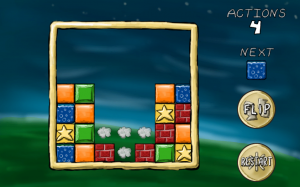
Clearing matches

Clearing matches

This is the trickiest part. Actually, this is probably why you’re reading this blog post.

Horizontal matching (as in Tetris) is pretty easy–you just need to look for contiguous tiles in the same row. Even allowing horizontal or vertical matches (as in Dr. Mario) is just a variation on this theme. However, trying to track a set of contiguous tiles that can vary horizontally and vertically is going to take some recursion.

Each time we take an action that changes the board, we’ll trigger a check. The first thing we do is copy our entire board array into another array:

 static void CopyBoard(GameTile[,] source, GameTile[,] destination)
 {
 for (int y = 0; y < BoardSize; y++)
 {
 for (int x = 0; x < BoardSize; x++)
 {
 destination[x, y] = source[x, y];
 }
 }
 }
 
 static bool clearedTiles = false;
 public static void MatchAndClear(GameTile[,] board)
 {
 clearedTiles = false;
 // Make a copy of the board to test
 CopyBoard(board, toTest);
 
 //... continued...

Why? We’ll see later that it makes it much easier to tell which tiles we’ve checked.

We start the process with a brute-force approach. We’ll go cell-by-cell (first rows, then columns), testing each cell. For each test, we’ll reset some variables we use to track our testing, and then call a separate function (which we’ll later use for recursion):

// Continued from MatchAndClear() above...
 
 currentTile = null;
 collector.Clear ();
 
 for (int y = 0; y < BoardSize; y++)
 {
 for (int x = 0; x < BoardSize; x++)
 {
 TestTile (x, y);
 
 // Continued later...

Let’s take a look at that TestTile function:

 static void TestTile(int x, int y)
 {
 // Tile already tested; skip
 if (toTest[x,y] == null)
 {
 return;
 }
 // Start testing a block
 if (currentTile == null)
 {
 currentTile = toTest[x, y];
 toTest[x, y] = null;
 collector.Add(currentTile);
 }
 
 // ** Skipped lines--we'll come back to these later **
 
 // If we're processing this tile, test all tiles around it
 if (x > 0)
 TestTile(x - 1, y);
 if (y > 0)
 TestTile(x, y - 1);
 if (x < Board.BoardSize - 1)
 TestTile(x + 1, y);
 if (y < Board.BoardSize - 1)
 TestTile(x, y + 1);
 }

If this function finds that the cell is null, then we skip it. A null cell means that it’s either empty, or we’ve already tested it. (That’s why we copied it into a separate array–we can manipulate the new array at will.).

If the cell has a value, though, we’ll do a few things. First, we’ll remember it as our “current” cell–the one at the top of the chain of recursion. Then, we’ll remove it from our copy of the gameboard so that we don’t test it twice. We’ll also add it to a List so we can remember how many contiguous tiles of the same color we’ve found.

There’s two other conditions we might run into later in the recursion, but we’ll talk about them later. Once we’ve tested a cell, we’ll then grab the four cells around them an run them through the same test.

The “current” cell is now set, indicating this isn’t our first level of recursion. On these function calls, we now have three possibilities for each cell.

First, the cell could be null, which again means we’ve already tested it or it’s empty. Again, we’ll do nothing if that’s the case.

Second, the cell could not match the “current” cell. In that case, we don’t consider it “tested.” Our recursion tests for a single set of contiguous tiles of a single color. Just because this tile isn’t part of the current set doesn’t mean it’s not part of a different one.

// From TestTile() above...
 
 // Tile doesn't match; skip
 else if (currentTile.TileColor != toTest[x, y].TileColor)
 {
 return;
 }

Third, the cell could be the same color as our “current” cell. If that’s the case, it’s been “tested,” so we’ll set it to null in our copy of the board. We’ll also add it to that List we use as an accumulator. This is one of the conditions we skipped in the example above:

// From TestTile() above...
 
 // Tile matches
 else
 {
 collector.Add(toTest[x, y]);
 toTest[x, y] = null;
 }

The function will continue recursing until it’s exhausted all options, either by hitting an empty cell or the edge of the board. At that point, we return to the main “brute force” loop to handle our results.

If our accumulator has more than three tiles, then this was a successful match. If not, then we’ve tested one or two tiles, but we don’t need to take action:

// Continued from MatchAndClear() above...
 
 if (collector.Count >= 3)
 {
 foreach (GameTile tile in collector)
 {
 ClearTile(tile.Column, tile.Row);
 clearedTiles = true;
 Soundboard.PlayClear();
 }
 }
 currentTile = null;
 collector.Clear ();
 }
 }
 
 if (clearedTiles)
 {
 SettleBlocks(board)
 }
 }

Here, as we’ll discuss later, I’m simply triggering some animations. The simplest approach, though, is to loop through our accumulator and call DestroyObject on each matching tile’s game object. That kills two birds with one stone: the in-game objects are gone, and the cells in our board state are set to null.

Dropping tiles
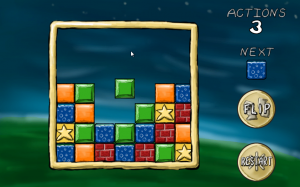
Dropping a tile

Dropping a tile

Certain changes–dropping a tile or clearing tiles, in this case–can leave unsupported tiles which must be resolved (if those are the rules of our puzzle game, of course). This is actually a really simple algorithm.

We’ll go column-by-column this time, then row-by-row. The order is important here.

In each column, we’ll work our way up from the bottom until we find an empty cell. Then, we’ll make a note of that cell. The next time we find a tile, we’ll simply shift it down to that location and add one to our “empty cell” index:

 static int? firstEmpty;
 public static void SettleBlocks(GameTile[,] board)
 {
 for (int x = 0; x < BoardSize; x++)
 {
 firstEmpty = null;
 for (int y = 0; y < BoardSize; y++)
 {
 if (board[x, y] == null && !firstEmpty.HasValue)
 {
 firstEmpty = y;
 }
 else if (firstEmpty.HasValue && board[x, y] != null)
 {
 board[x, firstEmpty.Value] = board[x, y];
 board[x, y] = null;
 firstEmpty++;
 }
 }
 }
 UpdateIndexes(false);
 }

When you’re done, don’t forget to call your matching function again. It’s entirely likely that dropping tiles has created some empty rows.

In fact, if we were scoring points, this would make it easy to award combo bonuses or multipliers. All of these repetitions of dropping and clearing blocks are just recursions of that first call that was triggered by a player action. We could tell both how many total matches resulted from a player action, and how many levels of “chaining” were required for each action.

Animations

This is a working game, but it’s not intuitive, primarily because we have no animations. Tiles disappear, then reappear on lower rows. It’s hard to figure out what’s really going on unless you’re watching closely.

This is tricky to do. Game objects are always a representation of game state, so our tiles are always laid out on a grid. Tiles are always in one space or another; so a tile might be in row 1 or row 2, but it’s never in row 1.5.

What’s the trick? We should never be manipulating the game board and animating at the same time. Think about how Tetris or Dr. Mario work–you don’t drop the next tile until everything has had a chance to settle. This gives a brief reprieve for the player, but it also ensure we don’t have any weird race conditions or interactions.

As an aside, I recommend creating a “game state” enumeration whenever you start a new project. I’ve never written a game where I didn’t need to know whether the game was in play, paused, showing a menu, in dialogue… I could go on. Best to plan for it early–that way you can ensure that every line of code you write tests that it should be running in this state.

Admittedly, my implementation is kludgy, but here’s the basic idea–when we clear or drop a tile, we trigger a state change. Each GameTile object knows how to handle this state change, and (more importantly) it knows when to tell the gameboard that it’s finished with its animation:

 void Update () {
 if (GameState.Mode == GameState.GameMode.Falling && Row != LastRow)
 {
 targetY = (Row * Board.TileSize) - Board.WorldOffset;
 
 tmpPos = _t.position;
 tmpPos.y -= FallSpeed * Time.deltaTime;
 if (tmpPos.y <= targetY)
 {
 Board.fallingBlocks.Remove(this);
 UpdatePosition();
 Soundboard.PlayDrop();
 }
 }
 }

When a clear animation finishes, the game needs to check if it should be dropping tiles:

 private static float timer;
 private const float DisappearTimer = 0.667f;
 void Update()
 {
 if (GameState.Mode == GameState.GameMode.Disappearing)
 {
 timer -= Time.deltaTime;
 if (timer <= 0)
 {
 GameState.Mode = GameState.GameMode.Playing;
 SettleBlocks(Tiles);
 }
 }

When the drop animation finishes, it needs to check for matches:

   if (GameState.Mode == GameState.GameMode.Falling && fallingBlocks.Count == 0)
 {
 GameState.Mode = GameState.GameMode.Playing;
 MatchAndClear(Tiles);
 }
 }

This cycle repeats until we finally don’t have any more matches, and then the game can go back to doing its thing.

Tags: LD30, SuccessStory, unity

Comments

SuaveDoesAmerica
17. Apr 2016 · 13:07 UTC
That unity plus tutorial is invite only :( Is there another version posted around the web?

How to make a 3D game in less than 48 hours

People keep wandering – how did I make my entry and comments like: “I don’t understand how you people make something like this in 48 hours. Do you even sleep?”, “Wow for 48 compo your graphics are spectacular!”, “Definitely a good looking game for 48 hours!” and “Thats really great work for 48 hours “. So, timelapse of my Twitch stream condensed to 144 times normal speed may give you hints how.

I used ShiVa3D game engine made by developer “Shiva Technologies” from France – awesome small community with great support and big potential, so check them out. Engine is awesome, it works great, you mostly play with it, it using LUA-like language – very popular gaming scripting language. Using this engine for couple of years now I’m so exited version 2.0 is coming soon to the public, opening more possibilities for developers to create great apps quick. And that the reason I use it for my company projects too – it is fast, especially if you making mobile games. It both simple and advance. Simple usage, compilation, import, export, security and ability to build for multiple platforms. Advanced users (not like me) can mess with theirs games, exporting code to c++, write plugins, make various API integrations like advertising and monetization for mobile platforms. All the things your “standard” game engine can do.

I’m not greatest designer in the world and I don’t even bother to make most of UV mapping for this project, time constrain, laziness, you name it, but ShiVa engine manage to fix it using advance graphic engine, which I didn’t crank up to the max.

Here we go – enjoy the “show”, don’t be to picky. Constructive criticism and job offers are welcomed.

Don’t forget to play the game: http://www.ludumdare.com/compo/ludum-dare-30/?action=preview&uid=35966

Tags: #48hours, compo, compo timelapse, LD30, shiva, shiva3d, timelapse, twitch

MERGE

First forgive me my bad English. I will try to express a synopsis of my game.
01
This game chronicles the journey of a last lapse of energy (perhaps a spirit, a conscience, a soul), who wanders into a mind in coma , trying to re-establish the connections to the higher layers of consciousness.
The player must drive this lapse in the moments that connect the conscious and unconscious. In constant oscillation, the game proves challenging.

Have Fun!

Lotus: A game development journal..

Well, Saturday was my mum’s birthday, so I had to travel to that, and then Sunday was a bbq and repeat watching of “Guardians of the Galaxy”, so I definitely had to go to that! In the end, I think I started development at about 8pm Sunday, and finished at 2am Monday night, so a game in 30 hours was pretty impressive as a personal best!

Sunday was a bit strange.. I was thinking about the rubiks cube on the table and wondering if there was a way to portray all the connections on a flat plane without any lines crossing over.. I drew out lots of different diagrams with the transitions between the colours about thirty times, searching for one. The best happened when I started again and drew a cube almost corner on. Drawing the lines led to a hexagon with all the vertices joining. From there it turned into a triforce with semicircles on the outside, and from there, it turned into three linked rings.

I learnt pretty fast that I can’t draw circles on paper (or ms paint) to save my life.. So after tightening up the rings, I switched to Java2D and had to figure out the measurements by hand. To draw everything, I used CVG to construct Area objects based on the overlap of circles which I could then colour in. After that I had to figure out a data structure. Perversely, I decided to have a data structure which is based on Boolean logic. This meant that to decide on the location of a cell, it was either on the inside/outside track, or within the center or outside the circle. For all the movement rules, I had to get the colour of the cell into an array, alter it, then push it back. This took me to 2am for all the shifts and I went to bed.

On Monday, I realised that the rotations of the pieces had not been added, so I did that and added the lines to make the control buttons more obvious. I could have written Shift left, or L/R on the buttons, but I wanted it to be mysterious, alien and independent of language. These little lines were a bit of a time waste.. It would have been better to have hover highlight on everything.

For kicks, I set all the colours of a rubiks cube and sent it to my friends. It was 5pm. Coming back from lunch, I decided that I could make some levels a puzzle game. This meant that I had to create an obvious win condition, and come up with puzzles.. And that is how I spent a lot of the day, fiddling to set cells and fiddling to see if puzzles were completable. I guessed that the pieces that corresponded to corner pieces would be able to be put anywhere, so I used that in the rest of the puzzles. I wasted a lot of time corresponding the puzzles to the colours, and positioning the outer circles for the level selection. Coming up to 2am, I realised that the final 2×2 rubiks cube had no win condition, but the logic was slow to write, so I left it. I don’t think anyone noticed.. It’s not like I had anything to show afterwards!

I was surprised that the reactions to the game were so positive and that someone had the patience and skills to complete it! And I was also relieved that it was completable!

I think I made the correct decision to make 6 levels, rather than work on extra features I had dreamed about.. With cells turning into coloured balls and moving round the circle to the next cell (the locations and movements would have to be coded by hand). Sound would have been fairly easy, but I was worried that music would be repetitive if someone was playing for a while, so I left it out.

It would have been better if I had used WYSIWYG to determine where the circles should go, or made a function for click to select cell (and report the cell). I didn’t, and I found it especially difficult to go through a process of selecting the correct cell every time. This would have probably saved 5 hours.

Rate link: http://www.ludumdare.com/compo/ludum-dare-30/?action=preview&uid=19350

Connecting Worlds – Post mortem

EntryImage

[Play my game “Connecting Worlds” here]


This time was actually the first time I had a chance to send in something that I felt was finished and worth posting.

Naturally this is also my first post mortem, so bear with me :p

Being in the Netherlands ment that the theme would be announced 3 am local time. I tried staying up but I kind of wanted to sleep at 1 so I decided to not stay awake.
The next day first thing I did was look up the theme and take a good shower which helped out pretty well.
I think I only got a few options for myself but this one seemed small enough to actually finish in 48 hours.
Sunday I wouldn’t have much time so I tried to complete as much as I could on Saterday.
I started out in Planbox (a handy tool I’de like to use instead of the old-school TODO txt files), planning all things I needed to do to complete the idea.

Starting with the art for the planets actually came pretty natural and I was very, very pleased with how it turned out.

World World2


I was going to use Unity which allows for coloring of sprites so I only used grayscale colors to “draw” the images (actually just placing pixels).
Also, I just love how you can make stuff look like something with a few layers of gray, presenting angles in the image that aren’t really there, if you get what I mean.

After 4 hours or so all art for the game was done (planets, bridge, turret, initial astroids) so it was time to build the gameplay.
Usually I just spend time making “useful” stuff to speed up development, though this time I just went with what I had to do and do more “hacking together”.

The next day I didn’t had much time and I ended up with all features implemented, just non of the interface to support it.

48hoursIn

This ment that I just had to move away from the compo and try submitting to the jam the next day.

The next day I spend some more time doing art for the UI and implementing that all.
In the end – it was the last 10 minutes before deadline – I called it done-ish and started to get the stuff ready for the web.
There was no sound and not much polish but it had to go and I was happy with it.


I guess it’s time for the propper post mortem categories now :p


The good

  • I made pretty sick art: I actually didn’t though I was able to impress myself with the quality of art I made this game. Sure I made art before but this time I felt like I grew a little in what I could do, and now CAN do.
  • I finished it and it has gameplay!!: As I said, usually I spent more time working on utilities that “help” me finish my games easier but this time I just went ahead and actually hook everything up and get it to work as a real game.
  • The game is pretty fun and easy to extend: I haven’t played it with someone else yet, but even solo the game was pretty fun (even it was too hard).

The love for programming flamed up as it never did before. Which is a good thing since it inspired me to continue to work on this thing and continue with my other projects a bit easier as well. Completing a game and sharing it is, I think, one of the most important things to do if you work in this industry. I had never done it before…well I did with the companies I worked for, but this time it was really something that is truely me and no-one else and that makes it feel very special.


The bad

  • Astroids: The art for the astroids!! Omg I have redone that so many times because I wasn’t pleased with it. The end result is pretty good. The other times I tried to hard to make it match the other style with the black and white stuff only. (Don’t tell anyone but the final astroids are just a random outline filled with a gradient stroke.)
  • Balancing: I didn’t took the time to actually play the game as a full thing during development. In the end this led to a pretty hard game since I didn’t had time to balance it out a little. Most of the values in there are just my first intuition of what I though would fit (not horrible but could have been better).
  • No explanation: I fixed this pretty early on the next day after submission by adding a simpel line that you can actually press f1 to show the keys again. I had this implemented but didn’t let the player know this.
  • Some bugs: Sure there were some bugs that actually broke how the game should be played (clicking disabled buttons with the mouse would trigger and such). This again was due to the fact that I didn’t played my own game.

The day after submission I spent the full day going through everything and fix the bugs that broke the game as well as update the entry post to provide extra information.


What’s After…

At the moment I’m still working on the same project and I’m almost done implementing the Versus mode that was brought up in several comments on my submission entry.
Thanks all for the comments! I really kept me focused on what was next.
I’ve also polished up some things and I still want to fully implement touch and mouse support since that’s what I’m trying to do with my other current project I’m working on (tablet racegame).

Versus

I will post the updated version with Versus mode soon so you can all play it against your friends and family!


Tags: post-mortem, tl;dr

Color Wheel (download error fixed)


For those who had issues with downloading the game before, the issues have been resolved by switching from dropbox to mediafire.

Click on the picture to visit the entry.

For those who have not played our game yet, I suggest you give it a try.

We hope to create an upgraded version of the game later this year to help the game reach our original vision of it. For more information on the upcoming Color Wheel Version 2, visit our blog.


Dude Launch Post-mortem (Ludum Dare 30 compo)

This was my first Ludum Dare and actually first game ever. I had a blast developing and playing my game, so I thought I’d contribute a small write-up of how things went.

DUDE LAUNCH -- launch dudes at the moon! Includes 3 game modes: campaign, endless, and &quot;infinite dudes.&quot;

DUDE LAUNCH — launch dudes at the moon! Includes 3 game modes: campaign, endless, and “infinite dudes.”

An example of Infinite Dudes mode of Dude Launch

An example of Infinite Dudes mode of Dude Launch

What I used:

  • Code: Haxe (language, targeted Flash), HaxeFlixel (library), Flashdevelop (IDE)
  • Art: Paint.NET
  • Sounds: bfxr
  • Music: Autotracker-Bu

What went right:

  • Theme/idea — I loved the theme and was inspired to draw from Italian author Italo Calvino’s short story “The Distance of the Moon” (from Cosmicomics) for my game. The premise is that the moon comes extremely close to the surface of the Earth, and all you need to climb onto it is a boat and a ladder. If you aren’t familiar with it, then you may recognize La Luna, a Pixar short that was based on Calvino’s work.

    A still from the Pixar short animation La Luna, based on Cosmicomics by Italo Calvino

    A still from the Pixar short animation La Luna, based on Cosmicomics by Italo Calvino

  • Central mechanic — I wanted something arcade-y, so skill-based and fast. Something fun. While brainstorming, I remembered an old DOS game called Night Raid (maybe Night Raid 2?), where you shoot bullets from a little bunker to stop parachuting dudes from landing and invading. This fit brilliantly with my initial idea: instead of shooting bullets, you launch dudes (hence the game’s name) from the ladder, who have to jump the gulf of space and use gravity to land on the moon)

    An old DOS game called Night Raid

    An old DOS game: Night Raid

  • Programming — I’ve been working on a hobby game in HaxeFlixel (nowhere near done), and I know programming already, so this was not too challenging for me. No bugs were found, as far as I can tell.
  • Music, sounds — the content generation tools recommended by the Ludum Dare community are amazing! They create assets almost instantaneously, which helped my game feel way more polished. Autotracker-Bu is next to magic, and I actually plan to sit down and peruse its source thoroughly.
  • Art — I am not a pixel artist. I decided to embrace my programmer art, and use a simple style (again, reminiscent of Night Raid). I stayed consistent in my style, so I think I pulled it off :) — the best part is of course the dudes themselves.
  • Juice — though I could use more juice, all the extra little things worked well. The pretentiousness of juxtaposing a Calvino quote on a Flash game works well on two levels: it heightens the silliness of “Dude Launch” and serves to set up the setting and theme of the game. Other little things include the particle emitters (explosions), level transitions, and the multiple game modes.

What (almost) went wrong:

  • Controls? — I say with a question because the whole point of the game is the wonky QWOP-like controls. If the ladder was rigid and the boat had pixel-perfect movement, what would be the challenge? Still, some people complained about it, though many more “got it” and loved it. Another person requested key-remapping, which I think is also a little much given this is a Flash game (can you remap QWOP keys?) and a game made in 48 hours.
  • UI / feedback — no one commented on this, but I feel it was a failure. If I had more time and skills at designing UI, I would’ve presented feedback to the user differently than just have “debug”-type info splashed in the upper screen. I think a bar at the bottom tracking dudes left would’ve been better. Also, dudes could’ve changed color to reflect their velocity, so players could better understand why they died or not.
  • Time — simply put, I went up until the last hour working on polishing my game, removing comments from the code, packing it all up, hosting it. Putting things like music (!) in at the last minute was risky but I am so glad I powered through and kept working. Next time I’ll have better pacing.
  • Scope — originally, the idea was to have dudes walk around on the moon then attempt a return. After the first couple hours of day 1, I knew there was no way I could get that to work. Thankfully, having dudes explode when they hit the moon or sea was fun enough by itself, so I had a better-scoped game than I realized! The lesson here is: pare your game down to the lowest level of workable gameplay and make it really good.

Overall, I’d say my game was successful. I set out to make a simple, weird, funny game that people found both amusing and fun. Most of “what went wrong” didn’t really go wrong — it almost did. In fact, it came out way more polished and bug free than I would’ve anticipated. But most important of all: the players. The feedback from players has been positive and most have embraced the ridiculousness of the game and controls. It’s really satisfying putting a game out there and seeing others enjoy it.

Thanks to all players and your input!

Thanks for being a really great community. Looking forward to more Ludum Dare compos/jams in the future!

P.S. – my favorite comment on the game: “Very creative and intuitive control scheme. This could be expanded into a full game with a bit more story, obstacles etc. It’s really fun as it is and there’s something strangely beautiful about seeing a host of little naked dudes caught up between the moon and the sea – Calvino would have approved. :)“

Tags: compo, dude launch, flash, haXe, HaXeFlixel, journal, LD30, ld48, Ludum Dare, post-mortem, postmortem

Streaming live plays of your game!

I will be taking requests and streaming live plays of Ludum Dare #30 games off and on August 30-Sept 1.  I am new at this so I may be a bit slow and disorganized, please be patient.  :)  But hay, it’s live feedback and I’ll rate your game on the stream as well.  (Special thanks to metaldemon (AtomicVikings) for the inspiration.) http://www.twitch.tv/haymanmarc/

Comments

KingBolonzo
30. Aug 2014 · 18:08 UTC
Sounds awesome love to see it please let me know when and where u start. If you could play my game id Love u forever lol my game is holiday nightmare

Connected Worlds with Connected Words

What is it like to be John Cleese, Emma Watson, or Notch? Connect words to enter their worlds through the social network.

In Connected Words, you arrange words to try to figure out what people are saying.

Just listen to the reviewers!

“Another typo theme interpretation, which turned out actually pretty fun and playable.”
— 43iscoding

“Surprisingly addictive” — mrexcessive

“this was too hard!” — danidre14

“this will be training of language for me” — shimage


Get connected today!

ConnectedWordsAnim

Comments

43iscoding
30. Aug 2014 · 19:31 UTC
When dragged out of context, my comment looks weird :/

** Post-Mortem


screenshot_bunny

What went right:

+ Memorizing: Dots to connect is surprisingly challenging even at your own pace.

+ No words: Matt suggested connect the dots and Diana had ideas about constellations. Jennifer and Beth also playtested, which clarified the tutorial. No words needed to play. The title ** also has no words. I now call the game .. (DotDot).

+ Drawing: Exported Flash drawings to Adobe Illustrator format and wrote a Python script to parse them into a JSON-like object. Clean separation of model and view.


screenshot

What went wrong:

– Convoluted teardown state: A bug that showed another drawing after the end of the game cost hours of troubleshooting. Next time could simplify the last trial teardown.

– Silent: Wasn’t satisfied with 8-bit sounds, so didn’t add sounds post-compo version. Next time could prepare to use MuseScore.

– Strict: Dots were too exact until post-compo version. Next time could playtest more Sunday afternoon.

– Scoreless: Wasn’t clear about a scoring system until the post-compo version. Next time could playtest more Sunday afternoon.

Play the 48-hour version or post-compo version

Ludum Dare 30 Postpartum

I wrote about my experience with Ludum Dare on my personal site.

LD30 – Planetary Devourers can be considered a puzzle game in which you have to navigate an all-consuming swarm from planet to planet in order to reach a warpgate to another solar system. The swarm consumes the planets it occupies, destroying them once they are completely consumed. This can cause the swarm to get stranded in space, sentencing it to doom with no way to escape.

More information about the game itself can be found on the official LD30 – Planetary Devourers game page.

Read the rest of the article on my site.

Tags: jam, LD30, ldjam, Planetary Devourers, post-mortem, postmortem, postpartum, unity, unity3d

Universal Love – Post Mortem

Hi everybody!

I’ve been away for the first week after the deadline ended (vacation and travel time, woot!) but I’m back now to just sit and recap for a moment the ups & downs that took place during the creation of my last submission:

universal Love Banner


 What went right

The initial concept for the game involved a space station that destroyed planets by chomping them to pieces right after catching them with a gigantic intergalactic hook. That idea seemed fun enough but from the moment I started thinking about it I just became bored with it. Instead of committing to it and trying to make it work somehow I completely ditched it in favor for a new and completely different idea. That’s when I came up with the idea of planets loving or blasting each other with missiles inside a solar system, while letting the player control one of them, allowing the player to intervene in this cosmic relations simulation.

Once the idea was decided y prototyped it pretty fast and the art came up together really nicely. I wanted to give the game a 16 bit look so I spent some time looking at how games like Super Metroid and Starfox draw their space and planets, you can totally see the similarities in there, apart from the fact that my art is nowhere near as good as those two examples.

The other big staple came up with the AI. I was a bit scared when I started to program it, thinking that it might not be fun enough to play against or that it may turn up to be way too random. Turns out my fairly simple approach worked right from the start so I didn’t have to tweak or change it too much. It works really good, and totally gives the impression that it is far more intelligent that it really is, which for me is a complete triumph.


scr2

 
 What didn’t go so well

To be honest I don’t really have much to say here. I managed to finish everything on time and without facing many real roadblocks along the way, but If I must mention something it should be the trouble I had trying to make the turn system work out. I might also add that I would have liked to have better looking menus and text, which now look a bit bland in my opinion. Also, apparently the objectives are not easily noticeable so I guess the notification messages need to be larger or better presented. Lastly, I didn’t have time to come up with any good ambience music, which I think would have boosted up the experience a bit further.

 Conclusion

In general I am absolutely happy about my submission, considering that my only and most important goal was to be able to finish something up that was completely done and playable and that it managed to give players at least 5 minutes of fun.

And I think I somehow managed to do just that :)

Go ahead and give it a try!

Play+rate Universal Love!


Connecting: post-mortem

This was originally posted over at my tumblr where I sometimes write about games. You can play Connecting here!

1 – The theme

The part of “Connecting Worlds” that interested me the most was not necessarily “Worlds”, but “Connecting”. It suggests liminality, something that exists between worlds but is not a part of either.* So my game, then, would be about being between, about being in a constant state of connecting – connecting being a present tense verb, so the title in a way suggests that sustained liminality. From there it wasn’t a difficult leap to “airport”; travel is one of the most obvious and popular forms of the liminal that we can all recognise.

“Connected” also suggests a relationship, not just the actual connection itself but what that connection represents to each part. Naturally I went for a very literal definition of “relationship” and decided to make the game about communication between partners. Texting was the best way of displaying information about the relationship to the player in an interactive way, and continuing with the idea of liminalities, the phone can be seen as something facilitating the relationship between the player and Sam without being in the relationship. I mean, obviously. That would be weird otherwise.

2 – Sam and Robin

One of the most interesting comments on the Ludum Dare page for Connecting came from vctr_seleucos* who wrote:

“One last thing, it took me a long to realize the player is a boy, at first i think i was the gf xD Well, Sam is a weird name. Other avatars (more realistic) or names should fix it.”

The thing is, the player isn’t necessarily a boy, and Sam isn’t necessarily a girl. The same goes with Robin – both** the named characters in the game are so called because Sam and Robin are gender-neutral names. As a result, the player is supposedly able to fill in these gaps if they choose to. It plays into the concept of not tying the player to any particular canon – something I brought up in my last journal entry.

I’m not saying vctr_seleucos is wrong for thinking Sam is a girl and the player is a boy. That’s their decision to make and forms one aspect of their personal relationship with the game, with the scenario that they helped form as much as they participated in it.

LD30screenshot1

3 – Player as co-author

I think this is a good place from which to extrapolate the wider ways in which I wanted to play with the relationship between the player and the game. In a journal entry on LD I wrote:

“What this is an experiment (?) in is presenting the player with a situation without giving them prior information on it. The game is essentially asking the player to roll with the punches, to take in new information, use it to adjust their view of the scenario and make a response accordingly. You are essentially blagging your way through this dialogue tree.”

In doing this, I wanted to expand the possible paths that the story could take. By not providing a fixed context for the story, it let the player pick up any threads they wished without forcing them into a tell the truth/lie about everything binary. One unintended side effect of this is that people were happy to replay the game, to pick different options and create different stories as opposed to having the same story told again differently.

4 – Problems and improvements

There are a couple of things that I would have liked to have changed that I feel were within the scope of the jam.

The first is something that a couple of commenters have picked up on, which is that some of the endings feel incomplete. They’re meant to be ambiguous as part of the process by which the player fills in contextual information, but nevertheless there are a few paths where the conversation seems to just end. This is particularly true of the endings where Sam breaks up with you; the conversation ramps up the tension towards your reveal of your indiscretion, but after that there are only two or three bits of dialogue before the game just ends. On the one hand, it felt realistic as I was writing it – why prolong a conversation doomed to end badly? On the other hand, it serves the player no good because the for the player that conversation is the entirety of their experience within the relationship.

The second is more technical. When the player selects a response there’s a short pause of a couple of seconds before another message from Sam is received. Initially, I wanted the dialogue option that wasn’t picked to disappear so that there was a visual telegraph indicating which option had been picked. Alas, no matter what I tried, Game Maker offered no solution for me to destroy an object from within the event programming of another. There is, supposedly, a GML-based solution floating around various old support forums, but it never worked for me no matter how hard I tried.

LD30screenshot2

5 – Future scope

A post-Ludum Dare version of Connecting would work out those problems I mentioned above, as well as extending the whole scope of the game. Originally, the player was going to have parallel conversations with three people: Sam, Robin and another friend. The scenario would have been roughly the same, except because the player could talk to Robin there’s an opportunity for the player to establish what happened the previous night which would then act as extra context for the conversation with Sam – essentially determining whether you lie or not. Depending on where the conversation with each character went, the other conversations would make subtle shifts in tone or subject. Something else that Mallot1 suggested was having parts of the game take place on the plane, essentially adding another conversation. This would have the added benefit of allowing for better pacing in terms of the revelation (if you choose to have one) and the aftermath (should it follow).

nothke suggested adding in a countdown to correspond with the time until your flight leaves. This was also briefly part of the original scope, and would help provide a sense of time progression as well as story progression to the game. You also had the option to ignore message for half an hour or so, which would have consequences on the way the story went, and I’d like to have all of that in a polished, expanded release.

6 – Closing thoughts

This is going to seem very arrogant, but I really like my little game. It turned out better than I imagined, thanks in huge part to Sandy Gardners amazing artwork – thank you again! I’m overwhelmed by the response that the game has gotten – hell, the idea that people played it multiple times to see how many different paths they could take is arguably the biggest compliment I could have received. I’m immensely glad that I decided to do Ludum Dare*** and the positive, energetic atmosphere around the whole community has both inspired me to do more game development in the future****, as well as acting as a welcome buffer against the awful month that the wider games community has had.


* vctr_seleucos made the platformer “Becky’s Adventure in Mirrorland” for LD30 which is, for my money, one of the more immediately enjoyable games I’ve played so far!

** Okay I guess Grey is a named character as well, but that serves the purpose of one optional joke. For what it’s worth, I think Grey is a really cool, interesting name and Sam’s totally being an asshole.

*** I only found out there was another jam with about 2 hours to go before it started!

**** Yeah, this was my first game ever.


Comments

Snoother
30. Aug 2014 · 22:10 UTC
Your first game? Wow! You should be really bloody proud. And I hadn’t noticed the gender neutral name thing — in my case I just assumed it was two guys. There are some gender suggestions though: I can’t really imagine two dykes using the ‘riding a stallion’ euphemism, for instance.
jackyjjc
30. Aug 2014 · 23:20 UTC
It was a really good game and you should definitely be proud! I would love to play your post ludum dare version of it :)

R.E.P.O.C.O.S.M.O.S. post mortem

greetings! I bring you the post-mortem for R.E.P.O.C.O.S.M.O.S.

Theme

First had an idea for a multi-player :) real time strategy game with connecting planets through some kind of piramid stargate when planets are aligned in the correct rotation, where you expolore and colonise planets, mine resources from asteroids and build spaceports for new ships and these piramid stargates to get a fast connection to travel between the planets. really liked this idea but the way i first envisioned it would be impossible to make sense off in 2/3 days, i kept the stargate – tower idea..but went for more close up scale. These stargates didn’t get any actual role in the game just yet. Right now it’s more part of the backstory where you need to re-secure this so stargate called the ‘worhole initiation tower’. In a post game these will get a lot more attention, and will serve as the goal of the game for different mission, perhaps with a bit of the RTS backstory on a more planetary level..

tower

What went right

This being my second Ludum Dare, i’m extremely happy with the result..the extra work i put in my first entry developing a post-game really payed off, a lot more experience with unity this time, i’ve had a nice balance between work spend on graphics, sound and coding, where the game is not over focused on only one particular element…the gameplay of gaining velocity and jumping between planets has come out really well, though i’ve probably spend a bit to much time polishing this in comparison to the combat system and level design..very pleased with the sound. I originally had an other track i made about a year ago for it..but i didn’t feel exactly right as is was more a song/soundtrack. fortunately my friend/composer Anna came up with a great track she had made, that fit the mood i was looking for extremely well, i just added some bass to it on the korg dw-6000 and it was done, i had a couple more synth chords to go with it when enemy’s appear but they didn’t get into the game yet. the sound effects on top off that I made with abletons operator fm synth…

repocosmos

What gives ?

not much really, time trouble maybe, could not start until Saturday afternoon, so i went for the jam..there is a lot more i wanted to put in, the enemy’s I put in the last few hours are only what I had planned as part of the planetary defense-system, some off the planets would be patrolled by rogue robots, some flying things and probably some bigger end-boss robot near the tower, so the level is not yet what i was aiming for, but what can you do in 2 or 3 days…Also the aiming of the laser still needs a lot of improvement. Still I’m really happy I got up a level which it is fully playable and the main ideas come across…

What’s next ?

Definitely going to work on this up to one full playable level the way i intended…I experimented a bit with mouse aiming, though i’m still sure how to implement it best when aiming for something behind the player…right now i’m already working on the droids and end-boss..when they are in i will take the combat system for a do-over :)

the droids that didn’t get in…yet..

newdroid


If this post-mortem got you enthausiastic to take a look, play it here :

http://www.ludumdare.com/compo/ludum-dare-30/?action=preview&uid=29159

Comments and suggestions are greatly appreciated.

I’d really want Unity to have a better MouseLook script in their default assets. If you think this issue is important, vote for it!

Are you tired of playing Unity3D games, some of which are great, while being annoyed by a terrible, hyperspeed camera movement that feels very buggy? Do you want Unity to come with a better MouseLook script? If so, please vote on this idea!

Enhance the MouseLook.cs script that come with Unity’s standard assets.

And if you are a dev, make sure to use better scripts:

http://forum.unity3d.com/threads/a-free-simple-smooth-mouselook.73117/
http://wiki.unity3d.com/index.php/SmoothMouseLook

(Note: you need an Unity3D account to vote.)

Let’s do this!


Comments

31. Aug 2014 · 04:45 UTC
Not sure if you’ve heard, but the Standard Assets won’t be used from Unity 5 onwards; instead, they’ll be replaced with ‘Sample Assets’, which won’t come bundled with the Editor, and are able to be updated without downloading a full new version of Unity (1.1GB currently).

What you did there is amazing!

Hello fellow darers and daresses,

Congrats to all of you who finished – the feeling you’ve been feeling the morning after (I hope it was – as in my case – overall positive) was very well deserved!
I have been playing and rating and playing and rating and I’m amazed with the high quality of so many entries. Of course of the small fraction of games I’ve played so far there’s some that I consider very very interesting, well executed or just simply beautiful in their entirety (connection of gameplay, graphics and audio).

Here’s my list of yummy LD games you might not have seen (thus far) – I know I know YOUR GAME is probably missing. So tell me where to find it ;) @leafthief !

  • One Ship Two Ship Redshift Blueshift a well polished PVP or PVE breakout/shmup crossover that’ll leave you wanting more.
  • Lady Lyla check it out and give it time – be patient – and you will see a cute and inspiring take on the theme, you’ll wish there was more (and sound ;))
  • Mor this is something else. Sounds and looks good and carries a message that’s rather obvious. Hauntingly executed.
  • Sun God Star Bridge like Power Rangers, Rainbow Unicorn Attack or He-Man? Then you’ll probably like this. I played it all the way through and had so much fun, it deserves some ratings!
  • Planetary Marriage Counseling had me laughing  so hard. Humor communicated through gameplay. I loved this and I think you should too. So well staged.

Ah that was great, wasn’t it? Wilma wants to tell you so as well:

wilma_goodjob

Now probably comes the shameless self-promotion. So here comes the shameless self promotion:

I made this game The Lion’s Song and I would really appreciate you taking time (~10 min) and playing it. It’s a short-story format point & click adventure game. If you have trouble playing it (it’s windows only) then there’s a small video of the first few minutes of “gameplay.”

Game Page download_thumb video_thumb

Ludum Dare site redesign

I was bored today, and seeing as there’s talk about re-doing the website I thought I’d try a quick redesign – mostly just different skin, similar layout for the most part. I added on a scrollable bar of random game thumbnails at the top. Would love to have a forum too. Click for full size:

Ludum Dare Redesign 03

Notifications would be nice:

Notifications

This colour scheme looks oddly similar to my game’s, lol.

I’m at pax prime! Any coders here want to meetup/have a chat on Sunday/Monday?

Hey guys, I’m here in a hotel attending pax prime all four days.

First off TL:DR If you have done the Ludum Dare/are a coder and are here at pax prime in Seattle, comment here or better yet, tweet me @djdduty I would love to chat/meetup and chill for a bit to get away from the Expo hall tomorrow, Sunday 8/31 or Monday 9/1.

This is my first time to pax and I love the friendly atmosphere, and knowing that everyone around you will share at least some interests. Being able to stop and talk to any random person you find like you are friends is an amazing thing, no awkwardness despite being sometimes awkward people.

Anyway, I notice the distinct lack of other programmers like myself that aren’t being swarmed because they are devs on some popular games, and I really want to meet up with some other programmers, sit and talk about coding, the ludum dare, just to say hello, anything.

Developing my entry into a full game

I’ve started work on developing my entry ‘Bound‘ into a full game. This isn’t the first time I’ve tried to develop a Ludum Dare entry further to make a full game, as I also started doing so with my first entry ‘Birth‘ after LD 27. But this is the first time I’ve had a clear vision for how the final game will look and play.

I thought some of you might be interested to see my current progress in developing the visual style of the game:

nomnom3


There are obvious comparisons to be drawn with Super Meat Boy, but the little slime guy in my game (currently called Nomnom) has a slightly bigger range of movement options to Meat Boy, being able to stick to and walk across ceilings for limited periods of time. The tile graphics are still very much a work in progress, but the character is coming along nicely.

I’ll shortly be starting a development blog for this game on my new site http://cavycade.com, so if you’re interested in seeing how he progresses come along and have a read. In the meantime, if you’d like to have a play of my admittedly incomplete entry for the contest, take a look here. You can at least get an idea of how Nomnom will control in the final game.


kosmovalse

Hello, everyone. Iam ‘the’, and i made a game for this Ludum Dare, named ‘KOSMOVALSE‘. It is a game where you fly in open space around asteroids, kill monsters, collect armor and health bonuses and earn scores.
Of course, i planned to make something more, but it is a 48 hours competition, right?

1234

So, let’s talk firstly about two big fails in my game:

  1. Theme. I wanted to do really small worlds in every asteroids with bosses and NPC. And enemies in space just must interfere to player to travel between them. Now it is sounds funny, but every time i planned to make a game, it is looks like Fallout, even not first. So, after a 24 hours when only mechanics was done, i decide to do something more then color changes only when i have enough time at the end of second day.
  2. PyOpenGL. It was first public game i made with PyOpenGL API instead of pure pygame and now i have a lot of comments like “crashed after button pressed”. That is means OpenGl shaders really do not work in many systems even between gamers from ludum dare community and i need to find a way to do something with that if i want to use them. Because of this I spend Monday morning to recompile sources with exceptions and also i very very sad now.

pic1

After this i want to say what in my opinion was a good in my game :

  1. Walking on asteroids. I do not know any other 2d games when you can walk on surfaces that placed at any angle (comment, if you know). Mostly people do platformers with simple gravitation scheme and sometimes with wall jumping, because of this it was pretty interesting for me to made a game where player can run on non-spherical asteroids.
  2. Black-white color scheme. I spend a lot of time in first day to understand how the game world will be looks like, especially asteroids (try to write shaders for them, use brown texture), and finally found this awesome simple scheme. I am not god at drawing (you can check my previous ludum dare game for example) and it was really great decision.

pic2

In addition this is a history of my ludum dare weekend:

  • Day 1, progress 0% ) O no, they chose this theme =(
  • Day 1, progress 2% ) This green rectangle is player and he is moving, not bad.
  • Day 1, progress 5% ) This connected lines are asteroids, let’s make a collision system.
  • Day 1, progress 15% ) Ok, i did it!
  • Day 1, progress 10% ) No, i dont =( need to find a bag
  • Day 1, progress 25% ) Now it is a lot of asteroids and i can walk on them and fly between them!
  • Day 1, progress 35% ) Made shader for player rocket-pack trace, not bad.
  • Day 1, progress 35% ) This shader for asteroids looks ugly.
  • Day 1, progress 35% ) This shader for asteroids still looks ugly.
  • Day 1, progress 35% ) x_X
  • Day 1, progress 35% ) Why i even decide to take a part in this ludum dare when i can spend my weekends for something else, i will never add a second world and complete this game in time!(
  • Day 1, progress 45% ) This black and white scheme looks cool, draw a player sprites in them.
  • Day ?, progress 50% ) First enemy appeared, need to sleep
  • Day 2, progress 60% ) Now player can shoot, also added new enemy.
  • Day 2, progress 70% ) Now with three enemy classes and routine with they sprites load code looks terribly, no way to found something in.
  • Day 2, progress 80% ) Finally I have a headache from all of this generated sounds.
  • Day 2, progress 90% ) Hey, this menu appeared when i smashed my head on keyboard.
  • Day 2, progress 95% ) Ok, compiled file do not work under Windows, need to load extra GLUT dlls.
  • Day 2, progress 100% ) Uploa….. sleep.

PS. You can find my entry here, some of my previous games available here and here. If you know what is a problem with OpenGl shaders please post some information or link, i will be really happy. Sorry for bad English!.

Tags: #indiegame, gamedev, indiedev, ludum dare 30, opengl, postmortem, pygame, PyOpenGL, python

Post-mortem

Honoring the traditions of our ancestors, I shall reveal my process, with all its flaws and failures.

So I did my this odd little thing called In My Garden, a text based… well, is it game? I’m not sure. It is some sort of experience and I guess, this was my starting point. I took the theme “Connected Worlds” more as a structural idea and thought about two different layers that might influence each other, without being to closely connected. I hoped this would give a more elusive and “magical” connection between video/sound and text, possibly stiring and creating subconcious motions.

So, what went well? I got some positive feedback for the writing. I spend the bulk of the time, almost eight hours, simply on that text, writing, editing, writing editing. I think this led to a particular quality, considering the short amount of time. My native language is German, so I was rather nervous to write and “publish” something in a language, that I learned for less then four years in school (what a vain sentence; I have been working in the English speaking world for a good decade, so I had enough time to practise…). I think there’s some substantial improvements that one could make considering the dramaturgy of the text, more garden, less retirement f.ex., but all in all, the general structure does seem to work.

What went wrong? My camera broke (video was recorded with mobile). My binaural microphones “broke” and I couldn’t record without a really annoying hissing noise, possibly the cable is. I would have liked to have a really good video and audio layer and possibly also have more footage, but I lost a good chunk of daytime, shouting at my equipment and accusing everyone around me to have tinkered with it.

What went… amiss? There’s plenty of things, that could have been done differently. Obviously an integration of video and text in the same layer would have been an option. I chose not to do that, since I would have spend most of the time fiddeling around in Unity and the file would have been slightly large. I prefered to spend that time writing.

What’s next? Other works. Me and Mr.Headchant will finish a nice action rpg over the next week, do some of our serious adult work and then I will make a post-compo version. Not sure where to go. Bin the video/audio and just make something for e-readers? Or at least attempt to bring the layers together in Unity. I’m happy for any advice and/or remark! And thanks for playing and drinking all that beer in the garden.

paper

Your games on our LiveStream!

Hi there, people!

I’ll be doing another livestream of your Ludum Dare games. This time I’ll be accompanied by my brother, so you’ll be getting a second opinion. If you want your game on the stream, click here and send us your entry.

We’ll start streaming in about 30 minutes, just need to finish setting up and all that. Do join us in the fun, we’re looking forward to playing some of your awesome games!

FACED – Post Mortem

    If it fits, I sits.  

Play the game!


Post mortem

Information

  • Start: ~11:00 AM (5:00 AM EST)
  • End 3:00 PM (9 PM EST)
  • Time spend sleeping: ~18 hours
  • Software used: Sublime Text, LÖVE, Aseprite, Pixitracker

Sick

So this Ludum Dare didn’t went smooth for me, because what happened, is that I got sick. This led me to end up with almost no progress on day one, except for maybe the main mechanic. I went to bed early and slept almost 12 hours. My last Ludum Dare I spend only 11 hours sleeping, so being sick cost me 7 hours on sleeping only. On day 2 I felt a lot better, and somehow got my motivation back to make the best out of this.

Idea

The game idea came natural to me. As if in a fingersnip I had the idea of the  whole game down. No idea what happened 😛

Good game choices

  • The artstyle

First the game looked like this:


It looked dark, gray, and just ugly. I decided I had to make it look more colorful. First I tried giving every color also its own shape, but that looked confusing. So then I decided to make them all squared, and give them faces. I get a lot of good feedback about how the faces tell you if they are overlaying or not. I’m very happy with the artstyle I ended up with.

  • The size

I think 5×5 was the perfect size for this game. I first made it really big, like 10×10 or something. I’m happy that I noticed I had to keep it smaller.


Bad game choices

  • The music

Hit me in the face. I am such a dumb-ass. So I can’t make very good music. I tried some stuff but it just sounded bad. I ended up with a very simple, short tune. The game itself looked simple, so the simple music would fit. But I was afraid people would get bored of the 4 second tune repeat 100 times. So I made the music pitch go up after a while, where after the pitch got really high, it would go back to normal again. I hoped that this change in the music would reset the player’s mind about the music. But what happened, is that people would think they were hitting a time limit. I should’ve completely removed the pitching.

  • The tutorial

Here is a summary of my tutorial vs the game:

In the tutorial you get the basics. Which blocks you can push and pull. Then level 7 is the first real level, and it’s on a completely other level. I should’ve slowly worked towards the full game’s difficulty.

Post Ludum Dare version

I’m definitely going to expand this game. Here are some features I’m thinking about:

  • Mobile version
  • Levels with step limits
  • Levels where you are awarded if  you finish it with low step counts (bronze, silver, gold, platinum).
  • Undo step button
  • Time limit mode

If you have any ideas for the game, I’d love to hear them!


Thanks for reading, and I hope you enjoy the game!

Comments

31. Aug 2014 · 11:23 UTC
“Play game” link go to -on take-

STAR TURTLE 64 POST-MORTEM

Hi there! We’re chikun, and we made a game called Star Turtle 64. It is the sequel to our Ludum Dare 29 game Turtle Simulator, which rode on the wave of ‘simulator’ games at the time and came first for Humour in the Jam with 4.58/5.00.

We are an eight-person group, and have competed in many game jams, as illustrated by the table below:
members

We experienced our best reception from Turtle Simulator, which has outlandish writing and strange characters. So we decided to continue that theme in this Ludum Dare. Sadly, our main writer had prior commitments, and we underestimated the extent of these commitments. As we realised this, and also realised that we were relying on our writing, we decided that we needed to focus on other aspects of the game. Here I will break down each part of the game and list what we did right and what we did wrong.

Main Menu

Let’s start off with an obvious one. The main menu was created almost entirely by Chris, one of our programmers. All of the code was written by him, and the final redesign was by Josef.
main1main2

This was a major success. Not many negative points to mention, except for potentially a better background image. The ‘scale mode’ and ‘volume’ options were little flairs that we hadn’t included in a game before.

Enemies

We hadn’t written a combat system like this before. Random enemy spawning was calculated by Mark and refined by Bradley, who also wrote the player’s weapons, inventory, and enemy movements and attacks.


As a positive, it was an interesting new system which was implemented quickly. Bradley’s code was effective and powerful, even though it was messy and structured strangely. The inventory animation was smooth, and the weapon-switch hotkeys on Q and E, though not widely used, were appreciated.

As for negatives, there were too many enemies according to some comments. This was a common topic of discussion, with some people praising the ‘fight or run’ battles, and others feeling overwhelmed. The final boss was also unclear, which makes sense. (The final boss has its type above its head instead of health – you have to shoot it depending on its weakness). Some people didn’t like enemies respawning upon leaving a room.

Writing

Ryan wrote a script with most parts fleshed out (intro speech, Garfunkel speech, level introductions and Broodmother), and Josef filled in the rest. Ideas were bounced around constantly, and a prominent one which stuck was the Michael Jordan basketball planet (originally the Air planet).
write1 write2


The dialogue was well-received this time. We planned to include so much more, along with many NPCs, but we had little time to complete anything substantial. We originally planned to have planets which were ‘at war’ and which hated each other, but that could not have existed without NPCs.

Map Design

Our map designer Mathew decided to approach this Ludum Dare with a greater focus on backgrounds than on tilesets. This may have lead to our maps being larger than we’d previously anticipated, though much more detailed.
lava

The largeness of our maps is a common criticism. We also originally planned to add much, much more into our environments, including collectibles to open up other puzzles, and small villages. A more concise and better developed script and vision would have lead to better maps. There were a lot of last-minute decisions which meant we didn’t have time to change the maps either.

Graphics

Only one member of the group didn’t contribute to graphics at any level and that was Cohen, our dedicated musician.

  • Bradley recoloured the knights and also designed the spaceship. He designed the weapon sprites and also created the inventory screen.
  • Chris designed the original main menu.
  • Gage designed the pulsating planet links and the hell gate which appears in the middle of the space pentagram. He also designed the on-screen controls of the Android port.
  • Josef edited the main menu and added HP above enemy heads. He also chose fonts and wrote the credits menu. He implemented animations and dialogue.
  • Mark designed most of the sprites in the game (including the main character). His pixel art was impressive, and also very quickly produced.
  • Mathew created all of the maps in the game (backgrounds and borders). He also designed all of the planets, except for the basketball planet.
  • Ryan designed the ‘cover art’ for the game.

9UjglVj (1)

Our graphical style was mostly criticised. One person claimed our graphics were disturbing. Why would they think that…
1One reason that people didn’t like our graphics was perhaps that our backgrounds had more detail than our moving entities. Seven people working on graphics also creates a certain level of inconsistency, which was probably a problem too. I suppose a dedicated sprite artist and greater attention to detail is what will help us next time.

Audio

Most of the (rather expansive) audio production was handled by Cohen, with Josef creating a few tracks and Ryan creating the main theme. We used Psycle, Cubase, Audacity, sfxr and an electric guitar.
psycke

This is the most work we’ve put into background music in a game, by far. It has resulted in a 21-track soundtrack. Some people wanted music to be improved, but most people enjoyed it. Not all sound effects were implemented due to time constraints, however.

Technical

Prior to this game jam, we used Dropbox. This was mostly terrible. We used Bitbucket and git this time, which was vastly superior, especially for a group as large as ours this time. We highly recommend it for even small groups. We created a framework before the Ludum Dare started which was highly helpful.

We also used bit.ly to track link clicks this time. This was useful to see who is clicking what:
links

Conclusion

We believe we performed well this time, however we feel there were many areas where we could have improved. We probably weren’t used to working in such a large group.

This time, we may do well in Humour again, but we aren’t sure exactly how we’re going to do in rankings. Hopefully we do well, and we’re confident that we’ll do well in -some- area, but we’re not sure where.

Thank you for reading! Please check out our game if you haven’t already. Here are some photos from the development process as well.

Submit your games for our LiveStream

Hey!
We had some technical issues when starting up earlier today, but we’re up and running now!
So come and join us as we play a bunch of your games.

You can submit your game here!

Space Horror Alpha 2 Build

I decided to continue working on the game since the LD version was pretty far from what I planned to do. Here’s the updated build that addresses a number of issues mentioned on the comments and adds features missing from the original.

One of the issues addressed is balance, as the original version was pretty much impossible to beat. The new one might be a bit too easy, or at least it feels like that to me.

Alpha2 Release Notes

– Modified game balancing, now the game should be completable.
– Added missions. They can be acquired from planets and yield rewards upon completion. You always start with a ‘Build Portal’ mission.
– Added a clear notification when the Horde Strength grows.
– Added an end of turn summary.
– Added a battle end summary.
– Added a particle effect to planets that already have portals.
– Navigation buttons now hidden when inventory is open.
– Added a button to view instructions during play.
– Added an exploration panel for choosing whether to explore or end turn.
– Added end of turn events, which can yield good or bad things.
– Added a menu (press ESC to access) for quitting / restarting.
– Normal enemies do not generate Horde Strength anymore (except if they defeat you).
– Types of enemies spawned are now tied to how many portals you have.
– Lots of small fixes.

Future Releases

I still have a lot of ideas on how to improve the game, including new events, randomised planets, new scenarios (meaning different win/lose conditions), explaining the backstory, etc. Whether or not I will continue working on the game depends a lot on the feedback I get, if there are people who’d actually want to see a further refined versions, I’ll have some motivation to keep on making them (so let me know!).

Another thing I want to do is take the game further away from the Arkham Horror design, as it currently feels a bit too much of a clone.

Downloads Links

Windows

Mac


Orbital Expansion, Working on a Post Compo Version

I’m currently working on the Post Compo version of my Ludum Dare Entry :

Orbital Expansion

I changed the UI System, making it more understandable, adding some icons and i also started to add more content, new buildings etc.

The menu now has new buttons with more space.

I will work a couple of more weeks on this Post Compo version, but If you want, you can try the 48H version of the game :

Orbital Exansion (48H Version)


Post Compo version 1.1

Since the Jam was over I’ve continued to work on my little game and I just posted the first post-jam version!

You can now battle your friends in local VERSUS mode! 
Destroy the other player before it destroys you!!! 

VersusBig

[Play it here]


Tags: post-jam

Garden of Oblivion Release : Escape the Garden

Better late than never, right XD ?

title screen

One day Reven awakens in a strange but beautiful place where the young teenager is treated like a very special guest. There are talking animals, each being rather kind and friendly. Unless the door is mentioned. The one in the back of the garden. But what could be behind that mysterious door ? And why Reven isn’t allowed to go out ? You shouldn’t try to know the truth…

GoO 02GoO 03GoO 04

Due to lack of time, the game jam version was really unpolished and full of bugs. We fixed many of them with an update but we felt it was still very much incomplete. So we took some more days to make a post-jam version on itch.io that offers a more polished experience.  If you want to rate the original LD entry, drop by our page =).

Post-mortem incoming !