I’m in!
This is my first LD. I’ll have only about 10 hours time this weekend, but I’m in!
Languages: Java, AS3
Frameworks: JGame, possibly JBox2D
Graphics: Gimp, Inkscape, evolvotron, structure synth
Sound: sfxr, audacity
No music.
This is my first LD. I’ll have only about 10 hours time this weekend, but I’m in!
Languages: Java, AS3
Frameworks: JGame, possibly JBox2D
Graphics: Gimp, Inkscape, evolvotron, structure synth
Sound: sfxr, audacity
No music.
My first LD ended successfully with a game submission at 3.00 A.M.
(and today I had to sleep off my “hangover” caused by staying up so late, but I had a good time playing other people’s games!)
When I woke up on Saturday and saw the theme I decided it would be easiest to translate the evolution theme to a “nature” graphics theme and some kind of clever powerup scheme (which is what many people did, but it leaves a lot of room for creativity). I took my tablet while still in bed and sketched up a little game design, based on an idea I once had about jumping around from cave wall to another.

Nom’s Evolvathlon first sketch
Somehow I love caves in games, even more so if they are procedurally generated and have water in them. And evolution is all about crawling out of the water and stuff, right? I’ve had creative block when it comes to starting on a new game, but now I was getting really enthusiastic. Most of the ideas I thought up during the first 20 or so minutes of the day I would implement in the next 20 hours. Actually, the worst part was the pathfinder algorithm, which has some nasty singular cases, which resulted in more than 2 hours of work and a bug I decided not to fix within the time frame. The second worst part was the control method, which I wanted to be touch screen compatible. The third worst part was inventing a name for the game. I finally decided upon a name that is easy to Google. And the best part is that it is actually a playable and interesting game that plays well on a tablet. I’ve had too many experimental gameplay ideas fail miserably because they just weren’t any fun.

Nom’s Evolvathlon: final product
>> Play Nom’s Evolvathlon here. <<
I definitely want to make a more polished version. Here are some postmortem thoughts:
It was an entertaining experience watching my own timelapse. I believe that, if you know about what you see on a timelapse, it becomes more interesting. The tools you see me use are the following:
By looking at the timelapse frame by frame, it was also possible to analyse the time I spent on different aspects of the game. I counted one frame simply as 30 seconds.
TOTAL: 1032 min = 17.2 hours Background textures: 23.5 min Tiles: 21 min Sprites session 1: 43 min Sprites session 2 (shading): 28.5 min GFX TOTAL: 116 min = 11.2% of total Text boxes: 31.5 min = 3.1% Audio: 17.5 min = 1.7%I spent more on graphics than I thought, a solid 2 hours. Still it’s only 11% of total time, so there’s not that much to optimize there. I spent very little time on audio, only 1.7% of total, so I shouldn’t be afraid of spending a little more time there. Most of the rest is spent coding (about 2/3, I did not count these frames because there were too many), and playing the game (about 1/3 of the time).
Tags: timelapse
It’s a little late, since Valentine’s day is almost over. But I had just a few hours to create this little game, so I’m very happy I finished it before the day is over. The game just continues on without levels or score, so it’s like an interactive postcard.
I plan to submit this or an improved version to “one game a month”. I have set a personal goal to create a number of games, taking only about 1 day for each game.
You can find the game here:
http://tmtg.net/apps/valentine/

This entry was posted on Thursday, February 14th, 2013 at 1:47 pm and is filed under LD - Misc. You can follow any responses to this entry through the RSS 2.0 feed. You can leave a response, or trackback from your own site.
As you might recall, I published a prototype random animated game sprite generator more than 6 months ago. Well, I finally gotten round to finishing it, in time for LD26 in which I am planning to participate. I hope there is as much interest as there was at that time, and that some of you will use it for LD26!
It now includes shading, random palettes, more animations, and the crucial save file function. There is also an Android version for your anytime-anywhere pixel art creation needs. The evolve feature was killed because it didn’t fit in the processing pipeline anymore. I’ll likely post an update before the start of LD26, and I’ll publish source when I clean it up. In particular I want to redo the evolve feature because it will save me time for the LD  I also created two example games using sprites directly taken from the sprite generator. In fact, almost everything in these games is procedurally generated.
If you find problems, you can help me out by reporting them!
Sprite generator: http://tmtg.net/ludumdare/spritegen/
Game 1: http://tmtg.net/onegameamonth/towergunner/
Game 2: http://tmtg.net/onegameamonth/twinvaders/
These are available on Google Play too. See also the screenshots below. I’ll also tell you some things I’ve tried and which failed. The sprites are 10×10 with 1 pixel space around them for the outline and animation. I also tried smaller, which was less interesting, and larger, which was too random. I also tried enlarging to double size using HQX2, but I wasn’t happy with the result.


Tags: procedural graphics, tools
I just finished my warmup entry. I tried to make minigames with achievements, though I spent a lot of time improving my sprite generator and experimenting with graphic filtering batch processing. The sprites in this game were scaled using Inkscape filters called from a batch file.
Conclusion 1: my graphics tools still have some issues, but I’ll make do with what I have.
Conclusion 2: I really like making minigames!
http://www.ludumdare.com/compo/ludum-dare-26-warmup/?action=preview&uid=14520
The random sprite generator can now generate tiles too! Check it out here:
What’s the minimum time in which you can make a game that looks reasonably finished and attractive and is fun to play? In an attempt to answer this question, I decided to spend this LD48 creating as many games as I could. I wanted them to be classic arcade-style in a varied mix of genres, so that each game really provides a different experience. To shorten time, I decided each game would have only one (hard) level, one enemy type, and one goal criterion, based on which you get a bronze, silver, or gold rating. Art is always a problem. However, with my new sprite generator I can create lots of sprites, and combined with Evolvotron, I have a “psychedelic shoestring” art style of my own I managed to churn out 8 games, taking a little over 2,5 hours for each game in total.
I consider the project altogether succesful, and I am quite happy with some of the games, which I think could be made into stand-alone games with only a little extra work. However, I did get carried away with the technical achievement of creating games with very different mechanics. Next time I should maximise even more on fun, even if the games would be more similar to each other.
I also made a timelapse, which I will post later along with a graphical analysis of time taken, hopefully shedding more light on the biggest time wasters this time round. I tried to create all graphics and sound in a single batch to save time. However, my impression was that I’ve been fiddling with the backdrops a little too long for comfort, in order to get reasonable colour schemes. Also, just typing in the code seemed to take a lot of time. I produced on average about one line of code every 40 seconds. What was definitely better than last time is that I didn’t need to playtest and tweak the game and controls for ages.
NOTE: there is a postcompo version with a restart game option.

Tags: minigames, postmortem
As promised, a timelapse and graphical analysis of my LD48 project, minigames octacade. Let me first explain something about the workflow used here. I batched several activities in order to save time. Before even knowing what games I was going to develop, I created 70 random sprites, and 15 tiles and backgrounds. After that I developed the games one by one. For each game I selected graphics using a “graphical selector” that shows different combinations of sprites, tiles, and backgrounds. After the games were finished, I created all sounds for all games, as well as explosions and particle effects, in a single session.
The batch activities are called “general activities” in the graphs below. Other general activities are programming that is not related to a specific game, deployment (uploading, creating LD entry, creating screenshots), and “other” (not classified).
Some graphics were created during game development as needed, these are classified under the particular game that the graphics were created for. This accounts for about 1-2 hours of development total.

Some conclusions: I created too few tiles at the start, given how little time it takes to do it batch-wise. More colour schemes to choose from would have been useful. The backgrounds are the most time-consuming, not shown under “backgrounds” are about 30 minutes of creating backgrounds during game-specific development. A more automated process for making them tileable etc. would have been useful. Sound also took more time than I expected. I spent a lot of time unsuccessfully mutating sounds in sfxr. Actually adding the sounds in the code took hardly more than 2 minutes per game. Surprising is that deployment actually took significant time, so this could be further optimised too.
About equal amounts of time were spent on each specific game. An interesting fact is that the game I spent the least time on (Axis Invaders) was actually the most popular with the reviewers, and the game I spent the most time on (Digger) is my own least favorite. Story of my life… this is what inspired me to do this project in the first place. In the wild, some of my simplest and even roughest games seem to be appreciated the most. Once I find out which games people like most, I can concentrate on further polishing these games.
And here is the timelapse which the analysis was performed on:
And, before I forget, you can play the games here:
http://www.ludumdare.com/compo/ludum-dare-26/?action=preview&uid=14520
Tags: infographic, timelapse
Ok… the final stretch towards the end of the rating period. Still many games I’d like to see but didn’t get round to. And time for a last announcement for my own project. I do hope to get one or two more comments. Yesterday I uploaded the latest postcompo version, which fixes a number of flaws. The idea of this postcompo is not to seriously change the games, but only to quickfix the problems that emerged as the most important. I spent maybe 3 hours on it, staying in the spirit of spending minimum time with maximum yield. I think Leaping Larry plays really well now, and Digger has also become more fun to play. You can find the link on the LD page. It includes a list of changes.
I made a gameplay video for the video compilation project, but that amounts to only 1 second of gameplay per game! So I also made a longer video with 10 seconds per game.
Tags: gameplay video, postcompo
I’ve been digging deep into the archive to ensure I’ve at least seen all the thumbnails. I found some nice games which seem to remain mostly undiscovered. One of them only has 6 ratings!

Stackman
A puzzle game that feels like a programming game. The first level is large and difficult. I saw this game only has 6 ratings, which is a real pity.

A combination of puzzle and mouse dexterity game. The puzzle element is a bit too easy and the mouse element a bit too hard, but some of the levels are great.

Unusual game. It has one major flaw, which is the slow movement speed of the cells.
sn (yes the game is called ‘sn’)

A very minimalist but fun puzzle game (as the author describes it: a 42-pixel one-button game).

Fun and original game with interesting graphics.

Complex but promising puzzle game.
The reactions to the ratings are flowing in, and I noticed there are some misunderstandings on how to interpret the ratings, and how to calculate a percentile. First of all, the ranking is based on the category. That is, if your game is in “48h compo” it is ranked within a total of 1610 games, if it’s “jam”, within 736 entries. But that is not the whole story. A number of games have not been rated because the number of ratings fall below the threshold (which I believe is 12 or 14 ratings or some such). Without knowing how many games were not rated, you can’t calculate your percentile. As a first attempt to solve this problem, I took a random sample out of all games, and noted the percentages that were and weren’t rated. Figures calculated from all games would be nice to have, but these aren’t available afaik.
Percentage of 48h games rated: 88.9% (32 out of 36 in my sample)
Percentage of Jam games rated: 64.5% (20 out of 31 in my sample)
Note that the percentage for Jam games is much lower for some reason. Anyway, this means the total number of rated games in each category is approximately:
48h: 1431 (1610*0.889)
Jam: 474 (736*0.645)
UPDATE: thanks to ashdnazg, we now have accurate numbers!
48h: 1357
Jam: 566
To get your percentile, divide your ranking by one of the numbers above and multiply by 100.
Also it makes sense to look at the absolute ratings (the number of stars) and to know something about the relationship between absolute and relative ratings. In some cases, a 0.1 star change can drop or raise your ranking by 100 or so. I’d also like to see a graph of this relationship. Maybe I’ll make one myself.
One advantage of creating 8 games for LD48 instead of just one, is that people get to tell you which ones they like best. Of the 8 games I created in Minigames Octacade, three came up as favourites, both by me and by the audience: Leaping Larry, Axis Invaders, and Roof Escape. I am planning to create postcompo versions of each of them.
I’ve just finished Fast Eddie Deluxe, also submitted to 1GAM. It’s available for Android and PC. Get it here:
http://tmtg.net/onegameamonth/fasteddiedeluxe/
https://play.google.com/store/apps/details?id=net.jgame.net.tmtg.jun2013
This time I have other things on my mind in the LD weekend. For one thing, I’m working on a bigger Ouya game project which is almost ready for release. Also I am trying to enjoy my last vacation days. So, I won’t produce 11 games like last time. Nevertheless I should be able to produce something interesting is less than 8 hours, and I want to participate in rating, AND I still need something for 1GAM August, so I’m in. I want this to be a learning experience, to hell with the ratings, so I want to make something I usually do not make:
I was thinking of producing something 3D, but I won’t have the time to prepare myself for a new 3D PC platform. So I will use Flash or Java with JGame as usual. And:
My planned schedule:
Saturday: lie on the beach meditating on the theme
Saturday evening: whip up a couple of prototypes
Sunday: spend 4-8 hours making the game
Monday: if all else fails, participate in the jam
The first thing that came to mind when hearing “10 seconds” was “kill as many enemies as possible in 10 seconds”. I started this LD with a laid back attitude. I had other important things to do in the week-end, such as relaxing on the beach and visiting friends on my last vacation days. And I just wanted to do something that I personally find fun and inspiring. To hell with the ratings, which many people think suck anyway (I myself prefer constructive comments over numeric ratings). So I stuck with this simple but fun idea. The enemies were going to be totally stupid. It’s the weapons that have interesting behaviour.
I spent little time coding on Saturday, just fiddling around with graphics and level layouts to see if I could find something that inspired me. But when I created the bullet bouncing mechanic, I found that this simple mechanic can result in some interesting gameplay, so I stuck with it. From Saturday night onwards I had a blast creating funny and interesting weapons, which took most of Sunday to implement and balance.
I decided to have the player play through all the levels without the need to “complete” any level before proceeding to the next. I just wanted the game’s appeal not depend on anticipation of the reward to see the next level for a change, something I got fed up with after playing too much WOW. The result is that the player is taken through a dazzling array of weapon mechanics and graphics in the span of two minutes. And hopefully think, wow, let’s try that again! Or maybe not, then at least the game has been entertaining for two minutes, which is not too far off from the recommended time to spend on a LD game review.
The graphics are mostly procedurally generated, using my sprite generator, and Evolvotron (a linux-only program). I spent a little over an hour on them, and it appears people like them, so I consider them a success.
Sound was added 30 minutes before the deadline. I decided to have the game trigger lots of “rapid fire” sounds, resulting in a sort of “ambient” noise, which I thought sounded quite OK when I used multiple slightly different samples for each sound. Unfortunately the sound is a little too loud compared to most games, and when it’s on loud, it sounds rather grating and unpleasant, as sfxr sounds tend to do. As is, the game is probably going to score lower on sound than a game without sound, which I believe scores about 2 stars on average. So, please turn the volume way down to make the game sound better. Reminder for next time: lower the volume by 6db for sfxr samples!
Which brings us to some other things that didn’t turn out so well. First of all, the game is too random, you need luck to complete some levels, and just shooting in random directions is a reasonable strategy. That’s the most important flaw I think, but it can be fixed. I am a little surprised I still find it enjoyable despite of that, in fact it has the same kind of appeal as a coin drop machine. Another is that the game probably lacks character. No cool intro or characters, no compelling or funny storyline. I am very bad at this sort of thing. I must admit, I personally don’t consider it important, but I know some other people do.
About the “kill as many enemies as possible in 10 seconds” concept, I wonder how many people though it up, but abandoned it because it was too obvious. As yet, I have to find a game that follows the same concept. I do hope to find some before rating ends!
Oh, I almost forgot… play the game here.
Yes, you read the right, LD26. I’m still not finished with that one. The original was called Axis Invaders (actually inspired by the Jeff Minter game Laserzone) and was created in 135 minutes. In this shooter you control two cannons at once, and you need both of them to destroy the enemies. I completely remade it. It took weeks, and I learned OpenGL ES 2.0. It was great fun playing around with shaders, and I really enjoyed using shadertoy to create fragment shaders (although that website can lock up your computer, be warned!).
I call the game XY Cannon. It will be released on Ouya and Android. This is my first Ouya game, my second game with music in it (not my own!), and my first game in OpenGL ES, so I’m really excited to get this out of the door. Here is a gameplay video of the work in progress being played on a cheap tablet. It’s not a very good video yet. It’s unedited and the video quality sucks. I’ll spend more time on a better video when the game is finished.
Today I whipped up a proof of concept for MiniLD #45. It is written in C. My tools of choice are MinGW and SDL2, everything being 100% open source. I wanted to do OpenGL as well, but since I am totally unfamiliar with either MinGW or SDL, I figured this would be a good enough start.
I managed to get all the basics to work, that is: bitmaps, sounds, keyboard, and mouse. In C I got a fair performance, of up to about 20,000 moving objects. The code is pretty simple, so it may be useful for some of you who want to participate in the MiniLD or another LD as well.
It’s not much of a game, though it’s playable and fully functional. Maybe tomorrow I can turn this into an actually interesting game. I hope it works decently on other computer as well! The first level has 1000 enemies, the second one 2000, etc, up till 5000.
You can download the game + source here:
tmtg.net/ludumdare/pix-l-tron/pix-l-tron-prototype-20130922.zip

Pix-l-tron level 1
I submitted Pix-l-tron yesterday night. The “low-level” tools used are C in MinGW and SDL2. The graphics suck. I didn’t spend any time on them, so consider them placeholder graphics.
An advantage of using C and SDL over my usual tools of choice is performance. So, i figured, I want this to be a game with massive amounts of objects. Since I was pleasantly surprised to see that my LD27 game (two minute mayhem) scored #144 on fun (3.5 stars), I took some ideas from that game and turned them into an arena shooter.
I wrote a minimalist game engine from scratch. The entire game is about 800 lines of code. It does most stuff you need for a basic game: bitmaps, sound, fonts, tiles, keyboard/mouse. I figure this code may be useful for anyone who wants to make a game in SDL2, so I’m releasing it as open source (BSD).
You can find the game here:
http://www.ludumdare.com/compo/minild-45/?action=preview&uid=14520
The video quality of the gameplay video sucks, set it to HD to get a fair quality video.

For a long time I’ve had plans to create a game engine entirely based on cellular automata which is universally applicable to different game genres. Somehow I never got round to it, until now.
Cellular automata (aka cellular spaces or CA) are found in various games. For example, games like the powder game and sand physics games can be built using CA. It can also be used for simple fire and water physics, as is for example found in Minecraft.
There have been several attempts at CA game engines that I know of. There is Rocks ‘n Diamonds, which is a sort of ultimate Boulderdash clone where you can define your own rules, Hacktile, which is probably the closest to what I want, but is very old and seems to have been abandoned, and the recent Puzzlescript, which looks like a promising project, but not targeted toward action games.
I created my own CA engine called CellSpace, which is just now in a state that you can actually define a complete game with it. It still has many limitations, but in the spirit of “release early, release often” I released a first version with a tutorial and two example games.
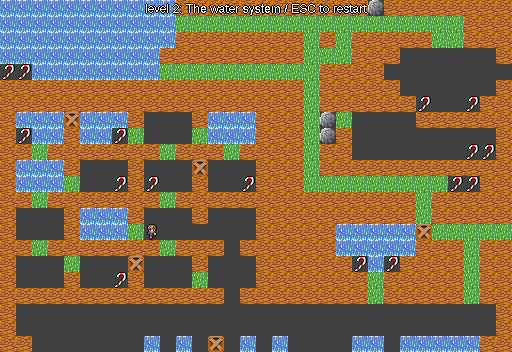
Candy Cane Dash, a Boulderdash-like game with some interesting game mechanics written in CellSpace
As an example of how it works, here’s how you specify falling and rolling boulders, Boulderdash-style:


The 3×3 grids represent 3×3 tile areas on the screen. Left is the pattern that it tries to find on the screen, and right is the pattern it rewrites to when it matches the pattern on the left. Black squares indicate “don’t care” values, grey ones indicate an “empty space” tile, and the boulders represent “boulder” tiles.
At this stage, you can define a game using a textual language called CellScript. I’m still experimenting with the engine’s expressive power vs ease of use, but I already found the current version enables easy creation of various interesting game mechanics. Ideal for whipping up a prototype of an original puzzle/action game.
Check out the CellSpace engine, including two examples and a tutorial.
OK… now I have this little idea involving fish and CA style water physics, so let’s see if I still have time to create a shark game for MiniLD #46 with this engine!
As promised, here is my second game written in the CellSpace cellular automata game engine.
In Flush the Fish you have to guide the fish to the bottom of the screen by blowing holes in the walls with bombs. But you have to make sure they do not get eaten by sharks!
This is a water physics game based on the idea of having different kinds of creatures swimming in the water, interacting with each other. I’m not used to creating levels for puzzle games, so this is a novel experience for me. I started on Sunday night, and got to create 5 levels before the deadline. Anyway, I really wonder if you like the puzzles.

I’m late and I have other things on my mind, but I do want to create something semi interesting this LD, and participate in the rating process. My purpose is to create another example game for my most recent gamedev project CellSpace, a cellular automata engine and scripting language, which enables creating games by just specifying cellular automata patterns. I also want to create my final entry for this year’s 1GAM event, and hopefully end up in the 1GAM top 50!
So, my tools of choice are: