LD29 April 25–28, 2014

Defend Your Kingdom – my entry

That’s my second LD. I was so tired and sleepless by reaching the compo deadline that I forgot to make a post about my entry.  I made a kind of shooter, a ‘kind’ because you will control a small army of archers and catapults. All graphic was made from simply unity3d primitives. So here it is :

Defend Your Kingdom

You are in times when legends are reality, your medieval companions and yourself have to defend the realm from evil.
The earth cracked open and demons started to crawling to the surface.
You and group of knights you’re commanding are bounded to stop them.

Protect the kingdom from demons coming forth! Keep them beneath the surface so that no poor soul get devoured!

Your army:

Logo2

Hordes of demons trying to reach the surface:

Logo4

Single catapult witch archer:

Logo

I appreciate any rates and comments!

link: http://www.ludumdare.com/compo/ludum-dare-29/?action=preview&uid=29762

Tags: compo, game, unity, unity3d

We’ve got a Trailer

Postmortem: Beneath The Surface

This was my first Ludum Dare and I’m pretty happy with the outcome, my game!

Click to play!

Click to play!


Tools

Unity
SFXR
Google!


Development Process

I started off with an idea to burn away at a layered sphere. Not sure why, or what would happen.

I made a geosphere in Max, added a Shell moodier to give it some thickness and then used Explode to break it into around 320 chunks which would all have their pivot point at the centre of the sphere.


Once that was done I imported it to Unity and added a bunch of mesh colliders to the chunks and got a camera rotating around it.

I still didn’t know what the game was going to be at this point as I didn’t go in with a plan :)

At one point I considered doing some kind of 3D Minesweeper game based on the surface chunks and the layers below, but then I realised I didn’t actually like Minesweeper and I’ve never managed to complete a level of it, so that idea was out the window!

Instead, I got Raycasting working and decided whatever you clicked would get destroyed!


One thing I’ve learned about action/arcade games it that MORE IS BETTER! So I duplicated the sphere layer twice and nested them within each other and make them all rotate separately and at different speeds.

At this point I started thinking about colours. I noticed I’d used a pastel kinda colour already, so I googled “pastel colours” and found this:


And there was my colour scheme! From here on I started just colour-picking from this image and based all the colours on this.


Next I added the enemies, ‘cus every arcade game needs stuff to shoot at! I added pulsing rings to the enemies so that they were easier to find amongst all the rotating stuff!


Now I had some enemies, I made them shoot at the player. How do you make them hit the player form anywhere on a sphere? Make the player another sphere! So i added the purple shield sphere which the whole game takes place inside and made this the player, with health.

Next, I added the “shoot everything on a layer to blow it up” mechanic and finally I was starting to have a game coming together!


And there you go! I had a game!

Finally I added a menu/level loading system and made four more levels.


Job done. My first Ludum Dare was over and I had a completed, totally playable game. And I’d had the most fucking fun I’d ever had making games! :)


Good

  • Fun game!
  • Easy to pick up (I think this helps when people are playing loads of games to rate and they probably don’t always give each game much time)
  • Straight into the gameplay. No intros, no tutorials, no novels to read before shooting stuff (I have a short attention span!)
  • Cool, low-tech visuals – I’m a programmer not an artist. If I had to draw or model anything beyond a sphere, it would have been crap. Stumbling on the low poly/shading visual style helped me out a lot here!
  • Really nice explosion effect (total accident!). I think this helped get peoples attention in the animated gifs and it looks cool in-game. I got a lot of comments about this. It was another accident too :) I was going for a different explosion effect but messed up and got this one instead, which looked way cooler :)
  • No plan! I don’t really do planning. I always dive in by throwing a bunch of objects into a scene and just playing around. There’s only 48 hours, why waste some of them planning to make a game that you have no idea if it’ll be fun or not anyway?
  • Clear and simple instructions on screen at-all time. Again, when people are playing through a bunch of LD games, I think making it as easy as possible for everyone to get up and playing ASAP is super important.
  • A menu! This sounds obvious but it was the one thing I made a conscious effort to get in. About 4 hours from the end I made a menu scene and handled all the level loading from the menu and in-level too. It’s the kind of thing that’s easily forgot until it’s too late :)


Bad

  • Audio – Simple sound effects and no music! I have no idea how to make music on a computer, so there’s no music. This is something I plan to start working on for the next LD 😉 Like 99% of everyone else, I used the awesome SFXR for the sound effects.
  • Not enough levels. This was down to time, I made the first level during the development of the game and the last 4 levels in the last 10 mins before I submitted 😉 I wanted it to be quite easy initial but the last level be pretty tough as there were only gonna be 5 levels in the LD version. Not sure how this worked out. Some people commented it was a bit too hard, but it seemed fine for others. I think this is pretty usual though. It’s one of the hardest things I find bout games dev though, balancing a game you’ve spent way more time with/playing than anyone else yet still trying to see the game through “fresh eyes”.
  • Naming my game after the theme. I didn’t even think about this until afterwards, but calling it “Beneath The Surface” was pretty stupid as it doesn’t stand out and makes finding any references to my game pretty tough!


Future

  • (Done!) Controller support.
  • (Done!) Change the firing mechanic. A few people commented that it seemed pointless having to hold down the fire button all the time. They’re right. I’m gonna try adding an energy bar that drains as you fire so you have to balance killing enemies with burning surfaces to discover them… and ties in with the next point…
  • (Done!) Boost! I’ll be adding a boost ability which will let you orbit around the planet faster to get to the other side etc. This will tie in tie in with the new energy bar. Boosting will also drain your energy, so you’ll need to balance firing with boosting and watching your energy.
  • More levels, more mechanics. I’m still not sure yet if the game can have enough depth to warrant becoming a full game, so I’ll need to think of some new gameplay mechanics!
  • (Kinda done!) Optimise for mobile. If it does become a full game, I’ll need to optimise it for Mobile as 600+ colliders in a scene doesn’t cut it on older devices. I already started this and came up with the following: Instead of rotating all the objects and their colliders (can be around 6-900) I split each surface into three separate layers and gave each one a separate camera which only renders that layer. I then composite the three camera images which results in the same view as the original one camera system, BUT: I can then move the CAMERAS around instead of the objects so that there’s no overhead from moving the physics colliders. This is ace and did the trick, I got a stable framerate on an older, low spec iPhone which wasn’t possible with the one camera way.


Here’s a sceenshot that hopefully explains better how it works.


Now I’ve proved this works, I’ve put it all back to how it was (it makes level design etc more difficult) so I can just get on with developing the game further now and worry about converting it if I have a good game at the end!

  •  Sexyness: bloom/glow, effects, camera shake. All the stuff that’s awesome at making games seem and feel way more fun than they are!! :)


Next LD

Same approach: Dive in, no plan, have fun and make something I think is cool!

Hopefully I’ll have learned some music-making basics by then so I can have a good at making a naff music track!


CYA NEXT TIME!


Click to Play my Game!


Comments

terraco
01. May 2014 · 20:10 UTC
You really did a great job, man. I like the development path you took as it’s EXACTLY the same thing I did with Box Simulator!
SteveSalmond
01. May 2014 · 21:55 UTC
Thanks for the massive (awesome) write-up dude! I will have to give this postmortem thing a go.

The Monastery has now a Web version!

Hello!

I’ve just finished the Web version of The Monastery! Enjoy!

Play The Monastery


The Monastery is my entry to LD #29. It is a party-based tactical RPG with approximately 1 hour playtime. The Monastery features 4 character classes, 9 unique monster types, unfolding story, spellcasting and three levels packed full of encounters, secrets and mystery.

Sinking Feeling now has fullscreen mode.

Not exactly by popular demand but hey. I doubt that’s a disqualifying feature, given it’s one line of code, and is  totally optional! 😛

http://www.ludumdare.com/compo/ludum-dare-29/?action=preview&uid=1508

LD29_delve_6

The Delve postmortem.

First off, thanks so much to those who played Delve and left such nice comments and feedback, I truly appreciate it. And also thanks to everyone for making such fun and creative games! Very inspiring as always.

The Concept
I struggled a bit with this theme and landed on a simple rummaging “down the rabbit hole” searching game that I wasn’t too excited about. Not a great way to start a game jam. It was a toss up between that and a wallpaper removal simulator, which I really hope someone ended up making. The direction I ended up taking at least let me practice some animation which is something I love doing.

The Visuals
This part of the project took about 95% of the time. For example I spent all day Saturday just on the title screen and half of Sunday on the end screen. In hindsight that was probably not the way to go since it left hardly any time to make the actual game, but I had a great time animating those parts and that’s what counts, right?

The Gameplay
Ha, not sure this section counts. I literally spent about two hours before the deadline scrambling to connect the title and end screens together. Since each letter of the title represents a world and had an animated looping component, I simply grabbed those loops and threw them on some backgrounds with a mask to reveal the world underneath. This ended up making the gameplay very shallow and for sure the weakest part of the piece.

The Audio
Most of the music was created Friday night while concepting. I used Figure on my phone to create multiple loops that I piece together later in Sound Studio 4. For the most part tho I don’t really think the music fits super great with the visuals. Ambient sound would probably have been nicer. The sfx that are there were created quickly with the amazing online tool as3sfxr.

The Time Management
I’ve recently started using a task tracking software called Tyme and used it for LD29. It’s kind of interesting to do this and would for sure recommend it. I found it helped keep me focused and minimized distractions. Here’s where I netted out:
Concepting / 1hr:43min
Audio / 2hr:18mn
Programming {includes design + animation} / 17hr:43
Submitting / 23mn
For a total of 22hr07mn

The Future
I’m not sure if I’ll make Delve more than it currently is, which is an unintentionally poor knock-off of the amazing pieces by Vectorpark like Windosill. I have several other game ideas that I may merge with it to give it its own unique voice so it can stand apart. But before that, I need to finish production of my miniLD48 game, Lucky Lighter, which should be done soon-ish. I’ll be periodically publishing dev updates on the twitter if interested. Thanks again for looking!

Comments

GreatBigJerk
01. May 2014 · 21:47 UTC
Delve definitely wins out as the nicest looking thing I’ve played. In the 200 or so games I’ve tried, it still stands out. Great work!
01. May 2014 · 22:08 UTC
Was that Andross from the first Star Fox game on the SNES?
conormn
02. May 2014 · 02:26 UTC
@GreatBigJerk – Thanks so much for the kind words. Really glad you liked it :)

@GaTechGrad – The face at the end of Delve came out of a lack of time and the ease of creating a face out of straight edges. Tho Andross is in my subconscious, the likeness was unintentional.

The Vole Beneath and Pixel Bat Attack Post Mortems…

(some of this is copied from my blog article here)


coding sm

My son (9 year old Oscar) and I participated in our second Ludum Dare Game Jam, #29, and it was, once again, a really rewarding and insightful experience.

Oscar used Scratch for developing his game (the new web-based version) and I used Flash, FDT, Citrus Engine, Illustrator, Photoshop, Audition, GarageBand, and Dragon Bones.

First, Take Aways

As with the last game jam, we learned a ton!

Oscar learned that you aren’t really done when you think you are done. This is especially true I think in any art of programming endeavor. There are bugs, refinements, and ways to make things smoother and more efficient. It’s a good lesson.

I also noticed Oscar having a bigger awareness of the things needed for a game to be playable – like a story, a clear goal, instructions. I love seeing how his knowledge is growing just from seeing others play his creation.

For me, I learned that it’s good to let go of the desire to have a unique idea, and instead focus on having a good idea. This may not be the case all the time, but starting with a good idea, and flushing it out seemed to lead to something pretty unique anyway.

This second gam jam continued to reinforce how awesome I think this approach to anything is: given a ridiculously short amount of time, we were able to create things that would probably feel much more daunting if we had wanted to make them over weeks or months of time. When you don’t have time to really think too much or second-guess design ideas, approaches to problems, or adding extra features or details, you just plow through and your mind seems to automatically prioritize the right things and in a pretty good order.

The Games

Oscar’s Game: Pixel Bat Attack (when you get there, click on the “Web” link)

My Game: The Vole Beneath (when you get there, click on the “Web” link)


Time Lapse

Oscar’s Game Time lapse Video

My Game Time lapse Video


Friday

We both dove in and started thinking of concepts. Oscar had an idea right away and started making his game within the first 20 minutes. I tried to follow the process I did last time, where I give myself 2 hours to come up with ideas, then sketch, and then start building a game.

sketches

That didn’t work out so well.

I generated a lot of ideas, but could really find one that connected with me. I think I was really putting myself under pressure to deliver something unique and different and nothing cliché and that really made it extra difficult. For us on the set coast, the competition started at 6pm on Friday and by the end of the night, I still had not chosen an idea.

And that added more stress and pressure to the situation.

But the time Oscar went to bed, he had about two solid hours of developing his game, which is great! I realized later that I should really follow his lead, and if I see that I am stuck, I should just dive in and start making something, anything, because this can sometimes really help to get me out of a stuck process.

I went to bed in hopes that my mind would figure something out magically by morning.

It didn’t.

Saturday

On Saturday morning, I picked one idea and started to put it together to see where it would lead. The idea was that you control a magnet under the surface and there is a piece of metal on top that you have to get over obstacles and challenges to reach the final goal. I wasn’t sure what the goal was, or any of the other details, but I put together a rudimentary version of it.

Meanwhile, Oscar was cranking along. He had this cave explorer concept and some bats that shot acid already working. It was neat to see how quickly he had envisioned an idea and worked toward realizing it. He really gave himself no pressure and just enjoyed the process. Something I needed to remember!

Oscar recorded sounds using his voice and then found a little wooden squeaky bat (or bird) sound maker that worked perfect for his bat sounds.

We had a few things to juggle Saturday, and that added to the pressure because I knew we wouldn’t have a full day to work on things. I wasn’t feeling my prototype with the magnet and as we headed out the door, I told Oscar as much.

I told him that originally I had a different idea that I thought I liked but didn’t feel very unique – this gopher or mole or some animal that lives beneath the soil and bumps the ground to get a nut or something. I ditched it because it just felt too simple, and I figured everyone would be doing a game about being underground, so it wouldn’t be too original.

Oscar liked it. He immediately latched onto the idea that the nut could go in a hole for the mole to get. It all made sense!

After talking with Oscar about it, I realized that I should just shoot for something fun and playable. I realized that I was placing undo pressure on myself to create something original and unique when having anything done in this short amount of time is the real goal.

Thanks Oscar!

It was now Saturday night and I started to work on this new idea.

Sunday

The deadline for the 48-hour competition is Sunday at 6pm. I dint know if I could get there, but I knew Oscar was finished so at least one of us would.

I was really excited now because I had a solid direction (thanks to Oscar) and had the beginnings of the concept working. A lot of my time was sunk into trying to figure out how to make the terrain move by bumping it from underneath. I not-so-quickly researched terrain generation code, different algorithms for drawing smooth lines through given points, ways of creating physics bodies that had angled edges. None of it seemed to work for me.

This is when I wish I had some knowledge of trigonometry. Or the ability to retain it.

I ended up really hacking together this approach where the terrain is actually a bunch of little blocks that I shift vertically, and that for any slice that I shift up, I shift its adjacent slices up a fraction of that so it creates a sort of jagged ramp.

It wasn’t pretty, but it sort of worked. But I wasn’t convinced. I wanted a really smooth surface for the ball to roll down so I got sucked in to searching again, trying to find some examples of the math I could use to create a smoother, rounded surface for each of these bumps. Dynamically.

So hours got sunk again trying things that didn’t work.

I finally gave up, stuck with my hacky solution and moved on.

I checked in with Oscar about submitting his game and if there was anything left he needed to do. I realized he didn’t have instructions or a story so I encouraged him to add those. And that’s when he realized he had some bugs.

Its hard to get a 9-year-old to shift from “I’m done” mode into “I have to add more stuff and fix bugs mode” but after some discussion (and convincing) Oscar dove back in to add a cool little story, instruction screen, and really persisted on tracking down and fixing the bugs that he found.

Go Oscar!

With an hour to spare, he submitted his game – he made the 48-hour deadline!

I would not. But that’s ok, because there is a 2-hour deadline (mainly for teams and with slightly different rules) and so I aimed for that and kept plugging away.

I jumped into artwork now. This was getting really fun. And with only a few hours I rushed through and created a vole (what? they’re cute!) and walnut and terrain. I really plowed through this all and got a lot done in a short amount of time.

Monday

The tricky part about missing the 48-hour deadline is that it means you have to finish things up on Monday. I had this cold that was also brewing over the weekend (probably due to stressing about the gam jam!) so it was not an idea situation on any front.

I continued to hone the artwork and animate the vole character. This was really fun and I got to learn how the Dragon Bones extension for Flash works. It let me create a bunch of parts for the vole and move them around to create different poses from those same parts. It really makes things efficient because instead of having a lot of different images for each frame of animation, you just have these few parts and a skeleton that animates under the surface (hey, that’s the theme for the jam!).

Once I got all those parts wired up in the game engine, I created the title screen, win and lose screens, and wanted to get some music and sound in.

I plucked a few strings on my guitar, added some background strings from GarageBand, made a rolling sound for the walnut, and wired those in too.

I really had intended to have multiple levels but just couldn’t squeeze that in.

I submitted my game to the Jam with minutes to spare!

Thanks for reading and dont forget to check out the games:

Oscar’s Game: Pixel Bat Attack (when you get there, click on the “Web” link)

My Game: The Vole Beneath (when you get there, click on the “Web” link)

Until the next game jam everyone!

Eat Champ Postmortem

Now that some time has passed since Compo deadline, and that I have/am giving myself some time to myself, my mind’s a bit clearer to reflect on my submission, Eat Champ.

action! tragedy! romance!

Although I did have a lot of fun making it, I have mixed feelings on the final result; on one hand, to make the deadline I had to cut a lot of corners, leave out a lot of polish, and ultimately submit the game in a barely-finished state. Despite that, I’m still happy with the concept I wound up choosing, and the fact that I was able to stick to it until the end without it becoming a completely buggy mess is something I can be proud of, at least for my first LD! It’s also MUCH more playable than my previous (and first) game jam submission made some time ago (link if you’re curious), so I do feel that I’ve grown since then.

I’d like to spend a bit of time talking about the choice I made during development; for as crude as the game is, I actually did put a lot of thought into things! Even if the protagonist looks like this:

head

what a hottie

–GAMEPLAY STYLE–
Right from the get-go, I wanted to avoid making a game with level navigation. In order for that kind of game to be fun, it needs solid mechanics AND good level design. I learned the hard way during my first jam that getting mechanics down is hard enough, and this time I didn’t want to have to worry about rushing to create levels to properly express my game’s mechanics. I only wanted to have one thing to worry about: keeping the mechanics fun, and to have them at the forefront of the game.

Another thing about games with level navigation is that they’re only as long as how many levels they have. With that in mind, I opted for a arcade-style gameplay, which naturally gives itself high longevity without much extra development effort. As much as I like games with levels, I knew that if I did make one, it would have been really short. I also hoped that a mechanic-oriented game wouldn’t be as hurt by time-saving cuts, since as long as the basics are down, the game can still be playable without having to be fancy or complex.

I think the style of game I wound up choosing, a “multitasking” game (I’m not sure if this style of game has an official name, but that’s what I’m calling it), accomplished those goals well enough. But remember how I just said I wanted a game that would be fun with just the basics? Apparently, I didn’t, because the “basics” of my game were several interdependent actions working together in tandem (managing eating/chewing with lung & belly capacity, etc etc). This meant that even putting one “action” in the game meant that I had to prepare every other action that depended on it, which made things tricky to finish in a timely manner. I still think keeping the actions dependent on another is an important part to the game, but next time I’ll avoid designing a game like that to allow for more modular development that can be taken one step at a time.

–FLASHPUNK–
If I had made this game a year or two ago, I would have used pure Actionscript 3 in tandem with Flash Professional. Lately, though, I’ve tried to branch out to using game-oriented frameworks, and fell in love with FlashPunk (for the most part). I feel its best for tile-oriented games, but I still used it to make this one because of its high performance and how it saves time on tasks that can get annoying in pure AS3.

With that said, using it made me realize all of the things I take for granted when using AS3+Flash, like being able to animate a movie clip/entity in Flash and import it to my game. FlashPunk uses spritesheets instead of Flash symbols, so to get all of my Flash-drawn assets in (it’s a great drawing tool) I had to use a sprite-sheet generator (grapefrukt exporter) on everything. This was okay for the most part (and for the player’s head and hands, was actually better), but drawing and positioning status bars and everything was a bit tricky without feeling as closely connected to the display stage as I do with AS3. Most of those difficulties were due to inexperience, though, and working in an unfamiliar (but still effective) environment was a great learning experience that gave me a good idea of what I need to learn to make things easier for myself down the road.

–PRESENTATION–
There isn’t much to say here…I made some placeholder graphics, and they wound up being the final ones! How embarrassing. I was saving the task of better visuals & sounds for last, which I suppose was the right choice since those are the most expendable parts of a rapidly-developed game. But it still would have been nice if I gave myself a little bit of time making the game less ugly (I have to defend my decision to use floating hands, though, which is the go-to method to easily & effectively animate hand movement).

I did try to do a good job on the status meters, as I knew if I cheaped out on those no one would be able to tell that they were supposed to represent a digestive system. I also made sure to put key prompts in, and to provide visual feedback (usually by making things flash) when it was warranted to direct attention or inform the user that pressing a key did something (like digesting), or to differentiate similar-looking actions from each other (biting fills your mouth with food, but chewing doesn’t, so I did my best to animate the teeth differently for each action so players can tell the two apart. Did I accomplish that?).

So the effort I spent towards presentation was to help prevent the game from being too cryptic to play, which is nice and all, but I still think it’s confusing to play without reading the instructions beforehand. For instance, I insisted on assigning the “breathe in” action to pressing P and Q at the same time, and to forbid it while out of air if your mouth is full of food, but I didn’t give myself time to explain those rules visually as well as I did others. Especially since the game’s presentation doesn’t immediately liken it to a set of conventions (like a platformer), it was my job to properly express how to play it, and I failed to do a consistent job of that. But at least I did a better job of it then for my last game, though, which was even worse in that regard (hey, I guess I learned more than I thought from that game, heh).

–CUTS–
I’ll keep this part quick. It’s probably clear that there were supposed to be many more features/actions to the game, as it’s a bit simple the way it is now. Of course, by mid-afternoon on Sunday I started to get the feeling that I would have to start making some cuts (I really thought I was going to be okay for time until right about then). I never thought that I had too much planned to put in the game, but it’s surprising what a time limit can do to you! So I did what I could to finish only what I needed to keep the game playable. I also didn’t give myself time to properly balance the difficulty of what I had put in, so I’m sorry that the game is so hard. 😛 The lesson learned here is that it’s best to start simple and build from there, rather than having even moderately-sized plans that will likely end up cut.

—

Also, those who have played the game probably raised an eyebrow while noticing that it’s currently hosted as a file dump, rather on its own page or as a game portal submission. To be perfectly honest, I’m not all that comfortable submitting it to a public portal in its current stage; unless its understood as being a hastily-made LD submission, it’s really not ready for public consumption, and I think it would do me more harm than good. With that said, I fully intend to release an upgraded version of the game within the next few days (hopefully over the weekend [EDIT: haha yeah right], when LD buzz is still hot!!), while keeping the original version in it as “48-hour mode” or something, for context. It’ll probably be just an audio/visual update, but if I have time I might even add in some cut features!

So thanks for playing, and thanks to anyone who read all the way to the end of this rambling mess! I do what I do for folks like you. <3

PS: I will probably be **STREAMING** some submission surfing soon. I'll make another blog post about it, so sit tight! Because I know you all care immensely!!

From Below – Postmortem

From Below is my entry for LD29 jam rules, this is the second time I submited a game.
Play From Below here

Title Screen

The Concept

My first ideias were :

  • Something with subways
  • rats
  • living in the swears/slums
  • giant worms from beneath
  • monsters that cause earthquakes

Initial ideias

In the end I mixed the last two an I the main concept end up being “Giant worms cause earthquakes our job is to make them weak as possible”

Tools
I’m a programmer but I decided that I have to improve other skills (for this LD teh skill was just finish a game) so I choose Construct 2 to make the game so I wouldn’t have to program at all. For sound effects I picked sfxr and audacity and for music autotracker.py. For graphics Photoshop and Illustrator.

Graphics
Even before the compo started I knew I didn’t want to lose time trying to make art, so I used @KenneyWings assets pack

Mechanics

First the main character is the monster so the camera scrolls with him. In the begining there were walls in the sides of the level but that limited the movement to much so I remove the and let the player warp from on side to another. Since is a GIANT WORM moving beneath the surface I added diferent kinds off falling rocks that damage and throw the player down. To make the worm weaker so the earthquake would be weake as possible the player shoot lasers that can be upagraded with powerups, tha are not easy to get. When the worm hits the surface the highest earthquake is 10.0 and the lowest is 1.0.

The right and good things

  • Construct2 and KenneyWings pack were my best decisions because I was able to focus on the gameplay and could easely make chances in the gameplay when I thougth something was worng
  • The concept : I am really happy with the ideia I choose, with more effort it can be a much better game

The wrong and bad things

  • The difficulty : the game is hard, is frustrating to die, the plataforms are to short. I need to pratice level design
  • Only have one level, I wish I had time to make procedural generated levels
  • Better feedbacks to the player

From Below

PS. Sorry for my english I need to pratice that too.

Fast pace FPS (48 hour compo)

Everybody else seems to be making a post about their game, so I figured why not. I made a doom/wolfenstein like fps called Battle through Hell.

You can play and rate it Here

BTHwindows 2014-04-27 21-18-48-200BTHwindows 2014-04-27 21-19-11-628build1.4 2014-05-01 21-31-36-892build1.4 2014-05-01 21-37-40-523

Post-Mortem (Invasion From Below, 48-hr Entry)

First off, I’m not even quite sure what I’m supposed to write here; I’m just assuming it’s supposed to be a summary of the process and what I learned…

My entry, Invasion from Below (http://www.ludumdare.com/compo/ludum-dare-29/?action=preview&uid=36095) was a 48-hour entry, which was actually completed in about 10 hours done live in my livesteam (www.livestream.com/stencyl).

As the livestream name indicates, the entire game was made with the game creator Stencyl. I’ve been using Stencyl almost since it came out (version 1.1), but there was a new API added in 3.1: the Image API. I guess it’s a pretty common thing in most game creation tools, but it’s brand new for Stencyl.

Thus, I decided that a 48-hour competition (in which I knew I’d only have a few hours of the 48) would be a great time to learn how to use it. Yeah, it was brilliant. I had many issues right from the start and actually drastically changed the game soon after starting (was originally going to use bullets, lasers, etc. from the buildings at the top of the screen instead of laying mini mines).

The idea for the game was born out of the desire to use the image API in a creative way. I originally thought of the enemies burrowing upwards and making tunnels behind them that would speed up enemies that followed after them. I quickly realized that was going to be too much with the time constraint, and the game you see is the result instead.

I also quickly realized that I was going to have to give up in certain areas in order to finish on time. Those areas were graphics and especially sound (there is no sound at all in the game).

In the end, I’m mostly pleased with the result. I do realize that I should have at least added sound effects (I REALLY suck at making music). Also, I really should have tried to take more time balancing the game. It’s really tough when you first play, but when you get down the system, it’s possible to get really far.

One thing I’m surprised with is the overall response from fellow LD players. I personally didn’t think my own game was that great in the end (for playing; the technical aspects behind it are pretty impressive since this is my first Image API application and got it all to work), but overall the comments have been decent. The lack of sound will definitely kill it in the end, but I’m glad that it seems like a lot of people are finding it to be a worthwhile game.

In the end, I only used three resources: Stencyl, Paint.NET, and, of course, some music to code to ;).

Will I ever do another LD? I tend to doubt it. This past weekend really wore me out; I’m still recovering from it. If the game does a lot better than I’m expecting it to though, I may just go ahead and try again, focusing on a simpler idea to pull off.

Thanks for reading!

Side B, Track 1: aftermath.

Hi everyone :)

I guess it’s about time I share with you my thoughts on what went well and what went wrong, and what I can do with it the next time.
Also, I’ll try to give some insights on making games using Unity.
Sooo… What I attempted:

Motorbike shooter.
Core concept was plain and simple, but I kinda underestimated the task of writing bike physics. Ended up spending about 75% of my time on it 😀
Insight: learn to use Physics.SphereCast, that thing is a beast when working with physics-based stuff. It’s also a nice idea to write visualiser for those, or you can use/rewrite to C# mine: https://bitbucket.org/Taugeshtu/assistings

Level made out of tiles, which can be flipped, after what player can ride upside down. That went all right, I’m no stranger to per-entity variable gravity. One thing that I would’ve added if I had more time would be static batching. Another possible optimisation would be to have colliders only appear near bikes.
Insight: to toy around with gravity all you need is set your rigidbody not to use gravity, add a script to it with something like rigidbody.AddForce( -Vector3.up *Physics.gravity.magnitude, ForceMode.Acceleration ) in FixedUpdate() and you’re good to go. Another thing worth mentioning is: you don’t want to move/apply forces to physical objects inside Update(), and you don’t want to collect your input data inside FixedUpdate(). Grab the input in Update(), store it in private variables, apply in FixedUpdate(). That’ll save you from several glitches :)

Art.
My usual art pipeline includes SketchUp for hard-surface and Sculptris for organics/textures. It served me well this LD, though I didn’t needed Sculptris this time around. Unfortunately, I don’t really have any insight for you on this side regarding unity.

That’s pretty much it as far as game goes, but there were several issues with my workflow as well I’d like to write down:
Sleep management. I think it would be ideal for me to wake up next time right when LD starts, so that I can have one sleep session and not be exhausted as I was this time.

Atomicle – Post Compo

I took some time to rough out the edges of Atomicle now that the compo is over, and I wanted to give everyone a chance at a more ‘full’ experience. A proper menu, fixed some bugs/gameplay, and added high scores.

(Note: The game isn’t designed to be ‘easy’ so don’t let the music fool you.)

The full latest update can be played here: http://www.lostautumn.net/atomicle and the original Ludum Dare version can still be found here:
http://www.ludumdare.com/compo/ludum-dare-29/?action=preview&uid=34026

I also have a ‘postmortem‘ write-up of the game from start to finish, as well as some thoughts on my first experience with Ludum Dare, and you can read it at: http://blog.lostautumn.net

This has been a real treat, and I look forward to participating again in the next go-around. I’ve met a lot of awesome developers and played a ton of excellent games this past week. Keep up the great work!

Release – Necronomicon

Poster

That is our game.  NECRONOMICON

The epic story of Neko, the Guardian of Earth.

This time we try new challenges for us, like, put music in different places and do the transitions. Put a sound in everything. Made a game a little more complex. Bro… It was a intense Ludum Dare, with a lot of learning.

And we did it!

neko-em-pe

Of course, it had a lot of problems to solve… but for a 72h hour game (plus 72h to solve serious problems), we did it. Necronomicon is real and you can enjoy this game.

The plot is simple: you need save the world. To do this, you need to find four rings, they are the Key. BUT, not so simple, a lot of minions will try destroy The Altar, and release the monster. So save the altar! Kill the minions!!!
In the end, you need win the last fight, a Epic Battle!

SS02

old layout, play the game to see an awesome new ^^

But you also can explore the scenario, listen the songs,  all this was made for you :)

Enjoy!

The fellas who made this game:

Davi Santos – Code (He made the final animation, and all explosions)

Fernando Perazzoli – Art and Level Design

Fernando Scaff Moura – Game Design (he also do some art too)

Adalberto Rodrigues – Music and Sound Design

Tags: release

Unity Web Games

Lots of people are making their games with Unity. I like that. Unity is good, but unfortunately the web player is not fully cross platform. I run Linux, and I would like to play all your Unity games but there isn’t a Linux build =[

I’d like to see some more Linux builds for Unity games

Comments

02. May 2014 · 02:57 UTC
I feel you, been having the same problem. Linux for life (:
shatley123
02. May 2014 · 03:16 UTC
Mine has a Linux build 😀
02. May 2014 · 05:28 UTC
Mine has linux also
OhFiddleDiddle
02. May 2014 · 06:56 UTC
Yeah, I am not sure how many JUST have the web build up, but they should also be putting up their Linux build. ( Like me! 😀 )
02. May 2014 · 07:04 UTC
This is a pet peeve for me as well, being a web developer and a Linux user. When I think of a web game I assume it’s built in some combination of HTML, JavaScript, CSS, canvas or WebGL. When I click the “Web” link and find I can’t play the game because it’s a plugin, that’s just annoying. Flash games embedded in web pages are marked as Flash, why aren’t Unity games marked the same way?
02. May 2014 · 07:10 UTC
Stop. It’s not finished uploading yet. Duh. I’ll let you know when it’s finished.
02. May 2014 · 07:21 UTC
Ok. It’s done uploading. If someone can please test and report back here. I’ll give your game a review and I’ll be the happiest man in Brisbane, Australia tonight.
02. May 2014 · 08:23 UTC
I’ve added it to my list to play over the weekend.

Strider Submerge! Post Mortem

PLAY

I was excited and nervous heading into this Ludum Dare, as usual. I was excited to see my jam group again, and to with Britt as my graphic artist since he’s been cranking out game projects like crazy for the last 4 months. He did an amazing job our Mini LD submission Terrarium, too. I always go into jams feeling nervous, too – nervous that as a programmer I won’t be able to deliver on the designs we come up with. Time pressure forces tough decisions, and some of my toughest calls during jams so far came while working on our most recent jam, Strider Submerge.

When the theme “Beneath the Surface” was announced, we kicked around a few ideas about being underground, underwater, or beneath the surface of someone’s psyche. The psyche idea was super interesting, but we ultimately decided that it was too abstract for a rapid prototyping exercise. Britt wanted to have something with an underwater bubble city. Having mostly programmed platformers so far, I wanted to expand a bit and try something top-down. Our first night’s build was a sort of shooter where the player commanded a submersible dome city covered in tentacles.

strider 1

To drive home that you were a moving city, we thought it would be interesting to incorporate resources for the player to manage, including food, oxygen, and energy. We ended up simplifying the resources to only include energy (and health), and threw out the city idea entirely. One of the hold overs from that is that the healing items in the game are fish you have to catch by submerging into the ocean, which is kind of funny when you’re just a spaceship. We were left with a submersion mechanic that expressed the theme strongly enough for us to run with it.

strider 5

The submersion mechanic itself was something we struggled to make relevant. Most enemies can’t submerge, and so their missiles won’t hit the player if he/she is submerged. We eventually changed mines so that the player could swim under them, and made coral pieces that would allow the player to fly over, but not through them. This worked pretty well with our energy resource limiting how long the player could stay beneath the surface. We also added submerging enemies that could follow the player as they tried to hide, which feels pretty interesting but caused a lot of problems.

strider 3

We also wanted a reason for the player to kill the various enemies, since submerging and going right past them was a viable option. I’d never made anything resembling a skill/tech tree before, but that was just the thing that would make killing enemies and earning credits interesting. Unfortunately, most players never get to see the upgrade screen – the game has only one level and we had intended for upgrades to happen in-between missions.

strider 4

The single level that made it into the game was a dummy run intended to demonstrate and test the various enemy behaviors. We had planned out at least 4 levels, but ran out of time before we could implement any of them. Since the one that remained was not really designed with care, it ended up being way too difficult. The tutorial levels preceding it were put in early, which I’m happy about. Unfortunately, the submersion tutorial level is the only place you’ll see the a bridge implemented because, again, we ran out of time to build levels. Part of this reason was performance issues…

When working with Flash, it’s tempting to use color tinting, alpha fading, and crazy particle effects. I worked with Britt previously on a game called Terrarium that made the same mistake – the game looked amazing for about 4 seconds before becoming incredibly choppy. Performance is a major issue in Flash, especially when constantly changing multiple levels of alpha for various actors. The diving enemies gave us a lot of problems. They were animated with the same splashing and color tinting effects as the player, which became an issue when 6 of them popped into the screen. On top of that, enemies would sometimes try to dive on top of coral. This wasn’t normally a problem, but when two pieces of coral are too close to one another to allow the ship to fit between, the ship gets stuck in a collision problem and crashes the game. A couple of methods were tried for detecting coral beneath the diving enemies, and eventually one worked well enough to prevent about 90% of these crashes.

Despite the problems we had, we ended up with a game that I like quite a bit. I enjoy the mechanic and feel like there might be something there. Also, I love that we got voiceover for the boss fight and menus. Will Bucknum nailed the ’80s action hero vibe we were going for. The controls are a bit off, though – I intended to use WASD and force-based movement, but eventually but forgot about that as the weekend marched along. I’ve been working to improve the Strider Submerge’s performance in a separate upload from that submitted for the jam, and intend to build out those levels too. Moving the upgrade screen to right after the tutorial also does a better job of showing off all the hard work I put into making that work, so if you get a chance check out the original upload as Strider Submerge, then go try my current build: Super Strider Submerge.

Box Simulator – Bug fix, joy to all!

From one box to another, I present joyous news to all.

INTERNET PLAY FOR ALL!

A bug was found that prevented internet play from working.
We put said bug into a box.
This box was placed into the back of a truck.
This truck was placed precariously at the edge of a cliff.
The cliff was lined with TNT and subsequently detonated.

Play Box Simulator

To play Box Simulator over the internet, the PC hosting the game must have the port forwarded to it. Exactly the same if you use a torrent client or host your own Minecraft server.

boxtitle

I am led to believe this bug fix is acceptable and within the rules and guidelines of the competition. Please let me know if I am mistaken and I’ll move this build to another link.

Snake Driller – LD29 – Post Mortem

I missed two Ludum Dare since the last time but thankfully I was able to took time to participate last week-end !

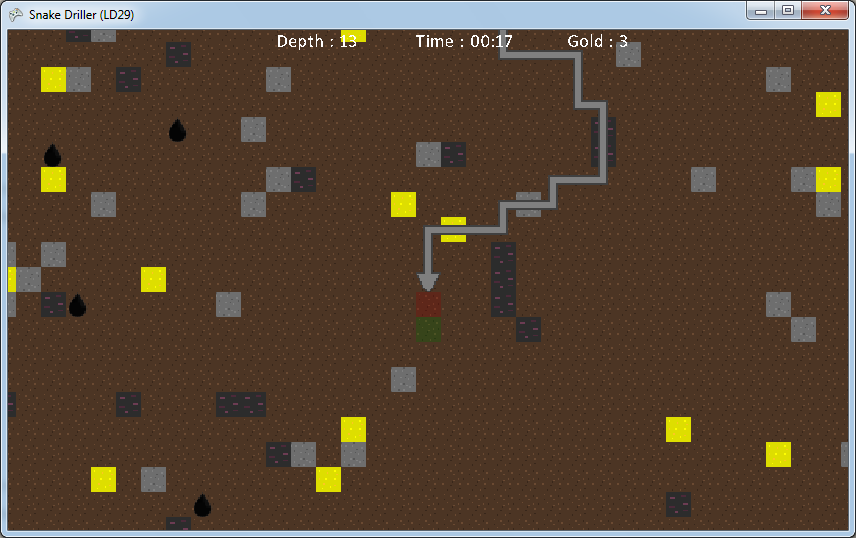
I understood the theme quite literally with a mining game. Snake Driller is a Sake-kindoflikebutnotsomuch mining game. You have to drill the deepest before the time’s up, sometimes going sideways to mine interesting blocks or dodge those you can’t drill. You can also buy upgrades for your drill in a store to drill more types of blocks or drill faster.

Download and rate it on its entry page.

WHAT WENT RIGHT

Idea.

Even if my idea isn’t original or creative at all, I got it pretty quickly, I liked it and in one hour after I started working on the game, I had a solid design document. It turns out it was simple enough for me to implement almost everything I had planned but also interesting enough to play.

Development.

The game is made with :

  • CraftStudio, which makes things very easy especially since I have quite some experience with it.
  • Daneel, my framework for CS which makes things even easier and faster.
  • A simple leaderboard library I just implemented the week before.

So I didn’t had to invent anything or code complex stuff. The majority of the time spent on the game was actually implementing the game, either menu or gameplay.

The first day, I implemented the map generation and basic drilling gameplay. The second day I did all the menus, and the store.

What strikes me, thought was the crappyness of the code. It was sometimes odd to just copy and paste code rather than find a clever way to having it written in one place. Also I never refactored anything so the structure of the code and data may not be quite efficient (or even just right). I think that’s kind of expected for a jam game, but I hadn’t had this feeling before and that’s something that really surprised me.

Completeness.

The game is more than just one level with gameplay (those are fine, too !). It has intro screens, a main menu, other screens/menus for “tutorial” and leaderboard as well as an in-game menu and end screen.

It may be “wrong” for a jam game since all the time I spend on all that (most of the second day !) could have been used for much needed gameplay tweaks. But having a complete game is as much important and rewarding to me as having “only” slick gameplay, even for a game jam.

WHAT WENT WRONG

Time.

No one spent 48 hours on their games. I certainly didn’t since I only logged 16 hours of work (6h30 on saturday, 8h on sunday, 1h10 on monday night).

That’s very few hours, and almost 10 hours less than I worked the last time !

It really shows how much I am not good (and I don’t like) at “crunching” long hours in a row. The game would definitely have benefited of a few hours of polishing and gameplay tweaking.

On the other hand, creating a game of that completion in only 16 hours is quite a success. It really shows how much I improved at gamedev and how much the tools I used makes things easy and fast !

Balancing.

Due to the lack of time, the game is not balanced. It’s too easy since once you have the refinery (to gain time by mining oil) and the iron drill (to drill stone blocks), all you have to do is dodge the few obsidian blocks to spent money on more time or more speed (which only makes you encounter more oil (time) or gold).

Every time you buy an engine upgrade (to drill faster), the odds of the obsidian should increase while the odds of the gold and oil should decrease, in order to ensure that the player either run out of time, either can’t evade obsidian any more. It’s really too bad that’s I didn’t had the time to implement this since it’s really easy to do.

Message.

The first feedbacks shows that the drill may be difficult to control because you have to understand that you don’t directly control where the drill will go but which block will be drilled after the one currently being drilled. And this one isn’t where is the drill but next to it. This is shown in-game with the reddish and greenish squares next to the drill’s extremity but it’s not very clear, especially for people who quickly (or don’t) read the game’s description. I planed to have a drilling animation and a clear arrow to point where the drill will be but again, I didn’t spent enough time on gameplay to do this.

Also I forgot to write the controls on the in-game “How to play” screen, which didn’t helped people top find the store. You just have to press the Escape key to bring up the in-game menu with the store but it appears it’s not natural to everyone.

CONCLUSION

Overall, the game felt to me like a definite success ! I think it’s definitely better than the last one and I am confident the next one will be even better ! Improving at gamedev is what game jam are for after all.

If you are interested about the sources you can check them out over at GitHub. Or if you have CraftStudio installed, you can just join the project by clicking this link.

Tags: #LD48 #LD29, craftstudio, ld29, ld48

After Action Report

I wrote up an after action report for my Ludum Dare entry “It Came from Beneath the Surface of the Sea!” — a game about a monster who loves nap time.

I hope you’ll check it out! Inside I talk about doing character animation and AI for the first time, and the pre-deadline despair that I’ve seen others admit to.

In the end of course, Asiatic clam farmers know the secret: Never Give Up!

Ants at War – Postmortem 1/2

Preparation

For this Ludum Dare 29 I teamed up for the first time with my brother, with whom I have collaborated in game development since I am ten years old. But in the last eight years we only produced one game together, so it was a good opportunity to produce something together one more time!

I will discuss in this post the jam from my point of view, and he will do the same very soon.

A few hours before the theme announcement we discussed and thought it could be fun to do a tower-defence game, since we had not yet created such a game. It was also clear that if the theme was not fitting, we could find another genre of game to create.

For the jam he chose to go with Clickteam Fusion 2.5 Developer, since it allows a very rapid development (at least in the first stages of the game 😉 ). Therefore the game would most likely be 2D (and I have very few experience with 3D games), and I had the choice between pixels/vectors/pseudo-3d for the graphics. In already created some graphics for LD jams in Illustrator and also in Gimp, and both were satisfying in the overall aspect, but it takes a lot of time to create something that seems polished and original. So this time I went for 3D renderings that we could use in a 2D game. In fact, our last project was done this way, and looked really nice! It’s also a lot easier to make some artwork for the menus and titlescreen in 3D since it only needs a few change of camera and lighting.

I had not used Blender in years, so six hours before the theme announcement I decided to install the latest version of Blender, and quickly see how the particles system was working, and also the animation (which I never learned before) with bones and key frames. I quickly drew a low-poly pine-tree, and duplicated it using particles system in order to generate a quick procedural map.
postmortem-screen1

It is the same technique that I used later for grass/rocks/crystals generation.

Saturday

After the theme announcement we quickly came on the idea of ants, since its the season where they are invading all the surroundings (and even the house from time to time).

My first objective was to design a good first character, a basic worker ant. It took me the until the middle of Saturday afternoon to achieve a good result:
postmortem-screen2

I also did the following animations: idle/walk/attack/die. As the animation bones are separated from the mesh, I could use most of the animations with little modifications for the other type of ants.

The rest of the afternoon and beginning of the evening was spent on designing a first level.

All the particles (rocks and grass) where generated on the map using some weight maps of the base mesh. I learned a lot from this Blender tutorial: https://cgcookie.com/blender/2012/09/20/creating-realistic-grass-in-blender/ . In the next screenshot you can see the weight map corresponding to the density of small rocks. I had a weight map for the density of rocks, one for the size of rocks, and two similar maps for the grass.
postmortem-screen4

Since our playground is underground I could not produce realistic grass, and by luck my grass was not generated realistic at all! It would have been a problem if I really wanted realistic grass, but in this cas it is producing a strange line effect which gives a small sense of strangeness to the overall mood, so I decided to keep it that way and not spend too much time tweaking the grass properties.
postmortem-screen5

The next idea I had was to create some lava. This is the resulting work of my first day:
postmortem-screen3

Sunday

I was not satisfied with the aspect of the lava, since it was more looking like a glowing ketchup. So on sunday I spent more than two hours just on producing better textures for the lava, and changing various settings (emit, raytracing, glow) which were not satisfying either. For the whole graphics creation I always compared the renderings to real photographies, to achieve a similar looking thing. And then I thought again of particles! Particles are the key to pretty things! And after half an hour I had this result:
postmortem-screen6

The rest of Sunday was spent designing and animating the soldier units, the queens (red and black), and also some turrets (ant-lion, destructible rock, spider-web, a ground bug…). Every unit/turret was rendered in 8 directions for every animation, and later used by my brother in the actual game. End of second day screenshot:
postmortem-screen7

Oups I forgot I designed the second map meanwhile too 😀
postmortem-screen8

Monday

Monday was then the day for producing music, level design maps, testing, sounds effects, and some artwork for the titlescreen, menus, victory and defeat screens. Thanks to the quick map ornaments (using particles), it was very quick to produce a third map: create a base grid layout, deform the mesh a little, add particles, think of a new environment (purple mushrooms), add some lighting and it’s done! In fact most of the time was waiting on the rendering (7 minutes for the biggest map).

I took some hours in the afternoon (not enough for my own expectations) to produce a first music, and also the “defeat theme”, which is the best of the three tracks in my opinion, but since the game is too easy to play no one has heard it probably 😉

At that point its the end of Monday afternoon, and the game was not really working, some path-finding problems, and I tried to not put any more pressure on my brother. Therefore I took some time polishing the graphics, and doing the artwork screens. Two hours before the end of the deadline (1 AM here) I went in the garage to record some sounds effects: for the ants attack sounds I used various gardening tools, such as a machete, a saw, gardening shears, some secateurs… for the ants birth I wanted a popping sound, so I took an empty plastic box of medication which has a nice sound when opening quickly. For the sound recording I used a Zoom H2n which is very convenient for recording anything anywhere with a good sound quality. Then I took some time to polish the sounds in Cubase (add a small delay on the secateurs sound), and normalize all sounds.

That was almost the end of my work for the jam. The last half hour was dedicated to testing and preparing the submission post with nice screenshots.

Conclusion

I’m quite satisfied with the looks of the game, and with all I could learn about Blender, animation, rendering techniques (use of mask, composite renderings), particles, animations… The gameplay is overall satisfying, we were just a bit frustrated to remark that a small change in the last hours disabled the enemy queens to drop soldier ants, so the game was too easy. But the game was working, so it was not a too big deal.

Like almost every other Ludum Dare jam I entered, I think we (my team) spent too much time on thinking of (and implementing) difficult gameplay mechanisms, and not enough time actually playing or testing the game. But maybe this is how this short-time jams work. It’s also a good opportunity for experimentation, so I’m not saying it’s necessarily bad to think about different gameplay mechanisms than what we’re used to.

One more thing that I need to be careful about is how the game is presented to the player, and how to help him discover the mechanics quickly. For example in our game, we forgot to mention anywhere that the player controls the black ants and have to defend the black queen. We had no time to implement the units/turrets descriptions, and I even forgot to mention them in the description of the game during the first day.

To conclude, I think it was really nice, the sleep management was very good (although too much excitement prevented me from sleeping much), the work flow was also good, so I’m really looking forward for next the next jam! And maybe with a bigger team!

The jam game is available here http://www.ludumdare.com/compo/ludum-dare-29/?action=preview&uid=36462, and a new version with less bugs and 3 level difficulty will be released very soon (maybe even today!)

UnderTheLibrary: Post-Mortem

I waited to get some feedback on my game before doing a post-mortem, and now that I got some, here it is.

This Ludum Dare, I entered UnderTheLibrary, a little platformer in which you play as a robot trying to navigate the basement of a library to get back to the surface. You can play/vote for the game here.

Making title screens out of the ingame tileset is becoming a habit…

The genesis

Last time, I struggled a lot with the collision code for my platformer, so this time, I decided to try and use a game engine so as to be able to focus more on the content and actual gameplay. I ended up going with Phaser, a HTML5/JavaScript game framework, because it meant that I would be able to play the result on my Surface RT (I will NOT justify myself for that one…); plus, I learned JavaScript last summer for fun and I wanted to do at least one significant project with it.

Where I live, the theme was revealed at 3 A.M. … which obviously means I went straight up to bed after seeing it. I would have prefered ‘Break the Rules’, but I thought I could manage to do something with it.

Fastforward to 9 A.M., I have been at it for an hour, and could not think of an original intrepretation of the theme. I supposed the most common ones were going to be underground/underwater/under the looks of something (it seems I was right, at least), and I wanted to do something else. Problem was, I could not think of anything I felt like coding; so I chose the most obvious one, the underground setting, and went with it. Same with the platformer: I realized that this is the only kind of game I am sure of being able to code (almost) ‘right’, and since my goal was to learn/use the Phaser game engine, it went right with it.

The whole library thing started as a basement with books. And where do you find books, lots and lots of books? BAM.

What went right

  • Phaser is a nice engine, and thanks to some training during the previous two weeks I was able to set up something playable really quick.
  • I made some graphics which I think are good; I especially like the wood texture of the shelf (yes, there are books protuding on the sides of it :p).
  • While fiddling with the MIDI instruments available, I stumbled on one called ‘Rock Organ’, which I liked from the first note it played. In the end, the ingame music sounds really good and fitting (at least, I think so).
  • Looking back,one of the thing I wished I had done better in my previous Ludum Dare (#27) was storytelling. Even if I raced against the clock in the end, I managed to do a little bit of it this time.
  • Almost no bugs in the dialogBox thingy, which is somewhat cool, I guess. I liked it!

The tileset I made for UnderTheLibrary

What went wrong

  • Content! I spent a good amount of time on each level, and could only do two of them within the time limit (the third one took some time, but was not a level as much as an ending/credit screen). I also cut two ideas I had for others enemies, a second environment based on the sewers (the original idea was to travel far away while still staying just below the surface), powerups, et cetera.
  • Browser compatibility! I had to ‘port’ the game to IE/Safari/Opera because the Math.sign() function I used (once) was not available, thus crashing the entire game. I knew it was a risk with JavaScript, but as I only playtested with Firefox/Chrome, I did not see that one coming.
  • Although it is nice to have a game engine at hand, it is not as flexible as doing all your code from the ground up.
  • I am not very satisfied of the player’s sprite. I actually had no idea what the player could be, so I ended up going for some generic (again) robot.
  • The title screen music is bad. I started to do it, but could not get enough inspiration to do something pleasing to the ear. At least, I got something out of it for the ingame music.

Will anyone get to this area (without cheating)? I hope so.

As a conclusion…

I am not as satisfied with this game as I was with my LD27 entry. While I feel UnderTheLibrary is more complete (which I think is because it actually told a story), I must admit that I prefer Ephemeral‘s setting, ‘characters’, gameplay, et cetera. That is something I felt while making the game, and maybe that is why I could not get as inspired as I was last time.

I will try to do my best next time though!


Bonus: Game Highlights

I rated 30 or so games so far, and some of them were really good. Here are the ones I think are worth a shot:

Compo

  • Scratch (bentosmile): the first game I played, I actually tried it before rating was available. A bit partial, but I love visual novels, so…
  • Beneath The Surface Of Scratch Ticket (dejant): try to win at scratching ticket by scratching it a little to see what is under the surface of the ticket. A nice concept, and very well executed.
  • Lights (Seyroth): the description says ‘meticulous level design’. Try to get the three endings and you will understand why.
  • Frictionless (Matthew Brown): a well-designed puzzle game, which may remind you of Pokémon’s ice-sliding puzzles.

Jam

  • Ghostlord Depths (HelixFox): you are a floating skeleton fighting flaming and giant skulls. Very pleasant game, with polished graphics and audio.
  • Necronomicon (lowcade): as a hipster cat, you have to collect four rings to gain more abilities and try to defeat the ultimate evil overlord.

Comments

Caridorc
02. May 2014 · 10:32 UTC
def my_sign_function(a)

{

if (a > 0) {return(1)}

if (a == 0) {return(0)}

if (a == -0) {return(-0)}

if (a < 0) {return(-1)}

}

[Post-Mortem] So about that ending…

Figured it was about time for a postmortem of the game, talk about what worked well, what worked not-so-well, the ending (or lack thereof)…

First thing’s first: if you haven’t played it already, give it a go here: http://bit.ly/1rAlWhZ


Inspirations:

I drew from a number of inspirations for this: The first, was from an old Star Wars game (Jedi Knight: Jedi Academy or something like that). In one of the levels, you crash your ship like an idiot, and have to hop across parts of broken ship to get to the end, but if you stand on the sand for too long, a big ol’ worm will burst out and eat you. This was the initial ‘Beneath the Surface’ concept that occured to me.

I’d also been playing a tonne of Shadow of the Colossus, of which there are 3 or so Colossi that spend most of their time underground (or underwater). I wanted to do something similar, but also didn’t want to deal with fighting them; ‘Survival > Defeating’ for this concept, in terms of both gameplay, and what I could realistically accomplish in <30 hours.

SO: I decided on underground stone snake-worm creatures, Guardians, that would become aggressive if you stood on their sand.


What worked:

The visual aspects all worked! This was something I was pretty proud of, since I’m neither a modeller, nor a texturer. Because of that, the models aren’t actually textured properly – I just applied a sort-of-tileable texture to them, that I made from inside of Paint.NET (32×32 – 64×64 pixels = great visual consistency, because there isn’t enough detail for inconsistency)!

The Guardian’s AI (mostly) worked! It was a very simple “AI system” – if player is on the sand, go to him. If we’re above x height, dive below, otherwise surface. If player is on a platform, dive, and just wonder around for a bit. To make it much more ‘robust’, I actually raycast above the Guardians head to check for terrain, and create a ‘Relative Y’ value; the terrain’s face’s position becomes y, instead of y= World Space 0. This means it’ll behave the same on hills or mountains as it would on ground level, rather than just take a WS value of 0 and find mountains unconquerable.

For some reason, the AI goes weird in the WebPlayer build, and will often just wind up going around in circles for eternity. Some kind of surface-timer could probably fix this.


What didn’t work:

Skybox was atrocious. I have no idea how to do them properly at all, so I just made a circular shape, distorted it, added a bunch of effects, and called it the sky. The other 5 textures of the skybox are just a 4x4p (I think) black texture.

Ending was… Bad. So bad that I actually removed it. Not bad as in, “Wow, what a bad ending; that wasn’t satisfying at all,” bad as in glitch-bad (not even good glitches, either!). If I weren’t for work starting 4 hours after I submitted it, I’d have definitely either fixed it or replaced it (since there was still ~12 hours left of comp at that point).

Sounds were bad. By the end of the comp, I was so sick and tired of the sounds that I just wanted to go soundless again (They were actually about 800% louder originally). People seemed to like the sounds for the most part, which I guess is good, but I hate the sounds now. Next time I’ll use placeholder sounds until I’m ready to submit it…


Overall:

A lot of it all came together nicely, so overall I’m pretty happy with it! I learned a lot about how to cheat AI and keep it natural-looking, which is something I’ll be keen to exploit again in the future!

Unity3D is still, by far, my favourite engine to use. I was able to prototype a lot of this stuff (after scrapping previous prototypes, too!) in such a short time, and achieve most of what I set out to do.

Shadow of the Colossus was one of the greatest games of the PS2, and remains one of my biggest inspirations as a developer and pretend-designer.

Small Fix

We made a small, quick update for our game Hell Hole.

Version 1.1.1

Fixes

  • Rebalanced the game: now it takes 3,000 points to reach the boss instead of 5,000.


Go play the game here, if you haven’t… please? ‘Aight, see y’all soon!

A Bigger Fish

A Bigger Fish

Hey everybody! Last weekend, @gavinpinkney, @fenixtao and myself (@jhrrsn) made a game about piloting a sub and exploring alien seas. It’s pretty cool! You should check it out… We’re getting into gear and playing your ace games, let us know how we’ve done and how we could improve! ABF screenshot

Diamond Diggers Update

Hi there, I fixed a few bugs on my game. Thank you all for your feedback!

Splitscreen Action!

If you haven’t played it yet, check it out now! Thanks! <3

Next: Starting to work on a Post-Compo Version!

More Let’s Play videos

I uploaded another for Let’s Play Videos of LD29 games, which makes a total of seven videos:

See the Playlist here.

Want yours played, too? comment on my game with feedback!

Comments

02. May 2014 · 13:52 UTC
Awesome. I rated and commented!
02. May 2014 · 19:03 UTC
What?! You’re not going to play through ALL 2497 games?

All tied up!

So I have been in six Ludum Dares so far. LD has beaten me three times, and I have completed a game three times, so we are tied. Next LD I will finally take back my pride!

This LD was a lot of fun. I had no idea what to do when the theme came out. At first I was thinking of doing some type of underwater game, but then I thought of the movie Tremors. I really wanted to do something where you control a creature underground that eats people on the surface.

This is what I came up with:

Sand Shark

Sand Shark

I may have made it a little to hard and the rocks to close together. I feel like people usually either die right away, or they don’t die until they stop being careful.

Try it out here!


Soulitude Postmortem

This was our 3rd Ludum Dare and we went with somewhat of a platformer again. Feel free to give it a go, it’s rather short

We decided weeks before LD to focus on action and fun more than anything else, yet we placed the least amount of energy into that area. We ended up making a metaphorical game about a hobo and his inner fantasy world removed from the viciousness of society.

Forest

City


The Good

Visuals were mostly good
I have poor experience with animating and characters so I’m really happy with all of the animations.

The switch mechanic was great
Ended up exactly as imagined, I definitely plan to do something larger with it at some point.

The Mood
Again, we made a moody game, that’s some consolation…


The Bad

It’s not Fun
We spent Saturday working on everything but. Then we spent most of Sunday brainstorming on gameplay elements, just to go with some very simple; and homing projectiles. These ended up being implemented poorly, unpolished and overall really redundant as there was no longer any time to work on level design and action (and their purpose).

Forest area background graphics are horrid
Even though people seem to like them I can’t look at them. I’m quite please with the city though.

Poorly implemented mobs, no ending, It’s too short
Or rather, it’s too long for what it offers, and in terms of gameplay it doesn’t offer much as most comments have stated.

That coin…
The coin was this big symbolic thing that barely made it in, and it made no sense as it was unfinished.

Massive burnout
I’m still recuperating, I barely slept and were hugging my laptop for 16-17 hours a day


Conclusion

Really need to focus on gameplay elements more, or might as well make a movie next time…

Comments

02. May 2014 · 18:19 UTC
I thought the game WAS fun. The atmosphere and ‘feel’ was likely more enjoyable than any value projectiles would have given (not sure how they would serve your vision). Although it was only horizontal movement, the jarring jump back and forth through worlds made it feel like exploration.

Everyone who rated my game.

Everyone who rated my game please play it again and rate it.

Isue is fixed please if you rated this game before play and rate again.

Do you think it’s game about fishes?
It’s not!!!(play game if you want to know about is this game)

Controles: Up arrow – jump
Down arrow – change direction
Space – go forward
Ctrl – fire(you ‘ll see what)

Lair M.D. Updated!

We’ve squeezed in a little extra time to prod and tweak our jam entry Lair M.D.

There was plenty of feedback about how difficult the original build was, being both somewhat confusing and giving the player very little time to diagnose the patients. With our post-compo build, we’ve added a much longer timer, and added highlighting on the tools when the player hovers over them. We also added a few more interesting patient files, made the tools easier to put down, and added a visual goodie or two.

lairmd


You can play the new version by following the Post Compo version link on the LD page, or play and download the newer build here. If you’re going to rate the game however, please do so based on the original jam version.

Let us know if these improvements help, and any more feedback is totally welcome, and awesome!


It Came From the Sewer: the Post Mortem!

Attack

How it all started in a hot day of summer on Gilese 581 g

– “Commander, we are approaching Earth.”

– “Good, good. Prepare the attack. I want it to be fierce, but subtle. Cruel, but gentle. Gruesome, but somewhat happy.”

– “Of course, great commander, of course. I have prepared a devious attack plan. We’ll send our invisible interceptor ships first, taking out all human aerial force. We’ll then focus on…

– “Wait, what?”

– “…I said we’ll use the invisible interceptors, the pilots are eager to start! May I send the order, may I?”

– “What are you  talking about? Invisible interceptors? You idiot! Do you know how much they cost?”

– “Well, commander… yes, but the humans…”

– “Are you stupid or what? Aerial force? Don’t you know how to conduct a successful invasion? We’ll attack from the sewers!”

–  “Excuse me, commander, but I do not see how…”

–  “Of course you don’t. You couldn’t possibly understand my genius plans! Do as I say: attack from the sewers!”

–  “Err…. very well, commander, we’ll do as you wish.”

–  “Oh, also…”

–  “Yes, commander?”

–  “Kill the girls. All of them. And nothing else. It’s part of my grand scheme.”

–  “…fine.”

So, this is roughly how the aliens’ latest Council for Earth Invasion (CEI) went. Ok, maybe these weren’t the exact words (they do speak alien after all, not english), but I think you’ve got the point. An invasion through the sewer, directly from outer space: here is where our game starts!

The game

I hereby present to you It Came From The Sewer! This is the result of my first LD 48h competition after two jams with friends, so I was a little worried about it, with all that doing everything by myself and not using any piece of previous code.

screen_A

It came from the sewer. A.k.a. what happens when you leave little girls playing with fountains and WCs in the backyard.

I am more on the ‘engineer & code’ side of development (and design, too), so I was especially worried about the graphics, although I had practiced a bit with pixel art before. Still, I’m no artist.

However, I am satisfied with the result, and you can even watch the process I went thru in my timelapse here (although in a twitchy, multi-tasking and somewhat OCD-ish way) .
Without further ado, let’s get to the usual post-mortem quartet*: the good, the bad and the ugly!

CONTINUES DOWN HERE!

The good

Gif_Girl_Happy
“Nanananan abracadabra bububu!” – a girl oblivious to the alien menace

The graphics

As I said, I am no artist, but I always wanted to try out pixel art. I have been following a few tutorials, and I am really satisfied with the results so far, and also with the speed. This was also the first time I tried doing actual sprite animations, and it was really fun. Creating those sprites was so fun that I added animations I could have probably left out just for the sake of it!

To further go with the B-movie alien style, I decided to use a lot of green, orange and purple: colors that gave me that alien feeling.

Gif_Alien_Spawn_and_Explode

The alien goes in, the alien goes out. Ahah.

For this project, I used DawnBringer’s 16 color palette. It is cool, if not even awesome, and works like a charm. You’ve got only 16 colors, but they are so wisely chosen that you can actually use a single color for many different sprites in your game and you won’t miss having more choice! Use that yellow for shading skin, or foliage, or sand, or even water… Choosing this palette was surely a good idea.

DawnBringer’s 16 color palette in all its splendor

Unity, with its new 2D options, was a great asset in helping me to create the game. Just dragging and dropping the sprites in the level was enough to get started, and that really helped in speeding up the graphics pipeline. Making animations is also really fast and easy: you just drop multiple sprites in the scene and an animation is created for you! It is more problematic to switch between animations through code, however, especially with the new mecanim animation system which does not really help for doing simple animations, but I’m sure the Unity developers will improve that as well.

screen_B


The first level of ICFTS, easy as pie.

As a nice touch, I made sure the particle systems used a pixelated material as well, so that the particles coming out of the fountain (or of the aliens’ innards) blend well with the rest of the graphics.

A note of caution, when doing pixel art: making good drawings is just not enough, you also need to correctly import, display and animate them in the game engine, otherwise you’ll lose the pixelated aspect! I’ve seen many games using pixelated images paired with bilinear filters to enlarge them, creating a bad effect. Keep that in mind!

The sleeping
At game jams I usually try to stay awake and do as much as I can in the first day, going to bed at 4 a.m. and waking up three hours later. This is fun when there are other people around, but it is not quite so fun when I am alone. I figured that all the benefits I’d get from having more work-hours would be wasted if I was tired, so I tried a different approach.

The first day, I woke up at a good 8 A.M (due to being nervous for the jam, or I would have slept more :D), and I worked all day till around midnight. As the clock ticked the midnight, I went to bed straight away. I woke up the next day at 9.30, and I took another hour of relax before starting.

It turned out that I was quite more productive in the fewer hours I had to work, and made up for the lack of hours with that. Scrap crunching, sleeping is the way! :)

Plus, I really LOVE sleeping, so yeah.


The sound effects
It was my first time using BFXR, and I was a little bit worried that it would be useful only for actual 8-bit games. After all, the games of the SNES era used pre-sampled sounds, and BFXR generates instead them on the fly, similar to what NES era games had. Instead, I was pleasently surprised, as I think the resulting sounds are good and appropriate.

In this case, my automation engineering knowledge really helped.

What? Automation engineering? What does that have to do with sound effects? It turns out that generating sound effects is just a matter of working with wave frequency responses, which is incidentally the same thing you do when engineering the control system of a robotic arm. Cut-off filters, amplifications, phasers, oscillations… these are concepts that are shared by both fields, and if you understand them in one, you can re-use that knowledge in the other. Knowing what happens when you change a slider in BFXR really speeds up the process and lets you achieve effects that would have been very hard with just randomly pressing buttons.An example could be the laughter of the girls when they are happy.

So, if you have studied a bit of control systems, get a shot with BFXR and see what you can do!

Look at all these robotic arms! Don’t they look cool? They sound like noisy musical instruments, if you try to listen. Like a badly tuned distorted guitar!

The code highlights

I rushed the coding part, since I had already experience with it. The mechanics were not hard to implement at all (no physics nor collisions made me happy) and the bulk of the effort was on figuring out how to implement the new design aspects. Code organization was straightforward, with a main game controller handling everything else, a grid code to handle the pipes and the aliens and girls having their own controllers.

Since I didn’t have enough time to do them by hand, I made all the levels random and just changed the seed, stopping and saving the seed when I found something cool. This was a good approach and easy to code, and I think I’ll use it again in the future.


The bad

Gif_Girl_Scared
“They’re coming outta the fucking WC!” – a girl that shouldn’t use those bad words


The rushed design

As much as I love inventing and designing (surely) weird and (hopefully) innovative games, this time I didn’t spend a lot of hours thinking about the concept.
Instead of focusing on finding a concept that would really click with me, I told to myself: “Michele (no, I’m not a woman. It’s an Italian name), I have an idea: you’ll take one of the first funny ideas that will come to mind and focus on its presentation, this time!”.

I followed my own advice, looking for the first funny, stupid idea: aliens from the sewers.

Needless to say, I didn’t resist the urge to take a few well known mechanics and mix and match them (I cannot seem to be able to limit to one mechanic :P). I chose two: tile-rotating and zerg-rushing (if you can call that a mechanic!).
However, this was not the best course of action, especially since I had decided to not allocated a lot of time to the design.

CropperCapture[9]

This. This is fun. Watching aliens eat people is fun. I’m on the right track!

Well, it didn’t turn out to be a really good idea. I didn’t spend enough time to refine the game design concept, and mixing tile-rotating and zerg-rushing was not so straightforward.

Remember, people: if you want to do an original design, you need a lot of time to perfect it. If you don’t have time for that, just make a random runner, people always love those. 😉 If you are in any way similar to me,  you will probably disregard this advice and try something original. After all, we are full of runners! Screw runners! Let’s try some weird mix of strategy, platforming and puzzle!!! I know I will repeat this error the next time. Life is too short to not try out weird mechanics synergies.

Screen3

Ahhhh… a white, clean, porcelain WC in the open, it’s a dream come true!

The design was larger than expected and I found myself having to find solutions to many problems. How would the aliens move? At what speed? Where would they go when stopping? Do they idle? Can they go back? What if two aliens meet? What if an alien gets into a spawner (ehehehhe)? What if you rotate a tile with an alien it (for this one I did find a good solution, killing the aliens that were moving)? How would they attack? When? How many hits to kill? How do you win? How do you lose? Too many questions for so little time!

The funny thing is: I didn’t think it would be an original design and so I thought I’d have an easier time: I just took two random mechanic and added them together. I guess it’s not that simple, if you don’t have a reference game that already solved the small design issues. You know what they say, ‘the sum is greater than the parts’. That works also for complexity!

screen_C

The problem appears already in level 2, as the spawner on the right is outright useless, and would be even if it wasn’t blocked!

Should I have dedicated more time to the design? Probably, yes. But I still had a blast with pixelating and sound and music making, so I’m happy anyway. I’ll surely try to better the design now, however, and many ideas have already come to mind. What if the multiple spawners must be used together, creating merged giga-rat aliens? What if the girls counterattacked? What if the pipes changed during the level? What if… you were the last alien on the planet and you made friends with a girl (disney drama, always works)?


The ugly

Gif_Girl_Hit

“Please, mr. doggy alien, don’t hurt me!” – a girl that is starting to learn what pain is. :(

The level design
I spent the last two hours of development making levels and testing them, using the randomization code I’ve written earlier about. The result is somewhat okaish, but it doesn’t keep up with hand-made level design. Also, the spamming really made it hard to create interesting levels. Note to self: next time spend more time to perfect the design, so the levels will be easier to create!

The timelapse
First time doing it…. and I took a shot every minute. I thought the result would be great. The result was CRAP. It looks like I have OCD (and I do, but that’s another story) and that I cannot focus on a single task (which I do too). Note to self: next time take a damn screenshot every second or so.


Bonus: the tidbits

Gif_Girl_Walk
Did I write ‘quartet’ in the introduction? Yeah, I did. Since I’m in a good mood right now, I decided to write a bit more for the knowledge-thirsty, letter-chewing readers (I know there must be at least a couple of you out there).
So, here are some random tidbits about the development of the game:

– I wanted to make the music sound alien, while also being funny and good for this kind of puzzle game. I did that by adding those semi-random notes played using a bottle flute with a phaser effect: my goal was to recreate something akin to what you hear in XCOM when aliens appear, and thus achieve that B-movie effect! I hope it turned out fine. :)

– Can you guess from which old game I took inspiration for creating the title? Here is a hint:

I live in colonies, but not in space. I love my queen, and know my place. Who am I?

 – “Killing small girls with aliens? That’s so cruel!” is one of the feedbacks I got about the game. But how did it turn out to be little girls? This is a funny story.

You see, at the beginning it should have been random people being killed (and indeed the girls’ sprite filename is Dude.xfc), but then, on Saturday, some parents decided to come by, bringing with them a shrieking small nephew. Needless to say, that killed my workflow focus for a few hours, and it seems the shrieks quietly (or not so quietly) made their way into the game itself!

In addition, I didn’t want to draw the whole clothes of the girl (drawing aliens is funnier!), so I left her with that long robe, which makes her look more like a small girl.

So, this is why there are small girls instead of dudes. Have fun eating them! :)

Closing words

Well, it was a good weekend of creative work, and good to take my mind off of the usual work. Also, I now have another small game to add to my portfolio, which is always good, isn’t it?

I hope my words were useful to you, in some way. If you have any feedback, feel free to comment!

See you next time! And also…

Play and rate!


post-compo updates

I’ve had some really helpful feedback on my entry, so I decided to make some updates and put up a post-compo version. It reworks the economy and tones down the difficulty quite a bit, so hopefully should be a bit more fun to play.

Play Tokelau

I still have a few ideas I’d like to implement, so I’ll be making a few more updates before I’m done on this one.

Comments

02. May 2014 · 15:36 UTC
Uh, your link for playing the game’s a little busted.
Chinchilla
02. May 2014 · 15:40 UTC
woops! you’re right. Fixed.

Thought Police Post-Mortem

title

Okay, so now I’ve had a few days to mull the experience over and got a little feedback on Thought Police (Please go play it if you haven’t!), I feel prepared to go over the experience properly:

What Went Right

The planning stages

Jacek Klimy (Blush)What we achieved out of the gate was pretty efficient, all told. A mixture of me and Aryn thinking alike, and having all the resources set up in the hours before meant we could quickly sit down, take out the whiteboard and marker, and come up with a plan. Because we had previously established that we’d work in Ren’Py, it was easy to say whether an idea would be simple or hard to implement with my level of coding knowledge.

Because Ren’Py is purely code-based, there’s no way to see the overarching structure of the story. So when planning the script, I used Twine to shape the story’s structure. This was an absolute godsend, as the story branches and rejoins multiple times. Eventually I just wrote straight to Ren’Py instead of pre-planning. That worked fine for a game this short, but I should definitely plan as I go when crafting more complex stories.

The character design process

Compelling characters are so, so important in anything narrative driven. I like to tell my stories in second person (so the player is put into the protagonist’s shoes, but the protag is their own person), and although that wasn’t the case for this game, it still made me place having a likeable player character quite high. Which, considering Alexis never really smiles, was maybe a challenge!

The moodboard ued for Chief Gentry

The moodboard used for Chief Gentry

Outfit design is equally important, I feel. Just like how you express your personality through what you wear, so do characters in fiction. Having a stage where we did mood boards of character body types and clothes (I have a tumblr where I archive clothes I like, so this was easier for me than most, possibly) made the art asset stage more driven, and gave me a better idea of character dialogue style.

The mood

We had initially planned to work around the idea of a black comedy. Aryn likes doing stories with heavy subject matter, where my stories are fluffier and less serious. The PSP/Vita game Dangan Ronpa informed a lot of design choices in this regard – it’s a very visually bright game about murder, with settings that utilise a lot of black and heavy gradients, and objects intentionally being off-kilter in proportions.

skyscraper

Cast Diversity

This went largely right. Because I’m a queer person of colour, having characters that identify with one or both of those things is both important to me, and something that I work in without too much effort. It’s a lot easier than some people claim it to be. I throw so much shade at those people. When a friend played the game, he felt the entire cast was queer in some way, which I have now decided is totally canon.

If I was to be super nitpicky, I would have has Alexis’ skintone a little more obviously Mediterranean, and another female-identifying character other than Julienne, but hey ho.


What Went Wrong

Proofreading, Proofreading, Proofreading.

I work in journalism as a career, and spelling mistakes are like loading a pistol and giving it to a five-year-old who hates your guts. It’s a bad idea, and no one who witnesses it will forget your poor actions for a while. In handling both the script and code, typos had different but equally severe negative effects.

Alexis Brambilla (Device - Exasperated)

In the time available I did my best to catch errors as I went, but in the final hours of the jam, Aryn had already left for home and was unable to help me proofread – and I was so tired, catching errors became harder and harder. Since uploading my work, I’ve found two typos – and I pray that I don’t find more. I have refrained from correcting them – it feels against the spirit of things.

In future jams, I will export my script as a .txt, and proof it that way, or better yet employ a second set of eyes to proof for me.

Scale and Asset Creation

Drawing sprites took a lot of time. While the end result was some absolutely immaculate character art, the inking process for a pose took up to three hours to produce.

For me, I sometimes ran into walls of coding issues, where the method of doing something I thought was simple became an hour of scrabbling through Ren’Py documentation, screaming inwardly.

While I did use Warmup Weekend to discover a few coding techniques (that I went on to use in the jam, no less), there were still things I didn’t think to research first. For the emotion system, although it all looks synched up and seamless when you play the game; the code behind it is pretty heavily jury-rigged and inefficient. Maybe there’s a way to reduce the lines of code needed for it, who knows.

Humour

This is something I didn’t really think about until we started getting feedback on the game (and I definitely appreciate the feedback). Some players said that the humour took away from the mood; which I can understand – but I just couldn’t bring myself to follow through on the heavier topics the game brings up.

I mean, police corruption is a pretty major and serious issue that my “Fuck the Police” Bad Ends don’t appropriately broach, nor would I ever intend them to. Alexis was initially written to straight up slap Jacek as a dialogue option, which I changed because that felt far too real. Kayode and Julienne get really cruel deaths if you stop to think about them, but that flashback is injected with extra melodrama to offset that. Jacek is an unreliable narrator, at that.

But maybe I was wrong for doing that. By using a lighter tone, it’s fair argument that I’m being trivialising. I could talk myself in circles about this – but so far no one has found the game problematic, which, considering the subject matter, I’m going to take with pride.


Final Thoughts

I’m super happy this all came together. I was a lot more ambitious in this game than my last, and it shows (A lot of people have said the story is surprisingly large for an LD game, and that makes me incredibly happy)! My next personal target is efficiency – know the ins and outs of Ren’Py a little better, schedule in proofreading time, and work out more efficient ways to get the assets together.

Thank you to everyone who has played the game so far! We love you.

Comments

02. May 2014 · 17:51 UTC
Good post-mortem – thanks for posting!

Glückauf troll

Hello guys.

A youtuber created a video from our entry for the LD29.

123123123


Her name is Dashielgamer. She is spanish. You can see here.

We are happy for a youtuber play our game, if you want to play the game you can do here. We think this is our best game for a ludum dare and maybe, want to port to mobile. What do you think about our game?


Sub Terraria Zero Post Mortem (Pt. 1?) : Game Design

Hey all! Here comes another post-mortem (or at least part of it.) Here I talk about the underlying design of my game, Sub Terraria Zero. Sub Terraria Zero Icon The Idea


Friday night was basically me bouncing ideas around. I had a couple that “sounded” cool but that really didn’t grip me. Basically I had three questions in mind:

  1. Is it fun?
  2. Does it immerse the player/take the player out of their element?
  3. What is the focus/selling point of the game?

I basically tried to flesh out what “Beneath the Surface” could entail: what can I be beneath, or what kind of surface am I talking about? I actually played some Mega Man 10 in an attempt to get the gears turning; it was here that I recalled the quicksand of Commando Man’s stage which led me to consider how well that could fit into the theme. I came to really like the potential of a quicksand mechanic and began trying to take it further. Eventually, I came up with the idea of a monster that lurked beneath the surface and tried to catch prey who fell too deep into the game’s terrain. It wasn’t the most “innovative” take on the theme, if you will, but I felt it lined up very nicely with the air of suspense that naturally followed it.

Of course, there is no quicksand in the game. I considered that quicksand monsters were somewhat common and/or cliche, so I began to consider a different setting. Thus, I came up with a monster that burrowed and hid in the snow instead. Suspense and tension–alongside the apprehension of loss by insta-death–would be the game’s calling card, and to wrap it all up into a strong package I went with an open exploration type format; this would allow the player to kind of find their own way through the game, including what to do with the monster and how to deal with it.

The Development/Gameplay


Early on and as you may have already guessed, I knew what I wanted the game to revolve around: the snow beast. It was about the severity of mistakes (falling into the snow, for instance) and the perpetual awareness that it was basically waiting for you to make such mistakes.

The “no-health” system was deliberate. Grunt monsters would only knock you back, not hurt you, and that was because it was the job of the snow beast to do the “hurting.” Oh, you got killed by a little firefly? How cute. No, the firefly’s point is to make you panic when you accidentally tumble into the beast’s bed of snow and you have to scramble to reach higher ground. The snow fish was the star of the show, and the small monsters its supporting actors; I tried to play to that in a different way.

Other facets played into this as well. The dark/light effects further concealed the monster and made it easier for you to trip up. Part of this had to do with what I exposed and how I led the player along using, for instances, torches as guides (be them good or bad guides.) If I could lull the player into false sense of security, it could make the simple, “silly” mistakes that much more jarring without using a forced “razor-sharp” difficulty, if you will. Simple little touches that get ignored can be all that it takes.

To lend to the mystique of it all (and/or because I was short on time and/or didn’t feel like it :P ), I didn’t try to do a lot of hand holding. You get very little direction; the rest is left to the player to figure out using subtle hints.I wanted there to be an element of player intuition to the game. For instance, the ruby (flame projectile) is put in a pit for a reason. That way, the player can more easily deduct one of the purposes of his new toy. I haven’t directly told him what to do, but I’ve quietly hinted and pushed him in the right direction. All of these helped add to the in-the-rough “wild” feel I wanted for my game, or at least they appear to have done so.

The Results/Reflections


I was pretty much exhausted by the time it was all said and done and kind of just happy that I’d made it because I really had taken it down to the wire. Fortunately, the game’s simplicity had made it easy for me to ram out some content in a pinch and give the game enough of a completed feeling to it (not that anyone has made an indication that they’ve made it to the end yet, LOL.)

But the simplicity for me was key. Whether or not it was more of a deliberate design principle or a subconscious decision to stay well-scoped for the jam, I’m not sure at this point. But it worked, and it worked well. Even the simplicity of the monster seemed to work well; I had some features planned for the monster that didn’t make it in, but it may have been for the better. I had planned to make the monster stronger as it ate small monsters, for instance, but it really wasn’t needed. Not every little detail has to be ironed out and part of a complex web; sometimes you just let the mechanics do their things.

Which spins me into my next point: gameplay and difficulty don’t have to be the result of rigid design. What I mean is that not everything has to have a pixel-perfect place. I may “acknowledge” this, but it doesn’t mean I follow it well. This entry has brought that back into the light. Sure, there are some things I still think could be balanced or structured better, but sometimes you just need to leave the game mechanics, the player and whatever else alone and just let them all duke it out. Let the player “make plays” on his own terms. Let scenarios be naturally and intuitively difficult, if that makes any sense; you don’t have to look at a level from every angle and try to block or force player creativity and difficulty. Just leave it alone for once! Although you still have to design the game thoughtfully, which is where striking a balance between two seemingly opposite agendas may seem tough, I think there can be a happy medium.

Finally, three words: minimum viable product. Again, I didn’t get to everything and I probably didn’t need “everything.” But the bit I did finish showed promise. Maybe its time to stop focusing so hard on the “perfect” game design. Development can be tough and time-consuming which is why I might spend so much time racking my brain over how to make a game, but that’s why a “MVP” can be so important… because of the “M”. Its minimum. Don’t be afraid to run with an idea for a few days and see where it takes you. Ludum Dare, if you take to heart how it forces you to adjust your normal habits, can really take you out of that “perfection” mindset.

At the end of the day, shelf your pride and just make something. Stop trying to look good by going for the home-run; experiment. Try to see the forest AND the trees. Its amazing how effective the simple touches–not the complex details–can make the biggest difference. Although I really did like this idea from the beginning, I think I’ve learned more from this experience than I imagined I would.

What Now?


So far, the feedback has been really positive for this game; I’m already looking forward to how well its ratings are going to turn out at the end of the jam, though at this point I seem to have accomplished my goal of delivering a fun, quality experience. Thanks to all who have played, commented, and enjoyed! It means a lot to me!

At this point, I feel like the game has a lot of room left for expansion. If I properly build on the no-nonsense foundation that’s there, I can see this going places. And after seeing what can be accomplished with the right level of detail and scope, I feel like its something I could actually maintain momentum with (art is manageable, audio is low level enough.) I may mess around with it and try to develop it further, seeing what other kind of suspenseful effects I may be able to garner and utilize in the game.

Thanks for reading. I may write about the actual development later as well (yes, even more text.) If you haven’t played it yet, you can go play it here:

http://www.ludumdare.com/compo/ludum-dare-29/?action=preview&uid=7658

LDPic2


Epsilon Adventure Timelapse

Below is the time lapse for my game Epsilon Adventure. If you haven’t played it yet, please check it out HERE.


My LD29 game + gameplay/review video of it!

Hi Ludum Dare folks, so for the LD29 Compo I made a game called Alien Cyclope Miner on Mars. It’s my first game for a LD Compo, and so far I’ve got a lot of positive feedback which is great 😀

It’s some kind of Minecraft/Terraria/Starbound etc. inspired game, about mining, building and just getting resources.

LD29-screen-1


I might make an update to the game where I add the features I didn’t make in time, and some other cool stuff such as:

– Enemies (feat. the famous Pepsi Consultant)

– Craftable weapons and tools

– More ores, and new blocks to build with

– Controls fixes, so that you don’t have to use mousewheel

– Other bug fixes


Another cool thing is that the very nice guy Caridorc made a little review/gameplay of my game and put it on YouTube 😀

Also check his game out 😀

Tags: final, gameplay, ld29, my game, post-mortem, review

“Winter is Coming . . .” Postmortem

Alrighty, then. Time for my first postmortem. This was PixelFeet’s first Ludum Dare, and we entered the game “Winter is Coming . . .” into the jam (and for the sake of SHAMELESS SELF-PROMOTION, you can play it here). We are a group of high school seniors who, more than anything, wanted to participate in something that would force us to make a game instead of just talking about it. We went into this almost completely blind: I barely knew how to write code in Haxe, our “producer” went on a road trip, our graphics design guy joined the team because he was the only person we could find that didn’t not want to make sprite art, and our musician wasn’t even on the team until Sunday when we realized, “Crap! We don’t have music!” Fun, right? Here’s our story.


We started out as little seedlings, or some such figurative nonsense. View more images here.


It’s a Good Thing We Didn’t Plan on Pepsi Consultant.


Because we had such a short period of time to complete the game, Zack and I wanted to come up with an idea for our game as early as possible. That meant looking at the final round of voting and asking, “How can we use each topic to make a game?” The first idea we came up with is too good to share; we’re going to make it some day, but it didn’t end up fitting the chosen topic. Then we asked, “What can we do if ‘Break the Rules’ wins?” We come up with “Breaking Rulers,” a spoof of Breaking Bad made by people who have never watched the show. That didn’t really seem to work either. So when we saw what the topic was, we thought, “Let’s do a plant simulator-strategy-puzzle-y thing.” And that’s what happened.


The Universe Didn’t Want Us to Make a Game. Seriously.

Friday: Zack stays up until 1:00 PM listening to me wrap my head around two-dimensional arrays in Haxe. Then I go to bed.

Saturday: Most of the day goes swimmingly. I write code that would make my professor cry, and not because it’s so beautiful. I make it possible to place tiles of wood, currently represented by a brown square, anywhere. Then I add the seed. And restrict placement of wood blocks. I do the same with leaves. Later on, Zack calls me so we can discuss the game mechanics and where we’re at. I add resource counters to the game. Then I try and change the text color. It doesn’t work, and I proceed to unintentionally break my installation of HaxeFlixel, and in attempting to fix that I break OpenFL and Lime. We almost give up, but we fix it. I proceed to change the text color. This time I succeed. After adding all of the counters, I go to bed.

Sunday: Now that the base game is essentially finished, it’s time to add things like water and nutrients and resource generation and resource costs and graphics and sound and a title screen and a win condition and at the very least the facsimile of balance (which you can read more about farther down). So many things yet to do. However, I get through most of them without a hitch: water and nutrients work fine with the root system, I implement Matthew’s graphics, and I add a timer. This is where “winter is coming” originates. The big problem here, though, is that I don’t have the foggiest idea how to procedurally generate resources, but I “get around” it (again, more on that later). The rest of the game goes smoothly, and we bring in Jonathan, our music guy. He also ends up being our primary tester, and is the reason the score counter presently exists as it does. Eventually, the game is “finished,” and after some more testing we arrive at what would become the version of the game we submitted. That’s a problem. Zack is supposed to take a final look at it and see if he can work out some of the balance issues. That’s the plan, anyway. Then his car doesn’t start. He arrives home a couple of hours late. No big deal. But his Internet is down. We have school the next day. Crap. I submit the game and hope for the best.

We Did This Wrong.

  • The code is so messy. I know. If you looked at it your brain might melt. I apologize for that in advance.
  • The game is pretty slow to start. A number of players have suggested a speed up time button. Personally, I’d rather balance the game in such a way that players won’t want to have that functionality. Much of this is down to our method of procedural generation, but there are plenty more reasons on the side, I’m sure.
  • We don’t know how to procedurally generate resources. Instead, I used the FlxCaveGenerator add-on to spawn water. Then I do the same with nutrients—except I don’t place them if they’re over water. This is far too inconsistent. In one game, players may have a balanced arrangement of resources, while in the next there are only about eight blocks of nutrients.
  • Resources don’t regenerate. This was a major oversight that we didn’t really pick up on until after people suggested it.
  • There’s no reset button. It seems trivial, but with such inconsistent procedural generation, it’s actually a necessity.
  • There’s no leaderboards. But there just wasn’t time. Furthermore, our goal is not just to let players post scores, but rather to post their entire trees.

But Hey, I Guess These Things Went Okay.

  • We had a pretty great idea. It’s just marred by inconsistency and bogged down by imbalance.
  • We actually made a game. It’s about time.
  • We could find at least two positives. That’s a positive, right?

Onward!

So where to now? We’re going to expand “Trees.” Yes, that’s what we’re calling it now. But it’ll remain “Winter is Coming . . .” for the duration of the competition. We’ve got so many great ideas, so much more time, a wonderful community, and a lot of motivation. Sounds like fun.

Qp – Post-mortem of my 5th LD48

Hi all,

I really enjoyed this LD !

Our team tried something new this time, a 2d game.

Mandatory link : Qp : Fix the leak

The theme gave us a lot of inspiration and I think we found a good variation.

Our game is a 2d physics game where you have to put a cap on a oil leak on the ocean floor.
While going deeper and deeper, you have to avoid hitting the wall or the cap will be destroyed and you need to start again.

We also used a new tool : AutoTileGen, that was on an indiegogo campaign not long ago. It was really useful to build the level with good light in no time. You can get more info at : http://autotilegen.com/

Now the pros and cons:

Pros:

  • After many LD and other game, we know Unity3d quite well now and we were able to do all the logic without much problem.
  • The graphic art were easy to find and to adapt (mostly from opengameart.org)
  • Our audio composer is super good ! He made an awesome soundtrack for the game
  • We got really good support from AutoTileGen developer when we got issues with the tool. Thanks @javicepa.
  • We used Trello for tasking and it when really well. We will continue to use it for next LD and gamedev.

Cons:

  • We got a lot of issues with BitBucket and Git, mainly because we didn’t use it outside of LD and we are still noob to it.
  • We didn’t have enough time to create more levels (only one was made).

TL;DR: We had a great weekend and we will be back in august ! Thanks LD team for this awesome event !

Also, thanks to the other dev of my team : ElStevo and Francois Bilodeau !


PS: if you want to see the progression of the team, see the others LD game :

  1. LD25 – The Corrupt (first game)
  2. LD26 – MiniMemory (made alone)
  3. LD27 – Get out !
  4. LD28 – Save the keg
  5. LD29 – Qp

—

jpcote


Super Plumber Bros. (post mortem)

What went wrong.

Well, for one, I can’t get that damn Mario theme out of my head! Too much Mario for one weekend.

What wouldn't you do, to save the kingdom you love?

What wouldn’t you do, to save the kingdom you love?


Seriously though: physics, collision detection, and scope. I decided right from the start that this would be the jam where I implement physics and collision from scratch, and then regret it for weeks. And guess what happened?

I don’t really understand why, but my physics, with all those vectors and gravity, just wouldn’t give me the “marioness” I sought for. Tinker and fiddle as I might with those forces… The jump arcs,  acceleration, and movement speed just were not coming together. I felt like I was trying to plug holes on a sinking ship.

In Super Plumber Brothers, Mario lands with a heavy thud, sticks to the sides of blocks, and sometimes is inexplicably sucked into the earth. These are the problems that crept out of my collision engine. I took the approach of using four or more “collision pixels” on the corners and sides of mario’s sprite, and then to push Mario away any time they became embedded in something. Every day of the Jam I had to spend at least 4 precious hours tweaking and pleading just to get through the day!

Has this ever happened to you?

Has this ever happened to you?

Scope! These last two problems lead to a third. On day one, in the first three hours, I insisted on controlling scope. Our original concept took place over nine levels, had many NPCs and cutscenes, and included more metroidvania style power ups. I lobbied for prioritization and reduced scope, and everyone agreed on a scaled down jam version. The problem? We stuck to that scaled down scope.

At the end of the first day, we had a pretty unplayable platformer with a ton of content designed to play well with the features we had hoped for. No one really took the time to actually play the game at that point, and as a result we ended up sticking with our now o’er lofty goals. I fell that if we had taken the time to play the game for even just half-an-hour we would have realized that we needed to scale way down to finish with something nice. Maybe this is just behind-sight, though! Maybe @clangmuir would played it and said, “dude, this platforming is terrible!” and I would have promised the moon tomorrow and just kept pressing on. The past is the past, but the take-away is clear.

The lesson

There are some things I will do differently next time. The physics engine and collision detection is part of it, for sure: I’ve thought about whether I should try to program games a little more like I program web apps; that is, by importing a ton of libraries to do my bidding. On the other hand, exploring coding is valuable and certainly more true to the spirit of the dare. “Programmare aude”, I believe they say. So that’s not the lesson.

No, the real lesson for me is that “limiting the scope” is not good enough. You need more fine grained control than any one “scope” can give you. You need the scope, for sure, and you need to limit it at the start of the project. You also need to make a game that is fun. Next time I’ll dream up a crazy game and then ask myself, “What am I making?” Is it a zelda-like? Then before I work on what makes my game special I need to at least have a playable zelda-like that is fun.

If at the end of day one, you sit down and play your fledgling platformer, and you realize that the physics isn’t fun and you keep getting sucked into the floor… Then you need to spend day two making it fun! To just soldier on thinking the bells and whistles will shine brightly enough to blind a gamer is madness! Don’t make a plan and stick to it. A road map will only get you so far in inclement weather. Instead, dream a lovely dream and then set the most fundamental goal. Don’t set the next goal until everyone agrees you reached the first one. If you run out of time, you will still release a fun, well designed game. This way you will find tao.

This way you may find tao.

This way you may find tao.

Comments

arrogant.gamer
02. May 2014 · 23:19 UTC
I’m so good at this game, though. Maybe next time I should try to make a game that only I can play. Hmm!
nomoon
06. May 2014 · 04:49 UTC
How did you get there without getting even a single flower?!

The Crack Post-Mortem

First, thanks everyobody that commented my game, so much love in the LD community, also very constructive =).

The Crack is my second game, first was SuperJot for the last minild.

Development

Friday Night

I really get blocked with this one, in the first hours i couldn’t get any idea.. the first thing i got in my mind was this draw, while sketching something, trying to get “illuminated”:
one

I thought, let’s make a hand drawn game, i really love the style of those games, so i made some more sketches:

two

And
three

And
four

Saturday

Saturday was really frustrating, i only get the character walking to dead in the first scene.

Sunday

I woke up with only 7Hs left! i panicked.. started to draw, and draw, and put collisions, and draw.. and i got 4 functional levels, plus the end scene, with just minutes left to upload the game, make some screenshot and post in the compo.

The Results

I wanted to add more platformer style to the game, some puzzles, items to be found, characters to interact, better history telling.. but, i liked the end result, although i didn’t put so much attention to good collision or good jumps.

Maybe i’ll continue this game, i really enjoyed working on it.

Diary of a Game Dev

So this was my first Ludum Dare.  And what an experience it was…

Luckily, I was on a team of five very talented people, two of whom were LD veterans.  Below is a quick recap of the weekend covering the highs, the lows, and everything in between.

Here is what we ended up with:

evolve_gif_3_very_small

evolve_gif_2_very_small


http://www.ludumdare.com/compo/ludum-dare-29/?action=preview&uid=3223


And here is how we began…


Day 0 – Friday night

After work we head out for dinner as a group to brainstorm ideas based on the newly announced theme.  We continue to brainstorm afterwards, listing concepts, themes, mechanics, etc. that we all like, but we have trouble nailing it down to a single idea.

We agree on a basic underwater setting – from there, to gather further inspiration, we each split to work on our own prototypes/concepts to see where our imaginations can take us.  We reconvene a couple of hours later – we have the beginnings of our character and some very rough swim controls…things slowly start to take shape.

By the end of the night we have a good idea of how we want the swim mechanic to work, the look of our new character, and a comp for direction on the environment.  We split for the night – sleep is important and we wanted to let the new ideas simmer over night.


Day 1 – Go time

Saturday morning (or afternoon for some of us ;)) we reconvene and continue work:  finalize the swim mechanics, flush our character design/monster design, begin animation, stub out the level.  From there we worked out the mechanics one step at a time – collectables that level up the character, two gained abilities chosen from a brainstormed list, etc.  By Saturday night we knew what we were building and where we wanted it to go – but there was still so much to do.


Day 2 – Is it Sunday already?

Sunday is a bit of the blur (despite sleep being important it was proving more elusive than planned).  The game was starting to look great, but the gameplay was lacking.  Improvements to the monster fish made the game start to feel like a game.  Later in the day the shockwave ability went in and things started to come together.  When audio went in, it made the game a whole new experience – adding that creepy vibe and really selling it.  We worked until 3am Monday morning frantically polishing every last bit we could.  We were able to stub out a rough intro sequence and a finale sequence by the end, and we wired up the UI for a more polished experience.


Day 3 – Game day

We all work full time, and Monday was a work day.  We fixed a couple of minor bugs before work and then a few more at lunch.  Send the game out to the office for feedback, spend an hour fixing major problems, and then submit.  We’re done!


Lessons Learned

First, if at all possible work in the same location.  We all work in the same office and we were able to gather and work there for the majority of the project.  It is impossible to overstate how much of an impact this had on the project.  We were immediately able to hash out new ideas or brainstorm to solve challenges as they arose.  It was a great way to work and I highly recommend it when possible.

That said, the biggest take away from this experience for me was that you don’t really need a fully flushed out idea to begin game development.  When we started working Friday night the only bit we had figured out was that the game would be underwater.  The rest came throughout the process, little pieces at a time.  It wasn’t until late Saturday that we really had most of the idea figured out.  Don’t wait until you have the perfect idea to make a game…start making one and see where it takes you.  Often the most fun and enjoyable parts of a game were mistakes or accidents that happened along the way.


Summary

Monday evening and all day Tuesday I had this really strange feeling overcome me – it almost felt like we had been working for months on this project and were just now resurfacing.  Another team member described the feeling as almost like being hung over.  Ludum Dare was an amazing experience, and one I hope to repeat someday.


Stream starting soon!

I’ll be streaming some LD gameplay/”reviews” here pretty soon. I’ll be playing Compo games alphabetically, interrupted by whatever people suggest on #ludumdare or in the channel chat.

ALERT THE MODS!

ALERT THE MODS!

Stupid “bug” or otherwise implementation problem in Ludum Dare’s site.

First, there are two three (WTF?) profile pages:

  1. http://www.ludumdare.com/compo/?author_name=insert_name_here
  2. http://www.ludumdare.com/compo/category/ld-29/?author_name=insert_name_here
  3. http://www.ludumdare.com/compo/author/insert_name_here/

The problems are:

  1. On the first one, the trophies appear, but the links to your games don’t work, they are all like “http://www.ludumdare.com/ludum-dare-29/?action=preview&uid=insert_game_id_here” instead of “http://www.ludumdare.com/compo/ludum-dare-29/?action=preview&uid=insert_game_id_here” as they should be (they are missing the “compo/”)
  2. On the second one, the links work, but the trophies don’t appear
  3. On the third one, both the trophies and the links work

Depending on where the link to your profile appear, you will be sent to a different URL:

  1. I forgot where the first URL appears in a link, but it’s there somewhere
  2. In your game’s “view author profile” link, you will be sent to the 2nd URL
  3. Clicking in Ludum Dare posts author names, like the drnick above this text, will send you to the 3rd URL (the correct one)

Also, free propaganda for my game: Click here to play my game

Read Between the Tropes: A Postmortem

At the end of last Ludum Dare, I decided that much as I like the enchant.js library, I don’t want to use it for another LD until they fix the glaring problem with sound and Firefox, which is that if you have sound, the game won’t load — it freezes about 3/4 of the way through. I decided to switch to Phaser, a popular library that looks quite promising. Shortly thereafter, however, Limb Clock and I decided to collaborate on a Twine game for this Ludum Dare and I didn’t end up learning Phaser, instead starting on a Twine project to help my students with their English.

Unfortunately, due to family obligations, the collaboration fell through. For now, anyway. But that left me in a pickle. I didn’t want to use enchant, I had no clue how to use Phaser, and although I could do a Twine game anyway by myself… I kinda didn’t wanna with Beneath the Surface as the theme.

On the first day, I came up with an idea for the theme and went to work trying to implement it in Phaser. It didn’t work. It was demoralizing and I ended up spending several hours playing Minecraft with my best friend instead, then putzing around after he went to bed (since he’s in Alaska to my Japan). I eventually decided to go Twine after all, but… but… theme?!

It came to me late, after midnight and before I went to bed, that I could do a Twine game which, ultimately, is about the use of tropes. Tropes, for those who are unaware, are narrative devices used commonly enough in storytelling that writers can reasonably expect their patterns to be familiar to readers/watchers/players. They’re really fascinating, and at risk of you clicking the link and never coming back to finish reading my postmortem (because this web site is the greatest time sink in the history of the internet), I recommend checking out TV Tropes for more information. It’s called TV Tropes because it started out being just about television tropes, but has since expanded to cover ALL the tropes.

Anyway, I realized that tropes basically float beneath the surface of stories helping the writer make their point, whether the tropes are used in the regular fashion or averted. They’re not exactly building blocks, though they are tools, and my initial goal was to write a Twine game that would explore tropes about Alaska, Japan, and space. I was raised in Alaska, live and work in Japan, and have been fascinated by space since I was young. So before I slept on the first day, I created a Twine file, put together the first few passages, and posted this screenshot on Twitter:

Read Between the Tropes, first draft

When I got up the next day, I still didn’t get to work immediately. I was still demoralized. Over the course of the day, I came up with the idea of doing not just trope- and cliche-ridden versions, but following them up by asking the player if they wanted to learn more about what those places are really like and cut out space altogether. I started on Japan first (just because) and decided to have two tracks, one for being a mech pilot and one for being what I called a magical guardian — a magical girl, essentially, but I wanted to be gender neutral. That led me to wanting to do both adolescent and adult versions of both and that was where I realized my scope was going to get out of hand if I didn’t pull on the reins right away.

In the end, I ended up cutting out Alaska, taking out any references to Japan (or any other country, for that matter), didn’t get any adolescent branches in, and still barely finished the second major branch of the story in time to submit for the jam. After only getting four hours of sleep the next night. What the player now sees as their first choice of the game is this:

Read Between the Tropes, LD Final

Both of these lead to stories about adults, each of which has two endings. Most of the passages (story chunks) that the player goes through add one or more tropes to a list behind the scenes and that list is shown to the player at the end of the game along with a recommendation that they look up the tropes they got.

I like this game and am already working on a post-compo version which will have expanded/improved versions of the existing branches and also an adolescent branch that starts in a high school. If you want to try the LD version, the entry page is heeya!

Without further ado, here are some bullet points listing some things I’m taking away from this Ludum Dare.

The Good

  • People like it! One person told me she wants to know more about the backstory of the mech branch and another said that they had TV Tropes up in another browser window and tried to guess what tropes they were getting when they played (a meta game I may suggest to people at the beginning in the post-compo version).
  • I’m pretty happy with the quality of the writing.
  • I’m now more familiar with how to use Twine, which will help with the aforementioned project for my students.
  • I nipped scope creep in the bud. \o/

The Bad

  • I should have just stuck with Twine from the start instead of diverting to Phaser. I wasted more than a full day because of trying and the demoralizing effects of failing.
  • Developing this game required me to immerse myself in the time-sucking mire of TV Tropes. I dunno how much time I spent on the web site instead of writing, but it was a significant chunk. Not good for a game jam. xD

The Hmm

  • The Mech Pilot (MP) branch has been universally more well-liked than the Magical Guardian (MG) branch. I have to agree that it is the better of the two. I feel like it’s better written in terms of allowing and reacting to player choice. It was the first one completed and was not rushed like the MG branch.
  • On a related note, there are more passages in the MG branch than in the MP branch and those passages have a higher average word count. I think there are two reasons for that. Firstly, I needed to describe an underground magical environment. Second, without the time to work out better player choice options, I may have subconsciously tried to compensate by fleshing things out more.

Tags: postmortem

World Beneath the Surface Timelapse

This video is very late, but I have been busy lately so I did not have the time to upload it. This is my timelapse of the creation of The World Beneath the Surface.

World Beneath the Surface Timelapse

Play the game here:
http://www.ludumdare.com/compo/ludum-dare-29/?action=preview&uid=36325

Some fresh statistics!

The chart below was created based on my timelapse:

timeUsage

Time spent on each activity during my game’s development


The chart below was created based on my bit.ly links to my game:

clicksPerDay

Clicks my bit.ly links to my game received

Both charts were added to my already ridiculously detailed post-mortem.

Comments

03. May 2014 · 09:22 UTC
You spent toooo long time for code. Normal time distribution for awesome games is:

Code: 25%

Leveldesign: 50%

Graphics: 25%

Sounds: 15%

Storyline: 10%
03. May 2014 · 21:56 UTC
For multitaskers, it’s not easy to determine long we spend on each component, as tasks will often overlap.

eg, thinking about A while doing B can mean that we’re deciding our gameplay mechanics/story while drawing art/coding.

Post Mortem for “Breaking the Waves”

It’s a bit too late. But still, let’s do it.


When the theme “”Beneath the Surface” pop out as this LD theme’s, we were freakin’ out. No one in our team expected this theme came out. The planner of our team  moved fast.

This LD was also our trial of using and developing scrum on our team. Mainly, this post will tell how we did with scrum.


The plan

The first time, we started by planning our work. However, at the very first beginning, we already broke a taboo. Only three people do the planning. This is happen due the other members didn’t show up yet to preparation. So, in the end, when they came, they just given the works without any idea how it should be done. Granted, this would be a problem.

Our project in this LD was quite ambitious. On a map of 250×250 tiles, heavy story and customized mechanic skill. However, soon we realized how big it is for only three days of doing works

The first day

The first day was quite inefficient. First 6 hours was wasted because the members wasn’t came yet. So, we couldn’t move as fast as we expect. However, all the planning and the game mechanic had been designed. The list of works had been put on our scrum wall. Yet, only 3 out of 7 started to work right away as the other members came late.

As soon as the members in full team, we started working fast. However we got distracted by cooking and eating hot pot. We need food to work! and after that, half of the team went to concert. Granted. The first day was mainly for planning only without not so much progress.

The second day

In the second day, we were rampaging. A lot of programming was done. Music was progressing quickly. However, the art was quite slow. Both of our artists work on character designs was quite confused. They didn’t know how to design the characters as they didn’t go to the planning. However, later day they soon follow up on the pace. The script was nearly done at the end of day two.

The third day

The third day, a lot of us need to came to classes. A lot of works hindered by that. The third day was soon full of chaotic. Progresses was slow while the clock was ticking fast. In the end, we didn’t proofed the script, a lot of game breaking bugs, unbalanced battles, and a lot of assets worked by those who can’t draw! The skill’s mechanic that intended to be able to do by inputing arrow and became rhythm game was a complete failure. Only music that had finished on time.

Backup plan was in commence. The story was squished. We just altered it to being boss rush and showing only main plot story. The skill was back to standard RPG Maker and for graphic and assets… We just put even the rawest sketch there.

What went wrong

A lot. First of all, we ‘re still adapting to the scrum. This trial shows how much we need to alter the scrum so we can suited for the works. The planning was also too ambitious. And even with scrum, we still can’t managed to get it properly. The Cards also didn’t implemented succesfully as we’re too busy (lazy) to renew the table.

However, not all go wrong. We mainly agreed that scrum will be very benefit as soon as we adapt to it. Mainly because we can peer check to finish our works.

Modifying our Scrums

The standard of scrums should be (from left to right) Backlog, To do, In progress and Done. We’re thinking to alter it a little.

Our scrums will be (again from left to right) Feature, Backlog, Todo, In Progress, Inspection and Done. With additional table on Pending box and Routine Tab.

The Feature (Or what we called it Parts) was used just like Backlog in normal scrum. It listed what feature should be done first. After that, we pick feature that first need to be done and move it to the backlog

The Backlog will contain the tasks that need to be done rather than the features. Of course we already should prepare the tasks at the first place at planning.

After that, To do and In progress should be same as standard scrum.

The Inspection is used for our Project Manager (PM) to check whether it has properly done or not. We choose to do this because our Project Manager is also our Lead Programmer. This will ensure there won’t be bottleneck because the project manager busy doing his share of works as lead programmer.

The Pending box is used so if there’s a more immediate task that need to be done, PM can move the task that in In Progress and change it to the new task. This is used to override the task to very important one. After the immediate task has been done, members are pushed to finish those in Pending box.

Routine Tab was used to list the task that need to do routinely. Just like posting in Ludum dare, twitter, etc.

Afterwords

We don’t know yet how our altered scrum will be able to work on us. However, we’re pretty sure that it would help on our next project.

What we learn here mostly on this LD is” Don’t be too ambitious of your project. You need to admit that sometimes we need to cut features”

Comments

03. May 2014 · 15:36 UTC
You shouldnt apply scrum during a game jam. Scrum is not designed for that purpose.. In normal software development, Scrum works flawlessly – but not here 😉

I couldn’t take it, I had to make some changes..

I had so many ideas that I just didn’t have time to do in the 48 hrs, so this week, after work and between baby feedings, I’ve been chipping away at it.

The instructions are now no longer lying to you.. you can actually shoot.  You can also be shot, and run into things.  The fuel tanks.. kind of work.. it doesn’t matter, no penalty for running out of gas yet.  Anyway, enjoy!  I’m having a blast working on it.

A quick Question

Hey,Just making sure I can add some leaderboard functionality for gamejolt now right?
As it has no affect on the gameplay it should be alright,please answer.

Comments

03. May 2014 · 08:23 UTC
Since this is an added functionality, you should keep the original version labelled as such and add another link to the enhanced version.
03. May 2014 · 13:13 UTC
IMO a global leaderboard can make a game much more fun because it adds the challenge of beating other people’s score, so as Codexus said it’s probably better to release that in a separate version.
Moosefly
03. May 2014 · 15:16 UTC
Like the others have said, you should probably at least label the new version as such and provide a way to play the old version for reviewing your game. The leaderboard isn’t as insignificant as you think either. It was quite an integral part of our game and many of our decisions at least.

Looking for android version beta testers!

Hi everyone! Thanks for a great LD!!

My game pond tycoon will soon be released for android and iOS in cooperation with my game company Mjölnir Games.

For the upcoming version I’m now looking for a handful of testers to find potential problems and test it out on different hardware.

The app also has a plugin for the SmartWatch 2 so if you have one of these it would be beneficial as well!

How to apply:

If you have android and want to participate in the beta, send me an email to r.lindh(at)mjolnirgames.se and I will get back to you in a few days when we launch the beta.

Play Pond Tycoon


PSA: Please make sure web games aren’t downloads

For the vast majority of games, this isn’t an issue. But some people have put downloads for desktop versions of their games down as web games. Mislabeled games make for a frustrating experience. Even worse are the people who put web games as downloads! Host it somewhere! There are TONS of free sites you can host your web games on!

It doesn’t stop me from playing the game, but it does add frustration.

Deep Sea Joyride – Post Mortem

So, time to evaluate our effort for Ludum Dare 29!

screenshot_menu_deepseajoyride


Play+Rate Deep Sea Joyride

Friday (Day 0)
Me and Magnus got our gear together, jumped in to the car and traveled for about 4 hours to our third member of the Ludum Dare team, located in Karlstad, Sweden. We were thrilled that it was finally time for Ludum! We got our gear rigged and went out for food and beer. A nice way to plan the upcoming 3 days.

In our everyday work we program controlsystems and game programming is nothing we normally do. For myself it’s my fourth Ludum (2 previous entries, LD26 Jam, LD27 Compo). Magnus just had his second Ludum and Jonathan had his first Ludum Dare experience. And believe me when I say he’s hooked!

We all really wanted to code most of the time, and with that in mind we decided to skip Unity this time. We ended up with XNA, which might seem strange to some people as it’s not something that will stay alive for much longer. But we wanted C# and we wanted something well documented and with a lot of answers online.

In the timezone we live in, Ludum Dare starts att 03.00 AM so we stayed up until the theme was announced and we immediately started thinking about game ideas. One of the first ideas was to make a “free runner” or a game that just goes on the longer you “run”, the higher score you get. The second idea that actually came up was it to be a diving game. And as Magnus is a spare-time diver he liked it right away. We stayed up another hour planning, probably making it to bed at about 05.00 AM, excited as ever!

Saturday (Day 1)
We went up at 10:00 AM and went out to a cafe for breakfast and to plan what we need to do, what classes are to be written, what graphics we needed to create and who’s was gonna do what. We ended up with Niklas taking care of main game flow, sprite animation classes, enemies and other entities. Magnus had background, foreground and ground objects as well as audio and music. Jonathan took care of the player object with related controls as well as a lot of graphics.

Everyone started off working with his tasks and in the evening, at about 09:00 PM we decided to take a couple of hours break and go to a Greek restaurant and celebrate my birthday with some delicious food and wine. (We even had a bottle of champagne that my girlfriend had ordered in advance to the restaurant).

After that we coded for another couple of hours and once again went to bed at about 05.00 AM.

Sunday (Day 2)
We woke up a bit late (11:00 AM) which was probably just good as we got another hour of extra sleep. Jonathan started out by rewriting the code for the player as he didn’t think it was “pretty” enough! That’s kind of serious to be in Ludum! I wrote the code for the enemy fishes and Magnus made some music. The sound effects were recorded and we even had to break some glass to get the right feeling! The following sounds were made:

  • Bubble: Made with a glass of water and a straw. Blew a very small amount of bubbles to get the single “blub” sounds.
  • Diver Breath with bubbles: Making a “Schhh” sound in a can. Bubble sounds by blowing hard and long in with a straw in a glass of water. Some fixing of speed and tone of the sounds in Audacity
  • Airtank pickup sound: Consisting of three sounds. First the sound of a well shaken, 1,5l Pepsi bottle opening. The second part is the opening of a beer can. The third sound is a well shaken 1,5l Zingo(!) bottle.
  • Hurt sounds: Just various sounds made by myself.
  • Glass shatter sound: This sound is played if you reach 200m. It’s the glass on the depth meter that shatters. We put a towel on the floor. Wrapped a shot-glass in paper and smashed it with a hammer against the floor.

The music consist of two tunes. One theme that is used in menus, and one looping tune when diving. All music was done by Magnus in Garageband on an iPad.

During the evening (read early morning) we had some play testing on Jonathans projector. We felt very proud!

Monday (Day 3)
We wanted three types of fishes (each type with it’s own swimming pattern) so all of us made one fish graphics each. We put those graphics in, and some code to save the high score. Then we submitted, packed our stuff and went for a 4 hour drive home. Totally exhausted, yet very proud.


What went right:

  • Planning. We did actually manage to implement most of the things we discussed and we still had a good time without being stressed out.
  • Graphics. None of us actually do graphics. Even if that’s the case, we really like the final look and feel of the game!
  • Audio. We did manage to create all sounds and music that we wanted. A little more time for the “diving-music” wouldn’t have hurt, but still we feel that it’s giving you the correct mood.
  • XNA. The choice to do this in XNA feels very good. None of us had tried XNA before, still we didn’t run in to any big programming issues. Excellent framework to start coding games in!
  • Probably a ton of other things. Most things did actually go very well!

What went wrong:

  • We didn’t have a proper setup for a team. Instead of Git or SVN we used dropbox… I say no more…
  • Too late I realized that the C# random() method isn’t that random without a good seed…
  • The balancing of the game is quite bad. At first it’s dead simple and suddenly it gets way too hard. It’s actually based on the random problem above…
  • Did not add an ingame help or tutorial.


Thank you very much for reading! Hoping to see you around next Ludum Dare!

Go Below – Post Morten

I finally found the time to write my entries post mortem. My entry is a platform game called Go Below with a pretty nice game mechanic. If you can’t proceed since your path is blocked, you can continue beneath the surface.

Another Go Below screenshot

Go Below – Play and rate now

Before we start, my favourites

Senilescape is an awesome platformer, where you need to escape from a prison and flee from the guards. I didn’t get very far but I tried over and over and over and over so it seems to be very good.

Beneath the Surface is a disturbing, creepy text-based experience where you get send into a bunker and need to kill the big red. During the game play you have some options to chose from, but I don’t think you can finish the game without feeling bad.

Gun Bat This game requires headphones. You need to resist against enemies that you don’t see. It uses audio to give you an idea where you have to shoot.

What went right

  • Nothing
    Just kidding. :)
  • Create an ingame level editor
    This time I started coding the game with the ingame level editor. This saved me a lot of time, especially since I could test jumps and alike directly after editing. The levels tiles were then saved in the browser (using localStorage), so I could reload for changes without losing the level. When I was done I used a little console stunt to export the level. The editor can be enabled in the source (class World, property editing).
  • Using Coffeescript
    Coffeescript is awesome. It allowed me to focus on the game logic without setting up the prototype chain and stuff on my own. The syntax is so much nicer than pure JavaScript.
  • Handdrawn style graphics
    This time, I’ve gone a different route than usual with my graphics. Instead of pixel art, I used the brush tool of gimp to create graphics that are looking like drawn by hand. The process to create those was really simple so I consider the style for the next Ludum Dare.

What went wrong

  • No music
    I tried to create a soundtrack with LMMS, but I have not learned usage yet so I skipped it. A little background melody would’ve helped atmosphere so much.
  • Not using a framework
    Like at all the other LDs before, yet again I had not prepared a framework. The basic setup always costs worthy time so I will use a framework next time (hopefully).
  • Level design
    The level is with a playtime of avg. 3 minutes quite short. On the one hand this is nice, since it allows the people who rate my game to beat it before rating. But too many seconds get wasted for simple walking and less puzzle solving. Especially in the middle of the game there is a pretty long walking part.

Finally, thank you to all those who commented, who created all the awesome games and to Jupiter_Hadley and shubshub for their videos of Go Below.

Tags: post-mortem

UHP Underground Facility – Gameplay

For those who cant play my game, here is a youtube video:

Here is my entry: CLICK HERE :D

I love all the games I’ve played so far, i think this Ludum Dare was the best, idk what happend but i had a lot of fun and all the games were awesome :’) great work to all :D

Last and Fourth And Final Stage

Soo the fourth stage is done and there won’t be anymore. At least all four stages are unique and represent a completely different way of gameplay.

6

Time for some fancy menu graphics

Directory of all games in a JSON file

I’ve uploaded the list of all the LD29 games submitted in JSON format, also including the first screenshot and all provided links for each game. I hope by sharing it, someone can find a good use and make something fun out of it. I used that list to produce my Ludum Maze.

LD29.json

This is the code to produce the list: https://github.com/jacklehamster/ludumdare/tree/master/LD29 (it’s in ActionScript 3).

August Date Check

Lets see what weekends there are Game Industry/Demo Scene/Indie related things going on in August.

  • August 2-3 – Assembly 2014 (Finland)
  • August 9-10 – Full Indie Summit (Vancouver), SIGGRAPH (Vancouver), GDC Europe (11th)
  • August 16-17 – Gamescom (Germany)
  • August 23-24 – ?? ** This SMELLS Like a good weekend for LD30 **
  • August 30-31 – PAX Prime (Seattle), PAX Dev (27-28)

– Evo is in July (11th-13th), so no conflict.

Rant: Unity is NOT Web

As someone who uses Linux it’s annoying to see links to “Web” which are actually Unity. Unity doesn’t have a web player for Linux so I end up clicking on a lot of links to games I can’t play.

Suggestion: have a “Unity” link and use that instead of “Web”.

Thanks

Comments

03. May 2014 · 13:09 UTC
<3
Huder
03. May 2014 · 13:16 UTC
“Unity” will be incorrect too because not always games made in unity must be web.
03. May 2014 · 14:09 UTC
Wasn’t aware that was te case, we’ve fixed it for our game now!
GreatBigJerk
03. May 2014 · 14:25 UTC
Good point. I’ve updated my web version to say Web (Unity).
03. May 2014 · 14:32 UTC
Thanks for pointing this out and thanks to the gamedevs fixing their games.
StrykerKKD
03. May 2014 · 14:42 UTC
During rating it was a little frustrating for me too. 😀
03. May 2014 · 14:54 UTC
It’s a valid point! Good post
03. May 2014 · 16:12 UTC
Fixed mine! Sorry for causing trouble there.
03. May 2014 · 16:21 UTC
“Unity is NOT Web”
04. May 2014 · 00:33 UTC
If we’re going to be “technical” both Flash and Unity are not “web” since they are nonstandard proprietary plugins. Whereas HTML5 is just standard web syntax.
Brian Stegmann
03. May 2014 · 17:16 UTC
So is Flash not web either?
03. May 2014 · 17:49 UTC
As Brian noted, a similar comment could be made for Flash, Java, Silverlight, or any web player that requires a plugin.

Falling – Postmorten

finalFalling

http://www.ludumdare.com/compo/ludum-dare-29/?action=preview&uid=35257

What went right:

  1. I fixed my state machine and now it works perfectly
  2. I realized that even i could make pixel game “art” with piskelapp
  3. I got a lot of great feedback about my game
  4. Game got a surprisingly good rating
  5. I had some really fun experience with Dart and StageXL

What went wrong:

  1. I didn’t expect the fixing that the state machine required
  2. I could only make one really short level for my game.  I had ideas for 3+ levels
  3. I had a name collision issue, so i could not change my background during play, although in the Dart version it works
  4. I used bounding box for collisions

Conclusion:

This was really fun and I hope I can participate in the next ludum dare. This was a great experience for me.

Thanks to ludum dare, I started making my own game engine in Dart, so I hope next time, I will have a better weapon to fight against you guys.

Post-Compo version in progress!

SO, I made that game, Beneath The Mirros’ Surface, and since then, I’ve been continuing some work on it. This is an announcement to say that the (beta?) early versions of a full version are now on the internet. There are the same levels etc, but a bunch of new features have been added, and more gameplay mechanics are coming soon.

So far, I’ve added a full main menu, with key-config, a short “How to Play” page, which will be made better soon, and an autosave feature, so you don’t have to run through the game in one go. On top of this, I’ve done some optimizations, so, with any luck, the game should run faster on some machines, but it is still slow on some lower end machines. Despite this, the Windows Executable still runs fine on these systems.

This version will be updated frequently. I’m going to fix the “through the floor” bug, improve “shadow” casting, and then pack a whole bunch of extra features into the games, to enable me to make some quite interesting levels. I’ll also be working on the easy-to-hardness rate, so the game doesn’t get too hard too fast.

If you want to check out the post compo version, check it here.

If you want to vote, I would encourage you to play the original version first, vote, then check out the new version, for fairness’ sake.

Magnum Postmortem


What is this, a postmortem for ANTS?

What is this, a postmortem for ANTS?

Play Magnum Here!

So it’s time for my postmortem of Magnum. It’s been a crazy ride, and it’s produced a crazy game. Here’s what I did right, what I did wrong, and what I have no idea if I did right or wrong.

Stuff I might have done right?:

  • I did something unique and weird. I went with what would be crazy instead of what would be safe. Because anything’s safer than doing a Zoolander Sim.
  • I “interpreted”  the theme uniquely. Kind of the same as the last point. I expect to either get a really high Theme score for interpreting it uniquely, or a really low one for barely incorporating it. Time will tell. But either way, it’s not another game about fish, oceans, surfers, or caves, and I’m happy about that. Although nothing’s wrong with those, no offense if you made a game about one of those things.
  • I switched up my language. Going into this I was pretty sure I was going to use Unity, but instead I used Processing. Literally my only reason for this was because I could use Bezier curves for the eyebrows and cheeks. It kind of sucks that I couldn’t get a working web version, but whatever.
  • Made a typing game. I used this as the game mechanic because I couldn’t think of any other one to use, but I think people in the comments seemed to like it!

Stuff I did wrong:

  • Check your code and test your game! After submitting my game, I started getting reports of it running super slowly and the keystrokes not registering. All this was because I forgot to remove one line of code that I meant to take out. If I had looked over my code, or sent it to a friend, I could have avoided all of the stress that this bug caused me!
  • Too short. If you win on the first try, the game is ten seconds long (should’ve made this two Ludum Dare’s ago!), and it has no replay value.

Gubble Quest Update

GQ

So this week my plan is to hugely update Gubble Quest. I’ve got some music in the works, I’m gonna fix up the code, and I plan to add some new features.

So far on the agenda I plan to:

  1. Fix up dialogue boxes (like above)
  2. Add more steps to game completion
  3. Add more incidental objects to interact with
  4. Add more interaction with the current objects
  5. Add some more secrets

However I would love to hear some feedback! If you’ve played the game, what improvements would you like to see? The sky’s the limit, suggest away! If you haven’t played it but are interested, give it a shot, and then come back and tell me what to add or change. It will be greatly appreciated!

Comments

03. May 2014 · 16:58 UTC
I would play your game if you provided a standalone executable. I (like many other people) don’t like having an installer mess up my PC. I know GameMaker can do this, I’m sure somebody (google) can tell you how.
Somfunambulist
03. May 2014 · 17:15 UTC
Thanks for reminding me, I’ve been lazily avoiding fixing it for a few days now. If you download it again you will find that it is a standalone exe, and that it is now uploaded to mega instead of mediafire.

Rating questione

If it’s jam game have I rate it harder than compo, easier than compo or it doesn’t matter?

Tags: rating

Comments

petey123567
03. May 2014 · 17:27 UTC
Doesn’t matter – the results are segmented anyway.

Post Mortem of Under Maintenance

Under Maintenance – LD29 Jam Entry. Select the image to go to the entry page.

So for this Ludum Dare, with the theme of “Beneath The Surface”, I decided to make a game where you work as a maintenance engineer who works between the streets and an underground train tunnel, this is Under Maintenance.

I wanted to get back into Ludum Dare because of how much I enjoyed LD27, however I was travelling out to see friends on Saturday so I had very little time to do a compo entry.  However it didn’t stop me from working on a simple game, so I decided to put as much energy I can during my free time to bring you this busy micromanagement platformer. As such I appreciate giving your time to reading my post mortem, which includes a timelapse and tweets among other stuff and see how I managed to fit social events and my job into this Ludum Dare.

The Theme

So being in the UK, I was up till 2am to see what the theme was for this Ludum Dare, which is why I ended up tweeting this in the early morning:

Beneath the Surface is the #LD29 theme for Ludum Dare! Now All you in the UK GO TO SLEEP! #LD48

— Gamepopper (@gamepopper) April 26, 2014

Development

Development technically began when I got on a 9:30 for my 2 hour train journey:

Today's mission: Find seat and power point on train to do #gamedev #LD48

— Gamepopper (@gamepopper) April 26, 2014

Since I had two hours both on the outward and return journey I decided to start off my coding on the train, luckily the train service I was on had charging points next to every seat so I grabbed the first one and got underway, although technical issues did set me back early on, mainly to do with building for Flash with Haxe, as a result I ended up building for Windows (a slightly longer process):

And I was one hour into coding, before I got library errors #LD48 @HaxeFlixel #gamedev pic.twitter.com/LqJDE3zbpL

— Gamepopper (@gamepopper) April 26, 2014

In the end I only spent about 4 1/2 hours on Saturday, majority on the train and the remainder at the bar I was at with friends. The rest of the time was when this stuff happened…

Anyways, Sunday was a lot more active. I had plenty of free time to work on assets and the more complex logic. Protip: Use rectangles or other shapes as graphics for your objects with assets not yet completed, it gets you working on the logic as soon as possible and it can help you get a good idea of how proportionally large you want everything for both appearances and collisions:

Current status, I've added people and rats. My game has you managing the undergound! #LD48

— Gamepopper (@gamepopper) April 27, 2014

Please don't sue @mikeBithell #LD48 #gamedev https://t.co/mMlgBOoDO8

— Gamepopper (@gamepopper) April 27, 2014

Just remember to work on graphics at some point if you don’t have someone to do graphics for you:

Only 12 hours left, and I still need to do graphics! :O #LD48 #gamedev pic.twitter.com/MedW9tFKP8

— Gamepopper (@gamepopper) April 27, 2014

Speaking of graphics, most of it was done in Paint.NET, which I find is better to work with for pixel art than Photoshop. It’s less bloated and had much more simpler controls, the main thing it lacks is in it’s Text controls and transforming selections, which is why the title screen logo was done in Photoshop.

Current #LD48 Progress! Look at the little rats! #gamedev https://t.co/f7LwRm9WfW

— Gamepopper (@gamepopper) April 27, 2014

Sadly by the end of the night I had work to do tomorrow, and it wasn’t finished in time for the compo. However I carried on after my job on Monday with the addition of sound, I decided against using BFXR since  I figured an outdoor environment would work better with outdoor sounds, so I used a voice recorder and just recorded at the carpark near my office, which is good because cars drive past and there are loads of different sounds to record when you are creative, but bad because there were crows constantly making sounds.

Voice Recorder Free

Voice Recorder – The second most easiest source for sound effects!

Well, I've got work tomorrow and I need to sleep. Looks like my game will be jam entry. #LD48 #gamedev pic.twitter.com/GY6dTlKvCX

— Gamepopper (@gamepopper) April 27, 2014

All of which lead to this.

What went right?

Well for starters, I was able to finish a game, unlike my last ludum dare entry, it was a submission that was fully implemented at it’s core. I didn’t over complicate the idea, nor did I overdo the game play to make it seem bigger than it already was. While the game wasn’t ready for the compo submission deadline on Sunday, I used whatever time I could use on the following Monday to finish off whatever was left and upload the game on time.

I also did a better job on graphics, as I had been practicing on pixel art during other projects, in comparison with my LD27 entry, I think the character artwork is a bit cleaner, and since I used smaller sizes and used the animation and sprite classes in HaxeFlixel, the overall file size was smaller.

Things I have learned.

1. Don’t use a large resolution for a Flash game: The one thing I forgot when working on Under Maintenance is that Flash game portals like Newgrounds and GameJolt aren’t designed for games with a window size 1280 x 720. If you play the game from Newgrounds, the window stretches beyond the site borders.

2. Bug Test your game: While this might sound obvious, when you only have a two/three days, you might skip it so you are able to upload the game on time. Don’t skip it! Get a friend to play through the game, or if you can’t make sure you play through the game entirely and make sure you know what the correct outcome for any actions should be. It’ll save you having to fix a bug and upload a “post-jam” version.

3. Plan around any events/activities you’re attending: If you cannot get a free weekend, but still want to make something, see what time you are free to work on the game, and see what time where you might not be free to use a computer, but still work on stuff for your game.

Thanks for reading, now I need to rate more games. 😀

Tags: Beneath the Surface, ld29, postmortem, timelapse, Under Maintenance

A Day in the Life – Postmortem

This post will contain spoilers about the game, so be sure to play it first!

Click this to play the game

Now let’s get to it. First I’d like to get the traditional stuff out of the way, so here’s what went right/wrong with development:

What went right

  • I achieved my vision! I’m starting to actually have visions of how I want my games to be, and it’s nice to have it work out as I planned it.
  • Graphics went without a hitch. Sure, they could’ve been better. Considering the fact that I made them, and the short amount of time it took me, they look pretty OK. The important thing is- they function as they should.

What went wrong

  • As people have said in the comments, the game could use some music. Next time, I’ll be sure to just pick something if I don’t have someone to make it. This proved to be more important than I could have foresaw, as people seem to react a certain way to the game, and this could very well be amplified with some evocative music.
  • I struggled with the theme (again). I’ll go into detail about this now.

Last time, I had serious problems with getting ideas for the theme. In fact, I didn’t have any idea of a game I wanted to make, never mind the theme. I ended up working on a tech thing unrelated to the competition.
I had a similar problem this time. I didn’t start working on the game until about 8 hours before the end of the compo. So, I looked at some of the themes before the compo began, and I was excited for ‘Time does not exist’. I had an excellent idea for it. In a philosophy lesson a few months ago, I had this idea that time is in fact a spatial dimension, and that all existence is static. Basically, there are infinite frames of the universe coexisting in the time dimension. In one, we all have some parameters. In another, those parameters are slightly altered. Each version constantly experiences one infinitely small time frame of existence; and so, we experience time linearly.
This was my idea for the time theme. I didn’t have any gameplay planned for it, it was just something that came to my mind.

Come the day of the competition, I had no idea what to make! I started to panic, so my dad told me to just make a game that I want to make, and find some connection to the theme, later on (as it turns out, Notch’s interpretation of the theme is apparently very similar to my own).
I told my friend about my idea of a time game, and as I was telling him about it, the whole thing with managing time frames of a person’s life just flowed out of my mouth, seemingly out of nowhere. It was fantastic! I went home and set out to make the game.

Now, if you’ll look at my sketches for the game, you’ll see that I had some ideas beyond the ‘Be happy’ task, which didn’t make the game (they suck anyway). The thing is, I wasn’t too enthused about the game by the end of the competition, and I just wanted to submit it and go to sleep. I completely forgot about ‘Be happy’, which renders the original version of the game worthless and boring.

With ‘Be happy’ in the post-compo version, I got some nice feedback. I didn’t realize the potential of the game until I watched DanielSND (InfectionTeam) and TimTipGames playing my game in their streams. I started getting amazing responses such as these

“I think this is the most interesting experimental game in this jam. Thanks!” – Maniulo

“It felt like a puzzle, and at first I thought ‘oh, maybe I can solve it…’, but I couldn’t; that was the ‘aha!’ moment when it clicked in my head. That’s not an easy thing to accomplish as a game designer, so well done!” – cageinabird

and many more. Thank you, LD community! And thank you, everyone who’s played my game!

Click to play the game. Don't forget to play the post-compo!

Click to play the game. Don’t forget to play the post-compo!

Tags: java, ld29, post-mortem, postmortem

~Sail~ Postmortem

SailScreenshot

Sail is my third game jam entry, and my second Ludum Dare entry! I applied a lot of the things that I learned from the previous competitions, and although there were a few hiccups, this has been my most successful game jam by far.

Process:

  • I mostly stuck to tools that I was familiar with, and that let me be wayyy more productive than I was with previous competitions. For Glass of Water, it was my first time using Unity so there was a lot of experimentation and learning that ate much of the time, and with Only One, it was the first time I used the 2D tools in Unity. This time around, I primarily developed in Unity, GIMP, and Blender, all of which I’ve been using almost daily for the past few months.
  • To elaborate on mostly, the problems I encountered were in using tools that were new to me. The Scaffolding GUI framework was great, but I only spent a day playing around with it before the competition. It shows in the final product in certain resolutions, and it forced me to try to lock the aspect ratio to 16:9 to avoid distortions.
  • I didn’t start with a fully fleshed out idea of the game beyond a Wind Waker-y treasure hunt, but as soon as I had that idea I started cranking out models in Blender and putting the core together in Unity. Some of the work (mostly modeling) wasn’t very mind intensive, so I let it wander and came up with add-on ideas, some of which made it into the game (the squid) and much of which didn’t.
  • I worked a full 8-hour shift on Saturday, but I don’t really look at it as lost time. I also had full nights of sleep this time around. I think that the extra rest and the work break from the game let me recharge and be a lot more productive than I would’ve if I just ground through the whole thing ramped up on caffeine like the last couple jams. It would’ve been nice to only have to have worked for 4 hours, but what can ya do 😛

Graphics:

  • I was pretty confident that I could do a 3D game even though I only learned to model and animate about two months ago. I’ve been spending a lot of time recently modeling for Homestead, I’m really happy with the results, and I’ve got a process down that actually flows pretty quickly (I’m actually working on a series of blog posts on it, so keep an eye on this site if you’re a programmer who can’t model!).
  • The design for Pudge (the cute little main guy :D) was actually an idea I had a while back that I’ve been itching to create. I never actually modeled or drew the character, but all my ideas for the possible themes this time around involved him and other adorable rolly-poly characters like him.
  • I picked the colors for the game based mostly in the same way that I pick the colors in Homestead: basically, I love how desaturated and bright colors look on my low-poly models when cell-shaded, so I stuck with that.I actually started with Unity’s default water, but towards the end of the first day I realized how similar my game ended up looking to Wind Waker so I made my own texture emulating that to put on a plane and learned how to scroll the UVs for a watery effect.

Design:

  • I really wanted to make a game based around chubby cute characters, so I kept that idea in mind when making Pudge and the squid. The squid’s dialogue just kind of came to me towards the end of the second day; I wanted him to be big and dumb, but unintentionally wise at the same time. Also, I really wanted to use the opportunity to actually write out the strange noises I make sometimes 😛
  • I played around a bit with the fish splashes to try to make them more visible from a distance, but then realized that if I put birds above them I could make the splashes look decent while still being identifiable from far away. I dropped a hint for this in the squid dialog, but I think I could’ve tried to make it a bit less obscure (maybe an icon for the net activating)
  • I did want to add a few extra effects to make it more clear what was happening (fish flying into your boat as you drag the net, fish flying into the squid’s mouth when you’re near him, maybe a ping when you’re near treasure when you have the map for it), but I didn’t have the time. Also, I was planning on having the treasure chest just being one of the objects you find, the rest being other interesting artifacts from under the sea :)
  • ***SPOILER*** The ending was a bit brutal 😛 I put it together right at the end, and I was tired, and a nice king-of-the-sea thing seemed too cliche. Plus, I kind of like the whole “dark and cute” aesthetic. However, I think I’ll expand this game, and I have a few alternate endings planned that aren’t so cruel. ***END SPOILER***
  • One last design decision that I think is really important to note is the basic “collect X amount of Y” form of progression. I mentioned this in my Glass of Water postmortem, and I think it’s extremely important to success in developing a full game in a tiny time-frame. Once I had the core gameplay down, all I really needed to do to extend the experience was to clone the “chest” gameobject, move it somewhere else, and crudely draw a map for it. This differs from Glass of Water, where I would’ve had to plan out an entire jump scare or scene and do a lot of extra scripting and modeling for each extra 30 seconds or so of gameplay. Obviously you don’t want to artificially extend the game by making the players collect 150 of the same object and boring them to death, but when you apply this pattern (waves of enemies also fits this in my opinion) with a good amount of balance I think it can work really well.

Thanks to everyone who has played my game! All the positive comments have had me buzzing all week, and the critical ones are very helpful! Like I said before, I’m working on a series of articles detailing my Blender and Unity workflow, so if 3D modeling seems impossible (or getting Blender models into Unity properly seems impossible :P) check back here or at my site over the next couple days! I hope that sharing my experiences doing these game jams helps a few people out.

A lesson in the madness

For this ludum dare I made a game about a character trying to make a game. The idea isn’t terribly novel and there was very little game to it, but I think there’s something that can be learned from it.

ff595bebd35f9d60024dca259c4cf5f1

The story of the game involves a character who attempts to make his own game, but completely fails to attract any sort of outside interest. Players won’t download his games even for free, reviewers won’t give him the time of day, and overall nobody cares. He pours a great deal of time into his craft but ultimately gives up after failing to earn not just fame, but any recognition whatsoever.

Anyone who has done any sort of creative endeavor, which of course includes making a game, can probably relate to the character’s plight. There is always a very distinct possibility that you’ll spend hundreds or thousands of hours on a project, and in the end it’ll only be looked at by an extremely tiny minority of people,  assuming anyone looks at it at all.  It’s a very miserable feeling when you think about it. You may spend a thousand hours working on something only to have everything you’ve done written off and ignored for reasons you’ll never know.

So what’s the lesson here? It’s simple: you have to accept the possibility that nobody except you will ever give a care about anything you produce, and continue your creative endeavor for one reason: because you enjoy it.


Breathless – Post Mortem

It was my first Ludum Dare and besides some technical problems, it went pretty well.

I knew upfront that I couldn’t work the full time, because a good friend celebrated his birthday at saturday evening. Also this was my first Godot project and I am not very experienced with game engines in general. So I set my goals pretty low because I really wanted to have the game done after the two days (that’s what we all want, don’t we?).

Breathless

Day 1:

I brainstormed for around one hour and came up with this simple puzzle idea. I did not plan every mechanic in detail, the only thing I knew was that there are some air bubbles under the water that the player has to bring up to the surface. In my first idea there were no pipes at all, the basic idea was that the bubbles will move up (as they naturally do) and are blocked by some walls and stuff, the player would have to shift around that walls to open up the way for the bubbles.

I started doing some basic tile artwork with Pyxel Edit, which I learned to use one day before. I am a programmer and I really have nearly no experience with this. After around 4 hours I had some basic tiles done and already implemented elements that you could drag around horizontally. During that work, I had the ideas with the pipes and since the artwork for those tiles was very easy to do I added them next.

Day 2:

I started adding the bubbles and valve animations. I knew I should really start implementing the main game logic, the only thing I had done so far were some parts that I could move around. I underestimated that part hard! It took my around 5 hours to add the logic to detect when the puzzle is solved correclty and for the move-bubbles-through-pipe animation. I thought I just use the physics engine and add an area (sensor) at every pipe link, which would me allow to easily detect when the pipe is connected, however I just could not find out how to detect collisions on two areas in Godots physics engine. So I ended up doing that stuff on my own.

Now it was sunday evening, and I finally had one working level. I only had a few hours left to finish the content, because I had to go to work at monday. So I made a checklist with all final tasks I needed to finish, and some tasks that would be nice to have. I estimated the time required for each task and worked on them. During the work I had to kick all nice-to-have tasks. However I made it just in time! I even made it to record some sounds and had 8 finished levels. I had the game finished at 1:30 am CET, at least I thought so …

The Release:

1:30 PM CET, 1:30h till the end. Time to submit, time to go to bed. I exported the game and then it happend :( Instead of playing the sounds, that exported version just started to lag everytime a sound should have been played back (as it turned out later, I was using the wrong player type for small sound effects). It was so late, I was not concentrated anymore, I just wanted to have the game done and when it was arond 2:30 PM ( 30 minutes before LD ended ) I decided to remove all sounds and create a final build, uploaded it. But that was not the end of that story, the next problem arised: I noticed a few typos in my start-screen, so I fixed those and reuploaded the binaries, but when I downloaded the game again, it was still the old version. I tried over and over again, but the text did still appear like the old version. As it turned out later on, bitbucket seems to do some strange caching of the files, however so tired and unconcentrated I did not really know what went wrong (and would never expect such a thing btw ^^). I tried it until time went out and uploaded my last version, around 2:59 PM and gave up. But the result was good, anyways.

Final thoughts:

I learned a lot, it made a lot of fun and I am really proud about the results :) I will definitly attend Ludum Dare again.

Thank you for this great experience!!

For the next LD, I hope to know my tools better and hope I can improve my artistic skills.

Breathless can be downloaded here.

New screenshots!

Took some new gameplay screenshots from the final game, since the previous ones were from the development phase XD

Since I saw some people posting some of the comments of the game on a blog post, I decided to mash the new screenshots and some comments together on this one ^^


Clean Them’All – PostMortem –

 = weaponshoot0


[EN] hey, Hey, HEY ! Here is my postMortem about this Ludum Dare 29 \o/

What can I cay ? “48h is not enouuugh” ! I’ve seen to big for this time ! Amon the ideas I need to reject, there is :

  • One mob additionnal : he could fly and pass through the wall and platforms. Very classic, yeah…
  • 3 Boss : only one have been added but I had two more in my mind => Each one of them had to be a ++ version of a mob. I was very inspired by this principe we found in old games.
  • Random generated levels : I want to use the Spelunky system, with the principe of number of exit, but it requires more time I have.
  • 3 melee weapons and 3 shoot weapons : and an upgrade système => lack of time here too (creation, code and balancing), that’s why I prefer to keep only one at the beginning (the continuous jet) and, when I see I have more time than I think, add a second one (the spray) more powerful, but with less range.
  • A more funny and offbeat universe : here, the fault is due to my lack of talent in art :/. The weapons had to be derived of household tools (vacuum, cleaning spray, brush, mop, Karcher, and so on!). Altough, if you look close, the hero’s weapon is a spray 😀

The base idea had to be a mix between Mega/RockMan (get power/weapons/objets on the boss ?), Metroid (one large map which is unlock itself), and a little of rogue…

I admit the game look like more funny in my head… I have so many idea to complete it !

That’s why I have a question for you : do you detect something in this “little” game who deserv I do something greater ? I had to take it back, complete and finish it, it will be my red thread to work and improve art, sound and, of course, development :) ! But I can leave it here, and go back in a new project, you tell me 😀 !

However, I have the intention to open a blog (Tumblr or WordPress, mmmmhhhh…), to, first of all, have a motivation to post regulary, and for you, to follow my wanderings ! You could find principaly my progress in game creation, but not only, sometimes reviews of games, reflexions, maybe some videos, who knows 😀 ?

Sorry for the mistakes in english 😀


[FR] Oyé, oyé ! Voici venir mon postMortem a propos de ce Ludum Dare 29 \o/

Que dire si ce n’est que j’ai vu trop grand ce coup ci ! Parmi les idées que j’ai dû rejeter se trouvent :

  • 1 Monstre en plus : il devait voler et traverser les murs en se dirigeant vers le joueur. Très classique en soi.
  • 3 Boss : Au final, un seul a été codé, chacun deux étant tiré d’un des monstres => J’ai été très inspiré de ce principe que l’on retrouve dans pas mal de jeux rétros.
  • Génération de niveaux aléatoire : je voulais reprendre le système de Spelunky, avec son principe du nombre de sortie, il ne me manquait pas bcp de temps pour le faire, mais au dela de la création, cela nécessitait du temps d’équilibrage, chose que je n’avais pas.
  • 3 armes de mêlée ainsi que 3 armes de tirs : ainsi qu’un système pour pouvoir les upgrader => Ici, c’est clairement le manque de temps (création, code + équilibrage), c’est pourquoi j’ai décidé de ne garder qu’une arme au début (le jet continu), et, voyant que j’avais un peu de temps, en mettre une deuxième (le spray) plus puissante, mais de moins grande portée.
  • Un univers bien plus décalée que ca : pour le coup, la faute incombe a mon manque de talent graphique ! Les armes devaient être tiré des objets de nettoyages quotidien (aspirateur, spray, balai, serpillère, Karcher, et j’en passe !). D’ailleurs, si vous regardez bien, l’arme du héros est un spray 😀


L’idée de base du jeu devait être un mix entre Megaman (récupération de pouvoir/objet sur les boss ?), Metroid (une gigantesque zone qui se débloque au fur et a mesure) et un peu de Rogue…

J’avoue que le jeu me semblait bien plus fun dans ma tête ! Et que j’ai tellement d’idée pour le compléter !

C’est pourquoi je vous demande : avez-vous décelé quelque chose dans ce “petit” jeu qui mériterait que j’en fasse quelque chose de plus grand ? Si jamais je devais le reprendre, le compléter et le finir, il me servirait de fil rouge comme travail sur des graphs, son et bien sur, code :). Mais je pourrais aussi le laisser tomber, et repartir sur un autre projet, à vous de me dire !

Sinon, je compte ouvrir un blog (Tumblr ou WordPress, je me tate encore), afin de me motiver à y poster régulièrement ! Vous pourrez y trouver principalement mes avancées en création de jeux, mais aussi d’autres diverses choses tel des avis à propos de jeux, des réflexions, peut-être même des vidéos, qui sait ! Je n’ai pas encore d’idée précise de ce qu’il y aura, mais je veux faire en sorte qu’il y ait du contenu réguliers (et intéressant !).


“Le bisou o/”


Comments

Geckoo1337
03. May 2014 · 20:34 UTC
Salut. Je réponds en français puisque nous le sommes. Déjà – bravo pour cette contribution flash, laquelle me semble vraiment aboutie. C’est un bon petit jeu qui semble “polished” comme disent nos amis d’outre-Atlantique. Ce qui me plaît beaucoup, c’est la fluidité des mouvements – même si la combinaison clavier/souris est un peu originale. Faudrait-il en faire autre chose ? C’est à toi de voir. J’ai du mal à rester sur un projet très longtemps – je me lasse vite. Il t’appartient de déterminer l’avenir de ce jeu. Bon courage pour la suite ++

Ocean WildLife [GAMEPLAY VIDEO]

Play&Rate

This is a video i made for my 48h entry hope you like it sorry for the bad qality :(

Remember to follow me to have every single update with my games


http://www.ludumdare.com/compo/?p=360061&preview=true

DO IT BECAUSE Trailer!

Welp, I’ve just uploaded a trailer thing for DO IT BECAUSE, my LD29 entry. Yes, I’ve been reading the comments posted on the game’s page, and yes, I’ll try to fix all the bugs in this version. But I’ll get more into that in a ‘Post-Mortem’ post or something like that, which I’m planning to do sometime. Probably tomorrow.

Anyway, here’s the trailer. Have a nice day!


Click here to view the game

Tags: ld29

Ninja vs Worms – Post Mortem

NINJA VS WORMS

What went right

I managed to get it done! This is my second Ludum Dare submission, and I really cut it close this time, but I managed to release a fairly finished product 30 minutes before the deadline. I had a few issues with my physics library, but I managed to solve most of them before releasing. The only collision issues left were some minor issues with the wall.

The game ended up being more fun than I though it would be, even though I didn’t plan ahead at all. I literally had no idea what I wanted to do before, other than wanting to have a ninja fire a bow at something coming out of the ground. I just started writing code and saw what it came out.

Some of the assets came out pretty nice. I really like the ninja, the arrows and the music (which I wrote in about 30 minutes). It’s not great, but I’m still proud of it 😛

What went wrong

I didn’t do enough work on the worm asset. It looks really choppy and awkward. If I could do it again, I would just draw an individual section of the worm and have the other sections follow it. I also wanted to add line beneath the worms showing the tunnel the worms dug. I just ran out of time before I could.

The balance was a little off. Some people figured out how to spam arrows and sit in the corner. I’ll have to add some safeguard against that.

Finally, I wish I’d added more variation to the gameplay. Maybe another weapon, or mechanic.

A few tips (if you want :P)

Good physics and collision solving are super important, guys. If the physics don’t work right, it turns me off the game really quickly. If you really want to write a physics engine for your submission, that’s fine, just practice it first. I spent a few days writing a simple AABB collision library, just to see how it works. I still prefer to use an external physics library, though.

Try to limit the scope of the game. Game jams are for getting interesting core gameplay, not for creating an entire game. A single level with fun gameplay is preferable to a multilevel game with stale gameplay.

Keep the art simple. Unless you have a dedicated artist (for the jam). I recommend sticking to pixel art, because it’s easy, fast and usually looks pretty good.

Thanks for reading. I learned a lot from this jam and I hope you got something out of it too. :)

– Chuck

Let’s Play some Ludum Dare #29 games! – Part 1

A Spanish guy had a great idea that I also have to do:

 damnit, how can I embed videos?!?!

In this video:
– Go, by mimiga
– Fluid Mind, by tinytouchtales
– Mining Incorporated, by treeman
– FedIt!, by zedutchgandalf
– OblivionMiner, by Prudiiarca


Comments

04. May 2014 · 00:41 UTC
Hey, if you want you can add my game to your to-play list. Also, I believe if you just past the link into your post (don’t try to embed or anything), the site will take care of the rest.
Gravity Games
04. May 2014 · 03:27 UTC
Mind doing my game?

MiDriPod – Postmortem But Still Alive!

If my humble entry wasn’t a true success, at least with one more week of work, it looks like something. As usual 24 hours wasn’t enough. I’ll try harder (and faster) next time. But for now, you can have a look at what it’s slowly becoming at www.gardn.fr!

screenshot_v1.5

My friends said it’s impossible to make a RTS for a Ludum Dare. I tried to show them it’s possible. Actualy I didn’t :) But I’m still trying to make one! Hey, fight and hostil AI are the next steps on my TODO list!

New features (since Ludum’s end):

  • Passing diagonally is no more a bug: it’s a feature!
  • New resource: the power-gem (green) is needed to produce energy!
  • New building: the energy stash store energy!
  • It now has a tutorial!
  • Better cave design, now with harder rock!
  • Mining Drones (MiDro) now autonomously mine and refuel!!!

Making an update for the game

I’ve been working on music and sfx for the game. Fixing bugs too so it’s more enjoyable. SO far, I made a song for the game “Into the Couch We Go”

http://www.ludumdare.com/compo/ludum-dare-29/?action=preview&uid=18514

Tags: ld29, music

Surf’s Down – Time Lapse

My game turned out simple but humorous. It makes you feel like you’re diving deep and the chaos grows fast. Here’s my tool list and a time lapse:

Surf’s Down – YouTube.

SurfsDownYouTube

Primary tools used to develop the game:

  • Flash Professional CS6
  • Flash Develop
  • Bfxr
  • github
  • Chronolapse

Special thanks:

  • Perforce
  • Emacs
  • Photoshop
  • Audition

Play the game here.

Tags: ld29, timelapse

Tiny Haunt Music

It seems like a lot of people like the music in my LD29 entry, so I thought I’d upload it to Soundcloud and share it.

You can also play the game here!

Tags: jam, ld29, music, tiny haunt

The Sun And Moon, a Post Mortem

Click Here To Play The Sun And Moon

Instead of a standard post mortem I’ll just talk about the development process I went through when making The Sun And Moon.

If you haven’t played it already, I would love for you to give my game a go before reading on! A lot of what I talk about won’t make much sense otherwise, and I think it’s really fun to discover the mechanics of the game for yourself.

One of the later levels in The Sun And Moon

One of the later levels in The Sun And Moon

The Idea

Long before the weekend I knew I would be out for the entirety of the first day. On the downside this meant I had a lot less time to work on the game than I would like. On the upside, I would have plenty of time to think of a good interpretation of the theme.

By Saturday night I had come up with two ideas.

  • My first idea was to make either a top down game or a platformer where you could use the mouse to flip tiles and expose what was beneath the surface. By flipping tiles you could create paths, remove spikes, block enemies, and so on.
  • My second idea involved controlling two characters at once. One would be above water, and the other would be underwater, and there would be multiple ways for the two characters to interact with each other. For example, I thought about the underwater character being able to surface and act as a temporary platform for the above water character.

I felt that either of these ideas might have had the potential to turn into a good game but that neither was really quite there yet.

So I kept thinking.

In particular, I thought of how the theme Beneath the Surface could apply directly to the mechanics of a platformer.

And then I came up with the concept which would eventually become The Sun And Moon. Very briefly my idea was to have the player control a bubble moving through air and water, but I quickly dropped this in favour of simply moving through air and ground.

My Original Game Idea

My original concept

The Features

I knew from this point that my game was going to be about using and building momentum to move through the level. I was starting to get ideas for puzzles, but wanted to lock down what elements the game would have before I started designing these particular puzzles.

Firstly, I considered having both passable ground and impassable ground, as this would give me the tools needed to make lots of interesting puzzles. I felt that, without impassable walls, the player would be able to find easy ways to move through each level which would limit the different ways I could challenge them. After some thought I dropped the idea of impassable ground as I felt it would make the levels feel too closed in; I didn’t want to build a wall around the player and force them down a single route. I wanted my game to feel open and free. On the other hand, I couldn’t let the player have complete and utter freedom of movement through each level so I introduced the spikes.

I thought about adding more features to the game, features such as enemies, moving platforms, ground that would make you weightless, buttons, springs and so on, but I decided against it. I wanted to keep the game as simple as possible and I wanted to challenge myself and see how much I could explore the central mechanic. I really like the idea of creating complex gameplay out of simple concepts.

When I added the collectible bits I hadn’t decided whether to make them bonus collectibles or a requirement to beat the level. After I made a few levels I found that making them compulsory allowed me to introduce more interesting challenges into levels by forcing players to move in and out of an area.

I spent about two hours while in the car planning the features.

The Code

I used Gamemaker: Studio, as it is fast and what I’m most familiar with. I also used my Beaver Engine for collision detection, tiling and camera control. There isn’t much I can think to say about the coding process. I knew what I wanted the game to do, and I knew what to code so that the game would do it, so for the most part I was simply on autopilot. The exception being that the following things all took a considerable amount of time and effort to get right: the player trail, the level select screen and fine tuning the player movement so that it felt exactly like I wanted it to.

Overall I spent about four hours coding, but most of this was interspersed with graphics and sound.

The Graphics

All my graphics were made in Photoshop CS6. I started off with a very basic Gameboy-esque color palette and over time I added more colors as I needed them.

Original Palette

Original Palette

Final Palette

Final Palette

For the parallax background images I created Render Clouds in Photoshop and used blending options to make the lighter half of the image transparent. By making the Render Clouds 1024px by 1024px they automatically tile. I really like this technique as it’s an easy way to create interesting, abstract shapes. So I made two images this way, colored each with a solid color and added parallax scrolling at different speeds to each. Much later on I added horizontal scrolling as well, to add more activity and life to the game.

Render clouds

Render clouds with transparency

For a while the player was a simple blob with no eyes or trail. I experimented a lot with different trails before I came up with the current version. In the current version, at each frame I created either a “light” or “dark” trail at the player’s position. For the light trail, it draws circles all the same size but of decreasing opacity. For the dark trail, it draws a line from (x,y) to (previous_x, previous_y) and the line thickness slowly decreases. I originally had it drawing circles of decreasing size but this had a few issues, mostly that as you began to move fast enough the circles would separate from each other and look terrible. Because I wanted my game to include really fast vertical speeds I needed a better approach.

Tileset

Sprites and tiles

Lastly, I wanted to make sure my game felt really responsive and so I added sound effects, screen shake and screen flash to various events. The intensity of the response varies depending on the event. For example, when you hit the ground the screen shakes relative to the speed you were travelling at.

An early example of what the game looked like

An early example of what the game looked like

I spent around four hours on graphics, though much of this was spent testing different styles.

The Audio

I used bfxr for the sound effects and FL Studio for music. Early on the Sunday I spent a long time trying to come up with an interesting melody for my game but with no success. It was only a few hours before the deadline that I came up with a track that I was relatively happy with. If I had had more time I would have made the track much longer and much less repetitive, but I’m happy nonetheless that I was able to include what I would consider adequate sound effects and music. In my previous Ludum Dare game, Javel-ein, the lack of music was one of my biggest regrets.

I spent about four hours working on the audio, but a lot of this was unproductive.

The Levels

I kept a notebook (the paper kind) with me at all times, and any level ideas I had I would quickly sketch them down. I found this really useful as it meant I could focus on keeping the coding, visuals and sound on track while slowly building up pages of level ideas. Then, when I wanted to take a break from some other aspect of the game which wasn’t working, I could begin creating levels without having to think. I made a large number of levels then began to play through them and test them for difficulty, uniqueness and fun. Any levels that weren’t unique or fun enough were modified or removed, then I ordered the levels.

Of course the main factor in ordering the levels was difficulty, but I also tried my best to order the levels so that levels with a similar structure or featuring a particular mechanic didn’t appear too close together. For example, levels 13, 17 and 26 all involve jumping from a large height and diving deep into a solid block. I wanted to keep similar levels far apart from each other so the player didn’t grow tired of a particular mechanic. I also didn’t want the difficulty curve to be simply increasing. When players beat an unusually difficult level I wanted to reward them with a fun, easier level. Here is one of many articles on this concept, which explains it much better than I have here.

I introduced the controls and mechanics across the first two levels and introduced spikes in the third level as I felt this was the fastest way to get the player used to the main ideas of the game. I purposefully left the central mechanic of the game up to the player to discover. I set up the second level so that (if all went according to plan) the player would find themselves in a pit too tall to jump out of, with instructions on which button the action button was and with nothing to do except try to figure out what this button did.

I also included a level select screen as I wanted a way for the player to track their progress as well as skip and later return to levels that they were stuck on.

Here are most of my level idea sketches. If you’ve played The Sun And Moon, a lot of these sketches should look familiar to you.

Level ideas

Level ideas

More Level Ideas

More level ideas

Even more level ideas

Even more level ideas

I spent about 5 hours making and testing the levels.

The Plan

Finally, something I’ve had trouble with in the past was keeping myself on track and making sure that everything got done in time. For this, I constantly referred to my online To Do list to make sure I was always working on the most urgent and important aspect of the game. I used Trello for this and I highly recommend it to everyone. On reflection, I could have made my To Do list much more in depth and extensive but it worked well enough anyway.

To Do list

To Do list

Thank you for reading this and I hope you enjoyed my game! If you have any comments or questions I would love to hear them.

Tags: ld29, postmortem, The Sun And Moon

LD29 Gameplay Stream Archives

As I mentioned in an earlier post, I’l be streaming some LD gameplay over the next few days. For those who won’t be/weren’t able to catch them live, the archives are located here.

There are probably plenty enough people doing Let’s Plays of this LD, but it’s fun to do so I’ll keep doing it. 😛

“Behind the Surface” – Post-Mortem

Since everyone does these, why not me too?

This Ludum Dare I spent way too much time playing League and not working on my game like I should’ve been. It still came out with the concept I wanted, but the gameplay was short and very limited. You dug up stuff, you bought more stuff, and you kept digging. With only a few things to destroy and 3 shop items, the game got old fast. A few people have commented and told me that they thouroughly enjoyed it and managed to play it for half an hour to an hour (Meaning they played it multiple times, it has a 10 minute time limit) because of its simplicity and addictiveness. While I personally find these people crazy, it’s nice to know my game was more entertaining than I thought it was at first.

That being said, I’m already in the process of remaking the game in Java rather than Lua so I can more easily optimize the game. In the Lua version, all chunk handling and terrain generation was handled along side player input and rendering. In the current Java version, all chunk management and terrain generation is run in a complete separate thread and not syncronized to the player input and rendering. When both were handled at the same time, there was obviously a lot of lag when loading new chunks. Having them separate, currently the only lag experienced by the user is due to rendering of particles.

The new game, now named Tellurion, will contain dozens more pixels (hopefully) and have a wide array of tools and items to craft and create from them. If all goes well, you’ll be able to control a civilization that can aid you in gameplay (or you aid them through gameplay, however you want to look at it). I hope to have the basics of all of this done in the next few days.

In short, this Ludum Dare was fun, but I needed to work harder. I’m making up for it now.

Our Game and a Possible Future For it

Our game was simple – you control a little guy, mine up some ores, and then buy explosives and other things from the shop. It didn’t really have any challenge or objective, which a lot of people noticed.

I decided to remake it. I originally programmed it in Haxe, using HaxePunk. I’ve decided that I like HaxeFlixel better, so I’ve started working on a newer version. But I think that the biggest change will be the lighting. In the original game, there was a circle of light around the character, and darkness everywhere else. I did that by drawing an image around the player and filling everywhere else with rectangles. That was really bad. It only really works for one light, so I couldn’t implement torches.

I’ve decided to get a little bit adventurous with the lighting for the remake, and it works a lot better. I can have multiple lights, they blend nicely, and they can even be different colors! How did I do it, though? It’s actually pretty simple, compared to how complicated I thought it was going to be. I made a BitmapData, filled it with transparency, draw circles with a radial gradient, and used BitmapData.merge to merge it into the FlxCamera’s buffer. Onlything is, it’s a bit slow sometimes. Gonna have to figure out how to optimize it

The new version will have lava, water, enemies, more items, more minerals, more game modes, pretty much more everything. I’m looking forward to playing it, which is a good sign that I might actually get pretty close to finishing it or actually finish it.

I guess I’ll find out =]

Six Clouds Above

Six Clouds Above

Six Clouds Above is a flight / shooter game in which you control an aircraft powered by solar energy.

To destroy your ennemies, you will have to dive under the surface of the clouds and shoot them.
But under the shadow of the clouds, the aicraft will not be powered by solar energy and will lose power.

You will have to keep an eye on your enemies and your solar power.

This ludum dare in solo was a very cool experience and i look forward to the next ludum dare.


Try Six Clouds Above